You are currently browsing the tag archive for the ‘1960’ tag.
Director: Robert McKimson
Release date: February 27, 1960
Rating: ★★★½
Review:

‘Wild Wild World’ is an obvious parody on the documentary series ‘Wide Wide World’, which run on NBC from 1955 to 1958. Of all cavemen cartoons ‘Wild Wild World’ is the one most directly anticipating The Flintstones, who would make their debut only seven months after the release of this cartoon.
The film is introduced and narrated by one Cave Darroway (a caricature of the original televison series’ host Dave Garroway), but the main cartoon is supposedly found footage (in “cromagnonscope”) from 75,000,000 B.C., which would explain the dinosaurs but not the cavemen. The trope of cavemen and dinosaurs existing together is almost as old as cinema itself, but ‘Wild Wild World’ goes at lengths to show the society of 75 million years ago as being just like ours, with sky scrapers, barbers, elevators and such.
The film exploits a pleasant cartoon modern design and knows a running gag of three hunters trying to catch a dinosaur, to no avail. These cavemen are drawn all too tiny compared to the dinosaurs, exaggerating the prehistoric animals’ sizes way too much.
‘Wild Wild World’ is more of a curiosity than a classic Warner Bros. cartoon, but shows that the studio could be inspired even in its nadir.
Watch excerpts from ‘Wild Wild World’ yourself and tell me what you think:
‘Wild Wild World’ is available on the DVD-set ‘Looney Tunes Golden Collection Volume Six’
Director: Gene Deitch
Release Date: September 1960
Rating: ★★★★
 ‘Munro’ is a charming little film which understandably won an academy award.
Jules Feiffer wrote the story based on a short story of his own. Howard Morris narrates the story and does all the voices of the cartoon except Munro’s, which is done by Deitch’s son Seth. The story tells about Munro, a little boy of four, who is drafted and who has a hard time convincing all the officials he’s only four.
Despite its fully American setting, director Gene Deitch made this film in Czechoslovakia. When one of his clients of his commercial work, Rembrandt films, promised to fund the film Deitch moved his production company to Prague, home of Rembrandt films. Deitch planned only to stay there for a few days, but on meeting his future second wife, he stayed there for the rest of his life.
Deitch uses very pleasant cartoon modern designs and monochrome painted backgrounds which fit the story very well. The Czech animators do an excellent job at the simple and limited, yet effective animation. There’s an undercurrent of anti-militarism in the cartoon that’s never played out in the open. The most critical scene is when the general explains why they’re fighting: “our side is on the fave of God, and the other side isn’t”.
But more importantly, the film is about how so-called authorities abuse and bully people, making them even believe themselves they are something they’re not. In this respect, the story of Munro is very akin to Frank Tashlin’s children’s book ‘The Bear That Wasn’t (1946), which was turned into an animated short itself in 1967.
Watch ‘Munro’ yourself and tell me what you think:
As far as I know ‘Munro’ has not yet been released on DVD or Blu-Ray‘Munro’ is available on the DVD ‘Rembrandt Films’ Greatest Hits’ (thank you, Jonathan Wilson!)
Directors: William Hanna & Joseph Barbera
Airing Date: December 30, 1960
Stars: The Flintstones
Rating: ★★½
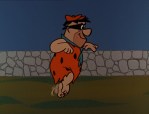 There’s a prowler in town and Betty and Wilma are taking judo lessons to protect themselves.
Fred doesn’t approve and to prove that this self-defense is all nonsense he dresses up like a burglar himself to scare the wives. When he and the real prowler turn up at the same time, this causes a lot of misunderstandings.
This is a particularly slapstick-rich episode, with Fred and Barney trying to get Fred through Barney’s window, Fred repeatedly running into the real prowler, and Fred getting a beating from Betty, Wilma and the prowler.
There are also two nice prehistoric gags: Fred uses a bee in a shell for a razor, and a dinosaur lawn mower.
Unfortunately, the episode is hampered by the backward depiction of judo professor Rockimoto, a foul caricature of a Japanese, with the obligatory round glasses, big teeth, and phony accent.
Barney’s voice wavers a little during the episode.
Watch an excerpt from ‘The Prowler’ yourself and tell me what you think:
This is Flintstones Season One Episode 14
To the previous Flintstones episode: The Drive-in
To the next Flintstones episode: The Girl’s Night Out
‘The Prowler’ is available on the DVD-set ‘The Flintstones: The Complete First Season’
Directors: William Hanna & Joseph Barbera
Airing Date: December 23, 1960
Stars: The Flintstones
Rating: ★★
 Tired of their jobs, Fred and Barney decide to open their own restaurant. So they quit their jobs to obtain a drive-in so lousy, they can even buy without the necessary cash.
Fred’s and Barney’s only mistake is not telling their wives, but of course, Wilma and Betty soon find out, thus ending the business. The running gag of this episode features two annoying waitresses who sing a particularly irritating drive-in song, which is also featured in the episode’s finale.
‘The Drive-in’ is one of the least inspired of all Flintstones episodes. The all too predictable story moves at a surprisingly slow speed, and even contains a completely superfluous scene with a bird stealing Barney’s flapjacks. The only prehistory gags in this episode are the giant ribs and eggs Barney and Fred serve at the drive in.
The designs of the characters are quite unsteady in this episode, especially Fred’s.
Watch an excerpt from ‘The Drive-in’ yourself and tell me what you think:
This is Flintstones Season One Episode 13
To the previous Flintstones episode: The Sweepstakes Ticket
To the next Flintstones episode: The Prowler
‘The Drive-in’ is available on the DVD-set ‘The Flintstones: The Complete First Season’
Directors: William Hanna & Joseph Barbera
Airing Date: December 16, 1960
Stars: The Flintstones
Rating: ★★★
 Both Fred and Barney and Betty and Wilma buy a sweepstakes ticket. They hide from each other, which leads to a small comedy of errors.
‘The Sweepstakes Ticket’ is not the most inspired of the Flintstones episodes: it relies heavily on tried and tested formulas. Most prominent is the ancient trope of devilish and angelic sides (typical examples include ‘Mickey’s Pal Pluto‘ from 1933 and ‘Donald’s Better Self‘ from 1938), which this time come to visit Fred. Then there is a W.C. Fields-like beggar, and Fred’s rather atypical asides to the audience.
Moreover, the episode reuses a gag from ‘The Engagement Ring’, aired only a few weeks before. At one point the story even reverts to the comedy of Tex Avery’s ‘The Legend of Rockabye Point‘ and ‘Deputy Droopy’ (both 1955) with Fred running away to a far away place to scream out his pain, and quickly singing a lullaby to the awakening Barney.
Fred’s behavior is highly questionable in this episode, burgling his very own neighbor, and it’s amazing to see his crime being unpunished.
Watch ‘The Sweepstakes Ticket’ yourself and tell me what you think:
https://www.dailymotion.com/video/x6upc6w
This is Flintstones Season One Episode 12
To the previous Flintstones episode: The Golf Champion
To the next Flintstones episode: The Drive-in
‘The Sweepstakes Ticket’ is available on the DVD-set ‘The Flintstones: The Complete First Season’
Directors: William Hanna & Joseph Barbera
Airing Date: December 9, 1960
Stars: The Flintstones
Rating: ★★
 This episode starts with a golf tournament, but turns out to be a story about a feud between Barney and Fred.
Part of the story is told as a flashback: Barney is chosen president of ‘The Loyal Order of Dinosaurs’ (first introduced in ‘Hot Lips Hannigan‘) and promises to collect overdue contributions. Because Fred is one of the late payers, this leads to a heavy and childish feud between the to neighbors, reminiscent of the one in ‘The Swimming Pool‘.
Barney even buys a vicious watchdog, with a laugh that sounds like that of Muttley from Hanna-Barbera’s future series ‘Wacky Races’ (1968). The low point is reached when Fred throws a party with people he doesn’t even like, only to provoke Barney (who turns out not to be home). In the end it’s up to the wives to settle the argument.
‘The Golf Champion’ is one of the duller Flintstones episodes. It contains some repetitive gags of Barney stealing his own stuff back from Fred’s yard. The sound of effect of Barney tiptoeing in these scenes, however, is a delight, as is the surprisingly inspired background music, which e.g. features a military version of the Flintstones theme music. Nevertheless, the opening scenes are arguably the best, with Fred having to deal with no less than two large dinosaurs occupying the golf course.
There are two stone age gags: a bird as a can opener, which informs us that he likes the food at the Rubble’s house better, and a record player, featuring a monkey and a bird.
Watch an excerpt from ‘The Golf Champion’ yourself and tell me what you think:
This is Flintstones Season One Episode 11
To the previous Flintstones episode: Hollyrock, Here I Come
To the next Flintstones episode: The Sweepstakes Ticket
‘The Golf Champion’ is available on the DVD-set ‘The Flintstones: The Complete First Season’
Directors: William Hanna & Joseph Barbera
Airing Date: December 2, 1960
Stars: The Flintstones
Rating: ★★½
 The wives win a trip to Hollyrock with their slogan ‘Mother McGuire’s Meatballs don’t bounce’. Within two days Fred and Barney miss their wives so much they decide to follow them.
Before soon, both Wilma and Fred are asked to star in a new television series called ‘The Frogmouth’. But within a day Fred is overdoing it, and the producer makes him nervous to get rid of him.
‘Hollyrock, Here I Come’ plays on the American myth that anybody can become a star. The best gag of this only moderately funny episode comes from the guy on TV announcing the winning slogan. The timing of this gag is surprisingly sharp for the series, which is generally does not display any fast gags. Another highlight is the great wild-eyed take on Fred when Wilma tells him she won a trip to Hollyrock, and he thinks he can go.
As always the concept of a stone age television is rather puzzling, a mystery that is pushed further by the animated commercial.
Watch ‘Hollyrock, Here I Come’ yourself and tell me what you think:
https://www.dailymotion.com/video/x6uoutd
This is Flintstones Season One Episode 10
To the previous Flintstones episode: The Engagement Ring
To the next Flintstones episode: The Golf Champion
‘Hollyrock, Here I Come’ is available on the DVD-set ‘The Flintstones: The Complete First Season’
Directors: William Hanna & Joseph Barbera
Airing Date: November 25, 1960
Stars: The Flintstones
Rating: ★★★★½
 Barney has bought an engagement ring for Betty and he asks Fred to keep it from him.
By chance, Wilma discovers the ring and thinks Fred had bought it for her. So Fred has to buy one himself. Unfortunately the jeweler doesn’t allow him any credit, so Fred makes Barney try to fight a boxing champ for three minutes to earn the necessary 500 bucks… All the time, the wives are way ahead of the boys.
‘The Engagement Ring’ is one the best written, most inspired and funniest Flintstones episodes, even if it doesn’t contain any prehistory gag. Especially, the cake bake scene accounts for some great slapstick, with Fred being covered in flour as a highlight.
At the same time this is also one of the sweetest of the Flintstones episodes. All four protagonists act lovingly this time. There’s none of Fred’s usual grumbling, save for one short early scene. And, for once the episode has a rare happy ending, celebrating the neighbors’ marriages. At the same time, the episode retains the basic idea of the husbands habitually lying to their wives.
The animation is funnier than usual, with more extreme poses. For example, when Barney realizes he has to fight the champ, we for once see the whites of his eyes. This episode contains a guest appearance by Bill Thompson (the voice of Droopy) as a poor bloke who finally made his 600th payment, and gets his children back.
Watch ‘The Engagement Ring’ yourself and tell me what you think:
https://www.dailymotion.com/video/x6ttklh
This is Flintstones Season One Episode 9
To the previous Flintstones episode: At the Races
To the next Flintstones episode: Hollyrock, Here I Come
‘The Engagement Ring’ is available on the DVD-set ‘The Flintstones: The Complete First Season’
Directors: William Hanna & Joseph Barbera
Airing Date: November 18, 1960
Stars: The Flintstones
Rating: ★★★★
 This episode starts with Fred and Barney playing pool in ‘Boulder Dan’s Billiard’. When they hear Dan wants to sell the place for 2 grand, Fred smells an opportunity.
Unfortunately, neither of them can raise the two grand in cash – they don’t even have the fifty bucks to bet on a horse (er… dinosaur) at one to forty to raise the big money. So Fred decides to use his pay, and to fool Wilma they think up a fake stick up. But as it goes in comedies like this, later a real stick up takes place…
‘At the Races’ is a fun episode, with Fred’s lies and over-confidence coming back upon him with a vengeance. Most painful in this respect is Fred’s rough treatment of his own boss, Mr. Gravelpuss, even before he has won the two grand that would make him independent. Strangely enough, Fred’s subsequent unemployment is not mentioned again during the rest of the episode.
This short contains a rare classic cartoon gag in which Fred makes the eight ball go through his skull: we can watch the ball rolling behind his eyes. A gag like this makes Fred suddenly akin to Hanna and Barbera’s earlier creation, Tom Cat. Also featured is a small elephant which Wilma uses as a vacuum cleaner, and a rather lame bus gag.
The designs of the characters vary a lot during this episode. Especially the drawings of Barney often seems rather off, giving him a huge nose in several scenes. Mel Blanc also voices a crackpot doctor with a strange accent.
Watch an excerpt from ‘At the Races’ yourself and tell me what you think:
This is Flintstones Season One Episode 8
To the previous Flintstones episode: The Baby Sitters
To the next Flintstones episode: The Engagement Ring
‘At the Races’ is available on the DVD-set ‘The Flintstones: The Complete First Season’
Directors: William Hanna & Joseph Barbera
Airing Date: November 11, 1960
Stars: The Flintstones
Rating: ★

This episode starts with Barney getting tickets to a big fight in town.
Meanwhile, their wives promise one Edna Boulder to make Fred and Barney babysit her little son Egbert, so they can go to the bridge tournament together. So, Fred and Barney stay home to watch the fight on television. Unfortunately, their area is blackened out (the replacement is a recital by Alice Blue Jean and her Magic Banjo), thus Fred decides to watch it at Joe Rockhead’s place, who lives outside the blackened era.
Yet, Joe is not home, and in the least convincing of the story twists, Fred busts in Joe’s door to watch the fight anyway. In another unlikely event little Egbert puts his clothes on Joe’s pooch (a little brontosaur), which promptly jumps out of the window, making Fred and Barney think it’s the baby.
The story of this episode rambles, to say the least, and contains an Irish policeman trope. Worse, the designs of the characters are pretty weird. Fred’s design in particular is very inconsistent and off model. On the upside, there’s a nice primitive elevator, and a bird functioning as a car horn. This bird is the first animal talking to the camera, a Flintstones trope that would occur throughout the series.
This is Flintstones Season One Episode 7
To the previous Flintstones episode: The Monster from the Tarpits
To the next Flintstones episode: At the Races
‘The Baby Sitters’ is available on the DVD-set ‘The Flintstones: The Complete First Season’
Directors: William Hanna & Joseph Barbera
Airing Date: November 4, 1960
Stars: The Flintstones
Rating: ★★★
 “Hollyrock” company ‘Miracle Pictures’ is going to shoot a low-budget one-day quicky monster movie called ‘The Monster of the Tar Pits’.
The producers randomly choose Bedrock as a location, because they cannot spend the money on a prop set. The whole town gets excited, because Hollyrock actors Gary Granite, Rock Pile and Tuesday Wednesday are in it.
Gary Granite is clearly a parody of Cary Grant, not really in looks, but certainly in voice. Wilma and Betty even go auditioning, but it’s Fred, who gets hired as Gary Granite’s stunt double. The look on Fred’s face when the director says he’d be perfect [as an actor] is priceless, and one of the best facial expressions in the entire series. Of course, Fred mainly gets hit by rocks and clubs, which are all too real, as the company cannot afford props for those, either.
The Movie Company’s slogan, “If it’s a good picture, it’s a miracle”, is a variation on similar slogans in ‘Daffy Duck in Hollywood‘ (1938), which uses the word Wonder, and the Popeye cartoon ‘Doing Impossikible Stunts‘ (1940) with the word Mystery.
The episode is only mildly funny, but contains a few stone age gags: Fred and Barney eating a huge brontosaur steak and pterodactyl drumstick, respectively, and Wilma doing the laundry using a pelican, and handling a little mastodon as a vacuum cleaner.
Watch ‘The Monster from the Tarpits’ yourself and tell me what you think:
https://www.dailymotion.com/video/x6ttko0
This is Flintstones Season One Episode 6
To the previous Flintstones episode: The Split Personality
To the next Flintstones episode: The Baby Sitters
‘The Monster from the Tarpits’ is available on the DVD-set ‘The Flintstones: The Complete First Season’
Directors: William Hanna & Joseph Barbera
Airing Date: October 28, 1960
Stars: The Flintstones
Rating: ★★½
 In this episode Fred accidently knocks himself out with a bottle. When he wakes up he has turned into a suave gentleman who loves opera and poetry.
Wilma, Barney and all other husbands soon get really fed up with this new ‘Frederick’ character, so Barney thinks up a scheme to get the old Fred back.
This is one of the more inspired Flintstones episodes, especially the scene in which Fred comes home, growling is a delight. Moreover, this episode finally features no less than three stone age gags: some birdlike creature is Wilma’s waste disposal, Betty’s shower is a mammoth, and Fred’s pick-up is a little bird with a will of his own.
Nevertheless, the episode’s message is rather dubious: one of Frederick’s new habits is his willingness to do some of the house cleaning himself. Such progressive, feminist ideas were clearly out of the question in this era…
Watch an excerpt from ‘The Split Personality’ yourself and tell me what you think:
This is Flintstones Season One Episode 5
To the previous Flintstones episode: No Help Wanted
To the next Flintstones episode: The Monster from the Tarpits
‘The Split Personality’ is available on the DVD-set ‘The Flintstones: The Complete First Season’
Directors: William Hanna & Joseph Barbera
Airing Date: October 21, 1960
Stars: The Flintstones
Rating: ★★½
 This episode starts with a conversation between Fred and Wilma providing the back story: due to a stupid action by Fred, Barney got fired. So, Fred helps his neighbor out by making him the caddie of his rich and influential golf partner, Mr. Boulder.
Barney’s authentic instructions makes the big shot win for once, so Barney gets a job as a debt collector, with his first victim happening to be Fred…
This episode is just one another example of Fred’s tendencies to deceive his wife, refusing to tell Wilma he has gambled the money away, necessary to pay the television bill. The story progresses at an even, rather slow speed, and is only moderately funny. The best scenes are the golf scene and the chase between Fred and Barney, with the latter looking like a television set with legs.
This episode is the first to feature Dino (although he has been in the titles since the beginning). Nevertheless, Dino’s appearance is restricted to the first scene, and no mentioning of him occurs during the rest of the episode.
Watch an excerpt from ‘No Help Wanted’ yourself and tell me what you think:
This is Flintstones Season One Episode 4
To the previous Flintstones episode: The Swimming Pool
To the next Flintstones episode: The Split Personality
‘No Help Wanted’ is available on the DVD-set ‘The Flintstones: The Complete First Season’
Directors: William Hanna & Joseph Barbera
Airing Date: October 7, 1960
Stars: The Flintstones
Rating: ★★★½
Review:
 This episode opens with another feature borrowed from The Honeymooners, the series that served as the example for The Flintstones: the idea of the boys being member of an all-male society.
In this episode Fred and and Barney are members of The Loyal Order of Dinosaurs”. This club is also featured in the episode ‘The Golf Champion‘, but later the two neighbors would join the ‘Loyal Order of Water Buffaloes’.
The story starts with the two having to perform at the annual meeting. Barney practices a trampoline act, while Fred tries his luck at magic, with stuff borrowed from ‘Rockstone the Great’. In a demonstration he thinks he made the wives disappear and he and Barney take advantage of the situation to go to the Rockland Dance Hall to see Hot Lips Lannigan, an old acquaintance of Fred. Fred and Barney join in at his concert with Fred singing ‘When the Saints Go Marchin’ In’, bebop style, and Barney beating the drums. Their act impresses the young hep cats, much to Wilma’s and Betty’s bewilderment, who have dressed up like hep cats themselves to catch their husbands red-handed.
‘Hot Lips Hannigan’ is one of the more inspired Flintstone episodes, even though there’s absolutely no reference to prehistoric times, at all. Highlights are the intoxicating jazz number at the dance hall, and Betty’s and Wilma’s ‘hep’ alter egos. The name Hot Lips Hannigan is modeled on that of trumpeter Hot Lips Page, but the character looks more like a white version of Dizzy Gillespie, with his beret and goatee, and he plays the latter’s iconic upright trumpet.
Hot Lips Page had already died in 1954, and bebop arguably died with the death of Charlie Parker in 1955, making this episode strangely anachronistic. Moreover, Hannigan appears to be a square in disguise (for example ‘When the Saints Go Marchin’ was a staple of the conservative dixieland bands of the time), and it’s clear the writers’ sympathies are with the conservative middle-aged, not with the more advanced music-loving youngsters. This is a rather painful conclusion in an era in which even rock-‘n-roll was already past its prime, and hard bop (the follow-up to bebop) already started to make place for post-bop and free jazz…
Watch ‘Hot Lips Hannigan’ yourself and tell me what you think:
https://www.dailymotion.com/video/x6uouyo
This is Flintstones Season One Episode 2
To the previous Flintstones episode: The Flintstone Flyer
To the next Flintstones episode: The Swimming Pool
‘Hot Lips Hannigan’ is available on the DVD-set ‘The Flintstones: The Complete First Season’
Directors: William Hanna & Joseph Barbera
Airing Date: September 30, 1960
Stars: The Flintstones
Rating: ★★★½
Review:
 ‘The Flintstone Flyer’ was the very first Flintstone episode aired on television. The story was one of two already conceived before the series went to production and used to sell the series (the other one was ‘The Swimming Pool‘).
The episode establishes many aspects of the series: the setting may be in the stone age, this is a rather poor excuse for a suburban situation comedy depicting very a very standard family from mid-20th century indeed, complete with modern inventions like cars, telephone and television (how the latter two work is never revealed). This is little wonder, as the series was modeled after ‘The Honeymooners’ (aired 1955-1956), which features remarkably similar characters (for example, they love bowling, too).
Hanna and Barbera’s stone age is one of pure fantasy, and features dinosaurs coexisting with humans, despite the fact that dinosaurs had died out 65 million years before the dawn of man. In that respect ‘The Flintstones’ stand in a long tradition: dinosaurs co-existing with man could be seen in e.g. Willis O’Brien’s short ‘R.F.D. 10,000 B.C.’ (1916), in the Alley Oop comics (starting in 1932), in ‘Daffy Duck and the Dinosaur‘ (1939), in ‘Prehistoric Porky’ (1940), and Fleischer’s Stone Age cartoons from 1940.
The Flinstones tells about Fred Flintstone and Barney Rubble. The two are neighbors in some suburban area of ‘Bedrock’ (population 2500). They both love bowling, and are willing to lie to their wives (Wilma and Betty, respectively) to go out to play their favorite game. When bowling, Fred has a particular walk on his toes, and when excited he shouts ‘Yabba-dabba doo!’.
In this particular episode, the guys want to go bowling, while they have to go to the opera with their wives. So, Fred pretends to be ill and then the two literally fly off to the bowling alley, using a flying machine Barney has invented before. The opera itself is a typical mismatch of Wagnerian costume and bel canto singing, a trope frequently encountered in cartoons.
The complete cartoon moves at a steady pace, and by 2018 one can only conclude that the humor is rather dated. One cannot resist the thought what poor marriages these must be that one cannot be honest to each other. This sets the tone of many episodes to come: by now they only seem to demonstrate the inequality between men and women at the time.
Moreover, little to nothing is done with the stone age concept: we watch monkeys grabbing the pins, and a soda machine that’s operated by a man, but that’s about it.
No, despite Warner Bros. veterans Warren Foster and Michael Maltese working on the stories, the classic status of this very first animated series to be aired on prime time must come from its appealing designs by Ed Benedict (who had designed cavemen before, for Tex Avery’s ‘The First Bad Man’ from 1955), clever layouts by Dick Bickenbach and Walt Clinton, and great background artwork (e.g. featuring olive skies) by Art Lozzi, Fernando Montealegre, Robert Gentle and Dick Thomas. Even the limited animation (by the likes of top-animators Ken Muse, Carlo Vinci, Ed Love, Don Patterson and Dick Lundy) remains quite interesting throughout, even if the designs are rather off at times.
Watch an excerpt from ‘The Flintstone Flyer’ yourself and tell me what you think:
This is the first Flintstones Episode. To the demo episode: The Flagstones
To the next Flintstones episode: Hot Lips Hannigan
‘The Flintstone Flyer’ is available on the DVD-set ‘The Flintstones: The Complete First Season’
Director: Friz Freleng
Release Date: March 19, 1960
Stars: Sylvester, Sylvester junior
Rating: ★★½
Review:

‘Goldimouse and the Three Cats’ starts as a re-telling of the classic fairy tale with Sylvester as the papa bear, Sylvester junior as the baby bear, and a rather anonymous female mouse as Goldimouse.
This part uses a classic fairy tale voice over, but after three minutes the tale is told and makes place for a routine in which Sylvester tries to capture Goldimouse to impress his son. This part borrows heavily from McKimson’s Hippety Hopper cartoons, with Sylvester junior hiding in shame under a paper bag.
A nice touch is that Sylvester keeps on trying, even after his wife and son have long lost faith, making him a genuine fanatic. This cannot hide the fact that this is a cartoon of tried routine spot gags, which adds nothing new, despite the fairy tale setting with which the film starts. Despite Freleng’s excellent timing, one thus has ample time to enjoy the charming background art.
Watch ‘Goldimouse and the Three Cats’ yourself and tell me what you think:
‘Goldimouse and the Three Cats’ is available on the DVD-set ‘Looney Tunes Golden Collection Volume Five’
Director: unknown
Production Date: 1960
Stars: Tom Puss and Ollie Bungle
Rating: ★★½
Review:
 ‘The Eastern Treasure’ is based on the great Tom Poes comic strip ‘De achtgever’ (1957).
In this cartoon Ollie Bungle is visited by an Eastern treasurer and his obedient servant, called Kowtow. Ollie Bungle takes over the job as treasurer, and immediately the servant joins his side. In the end Tom Puss manages to get rid of him by making the servant into the treasurer.
The strong story of the comic strip is condensed to its bare essentials, and has lost most of its strengths. Moreover, the two Easterners hardly look that way. ‘The Eastern Treasure’ was the last of the Tom Puss shorts completed, before Toonder discovered he had been swindled. His Tom Puss television series was never aired, neither in the US, for which it had been made, nor anywhere else. A lot of money, effort and work had just been wasted on a scam.
‘The Eastern Treasure’ is available on the DVD inside the Dutch book ‘De Toonder Animatiefilms’
Director: unknown
Production Date: 1960
Stars: Tom Puss and Ollie Bungle
Rating: ★★
Review:
 During a stormy night Ollie Bungle brags he can teach everyone everything, and in one evening, too.
He’s overheard by a wizard, who immediately places his lazy son under Ollie Bungle’s tutelage. The little brat changes all kinds of objects into beds for him to sleep in, makes a pen write the writing lines he has to do, and makes objects taunting Ollie Bungle. Meanwhile Ollie Bungle doesn’t teach the boy a thing. Yet, the wizard is content, as his son has learned many new tricks during that one evening.
This short is one of the weakest of the eight surviving Tom Puss films. Tom Puss has hardly a role in it, and even behaves uncharacteristically fearful. In one scene he even looks like a real cat, instead of his normal rational self.
‘Little Faustus’ is available on the DVD inside the Dutch book ‘De Toonder Animatiefilms’
Director: unknown
Production Date: 1960
Stars: Tom Puss and Ollie Bungle
Rating: ★★★½
Review:
 At the start of this cartoon Ollie Bungle is out of gas. He and Tom Puss meet a bearded fellow with a large box, and when they ask him for gas, he makes the large box change into a fuel station.
The little bearded man demonstrates that the box can change into virtually anything, and Ollie Bungle buys the machine on the spot. Unfortunately, the all-purpose machine turns out difficult to handle, and only causes for trouble.
The story makes little sense and is highly forgettable. Nevertheless, this short is noteworthy for its very beautiful limited background art.
Watch ‘The All-Purpose Machine’ yourself and tell me what you think:
‘The All-Purpose Machine’ is available on the DVD inside the Dutch book ‘De Toonder Animatiefilms’
Director: unknown
Production Date: 1960
Stars: Tom Puss and Ollie Bungle
Rating: ★★★★
Review:
 ‘Vengeance Valley’ is based on the Tom Poes comic strip ‘De wraakgier’ (which can be translated as ‘the revenge vulture’) from 1956.
The comic strip is one of the best in the series, and features Tom Puss encountering an island of vengeance-loving vultures. In the film the vultures inhabit a hick town in the mountains called ‘Vengeance Valley’. The whole concept of avenge, revenge and counter-revenge is played out well, and this short makes particularly well use of the limited animation. This makes this episode arguably the best of the whole series, despite the lame ending, in which a female vulture blows up the whole town, wiping it off the map, literally.
‘Vengeance Valley’ is available on the DVD inside the Dutch book ‘De Toonder Animatiefilms’


 Dr. Grob's Animation Review