You are currently browsing the tag archive for the ‘1961’ tag.
Director: Norman McLaren
Release date: 1961
Rating: ★★★½
Review:

‘New York Lightboard’ is a direct-on-film animation film that was never meant for the cinema. Instead, it was a commercial film commissioned by the Canadian Governmental Tourism Office to be projected in an endless loop on a big screen on Times Square in New York City.
The film is both in black and white and silent, but McLaren makes the commercial a very playful one, with letters bouncing and playing with each other, and metamorphosis running wild (we watch. e.g. the letters Canada change into a fish, which turns into a bird, which becomes a smiling sun, etc.).
Most of the film is pretty abstract, but there’s also some fine animation of swimming fish, a galloping horse, a man in a canoe and of Hamlet and Laertes fighting. Apart from the words Canada and ‘Dial PL 7-4917’ (for more information), the most recurring elements are animated fireworks.
The whole film seems a little too playful and too experimental for a general audience, but it certainly must have drawn attention. There’s also a short equally silent documentary called ‘New York Lightboard Record’ in which we watch the film on a screen on Times Square, and some of the responses of the audience watching it.
Watch ‘New York Lightboard’ & ‘New York Lightboard Record’ yourself and tell me what you think:
‘New York Lightboard’ and ‘New York Lightboard Record’ are available on the DVD-box ‘Norman McLaren – The Master’s Edition’
Director: Norman McLaren
Production date: ca. 1961
Rating: ★
Review:

This unfinished film from ca. 1961 must be the most extreme Norman McLaren ever made. In fact this is one of the most extreme films in the entire history of cinema. The film consists of a black and a white image only that are altered in different rhythms to cause a flickering effect. The electronic soundtrack matches the flickering.
It’s a testimony of McLaren’s genius that even such an extreme film contains some rhythm and variation, and even a sense of a build-up, but the idea remains too extreme to be entertaining, and the continuous stroboscope effect quickly wears done the viewer.
‘The Flicker Film’ is available on the DVD-box ‘Norman McLaren – The Master’s Edition’
Director: Chuck Jones
Release date: February 25, 1961
Rating: ★★½
Review:
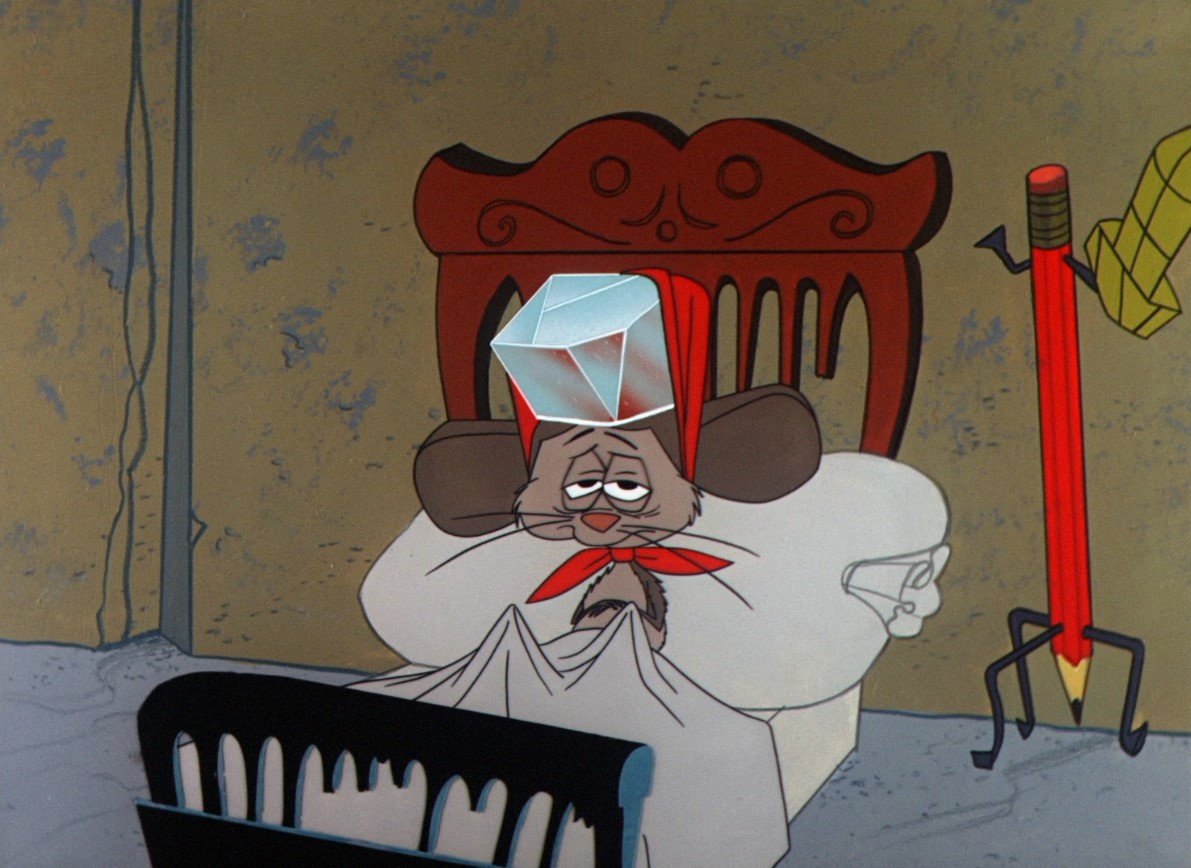
This short starts with a mouse eating his way through the largest uncut rum cake and getting drunk.
For a while we watch some fine silent comedy, but when the mouse mistakes a diamond for ice, the cartoon turns into an ordinary chase cartoon starring two talkative cops, with one being a late addition to a plethora of characters inspired by Lon Chaney jr.’s Lennie in the 1939 film ‘Of Mice and Men’.
These sequences are more tiresome than funny, but give the viewer ample time to watch the gorgeous background art, with its beautiful cityscapes. The animation, too, is top notch, but these elements cannot rescue the rather uninspired story.
Watch an excerpt from ‘The Mouse on 57th Street’ yourself and tell me what you think:
‘The Mouse on 57th Street’ is available on the Blu-Ray ‘Looney Tunes Collector’s Choice Vol. 3’
Director: Friz Freleng
Release date: July 15, 1961
Stars: Tweety and Sylvester
Rating: ★★★
Review:

‘The Rebel Without Claws’ is the penultimate Tweety and Sylvester cartoon by the original Warner Bros. studio. In this short Tweety is a messenger pigeon in the American civil war. Sylvester, naturally, is a ‘messenger destroyer’ trying to intercept Tweety and his message.
Except for the last one, the gags are fine, and Freleng’s timing, as always, is excellent. Especially the canon gag is a marvel. Moreover, the human designs are fine examples of the cartoon modern era. But it is a little grim to see our yellow friend in the service of the confederate army, which after all fought to maintain slavery. This makes this Tweety and Sylvester cartoon the only one in which one hopes that Sylvester wins (which he, incidentally, does).
Watch ‘The Rebel Without Claws’ yourself and tell me what you think:
‘The Rebel Without Claws’ is available on the Blu-Ray ‘Looney Tunes Collector’s Choice Vol. 2’
Director: Chuck Jones
Release date: June 3, 1961
Stars: Road Runner & Wile E. Coyote
Rating: ★★★
Review:
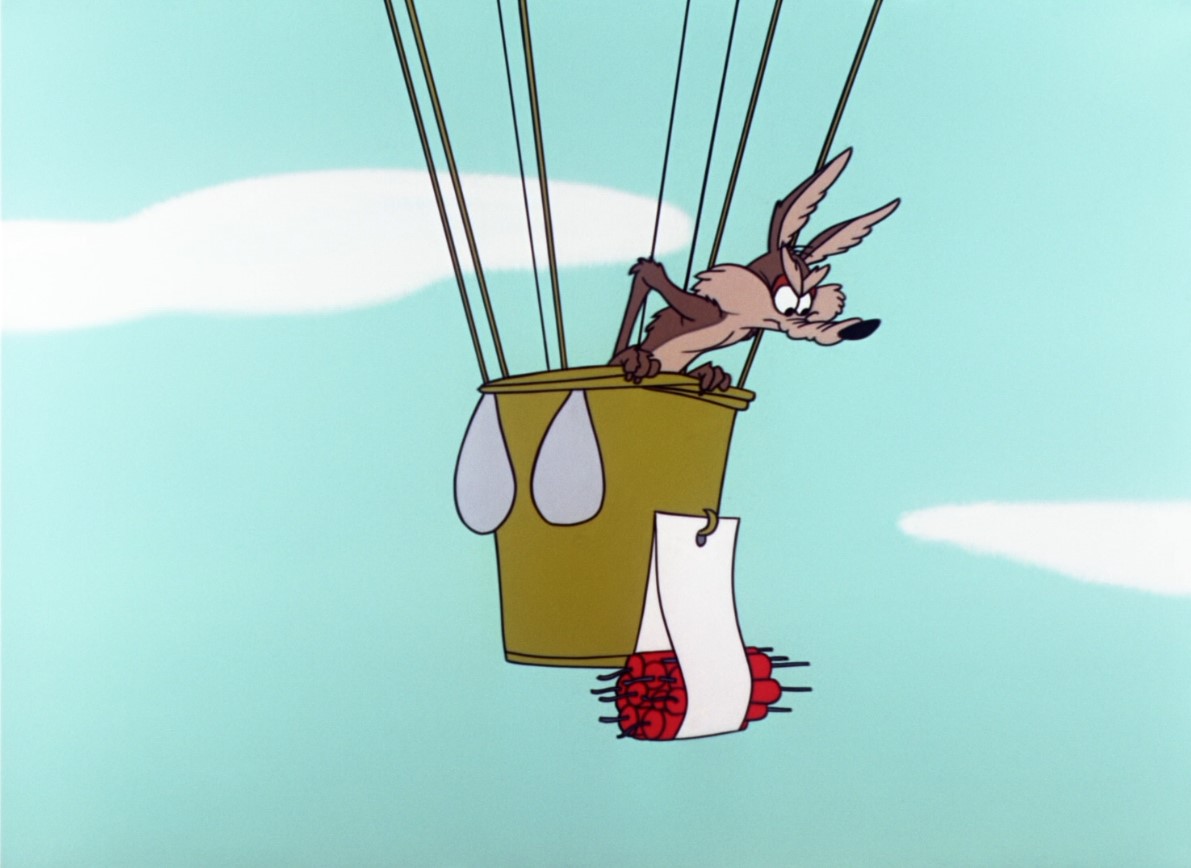
The twentieth Road Runner cartoon is a surprisingly inspired one. The short starts with the Coyote introducing himself and the Roadrunner with signs. What follows are seven attempts, with the third influencing all subsequent ones.
Both the animation and the background art are beautiful, Jones’ timing is excellent and the gags are fine. Milt Jackson’s score, on the other hand, makes one long for Carl Stalling, and there’s a level of mannerism that is a little irritating. Especially the extreme lagging of the coyote’s upper body, when zooming off, feels more tiresome than funny. Nevertheless, it’s a surprise that such a late Road Runner cartoon can still be of such a fine quality.
Watch an excerpt from ‘Lickety-Splat’ yourself and tell me what you think:
‘Lickety-Splat’ is available on the Blu-Ray ‘Looney Tunes Collector’s Choice Vol. 2’
Director: Jan Iván
Release date: 1961
Rating: ★★★
Review:
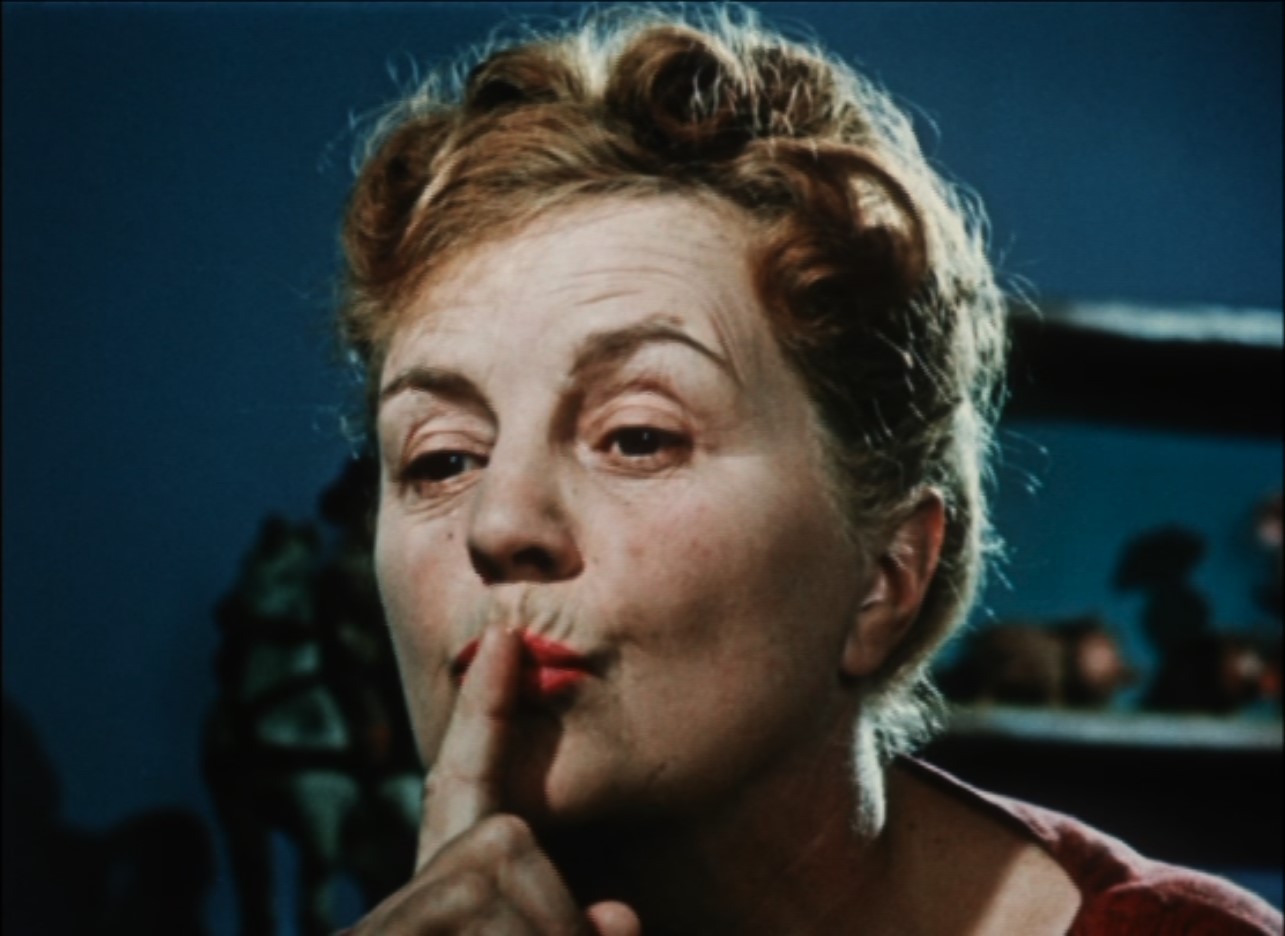
This a gentle documentary film made in honour of the Czech animation pioneer’s sixtieth birthday.
The film showcases excerpts from quite a few of Hermína Týrlová’s films, including her first, ‘Ferda the Ant’ (1944), Czechoslowakia’s first stop motion film anyhow. Other excerpts are from ‘Revolt of the Toys’ (1945), apparently an anti-fascist film, ‘The Knot in the Handkerchief’ (1958) and ‘Badly Made Toy-Man’ (1951), which is revealed as Týrlová’s favorite character.
Indeed, it’s the Badly Made Toy-Man who stars the bridging stop-motion sequences, for this documentary features quite some original animated material, made by Týrlová especially for this film. Especially, the short sequence starring the two balls of whool-characters for her upcoming ‘Two Balls of Wool’ (1962) are a delight, for this cannot be found in the final film, and is presented as a depiction of Týrlová’s imagination.
The film is narrated, and although we watch Týrlová acting out herself, e.g. recreating the painstaking ways with which she made ‘Ferda the Ant’ and interacting with children, her main audience, we do not hear her, and there are no interviews, only images. Nevertheless, the documentary succeeds in showing where Týrlová’s greatest talent lies: in creating charming animation films for children in which ordinary toys and objects come to life.
‘Hermína Týrlová’ is available on the DVD box ‘Hermína Týrlová Výběr z tvorby/Selected Works’
Director: Jan Lenica
Release date: 1961
Rating: ★★★★
Review:
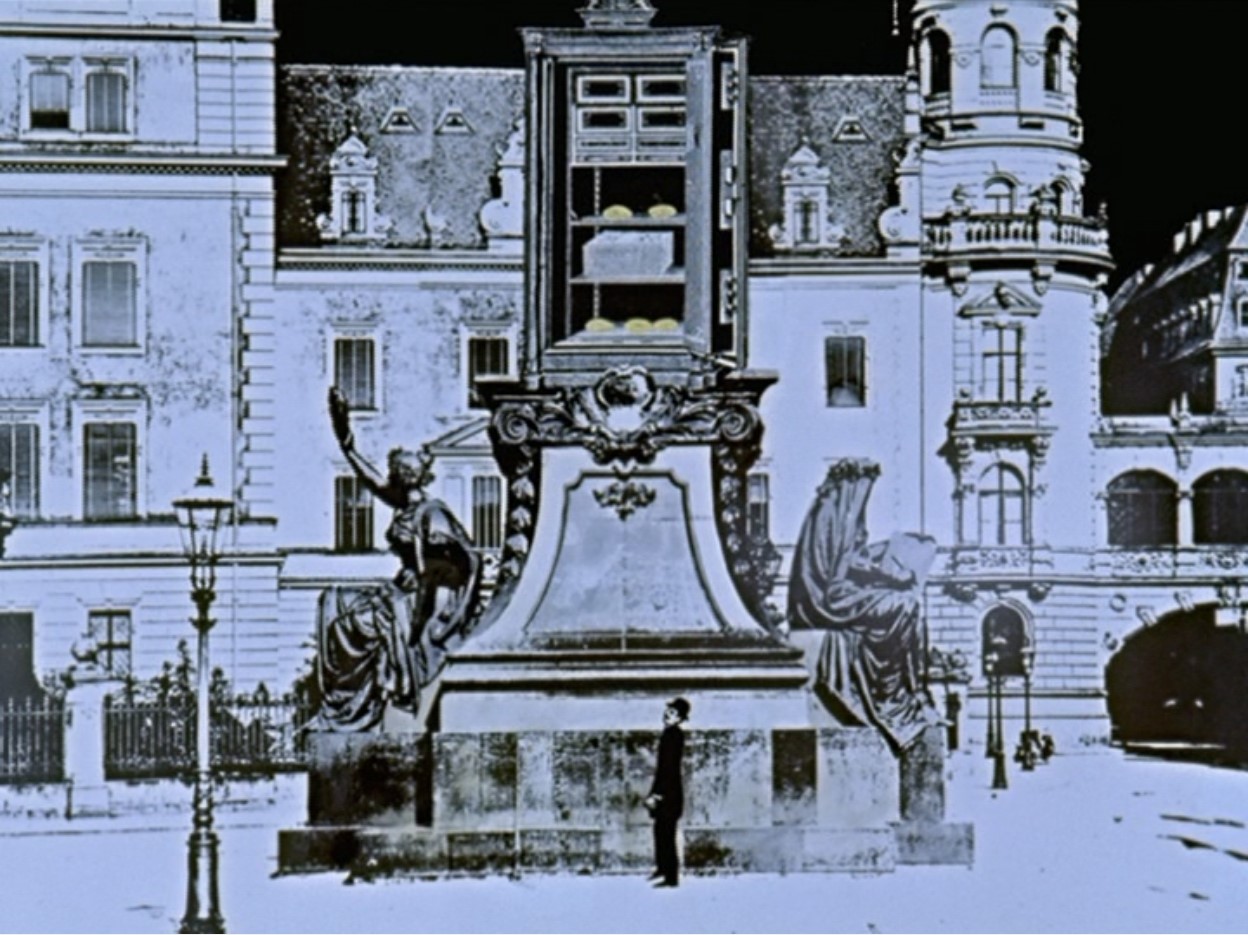
In ‘Labirynt’ a man flies into a seemingly abandoned city, only to find it to be a dangerous place, terrorized by strange creatures and machines, alike.
This is one of those rare animation films from Eastern Europe depicting what it’s like to live in an oppressive communist state. The film is highly surreal, featuring strange creatures, often mixes of animal and human parts, but I am still surprised the film got past the censors. For example, at one moment the man is captured by a bearded machine-man and thoroughly examined. At one key scene we watch is thoughts roaming freely inside his head, only to get barred by a strange contraption. The end, too, in which the man tries to escape the paranoid city is telling enough.
Jan Lenica’s world is based on partly colored old photographs and engravings. His animation is emblematic, but at one point we surely feel the man’s fear, as he tries to flee from his oppressors. The surrealist atmosphere is enhanced by Jan Radlicz’s sound design and by Włodzimierz Kotoński’s score.
Watch ‘Labirynt’ yourself and tell me what you think:
‘Labirynt’ is available on the DVD-set ‘Anthology of Polish Animated Film’
Director: Chuck Jones
Release date: May 20, 1961
Stars: Bugs Bunny, Daffy Duck
Rating: ★★
Review:
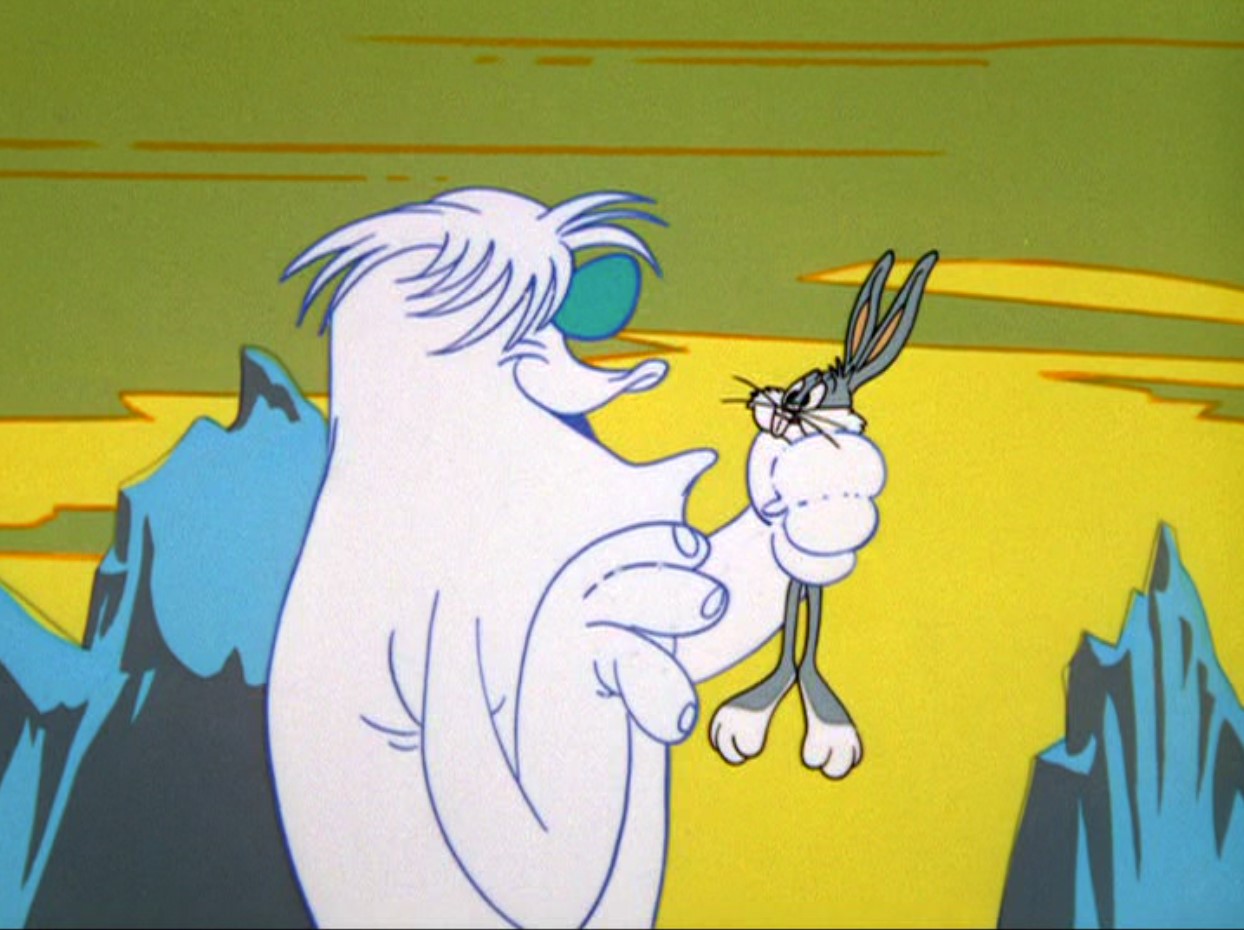
By the early 1960s the classic age of animated cartoons was clearly over. ‘The Abominable Snow Rabbit’ clearly shows the insipid state of affairs. Although both animation and background art are still top notch, and a delight to watch, the gags are uninspired and stale, and never reach the heights from similar films of the early 1950s.
In this cartoon Bugs and Daffy both travel underground, apparently on their way to Palm Springs, only to end up in the Himalayas, where they encounter a very cartoony and blue-nosed abominable Snowman. The Snowman is a late addition to a plethora of characters based on Lon Cheney’s depiction of Lenny in ‘Of Mice and Men’ from 1939, without adding anything. Apart from the jaded gags, the cartoon suffers from a large amount of dialogue, rendering the cartoon almost like the “illustrated radio” Chuck Jones detested in contemporary television animation.
Watch ‘The Abominable Snow Rabbit’ yourself and tell me what you think:
This is Bugs Bunny cartoon No. 153
To the previous Bugs Bunny cartoon: Lighter than Hare
To the next Bugs Bunny cartoon: Compressed Hare
This is Daffy Duck cartoon No. 87
To the previous Daffy Duck cartoon: Person to Bunny
To the next Daffy Duck cartoon: Daffy’s Inn Trouble
‘The Abominable Snow Rabbit’ is available on the DVD-box ‘Looney Tunes Golden Collection Volume Five’
Director: Jack Hannah
Release Date: April 25, 1961
Stars: Chilly Willy, Wally Walrus
Rating: ★★
 ‘Clash and Carry’ pairs Wally Walrus with Chilly Willy. The latter is hungry and tries to steal fish from Wally’s fish market.
To be frank, Wally clearly is no match for Chilly Willy, who easily empties the complete store before Wally’s eyes. The best gag is when Chilly Willy uses cardboard plaques attached to shopping carts to empty Wally’s market. The cardboard women all carry a sign telling Wally to ‘charge it’. Soon, more outlandish cardboard figures follow, like a picture of Napoleon. But Wally only sees his fish selling, and calls all ships out sea to catch more fish. This leads to live action footage of fishing boats, and even a whale hunt.
Unfortunately, neither story man Homer Brightman nor Jack Hannah apparently knew how to work this gag into the finale, and so, the cartoon dies out with the lame sight of Chilly Willy playing a vacuum cleaner like bagpipes, with marching fish behind him, apparently sucked by the vacuum cleaner.
Apart from the utterly disappointing finale, the short is hampered by Wally’s omnipresent vocalizations (by Paul Frees), which only become funny during the great scene mentioned above. Apart from that ‘Clash and Carry’ remains a very mediocre cartoon.
Watch ‘Clash and Carry’ yourself and tell me what you think:
‘Clash and Carry’ is available on the DVD-set ‘The Woody Woodpecker and Friends Classic Cartoon Collection Volume 2’
Directors: Clyde Geronimi, Hamilton Luske & Wolfgang Reitherman
Release Date: January 25, 1961
Rating: ★★★★★ ♕

Among the classic Disney films ‘One Hundred and One Dalmatians’ is a rather underrated little gem. Pretty modest in its story and ambitions, the film nevertheless is a milestone in Disney animation, introducing a completely new style to Disney feature animation.
After the costly debacle of ‘Sleeping Beauty’ (1959) it was clearly time for a change, and in many respects, ‘One Hundred and One Dalmatians’ couldn’t be more different from its predecessor. The new feature is no fairy tale, but set in contemporary times, it has an unprecedented crime plot, and it has a modern design which was a complete departure from earlier efforts, and which was fit for a more modern age.
Modern design had invaded Disney feature animation as far back as ‘The Three Caballeros’ (1945), but ‘One Hundred and One Dalmatians’ is the first Disney feature to have a modern outlook from start to end. The film is also the first Disney feature to be set in contemporary times, even if this is a little confusing: the English setting gives most of the film a vintage look, Roger Radcliffe is a jazz composer in the style of the 1930s, and Cruella drives a Mercedes Benz 500 K from the mid-1930’s. Moreover, Roger and his wife Anita may be depicted as being rather poor, at least in the eyes of Cruella de Vil, they nonetheless manage to have a maid, an anachronistic anomaly in the post-war age of television.
No, the modernity of the film is more present in it looks: ‘One Hundred and One Dalmatians’ is the first Disney feature to make use of Xeroxed cells, preserving the black outlines, which give the film a more graphic look. Initiated by art director Ken Anderson, and developed by Walt Disney old partner Ub Iwerks, the process was first tried out in the short special ‘Goliath II’ (1960), and deemed successful enough for further use. No doubt the xerox process was conceived to save money, and the process is particularly helpful in this film, with its 101 duplicate puppies, which are essentially black and white characters, anyway. Yet, the method preserved the rough animation outlines, which were more vivid than the cleaned-up cells, and the xeroxed cells give the animation an extra swinging touch. Indeed, the new process was a hit with the animators themselves, who, for the first time, saw their own drawings directly on the animated screen.
Iwerks even managed to xerox a cardboard model of Cruella’s car with marked black outlines. Thus, in the film Cruella’s car is essentially rotoscoped. This experimental method also accounts for the only unconvincing special effect in the film: during the finale Cruella’s car gets stuck in the snow. This scene was filmed using the cardboard model and real sand, and unfortunately the photographed sand is clearly visible, as its roughness deviates from the otherwise very clean artwork. Moreover, one can see this piece of xeroxed live action move on top of the background art.
Never mind the cost reduction of the xerox process, the depiction of 101 dalmatians could only be done at Disney’s at the time: as all the dogs’ spots had to be animated independently. The studio set up a sole unit for this task alone. No wonder, as Pongo alone has no less than 76 spots!
In ‘One Hundred and One Dalmatians’, the xerox cells are matched by xeroxed background art lines by e.g. Ernie Nordli, which make an ideal match with the background paintings by Walt Peregoy, with its bold coloring: the results are very intricate, very graphical, yet stylized, decorative and very appealing backgrounds, which belong to the most artful ever produced and which give the film its unique look. The new style, with its original mix of depth and flatness, works best in the urban setting, with all its straight lines. The scenes in the countryside have a more traditional feel and are more akin to earlier artwork by e.g. Mary Blair.
Unfortunately, Walt Disney himself disliked this background art, most probably because they are devoid of any romanticism. The xeroxed animation works particularly well with these graphic backgrounds. Yet the latter were not repeated, while xeroxed animation lasted until the mid-1980’s. By that time the style had become jaded and gotten a cheap feel and outdated feel. No wonder, Don Bluth chose to go back to painted cells in his nostalgic feature ‘The Secret of NIMH’ (1982). Nonetheless, in ‘One Hundred and One Dalmatians’ the xeroxed cells look fresh and modern, and they certainly contribute to the film’s timeless appeal.
That ‘One Hundred and One Dalmatians’ is a new, less pretentious and more fun film than ‘Sleeping Beauty’ had been, becomes immediately clear in the startlingly modern opening credits, with its visual puns on spots. This sole sequence itself is a sheer delight and sets the tone for the rest of the film.
The introduction uses a voice over by Pongo (Rod Taylor), Roger’s Dalmatian dog, and tells how he managed to get Roger and Anita meet each other, acting like a canine matchmaker. As Anita has a female Dalmatian dog, Perdita, this event also marks the welcome end to Pongo’s bachelor life.
Soon, Perdita is pregnant and gives birth to no less than fifteen puppies. This event introduces the arch villain of the movie: Cruella de Vil, apparently an old schoolmate of Anita. Cruella must be the all time best of Disney villains: she’s both ridiculously outlandish and genuinely menacing. Her voice by Betty Lou Gerson is spot on, giving her the perfect mix of class, disdain, selfishness and temper. The voice is matched by Marc Davis’s design and animation, which give the character an unprecedented screen presence: Cruella has the energy of a Stromboli, the deftness of a captain Hook, and the icy coldness of a Malificent all rolled in one, and then some. She’s the undisputed star of the film: a villain one loves to hate, from her first entry until her last lunatic car ride.
This was the last animation Marc Davis did before he moved over to designing for Disney parks. Cruella de Vil can be seen as his masterpiece and is his impressive farewell to animation. She undoubtedly inspired several subsequent Disney villains, like Medusa in ‘The Recuers’ (1978), Jafar in ‘Aladdin’ (1992) and Yzma in ‘The Emperor’s New Groove’ (2000).
Cruella de Vil may be an animation highlight, all of the animation in ‘One Hundred and One Dalmatians’ is excellent. Led by six of Disney’s nine old men, ‘One Hundred and One Dalmatians’ shows that these veteran animators were on top of their game. Roger and Anita (animated by Milt Kahl) have the perfect mix of caricature and realism, and make a believable real couple, if not a too memorable one. Likewise, Horace and Jasper, the pair of crooks that function as Cruella’s henchmen, have that great combination of silliness and threat, which make them so lovely to watch. The dogs are all good and it’s clear that the animators could rely on years of experience on this particular mix of naturalism and anthropomorphism, dating back to ‘Bambi’ (1942), but of course most notably to ‘Lady and the Tramp’ (1956), which also features numerous dogs. Indeed, Jock, Peg, Bull and Lady herself can all be seen during the ‘twilight bark’ scene, one of the highlights of the film.
As if to illustrate how for the animators had come, Disney shows a short excerpt from the Silly Symphony ‘Springtime’ (1929) on television in a scene in the old De Vil mansion. The old short provides the score for a large part of this scene.
Highly unusually, the film’s story was storyboarded by one man only: Bill Peet, and his story is a prime example of lean storytelling: there’s absolutely no unnecessary fat on this film, which moves to the grand finale on an excellent speed, with an increasing sense of danger. Thus, the film is over before you know it. Even better, Peet manages to tell the story without relying on too obvious story tropes – for example, in a modern version Pongo doubtless would estrange his friends, or break down in doubt just before the start of the finale. None of that in this movie! Even Dodie Smith, who had written the original book in 1956, thought Peet had improved on her story.
Apart from the Twilight Bark scenes, other highlights are the soot scenes in the mythical village of Dinsford and the preceding scenes at Suffolk, featuring ‘The Colonel’, a very British and rather deaf sheepdog (voiced by Pat O’Malley), and his brave tabby cat Sergeant Tibbs. These scenes made me laugh out loud.
Apart from its modern looks and setting ‘One Hundred and One Dalmatians’ is remarkable for its surprisingly lack of songs. With ‘Bambi’ this feature is the only classic Disney feature not to be a musical. In fact, there are only two (not counting a silly song accompanying a commercial for dog food on television), which is the more remarkable, as Roger Radcliffe is supposed to be a songwriter. Indeed, Roger sings both songs: first one about Cruella de Vil, just before she enters herself, and the second one at the film’s Christmas finale. This second song, ‘Dalmatian plantation’ lasts only 25 seconds, before dissolving back into the background score. This score, by George Bruns, is another departure from earlier Disney features: Bruns’s score is less lush, more brassy and more jazzy than previous scores and matches the scenes very well.
In all, ‘One Hundred and One Dalmatians’ is an undisputed highlight within the Disney canon: the film is forward looking and unpretentious, modern and timeless, exciting and funny, all at the same time. Indeed, the feature did well at the box office, evaporating the studio’s deficit of 1960. With ‘Jungle Book’ the film certainly is the best of Disney’s feature output from the 1960s and 1970s, and even if the feature heralded a less classy era, the film itself is one of sheer delight that can withstand the wear of ages.
Watch the trailer for ‘One Hundred and One Dalmatians’ yourself and tell me what you think:
‘One Hundred and One Dalmatians’ is available on DVD and Blu-Ray
Directors: William Hanna & Joseph Barbera
Airing Date: April 7, 1961
Stars: The Flintstones
Rating: ★★★
 ‘Fred Flintstone: Before and After’ starts with a television studio in search of a ‘before man’ for their commercial for ‘Fat Off Reducing Method’.
B.J., the president of the company picks Fred from the street. An outrageously proud Fred invites all his friends to watch him on television, only to realize afterwards he was the ‘fat guy’, not the muscular after guy…
In a very unlikely follow up scene the studio offers Fred $1000 if he can reduce his weight with 25 pounds. It remains completely mysterious what the studio would gain with this bet. In any case, Fred sets out to eat less, only to discover that it’s much, much harder than he thought. So, he seeks help from ‘Food Anonymous’….
‘Fred Flintstone: Before and After’ suffers from a rather weak and implausible story, and rather repetitive scenes of Fred not dieting at all. For a while it seems that the $1000 reward doesn’t play any role, at all. Nevertheless, Fred’s wild looks when begging for a burger are priceless and belong to the best pieces of character animation on the whole show. However, the episode’s highlight is in the beginning, when Fred thinks he’s on camera, and goes berzerk.
‘Fred Flintstone: Before and After’ rounds up the first season of The Flintstones. Five seasons would follow, lasting until 1966. In the first season the series had shown to be an original mix of sitcom, slapstick comedy, sight gags and cartoon humor. Moreover, the series proved that cartoons could be prime time material, although that lesson would only get a real follow up when The Simpsons started airing in 1989.
Watch an excerpt from ‘Fred Flintstone: Before and After’ yourself and tell me what you think:
This is the 26th and final episode of Flintstones Season One
To the previous Flintstones episode: Rooms for Rent
‘Fred Flintstone: Before and After’ is available on the DVD-set ‘The Flintstones: The Complete First Season’
Directors: William Hanna & Joseph Barbera
Airing Date: March 31, 1961
Stars: The Flintstones
Rating: ★★
 ‘Rooms for Rent’ starts with Fred calculating his and Wilma’s expenses.
Because the couple is overspending, Wilma decides to take in some boarders. Promptly she and Betty (who has the same financial problems) are visited by two music students. Unfortunately, the two jazz cats don’t have any money, so Wilma and Betty let the two youngsters stay for two weeks in exchange of help with their own act they want to perform at the Loyal Order of Dinosaurs. Despite Fred and Barney wanting some boarders, too, these prove two very long weeks for the husbands, as the two students practice their modern jazz at home, and eat the lion’s share of their meals.
‘Rooms for Rent’ is a rather weak entry within the Flintstones series, offering inconsistent designs, mediocre animation and few laughs. The episode also is one of those Flintstones entries showing the inequality of man and woman in the early 1960s: when contemplating how to earn some money, Betty and Wilma never contemplate working themselves, as “the boys won’t let us go out and get a job” (Betty) and “A woman’s place is in the home” (as Wilma quotes Fred). This episode is typical for its many shots of people addressing the camera. Also featured is a prehistoric subway, the working of which is never explained…
Watch the subway scene from ‘Rooms for Rent’ yourself and tell me what you think:
This is Flintstones Season One Episode 25
To the previous Flintstones episode: In the Dough
To the next Flintstones episode: Fred Flintstone: Before and After
‘Rooms for Rent’ is available on the DVD-set ‘The Flintstones: The Complete First Season’
Directors: William Hanna & Joseph Barbera
Airing Date: March 24, 1961
Stars: The Flintstones
Rating: ★★½
 In this episode Fred takes on a job as scout leader of the Sabre-Toothed Tiger Patrol, consisting of three little boys.
Fred and Barney go camping with the three kids. This main part of the episode consists of four rather unrelated and mediocre blackout gags: Fred encountering a sabre-toothed bear, Barney and Fred clearing the camping area by removing boulders in a few rather Road Runner-like gags, and the scouting team playing baseball. The trip abruptly ends, when their tent floats down a stream and straight to the obligatory waterfall at night.
In the opening scenes Fred has acquired a new walking cycle. The night scenes feature some beautiful and very stylish background art work. Also beautiful is the shot of the scouting team marching in silhouette. However, highlight of the episode is the late double-take on Wilma when Fred tells her he has joined the boy scouts.
Watch an excerpt from ‘The Good Scout’ yourself and tell me what you think:
This is Flintstones Season One Episode 24
To the previous Flintstones episode: The Long, Long Weekend
To the next Flintstones episode: Rooms for Rent
‘The Good Scout’ is available on the DVD-set ‘The Flintstones: The Complete First Season’
Directors: William Hanna & Joseph Barbera
Airing Date: March 17, 1961
Stars: The Flintstones
Rating: ★★½
 Wilma and Betty enter a baking contest with their recipe for an upside down bubble cake.
Fred ain’t too enthusiastic, until he hears of the prize money of $10,000. Indeed, Betty and Wilma get to the finals. But they get the measles, and cannot leave home. Enter Fred’s lunatic plan to take their place, impersonating Mrs. Rubble and Flintstone.
Following Betty’s and Wilma’s recipe, Fred and Barney even manage to win, but as Barney had used flour brand B instead of the sponsor’s Tastry Pastry flour, they never get the $10,000. Even worse, their plan only backfires on them, with the wives blackmailing them to tell their friends of their temporary womanhood.
‘In the Dough’ is a rather run of the mill episode, with the most inspired gag being a throwaway gag at the start of the show: Wilma packing Fred’s enormous lunch box. Moreover, this is another episode unwillingly revealing the plight of 1960s housewives: they pack their husbands’ lunchboxes, and only by using blackmail they can make their husbands doing the dishes…
‘In the Dough’ is available on the DVD-set ‘The Flintstones: The Complete First Season’
Directors: William Hanna & Joseph Barbera
Airing Date: March 10, 1961
Stars: The Flintstones
Rating: ★★★
 This episode starts with Fred complaining that none of his old pals ever writes him.
Promptly he gets a letter by old pal Smoothy, who runs a seaside hotel, so Fred gives old Smoothy a ring. Unfortunately, Smoothy just has had a major problem: all his staff has walked out of him, as Smoothy couldn’t pay them. So Smoothy invites Fred and his neighbors to come over and stay for free, only to make them work at his hotel with more than 200 guests coming to a convention. Of course, his plan doesn’t succeed.
‘The Long, Long Weekend’ is a rather badly scripted episode: Smoothy’s plan is laid out in advance; at no point his plan sounds feasible, and indeed it works for only a couple of minutes. A lot of screen time is wasted on Fred and Barney going swimming, fishing and skin diving – all without success. The fishing episode at least features a beautiful painting of Fred and Barney in a boat, silhouetted against an orange sky.
The episode is most important for introducing the Loyal Order of Water Buffaloes, the order Fred and Barney would join in the future.
Watch ‘The Long, Long Weekend’ yourself and tell me what you think:
https://www.dailymotion.com/video/x6pamff
This is Flintstones Season One Episode 23
To the previous Flintstones episode: The Tycoon
To the next Flintstones episode: In the Dough
‘The Long, Long Weekend’ is available on the DVD-set ‘The Flintstones: The Complete First Season’
Directors: William Hanna & Joseph Barbera
Airing Date: March 3, 1961
Stars: The Flintstones
Rating: ★★
 When Betty gets an address wrong, Fred and Barney line up at the army recruitment office instead of the physical examination for an insurance company.
Before they realize it, the neighbors have joined the army, for three years… Inside the army Fred and Barney volunteer for a space program lead by a German-sounding professor without realizing it. After the professor has conducted some weird experiments on them, Fred and Barney are shot away in a wooden rocket by a giant slingshot, only to land some yards further, in an artillery range, which they think is the moon.
‘The Astra’ Nuts’ has one of the weakest plots of all Flintstones episodes. The whole series of events which lead to the boys joining the army for no less than three years is very unconvincing. One suspects all these plot twists are only introduced to get Fred and Barney inside a rocket.
When the four realize Fred and Barney have enlisted, we get a series of rather poorly drawn double-takes. Much better are the bizarre tests, but the best gag is when we’re set up to expect an enormous band only to see the conductor conduct just one trumpet player. This episode features a sergeant with the same voice as the Snorkasaurus had in ‘The Snorkasaurus Hunter‘.
Watch ‘The Astra’ Nuts’ yourself and tell me what you think:
https://www.topcartoons.tv/the-astra-nuts/
This is Flintstones Season One Episode 22
To the previous Flintstones episode: Love Letters on the Rocks
To the next Flintstones episode: The Long, Long Weekend
‘The Astra’ Nuts’ is available on the DVD-set ‘The Flintstones: The Complete First Season’
Directors: William Hanna & Joseph Barbera
Airing Date: February 24, 1961
Stars: The Flintstones
Rating: ★★½
 This episode has an unusual narrative structure. It immediately starts differently, using a narrator, who first introduces bedrock and its inhabitants, before focusing on Fred Flintstone. Moreover, the episode uses a flashback, and ends inconclusive, much unlike all the other Flintstone episodes.
The story is an example of a classic mistaken identity, when Fred Flintstone is mistaken for business tycoon J.L. Gotrocks, and vice versa. The problems start when Gotrocks flips his wig, resigns and goes out on the street, and his employees convince Fred to take Gotrocks place. Surprisingly Fred does an amazing job by saying “whose baby is that?”, “What’s your angle?” and “I’ll buy that” only.
Nevertheless, the comedy hardly comes off, as the lookalike plot never gets convincing. The best prehistory gag involves a bird voice recorder, which repeats the message when thrown a cracker.
Watch ‘The Tycoon’ yourself and tell me what you think:
https://www.dailymotion.com/video/x6pam6m
‘The Tycoon’ is available on the DVD-set ‘The Flintstones: The Complete First Season’
Directors: William Hanna & Joseph Barbera
Airing Date: February 17, 1961
Stars: The Flintstones
Rating: ★★★
 The plot of this episode gets in motion when Wilma discovers an old love letter from Fred in a box full of memories. When Fred discovers his own poem in the drawer, he thinks it’s by somebody else, and suspects that Wilma has a secret lover.
What follows is a classic comedy of errors, also involving roller skates, a watch, and a private eye with a funny walk and the voice reminiscent of that of Tony Curtis as a millionaire in ‘Some Like It Hot’ (1959). Fred’s dramatic stances are priceless.
The episode is further uplifted by some amusing prehistory gags: a giant dinosaur from ‘Mastodon Motor Inc.’ full of cars on its back, a photo camera with a little bird drawing a picture in it, and a taxi you have to walk yourself. We also discover that Fred’s job, which already had been depicted in ‘The Snorkasaurus Hunter’, is being a “dino-operator”.
Watch ‘Love Letters on the Rocks’ yourself and tell me what you think:
https://www.dailymotion.com/video/x6ttnkr
This is Flintstones Season One Episode 21
To the previous Flintstones episode: The Hypnotist
To the next Flintstones episode: The Tycoon
‘Love Letters on the Rocks’ is available on the DVD-set ‘The Flintstones: The Complete First Season’
Directors: William Hanna & Joseph Barbera
Airing Date: February 10, 1961
Stars: The Flintstones
Rating: ★★
 ‘The Hypnotist’ is one of the silliest of the Flintstones episodes. The nonsense starts when Fred brags about being able to hypnotize himself after seeing one Mesmo on the television.
Betty and Wilma play along, but Fred really manages to hypnotize Barney, making him think he’s a dog. Unfortunately, Fred cannot make his friend snap out of it, and seeks the assistance of Mesmo. This leads to several slapstick gags, ending in a dog pound. In the end Mesmo turns Barney into human again, and two dogs, as well…
‘The Hypnotist’ is pretty gag rich, but few of the gags come off, due to poor timing and trite dialogue. Worse, in many scenes Fred’s designs are quite off, and the animation often is subpar. Most interesting may be the cash desk at the supermarket and the crazy veterinarian. This fellow is designed more stylistically than the other characters, recalling classic UPA modernism.
Watch an excerpt from ‘The Hypnotist’ yourself and tell me what you think:
This is Flintstones Season One Episode 20
To the previous Flintstones episode: The Hot Piano
To the next Flintstones episode: Love Letters on the Rocks
‘The Hypnotist’ is available on the DVD-set ‘The Flintstones: The Complete First Season’
Directors: William Hanna & Joseph Barbera
Airing Date: February 3, 1961
Stars: The Flintstones
Rating: ★★★½
 It’s Fred an Wilma’s tenth anniversary, and Wilma thinks Fred has forgotten the day, as usual.
On the contrary, Fred is buying a piano for her, at least he was until he discovers a piano costs $1500 instead of his $50. Yet, Fred manages to buy a ‘hot piano’ from a sleazy guy on the corner for just that sum.
A lot of screen time of this episode is devoted to Fred and Barney trying to get the piano in Fred’s house at night. This is a long string of slapstick gags, ending with Fred riding the piano on the street. Like ‘The Sweepstakes Ticket‘, this part has some throwback gags to Tex Avery’s ‘Deputy Droopy’ (1955) with Barney running to a mailbox to yell in it.
Much better though is the scene in which Barney and the shop owner play an elaborate, quasi-classical improvisation on the 1880 song ‘The Fountain at the Park’ at the Stoneway piano. This is one of the most delightful scenes within the complete series, greatly enhanced by the genuinely delightful music. Almost as good is the short’s finale, in which Barney and a quartet of policemen sing ‘Happy anniversary’ to the tune of Gioachino Rossini’s overture to William Tell over and over again, much to Fred’s chagrin.
Watch the anniversary song from ‘The Hot Piano’ yourself and tell me what you think:
This is Flintstones Season One Episode 19
To the previous Flintstones episode: The Snorkasaurus Hunter
To the next Flintstones episode: The Hypnotist
‘The Hot Piano’ is available on the DVD-set ‘The Flintstones: The Complete First Season’


 Dr. Grob's Animation Review