You are currently browsing the tag archive for the ‘1961’ tag.
Directors: William Hanna & Joseph Barbera
Airing Date: January 27, 1961
Stars: The Flintstones
Rating: ★★★
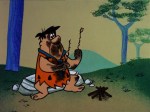 The story of this episode is set in when Fred gets angry about meat prices in a supermarket. So he decides to use his vacation to hunt the meat himself.
Thus the four neighbors are off with a trailer to the mountains where Fred and Barney try to clobber a ‘Snorkasaurus’ to death, while their wives experience all kinds of camping annoyances, like mosquitoes and ants. The Snorkasaurus turns out to be a wise-cracking, refined talking animal with a suave voice (according to Wikipedia imitating comedian Phil Sivers).
In the end the episode turns out to give us the origin of Dino, Fred and Wilma’s pet. This is a weird turn of events, as Dino has been seen before as a four-legged yelping dinosaur, behaving like a dog, not the two-legged suave and talkative animal as shown here. Indeed, this is this the only episode in which Dino talks.
‘The Snorkasaurus Hunters’ is the first episode to show Fred working as an excavator machinist at ‘Rockhead and Quarry’s Cave Construction Company’. In ‘Love Letters on the Rocks‘ Fred says he’s a ‘dino-operator’. Both his work and the supermarket lead to several prehistoric gags. The camping episode is particularly slapstick rich, and has surprisingly much in common with earlier Warner Bros. cartoons. For example, Barney chops an enormous redwood tree, which crashes on Fred’s car and trailer. Later, Barney goes fishing, but gets swallowed by a large fish himself. The best gag, however, is when the four dream what they could do with the money they save by hunting their meat themselves. Barney’s dream in particular is a delight.
Watch an excerpt from ‘The Snorkasaurus Hunter’ yourself and tell me what you think:
This is Flintstones Season One Episode 18
To the previous Flintstones episode: The Big Bank Robbery
To the next Flintstones episode: The Hot Piano
‘The Snorkasaurus Hunter’ is available on the DVD-set ‘The Flintstones: The Complete First Season’
Directors: William Hanna & Joseph Barbera
Airing Date: January 20, 1961
Stars: The Flintstones
Rating: ★★★
 This episode starts with two bank robbers (voiced by Mel Blanc and Stan Freberg) followed by a police car.
The robbers get rid of the loot, which lands on Fred’s head. When the wives convince Fred and Barney to return the money to the police, the boys are quickly seen as the robbers themselves. Fred and Barney flee into the wild Meanwhile, Wilma thinks of a rather unhealthy way to attract the real bank robbers, posing as sleazy gals (“Shirl” and “Myrt”) with too much dough on their hands. It remains a miracle that they only attract the original bank robbers to their house, and not the complete criminal scene of Bedrock with their act.
Anyway, in the end Fred accidentally knocks out the real crooks, earning the reward. But his bragging about it makes him all too vulnerable to blackmail, and in the end it’s the other three who spend all the money, leaving Fred only with his story as a conquering hero.
This episode features a gas station using a mastodon, but the best gag may be the police sketch, which is much more inspired than the tiring and completely superfluous scene in which Barney ends up in a pterodactyl nest. Moreover, this pterodactyl looks more like a bird than the real thing.
This is Flintstones Season One Episode 17
To the previous Flintstones episode: Arthur Quarry’s Dance Class
To the next Flintstones episode: The Snorkasaurus Hunter
‘The Big Bank Robbery’ is available on the DVD-set ‘The Flintstones: The Complete First Season’
Directors: William Hanna & Joseph Barbera
Airing Date: January 13, 1961
Stars: The Flintstones
Rating: ★★★
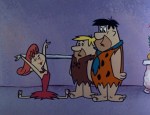 Wilma gets four free tickets for a big charity dance, but Fred and Barney refuse to go.
It turns out they can’t dance, and they are too ashamed to tell this to their wives. Thus they join ‘Joe Rockhead’s Fire Department’, a scam for husbands who want to go out each night, so they can go out and take dance lessons at ‘Arthur Quarry’s Dance School’.
Like many other Flintstones episodes ‘Arthur Quarry Dance School’ leans heavily on Fred and Barney’s rather depressing tendency to keep things secret from their wives, but this time it’s all for the good, and this is one of the rare episodes with a happy ending, even though Barney and Fred still can hardly dance in the end.
Highlight of the episode is the scene in which Fred and Barney meet their dancing partners at the school, two beautiful young ladies. The prehistoric gag department is limited to the mailman who uses a small Ceratopsian as a mail cart, and the bird as a record player, which by now has become a staple gag.
Watch an excerpt from ‘Arthur Quarry’s Dance Class’ yourself and tell me what you think:
This is Flintstones Season One Episode 16
To the previous Flintstones episode: The Girl’s Night Out
To the next Flintstones episode: The Big Bank Robbery
‘Arthur Quarry’s Dance Class’ is available on the DVD-set ‘The Flintstones: The Complete First Season’
Directors: William Hanna & Joseph Barbera
Airing Date: January 6, 1961
Stars: The Flintstones
Rating: ★★★★½
 The wives are complaining that the boys never take them out, so Fred and Barney take them to an amusement park, much to Betty’s and Wilma’s dismay.
At the amusement park Fred records a song for Wilma, which he leaves behind, as Wilma clearly isn’t interested. But Fred’s record is picked up by teenagers, and even makes it to the radio. Soon, Fred becomes the bespectacled teenage idol Hi-Fye.
In his new career as a pop star, Fred is managed by a colonel, who keeps rambling about a boy from Georgia ad nauseam in a rather lame running gag. The Georgia reference is a rare occasion of a real contemporary reference within the series instead of a phony one (like ‘Hollyrock’), and belies the supposed stone age setting of the series.
Anyway, Barney, Wilma and Betty accompany Fred, alias Hi-Fye on a tiring tour, until the wives are so fed up, they spread a rumor that Hi-Fye is in fact a square, thus ending the teen idol’s career within seconds.
This episode is a nice satire on the pop music industry of the late 1950s and early 1960s with its rapid turnover of pop stars. The period between the end of rock-‘n-roll (ca. 1958) and the advent of The Beatles in 1963 was particularly depressing in that respect, with teen idols with shallow hit songs and a short product live span flocking the jukebox.
Fred Flintstone seems to be the epitome of such stardom, having only one hit: his updated version of the age old song ‘Listen to the Mocking Bird’, the origins of which go way back to 1855. Nevertheless, watching Fred doing his ridiculous ‘gimmick’ as Hi-Fye is a sheer delight. The episode also contains a short reference to Hot Lips Hannigan (the star of the episode of the same name) as being way out.
Apart from the pop music scene of the early 1960s, this episode unwillingly gives us a little insight in the depressing life of housewives of the era, who never go out of their homes and whose reason of existence seems to be to serve their husbands. True, more episodes of The Flintstones display this sobering fact, but in ‘The Girl’s Night Out’ this pre-feminist life is made the main subject of the episode.
Watch ‘The Girl’s Night Out’ yourself and tell me what you think:
https://www.dailymotion.com/video/x6pavwm
This is Flintstones Season One Episode 15
To the previous Flintstones episode: The Prowler
To the next Flintstones episode: Arthur Quarry’s Dance Class
‘The Girl’s Night Out’ is available on the DVD-set ‘The Flintstones: The Complete First Season’
Director: Hamilton Luske
Release Date: June 21, 1961
Stars: Donald Duck
Rating: ★★★★
Review:
 ‘The Litterbug’ is the very last Donald Duck cartoon, ending a theatrical cartoon career that had lasted 27 years.
The cartoon uses a voice over in rhyme to describe ‘the litterbug’ as if it were some kind of harmful insect species. The short starts with live action footage of litter and garbage, then we cut to a book full of pests, containing the mosquito, the boll weevil, the termite, and… ‘the litterbug’, with Donald Duck representing the latter.
‘The Litterbug’ is one of the earliest environmental cartoons ever. Nevertheless the tone is light, helped by the joyful song by Mel Leven. Donald looks more angular than ever, and is clearly xeroxed. Al Dempster’s background art resembles that of ‘101 Dalmations’. Both xerox and background art give this short a particularly graphic look, which doesn’t suit Donald very well. Nevertheless, ‘The Litterbug’ is a fitting goodbye to a great career, and certainly better than Mickey’s last cartoon, ‘The Simple Things‘ from 1953.
Watch ‘The Litterbug’ yourself and tell me what you think:
This is the last Donald Duck cartoon
To the previous Donald Duck cartoon: Donald and the Wheel
‘The Litterbug’ is available on the DVD-set ‘Walt Disney Treasures: The Chronological Donald Volume Four 1951-1961’
Director: Hamilton Luske
Release Date: June 21, 1961
Stars: Donald Duck
Rating: ★
Review:
 ‘Donald and the Wheel’ is an educational special lasting almost 18 minutes.
The short features two ‘spirits of progress’, an old one and a junior, who are depicted by grotesque looking live actors, of whom we only see their silhouettes. These spirits are voiced by The Mellotones, who provide the rhyming dialogue, and who sing two swinging songs by Mel Leven: ‘Wheels of progress’ and ‘That’s the Principle of the Thing’. Donald Duck is only a pawn in this cartoon, and throughout the picture he’s depicted in his stone age appearance, introduced at the beginning: wearing a bear skin, and suddenly bearing a red scalp.
The educational value of this short is very limited: we watch how wheels are used in all kinds of transport, and in various machines – that’s about it. Thus soon the tiresome dialogue and the irritating duo of spirits wear out their welcome.
The short is further hampered by ugly colored live action footage of cars and industrial wheels, looking forward to the cheap look of Ralph Bakshi’s features from the late 1970s.
Watch ‘Donald and the Wheel’ yourself and tell me what you think:
This is Donald Duck cartoon No. 118
To the previous Donald Duck cartoon: How to Have an Accident at Work
To the next Donald Duck cartoon: The Litterbug
‘Donald and the Wheel’ is available on the DVD-set ‘Walt Disney Treasures: The Chronological Donald Volume Four 1951-1961’
Director: Robert McKimson
Release Date: January 7, 1961
Stars: Speedy Gonzales, Sylvester
Rating: ★★
Review:
 ‘Cannery Woe’ centers on Manuel and José, two poor mice, who live at the beach and who are starving.
They really would like to join the Grand Cheese Fiesta, organised by the mouse mayor for his re-election, but they are thrown out. Yet, the mayor has more problems: there’s no cheese at the fiesta (‘something new is added to the store’, explains one of the cheese committee mice). Luckily, José is friends with Speedy Gonzales, and only has to whistle to get Speedy’s help.
Speedy fetches the cheese from the store, unhindered by guarding cat Sylvester, who only gets hindered by his own tacks, mousetraps and cannon. In the end, José and Manuel are awarded as cheese inspectors, but Speedy gets even a better job as ‘chick inspector’.
‘Cannery Woe’ is a very mediocre cartoon with rather run of the mill gags. In fact, the mice José and Manuel are more interesting than anything that follows, and one wonders why storyman Tedd Pierce and director Robert McKimson didn’t devote more of the cartoon to them.
Watch ‘Cannery Woe’ yourself and tell me what you think:
https://www.dailymotion.com/video/x5bfqbq
‘Cannery Woe’ is available on the DVD-set ‘Looney Tunes Golden Collection Volume Four’
Director: Jack Hannah
Release Date: July 1961
Stars: Woody Woodpecker
Rating: ★
Review:
 ‘Franken-stymied’ starts with a classic stormy scene and Woody Woodpecker trying to hide from the storm in a castle.
Inside the castle a Frankenstein-like mad scientist has made a chicken-plucking robot called Frankie, and as soon Woody arrives, Frankie starts plucking him (luckily we see no effect – throughout these scenes Woody keeps all his tail feathers, no matter how many times they are plucked). It takes a while before Woody can take control, and in the end he manages to cover the scientist in feathers and make Frankie go after the unfortunate villain.
‘Franken-stymied’ was made by talented Disney veterans like Jack Hannah (direction), Don Lusk (animation), Homer Brightman (story) and Clarence Wheeler (music), but it doesn’t show. The cartoon suffers from bad timing, awful dialogue, canned music, ugly designs and poor animation, as if the budget was way too tight to deliver anything decent. Clearly, ‘Franken-stymied’ never comes near any Disney product, but even worse: it cannot even compete with Walter Lantz films from only one year earlier.
Watch ‘Franken-stymied’ yourself and tell me what you think:
This is Woody Woodpecker cartoon No. 109
To Woody Woodpecker’s debut film: Sufferin’ Cats
To the next Woody Woodpecker cartoon: Busman’s Holiday
‘Franken-stymied’ is available on the DVD-set ‘The Woody Woodpecker and Friends Classic Cartoon Collection Volume 2″ as part of the ‘Woody Woodpecker Show’
Director: Paul J. Smith
Release Date: January 1961
Stars: Inspector Willoughby
Rating: ★★★★½
Review:
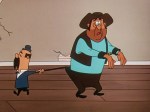 ‘Rough and Tumbleweed’ introduces Inspector Willoughby, an incarnation of the little guard from ‘Salmon Yeggs‘ (1958).
Inspector Willoughby is a very, very Droopy-like character: he is small, undisturbed and persistent and even sounds like Bill Thompson, the voice of Droopy. The animators added a funny jumpy walk to the character.
In his first film Willoughby tries to arrest fierce bandit Boy McCoy. This leads to several gags in the best Tex Avery tradition. Particularly inspired is the scene in which Boy McCoy tries to get a train to run over a safe full of dynamite, which is attached to his leg. Unfortunately, there are two train tracks, and a multitude of trains pass by without McCoy succeeding in his plan. It’s nice to watch such inspired comedy in a cartoon made as late as 1961, when the golden age arguably was already over.
Watch ‘Rough and Tumbleweed’ yourself and tell me what you think:
‘Rough and Tumbleweed’ is available on the DVD-set ‘The Woody Woodpecker and Friends Classic Cartoon Collection Volume 2″ as part of the ‘Woody Woodpecker Show’
Director: Friz Freleng
Release Date: December 2, 1961
Stars: Tweety & Sylvester
Rating: ★★★★½
Review:
 ‘The Last Hungry Cat’ must be one of the best entries in the Tweety and Sylvester series.
The short is a parody of the television show ‘Alfred Hitchcock Presents’, which aired from 1955 to 1965. Luckily, you don’t have to be familiar with this program (I’m not) to enjoy this cartoon.
Introduced by an Alfred Hitchcock-like shadow of a pig, the short tells the story of Sylvester, who for once thinks he has actually eaten Tweety and who is then eaten by guilt.
The cartoon makes use of a conscience-like voice-over and very beautifully colored and a surprisingly large amount of well-staged angular backgrounds (staged by Hawley Pratt, who gets co-directing credits, and painted in beautiful blues and yellows by Tom O’Loughlin). The images succeed in evoking an atmosphere that reflects Sylvester’s inner feelings. Especially the staging of Sylvester’s sleeplessness is very well done: still images of Sylvester lying awake are inter-cut with close-ups of his alarm clock, in rapid succession, zooming in all the time. These scenes are accompanied by Milt Franklyn’s ominous music and insistent ticking of the clock, only.
It’s a surprise such a well-made, beautiful and compelling cartoon could be made as late a 1961. The short is a worthy addition to the very small guilt cartoon canon, which also includes ‘Nursery Scandal‘ from 1933, ‘Pudgy Picks a Fight‘ from and ‘Donalds’ Crime’ from 1945.
Watch ‘The Last Hungry Cat’ yourself and tell me what you think:
Director: Gene Deitch
Release Date: December 12, 1961
Stars: Tom & Jerry
Rating: ★
Review:
 In ‘It’s Greek To Me-Ow!’ we see Tom and Jerry as citizens of ancient Greece.
Tom tries to enter a building (we don’t know why) and Jerry hinders him in doing that (why he does that we don’t know, either).
‘It’s Greek To Me-Ow!’ is the third Tom & Jerry-cartoon directed by Gene Deitch and animated by his Czech studio, and this time even the plot is terrible. This cartoon also painfully shows the complete lack of character in the Czech Tom and Jerry designs. The sad result is one of the worst Tom & Jerry cartoons ever made.
Watch ‘It’s Greek To Me-Ow!’ yourself and tell me what you think:
This is Tom & Jerry cartoon No. 117
To the previous Tom & Jerry cartoon: Down and Outing
To the next Tom & Jerry cartoon: High Steaks
Director: Gene Deitch
Release Date: October 26, 1961
Stars: Tom & Jerry
Rating: ★★
Review:
 In ‘Down and Outing’ Tom and Jerry join a fat man who goes fishing. During the cartoon Tom tries to get rid of Jerry, mostly on expense of the man.
‘Down And Outing’ is the second of thirteen Tom & Jerry films by Gene Deitch, and like in the first, ‘Switchin’ Kitten‘, a rather inspired story (by Larz Bourne) is ruined by bad design, bad timing, bad animation and bad sounds. The fat man would become Gene Deitch’s best attempt on a recurring character, returning in ‘High Steaks‘ and ‘Sorry Safari‘ (both from 1962).
Watch ‘Down and Outing’ yourself and tell me what you think:
This is Tom & Jerry cartoon No. 116
To the previous Tom & Jerry cartoon: Switchin’ Kitten
To the next Tom & Jerry cartoon: It’s Greek to Me-Ow!
Director: Gene Deitch
Release Date: September 1, 1961
Stars: Tom & Jerry
Rating: ★★½
Review:
 In ‘Switchin’ Kitten’ Tom visits an eerie castle, where Jerry helps a mad scientist with an experiment changing cats into dogs and vice versa. An anonymous cat, thinking he’s a dog, protects Jerry against an incomprehensible Tom.
‘Switchin’ Kitten’ is the first of a series of thirteen Tom & Jerry shorts directed by Gene Deitch, three years after the MGM animation studio had shut down and Hanna & Barbera had left for television. Gene Deitch’s animation team was based in Czechoslovakia, and it had only seen a handful of the classic Hanna & Barbera films.
‘Switchin’ Kitten’ immediately shows their problems: there’s a fairly good story with some great gags, but these are smothered in ugly designs (especially that of Jerry), bad timing, unappealing animation, terrible sound effects and unimaginative music, resulting in a surprisingly unfunny film. One cannot help but thinking that this short was made only to cash in on Tom & Jerry’s popularity. Unfortunately, it wouldn’t get better…
Watch an excerpt from ‘Switchin’ Kitten’ yourself and tell me what you think:
https://www.dailymotion.com/video/x2oflaq
This is Tom & Jerry cartoon No. 115
To the previous Tom & Jerry cartoon: Tot Watchers
To the next Tom & Jerry cartoon: Down and Outing
‘Switchin’ Kitten’ is available on the European DVD Box set ‘Tom and Jerry Collection’ and on the DVD-set ‘Tom and Jerry: The Gene Deitch Collection’
Director: Charles Nichols
Release Date: March 16, 1961
Rating: ★★★
Review:

‘The Saga of Windwagon Smith’ was Disney’s last tall tale cartoon after entries like ‘Pecos Bill‘ (from ‘Melody Time‘, 1948) and ‘Paul Bunyan‘ (1958).
Unlike the former, which were rooted in American folklore, this story seems to be an original, although it retains a traditional feel. The story, which is narrated in rhyme, and partly sung by Rex Allen and the Sons of the Pioneers, tells about Windwagon Smith, a sailor who arrives at Westport, a small town in Kansas on a wagon with a sail. He convinces the villagers to make even a larger one to sail the prairies to Santa Fe with. But when it’s ready the villagers get scared and abandon the ‘ship’, except for Molly, the mayor’s daughter, who’s in love with Smith. Together they vanish into a storm.
‘The Saga of Windwagon Smith’ was the last cartoon to be directed by Charles Nichols. It’s also the last of only six shorts directed by him not to feature Pluto. It’s moderately stylized except for Molly, who’s conceived and animated in a charmingly stylized way, seeming to float more than to walk. Nichols left Disney in 1962 for Hanna-Barbera, where he worked on countless television series. In the late 1980s he returned to Disney, where he worked onto his death in 1992, 81 years old.
Watch ‘The Saga of Windwagon Smith’ yourself and tell me what you think:
‘The Saga of Windwagon Smith’ is available on the DVD ‘Walt Disney Treasures: Disney Rarities’


 Dr. Grob's Animation Review