
You are currently browsing the tag archive for the ‘1971’ tag.
Director: Nick Park
Date: 1978
Rating: ★★★
Review:
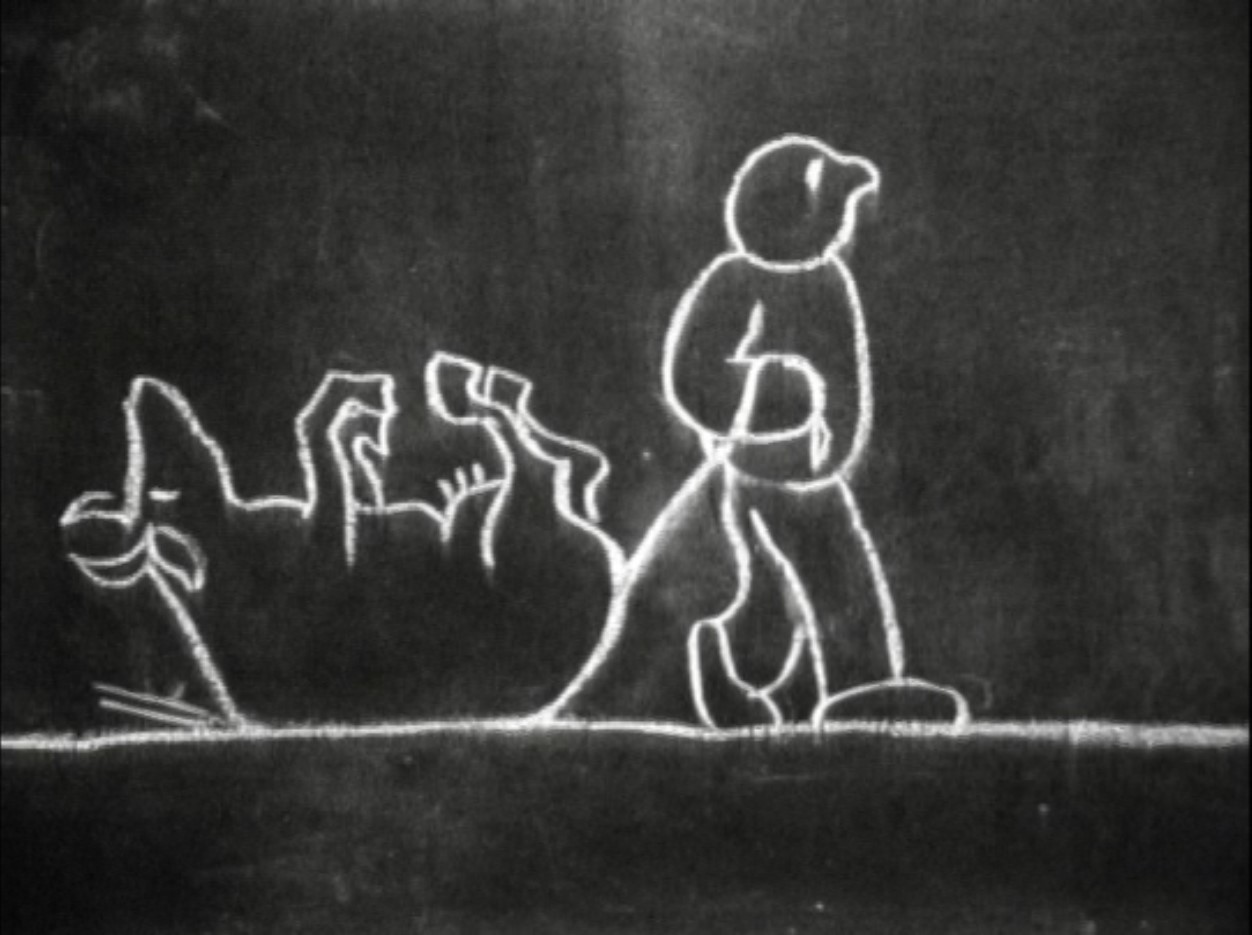
The interesting aspect of the DVD ‘Giants’ First Steps’ is that it shows well known animators and animation directors were not always that good. They had to start somewhere, and their early films show where they already succeeded and where they faltered.
With the charcoal animation of ‘Jack and the Beanstalk’ (made at the Sheffield Art School) Nick Park returns to the very origin of animation, with its earliest films using a blackboard. Nick Park retells the classic fairy tale in an original, stream of consciousness-like manner, with a lot of metamorphosis and weird sound effects.
Even though Park’s animation is crude, the film is pleasantly odd and original throughout. For example, Jack shoots a cow from the sky, and puts in a vending machine to obtain his magic bean, which turns out to be huge. My favorite part is a little guy talking gibberish into a microphone before the titles appear.
Park, of course, would later become world famous with his ‘Creature Comforts’ and Wallace and Gromit films, made at Aardman.
‘Jack and the Beanstalk’ is available on the DVD ‘Giants’ First Steps’
Director: Michael Mills
Release date: 1971
Rating: ★★½
Review:
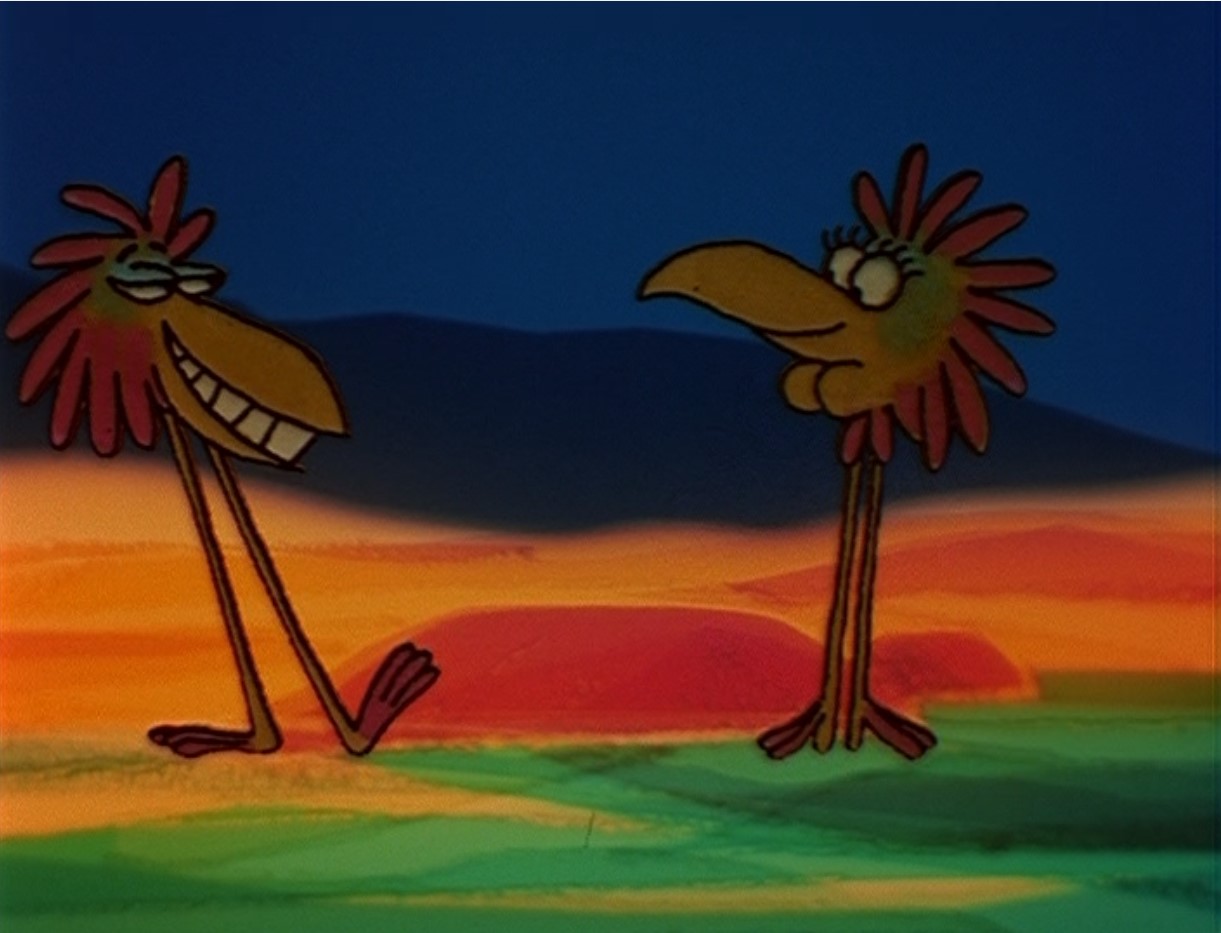
‘Evolution’ is Michael Mills’ cartoony take on the biological concept. The short features several fantasy creatures, starting with single cells in a pond (which all look like eye balls).
Mills depicts the origin of sex, the struggle of life, and the colonization of land, but none of his images are remotely serious, and most scenes consist of short gags. Unfortunately, the short is not too funny, and feels a little empty, ending quite abruptly and disappointingly.
Five years later Bruno Bozzetto did a much better job when depicting the same subject in his Boléro section of ‘Allegro non troppo’ (1976)
Watch ‘Evolution’ yourself and tell me what you think:
‘Evolution’ is available on the DVD ‘Best of the Best – Especially for Kids!’
Director: Mirosław Kijowicz
Release date: 1971
Rating: ★★★
Review:
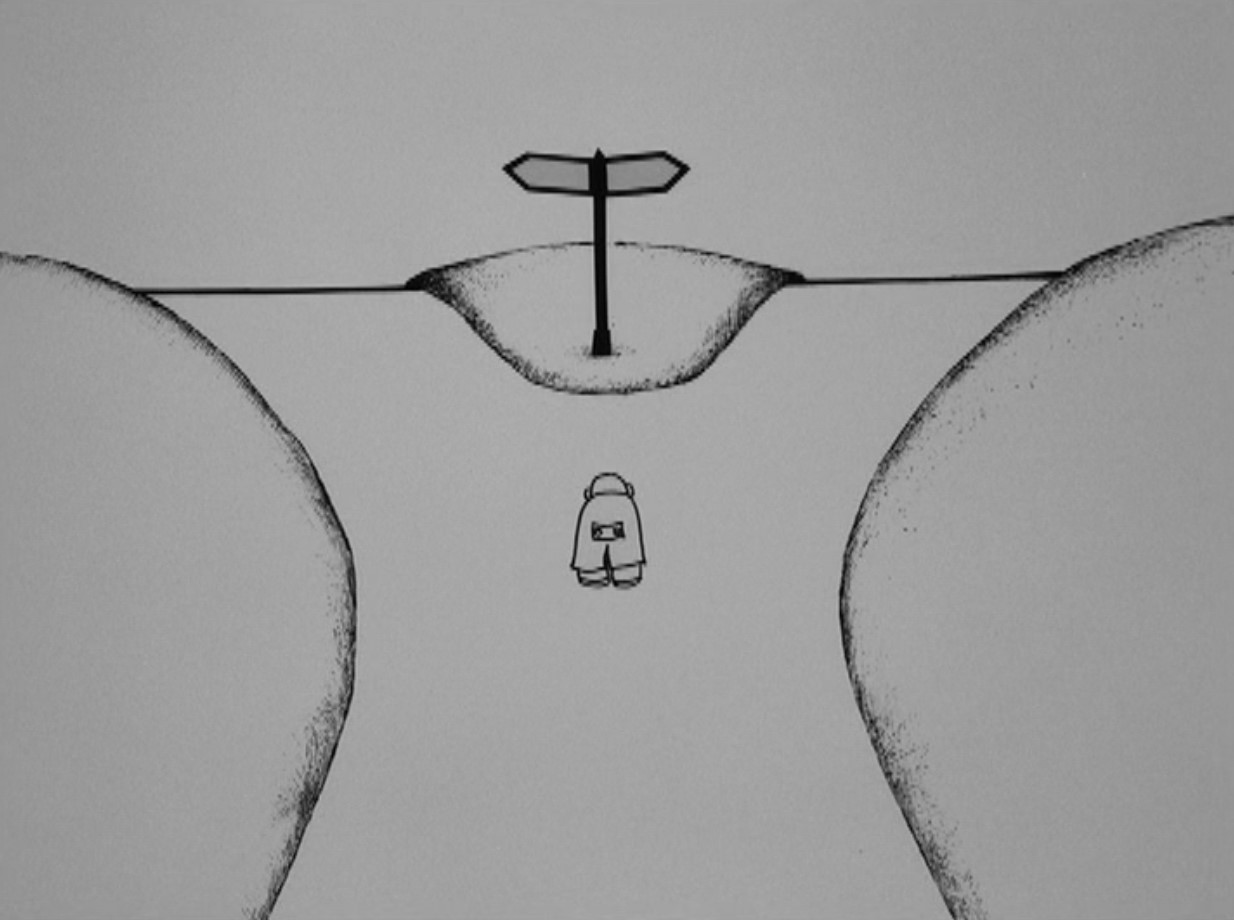
‘The Road’ is a simple little black and white film about a man walking a road, but then he faces a fork in the road.
According to IMDb this is a parable on how choices have consequences, and I can see something in that. Nevertheless the film may be a little too simple, making its message rather vague and puzzling. For example, we only see the man from the back, and only the second choice he has is clearly motivated, with help from a text balloon. Nevertheless, ‘The Road’ is a charming example of the experimental approach to animation in Poland.
Watch ‘The Road’ yourself and tell me what you think:
‘The Road’ is available on the DVD-set ‘Anthology of Polish Animated Film’
Director: Zlatko Grgić
Release date: 1971
Stars: Maxicat
Rating: ★★★
Review:
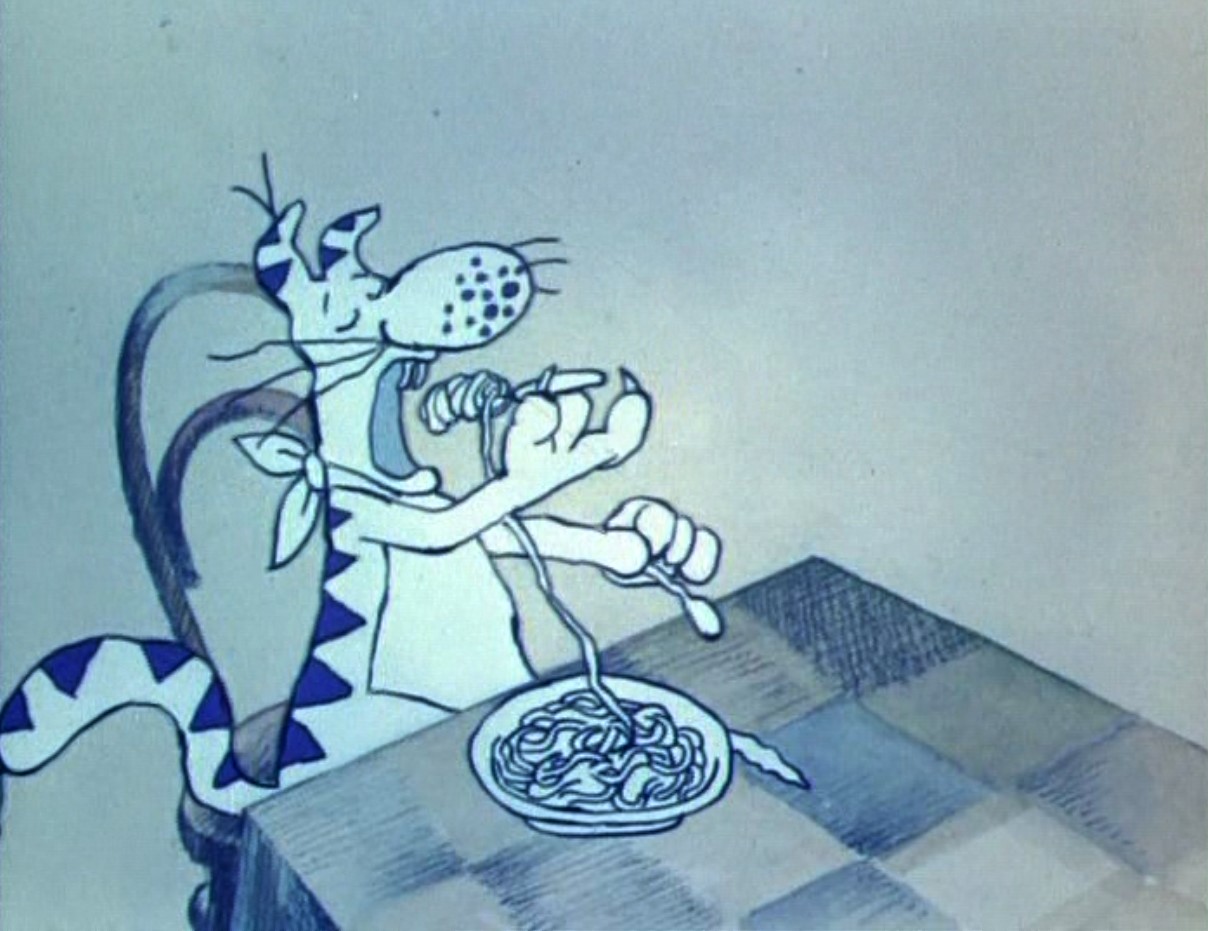
These are three very short episodes of the Maxicat series, which consisted of 24 episodes in total. These feature a very cartoony cat with a big nose experiencing Pink Panther-like adventures on a grey, featureless canvas.
In the first Maxicat finds a magical hat, in the second he eats spaghetti, and in the last he finds a flying broom. All three are short and classic gag cartoons with the dialogue-less action being accompanied by very jolly music. As these three episodes prove, Maxicat is an enjoyable series from the very creative Zagreb Film Studio from Yugoslavia.
Watch some Maxicat episodes yourself and tell me what you think:
These Maxicat episodes are available on the DVD ‘The Best of Zagreb Film: Be Careful What You Wish For and The Classic Collection’
Director: Daniel Szczechura
Release date: 1971
Rating: ★★
Review:

‘If You Spot a Cat Flying Through the Air’ is a strange little film in bold seventies design and with an avant-garde jazz score by W. Pażyński to tell us that If You Spot a Cat Flying Through the Air, it’s a cat who love birds. These words reappear a few times in the short itself.
Unfortunately, both animation and movement are rather limited, and the short is more interesting as an experiment than entertaining to watch.
Watch ‘If You Spot a Cat Flying Through the Air’ yourself and tell me what you think:
‘If You Spot a Cat Flying Through the Air’ is available on the DVD-set ‘Anthology of Polish Children’s Animation’
Directors: Ivan Ivanov-Vano & Yuri Norstein
Release date: 1971
Rating: ★★★
Review:
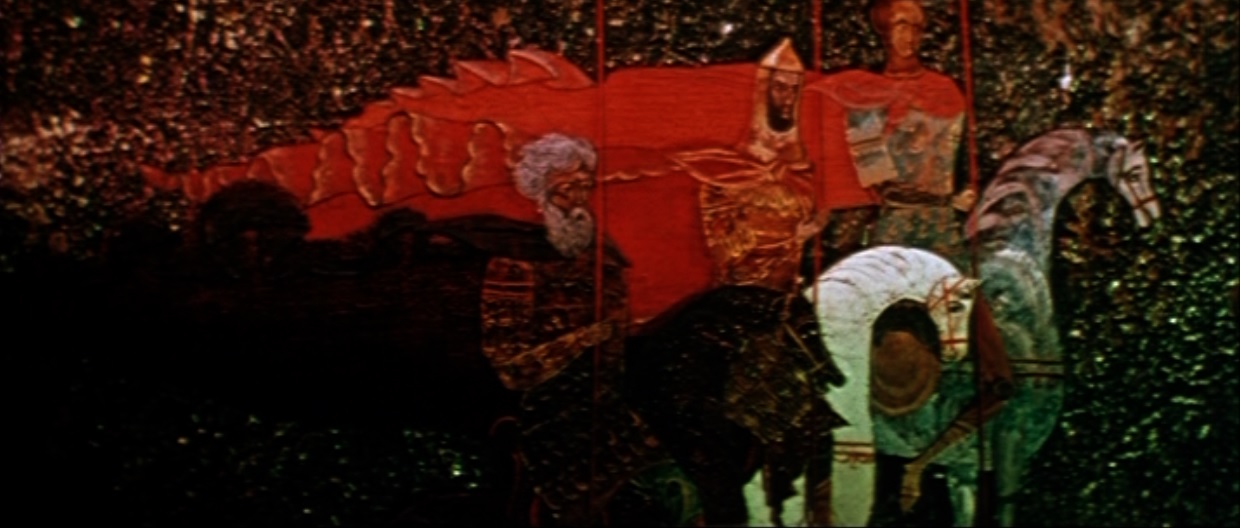
Veteran director Ivan Ivanov-Vano and young and up-and-coming talent Yuri Norstein co-direct the rather enigmatic ‘The Battle of Kerzhenets’.
Set to music by Nikolai Rimsky-Korsakov (excerpts from his opera ‘the Invisible City of Kitezh’), the film tells of a legendary epic battle of a Russian army against an invading army of Mongols, and of its aftermath. The film consists of three parts: in the first we watch the soldiers saying goodbye to their wives and children, the second depicts the battle itself, and the third part shows how life continues, with images of farmers sowing and harvesting and of children playing.
The short stops quite abruptly, and it’s quite unclear what the duo wanted to tell with their film. Nevertheless, the film is a marvel to watch. As the directors state themselves in the opening of the film, the visuals are based on Russian icons and frescos of the 14th to 16th century, and these give the short its unique style.
The cut-out animation is fair, and more emblematic than realistic, but the real treat lies in the way the two directors filmed their short. For a film about a battle, the filming is remarkably poetic: the images often flow into each other by the use of dissolves into black and back, and there’s a lot of soft focus on the images, creating a magical distance. In fact, the images are mesmerizing throughout the picture, and clearly look forward to Norstein’s individual poetic style.
Watch ‘The Battle of Kerzhenets’ yourself and tell me what you think:
‘The Battle of Kerzhenets’ is available on the DVD ‘Masters of Russian Animation Volume 2’
Director: Vladimir Pekar
Release Date: 1971
Rating: ★★
Review:
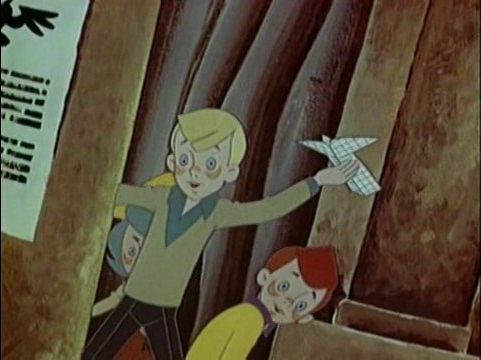 It seems that in the early 1970s Soviet Propaganda took a rather retrograde course, being more overtly propagandistic and using images that went all the way back to the 1920s.
Films with a peaceful message, like ‘Proud Little Ship‘ (1966) or ‘We Can Do It‘ (1970) were interchanged for self-important glorifications of the Soviet Union, and its ‘heroic’ history. This period produced some of the most terrible propaganda films ever made. ‘The Adventures of the Young Pioneers’ is a prime example.
The film plays during World War Two, Russia’s Great War. When their village is occupied by some goofy Nazi Germans, three communist children decide to withstand their occupants. They are betrayed by a collaborator, however, and captured when raising a red flag. Luckily, they are saved by the red army.
This children’s film uses ugly designs and very old-fashioned looking caricatures of Nazis, while the children and especially the red army are drawn quite heroically. The result is as unappealing and unfunny as it is sickeningly propagandistic.
Watch ‘The Adventures of the Young Pioneers’ yourself and tell me what you think:
http://www.fandor.com/films/the_adventures_of_the_young_pioneers
‘The Adventures of the Young Pioneers’ is available on the DVD box set ‘Animated Soviet Propaganda’
Director: Jan Švankmajer
Release Date: 1971
Rating: ★★★★★ ♕
Review:
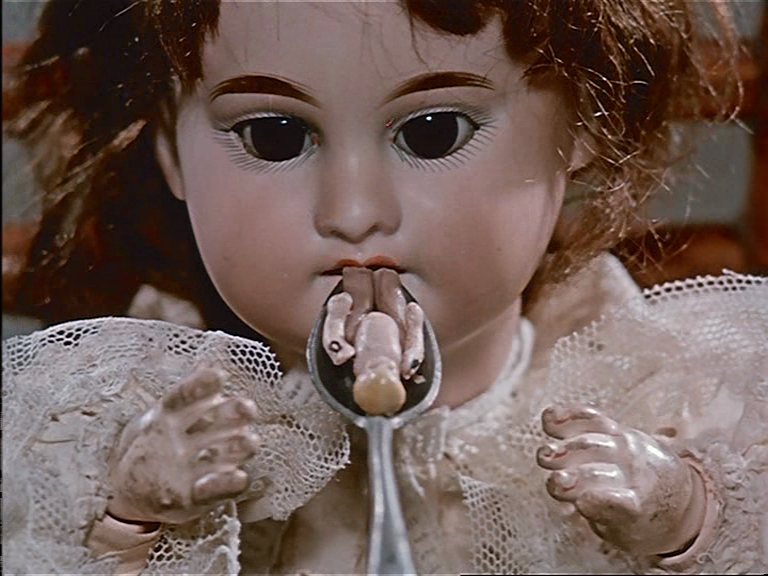 ‘Jabberwocky’ has little to do with the poem from Lewis Carroll’s ‘Through The Looking Glass’, although we hear it being recited by a little girl during the opening sequence.
The film it is Švankmajer’s surrealistic masterpiece on the loss of childhood, depicted by several episodes, which are separated by a box of bricks, a labyrinth and a black cat crushing the box of bricks.
During the episodes we are treated on extremely surrealistic images of very active inanimate objects in a child’s room. First we watch a boy’s suit growing a forest in his room, defying both time and authority (symbolized by the portrait in the room). Then we watch large cannibalistic dolls grinding, ironing and eating little dolls, a china baby in a cradle destroying two tin armies, a pocket knife performing acrobatic tricks until it makes an ill-fated fall and stabs itself, and finally, schoolbooks producing paper boats and planes, which fly out of the window, while the father’s portrait produces pictures of beautiful women.
This last episode shows the child’s changing interests. In the end the labyrinth is solved, the cat – the only living thing in the entire film – is caged, and the boy’s suit is replaced by an adult one. The boy is free from his parent, but the days of imagination are over, the fantasy is gone.
For this film Švankmajer makes excellent use of 19th century imagery (sailor suit, vintage dolls and toys) to create a completely unique world. It’s the film maker’s most typical film, partly expanding on ideas explored in ‘Historia Naturae, Suita‘ (1967), and showing his fascination with fantasy, cruelty and decay, which roam freely in the child’s self-contained room. The rather morbid behavior of the everyday objects is quite unsettling and it shows how a child’s fantasy can be both imaginative and cruel.
‘Jabberwocky’ is without doubt one of Švankmajer’s most powerful films. He would only top it eleven years later, with ‘Dimensions of a Dialogue‘ (1982). Švankmajer would explore the imagination of children further in the moving ‘Down to the Cellar‘ (1983), and in his unique adaptation of Lewis Carroll’s most famous work ‘Alice‘ (1987).
Watch ‘Jabberwocky’ yourself and tell me what you think:
‘Jabberwocky’ is available on the DVD ‘Jan Svankmajer – The Complete Short Films’
Director: Inessa Kovalevskaya
Release Date: 1971
Rating: ★
Review:
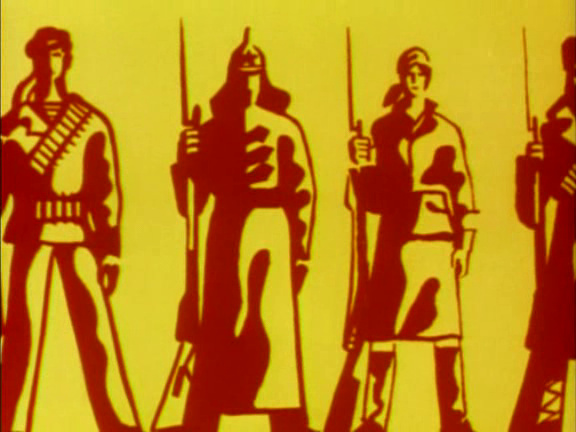 One could see ‘Songs of the Years of Fire’ as the Soviet answer to ‘Fantasia’.
This propaganda film features songs from the Russian civil war (1917-1922). These songs are accompanied by revolutionary and shamelessly patriotic images of the brave soviet army, to which the film is dedicated.
The resulting film is as graphically interesting as it is boring and sickening. It’s hard to believe such blatant propaganda could be made as late as 1971.
‘Songs of the Years of Fire’ is available on the DVD box set ‘Animated Soviet Propaganda’
Director: Raoul Servais
Release Date: 1971
Rating: ★★½
Review:
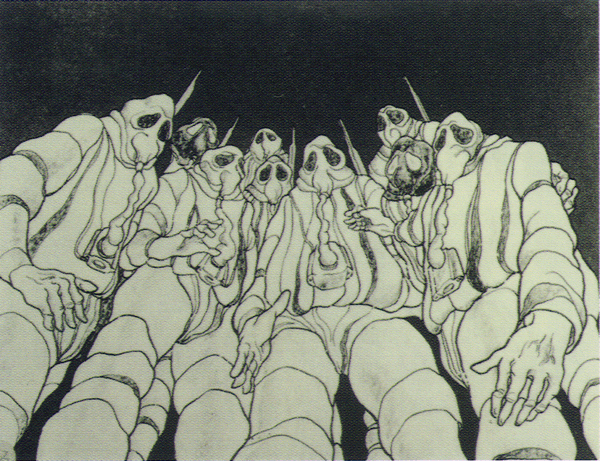 Operation X-70 is a half silly, half scary short by Belgian film maker Raoul Servais.
It tells about a poisonous gas, which turns people into spiritual beings. The gas is advertised as a ‘clean weapon’, because it doesn’t kill people. When the gas is accidentally bombed on the Benelux (Belgium, Holland and Luxemburg), it turns people into angels.
The film impresses with its weird idea, its dark and gloomy atmosphere, and its anti-war message. However, like Raoul Servais’s earlier film ‘Goldframe’ (1968), the film suffers from an all too present dialogue. In the end the short’s images are more lasting than the film itself is.
Watch ‘Operation X-70’ yourself and tell me what you think:


 Dr. Grob's Animation Review