
You are currently browsing the tag archive for the ‘1974’ tag.
Director: Eric Goldberg
Date: 1974
Rating: ★★★
Review:

‘Good Old Fashioned Cartoon Violence’ is another gag cartoon made by top animator Eric Goldberg when he was still in his teens.
In this black and white cartoon a cartoon figure watches a Tom & Jerry like violent cartoon on television. Immediately after that, cartoon violence starts happening to him, too. It only ends when the poor guy shoots his creator (a nice self caricature of Goldberg).
This is not really a funny or good cartoon, but Eric Goldberg’s talent is unmistakable.
‘Good Old Fashioned Cartoon Violence’ is available on the DVD ‘Giants’ First Steps’
Director: John Lounsberry
Release date: December 20, 1974
Stars: Winnie the Pooh, Piglet, Tigger, Rabbit, Kanga, Roo & Christopher Robinson
Rating: ★★★★
Review:

The third of the Winnie the Pooh-featurettes is based on chapter seven and four from ‘The House at the Pooh Corner’ and both stories are centered around Tigger.
Now Tigger was from the start a wonderful character, superbly animated, and he shines again in his second appearance after ‘Winnie the Pooh and the Blustery Day’ from 1968. In both stories Tigger’s main adversary is the serious and rather sour Rabbit, who, too, is greatly animated, and the enormous difference in movement and expressions between the two characters is a great testimony of what character animation is all about, and of the extraordinary art of the nine old men.
As the two stories are very simple and straightforward, it’s best not to say much else about them, but in the second one Pooh himself is at his best when he discovers some mysterious tracks in the snow. There’s again a little playing with the book setting, even if it’s less than in the previous featurette.
The result is another delightful little film that will appeal to youngsters and adults, alike.
‘Winnie the Pooh and Tigger Too’ was planned as the last of the Winnie the Pooh featurettes, and in 1977 all three were combined into a feature (which had been Walt’s original plan, anyway) called ‘The Many Adventures of Winnie the Pooh’, which adds one last and moving little scene to end it all. Nevertheless, 1983 saw another Winnie the Pooh short ‘Winnie the Pooh and a Day for Eeyore’.
And even that was not the end of the Disney-Pooh-adventure, as in 1988 the television series ‘The New Adventures of Winnie the Pooh’ started, followed by a few television specials and several straight to video features. And of course, in more recent times, the Winnie the Pooh franchise has gotten an update with films like ‘The Tigger Movie’ (2000) and ‘Piglet’s Big Movie’ (2003). One would almost blame the Disney company for milking the Pooh franchise too much, especially when getting far away from the source material, but then the company surprised us with the absolutely delightful ‘Winnie the Pooh‘ from 2011.
Watch an excerpt from ‘Winnie the Pooh and Tigger Too’ yourself and tell me what you think:
‘Winnie the Pooh and Tigger Too’ is available on Blu-Ray and DVD as part of ‘The Many Adventures of Winnie the Pooh’
Director: Paul Driessen
Release date: 1974
Rating: ★★★
Review:
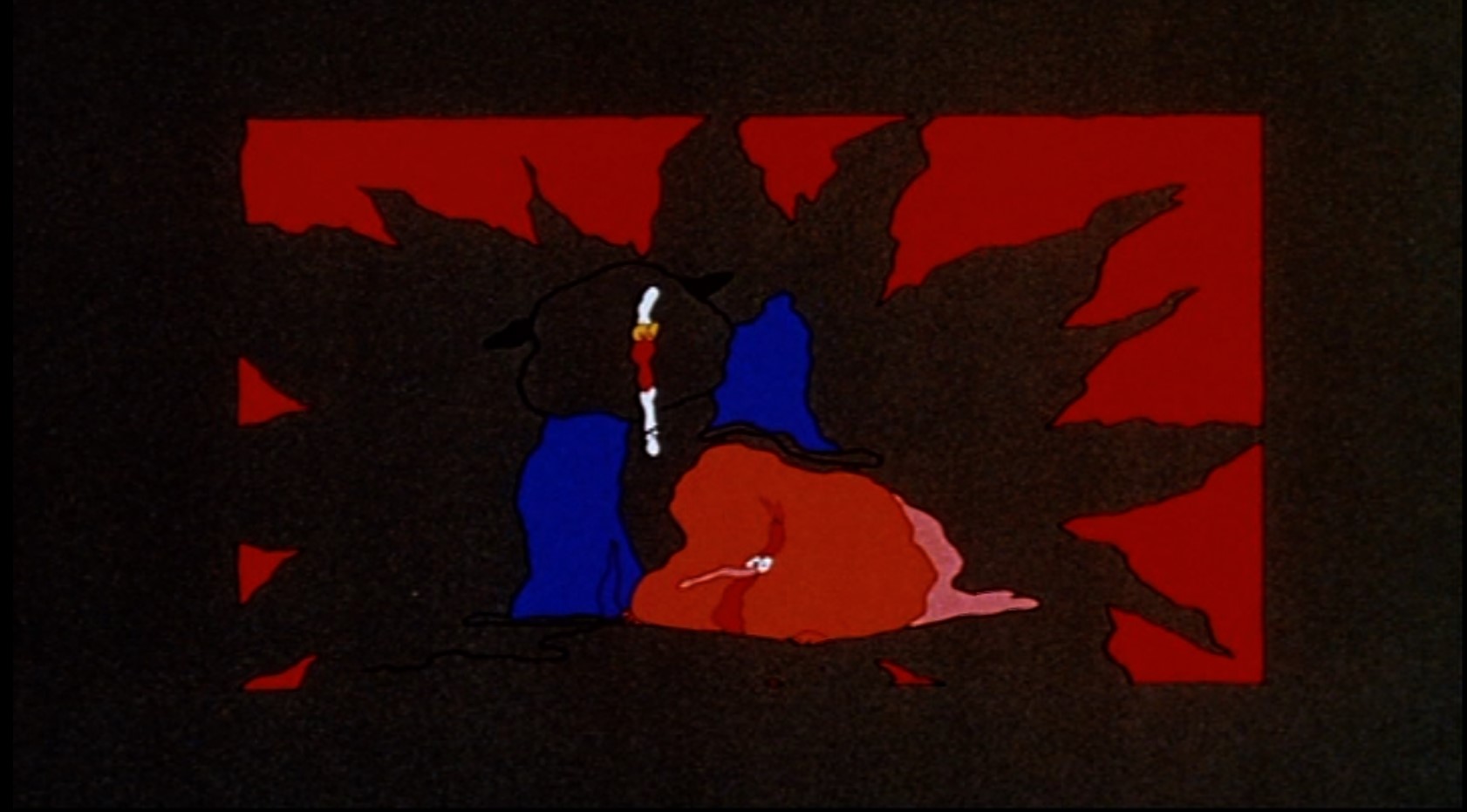
‘Cat’s Cradle’ is an early film by Dutch animator Paul Driessen for the National Film Board of Canada.
This is one of Driessen’s most enigmatic films, in which the images seem to flow in a stream-of-consciousness-like fashion, bridged by a string spun by tiny spider. Somehow the tale, if there is one, has a retrograde character, but it’s hard to make head or tail of Driessen’s narrative in this short.
The background art again is very limited and made of monochromes, and Driessen’s typical morbid humor is very present. For example, the spider is handled by a man, who in turn turns out to hang at a gallows pole.
Watch ‘Cat’s Cradle’ yourself and tell me what you think:
‘Cat’s Cradle’ is available on the DVD ‘Des histoires pas comme les autres’
Director: Caroline Leaf
Release date: 1974
Rating: ★★★★
Review:

‘The Owl Who Married a Goose: An Eskimo Legend’ was the first film acclaimed animator Caroline Leaf made for the National Film Board of Canada.
Done entirely in sand animation (in fact, Caroline Leaf was one of the very first animations to explore this technique for an entire film) the short tells about an owl, who marries a goose, but cannot follow her life style, with disastrous results. The legend is told and sung by real inuit, who also provide the goose’s and owl’s voices. As their Inuktitut language remains untranslated, one is lost in what is said, but luckily Leaf’s charming animation tells it all.
With its simple designs, effective animation and original soundtrack ‘The Owl Who Married a Goose: An Eskimo Legend’ created quite a stir, and the film surely is one of the most Canadian the NFB ever made. After this film Leaf set off to a great career as one of the most interesting of independent animation film makers, creating such intriguing masterpieces like ‘The Street’ (1976) and ‘Two Sisters’ (1990).
Watch ‘The Owl Who Married a Goose: An Eskimo Legend’ yourself and tell me what you think:
‘The Owl Who Married a Goose: An Eskimo Legend’ is available on the DVD ‘Best of the Best – Especially for Kids!’
Director: Zbginiew Rybczyński
Release date: 1974
Rating: ★★★
Review:

In ‘Soup’ avant-garde film maker Zbigniew Rybczyński shows his fondness of repetitive use of live action material to create startling new images.
Rybczyński would perfect this technique in 1980 with the Academy Award winning short ‘Tango’, but ‘Soup’ already is intriguing and hard to describe. Rybczyński has tinted his source material in stark, contrasting colors, with reds, greens, yellows and blues really popping out of the screen.
The images show the daily routines of a married couple, until it is suggested that the man dies in a train crash. At that point the film burns down. The daily routines are strangely juxtaposed to each other, and there are some very odd touches, like a fork taking a bite out of cheek.
The alienating effect is greatly enhanced by the soundtrack. For sound designer Mieczysław Janik and composer Eugeniusz Rudnik have provided a highly disturbing score full of ordinary sounds amplified to a grotesque effect. For example, when the man brushes his teeth, this rather sounds like a fork scratching on a plate.
I don’t think ‘Soup’ is for everyone, but this intriguing film shows both Rybczyński’s unique approach to film making and the sheer creativity that Communist Poland was in the graphic arts in the 1960s and 1970s.
Watch ‘Soup’ yourself and tell me what you think:
‘Soup’ is available on the DVD-set ‘Anthology of Polish Animated Film’
Director: Lee Mishkin
Release date: November 8, 1974
Rating: ★★★★½
Review:

This short video clip is an all favorite of mine, perfectly illustrating Roger Glover’s rather hippie-like hit song from his concept album for children ‘The Butterfly Ball and the Grasshopper’s Feast’, which in turn is based on a poem with the same title.
Both the original poem, the record were designed by Alan Aldridge, and so is Halas & Batchelor’s animation film, with charming results. Harold Whitaker has turned these images into charming animation very well, and Lee Mishkin does a good job transferring the lyrics to faithful, if often surprising images.
Young Ronnie James Dio’s voice is given to a minstrel frog, who walks to the Butterfly Ball itself, together with a number of a masked animals. Three drunken salamanders provide some comic relief, as does a fat toad at the ball itself. The slightly surreal images are a delight throughout and the clip is over before you know it. I wish the whole record was transferred into animation this way.
Watch ‘Butterfly Ball (Love Is All)’ yourself and tell me what you think:
‘Butterfly Ball (Love Is All)’ is available on the Blu-Ray ‘The Halas & Batchelor Short Film Collection’
Director: Phil Roman
Airing date: April 9, 1974
Stars: Charlie Brown, Linus, Lucy, Marcie, Peppermint Patty, Sally, Schroeder, Snoopy, Woodstock
Rating: ★★★
Review:

The twelfth Peanuts special was another holiday special, this time celebrating Easter. As with all Peanuts specials the story evolves at a leisurely speed, this time mixing ca. three stories into very short cross-cutting scenes.
The first and most entertaining story is about Peppermint Patty trying to teach Marcie how to paint eggs, but this goes haywire, because Marcie has absolutely no clue on how to prepare the eggs. The second story is about Snoopy buying a birdhouse for Woodstock, who initially shivers in the cold rain. Then there’s a story arc in which Linus tells the gospel of the Easter Bunny, just like he did on the Great Pumpkin.
Several scenes take place in a department store, and some of them are charming, if totally independent of the main story material, like Peppermint Patty, Marcie and Snoopy dancing to some Christmas-themed music boxes. This gives the episode a rather disjointed, almost improvisatory feel.
Vince Guaraldi’s soundtrack is great throughout, giving Snoopy and Woodstock an especially groovy soul-jazz theme, while the Easter Beagle is accompanied by a jazzy version of Beethoven’s seventh symphony.
Watch ‘It’s the Easter Beagle, Charlie Brown’ yourself and tell me what you think:
It’s the Easter Beagle, Charlie Brown’ is available on the DVD-set ‘Peanuts 1970’s Collection Vol. 1’
Director: Phil Roman
Airing date: February 1, 1974
Stars: Snoopy, Woodstock
Rating: ★★
Review:

‘It’s a Mystery, Charlie Brown’ is the first Peanuts special not to be directed by Bill Melendez. Instead, Phil Roman takes the director’s seat, after co-directing the previous episode, ‘A Charlie Brown Thanksgiving‘ with Melendez.
There’s little wrong with Roman’s directing, except for an odd staging here and there, but ‘It’s a Mystery, Charlie Brown’ is one of the weakest of the Peanuts episodes. Its story is incredibly straightforward, and lacks the little drama of the other episodes. This is mostly because the story is concentrated on Woodstock and Snoopy, instead of the children.
The episode starts with Woodstock trying to build a nest, and it’s this nest that drives the plot. The best parts of the episode deal with the power of imagination: Woodstock almost drowning in the bird bath and Woodstock riding an imaginary elevator. Also great is Snoopy as Woodstock’s attorney, issuing letters full of nonsensical Latin.
But the running gag in which Woodstock gets repeatedly wet falls rather flat, and one senses that more could have been made out of it. Also, the episode’s closing feels rather forced. In fact, the best aspect of the episode is its groovy soul-jazz music, which is a delight throughout the episode.
Watch ‘It’s a Mystery, Charlie Brown’ yourself and tell me what you think:
‘It’s a Mystery, Charlie Brown’ is available on the DVD-set ‘Peanuts 1970’s Collection Vol. 1’
Director: Nedeljko Dragić
Release date: 1974
Rating: ★★★★★
Review:
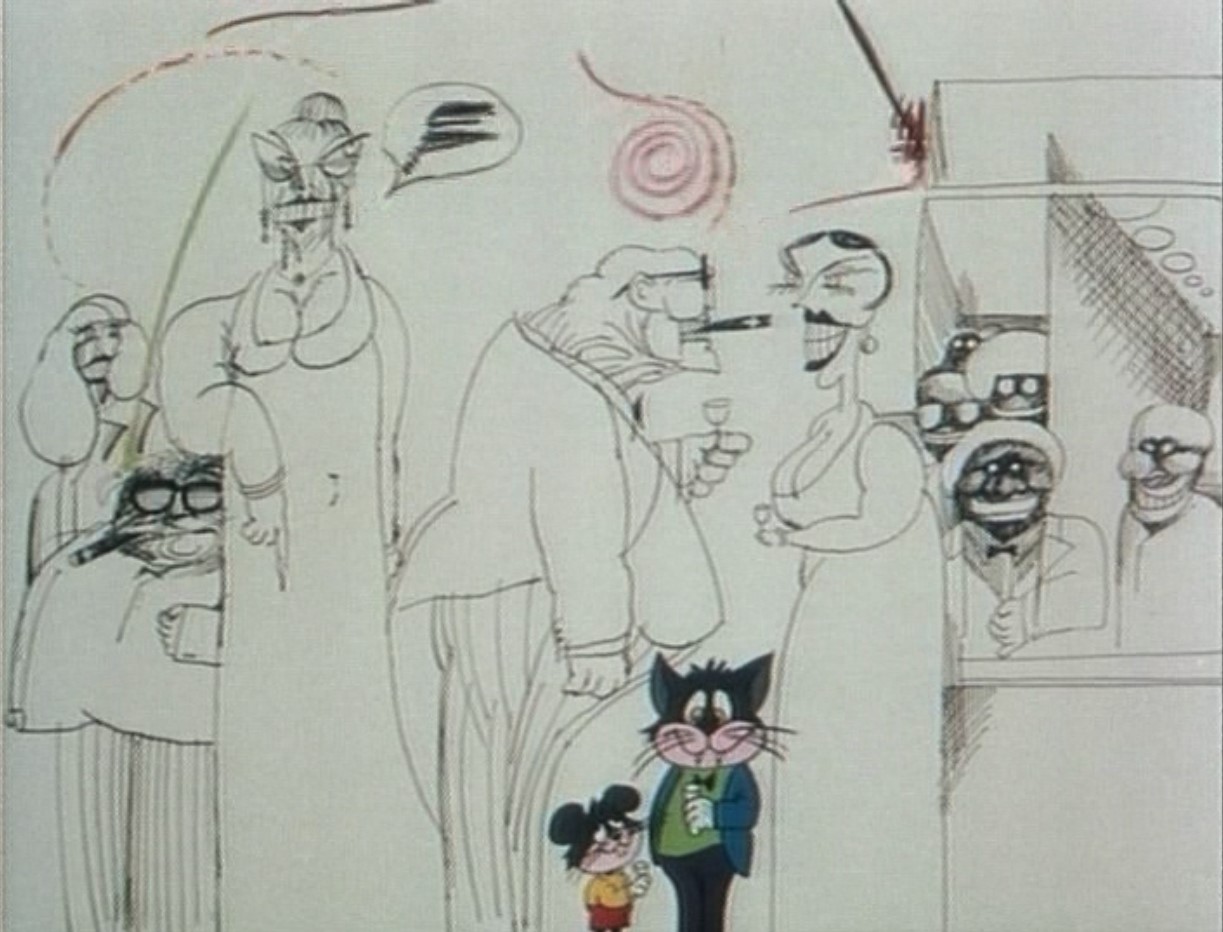
This animated short is very akin to the later ‘Satiemania’ by Zdenko Gašparović. The film features drawings and paintings on a white canvas, which change and morph in a stream-of-consciousness-like fashion.
The short starts with rather Saul Steinberg-like images of a man walking, while changing into all kinds of forms, figurative and abstract. The man then changes into a driver, while all the metamorphosis continues. This part contains some spectacular perspective and moving background animation.
The films then shifts to a party scene, in which a very cartoony mouse and cat form a running gag. From this point the film seems to say something about modern life and modern Western commercialism. As the film progresses, the images get more and more agitated, as if depicting the stressful life in the modern city. The film ends with another walking figure, showing a lonely man on an island inside.
‘Diary’ is a tour de force of imagination, and the images never cease to amaze. Nevertheless, the film’s purpose remains puzzling and leaves the viewer with more questions than answers.
Watch ‘Diary’ yourself and tell me what you think:
‘Diary’ is available on the DVD ‘The Best of Zagreb Film: Be Careful What You Wish For and The Classic Collection’
Director: Marcell Jankovics
Release date: 1974
Rating: ★★★★
Review:

‘Sisyphus’ is a very short animation film, which is indeed about a man pushing a large rock up a steep hill.
The animation is done in black pen on white paper, and there’s no background art whatsoever. Most impressive is Jankovics’s animation: his command of the human form is formidable, and of the suggestion of muscles pushing up an enormous weight absolutely convincing. What’s even more wonderful is that the man is rendered in various variations of abstraction, from quite realistic to only suggestive splashes of ink. The soundtrack, with its very heavy breathing and growning, maybe a little too much, but this short is a wonderful example of the marvelous things animation can do.
Watch ‘Sisyphus’ yourself and tell me what you think:
‘Sisyphus’ is available on the Blu-Ray of ‘Son of the White Mare’
Director: John Hubley
Release date: 1974
Rating: ★★½
Review:
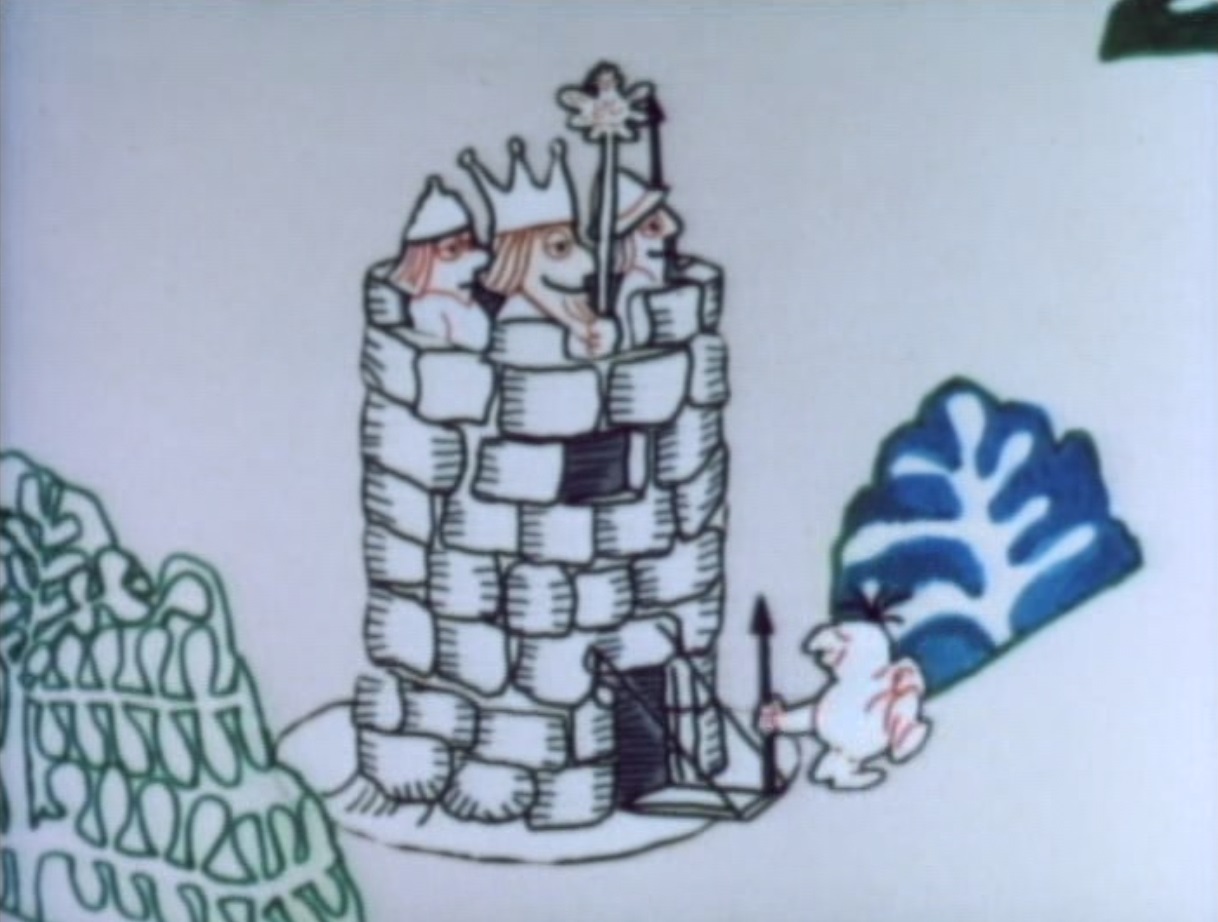
In ‘Voyage to Next’ mother Earth (voiced by Maureen Stapleton) and father Time (voiced by Dizzy Gillespie, who also provides the jazzy score) discuss humankind, and how its only hope is collaboration and sharing.
‘Voyage to Next’ is directed by John Hubley, but the pleasant designs of the two gods display the huge influence of Faith Hubley, who produced the film. The dialogue is improvised, and to be frank, rather rambling and disjointed, hampering the message. In fact, between an early conclusion that mankind is going nowhere and the final one that only collaboration will help little is happening in between.
‘Voyage to Next’ is very nice to look at, but little else, and one wishes the Hubleys for once would abandon their improvisational style for something more cohesive.
Watch ‘Voyage to Next’ yourself and tell me what you think:
‘Voyage to Next’ was released on the DVD ‘Art and Jazz in Animation’, which has been long out of print
Director: Ryszard Antoniszczak
Release date: 1974
Rating: ★★★
Review:

‘Farewell to Steam’ is a Polish children’s film set to a rock song. The short tells about a person who wants to become a train engineer.
This is one of those films from the early seventies that display a huge ‘Yellow Submarine’ influence. This short just breaths groovy seventies design. The man himself is a prototype of a seventies hippie.
The film uses full cell animation to show us images that are cartoony, surreal and weird. The images never cease to amaze, but a story is hardly present, and hard to follow anyway. In the end ‘Farewell to Steam’ succeeds more musically and visually than narratively.
Watch ‘Farewell to Steam’ yourself and tell me what you think:
‘Farewell to Steam’ is available on the DVD-set ‘Anthology of Polish Children’s Animation’
Director: Georges Schwizgebel
Release Date: 1974
Rating: ★★★★
Review:
 In ‘le vol d’Icare’ a man wants to fly like the birds. In the end he succeeds.
More important than the plot, however, is the technique of this film, which makes use of huge pixels, giving it a very digital look. Even though the man and the birds are extremely simplified, their motions are instantly recognizable. Even more remarkable is that the film contains some kind of baroque feel, amplified by Louis Couperin’s harpsichord music.
‘Le Vol d’Icare’ was Swiss animator Georges Schwizgebel’s first animated film. It doesn’t resemble his later films. In fact, it doesn’t resemble any other animation film. But it already shows Schwizgebel’s originality and virtuosity, and it can be considered his first masterpiece.
Watch ‘Le vol d’Icare’ yourself and tell me what you think:
‘Le vol d’Icare’ is available on the DVD ‘Les Peintures animées de Georges Schwizgebel’
Director: Osvaldo Cavandoli
Release Date: 1974
Stars: La Linea
Rating: ★★★★
Review:
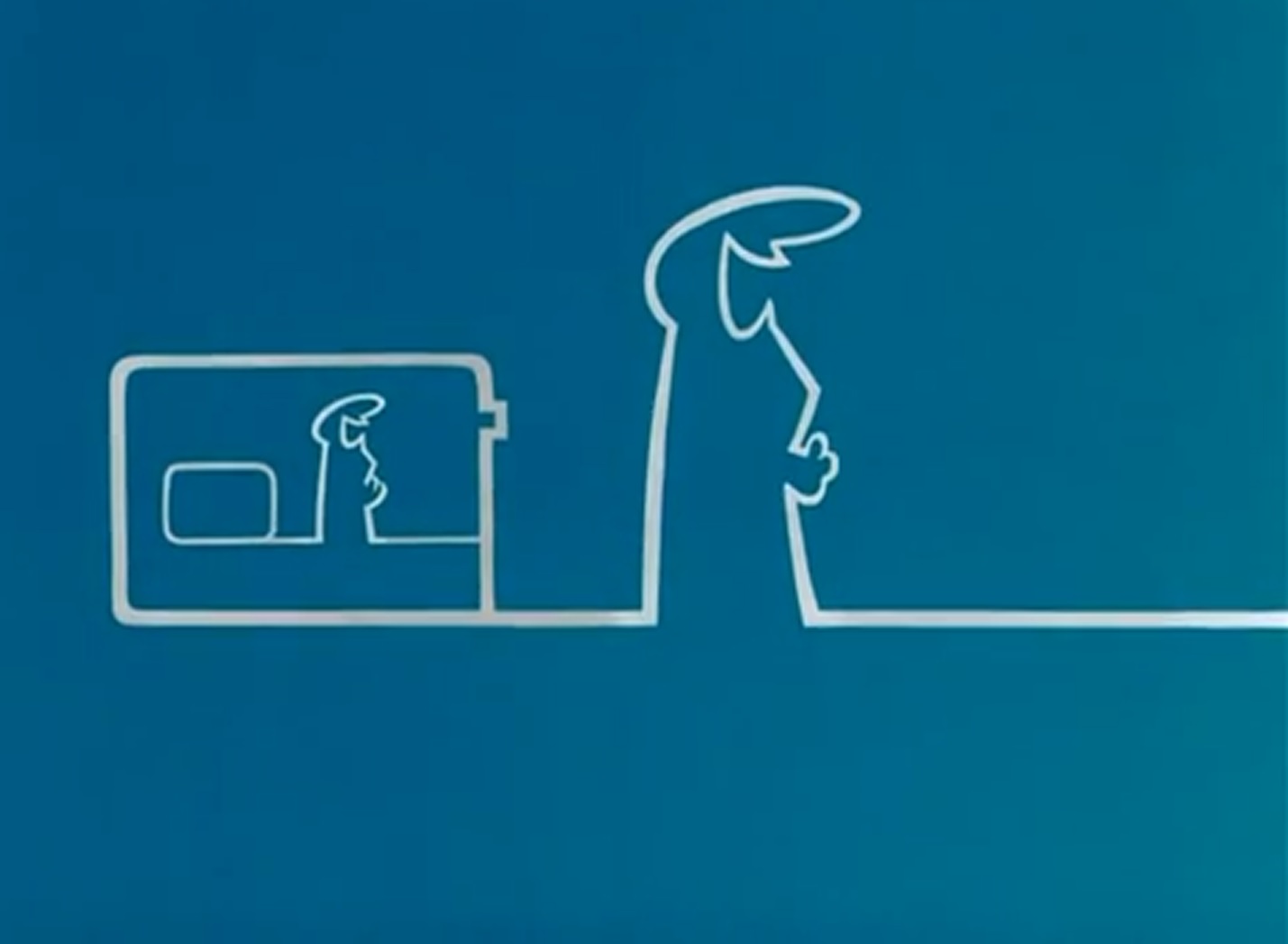 La Linea is an Italian television series, which takes graphic design, introduced by UPA to the animated screen, to the max.
The first of all La Linea shorts defines the complete series: it consists of numerous unrelated gags around the jabbering little man Linea, who lives in a 2-dimensional world, consisting of only one white line, of which he is part.
This cheerful, but temperamental guy has some characteristics that return in every single episode: First, he talks an Italian-sounding sort of gibberish, provided by voice actor Carlo Bonomi. Second, he always walks to the left of the screen. Third, he always encounters at least one interruption of the line during his walk. Fourth, he frequently argues with his off-screen creator, of whom we only see his hand drawing things for the little guy. And Fifth, our hero has also has an intoxicating laugh, which is heard at least once.
All designs are extremely stylized, yet perfectly recognizable, and beautifully animated. The backgrounds are monochromic, changing from green to red to blue etc. All these elements make this series such a classic, even though most of the episodes are completely plotless, and only last about 2 minutes.
In this particular episode La Linea encounters a turtle, a television set, a tap and a woman. He plays golf and takes a rollercoaster ride. It doesn’t make any sense, but it’s fun. Franco Godi’s music in this particular cartoon is more present than in the following ones, using a tune with voices instead of the instrumental background music of later cartoons.
Watch ‘La Linea episode 1’ yourself and tell me what you think:
‘La Linea episode 1’ is available on the DVD ‘La Linea 1’


 Dr. Grob's Animation Review