You are currently browsing the tag archive for the ‘2012’ tag.
Directors: Laurent Boileau & Jung
Release Date: June 4, 2012
Rating: ★★★
Review:

One of the striking developments of the 21st century was the advent of the animated documentary. Of course, the genre is much, much older, arguably going back to Winsor McCay’s ‘The Sinking of the “Lusitania“’ (1918), but the animated documentary film remained a scarcity throughout the 20th century, and never went beyond the length of shorts.
All that changed with the highly influential Israeli film ‘Waltz with Bashir’ (2008), arguably the very first feature length animated documentary. Subsequent films of this type often told personal stories, if not only told with, then at least augmented with animation, e.g. ‘Tatsumi’ (2011), ‘Kurt Cobain: Montage of Heck’ (2015, with added animation by Hisko Hulsing) or ‘Tower’ (2016).
‘Couleur de peau: miel’ is such a personal story. The film is based on an autobiographical graphic novel by Belgian author Jung, who is of Korean descent, and who was adopted at a young age. His story is told with an all too prominent voice over, and in live action, depicting the present Jung, now 44 years old, visiting Korea, with the use of 8mm films shot by his father in the 1970s, and with computer animation, depicting several of Jung’s childhood memories.
The film succeeds in showing the troubled existence of adopted children, and their struggling with their identity. Jung, for example, doesn’t feel entirely part of the family, and indeed, his parents sometimes snap that they see him differently from their own natural children. Worse, he feels uprooted, feeling neither completely Belgian nor Korean, and feeling alienated from both. This leads to a troubled youth, with Jung being far from a good boy. This unfortunately makes it rather more difficult to identify with him, for he often acts as a real jerk, being full of mischief, for example falsifying his school report.
The French title literally translates as ‘Skin Color: Honey’, and the animated sequences certainly use yellows, together with browns and grays as their principal coloring. Jung also has some dire memories of his early Korean days, which are rendered in more depressing grays than the Belgian sequences. These colors dominate the beautiful, two-dimensional background art.
For the animation the film makers have resorted to 3D computer animation, because it was cheaper. Unfortunately, it also looks cheaper, hampering an otherwise fine film. The characters are a strange hybrid of drawn images projected on three-dimensional models, and never become convincing characters. Instead, they look like wandering marionettes, uncannily devoid of life. In fact, the character animation is so ugly to look at that the emotions of Jung’s memories never really come off. I certainly wonder what a better film ‘Couleur de peau: miel’ could have been, if the film makers had made in traditional 2D animation… Now, we’re stuck with a film that certainly is interesting, but falls short in moving its audience.
Watch the trailer for ‘Couleur de peau: miel (Approved for Adoption)’ yourself and tell me what you think:
‘Couleur de peau: miel'(Approved for Adoption) is available on Blu-Ray and DVD
Director: Gert Driessen
Release Date: October 3, 2012
Rating: ★★½
Review:

In this short student animation film a man who has recently lost his wife, draws her with chalk on the wall. The chalk wife takes him into her chalk world full of memories.
‘Crayon d’amour’ is a gentle film, but hampered by rather ugly computer animation. The simple, cartoony character design doesn’t really match the 3D animation, nor the far more realistic settings. In fact, the traditional animation of the chalk scenes, not by director Gert Driessen himself, but by Florian de Hoes, Cederic Neven and Olivier vanden Busche, is far more impressive. One certainly wonders why not the whole film was made that way. Nevertheless, the 3D scenes have an attractive color design, consisting mostly of cardboard browns.
Watch ‘Crayon d’amour’ yourself and tell me what you think:
‘Crayon d’amour’ is available on the DVD ‘Framed – De beste Vlaamse korte animatiefilms 2010-2015’
Directors: Emma de Swaef & Marc James Roels
Release Date: January 28, 2012
Rating: ★★★★½
Review:

One of the most striking animation films to come from Belgium in the 2010s was ‘Oh Willy…’ by Emma de Swaef and Marc James Roels. The film immediately catches attention with its soft puppets and sets – everything is fluffy and velvety, even a rotting carcass. But ‘Oh Willy’ also impresses with its poetic way of story telling.
‘Oh Willy…’ tells about a middle-aged man who returns to the naturalist colony of his youth to visit his dying mother. The man is lonely and withdrawn, and clearly unable to blend in with the naturalists, even if he wants to. One night he gets lost in the woods, which sets him to an all new adventure…
‘Oh Willy…’ uses no dialogue, but the soft puppets breath a lot of animation. Moreover, De Swaef and Roels know how to show, don’t tell, and they leave it to the viewer to connect the dots between the scenes. Interestingly, some of the scenes are pretty raw, even if they’re rendered in the fluffiest animation conceivable. From these scenes one can guess why the man feels so awkward and lost without his mother.
True, when summarized, the story of ‘Oh Willy…’ makes little sense, but as told by De Swaef and Roels in their fluffy animation it absolutely accounts for a heart-warming experience. ‘Oh Willy…’ is one of those films showing the unique power of animation, and it certainly belongs to the best shorts of the 2010s. And yet, in 2018 the duo topped it with their 44 minute tour-de-force ‘Ce Magnifique Gâteau!’ (This Magnificent Cake!), employing the same soft visual style, combined with brutal scenes, and poetic story telling to dive into the dark corners of Belgium’s colonial past.
Watch ‘Oh Willy…’ yourself and tell me what you think:
‘Oh Willy…’ is available on the DVD ‘Framed – De beste Vlaamse korte animatiefilms 2010-2015’
Directors: Benjamin Renner, Stéphane Aubier & Vincent Patar
Release Date: May 23, 2012
Rating: ★★½
Review:

In a time in which American studio animation has discarded traditional animation practically altogether, only to embrace a rather generic post-Disney 3D computer style (Laika being the notable exception), one must look elsewhere for animation films in a more unique visual style.
In the 21st century France, especially, has emerged as a producer of animation films with an interesting visual style, using traditional means, with films as different as ‘Les Triplettes de Belleville’ (2003), ‘Persepolis’ (2007), ‘Une vie de chat’ (2010) and ‘Le tableau’ (2011) emerging from that country.
One of such films is ‘Ernest & Célestine’, which immediately draws attention with its gentle, children book-like watercolor style. Produced not only in France, but also in Belgium and Luxembourg, ‘Ernest & Célestine’ is based on a children book series by Belgian author Gabrielle Vincent (1928-2000). Vincent’s Ernest & Célestine stories were modest affairs, with the bear and mouse duo singing, picnicking, going to the circus, or celebrating Christmas. But ‘Ernest & Célestine’ the movie is a very different affair, telling a rather Romeo and Juliet-like story of the two heroes bridging two worlds that live in fear of each other. It remains a bit mystifying why producer Didier Brunner didn’t opt for an intimate story, fitting the source material. As such ‘Ernest & Célestine’ could have been a delightfully little film like ‘My Neighbor Totoro’ (1988).
Instead, Brunner asked French writer Daniel Pennac for a scenario. Now, Pennac is best known for his social satire. I’ve read his novel ‘The Scapegoat’ from 1985 and his graphic novel ‘La débauche’ (with Jacques Tardi, 2000) and both combine sharp social criticism with great humor. Yet, Pennac’s urban settings seem miles away from Vincent’s nostalgic worlds, and, indeed, the film doesn’t really bridge those.
In fact, the film’s story is its weakest link, as the film doesn’t entirely succeed in both setting this world and introducing both characters before the main story starts. Pennac makes it over-complicated with little mice gathering the teeth from the bear children, an invention completely superfluous to the main plot. Moreover, as soon as Ernest and Célestine meet each other, the latter suddenly turns into a brave, smart-alecky, rather dominating, and talkative character, something we would never have guessed from the earlier scenes.
It doesn’t help that initially neither she nor Ernest come off as very likable. Ernest, for example is introduced as lazy and well-known to the police, and he absolutely sees no problem in breaking in into somebody else’s cellar. Also, his treatment of Célestine is rude, while Célestine comes over as pushy, popping up rather uninvited in Ernest’s home. Only when the two rescue each other from nightmares, they grow towards each other. But this occurs apparently overnight, and the change isn’t entirely convincing.
Worse, when the story finally comes to the subject of Vincent’s books, with scenes of Ernest & Célestine living together, and having fun together, the film enters still water. Likewise, the finale feels forced and fails to convince. Directors Benjamin Renner, Stéphane Aubier & Vincent Patar (the latter two of ‘A Town Called Panic’ fame) should have known better.
Nevertheless, the film’s message that friendship and understanding can bridge two very different worlds and cultures, is a welcome one, and as said in the intro, ‘Ernest & Célestine’ employs a very pleasant visual style. All background art is painted in watercolors, and the digital coloring of the characters successfully mimics the watercolor style. Moreover, the linework is open, and the edges of the backgrounds dissolve into nothingness, emphasizing the story book feel.
Strikingly, the animation, supervised by Patrick Lambert and done by Les Armateurs and Blue Spirit in France and Studio 352 in Luxembourg, comes across as rather Japanese. Several moves and facial expressions are copied directly from Japanese tropes and are at odds with the European visual style. Indeed, the film makers admit being highly influenced by Ghibli, but unfortunately, story-wise, ‘Ernest & Célestine’ doesn’t reach the Japanese studio’s great heights. This is a pity, for now ‘Ernest & Célestine’ remains a film which is extremely pleasant to look at, but which is also highly frustrating to watch, with its rambling plot, and plodding pace.
Watch the US trailer for ‘Ernest & Célestine’ and tell me what you think:
‘Ernest & Célestine’ is available on Blu-Ray and DVD
Director: Peter Lord
Release Date: March 28, 2012
Rating: ★★★★
Review:

Aardman’s fifth feature film was, after two computer animated films, a welcome return to the stop-motion the studio is most famous for. It had been seven years since their last stop-motion feature film, ‘Wallace & Gromit: The Curse of the Were-Rabbit’, and meanwhile the studio had exchanged partnership from Dreamworks to Sony Pictures Animation.
Not that that is visible in ‘The Pirates! In an Adventure with Scientists!’ (also known as The Pirates! Band of Misfits’), however, as the film is one hundred percent Aardman. More precisely, even though Nick Park was not involved in this project, his recognizable style now had become the trademark general Aardman style, thus ‘The Pirates! In an Adventure with Scientists!’ explores characters with the same googly eyes and large teeth, if slightly more ‘realistic’ than in the Wallace & Gromit universe.
Unlike Aardman’s earlier features, ‘The Pirates! In an Adventure with Scientists!’ is not an original story, but an adaptation of a children’s novel by British writer Gideon Defoe. I haven’t read the book, so I can’t comment on any differences, but the film certainly is a pretty silly affair, and much of it must have been present in the original writing.
The film takes place in some fantasy take on the 19th century, and stars several historical figures, like Queen Victoria (here depicted as a furious pirate-hating monarch and the villain of the film), Charles Darwin (depicted as a whiny and cowardly character, longing for a girlfriend, and having an all too intelligent chimpanzee as a butler), and, in a small cameo, Jane Austen (the latter’s inclusion is particularly odd, as she died twenty years before Victoria became queen).
The pirates of the title have more in common with Gilbert and Sullivan’s operetta ‘Pirates of Penzance’ (1879)* than with the real thing and are depicted with all the present day cliches imaginable. They’re all dressed in 17th century fashion, belying the 19th century setting, there are wooden legs, flags with skulls, several ‘arrrr’s etc. The modern take on this time period in emphasized by a soundtrack of modern British pop music featuring songs by e.g. Tenpole Tudor, The Clash, The Beat and Supergrass. Thus historicity clearly isn’t the film’s main goal.
On the contrary, the film is self-consciously loony, and chock full of gags and pure nonsense. For example, there’s a pirate festival in which one pirate will be awarded ‘pirate of the year’; one of those pirates makes his entrance from the insides of a giant sperm whale landing on the small harbor; queen Victoria’s dress turns out to be a military killing machine, and so on and so forth.
The story tells about ‘The Pirate Captain’ (he nor his crew do carry names), who dreams of winning ‘the pirate of the year’ award, but who’s actually the laughing stock of the pirate community. In one of his puny attempts to loot a ship he meets Charles Darwin (on his voyage on ‘The Beagle’, which in reality also occurred before Queen Victoria was crowned). Darwin takes interest in the Pirate Captain’s parrot Polly, who’s actually a dodo, and persuades the captain to hand her over for science…
‘The Pirate Captain’, excellently voiced by Hugh Grant, is a round character, dim but enthusiastic, incapable but ambitious, and the story’s focus rests on the tension field between his own ambitions and the love for his crew, mostly personified by pirate ‘Number Two’, who acts as the conscience of the ship. The other six crew members are less well-developed, but allow for a lot of laughs, especially ‘Albino Pirate’ and ‘Surprisingly Curvaceous Pirate’ (an obvious woman with a false orange beard).
In the end the story is less interesting than the general silly atmosphere and the multitude of gags. In fact, the plot is disappointingly generic, containing the obligate break-up scene in which the ambitions of the main protagonist lead to an alienation of his friends (also present in e.g. ‘Up’ from 2009 and ‘Cloudy with a Chance of Meatballs 2’ from 2013), and an equally generic gravity-defying finale, once again bringing back memories to ‘Up’.
The animation is outstanding throughout, and one quickly forgets it’s all done in laboring stop motion. There’s way too much action, and even a breathtaking chase scene (inside Darwin’s London home) to stand still and marvel at the animation itself – it’s simply too fluent, and seemingly effortless – a testimony of the enormous talent present at the British studio. There’s even some traditional animation, when the Pirates’ voyages are depicted on a map of the world. Likewise, there’s hardly time to gape at the sets, which are magnificent in their elaboration and made with so much love and care that one gets immediately submerged into the pirates’ world. I’ve seen the pirate ship at an Aardman exhibition in Groningen, The Netherlands, and that alone is a prop of 3 meters high(!). The captain’s room, too, was something to marvel at – containing a lot of subtle jokes you’ll hardly notice in the movie – if at all. Look for the captain’s log!
In all, ‘The Pirates! In an Adventure with Scientists!’ is great fun, brought to you with bravado and a virtuosity that will leave you breathless.
* the whole concept of Pirate King seems to come from this operetta.
Watch the trailer for ‘The Pirates! In an Adventure with Scientists!’ yourself and tell me what you think:
‘The Pirates! In an Adventure with Scientists!’ is available on Blu-Ray and DVD
Director: Michèle Lemieux
Release Date: February 15, 2012
Rating: ★★★★½
Review:
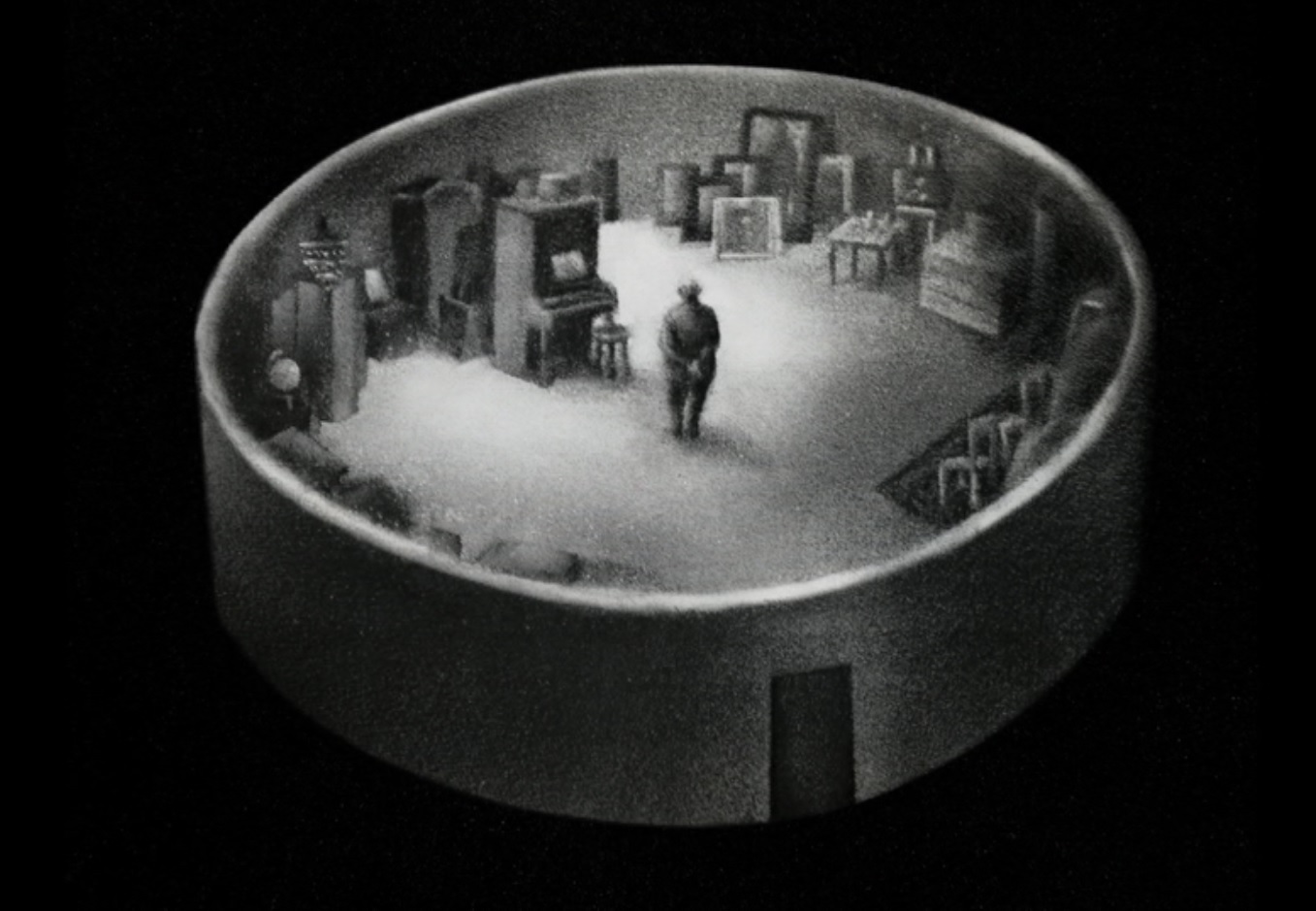
One of the most original devices for animation is the pinscreen, deviced by Alexandre Alexeïeff and his wife Claire Parker in the 1930s. Already in 1933 Alexeïeff himself demonstrated the power of this instrument with ‘Une nuit sur le mont chauve‘. However, it almost seemed that the use of machine would die with the great master.
Luckily, Canadian animator Jacques Drouin has continued this tradition, and passed it on to Michèle Lemieux. With its soft black and white images the pinscreen is especially fit for poetical images, and Lemieux’s film certainly is very lyrical. The film is subtitled ‘four meditations on space and time’, and consists of four parts, only bridged by the short’s protagonist, a piano playing man, living in a round chamber.
There’s no traditional story and no dialogue, and little music (which can only be heard during one episode and the finale). But the images are very absorbing, and the sound design is superb. The first episode, in which the man watches some strange phenomenons in the sky, is most intriguing, as is the second episode, which makes great use of metamorphosis. The third, however, is rather static, and relies a little too much on the music to evoke mood. Most disturbing is the fourth chapter, ‘The return of Nothingness’, in which a flying object sucks all objects in the man’s room away from him.
Lemieux ends her beautiful, if rather puzzling film with the pinscreen itself, and she cleverly uses the device to depict the man’s transfiguration. In all, Lemieux proves a very capable animator on this intriguing device, and one hopes she’ll make more animation films this way.
Watch an excerpt from ‘Here and the Great Elsewhere’ yourself and tell me what you think:
‘Here and the Great Elsewhere’ is available on The Animation Show of Shows DVD Box Set 8
Director: Till Nowak
Release Date: January 28, 2012
Rating: ★★★★
Review:

‘The Centrifuge Brain Project’ is a mockumentary in which a professor (Leslie Barnaby) of “the institute for centrifugal research, Florida” tells us about his research.
It’s best to let the film surprise you, so I’m not going to tell you too much, but the film’s main attraction is that Nowak has tried to hide the fact that any animation has been involved in the footage. The film makes clever use of live action shots of rides on fairs, ingeniously manipulated with computer animation, sometimes with quite ridiculous results. But as all experiments shown are based on real rides, the images remain stunningly convincing, even an extended Ferris wheel that seems to fill the complete sky.
The result is a fun short, with understated humor, which is over before you know it.
Watch ‘The Centrifuge Brain Project’ yourself and tell me what you think:
‘The Centrifuge Brain Project’ is available on The Animation Show of Shows DVD Box Set 7
Director: Fernando Cortizo
Release Date: October 31, 2012
Rating: ★★★★½
Review:
 2012 was a good year for stop motion animation fans: no less than four stop motion features were released that year. In March we had Aardman’s ‘The Pirates! In an Adventure with Scientists!’, followed by Laika’s ‘ParaNorman’ in August and Disney’s ‘Frankenweenie’ in September. Least known among these was the last release, from October: ‘O Apóstolo’ from Spain.
Somehow, stop motion feature film makers seem to favor horror-inspired plots, and ‘O Apóstolo’ is no exception. However, unlike ‘ParaNorman’ or ‘Frankenweenie’, ‘O Apóstolo’ is not a lighthearted family film. Instead, it’s a dark gothic thriller, and it succeeds surprisingly well in maintaining a high level of suspense throughout most of the picture.
Both the film’s theme and setting are typical Spanish: the film is drenched in a catholic atmosphere, and it’s set in a remote village on the road to Santiago de Compostela, famous for its numerous pilgrims. We follow the thief Ramon, who has escaped from prison to turn to this village to collect a treasure his cell mate has hidden there.
We soon discover that there is something terribly wrong with the little village. Its inhabitants seem to lure innocent pilgrims, and try to keep them there. It remains long unknown why, keeping the suspense at a high level. And even when the obligatory explanation of the events comes, the makers present it elegantly: the explanation, despite being long and quite absurd, is beautifully done in 2D animation with quasi-medieval designs, accompanied by a song.
Luckily, the film also has its lighter moments, mostly in a subplot, involving a particularly unsympathetic archbishop, who goes on his way to invest the loss of pilgrims. It’s soon clear that the film makers have plotted a punishment for this haughty, selfish character.
Apart from the gripping plot, ‘O Apóstolo’ excels in gorgeous production values. The little village and its sinister forest surroundings are conceived with stunning detail. They are as rich as any life action background, and contribute highly to the dark and creepy atmosphere. The puppets are designed less originally than the other features mentioned above, but retain a certain realism, which makes it possible to relate to them, especially with the main protagonist, Ramon the thief. The sole exception is the priest, whose appearance is too absurd and too sinister to blend in. It’s a pity, because his dominant presence casts a shadow on the more underplayed (and underdesigned) other village characters, whose threat is much more subtle, and therefore more disturbing.
In all, ‘O Apóstolo’ easily draws you in. It is without doubt one of the most original and best animated films of 2012. It definitely deserves to be more well-known.
Watch the official trailer of ‘O Apóstolo’ and tell me what you think:
Directors: Bill Jones, Jeff Simpson & Ben Timlett
Release Date: November 2, 2012
Stars: Graham Chapman
Rating: ★★★
Review:
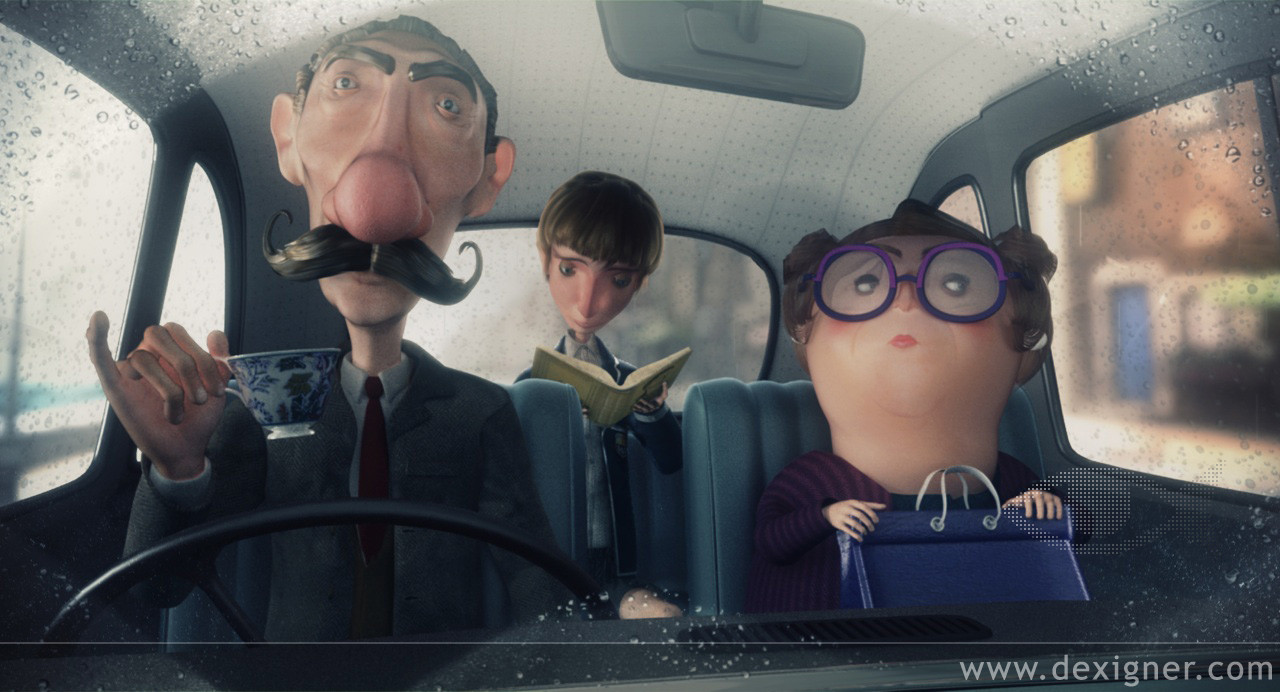 ‘A Liar’s Autobiography: The Untrue Story of Monty Python’s Graham Chapman’ is a film adaptation of Graham Chapman’s own nonsensical autobiography.
At first the film appears to follow Chapman’s book closely, using his own voice over from a audiobook recording. In fact, apart from one song all of Chapman’s vocalizations are by Graham Chapman himself, using various sources. Other former Monty Python members provide some voices, too.
The film adaptation of Chapman’s book is excellent, perfectly blending his dry humor with tongue-in-cheek images. However, the film makers want to make the film a biopic, leaving the book half way and adding some chapters of their own. At this point the film starts to drag. It becomes less humorous and more wandering, with lots of images drenched in sex and alcohol. And so, the film fades out ingloriously, leaving less an impression than it did when it started.
‘A Liar’s Autobiography’ was made by no less than fourteen different animation studios, and the overall array of styles is refreshing and at times mesmerizing. At the same time it can become a bit tiring to watch a changing of style at every scene, and sometimes the design is subpar, or downright ugly. The result is a moderately entertaining film that remains shallow and unmoving, nonetheless.
Watch the trailer of ‘A Liar’s Autobiography: The Untrue Story of Monty Python’s Graham Chapman’ yourself and tell me what you think:
Director: Don Hertzfeldt
Release Date: August 24, 2012
Rating: ★★★★★ ♕
Review:
 ‘It’s such a Beautiful Day’ tells about Bill, a man with some kind of terminal disease, which affects his memory. The film uses an episodic, non-linear narrative, and at times feels as confused as the protagonist’s mind.
Hertzfeldt uses some unconventional ways to tell his story. He himself tells us the story in a dry, matter-of-factly, slightly worrying voice over, which makes the sometimes poignant episodes even more gripping. The images themselves are very simple: the people in the film are no more than stick figures. But because of Hertzfeldt’s perfect sense of timing, these simple images are richer than many more elaborately drawn animation films. The stick figure images are interchanged with 8mm-film-like live action fragments of details in streets, trees, the sea etc. Hertzfeldt’s basic screen is black, in which often more than one of his images is projected. This technique harks back to the silent era, and gives his film a timeless look.
Hertzfeldt uses all these techniques to tell a fragmented, associative narrative, which is rich in detailed observations on daily life. The scenes motivate the viewer to try to connect the presented information into an overall story. The scenes are often comical, even hilarious, with Bill watching a man with a leaf blower as a particular highlight. As often, however, the scenes are moving and very emotional. Throughout the feature the deterioration of Bill’s mind becomes clearly visible, and when he decides to take a walk around the block, the result is as funny as it is painful. The most beautiful part, however, is when Bill celebrates life, paying attention to details that normally go unnoticed. The film’s finale, too, is no less than glorious.
‘It’s such a Beautiful Day’ is a compilation of three short films released earlier: ‘Everything will be OK’ (2006), ‘I Am So Proud of You’ (2008), and ‘It’s Such a Beautiful Day’ (2012). To compile these into one feature is a very logical step. In fact, watching them together as one continuous story actually makes much more sense. The result is one of the most original feature films ever made, and also one of the most moving. An impressive effort by any standard, and especially when considering that this is a one-man-project.
Watch the trailer of ‘It’s Such a Beautiful Day’ and tell me what you think:


 Dr. Grob's Animation Review