
You are currently browsing the tag archive for the ‘cat’ tag.
Director: Dave Fleischer
Release Date: April 16, 1931
Rating: ★★★½
Review:
 ‘Any Little Girl That’s A Nice Little Girl’ is a Screen Song about a cat who’s dating several girls at the same time.
First we watch him dating his girls through the telephone, then he goes through a bunch of photographs and chooses to visits hot Lulu Belle. When he tries to sneak out, Lulu Belle hits him with the couch. Enter the Screen Song, which is accompanied with images of e.g. a naked woman in a bath(!) and a picture of Betty Boop, who otherwise does not appear in this cartoon.
Only the first scene features lip-synch, and the scene with Lulu Belle also features an excerpt from the 1929 hit song ‘What Wouldn’t I Do for That Man’, popularized by Annette Hanshaw and Ruth Etting. This excerpt is much more interesting than the 1910 vaudeville title song. The last chorus features some nice interplay between the words and the animated characters, typical for the Screen Songs of this era.
Watch ‘Any Little Girl That’s A Nice Little Girl’ yourself and tell me what you think:
‘Any Little Girl That’s A Nice Little Girl’ is available on the French DVD Box Set ‘Betty Boop Coffret Collector’
Director: Wilfred Jackson
Release Date: July 28, 1931
Rating: ★★★½
Review:
 A cat is put out. When he tries to catch a bird, he falls down and gets knocked unconscious by a wind-flower.
Enter a nightmarish sequence, in which the cat imagines his lives are fleeing him, and that he’s being attacked by giant birds, hooting owls, bats, giant spiders and hollow trees. Luckily, in the morning it all appears to have been a dream.
‘The Cat’s Out’ is not devoid of dance routines (there are two dance scenes featuring scarecrows and a bat), but it has a surprisingly clear story, unmatched by earlier Silly Symphonies. It is arguably the first Silly Symphony with such a clear story, anticipating the straightforward storytelling of ‘The Ugly Duckling‘ of the end of the same year. This makes the short one of the most interesting Silly Symphonies of 1931.
Watch ‘The Cat’s Out’ yourself and tell me what you think:
This is Silly Symphony No. 20
To the previous Silly Symphony: The Busy Beavers
To the next Silly Symphony: Egyptian Melodies
‘The Cat’s Out’ is available on the DVD ‘Walt Disney Treasures: More Silly Symphonies’
Director: Priit Pärn
Release Date: 1984
Rating: ★★★★
Review:
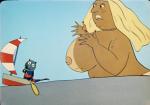 ‘Time Out’ is Priit Pärn’s fifth film, but the first to gain a widespread attention, and to win a number of international prizes.
It shows the filmmaker’s idiosyncratic style and unique surrealism, without the dark side, often present in his other films. The film is filled with child-like wonder, and a happy atmosphere, enhanced by the joyful reggae music by composer Olav Ehala.
The film opens with a room in which a very stressed out cat lives. The cat is in a constant need to check his alarm clock, which is on a shelf too high for him. When he finally reaches the clock, he discovers he can’t read it without his glasses, so he has to find them first, etc. Pärn shows this pointless ritual in several variations over and over again, following the cat running around in his room.
At one point, however, the alarm clock breaks, and time stands still. At this point of the film the cat finds himself in a fantastic world where everything can happen. This part is extremely rich in visual tricks, which go all the way back to Émile Cohl’s ‘Fantasmagorie‘ (1908). Nothing is what it seems, and metamorphosis runs freely. Unfortunately, in the end, time is restored, and the cat has to face his former stressful life once again.
‘Time Out’ certainly shows Priit Pärn’s mastery, and excellent timing. His fantasy is extraordinary, and the film shows the power of animation like few other films do. It’s also a reminder that we should snap out of the daily routine, and let our mind wander, and be really creative. When one takes time, everything may be possible!
Watch ‘Time Out’ yourself and tell me what you think:
Director: Frank Tashlin
Release Date: December 11, 1943
Rating: ★★★
Review:
 This cartoon opens with “Dicky Bird”, the canary, missing.
Rudolph, the cat who ate the bird (!), pretends the poor fellow has flown out of the window, so his mistress orders another one, which turns out to be considerably harder to catch.
The main body of ‘Puss ‘n Booty’ consists of blackout gags that anticipate the Tweety and Sylvester cartoons by four years.
This short was Warner Bros.’ last cartoon in black and white. Nevertheless, its broad use of blacks, greys and white and the startling camera angles (Frank Tashlin’s trademark) make it as modern as any other cartoon of the era.
Watch ‘Puss ‘n Booty’ yourself and tell me what you think:
Director: Jan Švankmajer
Release Date: 1971
Rating: ★★★★★ ♕
Review:
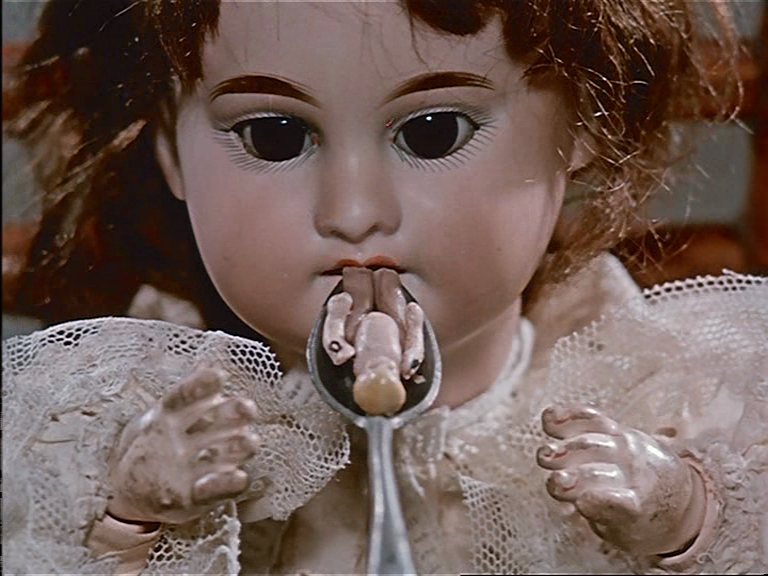 ‘Jabberwocky’ has little to do with the poem from Lewis Carroll’s ‘Through The Looking Glass’, although we hear it being recited by a little girl during the opening sequence.
The film it is Švankmajer’s surrealistic masterpiece on the loss of childhood, depicted by several episodes, which are separated by a box of bricks, a labyrinth and a black cat crushing the box of bricks.
During the episodes we are treated on extremely surrealistic images of very active inanimate objects in a child’s room. First we watch a boy’s suit growing a forest in his room, defying both time and authority (symbolized by the portrait in the room). Then we watch large cannibalistic dolls grinding, ironing and eating little dolls, a china baby in a cradle destroying two tin armies, a pocket knife performing acrobatic tricks until it makes an ill-fated fall and stabs itself, and finally, schoolbooks producing paper boats and planes, which fly out of the window, while the father’s portrait produces pictures of beautiful women.
This last episode shows the child’s changing interests. In the end the labyrinth is solved, the cat – the only living thing in the entire film – is caged, and the boy’s suit is replaced by an adult one. The boy is free from his parent, but the days of imagination are over, the fantasy is gone.
For this film Švankmajer makes excellent use of 19th century imagery (sailor suit, vintage dolls and toys) to create a completely unique world. It’s the film maker’s most typical film, partly expanding on ideas explored in ‘Historia Naturae, Suita‘ (1967), and showing his fascination with fantasy, cruelty and decay, which roam freely in the child’s self-contained room. The rather morbid behavior of the everyday objects is quite unsettling and it shows how a child’s fantasy can be both imaginative and cruel.
‘Jabberwocky’ is without doubt one of Švankmajer’s most powerful films. He would only top it eleven years later, with ‘Dimensions of a Dialogue‘ (1982). Švankmajer would explore the imagination of children further in the moving ‘Down to the Cellar‘ (1983), and in his unique adaptation of Lewis Carroll’s most famous work ‘Alice‘ (1987).
Watch ‘Jabberwocky’ yourself and tell me what you think:
‘Jabberwocky’ is available on the DVD ‘Jan Svankmajer – The Complete Short Films’
Director: Robert McKimson
Release Date:May 5, 1951
Rating: ★★★½
Review:
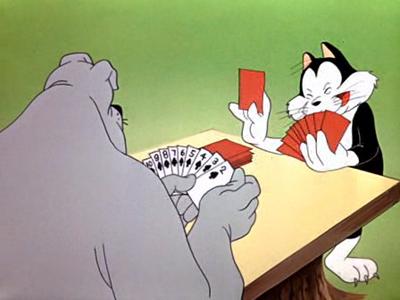 ‘Early to Bet’ introduces the ‘gambling bug’, a bug that makes people want to gamble.
The little insect infects a cat who then starts to play gin rummy for penalties with an over-confident bulldog. The bulldog wins several times, and the cat has to pay the elaborate and rather zany, yet painful penalties. In the end, however, he plays against the bug, and wins, making the bug pay a penalty.
Apart from the original and pretty funny penalties, this is a mediocre cartoon, which lacks stars or even appealing characters.
Watch ‘Early to Bet’ yourself and tell me what you think:
http://www.supercartoons.net/cartoon/681/early-to-bet.html
‘Early to Bet’ is available on the DVD set ‘Looney Tunes Golden Collection, Vol. 1’
Director: Robert McKimson
Release Date: October 14, 1949
Rating: ★★★★
Review:
 At the San Juan Capistrano mission a cat is waiting for the swallows to return. Unfortunately, the swallows have sent a scout who is too clever for him.
This cartoon contains of several blackout gags, and, unusual for a Robert McKimson cartoon, practically no dialogue. Actually, the cartoon is reminiscent of the silent blackout gag comedy of the Road Runner series, which were introduced only one month earlier. ‘Swallow The Leader’ may be atypical for McKimson, it’s well-directed,with the gags coming in fast and well-timed.
The mission featured does really exists and is indeed famous for its nesting swallows. The cat is a typical McKimson design, and very reminiscent of the Supreem Cat in ‘Paying the Piper’ from earlier that year. Typically, he wears a collar, which makes him look like a forerunner of the standard Hanna-Barbera television studio design.
Director: Art Davis
Release Date: August 14, 1948
Rating: ★★★★
Review:
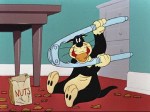
Art Davis is one of the unsung heroes of Warner Brothers animation. His unit existed for only three years, but in this short time period he released many fine cartoons, with a distinct and recognizable style.
‘Dough Ray Me-Ow’ is one of his best cartoons, and a rather macabre one, too. This short features a cat, called Heathcliff, who is even too dumb to breathe. Heathcliff, without knowing it, inherits an enormous sum of money. When his ‘pal’ Louie, a cynical parrot, discovers that if Heathcliff dies, this fortune will come to him, he tries to kill Louie in great, funny gags. Surprisingly, in the end he even succeeds, but when he tells the dying Heathcliff his secret, the cat’s nine lives simply refuse to go to heaven!
Apart from the main story, the cartoon contains a small running gag in which we see Heatcliff cracking nuts in ridiculously elaborate ways, always involving his own head.
‘Dough Ray Me-Ow’ features watercolor backgrounds, very unusual for Warner Brothers at the time.
Watch an excerpt from ‘Dough Ray Me-ow’ yourself and tell me what you think:
‘Dough Ray Me-Ow’ is available on the Blu-Ray-set ‘Looney Tunes Platinum Collection: Volume 2’ and on the DVD-set ‘Looney Tunes Golden Collection Volume Four’


 Dr. Grob's Animation Review