
You are currently browsing the tag archive for the ‘Chuck Jones’ tag.
Director: Chuck Jones
Release Date: 1957
Stars: Ralph Phillips
Rating: ★★
Review:
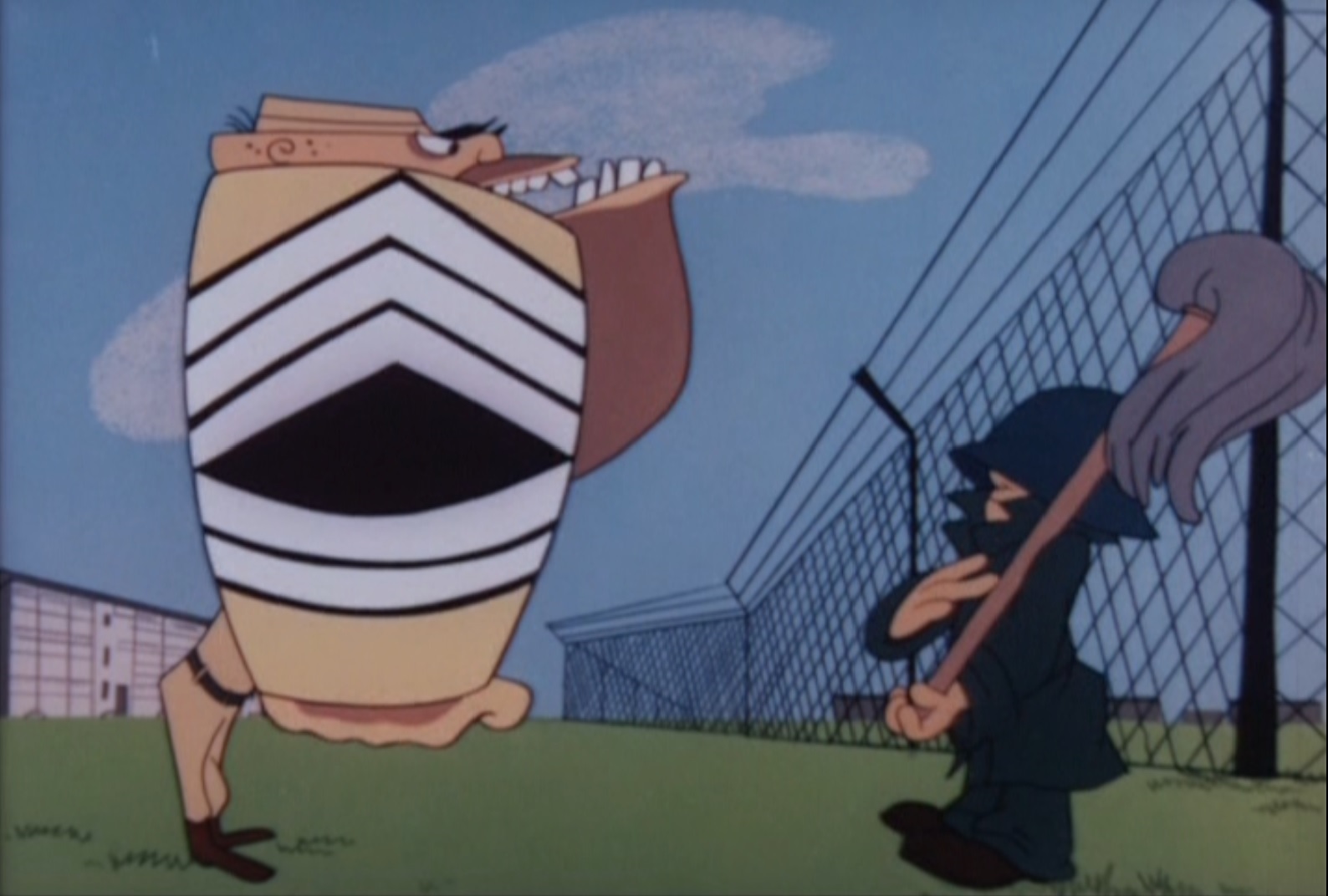 ‘Drafty, isn’t it’ is the second of two propagandistic advertisement shorts Chuck Jones made for the US Army in the late 1950s.
Like its predecessor, ‘90 Days of Wondering‘ (1956), it stars a young adult form of dreamer boy Ralph Phillips. In this short Ralph Phillips has nightmares about all his ideas of adventure being blocked by a giant shadow of a soldier beckoning him. Then he’s visited by an army pixie who elists some fictions and facts about the army. The cliches, of course, are the most hilarious. This short also contains a very Tex Avery-like running gag in which he pixie repeatedly has to put Ralph’s dog to sleep by singing it a fast lullaby.
‘Drafty, Isn’t It?’ is a well-made and beautiful film, and it would have been more enjoyable were it not so sickeningly propagandistic.
Watch ‘Drafty, Isn’t It?’ yourself and tell me what you think:
Director: Chuck Jones
Release Date: 1956
Stars: Ralph Phillips
Rating: ★★★
Review:
 ’90 Days of Wondering’ is a rather propagandistic advertising film to persuade ex-soldiers to reenlist.
Despite its rather questionable message, the film is beautifully designed and animated. Especially striking is its dazzling opening sequence in which we see a young man (an adult version of dreamer boy Ralph Phillips from ‘From A to Z-Z-Z-Z’ from 1954) being extremely happy to leave the army and rushing home. This opening sequence has a speed and gusto that recalls the Warner Brother shorts from the 1940s. It contrasts with the slow pace of the scenes following after, where the young man soon discovers he is out of tune with is hometown. Soon he is visited by two small characters explaining him why he should reenlist…
In 1957 ’90 Days of Wondering’ was followed by yet another propaganda film for the army called ‘Drafty, isn’t it?‘. It also stars the adult version of Ralph Phillips.
Watch ‘90 Days of Wondering’ yourself and tell me what you think:
Director: Chuck Jones
Release Date: November 10, 1956
Stars: Road Runner, Wile E. Coyote
Rating: ★★★★
Review:
 This ninth Road Runner cartoon has a deviant opening, in which we watch the coyote baking a chicken out of clay.
Of course he rather has real meat, and his attempts to catch the Road Runner include a spear on a chord, a revolver on a spring, a catapult, a bundle of maces, a half-sewn-through ladder, a wheel of dynamite sticks and a rocket.
The best gag is saved for last, in which the coyote has assembled several rocks above the road. When these fail to fall on the Road Runner, the coyote nervously tries to make them fall until he realizes that he succeeds and they will fall on him. He then brings forth a sign saying “In Heaven’s name, what am I doing?”.
‘There they Go-Go-Go’ contains the most abstract backgrounds ever conceived in a Road Runner cartoon – Maurice Noble really pushes the limits here. Nevertheless they were reused the next year in ‘Scrambled Aches’.
Watch ‘There They Go-Go-Go!’ yourself and tell me what you think:
Director: Chuck Jones
Release Date: July 6, 1957
Stars: Bugs Bunny, Elmer Fudd
Rating: ★★★★★ ♕
Review:
 One of the most celebrated animated cartoons of all time, ‘What’s Opera, Doc’ places the typical Elmer Fudd-Bugs Bunny chase routine into the world of Wagnerian opera.
The cartoon’s masterstroke is that it uses all the cliches of the chase, which go all the way back to the first Bugs Bunny Cartoon ‘A Wild Hare‘ (1940), but that they are carried out in the most serious, Wagnerian fashion. The result is ridiculously pompous, mocking Wagnerian opera, as well as playing homage to it. Milt Franklyn’s score quotes music from five Wagner operas: ‘Der fliegende Holländer’, ‘Die Walküre’, ‘Siegfried’, ‘Rienzi’ and ‘Tannhäuser’.
The cartoon’s operatic character is emphasized not only by operatic singing, but also by featuring Wagnerian magic (a magic helmet), a ballet (a staple of French opera, but only employed by Richard Wagner in his very first operas), and a sad ending, a cliche of 19th century opera in general. Michael Maltese provided new lyrics to Wagner’s pilgrim chorus from ‘Tannhäuser’ and made it into a rather Hollywood musical-like love duet between Elmer and Bugs.
The animation is outstanding throughout, especially in the ballet and love duet between Bugs and Elmer. Indeed, for the ballet sequence the animators studied Tatania Riabouchinska and David Lichine from The Original Ballet Russe, and there’s a genuine seriousness about this scene. Yet, the main attraction of the cartoon lies in Maurice Noble’s extreme background layouts and bold color designs. Especially when Elmer gets furious, there is a startling emotional use of colors that has not been seen on the animated screen since ‘Bambi‘ (1942).
The opening sequence, with Elmer casting a mighty shadow is a straight homage to ‘The Night on Bold Mountain’ sequence from ‘Fantasia’ (1940), while the shots of Bugs being dressed as Brünnhilde and riding an oversized horse are retaken from ‘Herr meets Hare’ from 1945 (which, like ‘What’s Opera, doc?” was also penned by Michael Maltese). In this sense the cartoon is as much a homage to animation history as it is to opera.
‘What’s Opera, doc?’ is a brilliant cartoon of pure grandeur and one of Chuck Jones’s all time masterpieces. What’s most striking is that it was made during the normal grind of a commercial animated cartoon studio. The film took much longer than normal to make, which Jones and his unit could only manage to do by cheating on their schedule, stealing time from a much more ordinary short, the Road Runner cartoon ‘Zoom and Bored’ (1957).
Watch ‘What’s Opera, Doc?’ yourself and tell me what you think:
http://www.dailymotion.com/video/x1atzuy
This is Bugs Bunny cartoon No. 131
To the previous Bugs Bunny cartoon: Piker’s Peak
To the next Bugs Bunny cartoon: Bugsy and Mugsy
Director: Chuck Jones
Release Date: December 31, 1955
Rating: ★★★★★ ♕
Review:
 ‘One Froggy Evening’ tells about a construction worker, who discovers a singing frog inside a cornerstone of a building.
He dreams of earning loads of money with the frog, but unfortunately the frog sings for him only, not for anybody else. This leads to the man’s ruin, and in the end he disposes the frog into another building. But in 2056 AD the same thing is about to happen all over again…
‘One Froggy Evening’ is one of the most perfect cartoons ever made (one competitor that comes to mind is ‘The Band Concert’ from 1935): its story, penned by Michael Maltese, is told with the most economical means, without any dialogue. The silent acting is superb, the timing excellent and the handling of the facial expressions gorgeous. The transition of the frog (baptized Michigan J. Frog in the seventies) from lively entertainer to ordinary amphibian is completely convincing, and a great example of the power of animation.
Although the frog was supposedly locked inside the building in 1892, most of the songs it sings are from a later date: ‘Hello! Ma Baby’ was published in 1899, ‘Won’t You Come Over to My House in 1906, ‘I’m Just Wild About Harry’ in 1921, and ‘Please Don’t Talk About Me When I’m Gone’ is even from 1930. Only ‘Come Back to Erin’ and ‘Throw Him Down McCloskey’ are apt, being from 1868 and 1890, respectively. The catchy ‘The Michigan Rag’ was written especially for this cartoon.
‘One Froggy Evening’ feels like a parable. It’s a story of greed, of misfortune, of headstrong belief in a bad idea, and of shattered dreams. It is not hilariously funny, but delightful and simply beautiful. It was Chuck Jones’s personal favorite, and it’s deservedly regarded as an all-time classic. Not that anyone in 1955 thought so, though. The Academy Award went to ‘Speedy Gonzales’, while ‘One Froggy Evening’ didn’t even get an Oscar nomination. Meanwhile, ‘One Froggy Evening’ remains one of the very, very few animated cartoons to inspire a scene in a live action movie, in this case the alien scene in Mel Brooks’s ‘Spaceballs’ (1987).
Watch ‘One Froggy Evening’ yourself and tell me what you think:
Director: Chuck Jones
Release Date: January 5, 1945
Stars: Pepe le Pew
Rating: ★★★★
Review:
 ‘Odor-able Kitty’, marks the debut of that French-speaking, amorous skunk Pepe le Pew.
In his book ‘Chuck Amuck’ Jones reveals that this character was based on story man Tedd Pierce. In any case, Pierce wrote the story, but how much of himself he had put self-knowingly into this smelly Don Juan remains a mystery.
Oddly enough, in his first cartoon Pepe turns out to be a fraud, being married and having two children. Even his voice changes in the end of the cartoon. But before this surprising finale he’s genuinely Pepe, complete with quasi-French accent, strange hop (including Stalling’s typical theme music), and a love for cats that look like skunks.
Only, in ‘Odor-able Kitty’ this is a male cat, who deliberately disguises himself as a skunk to get a happier life. He has one, until Pepe hops along. In the end, the cat washes himself and returns to his former life as victim of maltreatment, exclaiming “this is the life!”.
Pepe le Pew’s character didn’t really develop after this film, and all his films have more or less the same story as his debut film. Nevertheless Pepe would be one of the most successful of the characters conceived by Chuck Jones, second to the Road Runner and the Coyote, only. He lasted until 1962, starring fourteen more cartoons.
Watch ‘Odor-able Kitty’ yourself and tell me what you think:
http://www.220.ro/desene-animate/12-Odor-Able-Kitty/GcMYA69rME/
Director: Chuck Jones
Release Date: July 3, 1943
Stars: Bugs Bunny
Rating: ★★★★★
Review:
 Two castaways on a raft are so hungry they are ready to eat each other.
Then they land on a tropical, quasi-Hawaiian island, which strangely enough is inhabited by Bugs Bunny, and the two hungry men immediately try to catch and eat our hero. Of course they don’t manage to do so, and in a hilarious end scene, it’s Bugs, not they, who sails off on an ocean stormer into the distance.
The two castaways were modeled on the cartoon’s story men, Tedd Pierce (the tall one) and Michael Maltese (the short one), and the two men actually voiced their cartoon counterparts themselves.
The cartoon’s real stars however, are its outrageous backgrounds. Designed by Bernyce Polifka and painted by her husband, Gene Fleury, they are arguably the boldest backgrounds in any cartoon from the pre-UPA-era. The island is depicted in brassy, strangely colored, semi-abstract to abstract images, with no sense of three-dimensionality, whatsoever. Nevertheless, the clearly three-dimensional characters read surprisingly well against the outlandish backgrounds.
Polifka had replaced John McGrew, who had worked with Fleury on experimental backgrounds for Chuck Jones cartoons like ‘Conrad the Sailor‘ (1942) and ‘The Aristo-Cat‘ (1943), but who had joined the navy in 1942. The couple shared McGrew’s boldness, and worked with Jones on ‘Hell-Bent for Election’ (1944), one of UPA’s earliest films. But apparently they left Warner Bros. somewhere in 1943-1944. In 1949 they worked for Lou Bunin’s part live action part stop motion feature ‘Alice in Wonderland’, but after this job, they seemingly disappeared from the animation world. So, ‘Wackiki Wabbit’ remains their most famous and greatest legacy. The backgrounds themselves can be admired on the late Michael Sporn’s excellent blogpost on this cartoon.
Watch ‘Wackiki Wabbit’ yourself and tell me what you think:
This is Bugs Bunny cartoon No. 18
To the previous Bugs Bunny cartoon: Jack Rabbit and the Beanstalk
To the next Bugs Bunny cartoon: A Corny Concerto
Director: Chuck Jones
Release Date: December 12, 1942
Stars: Bugs Bunny
Rating: ★★★★
Review:
 Bugs Bunny is bullied by a large magician, leading to his catch phrase “Of course you realize this means war”. In the second part of the film Bugs Bunny wrecks the magician’s show, and finally the magician himself.
Bugs’s catch phrase was borrowed from Groucho Marx, an important inspiration on Bugs Bunny’s character anyhow. The line would become typical for Bugs as directed by Chuck Jones. Unlike Bob Clampett, Jones would treat the rabbit not as intrinsically mischievous, but as reacting to injustice placed on him.
The large magician in ‘Case of the Missing Hare’ is the first of many particularly large adversaries Jones gave to Bugs, all bullying the rabbit into action. Thus, the magician is the direct forerunner of e.g. the warehouse keeper in ‘Hare Conditioned‘ (1945), the crusher in ‘Rabbit Punch‘ (1948) and Giovanni Jones in ‘Long-Haired Hare‘ (1949).
‘Case of the Missing Hare’ shows that by the end of 1942 Chuck Jones’s mastery over material had become fully realized. The cartoon features his typical character designs, extravagant key poses, original camera angles and sense of design. The latter is exemplified by background artists Gene Fleury and John McGrew’s very unnatural backgrounds. In the first part we watch pink trees and yellow skies. In the second part they got even bolder, reducing the backgrounds to abstract forms in two colors, only.
In its typical and original design and cinematography ‘Case of the Missing Hare’ looks forward to Jones’ mature work of the late forties and fifties.
Watch ‘Case of the Missing Hare’ yourself and tell me what you think:
This is Bugs Bunny cartoon No. 14
To the previous Bugs Bunny cartoon: The Hare-Brained Hypnotist
To the next Bugs Bunny cartoon: Tortoise Wins by a Hare
Director: Chuck Jones
Release Date: March 2, 1940
Stars: proto-Bugs Bunny, Elmer Fudd
Rating: ★★
Review:
 In this slow and only moderately funny cartoon Elmer tries to photograph nature, but he’s hindered by a predecessor of Bugs Bunny.
This goofy rabbit is not quite Bugs, even though he behaves very calmly and does a Bugs-style death act. His looks and sounds are those of the crazy rabbit in ‘Hare-um Scare-um‘ (1939) and he still has the Woody Woodpecker-style laugh introduced in ‘Porky’s Hare Hunt‘ (1938). Jones has toned this loony fellow down, but it was to Tex Avery to introduce a really cool rabbit in ‘A Wild Hare‘ from four months later.
No, the importance of ‘Elmer’s Candid Camera’ lies in the fact that it marks Elmer’s debut. Although he’s still wearing an Egghead suit (the character from which he evolved), he lacks Egghead’s goofiness, and he has received his distinctive voice provided by Arthur Q. Bryan. Moreover, he utters his famous line “wabbit twacks” for the first time here.
Unfortunately, ‘Elmer’s Candid Camera’ is more historically interesting than entertaining, and outside its historical importance, the cartoon is quite forgettable.
Watch ‘Elmer’s Candid Camera’ yourself and tell me what you think:
http://ulozto.net/live/xzv5WBh/bugs-bunny-elmers-candid-camera-1940-avi
This is the last of four cartoons featuring a Bugs Bunny forerunner
To the first Bugs Bunny cartoon: A Wild Hare
To the previous proto-Bugs Bunny cartoon: Hare-um Scare-um
Director: Chuck Jones
Release Date: July 25, 1953
Stars: Daffy Duck, Porky Pig, Marvin Martian
Rating: ★★★★★ ♕
Review:
 ‘Duck Dodgers in the 24½th Century’ is a spoof of the popular pulp magazine science fiction series Buck Rogers, which was made into a television series in 1950-1951. This makes this short one of the earliest theatrical cartoons parodying a television series.
Daffy “Duck Dodgers” and his sidekick “the eager young space cadet” Porky have to claim planet X for planet Earth. Unfortunately, Marvin Martian wants to claim the same planet for Mars. This starts a feud, which ends in both blowing up the entire planet.
Although the story of the cartoon is rather similar to the Bugs Bunny cartoon ‘Haredevil Hare‘ (1948), Daffy’s unique performance gives it an entirely different feel, leading to new and great gags. More than being a typical science fiction cartoon, this short can be regarded the second cartoon in a series which pairs Daffy as a misguided hero to Porky as a more sensible straight man (the first being ‘Drip-along Daffy‘ from 1951). ‘Duck Dodgers’ must be the highlight of the series, as well as a peak in both Daffy’s as Chuck Jones’s career.
Unhampered by conventions, Jones, his layout-man Maurice Noble and background painter Phil DeGuard went totally berserk with the science-fiction theme, creating wild and lushly colored backgrounds, which make ‘Duck Dodgers in the 24½th Century’ one of the most beautiful cartoons ever made at Warner Brothers.
Indeed, so great is its fame, it spawned sequels in 1980, 1996 and 2003. From 2003 to 2005 Cartoon Network even broadcasted a Duck Dodgers series.
Watch ‘Duck Dodgers in the 24½th Century’ yourself and tell me what you think:
http://www.220.ro/desene-animate/Looney-Tunes-Duck-Dodgers-In-The-24-5-Century/aTflTNIyAr/
This is Porky Pig cartoon no. 142
To the previous Porky Pig cartoon: Fool Coverage
To the next Porky Pig cartoon: Claws for Alarm
This is Daffy Duck cartoon No. 65
To the previous Daffy Duck cartoon: Muscle Tussle
To the next Daffy Duck cartoon: Duck! Rabbit! Duck!
‘Duck Dodgers in the 24½th Century’ is available on the Blu-Ray ‘Looney Tunes Platinum Collection: Volume 2’ and on the DVD-set ‘Looney Tunes Golden Collection Volume One’
Director: Chuck Jones
Release Date: February 28, 1953
Stars: Daffy Duck, Bugs Bunny (cameo)
Rating: ★★★★★ ♕
Review:
 One of the most self-aware animated cartoons ever made, ‘Duck Amuck’, more than any other cartoon, plays with the conventions of animation and with the frustrations of Daffy Duck.
This cartoon shows how good the character is, because even when drawn awkwardly, even without sound, and even when animated as a small speck in the distance, we know it’s Daffy. His struggles with the off-screen animator (who in the end turns out to be Bugs Bunny) form the zenith of his new frustrated personality, which had replaced his zany personality of the thirties and forties three years earlier. Furthermore he’s the sole character in the entire cartoon, but so strong is his unwilling performance that we become hardly aware of this fact.
The poor Daffy has to deal with disappearing and constantly changing backgrounds, with absent and inappropriate sounds, with deformations of his own body etc. In this cartoon he’s the victim of an omnipotent ‘cartoon god’ whom he cannot escape. In this sense ‘Duck Amuck’ questions the relationship between creator and creation and the responsibility of the creator to the things he created. This makes ‘Duck Amuck’ also one of the most philosophical cartoons ever made. And amazingly, it’s funny, too.
Watch ‘Duck Amuck’ yourself and tell me what you think:
http://www.dailymotion.com/video/x2ofats
This is Daffy Duck cartoon No. 63
To the previous Daffy Duck cartoon: Fool Coverage
To the next Daffy Duck cartoon: Muscle Tussle
‘Drip-along Daffy’ is available on the Blu-Ray ‘Looney Tunes Platinum Collection: Volume 2’ and on the DVD-set ‘Looney Tunes Golden Collection Volume One’
Director: Chuck Jones
Release Date: April 19, 1952
Stars: Bugs Bunny
Rating: ★★★★
Review:
 Six years after ‘Hair-raising Hare’ (1946) Bugs Bunny faces the orange monster in sneakers again.
‘Water, Water Every Hare’ is a horror cartoon featuring almost everything a horror movie should have: an evil scientist, a monster, a mummy and a robot. This story is rather awkwardly framed, however, by a story about the river flooding Bugs’s home and transporting him to and from the castle. Facing the monster Bugs repeats his manicure-tric from the earlier film, although this time he pretends to be a hair dresser. He also makes himself invisible and he makes the monster shrink.
If not as funny as ‘Hair-raising Hare’, ‘Water, Water Every Hare’ is full of clever gags. It moves at a relatively relaxed pace, which only a very confident film maker could use with such effect. In that respect, ‘Water, Water Evey Hare’ shows the mastery director Chuck Jones had achieved. He needn’t be fast and furious to be funny and he knew it.
Watch ‘Water, Water Every Hare’ yourself and tell me what you think:
http://www.metacafe.com/watch/7621186/water_water_every_hare_1952/
‘Water, Water Every Hare’ is available on the DVD set ‘Looney Tunes Golden Collection, Vol. 1’
This is Bugs Bunny cartoon No. 90
To the previous Bugs Bunny cartoon: Foxy Proxy
To the next Bugs Bunny cartoon: Hasty Hare
Director: Chuck Jones
Release Date: January 19, 1952
Stars: Bugs Bunny, Wile E. Coyote
Rating: ★★
Review:
 The second appearance of the Coyote after his debut film ‘Fast and Furry-ous‘ (1949) was, surprisingly, not another Road Runner cartoon.
Instead, director Chuck Jones decided to place his still fresh carnivore character against Bugs Bunny, a character increasingly in need of worthy opponents.
in ‘Operation: Rabbit’ Wile E. Coyote gets his name (in the Road Runner cartoons he’s never called that way). Wile E. introduces himself to Bugs as ‘genius’, and suddenly he is a talking character, speaking with an eloquent, vaguely British voice. The experiment is not successful. The coyote’s ability to speak floods the action with a lot of superfluous dialogue, and he almost totally lacks the sympathetic frustration so wonderfully demonstrated in the Road Runner cartoons. Moreover, there’s hardly any chemistry between the two overconfident characters, which leads to remarkably unfunny gags, with only the one involving a flying saucer being able to create a chuckle.
Despite the shortcomings, Jones would make Bugs Bunny and Wile E. Coyote co-star in three more cartoons: ‘To Hare is Human’ (1956), ‘Rabbit’s Feat’ (1960), and ‘Compressed Hare’ (1961). Meanwhile the Coyote would have a much more interesting career in the Road Runner cartoons, with the second one, ‘Beep Beep’, appearing four months after ‘Operation Rabbit’.
Watch ‘Operation: Rabbit’ yourself and tell me what you think:
This is Bugs Bunny cartoon No. 87
To the previous Bugs Bunny cartoon: Big Top Bunny
To the next Bugs Bunny cartoon: 14 Carrot Bunny
Director: Chuck Jones
Release Date: January 3, 1953
Stars: Sam Sheepdog & Ralph Wolf
Rating: ★★★★★
Review:
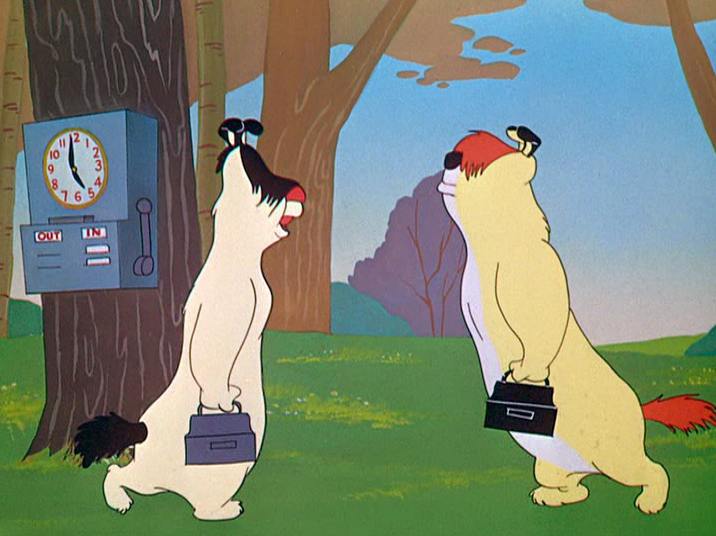 ‘Don’t Give up the Sheep’ is the first cartoon in a series of seven cartoons featuring the excellent duo Sam Sheepdog and Ralph Wolf.
In their first entry Sam Sheepdog is called Ralph, while Ralph remains yet unnamed. Sam goes to work, relieving his colleague Fred in attending the sheep. He has to counter the attacks by Ralph the wolf, who looks like Wile E. Coyote’s scruffy cousin. The cartoon is full of excellent, Road Runner-like blackout cartoons. In his silliest attempt the wolf dresses up as the God Pan to lull the sheepdog to sleep. To no avail, of course.
In this cartoon the backgrounds (by Carlos Manriquez) are becoming more stylized, although they still look like real nature. Sam and Ralph would never become major characters, but their miniseries is a little delight within the Warner Brothers canon.
Watch ‘Don’t Give up the Sheep’ yourself and tell me what you think:
http://www.wimp.com/hilariouscartoon/
‘Don’t Give up the Sheep’ is available on the DVD set ‘Looney Tunes Golden Collection, Vol. 1’
Director: Chuck Jones
Release Date: February 2, 1952
Stars: Marc Anthony
Rating: ★★★★★ ♕
Review:
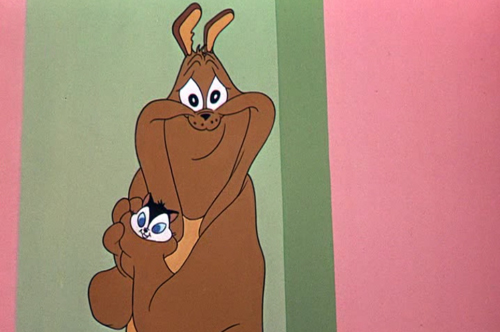 Among all the masterpieces of animation, this must be the most inconspicuous one: it’s a seemingly classical dog and cat story, involving quite some dull dialogue (provided by the dog’s mistress, of whom we only see her legs), and its looks are quite traditional, with unremarkable layouts and backgrounds.
Nevertheless, ‘Feed The Kitty’ is a real masterpiece, and its reputation is entirely due to the acting of its main character, the gentle bulldog Marc Anthony. His facial expressions are so wide ranging, so extreme and so heartfelt that ‘Feed the Kitty’ can almost be regarded as a study in depiction of emotion. Silent acting really reaches its peak here, and director Chuck Jones is without doubt at his all time best in this sweet little cartoon.
In ‘Feed the Kitty’ Marc Anthony adopts a sweet little kitten, but he’s not allowed to bring anything into the house. This leads to various gags with the dog trying to hide the little kitten from his mistress. However, the highlight of the cartoon is the sequence in which Marc Anthony thinks his darling pet is dead. His emotions are both hilarious and heartbreaking. Never before has the anxiety of having lost a dearly beloved been so convincingly put to the animated screen. At this point I often can’t keep my tears from running.
Indeed, this sequence is so popular among animators that it was almost exactly copied in ‘Monsters, Inc.‘ (2001) as a homage to the original. I’d say, if cartoons were shown at funerals (and why not?), ‘Feed the Kitty’ would be a perfect candidate.
Watch ‘Feed the Kitty’ yourself and tell me what you think:
http://www.dailymotion.com/video/xjw9ms_feed-the-kitty_shortfilms
‘Feed the Kitty’ is available on the DVD set ‘Looney Tunes Golden Collection, Vol. 1’
Director: Chuck Jones
Release Date: March 10, 1951
Stars: Bugs Bunny, The Crusher
Rating: ★★
Review:
 Three years after ‘Rabbit Punch‘ (1948) Bugs Bunny faces the Crusher again.
This time Bugs is the mascot of ‘Ravishing Ronald’, a gay looking ballet dancer type of character with a hair net. This guy challenges the Crusher in a wrestling match, but is clobbered immediately.
In order not to lose his job Bugs Bunny challenges the Crusher, too, as the ‘masked terror’. Of course, he wins the game, by strategy in a rather boring and uninspired cartoon, especially when compared to the delightful ‘Rabbit Punch’. The best gags are in the beginning: the Crusher showing his enormous excess of muscles and the extravagant entry of Ravishing Ronald.
Watch ‘Bunny Hugged’ yourself and tell me what you think:
http://www.ebaumsworld.com/video/watch/82493307/
This is Bugs Bunny cartoon No. 80
To the previous Bugs Bunny cartoon: Rabbit Every Monday
To the next Bugs Bunny cartoon: Fair-Haired Hare
Director: Chuck Jones
Release Date: July 8, 1950
Stars: Bugs Bunny, Humphrey Bogart
Rating: ★★½
Review:
 Bugs re-encounters the little penguin form ‘Frigid Hare‘ (1949), complete with the top hat and bow tie he gave him in that cartoon.
He promises the tacit little fellow to bring him home, which Bugs thinks is on the South Pole. This leads to a long voyage across the Americas, including Martinique, Panama and the Amazon. At several places they meet Humphrey Bogart begging for some money, a reference to his role in ‘The Treasure of the Sierra Madre’ (1948). This running gag may be the highlight of an otherwise tiresome and unfunny cartoon.
Watch ‘8 Ball Bunny’ yourself and tell me what you think:
This is Bugs Bunny cartoon No. 73
To the previous Bugs Bunny cartoon: What’s Up, Doc?
To the next Bugs Bunny cartoon: Hillbilly Hare
Director: Chuck Jones
Release Date: December 24, 1949
Stars: Bugs Bunny, Errol Flynn
Rating: ★★★★★
Review:
 We’re suddenly in medieval England, where Bugs Bunny tries to “poach” one of the king’s carrots and is arrested by the Sheriff of Nottingham.
This leads to several very funny encounters between Bugs and the Sheriff. The action is at times interrupted by a particularly dopey Little John who repeatedly announces the coming of Robin Hood. When Robin Hood finally does arrive, he appears to be Errol Flynn (live action footage from the 1938 feature ‘The Adventures of Robin Hood’ ).
The best gag however, is when Bugs sells the King’s Royal garden to the sheriff as the perfect site to build a house. The poor sheriff only discovers he’s fooled after he has built half the house. It’s gags like these which make ‘Rabbit Hood’ an unassuming and probably underrated highlight in the Bugs Bunny catalog.
Watch ‘Rabbit Hood’ yourself and tell me what you think:
https://www.dailymotion.com/video/x2fe9y1
This is Bugs Bunny cartoon No. 67
To the previous Bugs Bunny cartoon: Which is Witch?
To the next Bugs Bunny cartoon: Hurdy-gurdy Hare
Director: Chuck Jones
Release Date: February 26, 1949
Stars: Bugs Bunny
Rating: ★★★★★
Review:
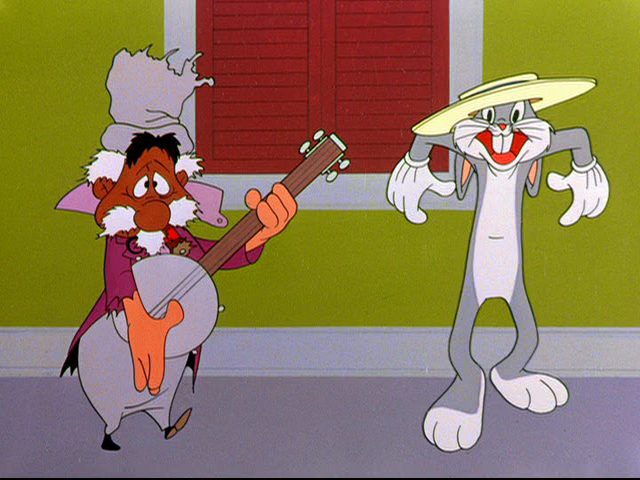 In ‘Mississippi Hare’ Bugs Bunny accidentally ends up at a Mississippi steamer, where he encounters colonel Shuffle, a small moustached Southerner who resembles Friz Freleng’s Yosemite Sam a lot.
Like Yosemite Sam, the colonel keeps taking the plunge, in an excellent series of gags. Bugs Bunny is particularly suave in this cartoon, and so are the backgrounds. But the highlight of the cartoon may be the superb and intoxicating animation of Bugs Bunny dancing with a straw hat.
The colonel would return to the screen the next year in the Charlie Dog cartoon ‘Dog Gone South’.
Watch ‘Mississippi Hare’ yourself and tell me what you think:
http://www.dailymotion.com/video/x2kytjz
This is Bugs Bunny cartoon No. 57
To the previous Bugs Bunny cartoon: Hare Do
To the next Bugs Bunny cartoon: Rebel Rabbit
Director: Chuck Jones
Release Date: March 11, 1950
Stars: Bugs Bunny
Rating: ★★★★
Review:
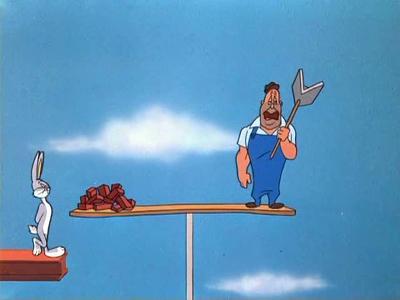 In ‘Homeless Hare’ Bugs’s home happens to be in a construction site.
When the excavator driver ignores Bugs’s pleas for leaving his home alone, Bugs nags him until the bully can’t take no more.
This film contains a gag of a half conscious Bugs walking at great heights without falling, a scene that is clearly borrowed from earlier shorts, like the Popeye cartoon ‘A Dream Walking’ from 1934 and the classic Disney short ‘Clock Cleaners’ from 1937. It also contains an elaborate final gag with a hot rivet, a type of gag Chuck Jones invented. It anticipates similar gags in the Road Runner series and Jones’s Tom and Jerry films from the 1960s. The Highlight of the cartoon, however, is a gag with the bully balancing on a plank with a bunch of bricks, which Bugs slowly withdraws…
Watch ‘Homeless Hare’ yourself and tell me what you think:
This is Bugs Bunny cartoon No. 70
To the previous Bugs Bunny cartoon: Mutiny on the Bunny
To the next Bugs Bunny cartoon: Big House Bunny


 Dr. Grob's Animation Review