
You are currently browsing the tag archive for the ‘Chuck Jones’ tag.
Director: Chuck Jones
Release Date: March 4, 1950
Stars: Daffy Duck, Elmer Fudd, Henery Hawk, Mama Bear, Porky Pig, Sylvester
Rating: ★★★★★ ♕
Review:
 ‘The Scarlet Pumpernickel’ starts with Daffy Duck being tired of comedy.
He proposes to one of the Warner Brothers (who remains off-screen) to make an Errol Flynn-like swashbuckler film based on ‘The Scarlet Pumpernickel by Daffy Dumas Duck’, with, of course, himself in the starring role. This leads to an all-star cartoon with roles for Porky Pig, Sylvester, Elmer Fudd (with Mel Blanc’s voice), Henery Hawk and Mama Bear. Never before were so many Warner Bros. cartoon stars seen in one short, and we had to wait until ‘Who Framed Roger Rabbit‘ (1988) to see the exercise repeated.
‘The Scarlet Pumpernickel’ is both an excellent parody on and a faithful homage to the Errol Flynn adventure films. But more importantly, this short is important in the evolution of Daffy Duck, for it marks the birth of Daffy’s final incarnation. In this film Daffy is more of a frustrated and misguided character than downright loony. This new role is still a bit out of Daffy’s element: at times his eyes and behavior are similar to that of Charlie Dog, especially in the opening scene. Nevertheless, in the following years the frustrated Daffy would completely replace the loony one.
‘The Scarlet Pumpernickel’ is also the first of Jones’s Daffy cartoons in which Daffy serves as a misguided hero, starting a great series of shorts, with highlights as ‘Drip-along Daffy‘ (1951) and ‘Duck Dodgers in the 24 ½ Century‘ (1953).
Watch ‘The Scarlet Pumpernickel’ yourself and tell me what you think:
http://www.220.ro/desene-animate/20-Daffy-Duck-Sylvester-The-Scarlet-Pumpernickel-1950/KJRkZjBcaE/
This is Porky Pig cartoon no. 131
To the previous Porky Pig cartoon: Boobs in the Woods
To the next Porky Pig cartoon: An Egg Scramble
This is Daffy Duck cartoon No. 51
To the previous Daffy Duck cartoon: Boobs in the Woods
To the next Daffy Duck cartoon: The Bitter Half
‘Boobs in the Woods’ is available on the DVD-set ‘Looney Tunes Golden Collection Volume One’
Director: Chuck Jones
Release Date: December 18, 1948
Stars: Porky Pig, Sylvester
Rating: ★★★
Review:
 Chuck Jones was the only director to pair Porky Pig with Sylvester.
His Sylvester is very different from the one in Freleng’s Tweety cartoons. In Jones’s shorts he’s a cowardly cat that cannot speak. In all Porky-Sylvester cartoons Porky tries to stay asleep unaware of the real dangers around him. Sylvester, on the other hand, sees them all, but fails completely in convincing his master of the dangers.
The aptly titled ‘Sacredy Cat’ was the first of a series of three. In this cartoon Porky and his cat Sylvester enter their new mansion, which has genuine horror allure, scaring Sylvester to death. And for a good reason, because this mansion is inhabited by homocidal Hubie and Bertie-like mice who make several attempts to murder Sylvester and Porky.
Only when Porky discovers the mice, too, who lead him to a certain death, Sylvester rediscovers his courage and chases all the mice out of the house, except for the headsman mouse, who knocks the cat down, and reveals to be a caricature of comedian Lew Lehr (1895-1950), exclaiming a twist on the comedian’s catchphrase: “pussycats is the craziest people!”. An odd ending to a sometimes rather unsettling cartoon.
Porky and Sylvester would reunite six years later in an all too similar cartoon called ‘Claws for Alarm’ (1954), and again in ‘Jumpin’ Jupiter‘ (1955).
Watch ‘Scaredy Cat’ yourself and tell me what you think:
http://www.dailymotion.com/video/x1z1upl_sylvester-the-cat-ep-12-scaredy-cat_fun
‘Scaredy Cat’ is available on the DVD set ‘Looney Tunes Golden Collection, Vol. 1’
This is Porky Pig cartoon no. 121
To the previous Porky Pig cartoon: Riff Raffy Daffy
To the next Porky Pig cartoon: Awful Orphan
Director: Chuck Jones
Release Date: January 29, 1949
Stars: Porky Pig, Charlie Dog
Rating: ★★½
Review:
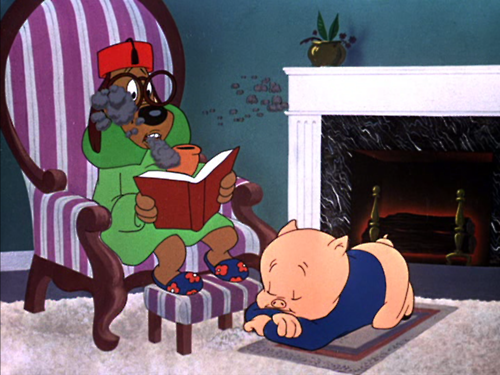 ‘Awful Orphan’ is the second cartoon of five starring that delightfully annoying mutt, Charlie Dog.
In this short Charlie Dog sneaks into Porky’s apartment ‘disguised’ as a canary. He then tries to persuade an unwilling Porky Pig to let him stay as a pet. In the end Porky even forces him to stay, as a master with Porky being his dog.
‘Awful Orphan’ is hampered by Porky’s untypical behavior, being rather nasty at several points. The animation, however, is top notch, and full of excellent poses and smears. On Porky’s wall we can see a rather fauvist painting of two naked ladies, one of the smaller signs of Jones’ interest in more classical arts.
Watch ‘Awful Orphan’ yourself and tell me what you think:
https://www.dailymotion.com/video/x6ecxen
‘Awful Orphan’ is available on the DVD set ‘Looney Tunes Golden Collection, Vol. 1’
This is Porky Pig cartoon no. 122
To the previous Porky Pig cartoon: Scaredy Cat
To the next Porky Pig cartoon: Porky Chops
Director: Chuck Jones
Release Date: July 24, 1948
Stars: Bugs Bunny, Marvin the Martian
Rating: ★★★★
Review:
 ‘Haredevil Hare’ Bugs opens with two headlines of the ‘Daily Snooze’: ‘Scientist to Launch First Rocket to the Moon’ and ‘Heroic Rabbit Volunteers to Be First Passenger’.
Cut to Bugs Bunny ‘volunteering’ (he’s literally dragged towards the spaceship by two men). Bugs changes his mind however, when he notices the supply of carrots dumped into the rocket. And so he’s off to the moon.
Bugs has a hard landing on the moon, which destroys his vesssel and leaves him in shock. But just when he’s adjusted to the fact that he’s alone on the moon, Bugs encounters Marvin the Martian (in his first screen appearance) and his green, talking Martian dog, who is designed like a green version of Charlie Dog and who speaks with the dumb voice of Junior Bear, provided by voice actor Stan Freberg.
The two Martians are on the first Mars-Moon expedition and want to blow up the Earth. But it’s Bugs who blows up the two and accidentally half the moon, too. In the end we see the three hanging on the left piece of the moon with bugs screaming to the control room: “Get me outa here!”.
‘Haredevil Hare’ is one of the first science fiction-themed films that flooded the post-war era. It even predates the first post-war live action features set in outer space, ‘Rocketship X-M’ and ‘Destination Moon’ by two years. In the 1950s outer space would become a popular film setting. Indeed, Chuck Jones himself would revisit outer space several times in his cartoons, most notably in ‘Jumpin’ Jupiter‘ (1955), ‘Rocket Squad’ (1956), and the greatest of all science fiction cartoons, ‘Duck Dodgers in the 24½th Century‘ (1953).
The latter cartoon also features Marvin the Martian, who would reappear in three more Bugs Bunny cartoons: ‘The Hasty Hare’ (1951), ‘Hare-Way to the Stars’ (1958) and ‘Mad as a Mars Hare’ (1963). Of all cartoon villains, Marvin the Martian is the most extraordinary. He’s as gentle, polite and mild-mannered as he is destructive. Although he would never become a major star, he’s still popular today.
Apart from introducing Marvin, ‘Haredevil Hare’ is a notable cartoon because of some nice and weird animation by Ben Washam of Bugs being a nervous wreck after his voyage to the moon: we watch him changing from one bizarre pose into the other, almost without any animation in between. The scenes inside the rocket scene are reminiscent of Bob Clampett’s ‘Falling Hare’ (1943).
Watch ‘Haredevil Hare’ yourself and tell me what you think:
http://www.supercartoons.net/cartoon/661/haredevil-hare.html
‘Haredevil Hare’ is available on the DVD set ‘Looney Tunes Golden Collection, Vol. 1’
This is Bugs Bunny cartoon No. 51
To the previous Bugs Bunny cartoon: Bugs Bunny Rides Again
To the next Bugs Bunny cartoon: Hot Cross Bunny
Director: Chuck Jones
Release Date: April 23, 1949
Stars: Claude Cat, Hubie and Bertie
Rating: ★★★★★ ♕
Review:
 Mouse Wreckers’ is one of Chuck Jones’s all time classic cartoons.
Hubie and Bertie have found a new home, which unfortunately is inhabited by a prize-winning mouse chasing cat, Claude (in his debut). But Hubie and Bertie succeed to chase the cat out of the house by turning him into a nervous wreck. Hubie and Bertie angle themselves through the chimney to evoke the cat’s doom. After several gags, ending with one using an upside down room, the cat, who never knew what was going on, flees the house in horror, leaving it for Hubie and Bertie to roast marshmellows at the fire.
‘Mouse Wreckers’ features some minor stars from the Chuck Jones vault, but its character comedy is brilliant nonetheless. The character animation of Claude Cat trying to deal with his supposed hallucinations is wonderfully well done, and his steady decline into madness is both hilarious and chilling to watch.
Fifteen years later Chuck Jones and Michael Maltese would reuse this story idea in their Tom and Jerry cartoon ‘The Year of the Mouse’ (1965).
Watch ‘Mouse Wreckers’ yourself and tell me what you think:
Director: Chuck Jones
Release Date: November 12, 1949
Stars: Pepe le Pew
Rating: ★★★★
Review:
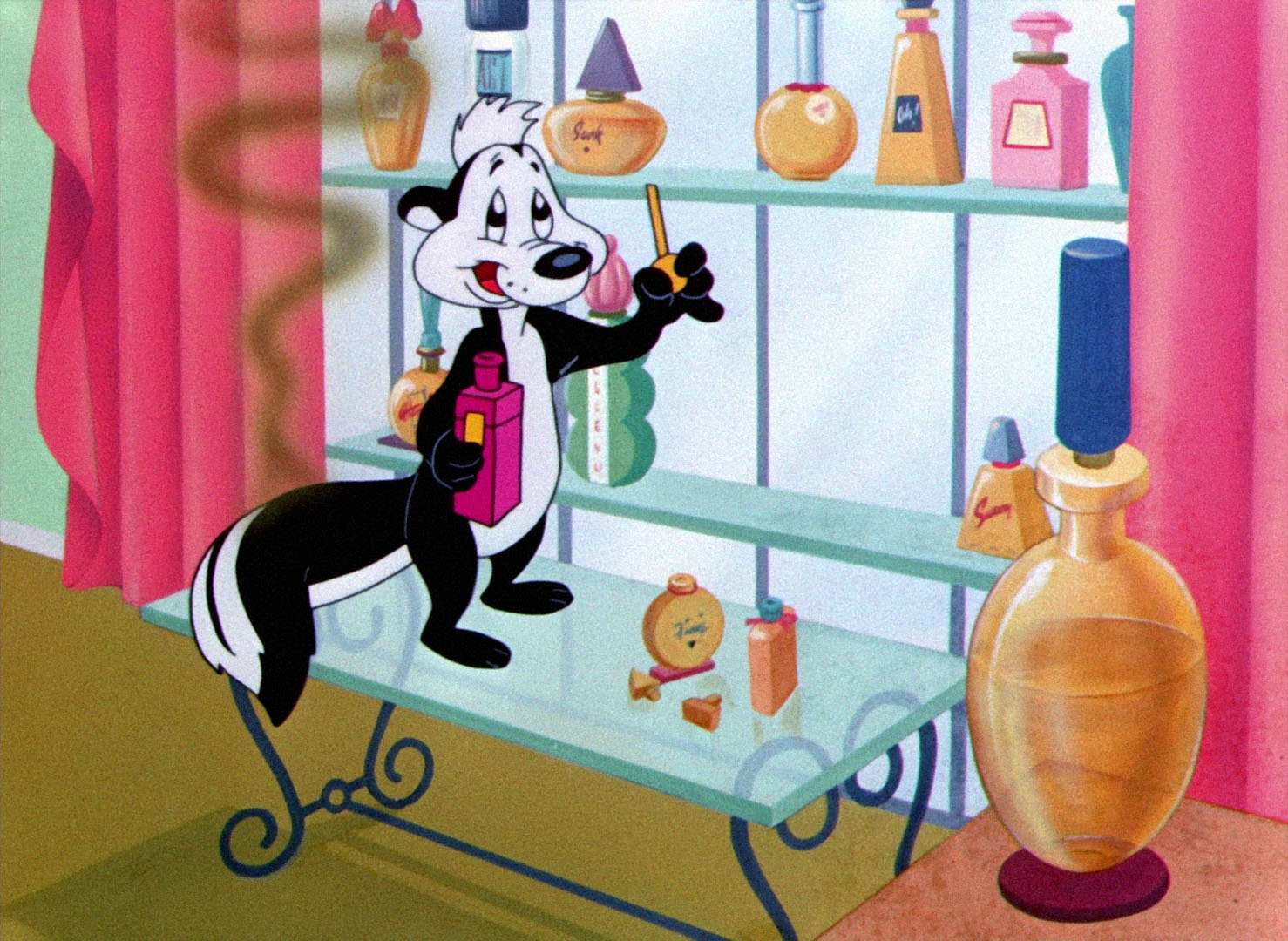 ‘For Scent-imental Reasons’ is the fourth Pepe Le Pew cartoon, and one of his best.
In this short a French perfume shop owner discovers Pepe le Pew in his shop and throws in his female cat to chase away our romantic skunk. Of course, she accidentally gets a white stripe on her back and she’s chased by the smelly Latin lover. But when Pepe accidentally falls into a barrel of blue paint, the tables are turned and he’s chased by the cat.
This short features an excellent scene of Pepe arguing with the cat through a glass window in silent pantomime.
Watch ‘For Scent-imental Reasons’ yourself and tell me what you think:
‘For Scent-imental Reasons’ is available on the DVD set ‘Looney Tunes Golden Collection, Vol. 1’ and ‘Warner Bros. Home Entertainment Academy Awards Animation Collection: 15 winners’
Director: Chuck Jones
Release Date: October 7, 1949
Stars: Bugs Bunny
Rating: ★★½
Review:
 On the way to Miami Beach Bugs misses a left turn at Albuquerque again and reaches the South Pole, where’s confronted with a little penguin chased by an Eskimo, who is as mean as he is out of place. Although Bugs wants to go to the beach, he saves the little fellow.
This is one of the weaker Bugs Bunny cartoons, mainly because of the rather inactive penguin, whose cuteness softens Bugs’s character and because of the large amount of dialogue, provided by Bugs alone. The short’s best scene is when Bugs dresses as a female Eskimo to rescue his waddling little friend. Jones would reuse the little penguin the next year in ‘8 Ball Bunny‘ with moderately better results.
Watch ‘Frigid Hare’ yourself and tell me what you think:
http://www.supercartoons.net/cartoon/663/bugs-bunny-frigid-hare.html
‘Frigid Hare’ is available on the DVD set ‘Looney Tunes Golden Collection, Vol. 1’
This is Bugs Bunny cartoon No. 65
To the previous Bugs Bunny cartoon: The Windblown Hare
To the next Bugs Bunny cartoon: Which is Witch?
Director: Chuck Jones
Release Date: September 16, 1949
Stars: Road Runner, Wile E. Coyote
Rating: ★★★★
Review:
 ‘Fast and Furry-ous’ is the very first Road Runner cartoon.
The short lays out the plan for all other Road Runner shorts, introducing the Road Runner, and the coyote, and their habitat: a desert canyon landscape covered by freeways. Like all following Road Runner cartoons it consists of blackout gags, involving mail orders, strange inventions, explosives, trucks, boulders and cliffs. It differs from the other Road Runner cartoons, however, in that only one of the products the Coyote purchases (the Superman suit) is made by ACME. It also features quite elaborate designs of Wile E. Coyote. In later cartoon his looks would become more streamlined.
Fast and Furry-ous is an excellent debut. It already contains a classic gag with the one in which the coyote constructs a ludicrous machine from a refrigerator, which produces snow to ski on. Unfortunately he runs out of snow when he’s skiing above a huge ravine…
‘Fast and Furry-ous’ introduces the excellent silent comedy of the Road Runner cartoons, second only to the Tom & Jerry series, and very welcome in an age in which animated shorts became more and more dialogue-driven.
Although we would call the series after the Road Runner, the speedy bird is essentially a one-dimensional character: being invincible, the Road Runner knows only one cheerful expression, and doesn’t do much more than running really, really fast and going ‘beep beep’.
The Coyote, on the other hand, is the best character ever conceived by Chuck Jones. Although he is the predator, in several shorts Jones goes at lengths to show he’s starving and desperate for food, making him more sympathetic. Moreover, the Coyote is an optimist, ever believing he will once triumph. He’s also a fanatic, not giving up despite all his mishaps. And he is an inventor, thinking of countless ways to catch the Road Runner. It is however his unfortunate doom to be confronted with bad luck no matter what he does. In Chuck Jones’s own words:
“In the Road Runner cartoons, we hoped to evoke sympathy for the Coyote. It is the basis of the series: the Coyote tries by any means to capture the Road Runner, ostensibly and at first to eat him, but this motive has become beclouded, and it has become, in my mind at least, a question of loss of dignity that forces him to continue. And who is the Coyote’s enemy? Why, the Coyote. The Road Runner has never touched him, never even startled him intentionally beyond coming up behind the Coyote occasionally and going “Beep-Beep!”. No, the only enemy the Coyote has is his overwhelming stubborness. Like all of us, at least some of the time, he persists in a course of action long after he has forgotten his original reasons for embarking on it.”
(from ‘Chuck Amuck’, page 219)
So when this wonderfully enthusiastic character looks to us for sympathy, when confronted by boulders, trucks, explosions or one of the immensely deep canyons of his homeland, he gains it, for we understand his frustrations and sympathize with him wholeheartedly.
These Oliver Hardy-like looks into the camera belong to the highlights of the series, and it is the silent comedy of the Coyote’s facial expressions that makes the Road Runner cartoons such fun to watch. Indeed, when given a voice, as in the Bugs Bunny cartoon ‘Operation Rabbit‘ (1952), the character becomes much less interesting; too pompous, too self-aware to gain the sympathy he would silently get. The four Bugs Bunny-Coyote combination shorts therefore never reach the comic success of the best of the Road Runner cartoons.
Watch ‘Fast and Furry-ous’ yourself and tell me what you think:
‘Fast and Furry-ous’ is available on the DVD set ‘Looney Tunes Golden Collection, Vol. 1’
Director: Chuck Jones
Release Date: June 25, 1949
Stars: Bugs Bunny
Rating: ★★★★★
Review:
 Bugs Bunny is singing nearby a villa, where a huge opera singer, called Giovanni Jones, is practicing.
The singer is heavily disturbed by Bugs’s performance and without arguing destroys our hero’s banjo, his harp and his tuba. Only then Bugs is prompted into war, which he reserves for the opera singer’s concert at the Hollywood Bowl.
What follows are great blackout gags featuring a string of opera tunes, with Bugs as ‘Leopold’ as a major highlight. This impersonation is an obvious reference to star conductor Leopold Stokowski, famous for conducting ‘Fantasia’ (1940). Bugs destroys the conductor’s baton, to direct with his hands only, like Stokowski does. From now on he controls the singer almost like a puppeteer. Bugs finally destroys his opponent by making him sing a ridiculously long high note, which tears the complete bowl down.
With cartoons like ‘Long-Haired Hare’ director Chuck Jones really came into his own: it shows Jones’ attitude to Bugs Bunny, who, in Jones’s cartoons, is only a misschief when provoked. Giovanni Jones is one of Bugs Bunny’s particularly large adversaries, following The Crusher (‘Rabbit Punch‘, 1948), and the warehouse manager in ‘Hare Conditioned‘ (1945).
‘Long-Haired Hare’ also shows Jones’ love for high culture, like opera. For instance, we can clearly detect a painting by Roussau le douanier decorating the opera singer’s villa. Jones’s love for opera would lead to two of his most famous and best cartoons, ‘The Rabbit of Seville‘ (1950) and ‘What’s Opera, doc?‘ (1958), which also feature Bugs Bunny.
In 1950, the Hollywood Bowl would be visited by cartoon characters again, when Tom & Jerry both tried to conduct in ‘Tom and Jerry in the Hollywood Bowl‘.
Watch ‘Long-Haired Hare’ yourself and tell me what you think:
http://www.dailymotion.com/video/x2fdnv1
This is Bugs Bunny cartoon No. 61
To the previous Bugs Bunny cartoon: Bowery Bugs
To the next Bugs Bunny cartoon: Knights Must Fall
Director: Chuck Jones
Release Date: December 14, 1948
Stars: Bugs Bunny
Rating: ★★½
Review:
 Bugs misses a turn at Albuquerque and ends up in Scotland.
When he mistakes a Scotchman’s bagpipes for a monster attacking an old lady, he ends up playing golf against the angered Scotchman. Of course, Bugs wins the game, which consists of several blackout gags, and he even manages to defeat the kilted guy at playing the pipes.
The Scotchman looks like a cross between Elmer Fudd and Yosemite Sam, but who hasn’t got anything near the personality of either of the two. Therefore the interplay between our hero and the villain never really come to live, despite some nice facial expressions on Bugs’ adversary.
Peter Alvarado’s backgrounds do not help: they are too vivid to ignore, but have none of the beauty of either Jones early 1940s cartoons or his cartoons from the 1950s. Instead they express a strange mix of realistic and more stylized patterns. The result is a rather mediocre entry in the Bugs Bunny catalog.
Watch ‘My Bunny Lies over the Sea’ yourself and tell me what you think:
‘My Bunny Lies over the Sea’ is available on the DVD set ‘Looney Tunes Golden Collection, Vol. 1’
This is Bugs Bunny cartoon No. 55
To the previous Bugs Bunny cartoon: A Lad in his Lamp
To the next Bugs Bunny cartoon: Hare Do
Director: Chuck Jones
Release Date: April 10, 1948
Stars: Bugs Bunny, The Crusher
Rating: ★★★½
Review:
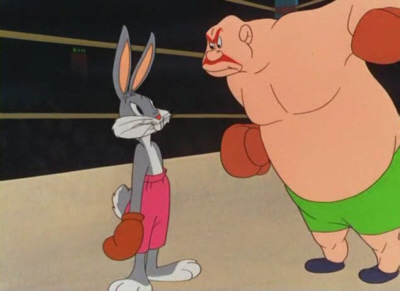 When Bugs jeers at the champion of a boxing game, he’s suddenly ‘invited’ to be in it.
The boxing game soon changes into a wrestling match with blackout gags, in which we only see round 37, 49, 73, 98 and 110. These blackout gags foreshadow the complete Road Runner series. In the last one the champ uses a train in order to ride over Bugs, but then the film abruptly breaks, a revival of a gag Jones used in ‘My Favorite Duck‘ (1942).
‘Rabbit Punch’ is one of the earliest cartoons in what we can call Chuck Jones’ mature style, which consolidated in 1949. Like in his earlier Bugs Bunny cartoons ‘Case of the Missing Hare‘ (1942) and ‘Hare Conditioned‘ (1945), Jones uses his sense of grace and deftness to portray a particularly large, human opponent to Bugs. And like in those cartoons he does that with stunning ‘camera angles’ and a cinematic approach. Bugs is pretty suave in this cartoon, acting out complete terror in the final scene, only to appear in full control, after all.
Watch ‘Rabbit Punch’ yourself and tell me what you think:
http://www.dailymotion.com/video/x2fby3f
This is Bugs Bunny cartoon No. 48
To the previous Bugs Bunny cartoon: A Feather in his Hare
To the next Bugs Bunny cartoon: Buccaneer Bunny
Director: Chuck Jones
Release Date: August 11, 1945
Stars: Bugs Bunny
Rating: ★★★★
Review:
 In ‘Hare Conditioned’ Bugs Bunny is working in a display at a department store. But the manager has other plans with him and wants our hero stuffed.
‘Hare Conditioned’ is full of director Chuck Jones’ typical sophisticated humor and extreme posing. For example, at the beginning of the chase scene we can see the manager looking for Bugs in three places. His move from one place to another is done in smears only one frame long, leading to extremely fast takes between the poses. Also, the final chase, involving elevators and stairs, is wonderfully timed. One of the short’s best gags, however, is set to a slower pace, and involves Bugs cross-dressing as a female customer and the manager courting him/her by tickling his/her feet.
Unfortunately, the cartoon ends abruptly with a rather trite ending: when the manager has Bugs Bunny cornered on the roof, Bugs convinces his adversary there’s a monster behind him, with himself posing as the monster, making the manager jump off the roof. But then he looks into the mirror himself…
‘Hare Conditioned’ is one of the great entries in the Bugs Bunny canon. The short clearly establishes Jones’s concept of the rabbit, as the director stated in his book ‘Chuck Amuck’:
“Golden Rule. Bugs must always be provoked. In every film, someone must have designs upon his person: gastronomic, as a trophy, as a good-luck piece (…..), as an unwilling participant in a scientific experiment (laboratory rabbit or outer-space creature). Without such threats Bugs is far too capable a rabbit to evoke the necessary sympathy”.
Indeed, Bugs only comes into action in this cartoon when threatened by death. First he tries to flee his foe, but when this proves impossible he takes control of the situation himself. Only then he does serious harm to his opponent. Nevertheless, Bugs remains calm throughout the cartoon.
Jones kept to his golden rule in the rest of his cartoons, giving Bugs other large or powerful adversaries like a giant red monster in ‘Hair-Rasing Hare’ (1946), a large boxer in ‘Rabbit Punch‘ (1948), or a Martian, capable of blowing up the earth, in ‘Haredevil Hare‘ (1948).
Watch ‘Hare Conditioned’ yourself and tell me what you think:
https://www.dailymotion.com/video/x5y67d2
This is Bugs Bunny cartoon No. 33
To the previous Bugs Bunny cartoon: Hare Trigger
To the next Bugs Bunny cartoon: Hare Tonic
‘Hare Conditioned’ is available on the DVD-set ‘Looney Tunes Golden Collection Volume Two’
Director: Chuck Jones
Release Date: June 12, 1943
Stars: Hubie and Bertie
Rating: ★★½
Review:
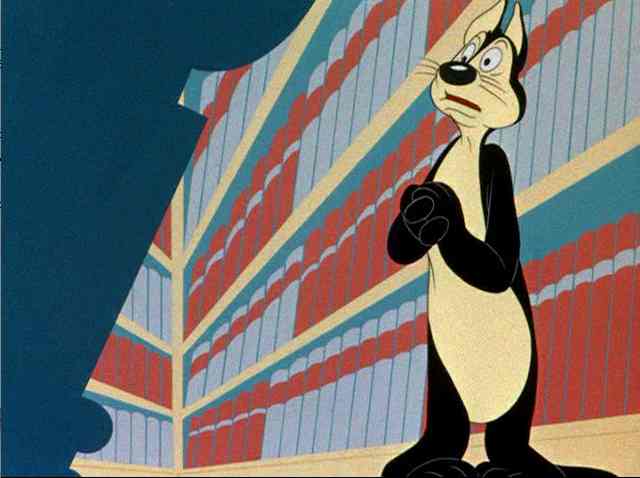 The aristo-cat is the pet of a rich lady. He nags the butler so much that the latter quits. Not knowing how to get food himself, the cat panics, until he learns from a book titled ‘the behavior of cats’ that cats eat mice.
He immediately sets out to get one, but when he encounters one (Hubie) he doesn’t recognize it and he’s scared to death. Hubie and Bertie take advantage of the situation to convince the cat that Rover, a vicious bulldog next door, is a mouse. This leads to several chase routines, until it is revealed that it was all a dream.
‘The Aristo-Cat’ is only moderately funny, and the aristo-cat has a rather ugly voice. But the cartoon’s highly stylized backgrounds are beautiful and an attraction on their own. They are based on layouts by John McGrew, who did some innovative work in a couple of Chuck Jones cartoons from 1942 and 1943, e.g. ‘Conrad the Sailor‘, ‘The Dover Boys‘, and ‘Flop Goes The Weasel’. The backgrounds in ‘The Aristo-Cat’ arguably form the apex of McGrew’s art with their expressionistic angles and patterns, supporting the cat’s agony and fear. In fact, such daring designs would not be seen again before the advent of UPA.
‘The Aristo-Cat’ marks the debut of the mischievous mouse duo Hubie and Bertie. Strangely enough, they were shelved for three years, although Hubie had one solo-outing in 1944 with ‘From hand to Mouse’. The duo returned in 1946 to star five more cartoons: ‘Roughly Squeaking’ (1946), ‘House Hunting Mice’ (1948), ‘The Hypo-Chondri-Cat’ (1950), ‘Cheese Chasers’ (1951) and the greatest of them all, ‘Mouse Wreckers‘ (1949).
Watch ‘The Aristo-Cat’ yourself and tell me what you think:
Director: Chuck Jones
Release Date: February 14, 1942
Stars: Conrad Cat, Daffy Duck
Rating: ★★½
Review:
 ‘Conrad the Sailor’ is the third and last cartoon featuring the early Chuck Jones character Conrad Cat, who also starred ‘Porky’s Cafe’ and ‘The Bird Came C.O.D.’, all from early 1942.
Conrad’s most distinctive trait was his voice, provided by Pinto Colvig, who also voiced Goofy. Indeed, Conrad’s and Goofy’s voices are very similar. However, in ‘Conrad the Sailor’ his voice is rarely heard, as most of the comedy is silent.
In ‘Conrad the Sailor’ Conrad Cat works as a sailor on a battle cruiser (a setting reflecting the war time), where he is nagged by Daffy Duck. Their chase is stopped several times by a small captain who pops up at unexpected moments, a type of gag typical for early Chuck Jones cartoons (see e.g. ‘Inki and the Minah bird’ from 1941 and ‘The Dover Boys‘ from 1942).
‘Conrad the Sailor’ is not a very funny cartoon: neither Conrad nor Daffy behave sympathetically, and the origin of their conflict remains unknown. The Daffy-Conrad-encounters appear to be nothing more than a string of unrelated events. Moreover, Jones’s pacing is still rather slow at times, wearing the comedy down. Conrad’s personality is rather undefined, and after this cartoon he was shelved.
Notwithstanding its weaknesses, the cartoon is noteworthy for its remarkably stylized and surprisingly angled backgrounds, courtesy of lay-out artist John McGrew, who collaborated with Jones on a number of cartoons, before joining the navy himself in 1942. The backgrounds in these cartoons are often the real highlight of the short, and look all the way forward to UPA’s cartoon modern style of the early fifties. McGrew would push the limits even further in ‘The Aristo-Cat‘ (1943).
This is Daffy Duck cartoon No. 12
To the previous Daffy Duck cartoon: The Henpecked Duck
To the next Daffy Duck cartoon: Daffy’s Southern Exposure
‘Conrad the Sailor’ is available on the DVD-set ‘Looney Tunes Golden Collection Volume Four’
Director: Chuck Jones
Release Date: September 19, 1942
Rating: ★★★★★ ♕
Review:
 ‘The Dover Boys’ or, as it is actually called, ‘The Dover Boys at Pimento University or The Rivals of Roquefort Hall’, is director Chuck Jones’s first masterpiece.
The short introduces his trademark of extreme poses, which in this cartoon are combined with ‘smear animation’ to unique results.
The extreme posing leads to highly stylized animation, which in itself is hilarious in its unnatural depiction of movement. In ‘The Dover Boys’ we watch both movement through poses, especially in the animation on Dan Backslide, as well as non-movement, with Dora descending the stairs as a prime example. Both techniques are important steps away from the classic squash-and-stretch animation, and from ‘believability through full animation’. Indeed, the animation style of ‘The Dover Boys’ looks forward all the way to the fifties, the era in which stylization of design and animation would flourish and dominate the animation industry. Indeed, the short’s prime animator, Bobe Cannon, would play an important role at UPA, the most influential animation film studio of the fifties.
The subject of ‘The Dover Boys’ is a sophisticated parody on melodrama, consisting of an archetypical story of a villain (called Dan Backslide) kidnapping a damsel in distress (dear Dora), taking her to his cottage in the mountains, where she is rescued by the heroes, in this case, the three Dover Boys, Tom, Dick and Larry.
Or is she? In the final scene they knock each other out, and Dora runs off into a distance with an odd bearded character in a bathing suit, who, as a running gag, hops along rather randomly throughout the picture to the music of ‘The Good Old Summertime’. This character is a relative of the equally mysterious Minah Bird from Chuck Jones’ earlier cartoon ‘Inki and the Lion’ (1941).
‘The Dover Boys’ is both innovative and funny. Its humor is as sophisticated as it is silly. In any case, the gags come fast and plenty, with hilarious nonsense as a result. An all time classic.
Watch ‘The Dover Boys’ yourself and tell me what you think:
Director: Chuck Jones
Airing Date: December 18, 1966
Rating: ★★★★★
Review:
 ‘How The Grinch Stole Christmas’ is a wonderful Christmas cartoon. The Christmas of a little town called the Whoville is threatened by a green character called the Grinch, who disapproves of Christmas, and particularly the noise involved. He decides to ‘steal’ Christmas from the little creatures, but then he discovers that Christmas is not restricted to objects.
This special, lasting 26 minutes, is one of Chuck Jones’s productions for MGM television. It’s a very faithful and beautiful reading of the classic Dr. Seuss children’s book, keeping Dr. Seuss’s rhymes and faithfully reproducing its designs, but extending those by long and beautiful silent comedy scenes and Jones’s wonderful facial expressions, to even better results.
Especially the Grinch himself is a wonderfully expressive character. In him Jones’ mastery of facial expression reaches its apex. Particularly amazing is the scene in which the Grinch thinks up his evil plan, making his face curl with wickedness.
The story is told by Boris Karloff’s grim voice, and it contains two songs: a rather annoying Christmas song sung by the Whos and an odd song describing the meanness of the Grinch. While we hear this song, we see the Grinch steal every Christmas item in Whoville.
All in all, it’s a classic. It’s arguably the best Dr. Seuss adaptation ever, and certainly one of the best Christmas cartoons ever made. It’s certainly better than the rather annoying live action remake from 2000.
Watch ‘How The Grinch Stole Christmas’ yourself and tell me what you think:
https://myspace.com/171601491/video/how-the-grinch-stole-christmas/47941731
Director: Chuck Jones & Ben Washam
Release Date: April 28, 1966
Stars: Tom & Jerry
Rating: ★★★
Review:
 Tom gives Jerry to his beloved, but she takes pity on the poor little mouse and protects him against Tom.
Jerry takes advantage of the situation, however, never stopping at putting the blame on Tom. Then, in the end, the puss’s love changes into hunger…
This is a very Chuck Jonesy cartoon, with loads of his wonderful trademark elegant designs and strong facial expressions. These solely make this cartoon one of the better entries in the series.
Watch ‘Love, Love My Mouse’ yourself and tell me what you think:
This is Tom & Jerry cartoon No. 147
To the previous Tom & Jerry cartoon: Jerry-Go-Round
To the next Tom & Jerry cartoon: Puss ‘n’ Boats
Director: Chuck Jones
Release Date: February 17, 1966
Stars: Tom & Jerry
Rating: ★★★½
Review:
 In ‘Jerry Jerry Quite Contrary’ Jerry is a somnambulist who teases Tom in his sleep, much to his own dismay.
This is a good story idea, and it leads to a wonderful scene of Jerry trying to stay awake, but also to a weak ending of Tom migrating to a distant desert and Jerry sleepwalking after him.
Two other things are noteworthy about ‘Jerry Jerry Quite Contrary’: it reuses the wire gag from Chuck Jones own classic cartoon ‘Mouse Wreckers‘ (1949), and Don Elliott’s music is even better here than in ‘Duel Personality‘.
Watch ‘Jerry Jerry Quite Contrary’ yourself and tell me what you think:
This is Tom & Jerry cartoon No. 145
To the previous Tom & Jerry cartoon: Duel Personality
To the next Tom & Jerry cartoon: Jerry-Go-Round
Director: Chuck Jones
Release Date: January 20, 1966
Stars: Tom & Jerry
Rating: ★★★★
Review:
 After another chase, Jerry challenges Tom for a duel.
What follows are rather Road Runner-like blackout gags in which the two try various weaponry. In the end it’s Tom who gets weary of their misguided attempts and goes back to the original chase.
‘Duel Personality’ is an original and entertaining film, in which the titles only arrive after 1 minute and 24 seconds. It’s also the first Tom and Jerry featuring music by composer Dean Elliott. Elliott replaced Eugene Poddany and his music is jazzier than Poddany’s, and his use of recurring themes make his music more like that of classic Tom & Jerry composer Scott Bradley. All in all a great improvement for the series.
Watch ‘Duel Personality’ yourself and tell me what you think:
This is Tom & Jerry cartoon No. 144
To the previous Tom & Jerry cartoon: The Cat’s Me-ouch
To the next Tom & Jerry cartoon: Jerry Jerry Quite Contrary
Director: Chuck Jones
Release Date: December 22, 1965
Stars: Tom & Jerry
Rating: ★★★
Review:
 Jerry orders a bulldog to help him against Tom. The bulldog turns out to be very tiny, but he’s ferocious nonetheless.
Unfortunately this nice idea leads to a slow and weak story, despite a clever gag with Tom and the little bulldog swapping doors.
The little bulldog, however, was a character to remember, and he would return in Tom & Jerry’ very last theatrical release, ‘Purr-chance to a Dream‘ (1967).
Watch an excerpt from ‘The Cat’s Me-ouch’ yourself and tell me what you think:
This is Tom & Jerry cartoon No. 143
To the previous Tom & Jerry cartoon: The Year of the Mouse
To the next Tom & Jerry cartoon: Duel Personality


 Dr. Grob's Animation Review