You are currently browsing the tag archive for the ‘devil’ tag.
Director: Chuck Jones
Release date: April 27, 1963
Rating: ★★★★
Review:
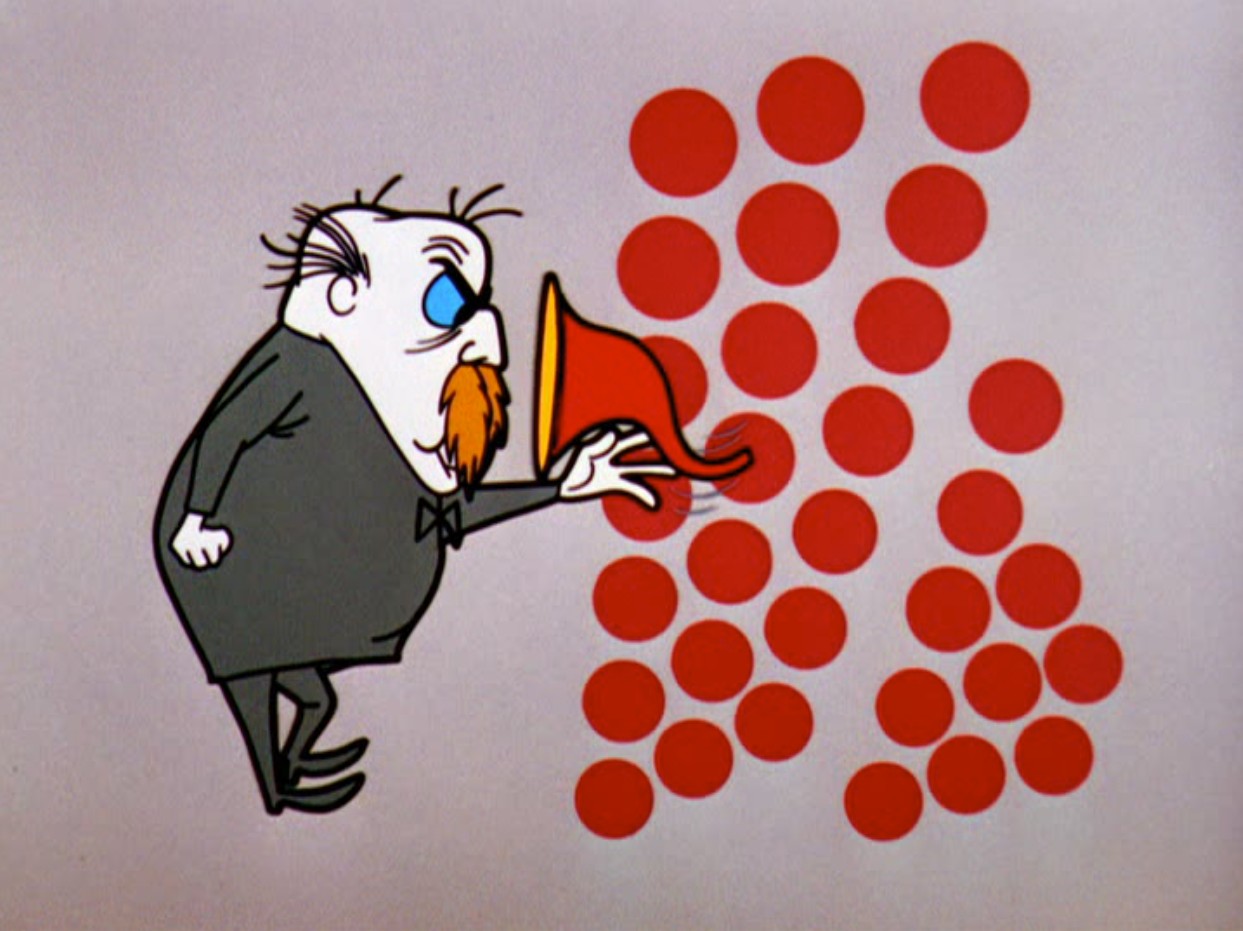
‘Now Hear This’ is a cartoon on sound. The film is one of the most original cartoons by a major studio of the 1960s, for its ultra-modern designs and idiosyncratic narrative. The film knows a stream-of-consciousness-like way of storytelling, exploiting an inner logic, but with only a dreamlike coherence.
In the film Chuck Jones and his crew only use monochrome backgrounds, with shapes, lines and typography emphasizing both the action and the emotional response. Only the three main characters (a devil, a deaf Briton and a small character dressed in pink) are drawn and animated traditionally, with the Briton being the audience’s connection to what happens on the screen.
Being a film on sound, sound effect man Tregg Brown goes berzerk in creating and combining the craziest sounds, from the decades-old ‘rubber band’ sound snippet to bizarre new sound effects accompanying lines, shapes and words. The result is as mesmerizing as it is rewarding in its originality. It’s striking that the studio could produce such an avant-garde film in its final days, which were mostly populated with much less inspired products.
Watch excerpts from ‘Now Hear This’ yourself and tell me what you think:
‘Now Hear This’ is available on the DVD-set ‘Looney Tunes Golden Collection Volume Six’
Director: Trey Parker
Release date: June 30, 1999
Rating: ★★★★★ ♕
Review:
The South Park television series was only midway in its third season when its first (and only!) theatrical feature film was released. Thus, the film contains many of the quirks so typical of the earliest seasons but long since forgotten, like Kenny’s obligatory death, Kyle performing the act of ‘kick the baby’ with his little brother Ike or Stan compulsory vomiting on meeting Wendy.
Also prominent are characters that years ago have disappeared from the sitcom like Chef and Mr. Hat. Moreover, Cartman’s personality as a complete and pretty evil ass is not yet defined here, and although he’s already a jerk, he’s just one of the gang here.
The animation, too, retains much more of its cut-out origins than later seasons, although in the feature film the all too primitive animation is juxtaposed to a swirling 3D computer animation, especially in the hell scenes, which gives the film extra grandeur, but which would become more of a style element in later seasons of the series.
The South Park series always was at its best in social commentary, and it that respect, ‘South Park: Bigger, Longer & Uncut’ delivers big time. The film painfully clearly shows America’s obsession to prevent their children to experience anything subversive, except gun violence (incidentally by now the major death cause of American youth). It’s best not to reveal the plot, but it’s enough to know that when the kids go see the new Philip and Terrance movie ‘Asses on Fire’, things quickly go out of hand.
The film also introduces the idea that Terrance and Philip are Canadian, and that all Canadians have disjointed heads and square hands, so the difference between the designs of the main characters and that of their favorite television show turns out not be one of style, but one of ‘nature’. This ridiculous idea is played out well, and was continued in the television series, too.
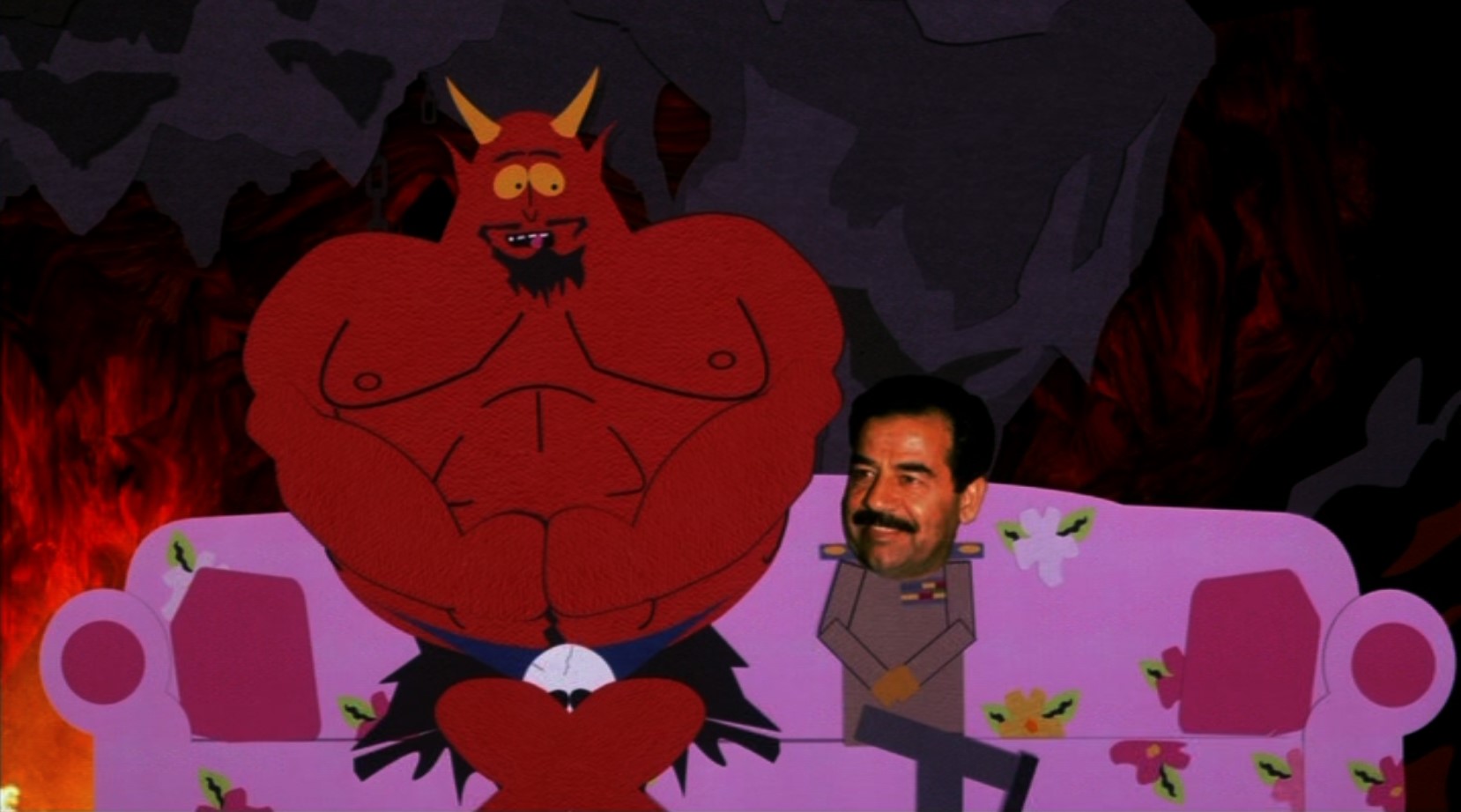
Kenny dies, of course, but for the first time we see what happens to him after his death, and quite a bit of the action takes place in hell, where Satan and Saddam Hussein get involved in the plot. Now, the Iraqi dictator was very much alive back then, and the film is a testimony of the US’ frustration they didn’t remove the villain from the office in the first Gulf War (1990-1991).
Because of Hussein Iraq was included in George Bush jr.’s nonsensical ‘Axis of evil’ (together with its arch enemy Iran), which ultimately lead to the misguided and very questionable invasion of Iraq in 2003. In ‘South Park: Bigger, Longer & Uncut’ Saddam Hussein is shown as being even more evil than Satan himself, dominating the prince of darkness in a toxic relationship. Of course, the inclusion of Saddam Hussein ages the film more than necessary, as do other references to real people, like Brian Boitano (whom I as a non-American had never heard of).
Yet, the biggest surprise of ‘South Park: Bigger, Longer & Uncut’ is not its high level of satire, nor its excellent plot, nor the introduction of elements that would become more familiar later on in the series. No, the biggest surprise of the film is that it is in fact, a musical, and a very good one at that, too. The film literally bursts with songs (there are fourteen of them), all ranging from good to excellent.
It seems Trey Parker knew exactly how to write a musical song: yes, practically all his songs are parodies of musical tropes, but his own creatures have such beautiful and memorable melodies they perfectly stand on their own. Absolutely top are ‘What would Brian Boitano do?’ and Satan’s Jesus Christ Superstar-like ‘Up there’. And then there’s a great musical moment when the Les misérables-like song ‘La résistance’ suddenly gets intermixed by four other songs, including a new one sung by soldiers, and the outstanding ‘Blame Canada’. This latter song, which was introduced much earlier in the film, is the undisputed highlight of the feature and was nominated for an academy award for best original song (which it unjustly lost to the bland ‘You’ll Be in My Heart’ Phil Collins composed for Disney’s ‘Tarzan’).
In fact, ‘South Park: Bigger, Longer & Uncut’ is so good at being a musical that it can easily be counted among the best animated musicals ever. Main composer Trey Parker, at least got on a new career as a musical writer. No, there were no other South Park movies to come, but not only did more and more songs creep into the South Park series itself, but Parker made another musical with the bizarre puppet movie ‘Team America: World Police’ (2004) and even hit Broadway with the stage musical ‘The Book of Mormon’ (2011).
In all, South Park: Bigger, Longer & Uncut’ is great satire, it’s a great musical, and it’s a great proof that feature films based on television series could (and should) be an improvement on the original series.
Watch the trailer for ‘South Park: Bigger, Longer & Uncut’ yourself and tell me what you think:
‘South Park: Bigger, Longer & Uncut’ is available on Blu-Ray and DVD
Director: Eiichi Yamamoto
Airing date: June 27, 1973
Rating: ★★★½
Review:
The late sixties and early seventies saw some striking experiments in the animated feature film. These films left the tried paths of family film and aimed at a more adult audience. In Europe Walerian Borowczyk arguably made the first experimental animated feature with ‘Théâtre de Monsieur & Madame Kabal (Theatre of Mr & Mrs Kabal)’ (1967), René Laloux made quite an impact with ‘La planète sauvage’ (1973), while in the UK George Dunning’s ‘Yellow Submarine’ (1968) caused a revolution, inspiring for example ‘János Vitéz’ (Johnny Corncob) in Hungary. Meanwhile in the US Ralph Bakshi experimented with more adult themes in ‘Fritz the Cat’ (1972) and ‘Heavy Traffic’ (1973).
In Japan, Osamu Tezuka led the way with his Mushi Productions studio, releasing three more adult themed feature films: first ‘A Thousand and One Nights’ in 1969, followed by ‘Cleopatra’ (1970) and ‘Belladonna of Sadness’ from 1973.
All three were directed by Eiichi Yamamoto, but in contrast to the earlier two features Tezuka had no direct involvement in ‘Belladonna of Sadness’. Even more striking, the great master left his own studio halfway production. Thus, ‘Belladonna of Sadness’ is very, very different from Tezuka’s own rather cartoony creations.
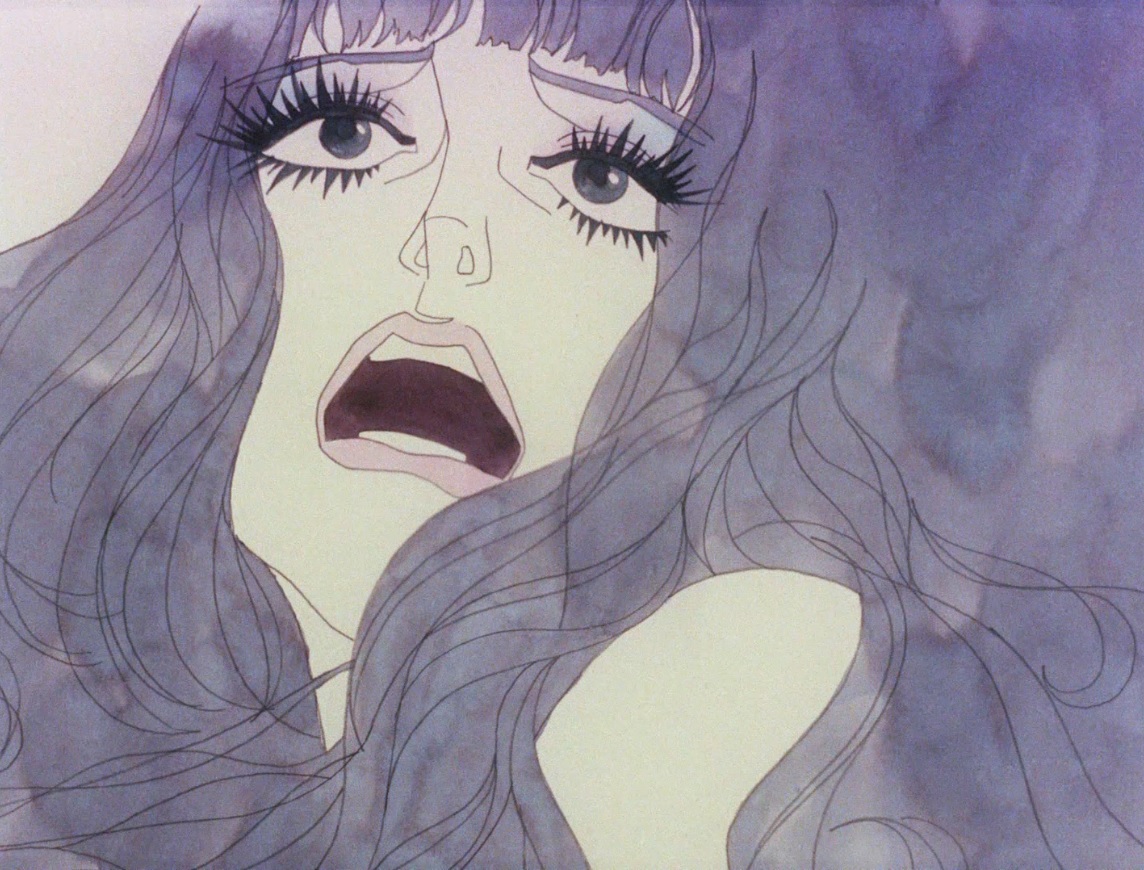
According to Yamamoto he wanted his film to be a Japanese answer to ‘Yellow Submarine’, and to make it one the drew inspiration from the artwork by Kuni Fukai. However, Kunai’s dark and disturbing artwork is quite the opposite from Dunning’s cheerful fantasies. On the Blu-ray Fukai calls his own work from the early seventies ‘decadent’, and that certainly is an apt description. Fukai’s drawings are baroque, graphical, lush, and highly erotic. They have a distinct neo-art-nouveau character, which is both very psychedelic and very seventies. For Belladonna of Sadness’ Fukai functioned as the art director, and his drawings form the base of the complete film, which uses animation only sparingly, often leaving the camera tracking over the static artwork.
And what artwork! ‘Belladonna of Sadness’ sure is a marvel to look at. The watercolor-and-pen drawings are all interesting and of a high artistic quality. Fukai almost always uses a white canvas, in which the drawings more or less disappear, and there’s ample and expressive ornamentation to accentuate the feeling of the scene. There are some odd design choices, however. For example, the villain looks like he has no eyes and as if three bones are stuck into his skull, making him rather grotesque and unbelievable.
Animation, as said, is only used only sparingly. There is no lip-synchronization, whatsoever, and some of the animation is crude and simple. The most interesting animation occurs when the events are not shown directly, but only suggested. For example, in the best erotic scenes more is hinted at than shown, and when the world is struck with the plague, we watch the landscape melt. There are certainly some trippy scenes, full of metamorphosis, which form the best parts of the movie. The undisputed highlight of the film comes when the baroque images are suddenly changed for a rapid-fire delivery of much more cartoony designs in bold seventies colors. This frenzy of animated images is followed by beautiful glass painted animation full of metamorphosis.
The psychedelic images are further enhanced by the soundtrack, which mixes psychedelica, spacefunk and rock into a very seventies-like mix, akin to Alain Goraguer’s soundtrack for ‘La planète sauvage’ from the same year, albeit of a lesser quality. There are even a few songs to enhance the mood.
In contrast to the beautiful art the story of ‘Belladonna of Sadness’ is subpar, and even objectionable. The film is based on ‘La sorcière’ (1862) by Jules Michelet, a non-fiction book on witchcraft, and the film’s story is set in a fictive oppressive kingdom in which a peasant girl becomes a witch. However, Yamamoto’s and Yoshiyuki Fukuda’s screenplay apparently only uses the book as a source of inspiration, as their own tale is as predictable as it is boring.
Yamamoto apparently instructed Fukai that his film was ‘porn but make it a love story’. Well, the movie is certainly porn, but hardly a love story. The two lovers Jean and Jeanne are more vignettes than characters, and if anything, Jean is a weak and will-less coward. Worse, the porn is exploitive, featuring several rapes and a lot of violence. As can be expected, there is a lot of female nudity, but hardly any male one, although penises are omnipresent, especially as the devil takes the shape of a penis himself. Jeanne’s best moment comes when she reveals herself as a full-blown witch, which provides one of the film’s most iconic moments. But during most of the film she’s used and abused by powers beyond her control. The ending, too, is unsatisfying, and all too abrupt, forcingly trying to make the porn story into something political.
Thus, ‘Belladonna of Sadness’ may transcend normal porn (it’s certainly weird and original enough to do so), but not that of a cheap comic. There’s no depth to the story, at all, and the film’s exploitive character gives a bad taste in the mouth. Nevertheless, the movie is a feast of the eye and stands as a great example of the sheer experimentation that were the seventies.
Watch the trailer for ‘Belladonna of Sadness’ yourself yourself and tell me what you think:
‘Belladonna of Sadness’ has been released on Blu-Ray, but this is currently out of print
Director: Dave Fleischer
Release Date: November 3, 1939
Stars: Popeye, Swee’Pea
Rating: ★★★★½
Review:
 This cartoon opens with Popeye softly spanking Swee’Pea, and sending him to bed without supper.
While Popeye struggles with his conscience (which materializes into his angelic and devilish side), Lil’ Swee’Pea leaves home, and almost immediately enters a hazardous, mountainous terrain. When Popeye’s angelic side has won, Popeye enters Swee’Pea’s room, only to find him gone. It’s now up to our hero to rescue Swee’Pea from grave dangers…
‘Never Sock a Baby’ is a morality tale, all too typical for the late 1930s, in which Popeye teaches us that it’s not right to spank a child. However, what a delightful morality cartoon this is! Despite the trite dream ending, the cartoon is full of wild and zany animation, plenty of gags and suiting music. Priceless is the scene in which Popeye reaches for his spinach only to find the can empty. The music score follows with a hilariously deflated version of the spinach theme. ‘Never Sock a Baby’ shows that by the end of the decade the goody-goody cartoon style of the mid-1930’s was at its end.
Watch ‘Never Sock a Baby’ yourself and tell me what you think:
This Popeye film No. 75
To the previous Popeye film: It’s the Natural Thing to Do
To the next Popeye film: Shakespearian Spinach
‘Never Sock a Baby’ is available on the DVD set ‘Popeye the Sailor Volume Two’
Director: Władysław Starewicz
Release Date: 1933
Stars: Fétiche
Rating: ★★★★
Review:
 ‘The Mascot’ shows that by 1933 Starewicz was the undisputed master of stop motion.
This 26 minute long film starts with live action, and is a typical melodramatic product of its time: we watch a poor mother making a dog doll, while her ill child lies in the back of the small room with fever. When she sheds a tear on the puppy doll, it comes alive. The puppy doll makes friends with the little girl, but the next day he’s about to be sold by a poor mother together with several other dolls she made.
On the way, however, a thief doll cuts a hole through the cardboard box they’re in, and all dolls leave the box, except for the little dog, who’s sold and hung in a car. Finally the dog makes his way home and rescues the little ill girl from a certain death by fetching her an orange.
The plot is more complicated than this main narrative, however, and features countless puppets. Besides the dog’s story, there’s a menage à trois featuring a ballet dancer, a Pierrot and the thief doll, and there are also a monkey doll and a cat doll involved.
Highlight of the film is a night scene, in which everything comes alive, from pieces of paper to skeletons of fish and birds. No less than the devil himself invites all creatures inside his cavern, where an grand ball is taking place. This sequence has a nightmarish character comparable to Alexeïeff’s ‘Une nuit sur le mont chauve’ from the same year.
The whole film has a unique, gritty atmosphere, however. Throughout, the animation ranges from primitive to astounding. Starewicz especially excels in facial expressions, which really make some of the characters come alive. The dog, for example, clearly is a timid, reluctant character.
Unfortunately, the film is completely silent, despite a sparsity of dialogue and sound effects, and sometimes Starewicz’s dolls fall prone to overacting to overcome the lack of sound. Edouard Flament’s angular soundtrack doesn’t help either. Moreover, the all too complex plot hampers the film, making it meander too much. The melodrama, too, is a little too much for present day audiences.
Nevertheless, ‘The Mascot’ is a tour de force of stop motion animation. At least it provided Starewicz with a contract for eleven more films about the cute little dog, which was baptized Fétiche and finally starred five more films.
Watch ‘The Mascot’ yourself and tell me what you think:
https://archive.org/details/The_Mascot_Complete
‘The Mascot’ is available on the DVD ‘The Cameraman’s Revenge & other Fantastic Tales’
Director: Friz Freleng
Release Date: August 7, 1954
Stars: Tweety & Sylvester
Rating: ★★★★
Review:
 During a chase Sylvester falls down and ceases to be.
He goes straight to hell, where a bulldog-like devil tells him he can return to earth because he has still eight lives left. Unfortunately, back on earth Sylvester loses his lives fast, especially during a chase at a carnival.
‘Satan’s Waitin’ shows some similarities to the Tom & Jerry cartoon ‘Heavenly Puss‘ (1949), including bulldog devils and a heavenly escalator. Nevertheless, it’s one of the most original and most inspired of the Tweety and Sylvester cartoons, on par with the celebrated ‘Birds Anonymous’ from 1957.
Watch ‘Satan’s Waitin’’ yourself and tell me what you think:
http://www.dailymotion.com/video/x1z2hgt_sylvester-the-cat-ep-46-satan-s-waitin_fun
Director: David Hand
Release Date: October 10, 1936
Stars: Mickey Mouse, Pluto
Rating: ★★½
Review:
 ‘Mickey’s Elephant’s opens with Mickey receiving a cute young elephant from the Rajah of Ghaboon as a playmate for Pluto. Unfortunately Pluto is not amused, and he thinks ‘Bobo’ is an intruder with intentions to replace him.
‘Mickey’s elephant’ is similar to ‘Mickey’s Pal Pluto‘ (1933) and to ‘Mickey’s Kangaroo‘ (1935), in which Pluto is also jealous of an intruder and which also feature his evil side. Like in ‘Mickey’s Pal Pluto’ Pluto’s evil consciousness has materialized into a little devilish persona, who talks with a strong New York accent and who persuades Pluto to fix Bobo using red pepper. Sneezing along Bobo blows is own new house down, but unfortunately Pluto’s too…
‘Mickey’s Elephant’ is a rare example of a Mickey Mouse film inspired by the Mickey Mouse comic strip. Most of the time the influence was reversed. But in this case Bobo the elephant had made his entrance in Floyd Gottfredson’s strip two years earlier. Bobo is a completely innocent character, and Pluto’s little devil notwithstanding, the cartoon is more cute than funny.
Watch ‘Mickey’s Elephant’ yourself and tell me what you think:
This is Mickey Mouse cartoon No. 89
To the previous Mickey Mouse cartoon: Donald and Pluto
To the next Mickey Mouse cartoon: The Worm Turns
Director: Boris Kossmehl
Release Date: 1993
Rating: ★★★★
Review:
 When she hasn’t paid her washing machine, a girl’s aunt has to go to hell.
However, she soon returns as a zombie to fetch her handbag. The devil tries to take her once again, this time disguised as the handbag.
Atypical for the Aardman studios, ‘Not Without My Handbag’ features puppet animation and hardly any clay animation. It’s a highly designed film, using stark colors, extreme camera angles and expressionistic decors. Its unique style is somewhat akin to that of Tim Burton, but is even more idiosyncratic. Despite its horror theme, the film is more lighthearted than the earlier Aardman films ‘Adam‘ (1991) or ‘Loves Me, Loves Me Not‘ (1992), because of its zany humor and matter-of-fact dialogue. For example, when her aunt returns as a zombie, the girl suddenly turns to camera and says proudly: “My auntie is a zombie from hell!”.
‘Not Without My Handbag’ is a modest masterpiece: it’s unpretentious, but it combines originality with virtuosity. The animation of the evil handbag is particularly good. Director-animator Boris Kossmehl later moved to 3D computer animation, performing character animation for Dreamworks’ ‘Antz’ and ‘Shrek’.
Watch ‘Not Without My Handbag’ yourself and tell me what you think:
‘Not Without My Handbag’ is available on the DVD ‘Aardman Classics’


 Dr. Grob's Animation Review