You are currently browsing the tag archive for the ‘Donald Duck’ tag.
Director: Jack King
Release Date: November 6, 1942
Stars: Donald Duck, Pete
Rating: ★★★½
Review:
 Sky Trooper’ is the third of six shorts dealing with Donald in the army.
The cartoon starts where ‘Donald Gets Drafted‘ ended: with Donald peeling potatoes. And like in the former cartoon Donald Duck wants to fly.
Sergeant Pete gives him a chance, letting him do some ridiculous test and sending him up to be a paratrooper. Unfortunately, Donald doesn’t want to jump and clings to Sergeant Pete. They both end up falling without a parachute but with a huge bomb in their hands. Surprisingly, they survive the fall, because in the end-shot we can see them both peeling potatoes.
‘Sky Trooper’ is surprisingly similar to the Woody Woodpecker cartoon ‘Ace in the Hole’ from five months earlier. However, the cartoon is an improvement on the former two Donald Duck army cartoons. The next ones would even be better…
Watch ‘Sky Trooper’ yourself and tell me what you think:
This is Donald Duck cartoon No. 36
To the previous Donald Duck cartoon: The Vanishing Private
To the next Donald Duck cartoon: Bellboy Donald
Director: Jack King
Release Date: September 25, 1942
Stars: Donald Duck, Pete
Rating: ★★½
Review:
 ‘The Vanishing Private’ is the second of the Donald in the army cartoons. Like the first, ‘Donald Gets Drafted‘ from four months earlier, it features Pete as Donald’s adversary.
In the opening shot we watch Donald singing the theme song from ‘Donald Gets Drafted’ and painting a huge canon in ridiculously bright colors. Sergeant Pete tells him to make the canon hard to see. Donald does so by using invisible paint from an experimental laboratory. He accidentally falls into the bucket of paint himself, making himself invisible and driving Sergeant Pete mad.
‘The Vanishing Private’ suffers because of two reasons:
1) the invisibility makes Donald all too powerful. It’s therefore hard to sympathize with him, and not with poor Pete. This is a problem shared by other invisibility cartoons, like the Tom & Jerry cartoon ‘The Invisible Mouse‘ (1947).
2) The other Donald army cartoons are all about the pains and annoyances of normal army life, which is absolutely part of their fun. But the subject of ‘The Vanishing Pirate’ is so unlikely, one can hardly relate to it.
The result is not a funny cartoon, making ‘The Vanishing Private’ arguably the weakest of Donald’s army cartoons.
Watch ‘The Vanishing Private’ yourself and tell me what you think:
This is Donald Duck cartoon No. 35
To the previous Donald Duck cartoon: Donald’s Goldmine
To the next Donald Duck cartoon: Sky Trooper
Director: Jack King
Release Date: May 1, 1942
Stars: Donald Duck, Pete
Rating: ★★½
Review:
 The attack on Pearl Harbor, December 7, 1941, suddenly smacked The United States into war. The war changed the life of many American citizens, including cartoon stars.
Donald Duck was the fourth of these to support the war effort on the big screen, following Porky Pig, Barney Bear and Popeye, who had joined the army and navy, respectively, in July (‘Meet John Doughboy‘) and November 1941 (‘The Rookie Bear, ‘The Mighty Navy‘). Moreover, Popeye had already engaged the enemy in February in ‘Blunder Below‘. Donald was soon followed by Pluto (May 22), and Woody Woodpecker (June).
In ‘Donald Gets Drafted’, Donald enthusiastically signs up for the army, because he wants to fly, especially after seeing posters of very attractive air hostesses in uniform. His rather naive enthusiasm soon is lowered, when he first has to go through a rather rude medical examination only to end up in the infantry, where he’s bullied by sergeant Pete. Donald doesn’t make a very good soldier, much to Pete’s frustration, and ends up peeling potatoes.
‘Donald Gets Drafted’ is the first of six Donald Duck cartoons devoted to Donald’s career in the army. It introduces Pete as Donald’s sergeant, a role he would fulfill in three other of these war cartoons. The Donald Duck army cartoons are noteworthy for their ambiguous propaganda. Donald is far from a model soldier, and the cartoons makes quite some fun of the army superiors, in the form of Pete. It’s difficult to see them as army advertisements. Moreover, five of the six cartoons are devoted to Donald’s timid life at the training camp. Only in his last war cartoon, ‘Commando Duck’ (1944) would Donald leave American soil to kill some enemies.
With its humor being still quite mild, ‘Donald Gets Drafted’ is not the funniest of Donald’s army cartoons. It is noteworthy, however, for revealing that Donald Duck’s second name is Fauntleroy.
Watch ‘Donald Gets Drafted’ yourself and tell me what you think:
This is Donald Duck cartoon No. 32
To the previous Donald Duck cartoon: Donald’s Snow Fight
To the next Donald Duck cartoon: Donald’s Garden
Director: Ben Sharpsteen
Release Date: September 28, 1935
Stars: Donald Duck, Goofy, Mickey Mouse, Minnie Mouse, Pluto
Rating: ★★★½
Review:
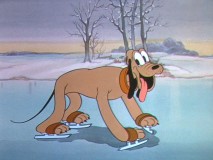 On Ice is the first of Disney’s ‘ensemble cartoons’.
Everyone is in it: Mickey, Minnie (in her color debut), Donald, Goofy, Pluto and even, albeit very briefly, Horace Horsecollar and Clarabelle Cow. ‘On Ice’ introduces two story ideas that would be used again much later: Pluto’s problems on ice in ‘Bambi’ (1942) and the idea of skating near a waterfall in the ‘Once upon a Wintertime’ sequence of ‘Melody Time’ (1948), although this latter idea first appears in the Popeye cartoon ‘Season’s Greetinks!‘ from 1933.
Apart from this, ‘On Ice’ has been very important in the development of Goofy. He’s been completely restyled, has more body to his looks and a much more distinct personality. All these important improvements on the character are attributed to Art Babbitt, one of the greatest animators of all time. Goofy sings ‘The world owes me a living’ from ‘The grasshopper and the ants’ (1934). The song naturally becomes his theme song. No wonder, for the grasshopper and Goofy share the same voice: that of Pinto Colvig. Also of note is Goofy’s original fishing style, using chew to catch fish.
Watch ‘On Ice’ yourself and tell me what you think:
This is Mickey Mouse cartoon No. 79
To the previous Mickey Mouse cartoon: Pluto’s Judgement Day
To the next Mickey Mouse cartoon: Mickey’s Polo Team
Director: Ben Sharpsteen
Release Date: August 3, 1935
Stars: Clarabelle Cow, Donald Duck, Goofy, Mickey Mouse
Rating: ★★★★★
Review:
 ‘Mickey’s Fire Brigade’ is the second of the classic trio cartoons featuring Mickey, Donald and Goofy, and the first of its kind in color.
When one compares this cartoon to the similar ‘The Fire Fighters’ from 1930, one can see what stunning progress the Disney studio had made in a mere five years: the backgrounds, the camera angles, the character animation, the effect animation: everything has improved considerably.
What’s more, its gags are faster, more clever and better constructed, and they build up to a wonderful finale. Among the numerous brilliant ideas are a burning title card, water splashing against ‘the camera’ and a bathing Clarabelle Cow who is not amused when saved by our heroes.
This cartoon is both Goofy’s first color appearance as the last time he’s seen in the design he got in ‘The Whoopee Party’ about three years before. In this film he’s got a particularly goofy cuckoo theme song, while some of the anthropomorphized flames play ‘who’s afraid of the big bad wolf’ from ‘Three Little Pigs‘ on the piano.
Watch ‘Mickey’s Fire Brigade’ yourself and tell me what you think:
This is Mickey Mouse cartoon No. 77
To the previous Mickey Mouse cartoon: Mickey’s Garden
To the next Mickey Mouse cartoon: Pluto’s Judgement Day
Director: David Hand
Release Date: November 17, 1934
Stars: Donald Duck, Fifi, Mickey Mouse, Minnie Mouse, Pete
Rating: ★★★★★
Review:
 Mickey and Donald (in his third appearance) are policemen hunting Pete who has ‘dognapped’ Minnie’s dog Fifi. The chase, which includes a lot of gunfight, ends in a sawmill where all three have to cope with a runaway circular saw.
The cartoon is outstanding for its fast pace and high content of gags. Mickey and Donald are staged as a duo, but, like in ‘Orphan’s Benefit’, Donald Duck is given the last shot. ‘The Dognapper’ would remain Mickey’s and Donald’s only genuine duo cartoon, but it set the stage for the famous trio outings of the late thirties in which Mickey, Donald and Goofy would fight the odds together. Goofy, the only missing element, would join Mickey and Donald a few months later, in ‘Mickey’s Service Station’ (1935).
Watch ‘The Dognapper’ yourself and tell me what you think:
This is Mickey Mouse cartoon No. 70
To the previous Mickey Mouse cartoon: Mickey Plays Papa
To the next Mickey Mouse cartoon: Two-Gun Mickey
Director: Wilfred Jackson
Release Date: February 23, 1935
Stars: Clarabelle Cow, Donald Duck, Horace Horsecollar, Mickey Mouse
Rating: ★★★★★ ♕
Review:
 Almost three years after ‘Flowers and Trees’ Mickey finally made the step to color, and it’s probably because of this that ‘The Band Concert’ has such a Silly Symphony-like feel to it.
In 1935 the concept of a concert cartoon was already an old one (Mickey’s first was the ‘Barnyard Concert’ from 1930), but it finds the peak of perfection in this one.
Likewise, the use of Gioachino Rossini’s ‘overture Wilhelm Tell’ and ‘Turkey in the Straw’ in cartoons was far from new, but who would have thought that the two tunes would fit together so perfectly? The overture is played inside-out culminating in the storm sequence which brings forth a tornado. That’s how it feels, Mickey is not only conducting the storm music but even the real storm itself!
Notwithstanding the cartoon being a Mickey Mouse showcase, it’s Donald Duck who is stealing the show, like he did in the two previous Mickey Mouse cartoons he appeared in: ‘Orphan’s Benefit‘ and ‘The Dognapper‘. Being the only character in the cartoon born in color, Donald makes the transition from black-and-white to color naturally. Mickey and the other characters, on the other hand, still have a strong black-and-white feeling in their design and are less fitting in the bright world of color.
During Mickey’s concert, Donald produces an unending supply of flutes out of nothing, playing ‘Turkey in the Straw’ right through Rossini’s music (this ability of bringing forth material from out of nowhere was a capability that Donald would soon lose, but it would become a trademark of Bugs Bunny several years later). It’s a bitter irony that it’s this tune, ‘Turkey in the Straw’, which signals Mickey’s demise, because it was the same tune that made Mickey a star in the first place.
Nevertheless, ‘The Band Concert’ is without doubt Mickey’s best concert cartoon, arguably his best cartoon since ‘Steamboat Willie‘ and certainly one of the most perfect animated cartoons ever made.
Watch ‘The Band Concert’ yourself and tell me what you think:
This is Mickey Mouse cartoon No. 73
To the previous Mickey Mouse cartoon: Mickey’s Man Friday
To the next Mickey Mouse cartoon: Mickey’s Service Station
Director: Burt Gillett
Release Date: August 11, 1934
Stars: Clara Cluck, Clarabelle Cow, Donald Duck, Goofy, Horace Horsecollar, Mickey Mouse, the Orphan Mice
Rating: ★★★★★ ♕
Review:
 In ‘Orphan’s Benefit’ Mickey and the gang are giving a theatrical performance for the orphan mice we know from ‘Mickey’s Nightmare’ (1932) and other cartoons.
We watch Donald Duck reciting ‘Little Boy Blue’, Horace Horsecollar, Clarabelle Cow and Goofy as acrobats and Mickey and Clara Cluck giving a recital.
‘Orphan’s Benefit’ marks Donald Duck’s second appearance, after his debut in ‘The Wise Little Hen‘ from two months earlier, and his looks are still a bit awkward: he has black feet (because of his transition from color to black and white), an elongated bill and he is very small compared to the rest of the gang. Nevertheless, ‘Orphan’s Benefit’ marks the real birth of Donald Duck: he’s cast outside the Silly Symphonies along Mickey and his co-stars, and he’s really stealing the show. Moreover, for the first time he’s showing his temper and his typical ‘dance of anger’ (created and animated by Dick Lundy).
Besides Donald Duck this cartoon also introduces Clara Cluck, the opera-singing hen. Her career was way less successful than Donald’s: in total she would star in only seven cartoons, and she retired in 1942. Mickey’s role is reduced to a scarcely visible and embarrassingly unfunny straight man. Therefore Orphan’s Benefit marks as much the start of Donald’s career as the beginning of Mickey’s demise.
‘Orphan’s Benefit’ was the only Disney cartoon to be remade. In 1941 it appeared again, now in color and with new designs (especially of Donald Duck).
Watch ‘Orphan’s Benefit’ yourself and tell me what you think:
This is Mickey Mouse cartoon No. 68
To the previous Mickey Mouse cartoon: Mickey’s Steamroller
To the next Mickey Mouse cartoon: Mickey Plays Papa
Director: Wilfred Jackson
Release Date: June 9, 1934
Stars: Donald Duck
Rating: ★★★★
Review:
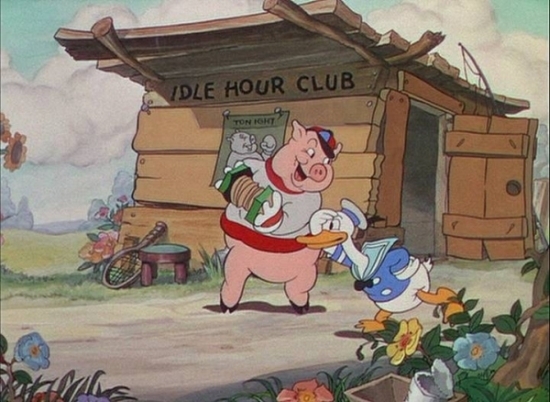 ‘The Wise Little Hen’ is a simple and quite moralistic Silly Symphony carried by a mediocre, yet all too memorable song. I guess it might have fallen into oblivion, were it not for Donald Duck.
In his first appearance Donald Duck is a real sailor, living on a boat and dancing the hornpipe. He’s a strong voice character from the start. When he joyfully shouts ‘oh boy, oh boy, oh boy!’ we all know it’s him, even though his looks are different.
Indeed, like Goofy’s voice, Donald Duck’s voice anticipated the character. When Walt Disney heard Clarence Nash use this particular voice, he really wanted something to do with it. According to animator Bill Cottrell, cited in ‘They Drew As They Pleased’, concept artist Albert Hurter was responsible for the duck’s looks. He gave Donald his trademark sailor suit, which he maintained to the present day.
Besides his typical voice and suit, Donald Duck displays two of his typical character traits: egotism and his tendency to trick others. However, he does not yet display his short temper: when ultimately foiled by the hen he’s not breaking down in anger, but joins Peter Pig in remorseful self-chastisement (a gag reused from an early Oswald the Lucky Rabbit cartoon called ‘Rival Romeos‘, 1928). But Donald would show his temper, in his next cartoon: ‘Orphan’s Benefit‘.
Besides Donald Duck this cartoon is interesting for an appetizing and startlingly realistic animation shot of butter melting on hot corn.
Watch ‘The Wise Little Hen’ yourself and tell me what you think:
This is Silly Symphony No. 45
To the previous Silly Symphony: The Big Bad Wolf
To the next Silly Symphony: The Flying Mouse
Director: Norm Ferguson
Release Date: December 21, 1944
Stars: Donald Duck, Joe Carioca, Panchito, The Aracuan Bird
Rating: ★★★
Review:
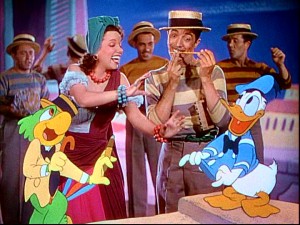 Donald stars in his first and only very own feature film.
In the opening scene he receives a large package full of presents. When he opens these presents, they lead him to the mild story of Pablo the cold-blooded penguin (narrated by the melancholy voice of Disney-favorite Sterling Holloway), and to the childish story of ‘Gauchito and his flying donkey Burrito’, before it reintroduces Joe Carioca from ‘Saludos Amigos‘ (1942). Joe takes Donald to Baía, where they dance the samba with Aurora Miranda, nicely blending animation with live action, something that occurs throughout the picture.
Another package introduces the Mexican rooster Panchito. Together the trio sings the intoxicating theme song, wonderfully animated by Ward Kimball, who regarded the scene as his best work. Panchito takes Donald and Joe on a magic serape ride over Mexico, visiting Mexico City, Veracruz en Acapulco Beach, where Donald plays blind man’s buff with a bunch of girls in bathing suits. Actually, Donald keeps hunting girls like a hungry wolf throughout the picture.
‘The Three Caballeros’ was the second of two ‘Good neighbor policy’ features, focusing on South America, and the second of six compilation features Disney made until returning to real features with ‘Cinderella‘ in 1950. When compared to ‘Saludos Amigos’, ‘The Three Caballeros’ is brighter, bolder and more nonsensical. It is noteworthy for its bold color design and for its beautiful color book artwork by Mary Blair, which in its modernity looks forward to the 1950s (especially in the opening titles, during the train ride and in the Mexican Christmas episode).
It is most interesting however, because of its zany surrealism, which invades many scenes with associative images, where metamorphosis and abstraction run haywire, not even sparing Donald himself. In this respect ‘The Three Caballeros’ is the boldest feature Disney ever made.
However, its lack of story, its strong touristic content, its outdated live action imagery, its sentimental songs and the two childish stories at the beginning of the feature all harm the picture. Thus watching the movie feels like being on a colorful journey full of beautiful images that nevertheless turns out to be unsatisfactory in the end.
Watch the title song from ‘The Three Caballeros’ below:
‘The Three Caballeros’ is available on DVD
Director: Jack Kinney
Release Date: January 1, 1943
Stars: Donald Duck
Rating: ★★★★★ ♕
Review:
 In ‘Der Fuehrer’s Face’ Donald is apparently a citizen of ‘Nutziland’, a fascist country where even trees and clouds are swastika-shaped.
Donald is awoken by a silly march band singing the sarcastic title song (penned by Disney composer Oliver Wallace and sung with gusto by Spike Jones). Then he has breakfast that consists of only one coffee bean, ‘aroma de bacon & eggs’ and a slice of wooden bread. All too soon he has to work at the assembly line, making shells and saluting to images of Adolf Hitler.
In the end, it appears that it was all just a dream, and Donald, in his Stars and Striped-colored room, sighs, embracing a golden copy of the statue of liberty: “Am I glad to be a citizen of the United States of America”. This closing scene is rather corny and the satire of the film misses some points: most of the (German) citizens of Nazi Germany were not poor and did not have to work like slaves, as is suggested here. Instead, the Nazis used forced labor forces from their occupied territories.
Nevertheless, ‘Der Fuehrer’s Face’ was both artistically and commercially the most successful of the Disney war time propaganda films. It even won an academy award for being the best animated short of 1943. It’s so successful, because, unlike most other propaganda shorts, it’s outrageously funny: its satire is so zany, its depiction of ‘Nutzi land’ so wacky, and the scene at the assembly line so out-to-lunch, that one cannot stop laughing. When Donald goes mad, these segments are even topped by a brightly colored, rather avantgardistic and very surrealistic stream-of-consciousness-like scene, which resembles similar dream sequences in ‘Dumbo‘ (1941) and ‘The three Caballeros‘ (1944).
This short was not directed by any of the two regular Donald Duck directors of the time, Dick Lundy and Jack King, who both preferred a more unassuming type of humor, but by Jack Kinney, who is most famous for directing Goofy, and who was undoubtedly the wackiest of the Disney directors, of which this film certainly is proof.
Watch ‘Der Fuehrer’s Face’ yourself and tell me what you think:
This is Donald Duck cartoon No. 38
To the previous Donald Duck cartoon: Bellboy Donald
To the next Donald Duck cartoon: Donald’s Tire Trouble


 Dr. Grob's Animation Review