
You are currently browsing the tag archive for the ‘heaven’ tag.
Director: Makoto Shinkai
Release date: July 19, 2019
Rating: ★★
Review:
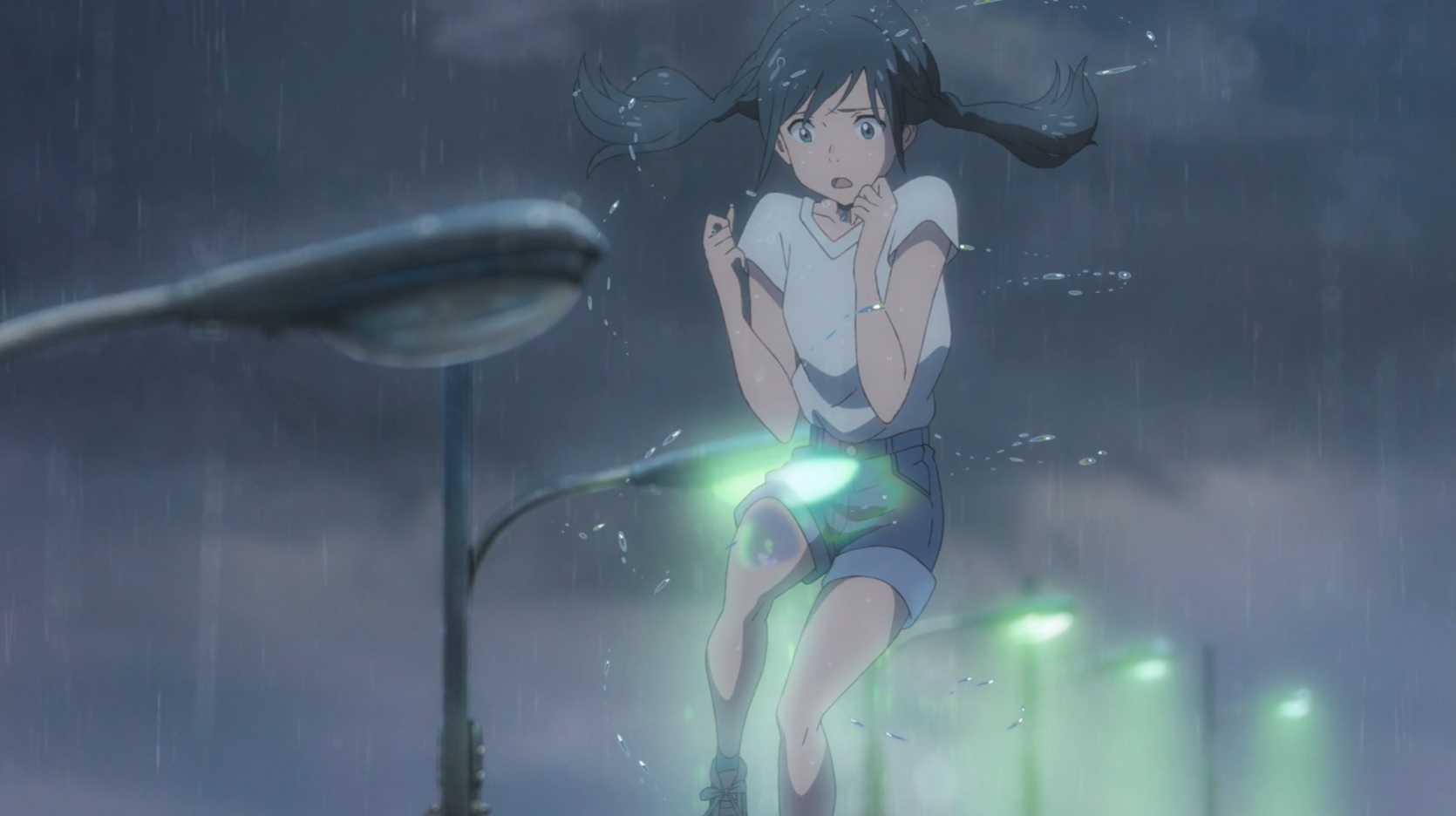
In 2016 Makoto Shinkai rightfully scored a huge hit with his feature film ‘Your Name’. This film’s successor, ‘Weathering with You’ from 2019, unfortunately isn’t half as good.
Like ‘Your Name’ the film is well made, sporting intricate background art, beautiful lighting and fine animation, if not particularly outstanding. But the story, with its high level of spiritualism and its bizarre ending, leaves much to be desired, not in the least because it overstretches its own believability. This already starts with the film’s premise: that Tokyo has been shrouded in rain for months, without any chance of the sun. In this depressing environment there is Hina, a girl who is able to pray for the sun, if only briefly and only locally…
But Hina is not the main protagonist of the film and even remains pretty enigmatic throughout. This is reserved for Hodaka, an sixteen years old boy who has run from home and tries to find his luck in Tokyo, only to discover that this is quite hard without having the legal age to work or a proper identity card. Hodaka is the narrator of the story, and we largely watch the events through his eyes.
Perhaps because the story tells about teenagers the emotions run free in this film, and these are at times quite overblown. One almost rejoices when reality finally checks in with the youngsters’ fantasy life.
Much happens during the course of the film, but little of it makes sense, least of all the aftermath, in which Tokyo is flooded after all. I can’t make head or tail of Shinkai’s tale or his message, and I was for most of the time quite bored. This of course left ample time to admire the background art, but these beautiful sceneries can’t save a film that succumbs under its own pretentions.
Watch the trailer of ‘Weathering with You’ yourself and tell me what you think:
‘Weathering with You’ is available on Blu-Ray and DVD
Director: Tatsuyuki Nagai
Airing of first episode: April 14, 2011
Rating: ★★★½
Review:

After ‘Erased‘ this is only the second Japanese anime series I’ve seen. The two series are from the same A-1 Pictures studio, and they are about of the same quality, so how they compare to others I wouldn’t know. Like ‘Erased’ ‘Anohana: The Flower We Saw That Day’ deals with friendship and loss, this time featuring on a group of six high school friends.
In the first of eleven episodes we learn that Teenager boy Jintan, who has dropped out of school, is troubled by a childish blonde girl called Menma, but it turns out he’s the only one seeing her. Soon we learn that Menma is dead, and that she was part of a group of friends led by Jintan when they were kids. After her death the group fell apart, but Menma is back to fulfill her wish. Unfortunately, she herself doesn’t know anymore what her wish was…
Menma’s unknown wish is the motor of the series, as the friends slowly and partly reluctantly regroup as they are all needed to fullfil Menma’s wish. On the way we learn that each of them had a particular relationship to either Jintan or Menma, and they all have their own view on the day of Menma’s fatal death. And what’s more, there are more traumas to overcome.
‘Anohana: The Flower We Saw That Day’ is surprisingly similar to the later ‘Erased’: there’s a jumping from the now to the past (although in Anohana these are flashbacks, not real jumps through time), there’s a supernatural element, there’s a group of friends, and one important mysterious girl who’s dead.
The first episode contains enough mystery to set the series in motion, but the show progresses painfully slowly, and at times I got the feeling Mari Okada’s screenplay was stretched over too many episodes. Especially episode five and six are of a frustratingly static character. In these episodes Jintan, the main character, is particularly and annoyingly passive, hardly taking any action to help Menma or himself, while Menma’s continuous cooing sounds get on the nerve.
The mystery surely unravels stunningly slowly in this series, and only episode seven ends with a real cliffhanger. Even worse, there are some serious plot holes, hampering the suspension of disbelief. Most satisfying are episode eight and ten, which are both emotional, painful, and moving. In contrast, the final episode is rather overblowing, with tears flowing like waterfalls. In fact, the episode barely balances on the verge of pathos. To be sure, such pathos occurs regularly throughout the series. In addition, there are a lot of unfinished sentences, startled faces, strange expressions, often unexplained, and all these become some sort of mannerisms.
The show is animated quite well, with intricate, if unassuming background art. Masayoshi Tanaka’s character designs, however, are very generic, with Menma being a walking wide-eyed, long-haired anime cliché. Weirdly, one of Anaru’s friends looks genuinely Asian, with small black eyes, while all main protagonists, with the possible exception for Tsuruko are depicted with different eye and hair colors, making them strangely European despite the obvious Japanese setting. For example, Menma has blue eyes and white hair, while Anaru has hazel eyes and red hair.
In all, if you like an emotional ride, and you have patience enough to watch a stretched story, ‘Anohana: The Flower We Saw That Day’ may be something for you. The series certainly has its merits, but an undisputed classic it is not.
Watch the trailer for ‘Anohana: The Flower We Saw That Day’ and tell me what you think:
‘Anohana: The Flower We Saw That Day’ is available on DVD
Directors: Stefan Fjeldmark & Karsten Kiilerich
Release Date: 1996
Rating: ★★★★★ ♕
Review:

‘When Life Departs’ is a cute little Danish film in which eight children share their thoughts on death.
Their musings include ideas on the soul, on heaven, on hell, on God and reincarnation. These are illustrated with very simple, but very charming color pencil drawings on monochrome backgrounds. The drawing deliberately have a childlike, pseudo-clumsy quality, but the animation is, in fact, of a very high degree. Especially the depiction of the children talking is very well done. Despite the simplicity of the drawings these scenes betray a wide range of emotions and involuntary gestures in a short time span.
One stunning scene is one child’s view of heaven, illustrated by an ever in-zooming background animation, as if one flies through the endless heavenly landscapes. At times the pleasant animation helps to keep the subject light. Nevertheless, the story of a boy who has lost his baby brother remains poignant and infinitely sad.
Watch ‘When Life Departs’ yourself and tell met what you think:
‘When Life Departs’ is available on The Animation Show of Shows Box Set 3
Directors: William Hanna & Joseph Barbera
Release Date: July 9, 1949
Stars: Tom & Jerry
Rating: ★★★★★ ♕
Review:
 When, during a typical chase, Tom is crushed by a falling piano, he unexpectedly dies…
His spirit goes up to heaven on a gigantic golden escalator. But he’s not allowed to go with the heavenly express, because of what he has done to Jerry. Nevertheless, he’s allowed one hour back on earth to persuade Jerry to sign a forgiveness certificate. If he doesn’t make it, it will be hell for him.
After loads of struggle and cheating Tom finally succeeds, but it is too late and Tom falls into hell. Fortunately it’s all a dream, and when he wakes up Tom rushes to Jerry’s home kissing and hugging the completely bewildered mouse.
‘Heavenly Puss’ is one of the all-time best Tom & Jerry cartoons. It draws completely on the two characters and their well-established love/hate-relationship. The silent acting is particularly superb and Tom’s feeble attempts to convince Jerry against a ticking deadline are both hilarious and chilling. His agony is heartfelt and his pantomimed pleas are moving.
‘Heavenly Puss’ may cover familiar grounds (comparable cartoons include Disney’s ‘Pluto’s Judgement Day‘ from 1935, and Paramount’s ‘A Self-Made Mongrel’ from 1945), it’s execution is both brilliant and original and a great example of both silent comedy and character animation.
Watch ‘Heavenly Puss’ yourself and tell me what you think:
https://www.dailymotion.com/video/x5vzdl1
This is Tom & Jerry cartoon No. 42
To the previous Tom & Jerry cartoon: Hatch Up Your Troubles
To the next Tom & Jerry cartoon: The Cat and the Mermouse


 Dr. Grob's Animation Review