
You are currently browsing the tag archive for the ‘high school’ tag.
Directors: William Hanna & Joseph Barbera
Airing date: December 7, 1962
Stars: The Flintstones
Rating: ★★½
Review:
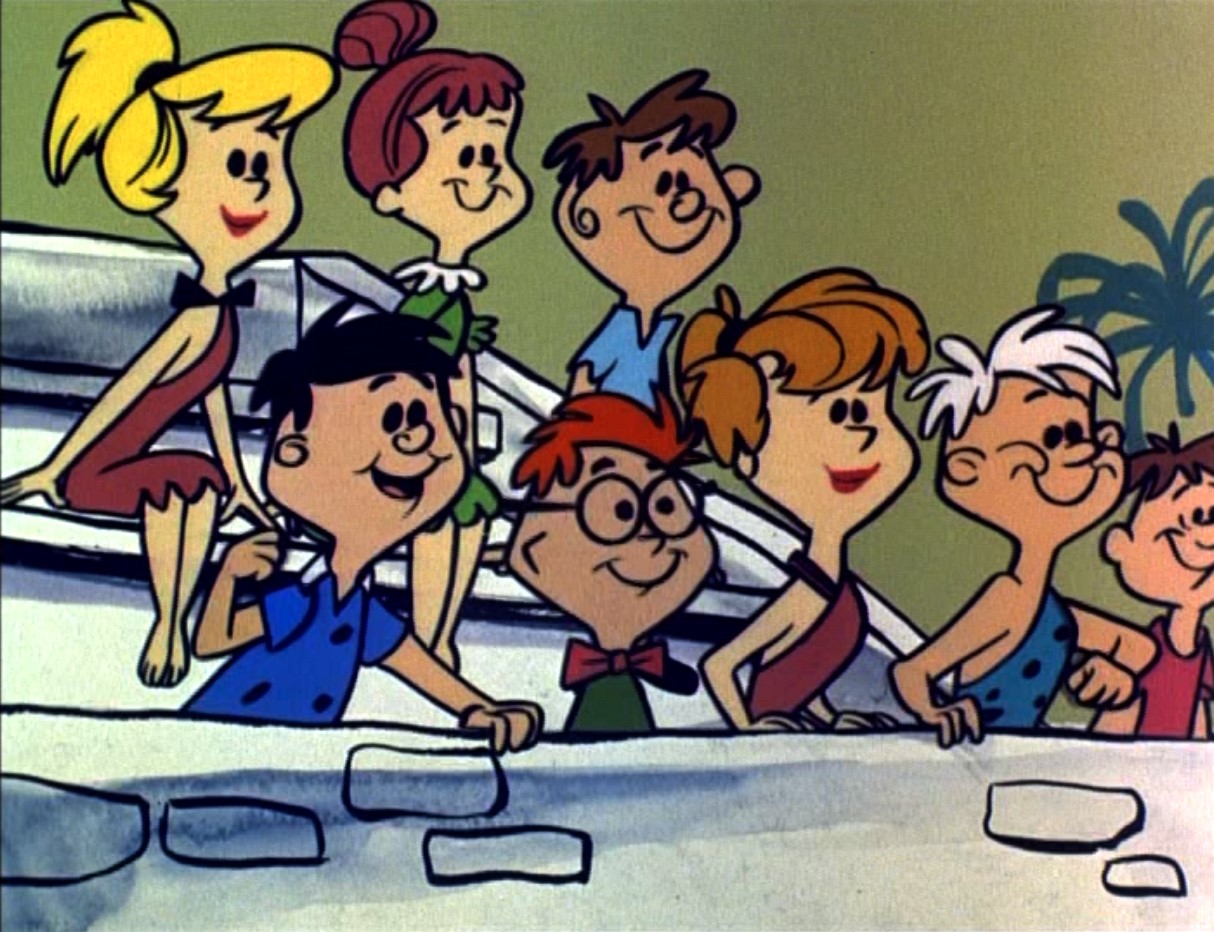
In ‘High School Fred’ Fred’s employer calls in an efficiency expert who tells Fred that he will be ‘terminated’ because he hasn’t got a high school diploma. But Fred’s boss lets Fred finish his missed last two weeks in high school, so he can stay. When Fred tries to tell Wilma all this, she misunderstands and thinks Fred goes to an executive school to get promoted.
Unfortunately, the writers do little with the high school premise and mostly show Fred excelling at sports. The whole episode is low on gags, the most bizarre being a throwaway gag of a roast bird preparing itself, while Barney and Betty are talking. There’s also a mini-mammoth used as a spray gun, and the occasional bird acting like a record player needle.
Watch an excerpt from ‘High School Fred’ yourself and tell me what you think:
This is The Flintstones Season Three episode 13
To the previous The Flintstones episode: Nuthin’ but the Tooth
To the next Flintstones episode: Dial “S” for Suspicion
‘High School Fred’ is available on the Blu-Ray ‘The Flintstones – The Complete Series’ and the DVD-box ‘The Flintstones Season 3’
Director: Shinichiro Ushijima
Release date: July 24, 2018
Rating: ★★★★
Review:
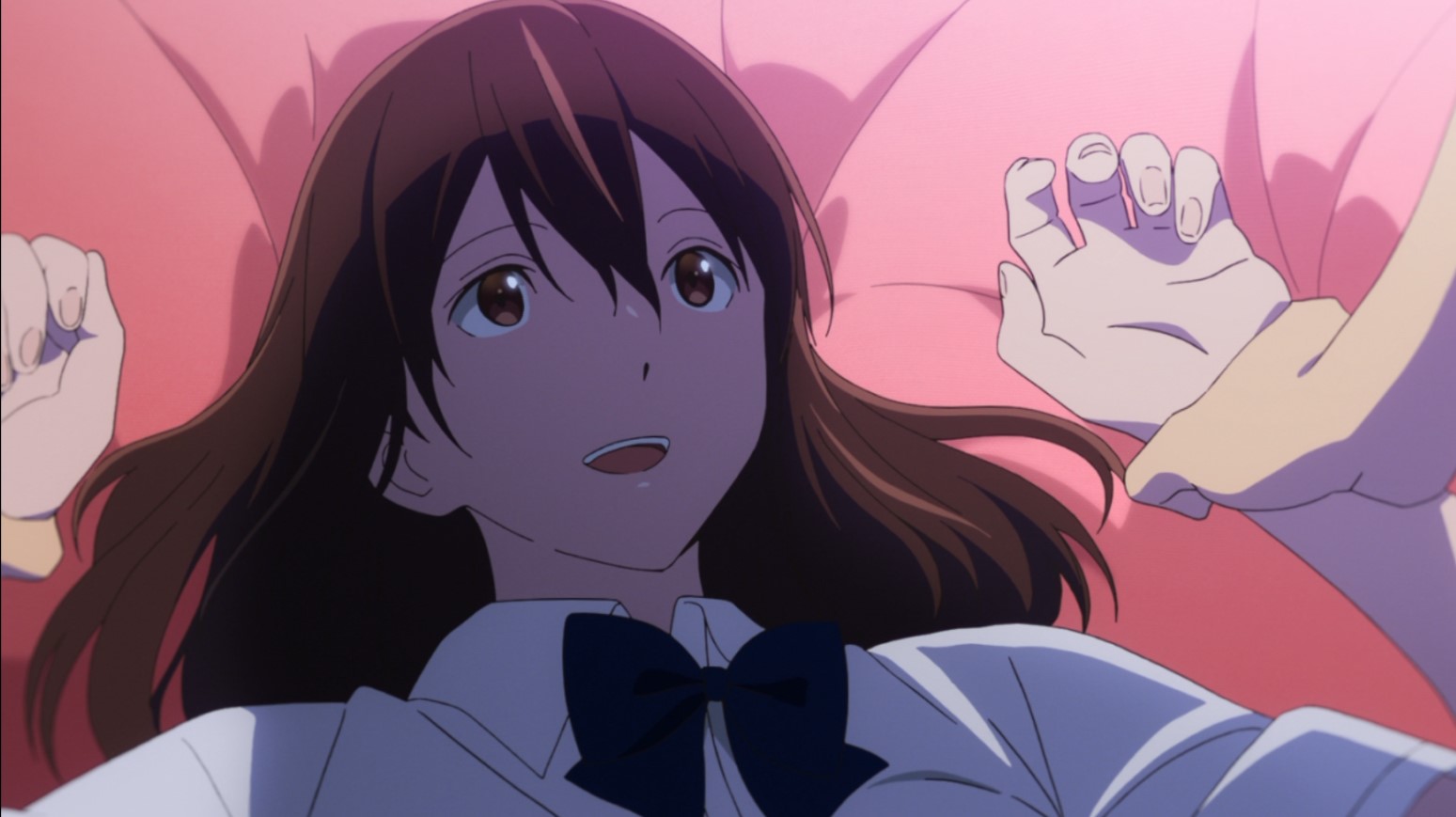
‘I Want to Eat You Pancreas’ is the first of only two animated feature films by the rather obscure Studio VOLN, which at least I had never heard of before. Studio VOLN isn’t even a big player in the television anime world, with only four series produced thus far. Strangely enough the studio made both its feature films in 2018.
The title of this film, which is a literal translation of the Japanese one, is a contender of the strangest film title of all time award, but what it means is revealed soon enough. The film is based on a novel, and as Japanese animation films often go, there’s nothing that implies the need for animation (except, maybe, for the long spiritual finale).
The film is told by a seventeen year old anonymous schoolboy (his name is only revealed in the very end). He tells about his surprising friendship with a fellow classmate, a girl called Sakura Yamauchi. Sakura is an apt name this character, as Sakura means ‘cherry blossom’, which is a symbol of impermanence in Japan, while the Sakura of the film is already dying from a pancreatic disease at her tender age of seventeen.
Sakura is a bit too much of a pixie girl, and although we also follow her own emotions and anxieties, it’s the story teller’s transformation through her influence that is the film’s focus. At the film’s start the unnamed narrator is a phlegmatic loner, always buried in a book, but indifferent to others and unwilling to commit himself to any relationship. Obviously, the extravert Sakura is going to change all that.
Highlight of this journey is a trip by the two to another town. Part of this trip is told in an original way by still images with dialogue on top, but even better are the scenes in the hotel, which are full of erotic tension. The film’s finale, on the other hand, with its overlong diary sequence is overblown and threatens to harm the complete film. Nevertheless, don’t forget to wait after the end titles!
Throughout, the background art and lighting are both of an extraordinary beauty, making the film a pleasant watch. The character designs, animation and soundtrack on the other hand are very generic and leave much to be desired. In fact, often the animation doesn’t transcend that of the average anime television series. There’s a little computer animation, but this is only used functionally on background art, traffic, fireworks, and such.
Even if the film is not the most interesting one in terms of animation, the film is (for most of the time) well-told, and its emotional tale does move. By all means the film shows that feature animation can be so much more than family entertainment, a message that is still lost on the American studio system.
Watch the trailer for ‘I Want to Eat You Pancreas’ yourself and tell me what you think:
‘I Want to Eat You Pancreas’ is available on Blu-Ray and DVD
Director: Gorō Miyazaki
Release date: July 17, 2011
Rating: ★★★★
Review:

Like ‘Ocean Waves’ (1993) and ‘Whisper of the Heart‘ (1995) ‘From Up on Poppy Hill’ is one of those Ghibli films that could do well without animation. There’s no fantasy or metamorphosis around. Instead, the film is a modest little human drama. In fact, the film has much in common with the two earlier Ghibli features. Like ‘Whisper of the Heart’ ‘From Upon Poppy Hill’ has a female teenager star, and like ‘Ocean Waves’ there’s a strong air of nostalgia pervading the movie, especially in the gorgeous and evocative background art.
‘From Upon Poppy Hill’ takes place in harbor town Yokohama, somewhere between 1961 and 1963, before the 1964 Summer Olympics in Tokyo and after the release of the melancholic song ‘I Look Up as I Walk’ by Japanese crooner Kyu Sakamoto, which is heard several times during the movie, and which even became famous in the West back then, with the silly and out-of-place title ‘the Sukiyaki song’.
‘From Upon Poppy Hill’ focuses on teenager Umi Matsuzaki who lives with her grandmother and little brother at a boarding house with five female boarders, for whom Umi cooks breakfast and dinner. Umi’s mother is a professor, who’s abroad most of the time, while her father, a seafarer, has died in the Korean war (1950-1953). Each day Umi raises some signal flags in remembrance of her father. These are seen by Shun Kazama, a schoolmate who works at a tugboat. Both Umi and Shun thus are hard working children, so typical for the Ghibli studio.
The story focuses on the love that grows between Umi and Shun, and some unforeseen complications it raises. But there’s also an important subplot in which Shun and his fellow students try to protect their old club house called ‘The Latin Quarter’ against demolishing. Only when Umi starts to help, leading an army of female students, the protest gains momentum. The clubhouse scenes provide some comic relief in an otherwise emotional deep and heart-breaking story of friendship, love, and loss.
It’s impressive how the film makers show the emotions in the subtlest of ways. For example, at one point Shun evades Umi’s presence, but we see her reaction to this neglect only sparingly on her face, and with the slightest of actions. Thus, when Umi finally lets her emotions flow, it hits the viewer all the harder.
Hayao Miyazaki’s son Gorō Miyazaki does an excellent job as a director, and the animation is top notch, especially on the main characters. There are a few flashback scenes and there’s a short dream sequence, but otherwise there’s a strong unity of time and place, with all the action taking place in only a few settings and in a limited time frame. The film thus stays focused all the time, even when showing minor deviations from the main plot, like one of the boarders leaving the house.
In all, ‘From Upon Poppy Hill’ may be a modest film, in its emotional depth it’s in no way less impressive than the studio’s more outlandish masterpieces like ‘Spirited Away’ (2001) or ‘Ponyo on the Cliff by the Sea’ (2008). Highly recommended.
Watch the trailer for ‘From Up on Poppy Hill’ yourself and tell me what you think:
‘From Up on Poppy Hill’ is available on Blu-Ray and DVD
Director: Igor Kovalyov
Stars: Duckman
Airing Date: May 7, 1994
Rating: ★★★½

Russian independent animation master Igor Kovalyov directs this erotically charged episode in which Duckman’s son Ajax falls in love.
The story features a very unlikely undercover investigation by Duckman and Cornfed dressed as ‘teenagers’ in Ajax’s school. More convincing and more importantly to the series is the search for Ajax by Aunt Bernice and Duckman in some honeymoon town in Mexico.
Duckman is more lustful than ever in this episode, which expands on both his relationship with Aunt Bernice as with his son, Ajax. Cornfed, on the other hand, is hardly present. His best gag is when he’s in a tree together with Duckman, spying on Ajax’s vice principle, fooling Duckman with describing erotic images to drive the latter’s lust to a boil.
The whole episode bursts with sex without revealing anything, and certainly is one of the most adult of all Duckman episodes, even if Duckman’s own desires and objectifications of women are rather juvenile.
Watch ‘It’s the Thing of the Principal’ yourself and tell me what you think:
This is Duckman episode no. 9
To the previous Duckman episode: Not So Easy Riders
To the next Duckman episode: Cellar Beware
‘It’s the Thing of the Principal’ is available on the DVD-box ‘Duckman – The Complete Series’
Director: Tomomi Mochizuki
Release Date: December 25, 1993
Rating: ★★★★½
 ‘Ocean Waves’ was an animated feature the Studio Ghibli made for television. It’s also one of those Japanese animation films that could pretty well be made in live action.
According to Wikipedia the film was an attempt by Studio Ghibli to allow their younger staff members to make a film reasonably cheaply. So, it may not come to a surprise that the film is a little underwhelming when compared to contemporary Ghibli films like ‘Porco Rosso‘ (1992) or ‘Pom Poko‘ (1994), let alone later masterpieces like ‘Princess Mononoke’ (1997) or ‘Spirited Away‘ (2001).
But taken on its own, ‘Ocean Waves’ is a very nicely told tale of high school romance, full of nostalgia, especially in its depiction of hot summers. The film takes place in Kōchi, on the Southern island of Shikoku. The film is told by Taku, now a student at a University in Tokyo. He reminisces about his high school friendship with bespectacled Matsuno Yutaka, and how he met the erratic girl Muto Rikako.
Rikako clearly is a troubled girl: she has moved to Kōchi from Tokyo, only with her mother and brother, and she hardly makes friends. Yutaka is clearly interested in her, raising jealousy in Taku, but it’s Taku who ends up in an all too improvised trip to Tokyo with Rikako, who wants to see her father again. The trip turns into a disaster, and Rikako even unwillingly manages to separate the two friends, but the film ends on a high note, even if years later.
The film’s style is very understated: only little is spoken out, and most of the feelings transgress through body gestures. Rikako remains enigmatic to the very end, and Taku blunders through his meetings with her. The film remains highly realistic, and the characters believable throughout.
‘Ocean Waves’ may not be a Ghibli masterpiece, it’s still a gentle animation film, well worth seeing.
Watch the trailer for ‘Ocean Waves’ yourself and tell me what you think:
‘Ocean Waves’ is available on DVD and Blu-Ray


 Dr. Grob's Animation Review