You are currently browsing the tag archive for the ‘jews’ tag.
Director: Ralph Bakshi
Release date: August 8, 1973
Rating: ★★
Review:
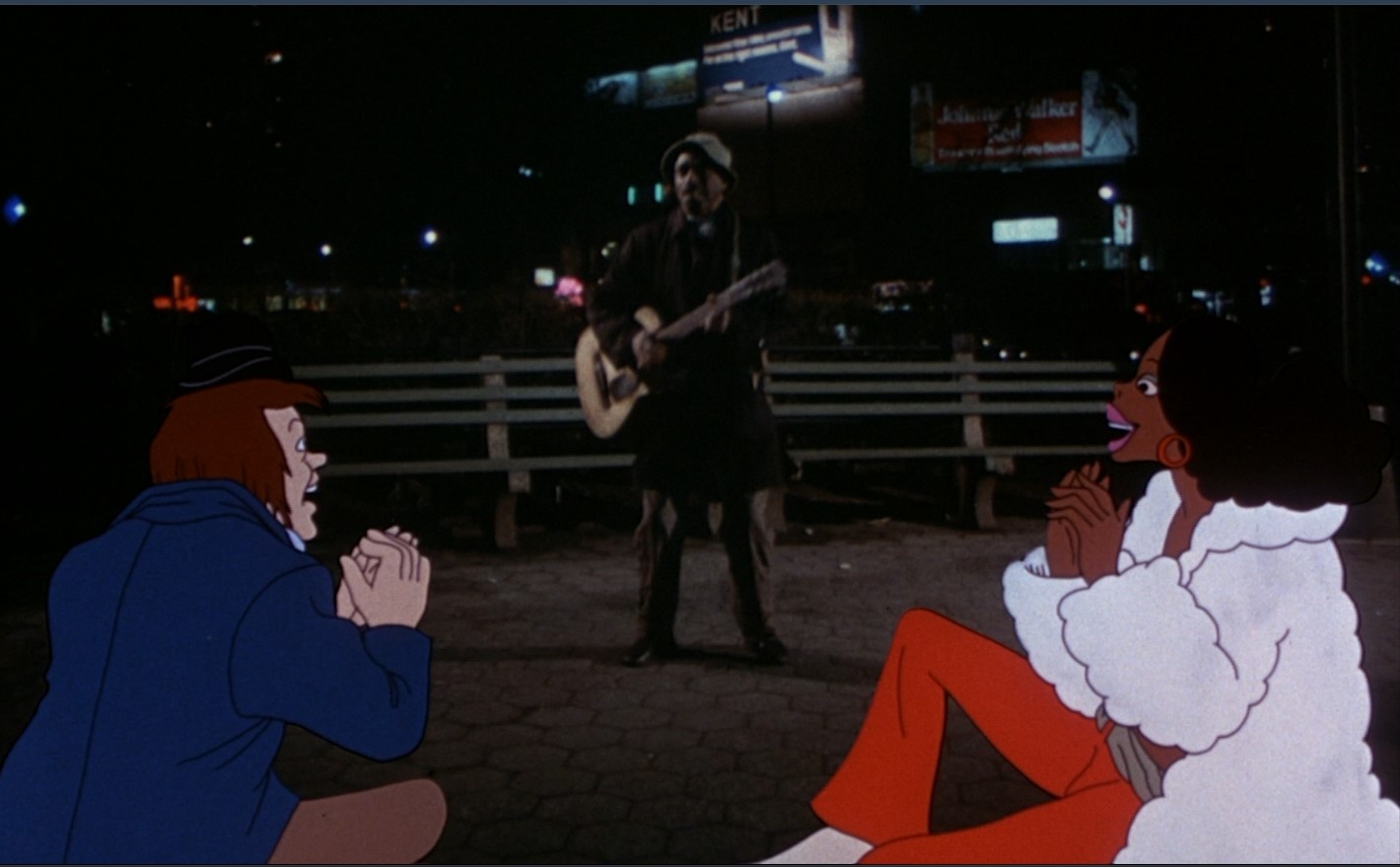
Ralph Bakshi arrived on the scene when American classic studio animation was in steady decline, reaching its low point in the 1970s and early 1980s. In this dry period, Bakshi tried to reinject classic animation with new energy, most notably by ripping it of its association with children. Now, in the golden age animation never had been solely associated with children, but due to the advent of the Saturday-morning cartoon in the mid-1960s American animation more and more became something just for kids.
Bakshi, on the other hand, saw the full potential of the medium, and enriched the animation world with several animated features aimed at adult audiences, thus bypassing the middle ground of the family film, which was Disney’s monopoly at the time, anyway. Thus, Bakshi is sometimes seen as the savior of animation during the medium’s dark ages, but I find it hard to subscribe to that opinion, and that’s because his films are sadly just not good.
Now, I will not talk about the abysmal ‘The Lord of the Rings’ (1977), which is a disgrace to the medium, but even ‘Heavy Traffic’, his supposed masterpiece, fails on several key features.
‘Heavy Traffic’ was written by Bakshi himself and has strong autobiographical elements. Set in New York the feature film tells of Michael Corleone, a young and aspiring underground cartoonist, who stills live with his quarreling parents (a Jewish mother and an Italian father), and who dates a black girl called Carole.
The film uses a voice over and the images of a pinball machine as bridging elements, but this cannot hide the fact that the film is a loose bag of scenes, and hardly goes anywhere. Sure, the film is depressing and draws a dark picture of the Big Apple, but its fourteen scenes have little to do with each other and are more about atmosphere than storytelling.
It certainly doesn’t help that none of the characters are remotely sympathetic. Even Michael himself, our supposed hero, is more of a self-centered jerk than anything else. For example, the comics he shows a publisher, wouldn’t interest anyone with a sane mind.
Worse, ‘Heavy Traffic’ falls for the misguided idea that making a film for an adult audience means it must contain sex and violence. ‘Heavy Traffic’ was not the first film to fall into this trap, and certainly not the last one (the unappealing ‘Sausage Party’ from 2016 comes to mind), but Bakshi clearly indulges in both, not only in this film, but also in ‘Fritz the Cat’ from the year before, ‘Wizards’ (1977) and ‘Cool World’ (1992), to name a few, which, to me, only proofs his immaturity. In ‘Heavy Traffic’, for example, bare breasts pop up from everywhere, with little other purpose than arousing the male audience.
Bakshi’s character designs are a mixed bag, sometimes reminiscent of the work of Mort Walker, as in the design of Michael’s father, at other times very cartoony, and reminiscent of DePatie-Freleng (e.g. the gay drag queen Snowflake), at other times quasi-realistic (Carole). Especially ill-conceived is Michael himself, whose quasi-realistic design is as mediocre as it is unappealing.
The background art too is a strange mix of drawings and photographs to a gritty effect. There are even some real live action footage elements from old films, like ‘Red Dust’ (1932) and ‘The Gang’s All Here’ (1943). In the end, the characters change into their live action counterparts, and suddenly one asks himself why this gritty film was not filmed in live action in the first place, as Bakshi’s animation adds surprisingly little.
Now, ‘Heavy Traffic’’s animator list features such illustrious names like Tom Ray, Carlo Vinci, Irv Spence, Manny Gould and Dave Tendlar, and it’s admirable that Bakshi kept these animation greats at work, but I doubt how many people watch ‘Heavy Traffic’ for its beautiful animation, for there’s hardly any. There’s manic animation, there’s outrageous animation, there’s fair animation, and there’s a lot of rotoscoping, but I’d prefer ‘Robin Hood’ from the same year anytime, even if that is the poorest of all classic Disney features.
For a supposed masterpiece, ‘Heavy Traffic’ feels like a sad affair, wasting a lot of animation talent on an egotistical document too heavy-handed for its own good, a film that is as depressing as it is boring and unappealing.
No, to me, Bakshi was more like the wrong guy at the right time: he could not save animation, for he lacked both the talent and the vision to do so. His films never transcend the dark ages, but are firmly rooted in them, and because of Bakshi’s limited view on what an adult film can be, the whole concept never really took off in the United States. This is an infinite pity, for this is one of the reasons we still must deal with the narrowminded view of animation being equal to family entertainment, today.
Watch the theatrical trailer for ‘Heavy Traffic yourself and tell me what you think:
‘Heavy Traffic’ is available on Blu-Ray and DVD
Directors: Joann Sfarr & Antoine Delesvaux
Release date: June 1, 2011
Rating: ★★½
Review:

‘Le chat du Rabbin’ is the film version of the comic strip series of the same name, which comprises eleven volumes thus far. At the time the film was made there were five albums, and the film retells the contents of volume one, two and five very faithfully, with a lot of panels and dialogue being transformed directly from comic strip drawings to film scenes.
Perhaps this is no wonder, as the comic’s author Joann Sfar co-directed the film. He must have had an important vote in the production, because the film flawlessly transcends Sfar’s idiosyncratic drawings to the animated screen.
‘Le chat du rabbin’ is set in Algiers, the capital of Algeria, when it was still a French colony. It’s a little hard to date the time setting of the film, but because carbon dating is mentioned and because of the presence of jazz guitarist Django Reinhardt this limits the time period between 1947 and 1953. In Algiers, the French, Jews, and Muslims all live together harmoniously, and we follow a rabbi of the Sephardic community, and his cat, who turns into a talking creature after swallowing a parrot.
It’s the cat who is the narrator of the film, and we see the events often through his eyes, although, unfortunately, this isn’t maintained consequently. The scenes with the talking cat, mostly recreating the first book, are the film’s best, for the cat turns out to be a skeptic and he asks his master philosophical and theological questions, which are all valid, but drive the poor rabbi mad.
Unfortunately, not only the cat, but the whole movie is rather talkative, and far too dialogue rich, a problem all too common in all French cinema. But this is not the movie’s main problem. No, regrettably, the film also shares the many story problems of the original comic books. Sfar seems to have started his comic book series without a plan, and the volumes are highly different in tone and content. Story ideas are introduced and dropped, and there’s a frustrating lack of focus.
The same accounts for the film. For example, halfway the cat loses his speech again, and with the film immediately loses its main attraction. Even worse, the most interesting character of both the comic books and the film is Zlabya, the rabbi’s daughter, but she lacks a story arc, and is rarely seen, especially during the second half of the film, which focuses on the contents of volume five, in which the attention shifts to a far less interesting character of Russian origin in search of a mythical city of Jews somewhere in Ethiopia. With this part we also leave Algiers and all hope of a consistent story. I actually find the Russian’s quest utterly boring, and I wish the film makers dared to stay in Algiers and tell more about Zlabya. What certainly doesn’t help is an irritating and incomprehensible encounter with famous comic book character Tintin, who turns out to be a complete dork in this film.
The film’s designs are delightful, transferring Sfar’s sketchy comic book’s drawings very well, and applying very attractive color schemes, which evoke the subtropical, Mediterranean, and North African settings excellently. Especially the background art is gorgeous. Although heavily hatched, and thus very graphical, the animation reads very well against those background drawings, and it’s nice to see such a consistency of style from animated drawings to background art. There are even some very attractive Van Gogh influences visible in some of the night scenes.Olivier Davaud’s music, too, attributes to the Arabian atmosphere, with its quasi-Arabic style elements.
The animation, on the other hand, is not always that good. For example, when Zlabya plays the piano, the animation and the music aren’t in tune, at all. The animation is at its best when deviating from realism, as in the cat’s dream. In this dream sequence a bolder style is explored, with a lot of metamorphosis, absent from the rest of the film. The finale, too, explores a bolder style, just like the comic book does in these scenes, and I guess with this Sfar tries to tell us by then we’ve abandoned reality and entered the realm of tall tales. These scenes are certainly interesting to look at, but as said before, by then I at least had lost all interest already.
In all, ‘Le chat du Rabbin’ is a visually very attractive film, showing what traditional animation still can do in terms of original styling, but its rambling tale and its lack of focus make the film a frustrating watch. But to be honest, when reading the original comic strips one will experience the same frustration, thus the original source material is to blame. One wishes Sfar was as good a story teller as a visual artist, but let’s face it, he isn’t.
Watch the trailer for ‘Le chat du Rabbin’ yourself and tell me what you think:
‘Le chat du Rabbin’ is available on Blu-Ray and DVD


 Dr. Grob's Animation Review