
You are currently browsing the tag archive for the ‘prison’ tag.
Director: Nora Twomey
Release date: September 8, 2017
Rating: ★★★★★
Review:

2017 was a good year for the animated feature film: Warner Bros., Dreamworks and the French Polivari and Panique studios gave us great laughs with ‘The Lego Batman Movie’, ‘Captain Underpants: The First Epic Movie’, and ‘ Le grand méchant renard et autres contes…’ (The Big Bad Fox and Other Tales), respectively; Pixar amazed us with the magnificent ‘Coco’, and the Japanese Science Saru studio made quite an impression with the mind-blowing film‘Night Is Short, Walk on Girl’.
However, the most important and most moving animated feature film was the Irish-Canadian-Luxembourgian co-production ‘The Breadwinner’. This was the third feature by the Irish Cartoon Saloon studio, which can be regarded as the most welcome and most original studio additions to the animated feature field of the 21st century, thus far. The Breadwinner’ shares with their previous two films, ‘The Secret of Kells’ (2009) and ‘The ‘Song of the Sea’ (2014) a very charming traditional animation style, and a surprisingly graphic overall design, although the latter is rather toned down in ‘The Breadwinner‘ when compared to the earlier two movies. But unlike the other two, ‘The Breadwinner’ completely lacks the Irish flavor, being set in, of all places, Afghanistan.
Based on the book by Deborah Ellis from 2000 ‘The Breadwinner’ is set in Kabul, the unfortunate country’s capital during the first Islamic Emirate of Afghanistan (better known as the Taliban regime, 1996-2001). By the time the film was made, this extremely oppressive regime was a ghost of the past, at least in Kabul (the Taliban never fully disappeared from the country), but sadly, since August 2021 this misogynist, backward movement is in full charge of the country, once again.
‘The Breadwinner’ makes no mistake how hard it is to live in such a violent, insecure country, where arbitrariness prevails, and where women have no rights, at all, whatsoever. The film follows the eleven-year-old Afghan girl Parvana, who lives with her disabled father, her mother, elder sister Soraya, and a baby brother called Zaki in a tiny house in Kabul. When the father gets arrested and thrown into a prison far outside town, the family quickly get into way more problems than they already had: as women cannot do anything outside without a man, their means to even obtain food completely come to a standstill. At this point Parvana takes an important decision to save her family’s life…
‘The Breadwinner’ is a very believable story, much more subtle than almost anything coming out of the United States. For example, the Afghan people are portrayed as real people, with a rich an ancient culture. Added to the sense of authenticity is the use of Afghan voices (except for the brabbling Zaki), while Mychael and Jeff Danna’s score clearly borrows from the Afghan musical tradition. Thus, the film’s Afghanistan is a convincing one, not a caricature seen through Western eyes. Moreover, although the film makes no mistake about the oppressive and misogynist nature of the Taliban regime, there are many shades of gray between the heroes and villains. Even the villain that causes Parvana’s family’s demise is shown in one last shot as not only evil, but insecure and afraid, too. Moreover, Parvana remains a relatable character, throughout. Despite her courage and adult responsibility, she remains a child, and is shown delighting in childish behavior, especially with her friend Shauzia.
Contrasted with Parvana’s dire circumstances are the images of a story she tells her beloved (her first audience is her baby brother, but she also tells the tale to others, and others even blend in, altering the direction of the story while doing so. These images are rendered in the most colorful, storybook illustration-like, faux cut-out animation, and tell about a boy who goes on a quest to retrieve his village’s seeds from an evil elephant king. This fantastical tale is picked up several times during the movie, and often reflects the events depicted in real life. Especially in the finale, in which the two seem to come together, this dual story telling comes to a harrowing conclusion.
As said, the film’s design is less graphic than that of Cartoon Saloon’s Celtic features. The background art is semi-realistic, with depressing greys, browns and yellows depicting the seemingly treeless town of Kabul. The character design is more graphic, with especially Zaki being an echo of the character designs from the earlier films. Noteworthy is the background art of a rather surreal scene in which Parvana and Shauzia are seen in a field full of abandoned tanks. The traditional animation is a delight, not only the very moving animation of the main characters, but also the cartoony quasi-cut-out animation of Parvana’s story. There’s only a little computer animation present, mostly for crowd scenes.
In all, ‘The Breadwinner’ is one of the best, most adult and most moving animation films to come out of any animation studio, and should be considered a modern classic.
According to director Nora Twomey ‘The Breadwinner’ may be set in Afghanistan but tells a universal story of all children growing up in oppressive countries, everywhere. Yet, we are still waiting for the animated depictions of their stories, while Afghanistan has been the subject of no less than three other animated feature films since then: ‘The Swallows of Kabul’ from 2019 and ‘My Sunny Maad’ and ‘Flee’ from 2021. Surely, the people of say North Korea, Syria, Eritrea, the Central African Republic, or Yemen deserve better.
Watch the trailer for ‘The Breadwinner’ yourself and tell me what you think:
‘The Breadwinner’ is available on Blu-Ray and DVD
Directors: Pierre Coffin & Kyle Balda
Release date: June 14, 2017
Rating: ★★★
Review:

The third installment of the Despicable Me franchise (not counting the spin-off ‘Minions‘ from 2015) is also the weakest of the trio. Like the other two the film is a fun ride, full of humor and action, but this time the film makers simply wanted to tell too much in one film. There are no less than six plot lines in this film divided over different main characters.
The first, and most enjoyable one considers Gru and his apparent arch nemesis Evil Bratt, a former child-actor from the 1980s gone bad. Evil Bratt, excellently voiced by Trey Parker of South Park fame, is a delightful villain, and the film makers indulge in 1980s tropes to make this character. For example, Evil Bratt sports a mustache and a mullet, and his weapons are based e.g., on bubblegum, Rubik’s cube, and a keytar. Moreover, whenever he appears, he’s accompanied by a 1980s hit, e.g., ‘Jump’ by Van Halen, ‘Take on Me’ by A-Ha, ‘Into the Groove’ by Madonna, and even ’99 Luftballons’ by German star Nena. The film immediately starts with this character, and it’s thanks to this wonderful villain that ‘Despicable me 3’ keeps on the right side between failure and entertainment, if barely so.
Much less interesting are the other story lines: Gru and Lucy are fired, and Gru desperately tries to get his former job back. In a third and totally unexpected twist Gru suddenly discovers he has a twin brother (also voiced by Steve Carrell, voice of Gru), who wants to be a villain, like Gru used to be, but who clearly lacks the skills. The fourth story line involves the minions, who walk out of Gru, a fifth involves Agnes (the youngest of Gru’s three adopted children) and her wish to see a unicorn. And the sixth is about Lucy, and how she tries to be a substitute mom for the girls, especially to Margo, the eldest of the three.
Now, the first three plot lines, all involving Gru, at least intertwine into one, albeit rather loose narrative, but the other three feel forced and superfluous: they’re only there to give the other characters something to do. And even then, Judith, the middle one, is lost in the plot.
Much of the action takes place in ‘Freedonia’ (a clear nod to the Marx Brothers), while the finale takes place in Hollywood. Freedonia clearly is modelled as some French Mediterranean island, and betrays the Illumination studio’s French origin.
The character animation, like in the other installments, is delightfully cartoony and over the top, and better suited for the broad comedy than for the more subtle moments, and only Margo is animated straight, acting like a normal girl, and not like a cartoon character. By now, the effect animation is so good that one hardly notices. For example, the water and smoke animation is excellent and feels so natural, one easily forgets it’s animated, too. I also liked how the film makers made the 1980s Evil Bratt episodes look like old video recordings. The cinematography, too, is top notch, throughout.
But all the quality cannot rescue an overcrowded film that scores high on action, but very low on originality and heart. There’s even an obligatory breakup scene, which feels extra unnecessary, because it lasts so shortly. ‘Despicable Me 3’ is well made, but also mediocre, and with the exception of Evil Bratt, forgettable.
Watch the trailer for ‘Despicable Me 3’ yourself and tell me what you think:
‘Despicable Me 3’ is available on Blu-Ray and DVD
Directors: Stephan Schesch & Sarah Clara Weber
Release Date: June 8, 2012
Rating: ★★★½
Review:
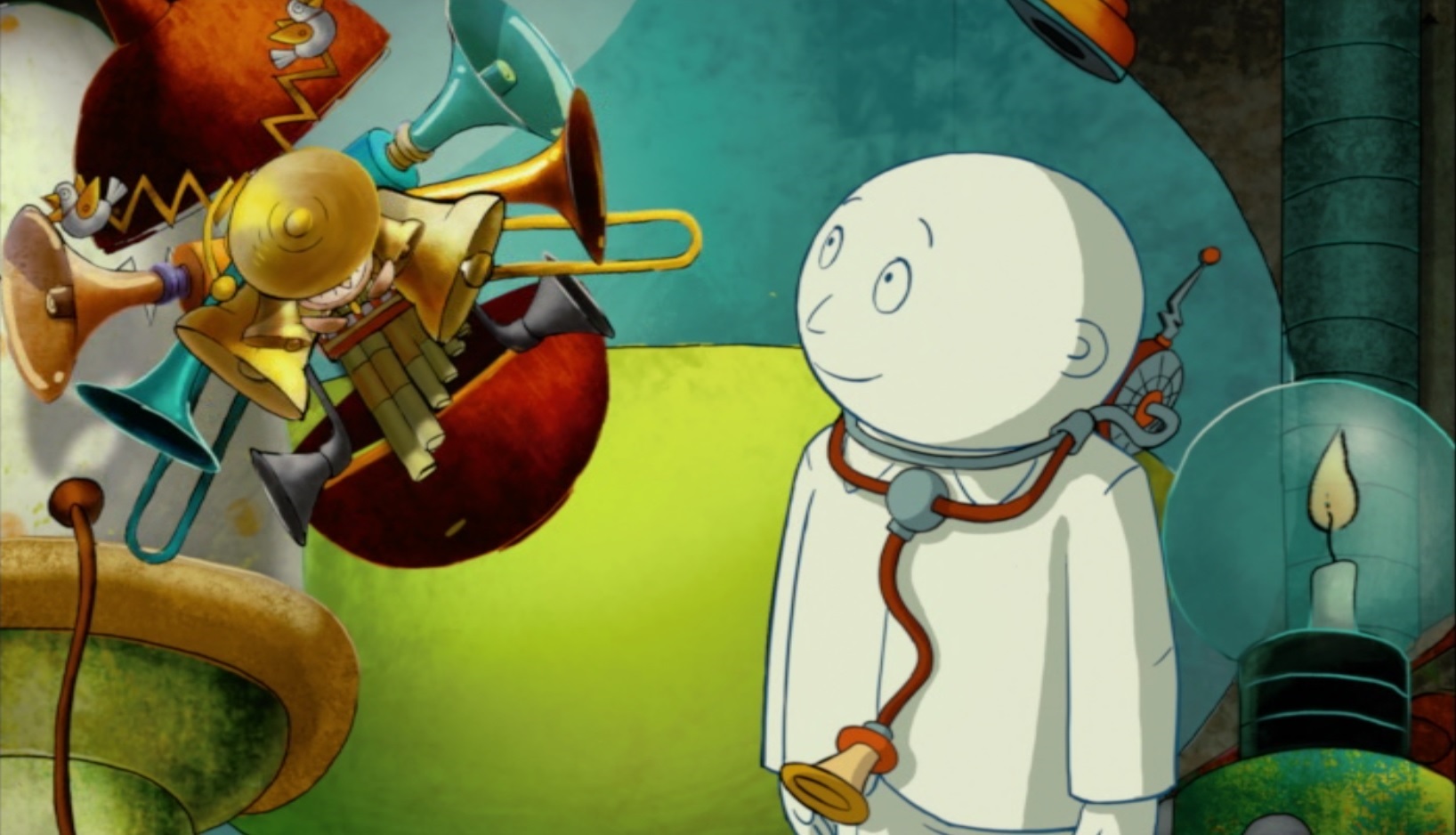
Germany is the biggest economy of Europe, but as producer of animation it’s a surprisingly minor player, especially when compared to France. It certainly didn’t help that the Nazi regime virtually wiped out all art life, and that from 1949 until 1991 the country was split into two.
When I think of post-war German animation I immediately think of Die Maus (The Mouse), the silent host of the educational children program ‘Die Sendung mit der Maus’, and of die Mainzelmännchen, the six little guys who embellish advertising blocks on German television since 1963. Germany also boasts some major independent animation artists, like Raimond Krumme, Andreas Hykade and Gil Alkabetz, but otherwise the country produces mostly rather listless feature films which make no impression whatsoever.
So it came as a surprise to me to find in a department store in Berlin an animated film based on a children’s book by Tomi Ungerer, one of the greatest children’s book artists in the world. Even more surprisingly, this is not the first German feature film based on his work. In 2007 Animation X Gesellschaft zur Produktion von Animationsfilmen mbH released a film based on Ungerer’s classic ‘Die drei Räuber’ (The Three Robbers) from 1961. I certainly wish to see that film, too, because ‘Der Mondmann’ is a pleasant surprise.
This feature film is much more elaborate than Ungerer’s original children’s book from 1966 (which Gene Deitch already turned into an animated short in 1981), but the character designs of the moon man and the children are very faithful to Ungerer’s artwork. Even better, Ungerer himself appears as the narrator of the tale (although his voice over is hardly used in the film). The adult characters, however, are more removed from Ungerer’s style, as is the extraordinarily colorful background art, which has a trace of surrealism to it. The looks of the film are on the verge of independent animation, but remain friendly and inviting nonetheless.
The story tells about the moon man, who occupies the complete sphere of the moon, and who is bored to death inside this cramped space. One day he grabs the tail of a fiery comet and descends to earth, hoping for some excitement. The shots of the moon man discovering animals and plants are particularly delightful. Earth, meanwhile, has apparently been occupied by a rather fascist looking regime (a great take is that its flag features a flag). The world president mourns he has conquered the complete world, and has nothing left to conquer, until some lady suggests to conquer the moon. Apparently, in this parallel universe space travel has not been invented, yet, while for example cell phones have.
The world depicted thus is not entirely ours, and this adds to the atmosphere of surrealism, as do several odd side gags that enter the screen and which are completely unrelated to the story. This type of throwaway gags are reminiscent of ‘La planète sauvage’ (Fantastic Planet) from 1973, and indeed, ‘Der Mondmann’ has something in common with that strange film, even if it is much friendlier, and less bizarre. These gags keep the adult audience awake in a film that is otherwise clearly directed to children. There’s also a running gag of a military officer who keeps saying “höchst bedauerlich”(most regrettable) as answers to the president’s complaints.
Anyway, both the Moon Man and the president turn to an inventor called Bunsen van der Dunkel to bring them to the moon. The moon man all too quickly discovers that Earth is not an entirely welcome place, and he discovers his role in the lives of children, who cannot sleep without him watching over them. The central theme of the film is what it means to be friends, something both Bunsen van der Dunkel and the Moon Man discover during the film.
‘Der Mondmann’ is well-told, focusing on only a handful characters, but it is also one of those delightful non-American feature animation films completely throwing American story rules overboard. For example, the film stars a father and his daughter travelling inside an American 1950s cabriolet. The two return several times during the film, but are only marginally involved in the plot. Despite being a children’s film there’s also a clear suggestion of a sex scene. The music choice, too, is pretty idiosyncratic, with important roles for the songs ‘Moon River’ sung by Louis Armstrong and ‘In-A-Gadda-Da-Vida’ by Iron Butterfly.
In all, ‘Der Mondmann’ is arguably the greatest animated feature film to come from Germany in the 2010s and well worth a watch, especially because it is available with English subtitles.
‘Der Mondmann’ is available on Blu-Ray and DVD
Directors: William Hanna & Joseph Barbera
Release Date: June 6, 1958
Stars: Tom & Jerry, Nibbles
Rating: ★★★½
Review:
 ‘Robin Hoodwinked’ is similar to Tom & Jerry’s four musketeer cartoons, but this time Jerry and Little Nibbles belong to Robin Hood’s merry men.
Alas! Poor Robin Hood has been locked inside the sheriff’s prison, so Jerry and Little Nibbles go to the rescue. Unfortunately, the prison is guarded by Tom. At one point Tom swallows the key, and Nibbles goes inside the sleeping Tom to retrieve it. This makes Tom getting the hiccups, and he swallows a jug of wine to stop them. Of course, Nibbles gets drunk, and at one point we watch him reappearing from Tom’s mouth, singing ‘The Bonnie Banks o’ Loch Lomond’. Unfortunately, the rest of the cartoon doesn’t build on this story idea, and all too soon Robin is rescued.
‘Robin Hoodwinked’ is not a bad cartoon, but rather routine and uninspired. Nibbles, who makes his twelfth and last screen appearance in this cartoon, speaks with an English accent in this short.
Watch ‘Robin Hoodwinked’ yourself and tell me what you think:
https://www.dailymotion.com/video/x3xzuvg
This is Tom & Jerry cartoon No. 113
To the previous Tom & Jerry cartoon: The Vanishing Duck
To the next Tom & Jerry cartoon: Tot Watchers
‘Robin Hoodwinked’ is available on the European DVD Box set ‘Tom and Jerry Collection’
Director: Dave Fleischer
Release Date: July 29, 1932
Stars: Betty Boop, Ethel Merman
Rating: ★
Review:
 ‘You Try Somebody Else’ is a screen song with Ethel Merman featuring the rather sentimental title song.
The cartoon opens with a cat being released from prison. He immediately sneaks into a house, emptying a fridge and almost eating a fish, the fish’s wife and his children. But then the owner enters, who turns out to be Betty Boop with a shotgun.
Soon the cat is back in prison again, where he reads the newspaper, with the picture of Ethel Merman in it, who immediately starts singing. The second chorus is accompanied by several prison gags, culminating in a jailbreak. In the end we watch four escaped convicts singing the song in a streetcar, all on electric chairs…
‘You try Somebody Else’ is a typical, yet mediocre Screen Song. Despite Betty Boop’s short cameo in the introduction, the second chorus is the most interesting part to watch, with its combination of silly and morbid gags.
Watch ‘You try Somebody Else’ yourself and tell me what you think:
‘You try Somebody Else’ is available on the French DVD Box Set ‘Betty Boop Coffret Collector’
Director: Burt Gillett
Release Date: August 18, 1930
Stars: Mickey Mouse, Peg Leg Pete, (Pluto)
Rating: ★★½
Review:
 In ‘Gallopin’ Gaucho‘ Mickey had been depicted as a bandit, but it still comes as a surprise to see him being a prisoner in ‘The Chain Gang’. We’re sure some injustice has been done, and that Mickey is in fact innocent…
Mickey is imprisoned in a mixed prison (one of the inmates is a cow), where Peg Leg Pete is one of the guards. When Pete goes to sleep Mickey brings out his harmonica, like he did in ‘The Shindig‘ one month earlier, and starts playing Vernon Dalhart’s 1924 hit ‘The Prisoner’s Song’.
This leads to an unremarkable sing-and-dance-routine, which abruptly ends in a massive jailbreak. Mickey escapes, but is followed by two bloodhounds, possibly the most elaborately designed dogs hitherto. Animated by Norm Ferguson, these bloodhounds would become the prototype of Pluto later on. Indeed, the animation of the blood hound approaching and sniffing into the camera was reused for Pluto as late as 1939 for ‘The Pointer’. The real Pluto would appear on the screen two months later in ‘The Picnic‘, and even then he still was called ‘Rover’.
The ‘birth’ of Pluto is the single most important feature of this cartoon, although it’s also noteworthy for the presence of gags involving recurring characters (something pretty new at the time), and for the chase scenes, which contain some nice perspective effects.
Watch ‘The Chain Gang’ yourself and tell me what you think:
This is Mickey Mouse cartoon No. 21
To the previous Mickey Mouse cartoon: The Shindig
To the next Mickey Mouse cartoon: The Gorilla Mystery
‘The Chain Gang’ is available on the DVD ‘Walt Disney Treasures: ‘Mickey Mouse in black and white’
Director: Friz Freleng
Release Date: April 22, 1950
Stars: Bugs Bunny, Yosemite Sam
Rating: ★★★★★
Review:
 To escape some hunters, Bugs Bunny hides inside a prison, where Sam Schultz (Yosemite Sam) is a prison guard.
What follows is a great series of prison gags, including two morbid ones resulting in Sam hanging on the gallows and being electrified in an electric chair. Throughout the cartoon the warden keeps calling for Schultz, not unlike the Nazi officer in the Ernst Lubitsch feature ‘To Be Or Not To Be’ (1942).
‘Big House Bunny’ is full of excellent gags and Freleng’s timing is superb throughout, making ‘Big House Bunny’ one of those little known masterpieces.
Watch ‘Big House Bunny’ yourself and tell me what you think:
https://www.dailymotion.com/video/x2l293q
‘Big House Bunny’ is available on the DVD set ‘Looney Tunes Golden Collection, Vol. 1’
This is Bugs Bunny cartoon No. 71
To the previous Bugs Bunny cartoon: Homeless Hare
To the next Bugs Bunny cartoon: What’s Up, Doc?


 Dr. Grob's Animation Review