You are currently browsing the tag archive for the ‘Wilfred Jackson’ tag.
Director: Wilfred Jackson
Release Date: May 16, 1931
Rating: ★★★★½
Review:
 Although this cartoon is one of those Silly Symphonies from 1931 using the half dance-routine half story formula, it is one of the most beautiful and most entertaining Silly Symphonies of the era.
The film is inspired by a Western view on a mythical ancient China. The film is without any dialogue and makes effective use of Albert Ketèlbey’s musical piece ‘In a Chinese Temple garden’ to create an oriental atmosphere. It tells a simple story of a little fisherman who saves a girl from drowning, falls in love with her and rescues her from an evil mandarin and a large (Western and fire-breathing) dragon.
After ‘Mother Goose Melodies‘ this is the studio’s second take at the human figure. The result is a mixed bag. The heroin’s movements are still cartoony, for example, and she walks with her knees sideways. Even worse, the long-legged China-man has no hint of realism at all. Moreover, the hero’s size is quite inconsistent, suddenly becoming very small when fighting the evil mandarin. On the other hand, the boy and girl are elegantly drawn, especially their hands. The two easily gain the audience’s sympathy and transcend the stereotypes that occupy most of the film.
Together with ‘Mother Goose Melodies’, ‘The China Plate’ is the most elaborate of the early Silly Symphonies. It’s surprisingly fast-paced and full of action. The complete cartoon is one of sheer delight.
Watch ‘The China Plate’ yourself and tell me what you think:
This is Silly Symphony No. 18
To the previous Silly Symphony: Mother Goose Melodies
To the next Silly Symphony: The Busy Beavers
Director: Wilfred Jackson
Release Date: February 23, 1935
Stars: Clarabelle Cow, Donald Duck, Horace Horsecollar, Mickey Mouse
Rating: ★★★★★ ♕
Review:
 Almost three years after ‘Flowers and Trees’ Mickey finally made the step to color, and it’s probably because of this that ‘The Band Concert’ has such a Silly Symphony-like feel to it.
In 1935 the concept of a concert cartoon was already an old one (Mickey’s first was the ‘Barnyard Concert’ from 1930), but it finds the peak of perfection in this one.
Likewise, the use of Gioachino Rossini’s ‘overture Wilhelm Tell’ and ‘Turkey in the Straw’ in cartoons was far from new, but who would have thought that the two tunes would fit together so perfectly? The overture is played inside-out culminating in the storm sequence which brings forth a tornado. That’s how it feels, Mickey is not only conducting the storm music but even the real storm itself!
Notwithstanding the cartoon being a Mickey Mouse showcase, it’s Donald Duck who is stealing the show, like he did in the two previous Mickey Mouse cartoons he appeared in: ‘Orphan’s Benefit‘ and ‘The Dognapper‘. Being the only character in the cartoon born in color, Donald makes the transition from black-and-white to color naturally. Mickey and the other characters, on the other hand, still have a strong black-and-white feeling in their design and are less fitting in the bright world of color.
During Mickey’s concert, Donald produces an unending supply of flutes out of nothing, playing ‘Turkey in the Straw’ right through Rossini’s music (this ability of bringing forth material from out of nowhere was a capability that Donald would soon lose, but it would become a trademark of Bugs Bunny several years later). It’s a bitter irony that it’s this tune, ‘Turkey in the Straw’, which signals Mickey’s demise, because it was the same tune that made Mickey a star in the first place.
Nevertheless, ‘The Band Concert’ is without doubt Mickey’s best concert cartoon, arguably his best cartoon since ‘Steamboat Willie‘ and certainly one of the most perfect animated cartoons ever made.
Watch ‘The Band Concert’ yourself and tell me what you think:
This is Mickey Mouse cartoon No. 73
To the previous Mickey Mouse cartoon: Mickey’s Man Friday
To the next Mickey Mouse cartoon: Mickey’s Service Station
Director: Walt Disney
Release Date: August 7, 1928
Stars: Mickey Mouse, Minnie Mouse, Pete
Rating: ★★★★★ ♕
Review:

Although Mickey’s first cartoon, ‘Plane Crazy‘, couldn’t arouse any distributor, Disney made another cartoon with his new character, ‘Gallopin’ Gaucho’. It was to be Mickey’s second and last silent cartoon.
If possible, he is even ruder in this short than in ‘Plane Crazy’: according to a poster in the background, he is a sought-after criminal, we watch him smoking and drinking, and dancing a stout tango with Minnie (who’s wearing a bra in this cartoon).
Nevertheless, this cartoon is also the first in which Mickey shows to be a small, but clever and courageous hero. For when Minnie is abducted by Pete (who, in his first appearance in a Mickey Mouse cartoon, has both his legs), Mickey rescues her in a heroic fight. He then earns the kiss he tried to get by force in ‘Plane Crazy’. It was of course this character trait which was greatly expanded upon in later Mickey Mouse cartoons. Mickey’s nemesis, Pete, was in fact a much older character than Mickey – he already figured in some of the Alice cartoons and he was also Oswald’s adversary. His design was initially more dog- or bearlike, but in the Mickey Mouse cartoons it was settled that Pete was some kind of big cat.
Due to the melodrama ‘Gallopin’ Gaucho’ contains less gags than ‘Plane Crazy’, but it’s still a wonderful and fast cartoon with ingenious gags like the scene in which Mickey uses his own tail as a tackle. ‘Gallopin’ Gaucho’ also set out a storyline that was to be copied a couple of times (e.g. ‘The Cactus Kid‘ (1930), ‘Mickey in Arabia‘ (1932),’ The Klondike Kid‘ (1932)), and self-consciously parodied in ‘Gallopin’ Romance’, the film shown in ‘Mickey’s Gala Premier’ (1933). ‘Gallopin’ Gaucho’ itself was a parody of the 1927 Douglas Fairbanks film ‘The Gaucho’.
This cartoon was de facto the first production of Disney’s new fledgling studio (‘Plane Crazy’ was made secretly when Disney was still under Mintz’s contract). Ub Iwerks, who had animated ‘Plane Crazy’ single-handedly, could now be assisted by the young assistant animators Les Clark and the recently hired Wilfred Jackson to work on ‘Gallopin’ Gaucho’. Both men would have long lasting careers at the Disney studio.
Unfortunately, ‘Gallopin’ Gaucho’ didn’t stir the distributors any more than did ‘Plane Crazy’. Disney had to come with something original, if he would get Mickey on the screen. And with something original he came…
A few final trivial remarks
- Mickey has shoes in this cartoon, which he shortly looses while whistling his ostrich in one scene.
- Mickey’s eyes change from the goggly to the familiar ones during the same scene.
- The bird Mickey’s riding might very well be a Rhea, a relative of the ostrich, that lives on the pampas of Argentina, the place where the cartoon takes place.
Watch ‘Gallopin’ Gaucho’ yourself and tell me what you think:
This is Mickey Mouse cartoon No. 2
To the previous Mickey Mouse cartoon: Plane Crazy
To the next Mickey Mouse cartoon: Steamboat Willie
Director: Wilfred Jackson
Release Date: June 9, 1934
Stars: Donald Duck
Rating: ★★★★
Review:
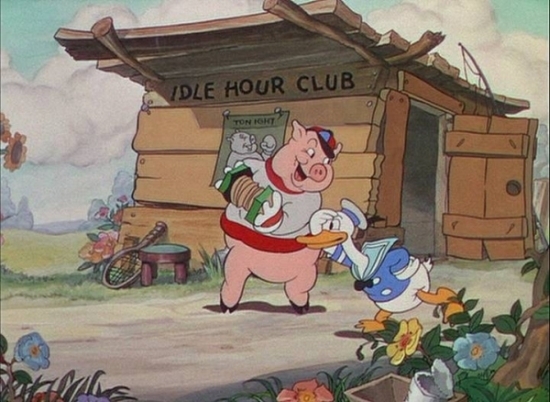 ‘The Wise Little Hen’ is a simple and quite moralistic Silly Symphony carried by a mediocre, yet all too memorable song. I guess it might have fallen into oblivion, were it not for Donald Duck.
In his first appearance Donald Duck is a real sailor, living on a boat and dancing the hornpipe. He’s a strong voice character from the start. When he joyfully shouts ‘oh boy, oh boy, oh boy!’ we all know it’s him, even though his looks are different.
Indeed, like Goofy’s voice, Donald Duck’s voice anticipated the character. When Walt Disney heard Clarence Nash use this particular voice, he really wanted something to do with it. According to animator Bill Cottrell, cited in ‘They Drew As They Pleased’, concept artist Albert Hurter was responsible for the duck’s looks. He gave Donald his trademark sailor suit, which he maintained to the present day.
Besides his typical voice and suit, Donald Duck displays two of his typical character traits: egotism and his tendency to trick others. However, he does not yet display his short temper: when ultimately foiled by the hen he’s not breaking down in anger, but joins Peter Pig in remorseful self-chastisement (a gag reused from an early Oswald the Lucky Rabbit cartoon called ‘Rival Romeos‘, 1928). But Donald would show his temper, in his next cartoon: ‘Orphan’s Benefit‘.
Besides Donald Duck this cartoon is interesting for an appetizing and startlingly realistic animation shot of butter melting on hot corn.
Watch ‘The Wise Little Hen’ yourself and tell me what you think:
This is Silly Symphony No. 45
To the previous Silly Symphony: The Big Bad Wolf
To the next Silly Symphony: The Flying Mouse
Director: Wilfred Jackson
Release Date: February 10, 1934
Rating: ★★★★★ ♕
Review:
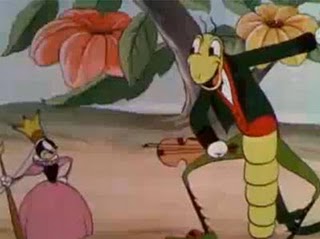 ‘The Grasshopper and the Ants’ is easily one of the best Silly Symphonies: it has a catchy song, great use of color and beautiful effect animation. Notice, for instance, the realism of the leaves blowing away during the autumn scene. One can even recognize which trees they’re from!
The grasshopper, too, is a wonderfully designed character, based on concept art by the great Albert Hurter. In contrast, the design of the ants looks a little primitive, still belonging to the black and white era. But, by now, the Disney staff has fully mastered the idea of character animation. This is best shown in the final dance scene: even in a crowd of lookalikes one easily recognizes the joyful ant the Grasshopper had tempted earlier.
Note that morality notwithstanding, the grasshopper is allowed to do what he does best: singing and playing. An encouragement to view art as an important contribution to society. Even so, the way the queen finally invites him is a real cliff-hanger.
This cartoon’s theme song, ‘the world owes me a living’ was composed by Leigh Harline, who would also compose the catchy songs of ‘Pinocchio‘. the grasshopper’s catchy song would become Goofy’s theme song. No wonder, for he and the Grasshopper share the same voice, by Pinto Colvig.
Watch ‘The Grasshopper and the Ants’ yourself and tell me what you think:
This is Silly Symphony No. 42
To the previous Silly Symphony: The China Shop
To the next Silly Symphony: Funny Little Bunnies
Director: Wilfred Jackson
Release Date: August 19, 1933
Rating: ★★★★½
Review:
 In ‘Lullaby Land’ a baby is lulled to sleep by his mother, singing ‘rock-a-bye baby’. The song takes the baby and his stuffed dog to Lullaby Land, a wonderfully surreal land made of plaids, rattles etc.
There the baby encounters a parade of baby objects, and a forbidden garden, full of sharp things, like knives and scissors. Despite the warnings of the female choir in the soundtrack, the baby enters. He destroys all watches from a watch tree with a hammer, and plays with matches. The smoke evokes three bogey men, which scare the baby away. Finally, the baby meets the Sandman, who puts the baby asleep to the tune of Johannes Brahms’s lullaby.
With cartoons like ‘Lullaby Land’ Disney set new standards for animation that are still thrilling today. Don’t get me wrong, the cartoon is rather patronizing and sugary cute, especially through the soundtrack. But this is compensated by wonderful surrealistic images, beautiful artwork and superb animation. And, hey, this way of warning against sharp things and matches just may work with small children.
Lullaby Land itself is a highly original fantasy world, and especially its first images are stunningly beautiful. The dance of the bogey men contains some striking use of color that anticipates similar surreal images in ‘Dumbo‘ (1941). Moreover, it is the first example of totally unrealistic color use in animated cartoons, and therefore a milestone.
Unfortunately, the cartoon also marks a trend of childishness creeping into the animation world, not only at Disney’s, but at all other studios, as well. For example, ‘Lullaby Land’ is the first of a whole series of Silly Symphonies obsessed with little babies, and their bare behinds in particular, with ‘Wynken, Blynken and Nod‘ from 1938 being the last example.
Anyway, ‘Lullaby Land’ left all competitors far behind. Later, both Walter Lantz (‘Candy Land’, 1934) and Max Fleischer (‘Somewhere in Dreamland‘, 1936) tried to copy the concept with far less convincing results.
Watch ‘Lullaby Land’ yourself and tell me what you think:
This is Silly Symphony No. 38
To the previous Silly Symphony: Old King Cole
To the next Silly Symphony: The Pied Piper
Director: Wilfred Jackson
Release Date: March 24, 1934
Rating: ★★
Review:
 ‘Cute Little Bunnies’ would have been a better title for this easter short, for the bunnies are very cute, not funny.
In fact, “Funny Little Bunnies’ is so cute it can only have been meant for children. It makes one wonder what movies it was supposed to support in the theaters (surely no grim gangster thriller!).
Because everybody copied Disney at that time, other studios were copying this ‘new cuteness’ as well. Especially 1934 saw an explosion of Silly Symphonies imitating series, combining the appeal of color with sugary tales. Former Disney associate Ub Iwerks was the first, releasing his first Comicolor cartoon on December 23, 1933. He was followed by Max Fleischer (Color Classics, August 1934), MGM (Happy Harmonies, September), Van Beuren (Rainbow Parade, September), Columbia (Color Rhapsodies, November), and Walter Lantz (Cartune Classics, December). This resulted in a spread of cute (and severely unfunny) cartoons in the mid-thirties.
One is therefore particularly thankful that in the late thirties Tex Avery restored nonsense, wackiness and absurdism in the animated cartoon. These qualities Disney sometimes seemed to have forgotten during his pursuit for greater naturalism and beauty.
Notice how, for example, ‘Funny Little Bunnies’ uses animation to tell a story that cannot be told in live action, but how it tries to tell this story in the most conventional, ‘live action-like’ way. Especially the opening shot of this short is stunning, with two bunnies hopping realistically and lots of birds and butterflies flying around.
Watch ‘Funny Little Bunnies’ yourself and tell me what you think:
This is Silly Symphony No. 43
To the previous Silly Symphony: The Grasshopper and the Ants
To the next Silly Symphony: The Big Bad Wolf
Director: Wilfred Jackson
Release Date: December 12, 1931
Rating: ★★★★★
Review:
 This is the first of two versions of ‘The Ugly Duckling’ made by Disney.
Unlike the latter, more familiar version, this ugly duckling is a real duck, accidentally born to a chicken. He’s rejected until he saves his chick brothers and sisters from drowning in a long, fast and exciting action scene, involving both a tornado and a waterfall.
Although looking crude and primitive when compared to the 1939 short, this first version of The Ugly Duckling is a milestone in Disney’s storytelling: while the earlier Silly Symphonies contain a lot of repetitive animation and dance routines, The Ugly Duckling is the first Silly Symphony to tell a coherent story from the beginning to the end. Even the Mickey Mouse films of that time are not that consistent. There still is some rhythmic movement, especially at the beginning, but most of the animation is there to tell the story.
The duckling (who repeatedly looks to the audience for sympathy – not unlike Oliver Hardy) is a real character who transforms from an outcast to a hero, and gains its well-earned sympathy at last. Its best scenes are when it feels rejected, not only by his ‘family’, but also by a cow, a dog and a frog. There’s some genuine feeling of loneliness and unhappiness in these scenes, unparalleled in any other animated film of the time.
This short, which is neither about gags nor about moving to music, would be the first testimony of Disney’s ambitions in storytelling.
Watch ‘The Ugly Duckling’ yourself and tell me what you think:
This is Silly Symphony No. 25
To the previous Silly Symphony: The Fox Hunt
To the next Silly Symphony: The Bird Store
Directors:Clyde Geronimi, Wilfred Jackson and Hamilton Luske
Release Date: February 15, 1950
Rating: ★★★★★
Review:
 ‘Cinderella’ was Disney’s first fairy tale movie since ‘Snow White and the Seven Dwarfs’ (1937) and Disney’s first real feature animation film in eight years.
With its classic fairy tale story featuring a heroine, whose unhappy fate is turned, Cinderella seems to be like ‘Snow White and the Seven Dwarfs’, Disney’s only million seller feature up to that point, and, indeed, ideas for this film go back as far as 1938. However, it is very clear many things had changed for the studio since then:
First: Gone are the lush water color backgrounds. They’re replaced by way more stylized oil backgrounds, based on the colors and styling of designers Mary Blair and John Hench, who both favored bright and unrealistically vivid colors. Mary Blair’s influence is particularly strong in the dreamlike ‘So This Is Love’ sequence and the chase of Cinderella’s pumpkin couch: here the stunningly beautiful backgrounds lose all sense of realism, in favor of emotional storytelling.
Second: The animation of humans, hardly mastered in 1937, now looks fluent, convincing and even easy. It’s also striking how very realistic humans (Cinderella, the prince, the evil stepmother) blend easily and convincingly with more caricatured humans (the king, the grand duke and the two stepsisters) and anthropomorphic animals. The Disney studio clearly had matured.
Indeed, the animation studio had been greatly streamlined in the forties. Gone were the experimental, time consuming and costly work methods of ‘Snow White’, ‘Pinocchio‘ and ‘Fantasia’. For his new feature Disney would take no chances: all human scenes would be filmed first with live action actors, in order to perfect the staging before it went into animation. Only one short scene with outrageously colored soap bubbles evokes some of the earlier experimentalism.
Disney’s animation unit was now led by a group of younger, highly talented animators, who had matured their skills in the forties, and whom Walt Disney affectionately called his ‘Nine Old Men’. In Cinderella these Nine Old Men are all credited as supervising animators (alongside, like a ghost from the past, pioneer animator Norm Ferguson [see ‘Frolicking Fish‘ and ‘Playful Pluto‘], although his contribution remains unclear). The Nine Old Men would be responsible for Disney Feature animation way up to ‘The Rescuers‘ (1978). The fluent and confident animation in ‘Cinderella’ clearly shows why.
Especially the stepmother (animated by Frank Thomas) is a wonderful character: she’s very nasty, but her evilness is acted out in the subtlest way. She’s only indirectly responsible for the most dramatic scene of the film, in which the two stepsisters tear Cinderella’s dress from her body. The horror of this scene is heartfelt, especially because we had seen that this dress was made for her by some friendly birds and mice in an earlier scene .
These animals star a huge subplot with leading roles for a keen mouse called Jaq, a fat, dumb mouse called Gus, and a mean old cat called Lucifer (all animated by Ward Kimball, who went berserk on the outrageous animation of Lucifer). This subplot provides a funny counterpoint to the familiar fairytale and even completely dominates the first twenty minutes of the film.
Cinderella was a huge success and paid the studio well. Once again Disney’s attention and reputation rested with animated features and the studio would dominate the scene up to the 1980s, being practically the monopolist on animated features in the United States.
In a time when TV would cause the decline and fall of the animated cartoon industry, this was no luxury, at all.
Watch an excerpt from ‘Cinderella’:
Director: Wilfred Jackson
Release Date: August 19, 1931
Rating: ★★★
Review:
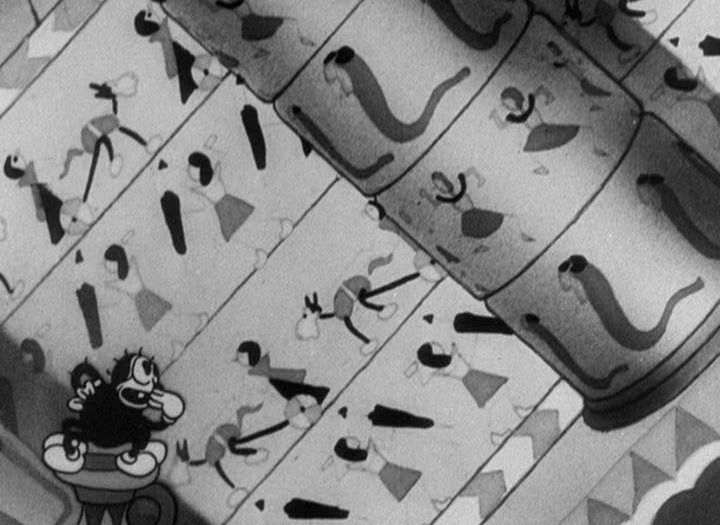
In ‘Egyptian Melodies’ the little six-legged spider from ‘Midnight in a Toy Shop‘ (1930) returns to the animated screen.
The short is one of those early Silly Symphonies that offers quite a dull dance routine only (and no story). Nevertheless, the introduction of the cartoon is well worth watching: when we follow the spider down into the pyramid, we experience some astonishing 3D-effect animation, creating the feeling that the camera wanders with the spider through corridors and staircases.
This unique exercise in perspective would not be repeated in animation until labyrinth computer games were introduced in the 1980s. The Disney Studio itself must have been impressed by this stunning piece of animation, for it was reused two years later in the Mickey Mouse cartoon ‘The Mad Doctor‘ (1933).
Once inside the pyramid, the spider watches four mummies dance, and the drawings on the walls coming to life. These last scenes feature 2-dimensional characters, which can be seen as very early and primitive forerunners of the cartoon modern style of the 1950s. Unfortunately, these scenes are a little bit dull, but they do lead to a great finale. This is one of the earliest nightmare-sequences, in which the montage of images is diffuse and increasingly sped up, in order to suggest the feeling of getting insane. This predates similar sequences in films like ‘Der Fuehrer’s Face‘ (1943) by many years.
The idea for ‘Egyptian Melodies’ may have come from the Van Beuren cartoon ‘Gypped in Egypt‘ (1930), which also features dancing hieroglyphs, nightmarish scenes, and even a corridor scene. Notice that the classic horror film ‘The mummy’ (1932) hadn’t been released, yet, at the time.
This is Silly Symphony No. 21
To the previous Silly Symphony: The Cat’s Out
To the next Silly Symphony: The Clock Store


 Dr. Grob's Animation Review