You are currently browsing the yearly archive for 2021.
Director: Earl Hurd
Release Date: August 21, 1921
Stars: Bobby Bumps & Fido
Rating: ★★★
Review:

In ‘Hunting an’ Fishing’ Bobby Bumps does exactly that, and in an area where it’s prohibited, too. But how he’s supposed to know? He has blasted off the ‘no’ from a ‘no hunting allowed’ sign while trying to hit a rabbit. In any case, soon the gamekeeper is on his tail…
‘Hunting an’ Fishing’ looks uncommonly cheap for a Bobby Bumps cartoon: the background art is extremely limited, and Hurd uses quite some animation cycles. More interesting is the fact that this short seems like a very early ancestor of the chase cartoon. A great deal of the cartoon features the gamekeeper chasing Bobby, and Bobby and Fido trying to get rid of the fellow in various ways.
Yet, the best gag is reserved for a completely different set of characters: a bird and a frog using a sleeping rabbit’s stomach to rock themselves to sleep as well. This is an inventive, unique and surprisingly well staged gag.
‘Hunting an’ Fishing’ is available on the Blu-Ray/DVD-combo ‘Cartoon Roots: Bobby Bumps and Fido’
Director: Earl Hurd
Release Date: November 9, 1919
Stars: Bobby Bumps & Fido
Rating: ★★★½
Review:

In this short film, little boy Bobby Bump jumps out of the inkwell, together with his dog Fido, and calls his master, who hasn’t arrived at work, yet, on the phone.
Their creator Earl Hurd invites them at his home. What follows is a funny smoke gag, but shortly after Bobby and Fido start packing, the cartoon ends, cutting short a promising premise.
As ever with the Bobby Bump cartoons, the designs are very appealing, but the animation is very limited and a bit crude. Yet, the simple gags have their own charm, and this cartoon is particularly interesting for starring the master Earl Hurd, himself.
Watch ‘Their Master’s Voice’ yourself and tell me what you think:
‘Their Master’s Voice’ is available on the Blu-Ray/DVD-combo ‘Cartoon Roots: Bobby Bumps and Fido’
Director: Earl Hurd
Release Date: January 24, 1919
Stars: Bobby Bumps & Fido
Rating: ★★★
Review:

‘Bobby Bumps’ Last Smoke’ starts with Earl Hurd’s hand drawing Bobby Bumps, tickling him on the way. Then finished he gives the boy a cigarette, and immediately the scenery sets in.
Bobby starts smoking enthusiastically, but soon gets dizzy and throws the cigarette away. The cigarette smoke transfers him and Fido to a sultan’s palace in a 1001 Arabian night version of Turkey. The duo rescue a lady from the Sultan’s dungeons, with Bobby knocking out all the guards, and some lions, with the lady’s former ball and chain. He earns the damsel’s kiss in reward, which turns out to be Fido licking him.
Now, one would suspect that ‘Bobby Bumps’ Last Smoke’ is a typical anti-smoking cartoon, with Bobby giving up smoking after this trippy experience. But no, the one thing he’ll never do again isn’t smoking, but “insulting a sultan”. And so, with this pun, the short ends.
‘Bobby Bumps’ Last Smoke’ boasts elaborate human designs and intricate background art, but as with most animated cartoons from the 1910s, the animation is limited and jumpy.
‘Bobby Bumps’ Last Smoke’ is available on the Blu-Ray/DVD-combo ‘Cartoon Roots: Bobby Bumps and Fido’
Director: Władysław Starewicz
Release Date: 1920
Rating: ★★★★
Review:

In ‘Dans les griffes de l’araignée’ Starewicz tells his own, quite elaborated version of the classic ‘Spider and the Fly’ tale.
In Starewicz’s version the fly is called Dame Aurélie, a simple fly living at the countryside with her uncle, Beetle Anatole, and being in love with a longhorn beetle. One day a famous Paris star, a butterfly called Phalène, crashes in the fly’s village, and stays at her home. Phalène paints an all too rosy picture of Parisian life, and soon after her departure, Aurélie goes to the capital, as well.
First all goes well, as Aurélie works as Phalène’s house maid. But when she’s fired because of seeing a secret lover, things go downhill, indeed. The tale ends rather gruesomely with quite a spectacular finale, and in the epilogue we watch Aurélie returning to the village…
‘Dans les griffes de l’araignée’ is quite a tragic tale, but it’s hard to call it very engaging. Starewicz’s puppets are quite sophisticated, e.g. capable of rolling their eyes, but they don’t transgress the emotions very well, which remains emblematic. The emotional scenes are augmented by close-ups of the insect characters, in which live action puppets are used. Most spectacular is the finale, in which the title cards make place for a long action scene. The surviving print is gorgeous with its hand-painted colors, which certainly add to the film’s unique atmosphere.
‘Dans les griffes de l’araignée’ is available on the DVD-box ‘Starewitch 1882-1965 DVD Cinquantième anniversaire’
Directors: Max & Dave Fleischer
Release Date: July 6, 1920
Stars: Ko-Ko the Clown
Rating: ★★★½
Review:

‘The Clown’s Little Brother’ is one of the Fleischer brothers’ earliest films, when they were still working at Bray Studio.
The film stars Max Fleischer as the artist drawing Ko-Ko the clown, who’s only known as ‘the inkwell clown’ in this cartoon. Interestingly, as soon as Max tries to draw the character, his pen fails and Ko-Ko jumps out of the glass in which Max washes his pen. Immediately thereafter Max gets his mail, which strangely enough contains a live kitten. The Inkwell Clown gets a letter, too, stating that his kid brother arrives in another mail package. But Ko-Ko’s kid brother turns out to be a cheeky brat and Max leaves.
Undeterred, Ko-Ko tries to entertain the little kid with his antics, but the boy easily outperforms the clown, not in the least because he’s 100% animated, while Ko-Ko is partly rotoscoped. Thus the kid’s movements are wilder, less realistic and more impossible than Ko-Ko’s. At one point Ko-Ko falls off the piece of paper, and on the kitten, who plays with the poor cartoon character. At that point the kid brother shows his kinder side, and rescues Ko-Ko from the clutches of the feline foe. Yet, their antics end when Max returns, and the bottle of ink falls on the floor.
‘The Clown’s Little Brother’ is by all means an action rich and entertaining short, and shows that the Fleischers brothers were very competent players in the field. Fleischer’s inkwell clown was a sensation back then because of his fluid movements, based on Max Fleischer’s rotoscope invention. But in this cartoon Max Fleischer shows to be a competent animator without the aid of rotoscope, as well. For example, when the kid brother tries to pull Ko-Ko out of the inkwell, one can sense some pulling force.
Watch ‘The Clown’s Little Brother’ yourself and tell me what you think:
‘The Clown’s Little Brother’ is available on the DVD-set ‘Popeye the Sailor 1941-1943’
Director: Max Fleischer
Release Date: 1920
Rating: ★★★★½
Review:
‘All Aboard for a Trip to the Moon’ is a very early educational animation short. The short was animated by Max Fleischer at the Bray Studios, and apparently part of a series called ‘Goldwyn Bray Pictograph – The Magazine on the Screen’. For this short Fleischer got assistance of the Popular Science Monthly for the scientific details.
In less than 8 minutes ‘All Aboard for a Trip to the Moon’ tells about a hypothetical trip to the moon, telling us how far the moon is, and how to overcome the Earth’s gravity by using a radium-propelled rocket. Fleischer depicts quite a hard, bouncing landing of the rocket on the moon, and it’s never revealed how the vessel would be able to return to Earth, but we get some nice and convincing shots of the moon’s landscape and earth from the moon itself.
Fleischer’s drawings and animations are combined with live action footage, e.g. of a man handling radium, and another one getting dressed for the trip. Apparently in 1920 the scientists deemed a thick fur coat and a gas mask enough protection in outer space…
The short also states that radium alone can create the force to overcome the Earth’s gravity, while the Saturn V rockets that eventually would put man on the moon were fueled by a modified form of kerosene, and in 1920 kerosene itself was already well-known…
Anyhow, scientific errors aside, ‘All Aboard for a Trip to the Moon’ is an entertaining piece of infotainment. It not only predates Disney’s similar futurist television specials, like ‘Man and the Moon‘ (1955) with a staggering 35 years, it also gives an insight look in how space travel was perceived in the 1920s.
‘All Aboard for a Trip to the Moon’ is available on the Thunderbean Blu-Ray ‘Fleischer Rarities’
Director: Walter Lantz
Release Date: February 27, 1920
Stars: Jerry on the Job
Rating: ★★★★
Review
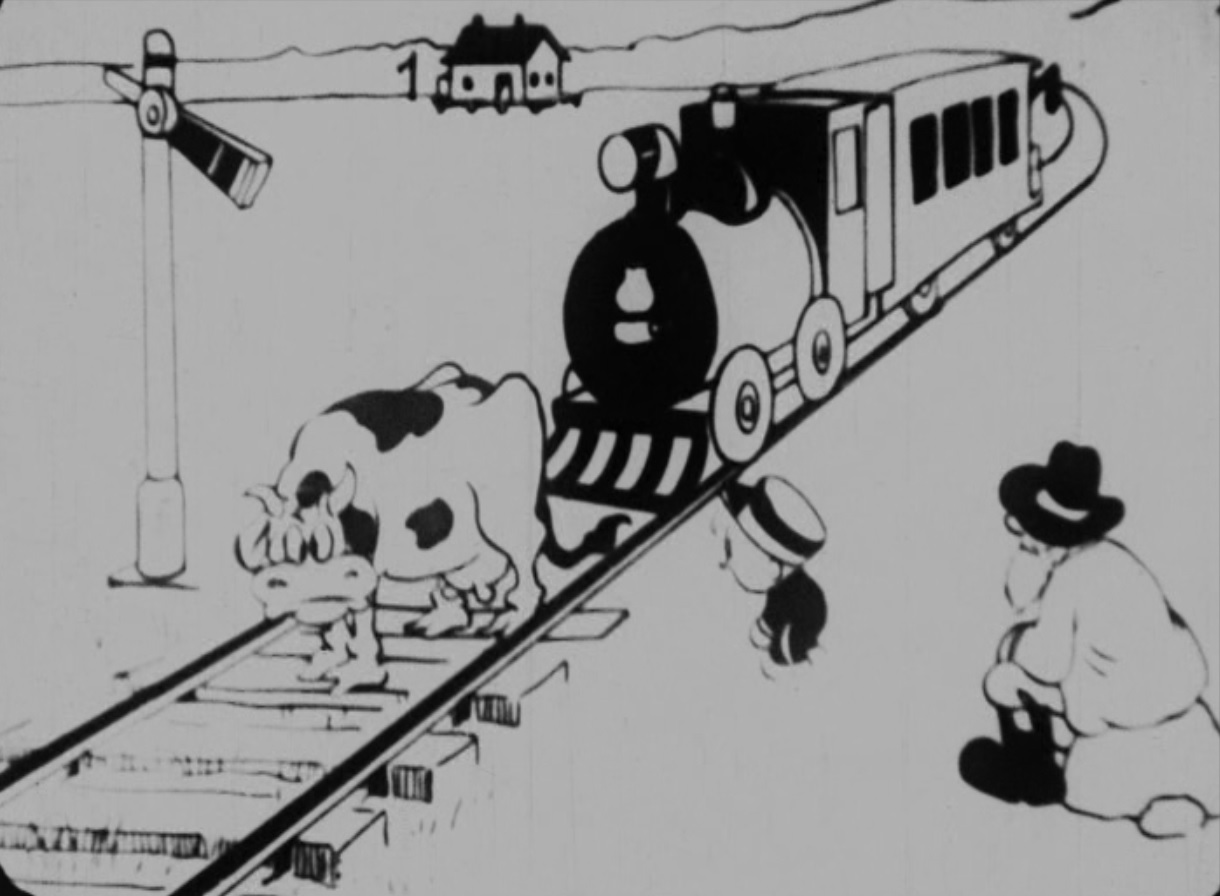
‘The Wrong Track’ is a short gag cartoon featuring ‘Jerry on the Job’, apparently a little kid doing all kinds of jobs.
In this short he’s a train engineer, who’s scolded by his boss of killing too many animals on the train track. And indeed, only a few seconds after leaving the train station Jerry encounters a cow, which after some action is killed.
The short features quite some funny gags and ends with a great punchline. The designs are simple, but pleasant and Walter Lantz’s animation is fair and effective. ‘The Wrong Track’ may not be a masterpiece, it’s a fun bit of early animation, and certainly one of the better shorts from this era.
The Wrong Track’ is available on the Thunderbean Blu-Ray/DVD-combo ‘Technicolor Dreams an Black & White Nightmares’
Director: Howard S. Moss
Release Date: 1917
Rating: ★
Review

‘Dolly Doings’ is an entry in the ‘Motoy Comedies’ series, which was apparently based on the book series ‘Motoys in Life’.
The short mixes live action and stop motion to tell the story of a little girl who dreams that her dolls come to life. One particularly mischievous doll called Jimmy taunts the others with a needle.
The dolls lack any character and are very poorly animated, not exceeding the amateur level. The action is hard to comprehend, and the ‘story’ too trite to be of any interest. The intertitles, too, are painfully unfunny. I’ve no idea how many Motoy Comedies have been made, but based on the judgement of this entry this series can’t hardly have been successful.
Dolly Doings’ is available on the Thunderbean Blu-Ray/DVD-combo ‘Techicolor Dreams an Black & White Nightmares’
Director: Dick Huemer?
Release Date: July 14, 1918
Stars: Mutt and Jeff
Rating: ★★★½
Review:

In this Dick Huemer-animated short Mutt and Jeff appear to own a lunchroom. Mutt is the waiter, and Jeff the cook.
There are essentially three gags: a bearded customer wants some ox-tail soup, another costumer some pie, and the third, a beautiful woman, the best flapjacks they have. When she notes that the flapjacks don’t look so good, Mutt places one on the grammophone player and promptly starts to dance with her to the music. The dance ends when a policeman shows up, knocking out both Mutt and Jeff, but taking the dance with the beautiful dame himself.
While seating the lady looks like from another picture, when compared to the cartoony design of Jeff, but this feeling vanishes during the dance scene, and one must admit Dick Huemer does quite a good job in animating this particular scene. Another fine piece of early character animation are Mutt’s deft hand movements while handling the second customer.
Watch ‘The Extra-Quick Lunch’ (Flapjacks) yourself and tell me what you think:
‘The Extra-Quick Lunch’ (Flapjacks) is available on the DVD ‘Mutt and Jeff – The Original Animated Odd Couple’
Directors: Jennifer Yuh Nelson & Alessandro Carloni
Release Date: January 23, 2016
Rating: ★★★ ½
Review:

‘Kung Fu Panda 2’ had suggested a background story for Po, an extermination of all Pandas by the evil peacock Lord Shen. So, it would have been logical to expand this story line in ‘Kung Fu Panda 3’.
And indeed, this is the movie in which Po finally meets more pandas, not to say even his very own family. And yet, virtually nothing is done with the plot elements of ‘Kung Fu Panda 2’. Po’s natural father pops up in Po’s village, virtually out of nothing – there’s no quest whatsoever.
Instead, ‘Kung Fu Panda 3’ introduces a completely new background story, involving the spirit realm, and introducing Po’s most powerful opponent thus far, master Oogway’s former friend, the bull Kai. Kai returns from the spirit world to the mortal world, creating havoc and changing all kung fu masters into his own mindless army of jade. And being immortal he’s a tough one to take. It’s up to Po to fight off this formidable foe.
Despite this splendid super villain, ‘Kung Fu Panda 3’ is quite a disappointing sequel, stretching the all too American dream-like messages of ‘believe in yourself’ and ‘if you want to, you can achieve everything’ way beyond believability. Po’s transition of his lazy, food-loving parent village into a gang of fearless fighters, able to battle the greatest kung fu masters of China, in only a matter of days, is stretching the imagination, to say the least. Traditional wuxia cinema emphasizes that true mastery only comes with hard and long training, but in the American Kung Fu Panda universe, you get it for free if you only believe in yourself. If only. One wonders what entered the makers’ minds to send off a phony message like that.
Unfortunately, there are more story problems. There’s an all too obligate break up scene, when Po’s father appears to have lied to Po. Moreover, for a village that is supposed to be secretly hidden, the Panda settlement is found surprisingly easily by both Tigress and Kai. And the story line of the pandas having forgotten how to use Qi, only to remaster that in an instant, is, again, quite unconvincing. True, Po never was an entirely convincing character, but he certainly isn’t in this film.
Meanwhile, Po’s former co-stars are reduced to minor players, uttering only a few lines, if any, while none of the new players, save Kai, show the same charm. Only Po’s duck father, Mr. Ping (voiced by James Hong) thrives as the jealous father.
No, the main attraction of ‘Kung Fu Panda 3’ is not its story, or its characters, but its design. The film makes great use of wuxia imaging, including gravity defying runs and jumps. Even better, the feature at times becomes surprisingly graphical: for example, the film occasionally uses the split screen to a great effect, Oogway’s story is rendered in gorgeous 2D, and the learning sequence employs a bold and very beautiful color scheme.
In addition, ‘Kung Fu Panda 3’ is noteworthy for introducing the utterly Chinese concept of Qi to Western audiences. Qi roughly translates as ‘life energy’ and forms the central theme of the film, making ‘Kung Fu Panda 3’ an interesting blend of Western (the individualistic tropes stated above) and Eastern concepts. Nevertheless, one cannot help but feeling that there could have been more to ‘Kung Fu Panda 3’, and that it in fact is more run-of-the-mill than the film could have been.
Watch the trailer for ‘Kung Fu Panda 3’ yourself and tell me what you think:
‘Kung Fu Panda 3’ is available on Blu-Ray and DVD
Director: Peter Sohn
Release Date: November 10, 2015
Rating: ★★
Review:

During the 2010s Pixar lost quite some of its brilliance. Not only saw the decade a multitude of sequels (seven out of eleven), two of the remaining stand-alone films, ‘Brave’ and ‘The Good Dinosaur’ were in fact strikingly disappointing. Particularly ‘The Good Dinosaur’ feels rather lackluster for a Pixar film. The general public apparently thought so, too, causing ‘The Good Dinosaur’ to become Pixar’s first financial disappointment.
For once, ‘The Good Dinosaur’ feels as if it had hit the theaters before its story problems were entirely solved. The film’s story had a troubled history, with two of its original writers (Bob Peterson and John Walker) being removed from the project halfway, and a release date being postponed two years. And yet, the final product still feels half-baked, and badly thought through.
The film’s premise is an alternate history in which the asteroid that hit Earth 66 million years ago only passed by, sparing the dinosaurs, and allowing them to evolve to the present day.
If you realize that this allows for a staggering 66 million years of extra evolution, surprisingly little is done with the concept. First, we hardly see any dinosaurs, at all. Only four species are depicted: Arlo’s family of Sauropods, a single Styracosaurus, a few hideously ugly Dromaeosaurids (who look like plucked chickens which makes them the most revolting looking Dromaeosaurids ever put to the screen) and three Tyrannosauruses. We can add some grisly Pterosaurs to the mix (another example of appalling design), but that’s it.
As you may have noticed, the species depicted are all recognizable as familiar species, as if nothing would have happened in 66 million years! Thus, the whole initial concept has been largely thrown away at the beginning. Instead, we are invited to believe Sauropods have invented agriculture, and Tyrannosaurids (who are very well-designed, but certainly not according to the latest scientific evidence of the time) have invented cattle breeding. Even worse, the film makers have allowed mammals to evolve beyond, as well, as if they wouldn’t have had competition from the well-established dinosaurs, depicting buffalo and, sadly, humans. How humans could ever have evolved in the shadow of dinosaurs baffles me, but here they are, and in the Americas, too. And yet, the story seems to take place during the Pleistocene, not extending the time period to the present, but why this may be so, will never be known. It unfortunately only adds to the age-old trope of co-existence of dinosaurs and early man, making ‘The Good Dinosaur’ strangely akin to the nonsense of e.g. The Flintstones.
The film focuses on Arlo, a small, weak and cowardly Sauropod, who loses his father and his home, but befriends a little human whom he calls Spot, and who overcomes his fears on his journey back home.
This story is already pretty uninteresting, but the execution is remarkably boring, and despite a modest length of 93 minutes, the film plods through its story following familiar tropes, and delivering no surprises. As too often in Disney movies there’s a strong focus on ‘family’ that feels tired and cliché. Moreover, Arlo’s development, given the traumatic loss of his father, feels obligate and is rather unconvincing, to say the least. Unlike Simba in ‘The Lion King’ (1994) there’s no sense of guilt or self-punishment, and Arlo’s dream encounter with his father is nothing like that of Simba in the former movie.
It doesn’t really help that for most of the time Arlo is a rather unpleasant character. His weakness and cowardice is not appealing, but annoying, and he behaves selfishly most of the time. To me it’s no less than a marvel that Arlo doesn’t die in the wild, so unbelievably unfit is our ‘hero’ for survival. I certainly believe the voice choice for Raymond Ochoa is part of the problem, for Arlo’s voice got on my nerves over time.
The other animals don’t help either. True, Spot is a well-established character, and surely forms the heart of the film, but Arlo’s family is quite bland, and almost all other creatures Arlo encounters seem rather lunatic, not to say insane. The only exceptions are the three Tyrannosaurs, and they form the highlight of the film. The animation of their walk, which looks like cowboys riding horses, belongs to the most original and best animation of movement ever put to the screen. Moreover, voice actor Sam Elliott is cast perfectly as the leader of the three. I don’t know why but somehow this Tyrannosaurus design is the perfect depiction of the mustached actor in Dinosaur form, as if Elliott had always been a Tyrannosaur deep inside, and the animators have brought his inner dinosaur to life.
Apart from story and personality issues, the film suffers from design flaws. The problems already start with the very first scene, which is a very, very unrealistic depiction of the asteroid belt. As said, the Dromaeosaurid and Pterosaur designs are atrocious, but also Arlo himself suffers. Compared to his co-stars he is way to cartoony, with oversized limbs, eyes and teeth, and essentially unappealing.
Spot is much, much better, but for some unknown reason Spot is shown as only partly bipedal and he’s given some dog-like behavior, while this is discarded in the depiction of other humans. One can argue that the orphan Spot is a feral child, like Mowgli, but as it’s never explained, I doubt whether this concept was even used in the background story.
No, the film’s real highlights are its landscapes. The film excels in impressive depictions of North American nature. The rivers, forests, mountains and plains depicted all look absolutely gorgeous, and are a giant move forward since ‘Cars’ (2005), which itself had been a milestone of landscape building in computer animation. The depiction of wet rocks and needle covered forest floors is no less than stunning and are still unparalleled in their realism and beauty. Indeed, it’s clear the film makers were most proud of their background art, for it’s the landscapes that ornament the end titles, not the characters. To me this says enough.
Watch the trailer for ‘The Good Dinosaur’ yourself and tell me what you think:
‘The Good Dinosaur’ is available on Blu-Ray and DVD
Directors: Alain Gagnol & Jean-Loup Felicioli
Release Date: September 12, 2015
Rating: ★★★★★ ♕
Review:

2015 was a good year for French animation. June already saw the release of the great movies ‘Avril et le monde truqué’ (April and the Extraordinary World) and ‘Tout en haut du monde’ (Long Way North), but these were topped in September by the Franco-Belgian production ‘Phantom Boy’.
‘Phantom Boy’ was created by Alain Gagnol and Jean-Loup Felicioli, who have been working together at the French Folimage studio since the mid-nineties, and who brought us the entertaining feature film ‘Une vie de chat’ (A Cat in Paris) in 2010. But compared to the earlier feature scenarist Gagnol adds an extra layer of depth to ‘Phantom Boy’, because this is not only an adventure film, but it also tells about a boy suffering from a deadly disease.
‘Phantom Boy’ is a children’s film set in New York, and tells about Léo, an eleven years old boy, who’s seriously ill (he’s probably suffering from cancer, but the exact illness is never revealed) and hospitalized. In the hospital Léo discovers that his spirit can leave his body and look around, encountering other spirits while doing so.
During one of these wanderings, he encounters the spirit of Alex Tanguy, an injured policeman. Tanguy is after a master villain, the “man with the deformed face”, who threatens to shut down the whole of New York with a computer virus if not delivered a huge sum of money. Unfortunately, Tanguy is stuck at the hospital, but he discovers Léo’s spirit can snoop around for him. Thus, Léo can help miss Delauney, a feisty journalist, who’s also on the villain’s trail. There’s a catch, however, Léo’s spirit must return to Léo’s body in time, or Léo will certainly die…
The film is thus a very nice mix of adventure, in which Léo’s superpower is used to a great effect, and drama, because the film makers never lose sight of Léo’s illness, and show the ails, fears, and sorrows of Léo and his family, as well. Thus, the film is not only exciting, but knows some really moving scenes, too.
Nevertheless, the film never becomes heavy-handed, and in fact is often very funny. Especially the master villain’s two helpers are great comic relief, but the best gag goes to the master villain himself, who several times tries to tell the story behind his deformation, only to get cut short all the time.
The film has a very pleasant visual style, courtesy of Jean-Loup Felicioli, who has given the film a very idiosyncratic take on the Franco-Belgian comic strip tradition. Typical for Felicioli is a strongly graphical and very angular style (not a thing is straight in this film), and the slant eyes of most characters. The man with the deformed face is practically cubist, with his multi-colored and checkered face. The color palette is warm and appealing, and the animation uses the jittery style often encountered in independent shorts.
Films like this prove that traditional animation is far from dead (‘Phantom Boy’ was even drawn on paper, and hand colored, even though the final composition was done on the computer), and in fact allows for a less generic and more adventurous style than contemporary computer animation. I’ll even go that far to name ‘Phantom Boy’ the best animated feature of 2015, despite serious competition from both ‘Shaun the Sheep Movie’ and ‘Inside Out’.
Watch the trailer for ‘Phantom Boy’ yourself and tell me what you think:
‘Phantom Boy’ is available on Blu-Ray and DVD
Directors: Fabrice Joubert & Brian Lynch
Release Date: December 8, 2015
Rating: ★★½
Review:

‘Binky Nelson Unpacified’ is the third of three shorts accompanying the Minions feature on its DVD release. Unlike the other two, this short doesn’t star any Minion at all, but focuses instead on the criminal Nelson family the Minions encounter in their feature film.
The short starts with the Nelson just having robbed a museum and returning home. Unfortunately, they’ve left baby Binky’s pacifier at the museum, and the parents tell Binky he has to live with it. But that night, Binky returns to the museum to look for the pacifier, after all.
The best scenes of this comedy short stem from baby Binky’s Mission Impossible-like heist, all done with baby stuff, like diapers, talk powder, and a mobile. Unfortunately, ‘Binky Nelson Unpacified’ is also the most talkative of the three, and Binky’s co-star is a remarkably unfunny night guard with a cowboy hat. Binky quickly gets rid of this night guard, and the film could very well without him.
Watch ‘Binky Nelson Unpacified’ yourself and tell me what you think:
‘Binky Nelson Unpacified’ is available on the Blu-Ray and DVD of ‘Minions’
Directors: Kyle Balda & Julien Soret
Release Date: December 8, 2015
Rating: ★★½
Review:
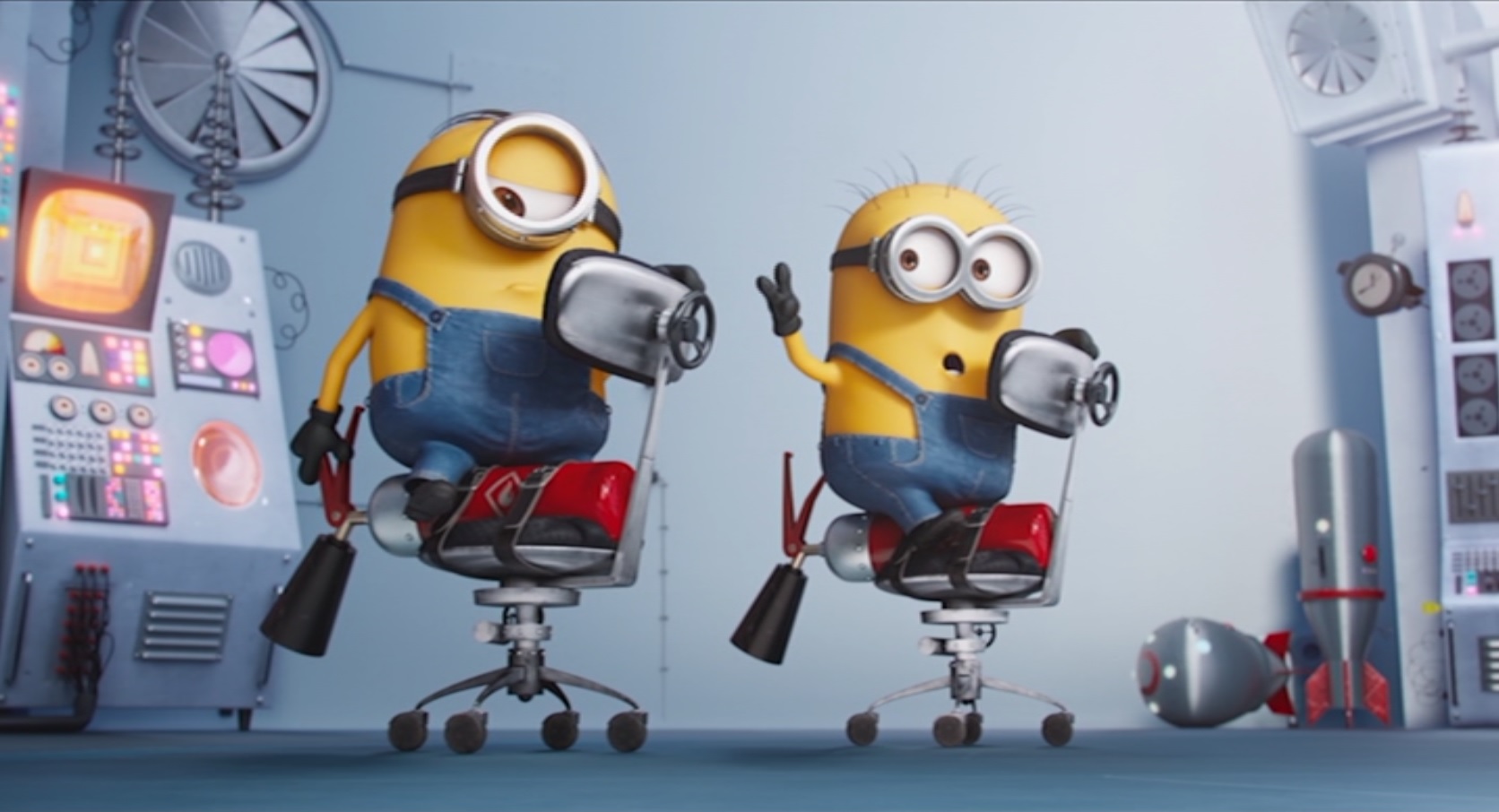
‘Competition’, the second of three bonus shorts on the Minions DVDs, is probably the best of the three.
The short takes place in a secret subterranean nuclear lab full of Minions. Two of them suddenly get involved in a series of competitions, resulting in some nuclear blasts (which the two survive).
The film is pretty nonsensical, but fast, with the competition between the two Minions escalating quickly. The short also has the best visual punchline of the three.
Watch ‘Competition’ yourself and tell me what you think:
‘Competition’ is available on the Blu-Ray and DVD of ‘Minions’
Directors: Didier Ah-Koon & Régis Schuller
Release Date: December 8, 2015
Rating: ★
Review:

‘Cro Minion’ is the first of three bonus shorts available on the Minions DVD. From their own feature length film we had learned that Minions always have been around, thus ‘Cro Minion’ is set in prehistorical times.
Two minions have eaten the last bananas, so a prehistoric man has to go hunting a large bull he sees in the distance, while the minions have to watch his baby. The baby has a strong will of his own, however, giving the two minions a hard time.
The short is full of wordless slapstick that never becomes really funny, despite all the antics. Also featured is a totally out of place Pterosaur, whose inclusion makes the short a completely backward affair. Not only are the Pterosaur and early man 66 million years apart in time, the Pterosaur looks like a 1950s horror monster, instead of the real thing. The Illumination animators should update their prehistorical knowledge. ‘Cro Minion’ of course is an unpretentious comedy short, but still.
Watch ‘Cro Minion’ yourself and tell me what you think:
‘Cro Minion’ is available on the Blu-Ray and DVD of ‘Minions’
Director: Josh Cooley
Release Date: November 3, 2015
Rating: ★★★
Review:

‘Riley’s First Date?’ is an unnecessary, but fun spin off short from ‘Inside Out‘. During this short a boy comes to visit Riley, an event freaking out her parents, until Riley’s father and the boy suddenly find something they have in common.
As in ‘Inside Out’ we take a look inside the four protagonist’s heads, this time focusing on dad’s inside. Nevertheless, Mom and dad are less round characters than they had been in ‘Inside Out’, being little more than cliches. The boy, too, is more a caricature than a real person, sitting lethargically and mindlessly in his chair most of the time. The only real person in this short is Riley herself, but she hardly takes part.
Let’s face it, ‘Riley’s First Date?’ doesn’t come near the sophistication of ‘Inside Out’, but it doesn’t aspire to, and can be safely regarded as ‘just a bit of fun’.
Watch ‘Riley’s First Date?’ yourself and tell me what you think:
‘Riley’s First Date?’ is available on the Blu-Ray and DVD of ‘Inside Out’ and ‘Pixar Short Films Collection 3’
Director: Steve Martino
Release Date: November 1, 2015
Rating: ★★★★
Review:

‘The Peanuts Movie’ was a project initiated by Craig Schulz, son of Charles M. Schulz, creator of the famous comic strip, and his own son, Bryan Schulz. The two chose the Blue Skye studio for fulfilling their dream, as the studio had been faithful to Dr. Seuss before, in ‘Horton Hears a Who’ (2008). And indeed, this Blue Sky film is a much more satisfying product than the two later Dr. Seuss adaptations by Illumination.
Blue Skye, of course, is a 3D computer animation studio, but the studio has done a remarkable job in combining the 3D techniques with Schulz’s essentially flat drawings. This means that there are added textures and 3D settings in which the characters can move around and about.
But at no point the characters get distorted or become too realistic for their own good. Blue Sky doesn’t fall into the trap of Sony Animation’s ‘The Smurfs’ (2011), uglifying the original designs by trying to make them too realistic.
In fact, the studio does an amazing job in transferring Schulz’s drawings into a 3D world. It’s refreshing to see that the crew did no ill-conceived attempt to ‘update’ the characters and their setting. There are no new characters introduced, but also no computers or cellphones in sight, but old-fashioned rotary phones and typewriters.
And, true to the original comic, no adult can be seen, not even partly. Instead, we have the famous baseball mound, and even a scene featuring the stone wall present in so many comic strip panels. Even better, during the opening and in some thought scenes the film reverts back to Schulz’s original black and white 2D style, rendering the style of the original comic strip convincingly, indeed.
Moreover, the film is not only faithful to the original comic strip, but also to Bill Melendez’s animated interpretations of it (1965-2006). This means that all children are voiced by real children, all adults by a trombone sound (courtesy of Troy “Trombone” Shorty), and Snoopy’s and Woodstock’s incomprehensible jabberings by Bill Melendez himself (Melendez had died in 2008, so the vocalizations all come from archive material, but you’d never notice). The film clearly plays homage to Melendez’s vision, copying the dance moves of several characters from ‘A Charlie Brown Christmas’ (1965). Moreover, the film starts with two of Vince Guaraldi’s tunes for that famed first Peanuts television special: the iconic and intoxicating ‘Linus and Lucy’ and ‘Skating’.
All familiar Peanuts characters are introduced in the intro, even older ones like Shermy, Patty, Violet, Frieda and Pig Pen. But as every Peanut fan would hope, the film concentrates firmly on Charlie Brown, leaving all the other characters, except Lucy, rather sketchy. Even Linus hardly gets screen presence. As I’m a lifelong Peanuts fan, it’s hard for me to guess what impression the gang makes on newbies. For example, there’s Marcie, calling Peppermint Patty sir, and Lucy having a psychiatrist’s booth in the street. Wouldn’t this strike odd to newcomers? I’ve no idea, for as a fan, these familiar tropes are most welcome.
As said, the film concentrates on Charlie Brown. The film essentially is his story. We watch him playing baseball and flying kites, and failing at both, but the crew chose the most moving of all of Charlie Brown’s subplots: his love for the little red-haired girl. In the movie, she moves in as Charlie Brown’s neighbor, and becomes his new classmate. Unlike the strip, in which Charlie Brown’s dream girl is never seen, the little red-haired girl gets screen presence. But the crew cleverly keeps her mysterious, offering us just glimpses of her during most of the movie. Thus we see her mostly with Charlie Brown’s eyes as a desirable but unreachable creature.
Surprisingly, the film is neither hasty nor all too straightforward in unfolding its story. At one point Lucy gives Charlie Brown a book titles ’10 Ways to Become a Winner’, and for a while it seems this book will be guiding line the story will adhere to. Charlie Brown even manages to read the whole of ‘Leo’s Toy Store’ by Warren Piece (as Peppermint Patty recalls the famous Russian novel), all to no avail. But then another story arc starts, in which Charlie Brown mistakenly is seen as a school genius, which also ends prematurely. Likewise, most of the film takes place during winter, but near the end we suddenly skip to summer, and even to the last day of school. Overall, the film’s speed is relaxed and unhurried, focusing on Charlie Brown’s emotions, as he blunders through everyday life.
Yet, there’s enough of excitement, because Charlie Brown’s mishaps are alternated with scenes starring Snoopy, who has his own subplot as, could it be otherwise?, a World War I flying ace pilot combating the Red Baron, and rescuing a female fellow pilot called Fifi. I wasn’t familiar with Fifi, and thought of her as the only new character in the movie, but even she has appeared before, in ‘Life Is a Circus, Charlie Brown’ (1980). As a lot of Snoopy’s imagined action takes place in the air, these scenes make welcome use of all possibilities 3D animation offers, resulting in breathtaking air battle scenes, which of course become ridiculous as Snoopy flies his own dog house, instead of a proper World War I plane. Even better are the scenes in which Snoopy’s fantasy is altered with scenes from the real world, featuring Snoopy sneaking, running and diving into scenes to the bewilderment of the children.
In all, ‘The Peanuts Movie’ is a delightful film, refreshing with its focus on every day life, and rewarding in its faithfulness to the original comic strip. Only the end may be too cloying and too optimistic, out of tune with the persistent sense of failure so present in the original comic strip. Yet, Craig and Bryan Schulz can be proud of this product, for together with Pixar’s ‘Inside Out’ this is the most rewarding American animated movie of 2015.
Watch the trailer for ‘The Peanuts Movie’ yourself and tell me what you think:
‘The Peanuts Movie’ is available on Blu-Ray and DVD.
Director: Marlies van der Wel
Release Date: September 26, 2015
Rating: ★★★★ ½
Review:

‘Zeezucht’ (which can be translated as ‘a longing for the sea’) tells about a man desiring to be able to dive into the sea from a young age on.
Van der Wel tells her tale by alternating images of the present with those of the past. In the scenes set in the present we watch the old man, complete with Jacques Cousteau-style red bonnet, doing some impressive beach combing during a stormy night. In the scenes from the past we learn how he came to love the sea, and how he made several attempts to dive into the deep with various contraptions, all to no avail.
Meanwhile his home on the dunes expands and expands by the use of flotsam and jetsam washed up by the sea. Then, when a giant fish factory ship sinks, the old man finally sees his chance…
‘Zeezucht’ is made in a very charming cut-out animation style, combining painted material with cut-out photographic material. There’s no dialogue, but the experiences and emotions of the sea-lover are greatly enhanced by the romantic music by Dutch band Benny Sings, and by the excellent sound design by Shark @ Haaifaaideluxe.
Watch ‘Zeezucht’ yourself and tell me what you think:
‘Zeezucht’ has been issued on DVD by the director herself in a limited number
Directors: Alain Gagnol & Jean-Loup Felicioli
Release Date: December 20, 2015
Rating: ★★★½
Review:

‘Un plan d’enfer’ is a comic short from the makers of ‘Une vie de chat’ (2010) and ‘Phantom Boy’ (2015).
The cartoon is set on a hot night in town. Two burglars plan to steal gold from an old lady. In order to be able to make a lot of noise and keep unheard, they release a multitude of cats on to the streets. These attract numerous dogs (including the vicious mongrel from ‘Phantom Boy‘), creating a lot of noise, indeed. The plan all goes well, until the two spill some katnip on their own car…
‘Un plan d’enfer’ is an unassuming, unpretentious short, told with charming drawings in the great Franco-Belgian comic strip tradition, and with the typical crooked style of Gagnol and Felicioli. There’s nothing mind-blowing or life-changing about this short, but it provides five and half minutes of genuine fun.
Watch the trailer for ‘Un plan d’enfer’ yourself and tell me what you think:
Un plan d’enfer’ is available on the Blu-Ray and DVD of ‘Phantom Boy’
Directors: Charlie Kaufman & Dick Johnson
Release Date: September 4, 2015
Rating: ★★★½
Review:
A welcome new phenomenon of the 21th century was the arrival of live action directors turning to animation, and to stop motion, in particular. Wes Anderson was the first, directing the gritty ‘Fantastic Mr. Fox’ (2009), while maintaining his idiosyncratic style. Next was Gore Verbinski, with the peculiar ‘Rango‘ (2011), and in 2015 Charlie Kaufman followed with ‘Anomalisa’, which fits very well in his oeuvre. ‘Anomalisa’ is extra welcome, because this is an adult film, not a family film, which normally appears to be the only type of animated films allowed in the U.S.
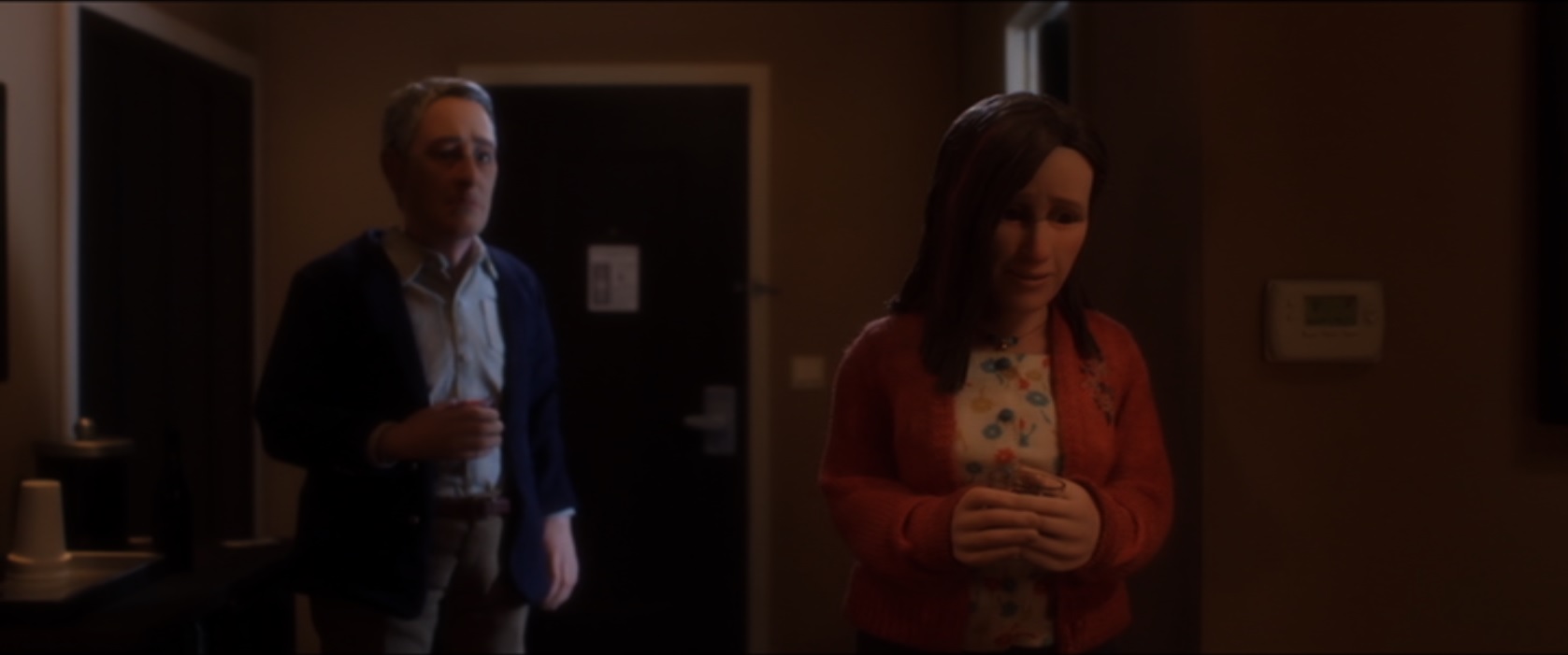
Main protagonist of this film is British customer service expert Michael Stone (voiced by David Thewlis), who is invited to give a speech on customer service in Cincinati, Ohio. Michael seems to suffer from a disease, which could almost only dreamed up by Kaufman: to him all people look and sound the same, making it impossible to distinguish between them. All the people Michael encounters have the same plain face, and the same voice (provided by Tom Noonan). Children, women, men, film stars and even opera singers – they’re all utterly indistinguishable to him.
But then he hears a voice, different from all the others, and desperately tries to contact her. This voice belongs to one Lisa (voiced by Jennifer Jason Leigh), a telephone sales employee from a food company based in Akron, Ohio. Lisa is homely and insecure, especially when accompanied by her much more beautiful friend Emily (we viewers cannot judge that, however, as we see Emily only through Michael’s eyes, which means she has the same bland face and voice as all other characters in the film). Lisa thinks she’s ugly and stupid, thus she’s utterly puzzled by Michael’s interest in her, and not very convinced, either. But Michael’s so glad he’s found someone different that he even dreams of leaving his wife and son, to spend the rest of his life Lisa, whom he calls Anomalisa, as she’s the only one different in a sea of sameness.
It’s important to note that Michael Stone is far from a sympathetic character: he’s self-absorbed, evidently hardly interested in other people, and clearly bored to death with his current life. Even though he has a wife and son at his home in California, he tries to have sex as soon as he has arrived in Cincinnati. So one could argue that his disease is only symbolic of his disinterest in others, but Kaufman does play it as a real disease. For example, when waiting for his old flame Bella, he only acknowledges her after she has recognized him.
Nevertheless, it’s clearly Michael’s own negative attitude which eventually spoils his idyll… Next morning Lisa quickly loses her special charm to him, fading into the sameness of others at a breathtaking speed. The scene in which this takes place, is the most horrifying of the entire movie, despite a nightmare scene preceding it. Especially because at this point our sympathy has long since shifted to Lisa, instead of Michael, who remains, in the end, a pedantic, egotistical prick.
Unfortunately, this great scene is followed by one in which Michael finally delivers his speech. This is a very unconvincing, disappointing scene, by all means. It’s not only rather superfluous, it also stretches the plausibility too much, and almost spoils the entire movie.
Apart from a short prelude in which Michael arrives by plane, a short scene at a “toy store”, and a short postlude, which takes place at his own home, the entire film is set in a very common and extremely bland hotel in Cincinnati, Ohio, where Michael is invited to give a speech on customer service. The hotel setting and short time span (the whole film takes place in less than 24 hours) gives the movie a unity of time and space, rarely encountered in current films. Indeed, the hotel’s bland browns and beiges color the film, adding to its visual character. Incidentally, the hotel is called ‘Fregoli’, after a disorder called the Fregoli delusion, in which the patient thinks several people are, in fact, one and the same person. Note that this Fregoli delusion is markedly different from Michael’s disease – he perceives people as different beings, but cannot distinguish them from each other.
The claustrophobia of the film is greatly enhanced by the stop motion, which always provides a sense of surrealism. Indeed, stop motion is such a logical choice for such an outlandish concept that one almost cannot believe the film is based on a stage play.
The film makes use of very lifelike sets and puppets. Nevertheless the puppets have different proportions than real people (the heads, hands and feet being larger than in real life), and have clearly visible seams at the eyes and ears, as the puppets have replaceable mouth parts. These seams give the puppets a rather uncanny edge. Kaufman even plays with this concept. At one point, Michael seems to be able to cut his own facial part loose, and in a nightmare scene it just drops to the floor, exposing the inner workings of his puppet self.
The realism of the puppets thus is mostly achieved through animation. Indeed, the animation of the puppets, directed by Duke Johnson, is of an extraordinarily high level. Highlight of the film is the sex scene, which in all its awkwardness and clumsiness is one of the most real sex scenes ever put to film, despite being acted out by puppets. The animators used reference from real sex actors for this scene, which took several months to shoot, and the result is a stunning tour-de-force of stop motion.
In all, ‘Anomalisa’ is a unique stop motion film. It’s admittedly not without its flaws, but Kaufman can proudly add it to his oeuvre of weird tales, and the film certainly is a welcome departure from the family film tropes of standard American studio animation.
Watch the trailer for ‘Anomalisa’ yourself and tell me what you think:
‘Anomalisa’ is available on Blu-Ray and DVD


 Dr. Grob's Animation Review