You are currently browsing the yearly archive for 2021.
Director: Petra Freeman
Release Date: 1994
Rating: ★★½
Review:

‘Jumping Joan’ is a dreamlike short about a girl who seems able to jump inside and outside reality.
The narrative is set around a house in the countryside, next to a forest and a river. Petra Freedman’s images are poetic and intriguing, but also very vague and incomprehensible. If there’s a story to this film I couldn’t detect it. What remains are the soft painted images of the girl moving through a garden and other-wordly places, meeting spirits of the earth, the wood and the sky, or so it seems.
The film turns particularly puzzling when the little girl drops two bunny-like creatures from under her skirt, which dance with a blue spirit, living inside a hollow tree, while the girl seems to change into some electrical firework(?) What this all might mean, remains an utter mystery to me.
Petra Freeman’s drawing style is soft, and a little spiritual. Her animation style is a bit slow, but very imaginative, and she uses a fair amount of metamorphosis to tell her story. The film is dominated by earthly reds and blacks, and the dreamlike atmosphere is greatly enhanced by the sound design, which uses strange sounds, and very little music.
Watch ‘Jumping Joan’ yourself and tell me what you think:
‘Jumping Joan’ is available on the DVD ‘The Best of British Animation Awards 1’
Director: Jonathan Hodgson
Release Date: 1994
Rating: ★★★★★
Review:

This hilarious little film features the most outlandish bedtime story ever put to screen.
A father starts to tell this story when his disobedient son starts hitting him with a mallet. Unusually for an animation film, the spoken tale is by far the main attraction of the film, as it winds in unpredictable directions, far from the realms of the ordinary fairy tale. But Jonathan Hodgson keeps the images interesting, as they illustrate the story, sometimes vaguely, sometimes very directly. Thus we watch the father and his son wandering on Mars, driving, in a forest and on a stage.
The film’s atmosphere is wonderfully surreal, greatly enhanced by dreamlike lighting and great timing on the otherwise rather simple, but definitely effective puppet animation. ‘Hilary’ may not have gained the fame of a ‘The Nightmare Before Christmas‘ or ‘The Wrong Trousers‘, it still is one of the most enjoyable stop-motion films of the nineties.
Watch ‘Hilary’ yourself and tell me what you think:
‘Hilary’ is available on the DVD ‘The Best of British Animation Awards 1’ and on The Animation Show of Shows Box Set I
Director: Philip Hunt
Release Date: 1994
Rating: ★★
Review:

‘Ah Pook is Here’ is a short but rather pretentious film using texts by avant-garde writer William S. Burroughs on the atomic bomb.
Read by William S. Burroughs himself from the book of the same name, the film mixes computer animation and stop motion to vaguely illustrate Burrough’s texts. The film is set on a small black planet, enircled by Gods, who look like satellites and bombs. Ah Pook is the destroyer, a.k.a. the atomic bomb. On the planet lives a red-headed alien who asks another flying alien about the nature of man, the nature of death and of democracy.
Unfortunately, the images are pretty irrelevant to the text: they neither illustrate nor counter it. Moreover, Burroughs’s text is pretty disjointed itself, making this short animation film remarkably aimless. For this reason ‘Ah Pook is Here’ must be regarded a cinematic failure, despite the virtuoso mix of computer animation and stop motion.
Watch ‘Ah Pook is Here’ yourself and tell me what you think:
‘Ah Pook is Here’ is available on the DVD ‘The Best of British Animation Awards 1’
Directors: Mike Gabriel & Eric Goldberg
Release Date: June 23, 1995
Rating: ★★½
Review:

In the early nineties the Walt Disney studio was on a roll. Since 1989’s ‘The Little Mermaid’ all its features met with both critical acclaim and huge box office successes. Especially, the studio’s previous film, ‘The Lion King’ (1994) rather unexpectedly broke all box office records, being the highest-grossing motion picture of all time until ‘Finding Nemo’ came along in 2003.
Thus, not surprisingly, the expectations were high for Disney’s next feature, ‘Pocahontas’, only to be followed by a huge letdown, even though the feature did rather well at the box office. ‘Pocahontas’ fails in almost every aspect Disney’s previous features succeeded: the film lacks an engaging story, interesting protagonists, a threatening villain, appealing sidekicks, inspired humor or great songs. Of course, being a Disney film, the film’s animation is outstanding, and so is the film’s design, but that’s unfortunately not enough to rescue a film that collapses under its own pretentiousness.
The film is very, very loosely based on the historical John Smith’s accounts of Pocahontas (ca. 1596-1617), and is terribly unhistorical in almost every aspect. Worse, the film is saturated by political correctness to a fault, and can count as a document of historical revisionism. The film tries very, very hard to portray the native Americans as real people, but nevertheless falls into the trap of the ‘noble savage’, reinforcing the myth that native Americans were living in more harmony with nature than Europeans ever did. Of course, the coming of the Europeans was a tragedy to the native Americans, as it started their demise (only a mere handful of the Tsenacommacah, the tribe depicted, still survive today), and it is practically impossible to make a positive film, let alone an uplifting Disney musical, out of such subject matter. In that respect the film was doomed from the outset.
The film starts In London with governor Ratcliffe (1549-1609) wanting to explore the new world to regain status at the court of king James I. We watch Ratcliffe establish Jamestown , and in the finale of the film Ratcliffe is overthrown by his own men, a very unlikely event, by all means (in reality Ratcliffe was killed in an ambush by members of the Pamunkey tribe). While in Virginia Ratcliffe is obsessed with gold only, regarding the native inhabitants as mere pests.
The misunderstanding between the Tsenacommacah and the British almost leads to war, while the love between Pocahontas and John Smith shows that this does not need to be so. The film is one large advertisement for mutual understanding. A welcome message, for sure, but delivered with heavy-handedness and aplomb. In fact, the rather hippie-like message of love conquers all has been stale since 1970, and is in fact rather painful considering the real events following the establishment of the British colony in Virginia.
Additionally, the film suffers from dire dialogue, and an all too obvious emphasis on delivering its message. Most of the movie progresses slowly and sentimentally. What doesn’t help is the uneasy mix between the serious clashes between the human groups, and the fluffy child’s world of the animal sidekicks. Perhaps the film’s best scene is the final one, in which, against all rules of Disney logic, Pocahontas and John Smith part, never to be reunited again…
Part of the movie’s problems are the leads themselves. Admittedly, star animator Glen Keane has animated Pocahontas very well – especially the scenes just prior the first meeting between her and John Smith are outstanding. However, Pocahontas is presented as a brave, mature and independent woman, which contrasts highly with her childish animal friends, and, to be frank, with her rather irresponsible behavior. Moreover, she has very little to do with the historical Pocahontas, who converted to Christianity, while the movie Pocahontas practically converts John Smith to animalism, in a historically very, very unlikely sequence. Even worse, the real Pocahontas later married a planter, and died already at the tender age of 21. These facts are hard to bear when looking at the stout and proud woman Pocahontas is in the Disney film.
Yet, Pocahontas fares much better than her lover John Smith, Unlike Pocahontas, it’s pretty hard to love John Smith, who’s presented as a fearless and almost flawless hero from the outset. John Smith is surprisingly blasé, and pretty vain, too. In fact, in a way Smith has more in common with Gaston from ‘Beauty and the Beast’ than the animators would be willing to admit, and there’s nothing really interesting about him. In fact, Smith remains a remarkably blank character, having a bland design and a weak story arc, typified with the song ‘Savages’, in which Pocahontas teaches him a lesson on the subject of ‘savages’, the worst of the all too clear messages of political correctness in the film. Animator John Pomeroy must have had a hard time breathing some life into this dull character.
More interesting characters are Pocahontas’ friend Nakoma, who, to me, has actually a more appealing character design than Pocahontas herself has, and her father, Chief Powhatan, who arguably is the best designed character in the whole movie. These two Indians are more interesting than all Europeans. Best of these is Thomas, a youngster that is so clumsy he would have died within months in the real world. Governor Ratcliffe is a very unhistorical character, who looks more Spanish than British, and who is foolish enough to try to dig up gold at a random shore. In the 17th century they certainly knew better than that. Ratcliffe is a rather poor excuse for a villain: he’s more vain than scary, and at no point a real threat to anyone, as is proven by the film’s finale. He’s accompanied by a servant called Wiggins, who provides the only convincing comic relief in this all too serious film.
Wiggins certainly is more tolerable than the three animal characters, the overtly cute raccoon Meeko, ditto hummingbird Flit, and Ratcliffe’s pet pug Percy. The three steal considerable screen time, they have their own subplot of enemies befriending each other, and are completely out of tune with the serious subject of clash of civilizations, and threat of war. By the time ‘Pocahontas’ was released, one got the impression that ‘animal sidekicks’ were obligate additions to the rule book of Disney feature film making, a feeling that was corroborated by ‘Mulan’ (1998), in which the animal sidekicks (a dragon and a cricket for God’s sake!) were even more outlandish and superfluous.
Yet, the worst character in the whole movie is Grandmother Willow, a talking tree. Apart from the fact that she’s brought alive by dated computer animation, this is a concept that even in a world full of spirits I will not buy. Grandmother Willow is such an outlandish, unbelievable character, she hampers the whole movie, and makes it very, very difficult indeed, to take the more realistic events seriously. Someone should have vetoed her presence early in the conceptualization of the story.
The soundtrack isn’t of any help either. The songs are by composer Alan Menken, who provided the hit songs for ‘The Little Mermaid’ (1989), ‘Beauty and the Beast’ (1991) and ‘Aladdin’ (1992). Not one of the songs in ‘Pocahontas’, however, reaches these heights. Instead, we are treated by very generic and surprisingly forgettable nineties-musical songs. What certainly doesn’t help are the trite lyrics by Stephen Schwartz, which suffer from the same political correctness as the rest of the movie. The ‘Savages’ song forms the low point of the film in that respect.
No, the film’s unquestionably strongest point is its design, and it’s art director Michael Giaimo and artistic coordinator Don Hansen who should be praised most. More than any other Disney film of the Disney renaissance ‘Pocahontas’ looks back to the stylized designs of the late 1950s. For example, the film starts with a 1607 scene that is very reminiscent of the London scene in ‘The Truth About Mother Goose’ (1957), while in the rest of the film the background art, supervised by Cristy Maltese, is a straight echo of Eyvind Earle’s artwork for ‘Sleeping Beauty’ (1959), including square trees. The human designs, too, are more angular than ever, even to a fault, rendering some of the characters stiff and unappealing, especially some of the Indians, who at times look like technical art school drawings instead of living humans.
In fact, the film is most interesting for its outstanding color design, which with its grand greens, blues and purples is comparable to the best of ‘Fantasia’ (1940) and ‘Sleeping Beauty’, and one must admit that ‘Pocahontas’ certainly is a film worth looking at, if not necessarily one to watch. Indeed, I believe ‘Pocahontas’ will be remembered for its design elements, a clear product of the animation renaissance, especially as an early product of the school that looked back to the cartoon modern age (ca. 1948-1965), as exemplified by several television series from Nickelodeon and Cartoon Network from the second half of the nineties, which were, not surprisingly, often made by former CalArts students of Giaimo.
Watch the trailer for ‘Pocahontas’ yourself and tell me what you think:
‘Pocahontas’ is available on Blu-Ray and DVD
Directors: Priit Pärn & Janno Põldma
Release Date: May 6, 1995
Rating: ★★
Review:

‘1895’ is Priit Pärn’s homage to hundred years of cinema. 1895 was the year the Lumière brothers invented the cinématographe, and Pärn, with his colleague Janno Põldma, tells their story in his own unique way. In fact, for 99% of the film we have absolutely no clue what it’s all about.
The film depicts the life of one Jean-Louis, born on November 26, 1863, whose life story takes him all across Europe. Jean-Louis’ biography is told with a voice over and in a rapid succession of short scenes, one more absurd than the other. Sometimes the narration switches to the life of his twin brother, which takes place underground, and which invariably is accompanied by a completely black screen. Little of it makes sense, and often the images are in sharp contrast with the voice over texts.
The film is chock-full of references to famous people of the 19th century, paintings, literature, and, of course, cinema. There’s even a Tom & Jerry parody, which is accompanied by the narrator naming all kinds of French artists. In another scene we can watch Jean-Louis crushing the penguin from Aardman’s ‘The Wrong Trousers‘ (1993).
The film is mostly shot in traditional cel animation, but Pärn and Põldma use a wide range of styles, including rotoscope done in pencil. Unfortunately, the film relies heavily on the narration, and is more absurd than satisfying. In fact, ‘1895’ should be regarded as Pärn’s least successful films, tickling one’s fantasy less than his other works.
‘1895’ is available on the DVD-set ‘Priit Pärn integral 1977-2010’
Director: Jeff McGrath
Airing Date: May 8, 1995
Stars: Duckman
Rating: ★★★★★
Review:

Season Two of Duckman lasted only nine episodes, much shorter than the other three (13, 20 and 28 episodes respectively).
The season ends with a “cheater”, a cartoon consisting substantially of existing material. But this is done in a surprisingly sophisticated way, resulting in one of the most “meta” of all Duckman episodes. In fact, even the first scene is a cheater, showing the same footage no less than three times, as Duckman, tied to a hospital bed, tries to remember what happened.
It turns out he’s kidnapped by one Harry Medfly, “currently unemployed TV-critic”, who reveals to Duckman that he’s in fact star of a TV-show, which Medfly finds repulsive. Medfly proves his point by showing short clips from previous episodes, showing Duckman at his most sexist, at his most politically incorrect, at his most inapt as a detective, as most cruel to his employees Cornfed, Fluffy and Uranus, and at his most insensitive to his family. These five series of snippets are very entertaining in themselves, but the framing story is interesting, as well.
Highlight, however, is Medfly’s attempt to kill Duckman by signalling a huge mass of television history through his head. At this stage Duckman changes into several very different television personalities in a very rapid succession of metamorphoses. This is by all means great television animation, topped only by the self-aware dialogue at the finale.
Watch ‘Clip Job’ yourself and tell me what you think:
This is Duckman episode no. 22
To the previous Duckman episode: Research and Destroy
To the next Duckman episode: Noir Gang
‘Clip Job’ is available on the DVD-box ‘Duckman – The Complete Series’
Director: John Eng
Airing Date: May 1, 1995
Stars: Duckman
Rating: ★★★
Review:

In this episode Ajax’s English teacher discover that Ajax is a poet. Soon Ajax recites his totally incomprehensible poems to a huge audience at a hip beatnik club called Kolchnik’s.
But then Duckman sells his son away to the ‘Watermark’ company (an obvious parody of Hallmark)… The introduction of the humongous Watermark company is a great little piece of cinema and involves some animated backgrounds, a rare feat since the early 1930s.
‘Research and Destroy’ is one of the most straightforward of all Duckman stories, with a clear story from start to end. Highlight is the screwball image that returns as a running gag throughout the picture, but most interesting is the supercomputer assembling metadata on all customers. In ten years time this would become more than true…
Watch ‘Research and Destroy’ yourself and tell me what you think:
This is Duckman episode no. 21
To the previous Duckman episode: In the Nam of the Father
To the next Duckman episode: Clip Job
‘Research and Destroy’ is available on the DVD-box ‘Duckman – The Complete Series’
Director: Norton Virgien
Airing Date: April 24, 1995
Stars: Duckman
Rating: ★★★
Review:

When Cornfed gets a visit from one Ng claiming to be his son, he has to get back to Vietnam to find out the truth. He asks Duckman to come along. Duckman brings his family with him as Cornfed pays for the trip and the family demands a vacation.
While the Duckman family amuses themselves in the war-themed ‘Euro Asia Land’, Cornfed looks hopelessly for his wartime love interest Mai Ling. The Vietnam setting allows for some spoofs on Vietnam films, like ‘Apocalypse Now,’ ‘Forrest Gump’ and ‘Good Morning Vietnam’. Unfortunately, the pace is rather slow and rambling, hampering the flow of the episode.
Fluffy and Uranus have a larger role than normally: when the two cute teddy bears ask for a vacation for themselves after eleven years of hard work, Duckman makes them explode inside a microwave. Yet, later we watch them entertaining Ng by showing him slides, much to Ng’s distress.
This is the first Duckman episode to use a shortened intro, leaving out the introduction of Duckman’s co-stars.
Watch ‘In the Nam of the Father’ yourself and tell me what you think:
This is Duckman episode no. 20
To the previous Duckman episode: The Germ Turns
To the next Duckman episode: Research and Destroy
‘In the Nam of the Father’ is available on the DVD-box ‘Duckman – The Complete Series’
Director: Bob Hatchcock
Airing Date: April 17, 1995
Stars: Duckman
Rating: ★★★½
Review:

This episode starts with Aunt Bernice finding a crystal in her own backyard and taking the family to a new age fair to let it examine.
Against all odds it’s Duckman who gets the most spiritual journey of his life, when he talks to his late mother, who has reincarnated as a highly infectious germ. It turns out that Duckman was heavily neglected by his mother during his childhood, and in a flashback we see some rare footage of Duckman as a kid. Duckman’s mother explains her son that it’s all about karma, which prompts Duckman to better his life in his own unique way, by stuffing his kids full of bad food, by bribing their teachers, and by building a baseball field right on a railroad track.
Duckman’s encounter with his mother forms the heart of the episode, and this part is surprisingly sincere, despite the occasional joking, making this one of those welcome episodes exposing more of Duckman’s emotional side.
Watch ‘The Germ Turns’ yourself and tell me what you think:
This is Duckman episode no. 19
To the previous Duckman episode: America the Beautiful
To the next Duckman episode: In the Nam of the Father
‘The Germ Turns’ is available on the DVD-box ‘Duckman – The Complete Series’
Director: Paul Demeyer
Airing Date: April 10, 1995
Stars: Duckman
Rating: ★★★
Review:
‘America the Beautiful’ starts with a warning sign stating that “the following contains scene of heavy-handed and over-obvious allegories and is not recommended for small children and certain congressmen from the South”.
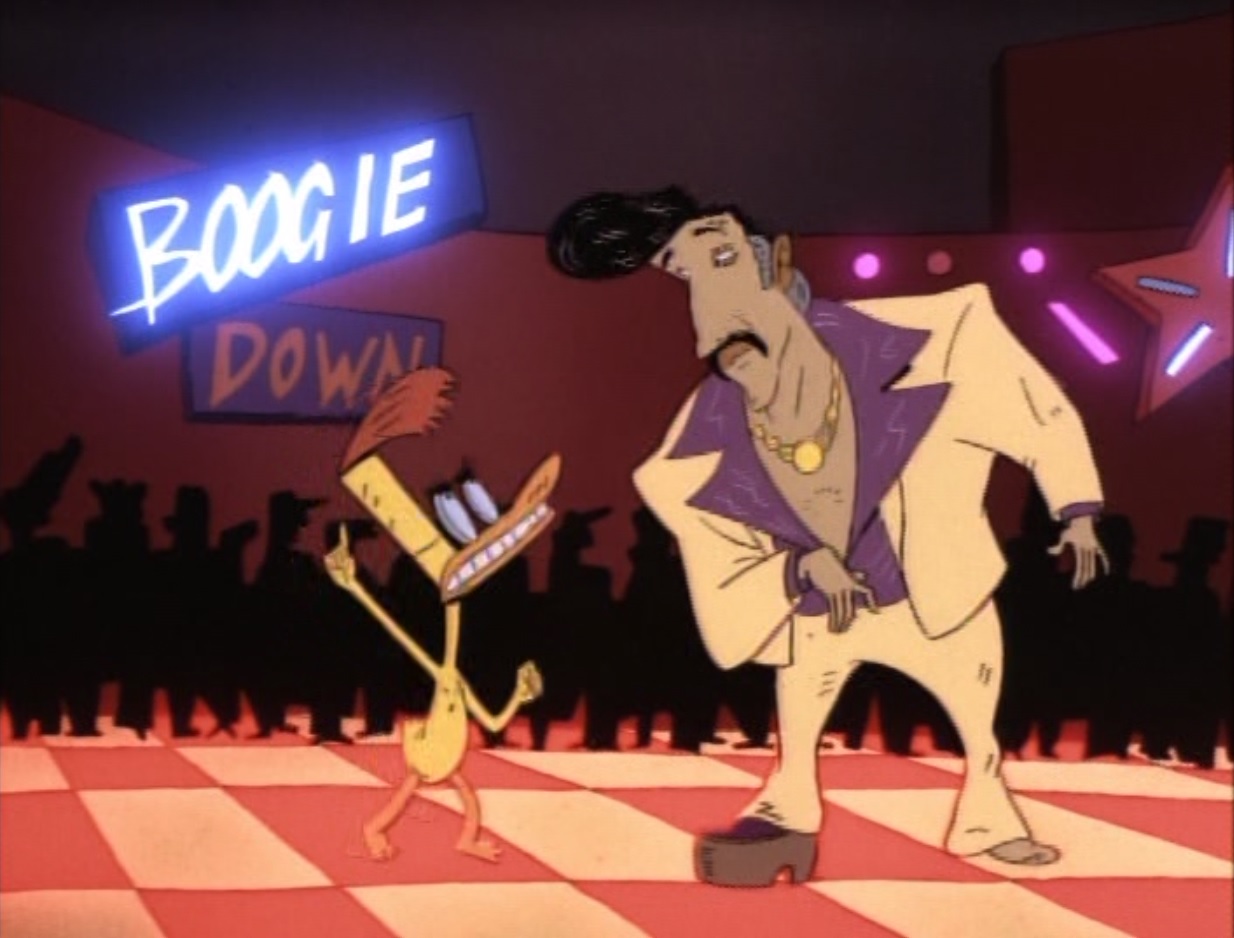
And indeed, this is an allegorical episode, with Duckman and Cornfed in search of America (who has taken form of a beautiful and noble woman) on behalf of some overtly cute little children. The quest takes them to a 1950s suburbia, a 1960s hippie university, a 1970s disco, and 1980s Wall Street. All the four have exploited America, giving nothing in return. Duckman finally finds America at a dump. The episode ends with a corny ‘We Are the World’-like song sung by all protagonists and the children called ‘We Are Here’.
The episode indeed suffers from heavy-handedness, and Duckman in particular, seems quite at loss here. The best part is when Duckman and Cornfed drive into the 1950s suburbia, which changes them from full color into black and white, prompting Cornfed to say “it appears they don’t allow people of color in this community“. Also remarkable, but much less functional is the beauty pageant-turning-into-a-big fight with which the episode opens.
Watch ‘America the Beautiful’ yourself and tell me what you think:
This is Duckman episode no. 18
To the previous Duckman episode: Inherit the Judgement: The Dope’s Trial
To the next Duckman episode: The Germ Turns
‘America the Beautiful’ is available on the DVD-box ‘Duckman – The Complete Series’
Director: Kevin Lima
Release Date: April 7, 1995
Stars: Goofy, Max, Pete
Rating: ★★★
Review:

‘A Goofy Movie’ arguably is the least known of Disney’s theatrical movies from the studio’s Renaissance period. The film is not even in its official canon of animated features. Maybe because it was Disney’s first animated theatrical feature based on a television series, in this case ‘Goof Troop’, which run from September to December 1992.
Now I’ve never seen an episode of this television series myself, but I comprehend that it does resolve around Goofy being a single father of his son, Maximilian (in short Max), and being neighbor to Pete, who is a single father of a son, too, Pete Junior or P.J. in short. ‘A Goofy Movie’ uses exactly this premise, focusing on the relationship between Goofy and his son, with Max being the undisputed main character of the movie.
Now, Goofy’s family life has always been odd, being the classic Disney character that changed the most during his career. And indeed, he has been seen having a son in a few of his classical cartoons, starting with ‘Fathers are People’ from 1951, but by that time Goofy had transformed into everyman George J. Geef, and this son clearly isn’t Max, as he’s called George Geef jr. In both ‘Goof Troop’ and ‘A Goofy Movie’ Goofy once again is his clumsy self, so he has evolved once more. Pete, too, has had a son in earlier entries, most notably in ‘Bellboy Donald’ from 1942. In ‘A Goofy Movie’ he’s not really the villain of the old days of old, but still a disruptive voice, not taking Goofy for full, and giving him ill advice.
Voice artist Bill Farmer reprises his role as Goofy from ‘Goof Troop’ and is an excellent successor to Pinto Colvig. Max is voiced by Jason Marsden, a different voice than in ‘Goof Troop’, in which he was voiced by a woman (Dana Hill). But this is understandable as the events in ‘A Goofy Movie’ take place several years after the ones in ‘Goof Troop’. Max’s singing voice is provided by Aaron Lohr.
Added to the mix, and apparently not present in ‘Goof Troop’, is Max’s love interest Roxanne, and the film starts with Max’s last day at school, on which he tries to impress Roxanne, in which he succeeds, and he manages to ask her on a date to a party. Unfortunately, his father, realizing he might be losing grip on his son, has planned a trip for two to some fishing lake, and Max invents a totally unconvincing lie of why he has to cancel the date, involving both Max’s and Roxanne’s pop idol Powerline (who, voiced by Tevin Campbell, sounds a little like Michael Jackson).
As said, the father-son relationship between Goofy and Max is the focal point of the cartoon, and as such the film is surprisingly realistic and down to earth, with Max being ashamed of his old-fashioned, awkward and clumsy father, and Goofy uncomprehending of Max’s interests as an independent teenager. However, the two learn to know and to respect each other on a rather forced road trip through America. In this respect, one can see ‘A Goofy Movie’ as a forerunner of ‘Finding Nemo’ (2003), which explores a similar theme.
The road trip, which takes place on Route 66, and which takes the two Goofs all through America, forms the main part of the film, and it’s surprising to note that this piece of Americana was animated in studios in Paris, France and Sydney, Australia. Unfortunately, ‘A Goofy Movie’ defies all realism in several scenes, hampering the heartfelt story with outlandish scenes, like the two Goofs encountering Bigfoot, falling off a cliff with their car, and escaping a waterfall in an all too improbable and inconsistent series of events.
Moreover, for a film starring Goofy there’s surprisingly little humor – it’s all not that goofy. Yet, the team has managed to keep Goofy’s optimistic and naive character, while adding some depth to the former simpleton, mostly his struggle in being a father to Max. Indeed, the film is at its best when keeping focus on the relationship between Goofy and Max. This focal point remains interesting despite the deviations from reality.
As a film of the early nineties, ‘A Goofy Movie’ is an obligate musical, and the movie knows three nice if forgettable songs by Carter Burwell, sung by Max, with Goofy joining in in two of them. They at least succeed in not being obnoxious.
The animation is of a very high quality, with considerable attention detail. There are some nice touches, like Max’s reflection in a window, or colors turning blue when Goofy gets sad.
In all, ‘A Goofy Movie’ is a nice little movie with a surprisingly mature theme. The film may not be a masterpiece, it’s of enough quality to be worth a watch.
Watch the trailer for ‘A Goofy Movie’ yourself and tell me what you think:
‘A Goofy Movie’ is available on Blu-Ray and DVD
Director: Jeff McGrath
Airing Date: April 3, 1995
Stars: Duckman
Rating: ★★★½
Review:

‘Inherit the Judgement: The Dope’s Trial’ starts with Duckman and the family driving through the desert in a hot car in search of some idiotic bargain.
They crash into some hick town, which happens to be the home town of Ducman’s rival King Chicken (see ‘Ride the High School‘ and ‘Joking the Chicken‘ from the first season). By exclaiming that the egg came before the chicken Duckman gets imprisoned and is about to be hanged, but he manages to save himself on trial by making King Chicken revealing his own vile scheme.
The episode ends with Cornfed parodying Porky Pig, but the episode’s highlight is King Chicken’s ‘Down with Duckman Carnival’, which is full of crazy rides based on killing Duckman.
Watch ‘Inherit the Judgement: The Dope’s Trial’ yourself and tell me what you think:
This is Duckman episode no. 17
To the previous Duckman episode: Days of Whining and Neurosis
To the next Duckman episode: America the Beautiful
‘Inherit the Judgement: The Dope’s Trial’ is available on the DVD-box ‘Duckman – The Complete Series’
Director: Van Partible
Airing Date: March 26, 1995
Stars: Johnny Bravo
Rating: ★★
Review:

Johnny Bravo was one of the striking characters of the cartoon renaissance happening at Cartoon Network. Together with Dexter’s Laboratory, Cow and Chicken, The Powerpuff Girls, and Courage the Cowardly Dog he was the flagship of the creativity at the network in the second half of the nineties.
Yet, this isn’t immediately visible in the very first short starring the character, aptly titled ‘Johnny Bravo’. This very first Johnny Bravo episode first aired as part of Cartoon Network’s ‘World Premiere Toons’ (later renamed ‘What a Cartoon’), and was re-shown later as the first part of three shorts forming the first Johnny Bravo episode broadcasted on July 7, 1997.
The episode firmly establishes Johnny Bravo as a character obsessed by his own body and presumable attractiveness to women, who don’t care about him in a bit. The short starts at a zoo where Johnny Bravo hopelessly tries to impress passing girls. When a gorilla has escaped he offers the female zookeeper to retrieve the animal.
The gorilla is a badly designed, purple talking beast that is one of the least funny characters to hit the television screen, especially when Partible tries to make him Bugs Bunny-like funny when talking to Johnny Bravo. This is a painful attempt at humor, indeed. Much better are Johnny Bravo’s attempts to show off and to attract women.
The animation overall is limited and very jerky, with especially Bravo jumping from pose to pose, an animation style that was remarkably fresh at the time. The hands mostly are mere paws until the fingers have to be drawn. This style unfortunately gives the character an ugly and cheap look. The color design, too, is far from interesting and arguably non-existent. In all, this debut cartoon hasn’t aged very well. Yet, the character would last four seasons, being on television between 1997 and 2004.
‘Johnny Bravo’ is available on the DVD-set ‘Johnny Bravo Season One: All 13 Episodes’
Director: John Eng
Airing Date: March 25, 1995
Stars: Duckman
Rating: ★★½
Review:

In this mediocre Duckman episode a guy named Milo, owner of a rehab clinic for the rich and famous, asks the help of Duckman to find out who wants to murder him.
Unfortunately, the man is killed even before Duckman can start the case. But Duckman isn’t focused anyway, and it’s up to Cornfed to solve the murder mystery, while Duckman gets ravingly mad in rehab.
Duckman behaves more cartoony than ever in this episode, and his hallucinatory ride in which he has visions of food and women forms the highlight of the cartoon. But he’s playing second base this time, for much screen-time is devoted to his assistant Cornfed at his most serious. There’s also some random violence by Duckman on his cutesy-wootsy assistants Fluffy and Uranus.
Watch ‘Days of Whining and Neurosis’ yourself and tell me what you think:
This is Duckman episode no. 16
To the previous Duckman episode: Married Alive
To the next Duckman episode: Inherit the Judgement: The Dope’s Trial
‘Days of Whining and Neurosis’ is available on the DVD-box ‘Duckman – The Complete Series’
Director: Raymie Muzquiz
Airing Date: March 18, 1995
Stars: Duckman
Rating: ★★★½
Review:

‘Married Alive’ start with Duckman’s house being in the baddest shape imaginable, with everything broken and undefined gore lying in heaps everywhere.
It turns out that aunt Bernice has been away, but when she returns, she’s not even mad, but sings Giacomo Puccini’s aria ‘O mio babbino caro‘, because she’s in love. During her holiday a billionaire and media magnate called Baron von Dillweed proposed to her to star the first infomercial-wedding ever. Duckman only starts to worry when Bernice reveals she’ll move to Switzerland and take the boys with her. At that point Duckman comes into action, and uses his dormant detective skills to unmask the baron in his own unique way.
This episode features a short reference to Indiana Jones, Cornfed doing karaoke, and Duckman grinding Fluffy and Uranus to rice, but the episode’s highlight must be aunt Bernice’s lovesick behavior.
Watch ‘Married Alive’ yourself and tell me what you think:
This is Duckman episode no. 15
To the previous Duckman episode: Papa Oom M.O.W. M.O.W.
To the next Duckman episode: Days of Whining and Neurosis
‘Married Alive’ is available on the DVD-box ‘Duckman – The Complete Series’
Director: Norton Virgien
Airing Date: March 11, 1995
Stars: Duckman
Rating: ★★★
Review:

The second season of ‘Duckman: Private Dick/Family Man’ starts with a rather rambling episode in which Duckman tries to get famous by exploiting the sleazy reputation he got by pinching the butts of two sexy ladies on camera.
The set up of this episode is rather incomprehensible and involves the president visiting town, and three sexy but dumb ladies visiting Duckman’s office for no apparent reason. Also involved is a commercial fellow with shades, a ponytail and an annoying voice, making Duckman sign a contract to get him famous. Nothing is done with this devilish scheme, however.
Highlight of this otherwise disappointing episode is Duckman’s feature film on his life called “Pinch Me, Kiss Me Kill Me: The Duckman Story”. This part is acted out in live action, and includes over the top sexy women falling for the cool Duckman character as well as ridiculous dialogue full of sexual references, and even blatant advertising.
Watch ‘Papa Oom M.O.W. M.O.W.’ yourself and tell me what you think:
This is Duckman episode no. 14
To the previous Duckman episode: Joking the Chicken
To the next Duckman episode: Married Alive
‘Papa Oom M.O.W. M.O.W.’ is available on the DVD-box ‘Duckman – The Complete Series’
Director: Raimond Krumme
Release Date: October, 1994
Rating: ★★★½
Review:
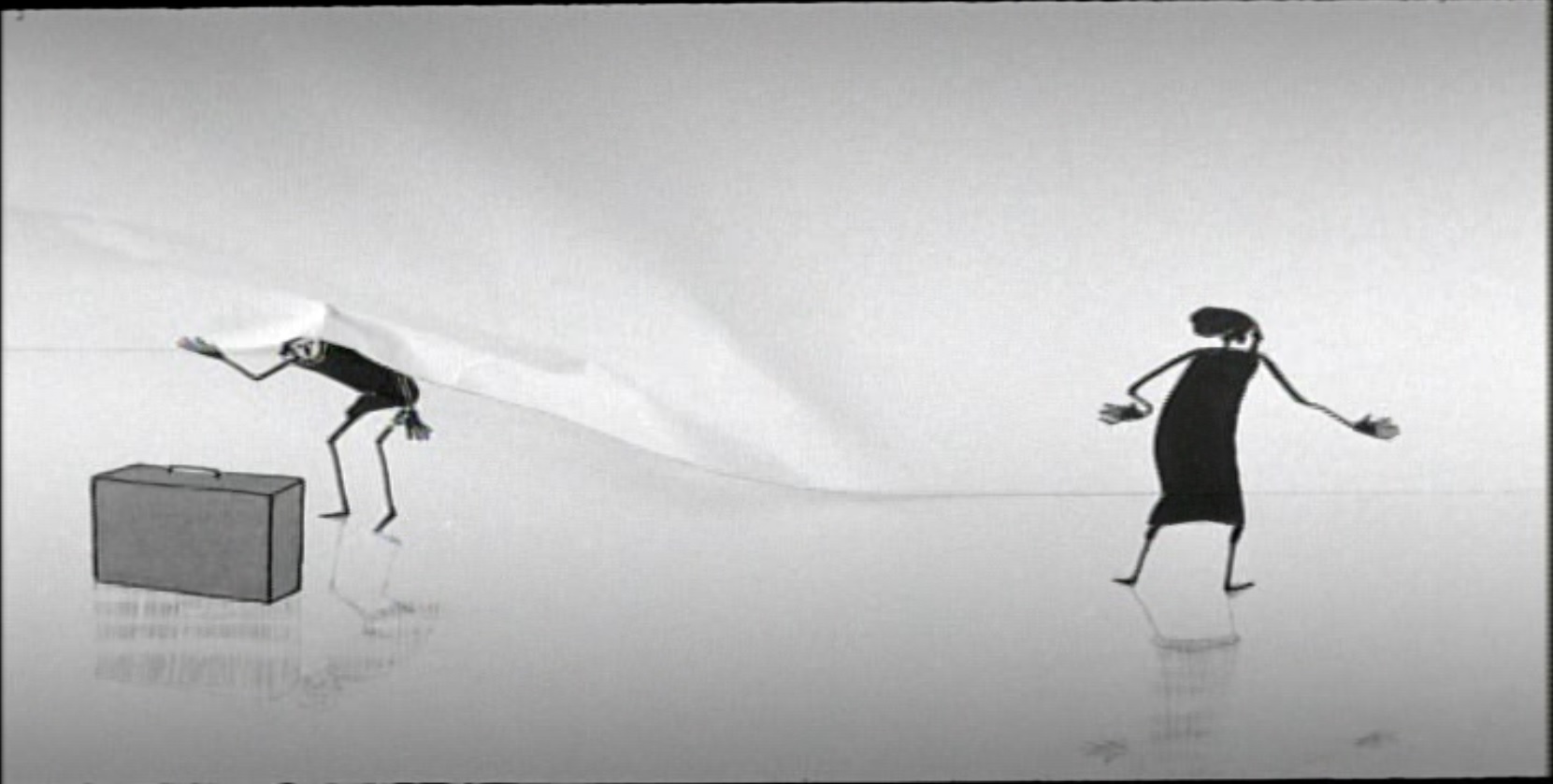
In ‘Passage’ a man and his servant, who carries a heavy suitcase, are crossing an empty space of snow and ice. The snow and ice provide a conflict between the two, even disrupting the integrity of the two men’s bodies.
Typically for Krumme even the background space isn’t what it seems to be, with the servant hiding behind the horizon line, and several pieces of paper wrinkling during the fight. This is inventive use of the medium of animation, indeed.
Unfortunately, one can hardly tell the two men apart, who are drawn and animated the same (one has a tall hat, but the two even exchange hats at one moment). Moreover there’s hardly any story, and the film appears to stop only because Krumme seemingly runs out of ideas.
Watch an excerpt from ‘Passage’ yourself and tell me what you think:
‘Passage ’ is available on the DVD ‘Spatial Pandemonium – Short Films by Raimund Krumme’ and on The Animation Show of Shows Box Set 9
Director: Jan Švankmajer
Release Date: September 10, 1994
Rating: ★★★★★ ♕
Review:
‘Lekce Faust’ (literally ‘Lesson Faust’) is Jan Švankmajer’s second feature film. It contains much less animation than his first feature film ‘Něco z Alenky’ (Alice) from 1988 and can be considered his first live action movie.
However, this film is still much connected to his earlier work, mostly through the use of life-sized puppets, which goes all the way back to ‘Don Šajn’ (Don Juan) from 1969, and of advanced clay animation, which Švankmajer first used in ‘Možnosti dialogu’ (Dimensions of Dialogue) in 1982. Moreover, there’s little dialogue in the film, with the first lines only appearing after 15 minutes. Instead, the film relies heavily on stark imagery and exquisite sound design (there’s no musical soundtrack), just like in animation film. The English dub, by the way, is excellent, and there’s no need to find the original Czech version.
Švankmajer retells the story of Faust in his own unique way, with an inner logic that is unique to his brand of surrealism. For this Švankmajer uses texts from Johann Wolfgang von Goethe’s two Faust plays (1808 & 1832), as well as Christopher Marlowe’s play Doctor Faustus from 1592, enhanced with text traditions from Czech puppet theater productions based on the same legend. Even a part from Charles Gounod’s opera ‘Faust’ from 1859 is used in a scene that features four ballerinas and which is probably the least essential and least successful episode in the entire film.
Importantly, the film stars an unnamed everyman (played by the deadpan Petr Čepek in his last role before his death in 1994), who’s slowly lured into the devil’s clutches. By using the most common protagonist imaginable we’re given the opportunity to live the nightmare the man experiences ourselves. There’s a sense of ‘this could happen to anyone’, with which we enter the bizarre series of events.
The film starts with two characters handing out copies of a map with a red spot but no explanation to passers-by. Our man gets one, too, and has a short look at it, before he discards the piece of paper. Nevertheless, immediately strange omens pile up around him: he watches a doll’s head getting crushed between two doors, a black chicken flees his home apartment, and when he goes eating he finds an egg inside his bread. As soon as he opens the egg, the man seems to be lost, and the next day he goes exploring…
The film mostly takes place indoors, and like in ‘Alice’ there’s a genuinely claustrophobic feel to it, with a total lack of logic with which the different spaces are connected. This of course contributes to the nightmarish atmosphere that stays throughout the feature. Nevertheless, Švankmajer occasionally returns to outdoor scenes, sometimes very abruptly, with staged sets switching to scenes taking place in nature, parks or ruins, and vice versa. But sometimes more naturally, with the man reentering the streets of Prague a couple of times.
Yet our hero never stays out of the clutches of the devils for long, and all too soon his curiosity brings him back to the theater set where he more or less has to play his part. For a long while, the man takes the whole play for a joke. It certainly doesn’t help that the part of the good angel is played by a puppet as well, making the man’s only chance to repent by all means a rather silly occasion. Thus only too late the man realizes that the devil will indeed collect his soul.
As the film progresses, the man transforms more and more into the character of Faust, and he becomes more and more a puppet himself. Indeed, several important scenes, like the signing with the blood, take place in puppet form. While the man becomes a puppet more and more himself, the puppets around him seem to behave more and more freely. First they are only seen operated by anonymous stage hands. But later we watch a devil, who’s summoned by the Jester, walking in and out of the street by himself. Later still, we can clearly see a puppet of a queen breathing, making its stagy death all the more poignant.
Like the man himself, the viewer has a hard time following the surreal course of events, but the film nevertheless progresses slowly but steadily to its logical and macabre conclusion. The film ends with the cycle starting all over again: as the man flees the devil’s place in horror, another one enters. But the man cannot escape the devil’s clutches: if the devil may not be able to take him in his puppet form, he’ll do it in real life, on the streets of Prague…
Despite the dark subject matter, there’s room for some comedy. For example, when the burning wagon rides off stage, it’s followed by a fireman in a cartoon fashion. More comic relief comes from a Jester puppet, who speaks in rhyme, and whose lines clearly come from the puppet theater tradition. In a way the Jester is smarter than his master, being able to tame a devil without losing his soul to it. Scarier, but still amusing are a bum carrying a severed leg, and the two men from the first scene, who return several times, showing their playfully mischievous characters repeatedly, e.g. making the man pay for all their beers, and stealing snacks during intermission.
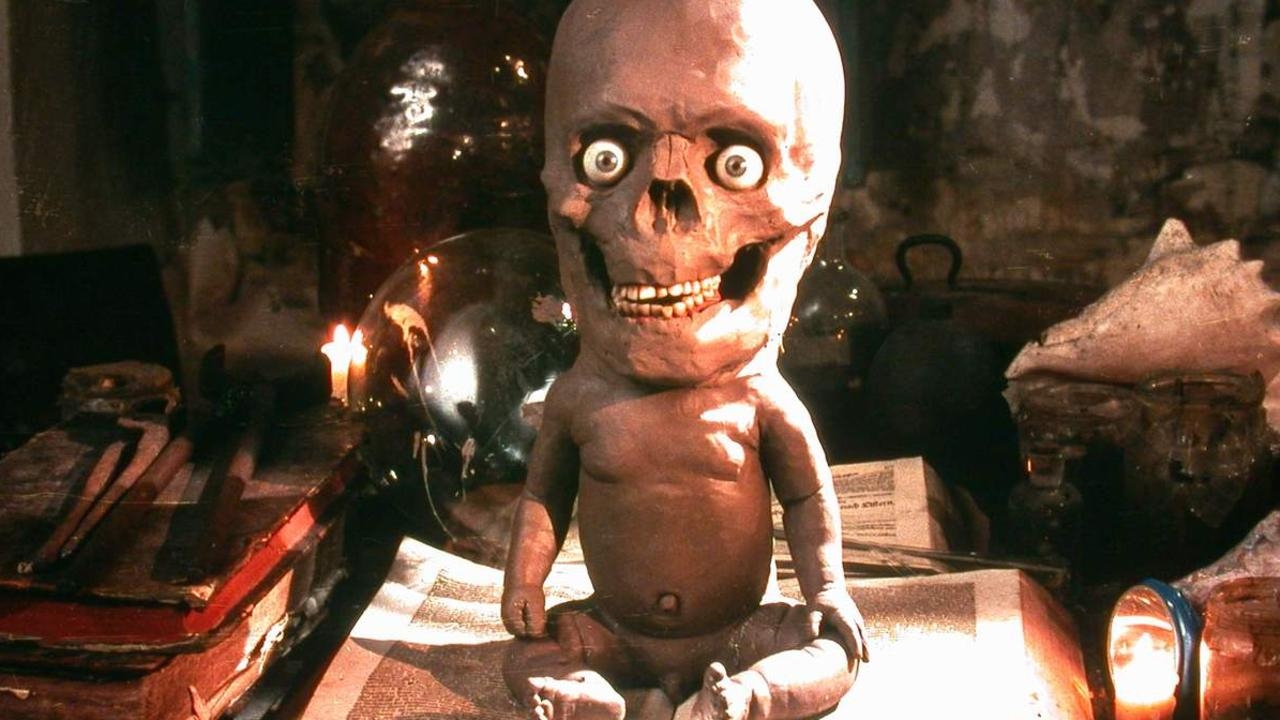
Animation reoccurs throughout the film, which nevertheless remains essentially a live action movie. For animation lovers highlight is a rather unsettling scene in which the man creates life, which quickly ages and transforms into a gruesome skull. This is done in Švankmajer’s characteristic virtuoso clay animation. A highlight of puppet animation is a short scene in which little devils molest and abuse little angels in order to make Faust sign his soul away.
The Best scene of the whole film, however, features little animation. This is when the man summons Mephistopheles. This scene is full of compelling images, with brooms dusting as if they were alive, drums playing themselves, crossbows appearing from pillars, and a burning wagon circling the summoner. During this scene the scenery changes from indoor to outdoor repeatedly, with the man finding himself in the woods, on top of a mountain and on a snowy plain.
Švankmajer tests the general viewer with his typical way of filming, using extreme close-ups, virtually no dialogue, fair use of puppetry and stiff old fashioned language during the staged parts. But viewers who stay are rewarded with a deeply layered film that will cling into the back of the mind for quite a while after viewing. To me ‘Lekce Faust’ is the best of his feature films, and together with ‘Jabberwocky’ (1971) and ‘Dimensions of Dialogue’ it forms the pinnacle of the Czech master’s art.
Watch the trailer for ‘Lekce Faust’ yourself and tell me what you think:
‘Lekce Faust’ is available on Blu-Ray and DVD
Director: Michaela Pavlátová
Release Date: 1995
Rating: ★★★★★ ♕

After the critically acclaimed ‘Words Words Words‘ (1991) Michaela Pavlátová returned with an even better film called ‘Repete’. This film explores daily routines, with a man walking a dog as a bridging elements.
The walking man repeatedly watches a beautiful woman passing by, a cyclist, and a hurried man looking at his watch. These street scenes are interspersed with scenes depicting three couples, all stuck in an unhealthy repetitive relationship. The first shows a woman feeding a man, who doesn’t even look at her, but keeps on reading the newspaper. The second depicts a man threatening to commit suicide the moment his love rejects him. And the third shows a couple about to have sex until a telephone calls the woman away, leaving the man waiting.
At one point the dog refuses to go on, and the repetition stops, allowing the couples to get mixed. It looks like the mingling of these people improves their relationships, but all too soon new repetitions set in…
Like ‘Words Words Words’ Repete is a great work of animated surrealism, making full use of the medium. Pavlátová uses a very crude and scribbly pastel technique, shifting perspectives and no dialogue. Her style is completely her own, and very engaging. No wonder Repete, too, swept many awards.
Watch ‘Repete’ yourself and tell me what you think:
‘Repete’ is available on the DVD ‘Desire & Sexuality – Animating the Unconscious Vol.2’
Director: Michaela Pavlátová
Release Date: 1991
Rating: ★★★★★

‘Words Words Words’ is set in a cafe, and explores different types of dialogue, like gossip, seduction, quarrel, pep talk, and talk of love.
The different ways of talking are depicted by colorful balloons that, contrary to the familiar text balloons in comic strips, are devoid of text. This leads to humorous and inventive images in the best surrealist tradition. The best sequence involves a couple falling in love, but then falling into discord. Luckily, the humble waiter saves the day. Running gag of the film is a little yellow dog, who secretly drinks from the visitors’ cups and glasses.
‘Words Words Words’ is a highly entertaining film, and was rightly nominated for an Academy Award.
Watch ‘Words Words Words’ yourself and tell me what you think:
‘Words Words Words’ is available on the DVD ‘Desire & Sexuality – Animating the Unconscious Vol.2’


 Dr. Grob's Animation Review