
You are currently browsing the category archive for the ‘Black and White Films’ category.
Directors: John Foster & Harry Bailey
Release Date: March 5, 1932
Rating: ★★★★½
Review:
 ‘Fly Frolic’ quite shamelessly puts its inspiration from films like Fleischer’s ‘Wise Flies‘ (1930) and Disney’s ‘The Spider and the Fly‘ (1931), visiting exactly the same theme of the spider and the fly.
In Van Beuren’s version, two flies go to the ‘Coffee Pot Cabaret’ for a night out. At one point an old spider enters, scaring the flies to death. He goes into a Cab Calloway routine, singing the bandleader’s 1931 hit ‘Kickin’ The Gong Around’, Calloway’s second song about Minnie the Moocher. Interestingly, this film was released a week before Cab Calloway himself appeared in an animation film in Fleischer’s ‘Minnie the Moocher‘.
After some scatting the spider kidnaps the female fly and takes her to his secret laboratory. At this point the film suddenly changes into a parody of the 1931 horror film ‘Dr. Jekyll and Mr. Hyde’, with the spider changing into a handsome dandy. This doesn’t fool anyone, however, and the hero fly beats him, joined by his fellow flies.
‘Fly Frolic’ is a quite consistent film with a lot of melodrama. The designs are pretty primitive, however, and the spider changes completely from the nightclub scene to the laboratory scene, even before drinking his potion!
Watch ‘Fly Frolic’ yourself and tell me what you think:
‘Fly Frolic’ is available on the DVD ‘Aesop’s Fables – Cartoon Classics from the Van Beuren Studio’
Directors: John Foster & Harry Bailey
Release Date: January 27, 1932
Rating: ★★★½
Review:
 ‘Toy Time’ is another typical Silly Symphony-like short by Van Beuren, trying to beat Disney at his own game.
The cartoon features two mice, Oscar and his girlfriend, who resemble Mickey and Minnie less than Van Beuren’s ill-fated stars Milton and Rita had done (see e.g. ‘Circus Capers‘ and ‘The Office Boy‘).
In fact, the two are portrayed as real mice, having fun in the toy shop at night. This premise comes directly from the Silly Symphony ‘Midnight in a Toy Shop‘, but the Van Beuren studio adds some drama, when a cat appears, and the two mice battle him with help of several toys. Strangely enough the cartoon doesn’t end at that point, but also features a scene in which Oscar serenades his girlfriend on the piano. Only then he earns his sweetheart’s kiss.
Like ‘The Family Shoe‘ (1931), ‘Toy Time’ is highly ambitious. For example, it features a splendid score by Gene Rodemich, and elaborate and quite beautifully painted backgrounds. Unfortunately, the animation is still pretty awkward, and the designs of the two mice primitive and bland. Nevertheless, it shows that the Van Beuren Studio was trying very hard.
Four months later, Warner Bros. would cover similar grounds in ‘It’s Got Me Again!‘, but with much more satisfying results.
Watch ‘Toy Time’ yourself and tell me what you think:
‘Toy Time’ is available on the DVD ‘Aesop’s Fables – Cartoon Classics from the Van Beuren Studio’
Directors: John Foster & Mannie Davis
Release Date: September 14, 1931
Rating: ★★★★★
Review:
 By 1931, Van Beuren’s ‘Aesop’s Fables’ had become the studio’s answer to Walt Disney’s Silly Symphonies, being the first studio clearly trying to copy Disney’s format (Warner Bros’ Looney Tunes and Merrie Melodies were only variations on the Silly Symphonies in name, being very different otherwise).
Given the studio’s animation output up to 1931, ‘The Family Shoe’ is a remarkably consistent and forward-looking product. With its consistent storytelling ‘The Family Shoe’ actually predates Walt Disney’s breakthrough short ‘The Ugly Duckling‘ by three months.
Merging the nursery rhyme of the old woman who lived in a shoe with the fairy tale of Jack and the beanstalk, the film anticipates Mickey’s ‘Giantland’ (1933) by two years, and the cute and childish cartoons of the Hays code era by three years. Also, the opening scenes, with hundreds of brats running around and causing mischief predate similar scenes in Walt Disney’s ‘Mickey’s Orphans‘ (December 1931) and ‘Mickey Nightmare’ (1932).
The cartoon retells the story of Jack and the beanstalk quite faithfully, and the cartoon may be a little low on gags. Yet, there are some typical Van Beuren throwaways present, like the bean planting itself, and the ending, in which the golden eggs transform the old lady into a classy aristocrat overnight.
Van Beuren is often described as merely an also-run studio, but this short shows that at least in 1931 it was more ambitious and more capable than one would expect.
Watch ‘The Family Shoe’ yourself and tell me what you think:
‘The Family Shoe’ is available on the DVD ‘Aesop’s Fables – Cartoon Classics from the Van Beuren Studio’
Director: Walter Lantz or Bill Nolan
Release Date: May 27, 1931
Stars: Oswald the Rabbit
Rating: ★★★
Review:
 In ‘The Bandmaster’ Oswald is the leader of a three-piece brass band.
This idea is dropped after three minutes, however, and after that there’s some kind of story with Oswald trying to comfort a crying hippo baby with music. This part features dancing flowers, rag dolls, and musical notes. The latter dance to the song ‘Happy Feet’, a huge hit for Paul Whiteman in 1930. The cartoon ends with the mother hippo hitting Oswald hard, and the baby hippo laughing.
Several animators worked on ‘The bandmaster’ who would later become famous in the field, like Clyde Geronimi, Tex Avery and Pinto Colvig. Could it be possible that the baby hippo’s laugh was provided by Tex Avery himself?
The cartoon contains some lovely flexible animation in a style also fashioned at Walt Disney and Warner Bros. The cartoon doesn’t make any sense, however, and the gags pop in almost randomly. Thus the Walter Lantz cartoon falls short in matching the quality of those other studios.
Watch ‘The Bandmaster’ yourself and tell me what you think:
‘The Bandmaster’ is available on the Blu-Ray ‘Technicolor Dreams and Black & White Nightmares’ and the DVD ‘Lantz Studio Treasures Starring Oswald’
Director: Rudolf Ising
Release Date: October 31, 1931
Stars: Piggy, Fluffy
Rating: ★★★★½
Review:
 With Foxy gone, Harman and Ising conceived a new star, Piggy, who, like Foxy is exactly Mickey Mouse (including the trousers), but now in Pig form. As with his predecessor, the plagiarism is most visible in Piggy’s girlfriend Fluffy, who is as Minnie as Piggy is Mickey.
Piggy was even more short-lived than Foxy, lasting only two cartoons, of which this is the first. In it we watch Piggy and Fluffy visiting a theater. At a certain point Piggy hits the stage to perform ‘Silver Threads Among The Gold’, a 1873 hit song that by 1931 had become synonymous with old-fashionedness. No wonder he’s booed away. At that point three drunkards burst into the title song. Piggy gets drunk, too, and leaves the theater and his girlfriend.
Outside he provides his car with some booze, a story idea borrowed from ‘Traffic Troubles‘ (Mickey Mouse) and ‘The New Car’ (Flip the Frog) from earlier that year. Unlike the earlier two films, though, this leads to a wonderfully drunken scene, in which the whole background becomes wobbly. This is one of the most memorable scenes of all early Warner Bros. cartoons, making ‘You Don’t Know What You’re Doin’!’a must-see, despite the rather mediocre scenes preceding it. Moreover, the cartoon features some particularly hot jazz music, provided by Gus Arnheim’s Brunswick Recording Orchestra.
Watch ‘You Don’t Know What You’re Doin’!’ yourself and tell me what you think:
‘You Don’t Know What You’re Doin’!’ is available on the DVD ‘Looney Tunes Golden Collection Volume Six’
Director: Rudolf Ising
Release Date: October 3, 1931
Stars: Foxy
Rating: ★★★½
Review:
 ‘One More Time’ is an aptly titled short, as it marks the third and last cartoon to star Foxy, Warner Bros.’ fox-like Mickey Mouse rip-off.
In this cartoon he’s a police officer, fining a hippo lady for driving too fast, and rescuing his Minnie Mouse-like girlfriend from some thugs. He does so riding a mechanical horse, a relic from the Oswald the Lucky rabbit cartoons (e.g. ‘Ozzie of the Mounted‘, 1927), on which Harman and Ising had worked previously. Strangely enough, Foxy is machine-gunned by one of the gangsters in the end. Perhaps this is why he never returned to the animated screen…
The short has a strong urban setting, uncommon in the Hollywood cartoons of the time, and it features some dazzling perspective animation, but otherwise it’s just another mediocre entry in the early Merrie Melodies canon.
Watch ‘One More Time’ yourself and tell me what you think:
‘One More Time’ is available on the DVD ‘Looney Tunes Golden Collection Volume Six’
Director: Rudolf Ising
Release Date: September 5, 1931
Stars: Foxy
Rating: ★★★
Review:
 ‘Smile, Darn Ya, Smile!’, the second of the Merrie Melodies, is also the second to feature that short-lived early star of Warner Bros., Foxy.
The film is practically a remake of Oswald’s first cartoon, ‘Trolley Troubles’ (1927), on which Harman and Ising had worked themselves: Foxy rides a trolley, inviting his very, very Minnie Mouse-like girlfriend along. Like in the former Oswald film, the ride ends with Foxy losing control of the trolley, which leads to some spectacular perspective animation. Unlike the earlier film, however, ‘Smile, Darn ya, Smile!’ ends rather cornily, when it’s revealed it was all a dream.
The title song is sung several times during the cartoon, e.g. by four hobos. It was revived more than fifty years later in ‘Who Framed Roger Rabbit‘ (1988), when Eddie Valiant enters Toontown.
Watch ‘Smile, Darn Ya, Smile’ yourself and tell me what you think:
‘Smile, Darn Ya, Smile’ is available on the DVD ‘Looney Tunes Golden Collection Volume Six’
Director: Oskar Fischinger
Production Date: 1930-1931
Rating: ★★★★★ ♕
Review:
 In Fischinger’s study No. 7 , made in 1930-1931, the shapes of Study No. 6 move to the 5th Hungarian dance by Johannes Brahms.
Like Study No. 6 Fischinger made this film with charcoal on paper. In this short the synchronization of music and movement is even better than in Study No. 6. Fischinger uses less diverse shapes than in No. 6, making the film more consistent. Some of them look like fluttering and folding pieces of paper.
According to William Moritz this particular film prompted four film makers into animation: Norman McLaren, Alexandre Alexeieff, Claire Parker and Len Lye. These four all became major players in avant-garde animation. This fact makes Study No. 7 one of the most important animation films in history.
Watch ‘Studie nr. 7’ yourself and tell me what you think:
‘Studie nr. 7′ is available on the DVD ‘Oskar Fischinger: Ten Films’
Director: Oskar Fischinger
Production Date: 1930
Rating: ★★★★★
Review:
 In this short study we watch white shapes moving on a black canvas to upbeat dance music (‘Los Verderones’ by Jacinto Guerrero).
Made with charcoal on paper, the result looks like a filmed sketch by Wassily Kandinsky. The only recognizable shape is an eye, which reoccurs a few times.
The twirling shapes are elegantly drawn, their movements match the jolly music perfectly, and there’s a feeling of gaiety that transcends the film’s abstraction.
In 1931 Oskar Fischinger’s friend Paul Hindemith and some of his students made new scores for this film, but unfortunately they were all lost in World War II.
Watch ‘Studie nr. 6’ yourself and tell me what you think:
http://www.tudou.com/listplay/R8qsaMltb9Y.html
‘Studie nr. 6′ is available on the DVD ‘Oskar Fischinger: Ten Films’
Director: Burt Gillett
Release Date: January 21, 1932
Stars: Mickey Mouse, Pluto
Rating: ★★½
Review:
 In ‘The Duck Hunt’ Mickey and Pluto are hunting ducks.
Their attempts are quite circumstantial and fail due to the inferior quality of Mickey’s gun. When the ducks discover that the female duck is only Pluto in disguise, they take revenge by taking Pluto by the ears and drag him and Mickey, who has gripped Pluto’s tail, into the air.
‘The Duck Hunt’ is a gag cartoon similar to ‘The Moose Hunt‘. Unfortunately it isn’t very funny. A lot of screen time is devoted to Mickey and Pluto marching to civil war tunes, and Pluto’s and Mickey’s flight through the air fails to become the intended great finale, because of a lack of great gags, although I liked the gag of Pluto’s flees leaving his fall by parachuting from his behind.
‘The Duck Hunt’ shows that not every Disney cartoon was a winner, despite the studio’s obvious efforts.
Watch ‘The Duck Hunt’ yourself and tell me what you think:
This is Mickey Mouse cartoon No. 37
To the previous Mickey Mouse cartoon: Mickey’s Orphans
To the next Mickey Mouse cartoon: The Grocery Boy
‘Blue Rhythm’ is available on the DVD ‘Walt Disney Treasures: Mickey Mouse in black and white’
Director: Burt Gillett
Release Date: August 7, 1931
Stars: Mickey Mouse, Minnie Mouse, Horace Horsecollar, Clarabelle Cow, Pluto?
Rating: ★★★★★
Review:
 ‘Blue Rhythm’ is a genuine concert cartoon, in the vain of ‘The Opry House‘ (1929), ‘The Jazz Fool‘ (1929), ‘Just Mickey‘ (1930) and ‘The Barnyard Concert‘ (1930).
Something has happened however, for now Mickey and the gang are not performing for their own fun or at the barnyard, but they are giving a concert in a large theater. It thus predates similar concert cartoons like ‘The Band Concert (1935), Bugs Bunny’s ‘Rhapsody Rabbit‘ (1946), and Tom & Jerry’s ‘The Cat Concerto‘ (1947), introducing several piano and conductor gags.
This is one of those rare Disney cartoons in which the music performed can be unmistakably identified as jazz (in the earlier ‘The Jazz Fool’ this is not the case, despite the cartoon’s name). In fact, the cartoon is one great rendering of the St. Louis Blues (and not ‘Blue Rhythm’, a composition also popular in 1931, and recorded by Fletcher Henderson and Mills Blue Rhythm Band).
W.C. Handy’s classic song is first performed by Mickey on the piano, borrowing some tricks from Chico Marx. Then it is sung by Minnie, followed by some scatting by the both of them. Then Mickey and Minnie leave the stage, the curtain opens to reveal a big band, to which Mickey returns to conduct. And finally the blues is performed by Mickey on the clarinet, imitating bandleader Ted Lewis, complete with the entertainer’s typical top hat.
Minnie’s blues singing resembles contemporary female vaudeville blues singers (e.g. Gertrude Lawrence, Ethel Levey and Victoria Spivey) and the pig trumpeter performs in the growling jungle style of Bubber Miley, who was a trumpeter in Duke Ellington’s band. Mickey shows to be an all round entertainer, performing as a stride pianist, a scat singer, a conductor and a clarinetist. Horace Horsecollar and Clarabelle Cow, on the other hand, are clearly a percussionist and flutist, respectively, roles they would also have in ‘The Band Concert‘ (1935), the greatest of Mickey’s concert cartoons. Also featured in Mickey’s band is a dog who may or may not be Pluto, and who plays the trombone, disturbing Mickey while doing so.
Blue Rhythm is a great cartoon, from the opening scene, in which Mickey casts a huge shadow on the curtains to the grand finale in which the excited performance makes the stage collapse. This cartoon may have few gags, it is a delightful ode to music, and to jazz in particular.
Watch ‘Blue Rhythm’ yourself and tell me what you think:
https://www.dailymotion.com/video/x3hwk77?GK_FACEBOOK_OG_HTML5=1
This is Mickey Mouse cartoon No. 31
To the previous Mickey Mouse cartoon: Mickey Steps Out
To the next Mickey Mouse cartoon: Fishin’ Around
‘Blue Rhythm’ is available on the DVD ‘Walt Disney Treasures: Mickey Mouse in black and white’
Director: Hugh Harman
Release Date: October 17, 1931
Stars: Bosko
Rating: ★★★
Review:
 In ‘Bosko the Doughboy’ Bosko is a soldier during World War one.
The cartoon opens spectacularly with several war scenes, including an enemy soldier firing his automatic gun at the audience. The cartoon is completely plotless, and Bosko actually only does three things:
- trying to cook a meal and kissing the picture of his sweetheart, before both are bombed (echoing the Oswald cartoon ‘Great Guns‘ from 1927 on which Hugh Harman had worked as an animator);
- helping an officer to get rid of his flees;
- saving a hippo, who has swallowed a bomb, by zipping its body open.
The cartoon is remarkably violent, and there’s a lot of killing going on. For example, we watch literally a dog being shot to pieces. Because all the animals involved still have mechanical bodies (a legacy of Harman and Ising’s work on Oswald the Lucky Rabbit), pain is never suggested, and the violence remains cartoony. For example, the dog, after being shot, just walks away much shorter, while a bird with a hole in his body only collapses because he’s supposed to, not because he’s in pain.
Nevertheless, there’s little to enjoy in Bosko’s World War I cartoon, and even when fought out by practically invulnerable animals, it remains a disturbing event.
Watch ‘Bosko the Doughboy’ yourself and tell me what you think:
‘Bosko the Doughboy’ is available on the DVD ‘Looney Tunes Golden Collection Volume Six’
Directors: John Foster & George Rufle
Release Date: September 5, 1931
Stars: Tom and Jerry
Rating: ★★
Review:
 In the opening scene of ‘Polar Pals’, Tom & Jerry’s second cartoon, the duo is apparently shipwrecked at sea.
Fortunately they land at a Pole (which one never becomes clear), where they encounter a walrus and a penguin. Then four creatures order Tom to play some music on a piano, which he does in jazzy fashion, making all animals dance.
But somehow they provoke the animals’ anger, and in the end we watch them fleeing on a polar bear’s belly. This final scene sets the tone for several Tom & Jerry cartoons to come: ‘Jungle Jam’ and ‘A Swiss Trick’ end with them fleeing, too.
Apart from the jazz-scene ‘Polar Pals’ is far from interesting. The cartoon is less elaborate than ‘Wot a Night‘, its designs are poor and the animation is often terrible. The Van Beuren studio clearly hadn’t hit its stride, yet…
Watch ‘Polar Pals’ yourself and tell me what you think:
This is Tom & Jerry cartoon No. 2
To the previous Tom & Jerry cartoon: Wot a Night
To the next Tom & Jerry cartoon: Trouble
‘Polar Pals’ is available on the DVD ‘The Complete Animated Adventures of Van Beuren Studio’s Tom and Jerry’
Directors: John Foster & George Stallings
Release Date: August 1, 1931
Stars: Tom and Jerry
Rating: ★★★★½
Review:
 In 1931 the Van Beuren studio was strengthened by two new staff members, both veterans of the New York animation scene: George Stallings (1891-1963) and George Rufle (1901-1974).
The two transformed Waffles and Don into two new characters that became Van Beuren’s first real stars: Tom & Jerry (not to be confused with the later, much more famous cat and mouse duo). Unfortunately, Tom & Jerry are as bland as their models, sharing with the cat and dog their only character traits: in ‘Wot a Night’ Tom clearly has inherited Waffles’s fear, while Jerry remains calm. However, already after ‘Wot a Night’ even these basic character traits evaporated. Yet, with their cheerful looks, the duo was more sympathetic than Waffles and Don ever had been.
Tom & Jerry lasted until 1933, starring 27 cartoons, but ‘Wot a Night’ remains their finest film. The cartoon borrows a good dose of surrealism from the neighboring Max Fleischer studio, and it’s much better animated than any Van Beuren cartoon before the coming of Burt Gillett. Already in the opening scene there’s a lot of flexible animation when we watch a train coming in at a station. Moreover, there’s a great deal of rain and water effect animation not seen before at Van Beuren.
Tom & Jerry are taxi drivers at the station, picking up a couple of strange bearded men, whom they drop at a castle. When the bearded men don’t pay the ride, Tom & Jerry follow them inside the castle. Inside the two have a typical horror cartoon experience, similar to ‘The Haunted House‘ (Mickey Mouse, 1929) and ‘The Haunted Ship‘ (Waffles and Don, 1930). The story is not any more consistent than that of other Van Beuren cartoons, but there’s much to marvel at, like a cloud playing organ on the battlements of the castle, a skeleton taking a bath while whistling, and another skeleton painting piano keys, on which it starts to play. There’s also a shot of four black skeletons singing a gospel song. Most extraordinary is the ending in which Tom and Jerry discover they’re nothing but skeletons under their clothes, themselves…
‘Wot a Night’ is a marvelous cartoon, one of the best of the surreal movement of the early 1930s. Unfortunately, only a few of Tom & Jerry’s lived up to the premise of their debut cartoon (‘Pencil Mania‘ from 1932 arguably is the best contender). Their future cartoons were quaint at best, to downright poorly animated. It is as if ‘Wot a Night’ was given some extra effort that was not put into the subsequent cartoons.
Stallings stayed at Van Beuren until 1935, when he joined Walt Disney to work on the stories of the studio’s animated features. Rufle’s career is more unclear: he seemed to have left Van Beuren in 1933, but only pops up at Famous Studios in 1948. He animated until his death, working on several television series in the 1960’s and 1970’s. But what did he do between 1933 and 1948? I haven’t got a clue…
Watch ‘Wot A Night’ yourself and tell me what you think:
This is the 1st Tom & Jerry cartoon
To the next Tom & Jerry cartoon: Polar Pals
‘Wot A Night’ is available on the DVD ‘The Complete Animated Adventures of Van Beuren Studio’s Tom and Jerry’
Director: Neil McGuire
Release Date: December 1930
Rating: ★
Review:
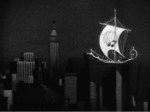 ‘Cryin’ for the Carolines’ was the first of the so-called Spooney Melodies, a short-lived series, produced by Leon Schlesinger, using semi-abstract images set to organ music.
Only five are known, and only this one has survived. The short features Milton Charles, ‘the singing organist’, singing and playing the sugary tune. Neil McGuire provides the classy, but static art deco art, e.g. of a sailing ship and a city skyline.
There’s practically no animation involved, although there is some movement on the screen. The images have an avant-garde quality, but as almost nothing happens, the complete film fails to satisfy. Schlesinger followed the series with the much more successful Merrie Melodies.
Watch ‘Cryin’ for the Carolines’ yourself and tell me what you think:
‘Cryin’ for the Carolines’ is available on the DVD ‘Looney Tunes Golden Collection Volume Six’ and the Blu-Ray ‘Looney Tunes Platinum Collection: Volume 2’
Directors: Hugh Harman & Rudolf Ising
Release Date: October 1930
Stars: Bosko
Rating: ★★½
Review:
 ‘Congo Jazz’, Bosko’s second official cartoon, is Harman and Ising’s answer to Disney’s ‘Jungle Rhythm‘ (1929).
Like Disney’s cartoon, it hasn’t aged very well. The cartoon opens with Bosko wearing a pith helmet and exploring a supposedly African jungle. When confronted by a tiger (a species not endemic to Africa), Bosko immediately loses the pith helmet.
He appeases the tiger with music, and then kicks it over a cliff. Then he has to sooth a large ape, which he does by giving it some chewing gum. Together they play some plucking string music with their gums, while a few monkeys dance. Soon, other animals join in, e.g. a kangaroo, another rather un-African animal. Bosko directs all the animals into an upbeat tune.
The cartoon is low on gags and feels endless, especially during the musical part. The most extraordinary scene is that of a palm tree shimmying to Bosko’s music as if it were a woman. The animation of Bosko is still very rooted in the Oswald-era: Bosko’s body is very flexible, and almost mechanical.
Watch ‘Congo Jazz’ yourself and tell me what you think:
‘Congo Jazz’ is available on the DVD ‘Looney Tunes Golden Collection Volume Six’
Director: Dave Fleischer
Release Date: January 16, 1932
Stars: Betty Boop, Koko, Bimbo
Rating: ★★★★½
Review:
 In ‘Boop-Oop-a-Doop’ Betty Boop works at the circus as a lion-tamer and as a rope-dancer.
We watch her in a sexy performance on the slack-rope. During this performance we can see the circus-master growing with lust, and back in her dressing room he tries to harass her. Luckily, Koko saves here, so he “couldn’t take her boop-oop-a-doop away“.
This is the first short to co-star Koko and Betty. Koko had returned to the animated screen in ‘The Herring Murder Case’, and he’s clearly comfortable in the circus setting of this short. Interestingly, it’s Koko who is Betty’s lover in this cartoon, not Bimbo. Bimbo’s role is reduced to being a peanut seller in a running gag. Koko’s career in the sound era was short-lived, however, and was to end already two years later with ‘Ha! Ha! Ha!‘ (1934).
‘Boop-oop-a-doop’ is an entertaining short, full of catchy music. For example, on the slack-rope Betty sings ‘Do Something’, a song associated by the singer who inspired her character, Helen Kane, who had recorded it in 1929. The two versions are indeed surprisingly similar, and it is not hard to see why Kane, whose own career had been in a steady decline, sued the Fleischer company on May 4, 1932.
It may very well be that this cartoon alone triggered that event. It at least should have been quite some evidence for Fleischer’s piracy, but after a case of two years, judge McGoldrick saw it otherwise. It’s rather difficult to understand now how the Fleischers could have won. Not only does Betty Boop sound like Kane, her looks are also strikingly similar. Indeed, according to her animator and creator Gram Natwick she was modeled after Helen Kane when conceived for ‘Dizzy Dishes‘ (1930). However, Betty’s grotesque, and rather ugly appearance in her earliest cartoons must hardly have given that fact away. Moreover, in her following films both Betty’s voice and looks were both subject to change. Only by the time of ‘Boop-Oop-a-Doop’ Betty really started to look like her source of inspiration…
Anyway, for a detailed account of the trial, see Trafalz’s excellent blog post on the subject.
Watch ‘Boop-Oop-a-Doop’ yourself and tell me what you think:
‘Boop-Oop-a-Doop’ is available on the French DVD Box Set ‘Betty Boop Coffret Collector’
This is Talkartoon No. 31
To the previous Talkartoon: Any Rags
To the next Talkartoon: The Robot
Director: Dave Fleischer
Release Date: November 14, 1931
Stars: Betty Boop, Bimbo
Rating: ★★★★
Review:
 In ‘Mask-A-Raid’ a very sexy Betty is queen of a masked ball.
The king, a dirty old man, fancies her, but she prefers Bimbo. Nevertheless, she makes Bimbo and the old guy fighting each other. Suddenly knights pop up from nowhere and everybody is fighting.
In ‘Mask-a-raid’ some of the random surrealism of ‘Barnacle Bill‘ and ‘Mysterious Mose‘ (both 1930) returns to the screen. The cartoon is full of weird images and odd gags, and at times should be seen to be believed. It ends with some great scatting by Bimbo himself.
This is Betty’s first cartoon as a human being (apart from the Screen Song ‘Kitty from Kansas City‘ from only one week before), with her dog ears having changed into large earrings. It’s also the first to give her starring credits. It introduces the new story idea of old men fancying Betty, and harassing her against her will. This story element would also be featured in e.g. ‘Boop-oop-a-Doop‘ (1932) and ‘Betty Boop’s Big Boss‘ (1933).
Watch ‘Mask-A-Raid’ yourself and tell me what you think:
This is Talkartoon No. 27
To the previous Talkartoon: In the Shade of the Old Apple Sauce
To the next Talkartoon: Jack and the Beanstalk
‘Mask-A-Raid’ is available on the French DVD Box Set ‘Betty Boop Coffret Collector’
Director: Dave Fleischer
Release Date: November 7, 1931
Stars: Betty Boop, Rudy Vallee
Rating: ★★★
Review:
 ‘Kitty from Kansas City’ is a Screen Song in which Rudy Valley sings his famous hit from 1930 about his dumb girlfriend Kitty.
This short starts with Kitty (whom we can recognize as Betty Boop) waiting for the train, until she’s picked up by a mail hook. Enter Rudy Vallee in bowler hat and with old-fashioned mustache, singing the title tune, accompanied by the bouncing ball. The cartoon ends with a particular fat Kitty involved in random events.
‘Kitty from Kansas City’ is important for two reasons: it’s the first cartoon in which Betty Boop is completely human, and second, it introduces a new story element, which was to be used frequently in the years to come: that of an old man fancying her. This time it’s an old station master.
Watch ‘Kitty from Kansas City’ yourself and tell me what you think:
‘Kitty from Kansas City’ is available on the French DVD Box Set ‘Betty Boop Coffret Collector’
Director: Dave Fleischer
Release Date: October 10, 1931
Stars: Betty Boop, Bimbo
Rating: ★★½
Review:
 Betty Boop, who lives in an apartment across the street, invites Bimbo over, but he can’t come, because he has to attend his little baby brother Aloysius.
Nevertheless, he does abandon the mischievous little brat and goes to Betty’s house to skip rope. However, Aloysius sucks them back into his own house, using a particularly powerful vacuum cleaner.
Aloysius is seen smoking a cigar and reading the paper, not unlike Baby Herman in ‘Who Framed Roger Rabbit‘ (1988). The cartoon establishes Bimbo and Betty as lovers, but it doesn’t make much sense, and its gags feel random and misguided.
‘Minding the Baby’ was the last cartoon featuring Betty with dog ears. in her next cartoon ‘Mask-A-Raid‘ she became fully human.
Watch ‘Minding the Baby’ yourself and tell me what you think:
This is Talkartoon No. 25
To the previous Talkartoon: Bimbo’s Express
To the next Talkartoon: In the Shade of the Old Apple Sauce
‘Minding the Baby’ is available on the French DVD Box Set ‘Betty Boop Coffret Collector’


 Dr. Grob's Animation Review