You are currently browsing the category archive for the ‘Black and White Films’ category.
Director: Unknown
Release Date: July 9, 1928
Stars: Oswald the Lucky Rabbit
Rating: ★★★★
Review:
 Before the rediscovery of ‘Sleigh Bells’ in 2015 ‘Tall Timber’ was the last surviving Oswald cartoon made by Walt Disney.
It features Oswald canoeing in the wild, shooting ducks and encountering wild animals, like a moose and a family of bears.
The cartoon’s story is sloppy (although it doesn’t help that some sequences are missing), but the short shows that Disney had advanced animation already before the advent of Mickey. For example, the cartoon features some spectacular waterfall animation, and a convincing falling rock sequence.
The falling rock eventually renders Oswald flat, and in a sequence animated by Hugh Harman we watch him wandering about a little as a flat character. In an attempt to get normal again, he becomes bulbous, which accounts for some surreal, almost trippy close ups of his inflated face, animated by Ham Hamilton.
‘Tall Timber’ was released in June 1928. By that time Disney had already started anew, trying to sell the very first Mickey Mouse cartoon, ‘Plane Crazy‘, to distributors.
‘Tall Timber’ was followed by two more Oswald cartoons by Disney (the recently rediscovered ‘Sleigh Bells’ and the lost ‘Hot Dog’), then by nine by Hugh Harman and Rudolf Ising, before the series was given to Walter Lantz’s studio. Lantz by far produced the most Oswald cartoons, releasing 142 in total. The character lasted until 1938. But by then Oswald looked quite different from the version in ‘Tall Timber’…
Watch ‘Tall Timber’ yourself and tell me what you think:
This is Oswald the Lucky Rabbit cartoon No. 23
To the previous Oswald the Lucky Rabbit cartoon: The Fox Chase
To the next Oswald the Lucky Rabbit cartoon: Sleigh Bells
Director: Unknown
Release Date: June 25, 1928
Stars: Oswald the Lucky Rabbit
Rating: ★★★½
Review:
 Oswald has a relatively small part in this cartoon, with many gags going to the fox outwitting the dogs.
This Oswald cartoon is noteworthy for a trio of original sight gags: in the first Oswald winds his elongated legs back into shape, in the second the fox pulls a pond to another place, and in the third Oswald’s squeezes a log like a tube of toothpaste.
‘The Fox Chase’ is the first of three cartoons in which Disney explores the humor of fox hunting, the other two, both titled ‘The Fox Hunt’ are a Silly Symphony from 1931 and a cartoon starring Donald Duck and Goofy from 1938. Curiously, all share the end gag involving a skunk.
Watch ‘The Fox Chase’ yourself and tell me what you think:
This is Oswald the Lucky Rabbit cartoon No. 22
To the previous Oswald the Lucky Rabbit cartoon: Sky Scrappers
To the next Oswald the Lucky Rabbit cartoon: Tall Timber
Director: Unknown
Release Date: June 11, 1928
Stars: Oswald the Lucky Rabbit, Honey, Peg Leg Pete
Rating: ★★★★★
Review:
 Where ‘Oh, What a Knight‘ was a forerunner of ‘Ye Olden Days‘, ‘Sky Scrappers’ is the blueprint for the Mickey Mouse cartoon ‘Building a Building‘ (1933).
Like the later cartoon, ‘Sky Scrappers’ opens spectacularly with a fantastic opening shot zooming out of Oswald’s excavator. Both feature Honey/Minnie bringing Oswald/Mickey lunchboxes and Pete kidnapping Honey/Minnie. Like in ‘Oh What A Knight’ Honey is shown without her pants.
The opening shot shows a lot of animation cycles, effectively suggesting a lot of working on the building. There’s also a great perspective gag with Pete punching right into the camera. However, the most remarkably animation achievement is that of Oswald pulling up a heavy barrel. The idea of weight and muscle stretch is very convincing, and stands out amidst the more formulaic animation of the rest of the cartoon.
Watch ‘Sky Scrappers’ yourself and tell me what you think:
This is Oswald the Lucky Rabbit cartoon No. 21
To the previous Oswald the Lucky Rabbit cartoon: Oh, What A Knight
To the next Oswald the Lucky Rabbit cartoon: The Fox Chase
Director: Unknown
Release Date: May 28, 1928
Stars: Oswald the Lucky Rabbit, Honey, Peg Leg Pete
Rating: ★★★★½
Review:
 ‘Oh What A knight’ can be regarded as an early forerunner of the Mickey Mouse cartoon ‘Ye Olden Days‘ (1933).
Both shorts feature a medieval setting and both Oswald and Mickey are minstrels courting their love in a castle. However, where in ‘Ye Olden Days’ Goofy is the unlikely villain, Oswald’s opponent is Pete, who wears an anachronistic high hat.
Oswald serenades his sweetie Honey with an equally anachronistic accordeon. Soon, Oswald and Pete duel in grand adventure film-like manner, with Oswald kissing Honey between the fights. One scene in particular has beautifully animated shadows. In the final falling scene Honey loses her pants, and is shown naked. All characters are animated very flexibly: there’s a lot of stretching, falling apart etc.
‘Oh, What a Knight’ is a very entertaining entry in the Oswald the Lucky Rabbit series, and shows that Disney already went for high quality before the advent of Mickey.
Watch ‘Oh, What a Knight’ yourself and tell me what you think:
This is Oswald the Lucky Rabbit cartoon No. 20
To the previous Oswald the Lucky Rabbit cartoon: Hungry Hoboes
To the next Oswald the Lucky Rabbit cartoon: Sky Scrappers
Director: Tim Burton
Release Date: October 1, 1982
Rating: ★★★★
Review:
 ‘Vincent’ a is short film, which director Tim Burton made while still working at Disney.
The short is as typical for Tim Burton as it is atypical for Disney. First, it’s a stop-motion film, something the studio was not famous for, at all. The only other stop-motion film ever released by the studio was ‘Noah’s Ark‘ from 1959. Second, the film is in black and white, and third, it has a genuine horror theme, miles away from the child friendly worlds of contemporary Disney films, like ‘The Fox and the Hound‘ (1981) or ‘Mickey’s Christmas Carol‘ (1983).
The film uses the deep voice of classic horror star Vincent Price to tell the story of Vincent in rather Dr. Seuss-like rhyme. Vincent is a little seven year old boy, who wants to be like, well… Vincent Price. Because his mind has become twisted by reading stories by Edgar Allen Poe, Vincent imagines himself a madman haunted by his deceased wife, and locked in by a cursed house. In the end his imagination runs haywire, taking hold of him.
Burton does an excellent job mixing horror with silliness. The result is a rather twisted version of ‘Gerald McBoingBoing’ – equally weird, equally expressionistic, but much darker. In ‘Vincent’ you find much of the Tim Burton to come. It’s not hard to see the link between this wonderful short and ‘The Nightmare Before Christmas‘ (1993), ‘Corpse Bride‘ (2005) or with his live action films like ‘Beetlejuice’ (1988) or ‘Sleepy Hollow’ (1999).
Interestingly, in the same year, Vincent Price would also lend his voice to the Michael Jackson song ‘Thriller’.
Watch ‘Vincent’ yourself and tell me what you think:
Director: Jan Švankmajer
Release Date: 1983
Rating: ★★★★½
Review:
 After his not all too successful adaptation of ‘The Fall of the House of Usher‘ (1980), Czech film maker Jan Švankmajer returns to Edgar Allen Poe with ‘The Pendulum, the Pit and Hope’, with much better results.
In ‘The Pendulum, the Pit and Hope’ Švankmajer tries to visualize Edgar Allen Poe’s most sensory and scariest story, ‘The Pit and the Pendulum’. He succeeds masterfully, merging the viewer with the protagonist, and retaining the horror of the discoveries of the torture chamber.
The story is told very straightforward, in black and white, without dialogue, voice over or music, giving it a raw and uncanny sense of realism. Švankmajer rejects Poe’s deus ex machina, however, but takes the story to a better, if more depressing conclusion.
‘The Pendulum, the Pit and Hope’ is essentially a live action movie, and contains little animation. However, in its disturbing take on Poe it is one of Švankmajer’s masterpieces, and definitely deserves to be better known.
Watch ‘The Pendulum, the Pit and Hope’ yourself and tell me what you think:
https://vk.com/video101655_142703210?list=141142ca159bb76093
‘The Pendulum, the Pit and Hope’ is available on the DVD ‘Jan Svankmajer – The Complete Short Films’
Director: Jan Švankmajer
Release Date: 1980
Rating: ★★
Review:
 Jan Švankmajer retells this famous story by Edgar Allen Poe using a narrating voice over and black and white images of several different objects.
The images, some of which are animated, are sometimes quite disturbing, and are at points even able to evoke the horror of the story. However, most of the time they seem totally unrelated to the narration, and their visual power in fact often distracts from the voice over, making the story very hard to follow, indeed.
‘The House of Usher’ is a daring experiment in cinematographic storytelling, but not really a successful one, and Švankmajer would not repeat it. Nevertheless, three years later, the Czech film maker would return to Edgar Allen Poe, in ‘The Pendulum, the Pit and Hope‘, with much better results.
Watch ‘The Fall of the House of Usher’ yourself and tell me what you think:
‘The Fall of the House of Usher’ is available on the DVD ‘Jan Svankmajer – The Complete Short Films’
Director: Joop Geesink?
Release Date: 1943
Rating: ★★★
Review:
 ‘Serenata nocturna‘, Marten Toonder’s and Joop Geesink’s first stop motion film, did raise interest of Philips, and the Dutch electronics company commissioned another short to advertise the Philishave, an electronic razor. This resulted in ‘Phi-garo in het woud’.
in ‘Phi-garo in het woud’ a bearded gnome tries to impress a female elf, but she rejects him. The gnome gets a shave at the local barber, but the elf still rejects him. Then a witch shows him the Philips Philishave, which does the trick.
‘Phi-Garo in het woud’ is less entertaining than ‘Serenata nocturna’, its story less logical, and its designs more generic than in the earlier cartoon. The animation, however, is a little more assured. More commissions were now to follow.
Watch ‘Phi-garo in het woud’ yourself and tell me what you think:
‘Phi-garo in het woud’ is available on the DVD inside the Dutch book ‘De Toonder Animatiefilms’
Director: Joop Geesink
Production Date: September 1942
Rating: ★★★★
Review:
 ‘Serenata nocturna’ is the first collaboration between two Dutch animation film pioneers, Marten Toonder and Joop Geesink.
The collaboration results in a charming little advertising film about a Mexican who tries to serenade his love, to no avail. He tries several instruments, without success. But then he magically produces a Philips Radio, and finally his love is impressed.
The puppet animation in this short is very reminiscent of that of George Pal, the Hungarian animator, who had an important puppet film studio in Eindhoven in the late 1930s, and who had made several films for Dutch electronics company Philips himself. Pal, however, had exchanged The Netherlands for the United Kingdom, and finally emigrated to the United States in December 1939, leaving The Netherlands without any animation studio of importance. Now, Toonder and Geesink tried to fill this gap. Perhaps, Philips would be interested to commission films from them.
However, the inexperience of both animators shows: the animation still looks primitive, with a lot of excessive movement. The short’s story, however, is funny and still entertaining today. Indeed, Philips saw potential, and would become an important commissioner to both film makers.
Toonder would soon abandon stop motion, but Geesink would continue in the field, creating one of the most successful stop motion animation studios of the post-war era.
Watch ‘Serenata nocturna’ yourself and tell me what you think:
‘Serenata nocturna’ is available on the DVD inside the Dutch book ‘De Toonder Animatiefilms’
Director: Isadore Sparber
Release Date: September 4, 1942
Stars: Popeye, Bluto, Olive Oyl
Rating: ★
Review:
 Popeye and Bluto are on a battle cruiser stationed somewhere in the South Seas.
There they meet a ‘princess Alona’ (Olive Oyl in a sarong). Her parrot warns the two suitors that if the princess get’s harmed, the volcano will erupt. In the end all turns out to be just a dream.
In this cartoon the comedy is mostly silent, and princess Alona doesn’t speak at all. Unfortunately, Jack Mercer’s jabbers are absent, too, and they are certainly missed. The result is the weakest Popeye cartoon in years.
Watch ‘Alona on the Sarong Seas’ yourself and tell me what you think:
This Popeye film No. 110
To the previous Popeye film: You’re a Sap, Mr. Jap
To the next Popeye film: A Hull of a Mess
Director: Dan Gordon
Release Date: August 7, 1942
Stars: Popeye
Rating: ★★
Review:
 ‘You’re a Sap, Mr. Jap’ is the first Popeye short by the Famous studio, after Paramount had taken over business from the Fleischer Brothers.
This film is immediately the most vicious propaganda film in Popeye’s career, and one of the most extreme cartoons of the entire World War II era. In it Popeye encounters some vicious caricatures of Japanese who doublecross him while suggesting to want to make peace. Their small boat turns out to be on top of a giant battleship which Popeye defeats singlehandedly. The cowardly admiral then commits suicide by drinking nitroglycerin and eating firecrackers, destroying the whole ship.
‘You’re a sap, Mr. Jap’ is as propagandistic as it is ferocious. In the Fleischer’s ‘Fleets of Stren’th’ from five months earlier, the enemy was still rather abstract, but in ‘You’re a sap, Mr. Jap’ the Japanese people themselves are attacked. The film was the first, but not the only one to feature extreme caricatures of Japanese, which in this cartoon are killed by the dozen. Later, cartoons like ‘Bugs Bunny Nips the Nips’ and ‘Commando Donald’ (both 1944) would follow suit.
These cartoons mark a clear difference between the two enemies: the Germans and the Japanese. While the Nazis were always portrayed as silly, the German people were almost never seen in cartoons, and when shown, they were regarded as victims of their leaders, like in ‘Education for Death‘ (1943). The Japanese, on the other hand, with their less visible regime, were treated as one and the same, from the military top to the average soldier. No doubt, a sizable dose of racism accompanied this view. And it’s views like this that resulted in the arrest and internment of American Japanese, something that also happened to Germans living in the United States, but on a much smaller scale…
In ‘You’re a sap, Mr. Jap’ the anti-Japanese sentiment results in a remarkably unfunny cartoon, and the short is more famous for its lack of politic correctness than for its humor.
Watch ‘You’re a Sap, Mr. Jap’ yourself and tell me what you think:
This Popeye film No. 109
To the previous Popeye film: Baby Wants a Bottleship
To the next Popeye film: Alona on the Sarong Seas
Director: Dave Fleischer
Release Date: July 3, 1942
Stars: Popeye, Olive Oyl, Li’l Swee’Pea
Rating: ★★★★½
Review:
 ‘Baby Wants a Bottleship’ opens with Olive visiting Popeye, whose battleship is stationed at the harbor.
Olive has brought li’l Swee’Pea with her. The baby wants to have a battleship en climbs aboard the cruiser. Popeye has a hard time catching him again.
The result is a cartoon of great comedy and excellent timing. The action includes a musical number in which Popeye is clobbered by a canon. Like in the previous Popeye cartoon, ‘Many Tanks’, Popeye’s design switches between old and new.
Watch ‘Baby wants a Bottleship’ yourself and tell me what you think:
This Popeye film No. 108
To the previous Popeye film: Many Tanks
To the next Popeye film: You’re a Sap, Mr. Jap
Director: Dave Fleischer
Release Date: May 15, 1942
Stars: Popeye, Bluto, Olive Oyl
Rating: ★★★
Review:
 In this World War II cartoon Bluto is a soldier who tries to sneak away to date Olive Oyl.
When Popeye passes by Bluto tricks him into his army uniform. Popeye unwillingly has to join a tank squad, which leads to hilarious antics. Only when he has eaten some spinach Popeye directs his tank out of the camp straight to Bluto, who is wooing Olive.
Jack Mercer’s ad libbing during Popeye’s tank ride is fantastic and a highlight of the cartoon, as is the extremely flexible animation on Popeye’s tank. Popeye’s design changes back and forth from the old Fleischer design to the later, more streamlined Famous design, which makes its debut in this cartoon.
Watch ‘Many Tanks’ yourself and tell me what you think:
This Popeye film No. 107
To the previous Popeye film: Olive Oyl and Water Don’t Mix
To the next Popeye film: Baby Wants a Bottleship
Director: Dave Fleischer
Release Date: March 13, 1942
Stars: Popeye
Rating: ★★★
Review:
 ‘Fleets of Stren’th’ is the third in a series of cartoons in which Popeye has joined the American navy.
In this cartoon Popeye still is a lousy sailor, but when the battle cruiser is under attack, he once again shows what he’s able to do (see also ‘Blunder Below‘). This time the battle cruiser is attacked by a squad of Japanese dive bombers. It takes some time before Popeye is able to eat his spinach, but when he does, he turns into a plane himself, defeating the complete enemy fleet.
In this process we see only one pilot, the other planes are subtly dehumanized. In this way we’ll never think of the fate of the Japanese pilots, at all. This was a clever device used in many war propaganda films of the time.
Watch ‘Fleets of Stren’th’ yourself and tell me what you think:
This Popeye film No. 104
To the previous Popeye film: Blunder Below
To the next Popeye film: Pip-Eye, Pup-eye, Poop-eye and Peep-eye
Director: Dave Fleischer
Release Date: February 13, 1942
Stars: Popeye
Rating: ★★★★
Review:
 Popeye had joined the navy before the United States entered the war, in ‘The Mighty Navy‘ (November 1941), so in ‘Blunder Below’ he’s ready to fight the enemy, the first major cartoon star to do so on the movie screen.
In the first part of this cartoon Popeye tries to be a normal sailor, among Superman-like sailors, trying to learn gunning. He is no talent, however, blundering away and almost shooting down the captain by accident.
But when a submarine approaches, Popeye shows his real worth: he beats the submarine single-handedly, saving the battle cruiser. It’s this great combination of clumsiness and superhuman powers which make Popeye such an appealing character.
The approaching submarine is accompanied by the music of Franz Schubert’s Erlkönig, indicating a German origin. However, it soon turns out to be Japanese. The submarine is anthropomorphic itself and completely dehumanized, as if it were not manned by people at all. When in August 1942 Popeye changed hands from the Fleischers to Paramount, this would radically change…
Watch ‘Blunder Below’ yourself and tell me what you think:
This Popeye film No. 103
To the previous Popeye film: Kickin’ the Conga ‘Round
To the next Popeye film: Fleets of Stren’th
Director: Friz Freleng
Release Date: May 18, 1940
Stars: Daffy Duck, Porky Pig, Leon Schlesinger
Rating: ★★★★★ ♕
Review:
 ‘You Ought to Be in Pictures’ is the very first cartoon to bridge two ideas of animation film figures being ‘real’.
First, the idea that cartoon figures can come alive from the drawing board into the real world, an idea that hauls all the way back to Max Fleischer’s first ‘Out of the Inkwell’ cartoons (1915). The second idea is that of cartoon figures being real Hollywood stars, explored in cartoons such as ‘Felix in Hollywood’ (1923), ‘Movie Mad‘ (1931), ‘Mickey’s Gala Premier‘ (1933) and especially ‘The Autograph Hound‘ (1939), with which ‘You Ought to Be in Pictures’ has most in common. ‘You Ought to Be in Pictures’ synthesizes these two ideas, making it a direct ancestor of ‘Who Framed Roger Rabbit‘ (1988).
‘You Ought to Be in Pictures’ was one of the first films director Friz Freleng made after his return from an ill-fortuned move to MGM, and as Jerry Beck points out in the audio commentary track, one can see this film somehow as autobiographical.
In any case, this short marks is Freleng’s first take on Daffy Duck, and he places him firmly as Porky’s rival. In this cartoon Daffy is not necessarily zany, like in Tex Avery’s and Bob Clampett’s cartoons, but overconfident and sneaky, with a tendency to show off; character treats that would be explored more from 1950 on, especially by Chuck Jones. However, by then the relation between Porky and Daffy would be changed completely.
In ‘You Ought to Be in Pictures’ Porky is still an innocent, cute and Boyish character. In the opening scene we watch him being drawn by animator Fred Jones on the drawing board. When all animators have rushed off to lunch (reused footage from a Leon Schlesinger Christmas Party film), Daffy, framed on the wall, addresses the Porky drawing. He convinces Porky to leave Leon Schlesinger’s studio to get a real job in the business of feature films. Leon Schlesinger lets Porky go, saying into the camera “he’ll be back!”. While Porky has a hard time in the neighboring live action studio, Daffy tries to get his plays at Warner Bros. But Porky returns and beats the hell out of the double-crosser.
‘You Ougt to Be in Pictures’ is a lovely cartoon. It mixes animation and live action, partly from other Warner Bros. features, to great effects. The scene in which Porky talks to Leon Schlesinger is very convincing, and Porky’s drive back no less than breathtaking. Besides Leon Schlesinger, the film stars writer Michael Maltese as a guard, animator Gerry Chiniquy as a director, and executive producer Henry Binder as a sound man. However, as the live action footage was shot silently, all are voiced by Mel Blanc, except for Leon Schlesinger who does his own voice.
Watch ‘You Ought to Be in Pictures’ yourself and tell me what you think:
http://www.dailymotion.com/video/x1ykibb_daffy-duck-ep-12-you-ought-to-be-in-pictures_fun
This is Porky Pig cartoon No. 73
To the previous Porky Pig cartoon: Porky’s Poor Fish
To the next Porky Pig cartoon: The Chewin’ Bruin
This is Daffy Duck cartoon No. 9
To the previous Daffy Duck cartoon: Wise Quacks
To the next Daffy Duck cartoon: A Coy Decoy
‘You Ought To Be In Pictures’ is available on the DVD-sets ‘The Looney Tunes Golden Collection Volume Two’, ‘Porky Pig 101’, and the Blu-Ray ‘Looney Tunes Platinum Collection: Volume 2’
Director: Frank Tashlin
Release Date: December 11, 1943
Rating: ★★★
Review:
 This cartoon opens with “Dicky Bird”, the canary, missing.
Rudolph, the cat who ate the bird (!), pretends the poor fellow has flown out of the window, so his mistress orders another one, which turns out to be considerably harder to catch.
The main body of ‘Puss ‘n Booty’ consists of blackout gags that anticipate the Tweety and Sylvester cartoons by four years.
This short was Warner Bros.’ last cartoon in black and white. Nevertheless, its broad use of blacks, greys and white and the startling camera angles (Frank Tashlin’s trademark) make it as modern as any other cartoon of the era.
Watch ‘Puss ‘n Booty’ yourself and tell me what you think:
Director: Unknown
Release Date: April 30, 1928
Stars: Oswald the Lucky Rabbit, Peg Leg Pete
Rating: ★★★½
Review:
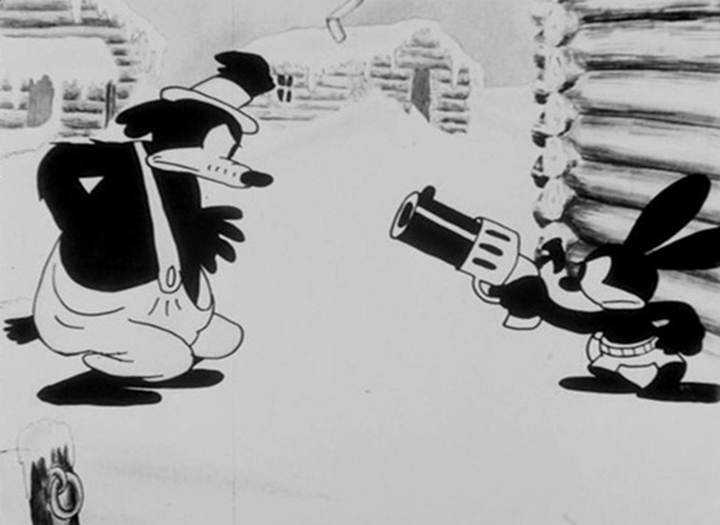 Oswald is a mounted police officer in charge of catching Peg Leg Pete, who, in spite of his name, has two legs here.
Oswald follows Pete on a mechanical horse, but in the end they’re both chased by a bear. Oswald, however, manages to get both Pete and the bear into prison.
‘Ozzie of the Mounted’ feels rather routine, and is less remarkable than say ‘Rival Romeos‘ or ‘Oh, What a Knight‘. The chase scene fills a large part of the cartoon, but contains few clever gags. Nevertheless, the animation of Oswald swinging around on his mechanical horse’s loose spring is still fascinating to watch. It’s also interesting to point out that Oswald’s mechanical horse looks far more mechanical than his mechanical cow in ‘The Mechanical Cow‘ from seven months earlier. This shows the subtle but steady progress the Walt Disney studio was making in animation, even before it became famous for that.
Watch ‘Ozzie of the Mounted’ yourself and tell me what you think:
This is Oswald the Lucky Rabbit cartoon No. 18
To the previous surviving Oswald the Lucky Rabbit cartoon: Bright Lights
To the next Oswald the Lucky Rabbit cartoon: Hungry Hoboes
Director: Unknown
Release Date: March 19, 1928
Stars: Oswald the Lucky Rabbit
Rating: ★★★½
Review:
 Although broke, Oswald tries to enter a vaudeville theater where Mademoiselle Zulu performs her shimmy dancing.
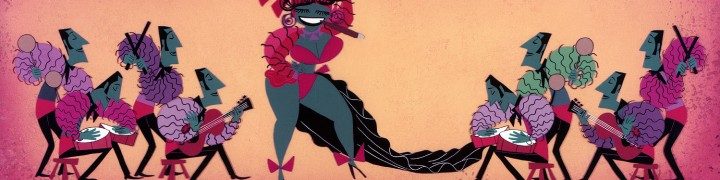
After we watch some cat chorus girls dancing the can-can, Mll. Zulu, a female cat character, is shown doing her erotic shimmy dance, probably inspired by Josephine Baker. Oswald manages to enter the theater by hiding beneath a man’s shadow(!), but he is discovered. He tries to hide in a cage, which contains a fierce leopard. When the leopard breaks loose, and later a couple of lions, the whole theater is emptied.
This rather plotless, yet entertaining short contains many surreal gags and a very flexible use of body parts. Oswald’s body is deformed even more than normal, and in one scene we watch him without his pants on.
The best scene is when Oswald pantomimes his love for Mlle. Zulu. This scene is acted out very well, and this embryonic character animation is far more sophisticated than the animation surrounding it.
Watch ‘Bright Lights’ yourself and tell me what you think:
This is Oswald the Lucky Rabbit cartoon No. 15
To the previous Oswald the Lucky Rabbit cartoon: Rival Romeos
To the next surviving Oswald the Lucky Rabbit cartoon: Ozzie of the Mounted
Director: Unknown
Release Date: March 5, 1928
Stars: Oswald the Lucky Rabbit, Honey, Pete
Rating: ★★★★½
Review:
 In this gag-packed cartoon Oswald and Pete compete over Honey, a female cat character, who was Oswald’s girlfriend in 1928.
Pete and Oswald both ride in their cars to her house in a scene looking forward to the early Mickey Mouse cartoon ‘The Barn Dance‘ from later that year. Oswald serenades her until a goat eats all his sheet music and even his banjo. Then he turns the animal into a hurdy gurdy, like Mickey would do later that year in ‘Steamboat Willie‘. When Pete arrives, he and Oswald fight over Honey, almost tearing her apart. Honey gives them the cold shoulder and leaves with a third guy into the distance. Then our rivals kick each other in remorse, like Donald Duck and Peter Pig would do six years later in ‘Wise Little Hen‘ (1934).
As you may notice, ‘Rival Romeos’ contains quite a lot of embryonic gags that Walt Disney would reuse later in other cartoons. Because of these prophetical gags ‘Rival Romeos’ is a highlight among Disney’s Oswald cartoons.
Watch ‘Rival Romeos’ yourself and tell me what you think:
This is Oswald the Lucky Rabbit cartoon No. 14
To the previous Oswald the Lucky Rabbit cartoon: Africa Before Dark
To the next Oswald the Lucky Rabbit cartoon: Bright Lights


 Dr. Grob's Animation Review