You are currently browsing the category archive for the ‘Czech Republic’ category.
Director: Jan Švankmajer
Release Date: 1971
Rating: ★★★★★ ♕
Review:
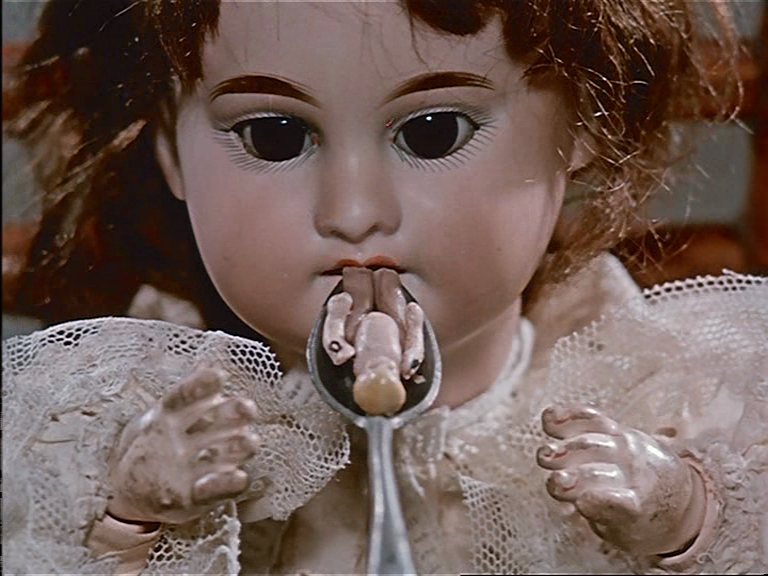 ‘Jabberwocky’ has little to do with the poem from Lewis Carroll’s ‘Through The Looking Glass’, although we hear it being recited by a little girl during the opening sequence.
The film it is Švankmajer’s surrealistic masterpiece on the loss of childhood, depicted by several episodes, which are separated by a box of bricks, a labyrinth and a black cat crushing the box of bricks.
During the episodes we are treated on extremely surrealistic images of very active inanimate objects in a child’s room. First we watch a boy’s suit growing a forest in his room, defying both time and authority (symbolized by the portrait in the room). Then we watch large cannibalistic dolls grinding, ironing and eating little dolls, a china baby in a cradle destroying two tin armies, a pocket knife performing acrobatic tricks until it makes an ill-fated fall and stabs itself, and finally, schoolbooks producing paper boats and planes, which fly out of the window, while the father’s portrait produces pictures of beautiful women.
This last episode shows the child’s changing interests. In the end the labyrinth is solved, the cat – the only living thing in the entire film – is caged, and the boy’s suit is replaced by an adult one. The boy is free from his parent, but the days of imagination are over, the fantasy is gone.
For this film Švankmajer makes excellent use of 19th century imagery (sailor suit, vintage dolls and toys) to create a completely unique world. It’s the film maker’s most typical film, partly expanding on ideas explored in ‘Historia Naturae, Suita‘ (1967), and showing his fascination with fantasy, cruelty and decay, which roam freely in the child’s self-contained room. The rather morbid behavior of the everyday objects is quite unsettling and it shows how a child’s fantasy can be both imaginative and cruel.
‘Jabberwocky’ is without doubt one of Švankmajer’s most powerful films. He would only top it eleven years later, with ‘Dimensions of a Dialogue‘ (1982). Švankmajer would explore the imagination of children further in the moving ‘Down to the Cellar‘ (1983), and in his unique adaptation of Lewis Carroll’s most famous work ‘Alice‘ (1987).
Watch ‘Jabberwocky’ yourself and tell me what you think:
‘Jabberwocky’ is available on the DVD ‘Jan Svankmajer – The Complete Short Films’
Director: Jan Švankmajer
Release Date: 1970
Rating: ★★★
Review:
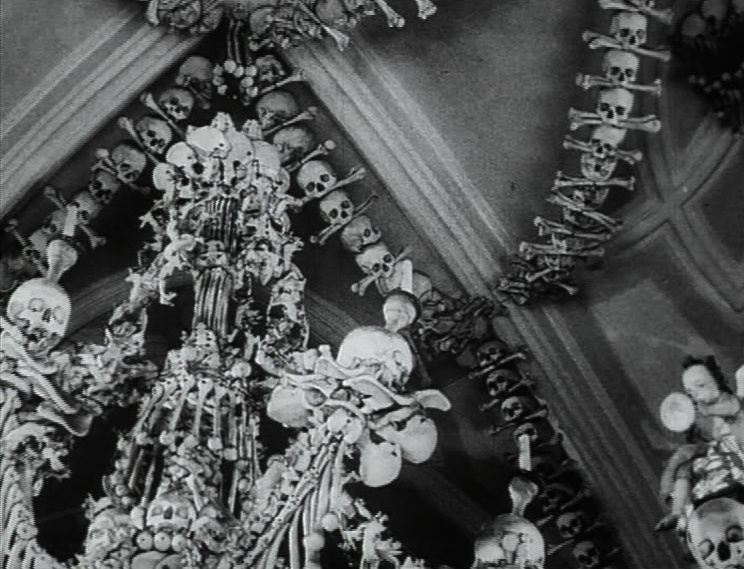 ‘The Ossuary’ is a commissioned documentary film about a Czech chapel in Sedlec, which is decorated with thousands of bones and skulls of victims of the 1318 plague and of the Hussite wars of 1421.
Two versions of this film exists: one with a soundtrack of a rather mundane guide guiding a group of children, in which she repeatedly warns not to touch the bones on a penalty of fifty crowns. Her tour is mixed with the uncanny sound of a rattling bicycle. For unclear reasons this soundtrack was considered subversive and forbidden by the Czechoslowakian regime. Therefore a second version was made using a jazz soundtrack.
In both versions the soundtrack conflicts with the morbid images, which are composed in a rhythmical way that even appeals when watched silently. The film contains no animation, but is full of Švankmajer’s idiosyncratic cinematography.
Watch ‘The Ossuary’ yourself and tell me what you think:
‘The Ossuary’ is available on the DVD ‘Jan Svankmajer – The Complete Short Films’
Director: Jan Švankmajer
Release Date: 1969
Rating: ★★★
Review:
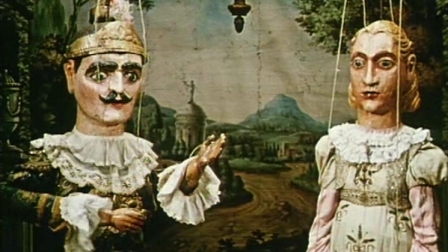 In ‘Don Juan’ Švankmajer’s retells a classic tale from the marionette theater.
The story unfolds in half an hour: Don Juan is a rogue who kills his father, the father of his beloved and his own brother, only to be taken into the depths off hell.
Oddly enough the film is enacted by people dressed as marionettes and behaving accordingly. This allows the marionettes to leave the theater and to perform in the real world, which is strangely intermingled with the marionette theater. This blend of the real and the artificial gives the film a weird and disturbing atmosphere. Švankmajer would reuse and improve upon this mix in his masterpiece, the feature film ‘Faust‘ (1994).
This film contains hardly any animation, and may therefore not be included in this blog. However, it takes a central part in Švankmajer’s oeuvre, who has always blended several different techniques into his works. It’s best to review his oeuvre as a whole, being animated or not.
Watch ‘Don Šajn’ yourself and tell me what you think:
‘Don Šajn’ is available on the DVD ‘Jan Svankmajer – The Complete Short Films’
Director: Jan Švankmajer
Release Date: 1969
Rating: ★★
Review:
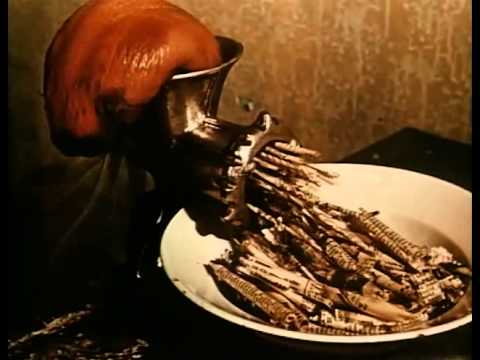 ‘A Quiet Week in the House’ is the last film in a series of four involving people facing surreal settings, which Švankmajer made in 1968-1969.
in this film a fugitive seeks shelter in an abandoned house. Every day he digs a hole in one of the doors of the corridor in which he sleeps. Every day he looks through the hole to watch weird surrealistic images of inanimate things behaving strangely. After a week he sets up a device to blow up all doors.
The live action footage is shot in black-and-white, and is accompanied by the sound of a camera. The surrealistic images, on the other hand, are shot in color and completely silent. Unfortunately, the film is too long, and it fails to be as impressive as related films like ‘The flat’ (1968) or ‘Jabberwocky‘ (1971), being neither completely disturbing nor very entertaining. ‘A Quiet Week in the House’ remains one of Švankmajer’s rare weak films.
Watch ‘A Quiet Week in the House’ yourself and tell me what you think:
http://www.dailymotion.com/video/xpfbvj_a-quiet-week-in-the-house-de-jan-svankmajer_shortfilms
‘A Quiet Week in the House’ is available on the DVD ‘Jan Svankmajer – The Complete Short Films’
Director: Jiří Trnka
Release Date: 1954
Rating: ★★★
Review:
 A young man on a motorcycle is on his way to his girl.
Along the way he stops at a bar, where a wedding is taking place. There he’s offered a drink, which he reluctantly accepts. However, one leads to another and he is quite intoxicated when leaving the bar. Driving at night he tries to speed against a car, a train and even a plane, but he finally crashes, never to see his girl.
This educational film warns us not to combine drinking with driving. In this respect the film is very dull and predictable, but Trnka’s illusion of speed and drunkenness is astonishing.
Watch ‘A Drop Too Much’ yourself and tell me what you think:
http://en.channel.pandora.tv/channel/video.ptv?ch_userid=noisypig&prgid=46485008&ref=rss
Director: Jiří Trnka
Release Date: 1951
Rating: ★★★½
Review:
 ‘The Merry Circus’, is puppet-animator Trnka’s try at cut-out animation.
The film shows that Trnka was a master in this technique as well: the animation is superb: the sense of weight, muscular tensions and balance is nothing less than stunning. Moreover, the cut-outs seem to float in mid-air, casting wonderful shadows on the background.
Unfortunately, the film’s subject is not that interesting. We watch circus artists perform, among them two sea lions juggling, a girl on a horse, three trapeze acrobats and an acrobat bear balancing on a chair on a bottle on a glass. Even though some of the shown tricks are quite improbable, the only truly surrealistic act is the fish on the slack-rope.
Despite the lack of story, the film is an enjoyable watch: its visual design is beautiful and poetic, its animation fluent and convincing, and its circus atmosphere well-captured. ‘The Merry Circus’ may not be Trnka’s best film, but it’s only the high quality of some of his other films that makes this one second-rate.
Watch ‘The Merry Circus’ yourself and tell me what you think:
http://veehd.com/video/4587370_Jiri-Trnka-The-Merry-Circus-Vesely-Cirkus-1951
Director: Jiří Trnka
Release Date: 1949
Rating: ★★★
Review:
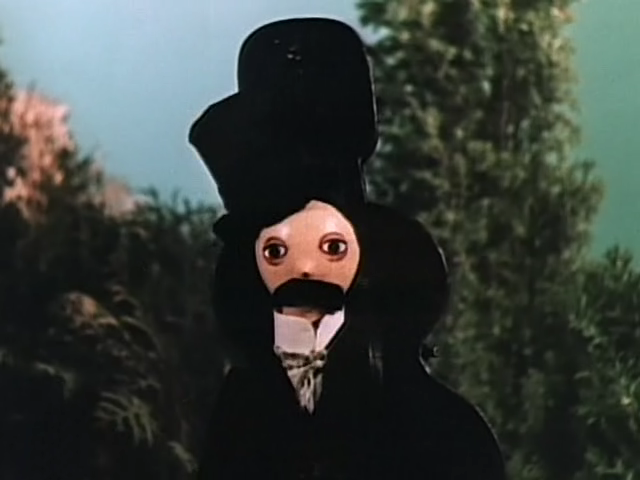 ‘Story of the Bass Cello’ is a re-telling of a classic story by Anton Chekhov.
The film tells about a bass player and a girl who both take a swim, but whose clothes are stolen. The bass player invites the lady to take place in his bass case, but when he’s after the possible thief, the case is picked up by his fellow instrumentalists and brought to the palace, where an astonished crowd discovers the naked lady inside.
‘Story of the Bass Cello’ is a mildly amusing and sweet film. It contains nice silent comedy. The short is a little bit slow, however, and not as good as Trnka’s more outrageous ‘The Song of the Prairie‘ from the same year.
Watch ‘Story of the Bass Cello’ yourself and tell me what you think:
http://veehd.com/video/4587175_Jiri-Trnka-Roman-s-Basou-Story-Of-The-Bass-Cello-1949
Director: Jiří Trnka
Release Date: 1949
Rating: ★★★★★
Review:
 With ‘The Song of the prairie’ Trnka’s both made a parody of and a homage to the classic Western.
The film uses all the cliches of the genre: a stagecoach, masked bandits, a damsel in distress, a hero with a white hat, a villain fancying the girl, and a climax on a cliff.
Trnka’s animation has much improved since ‘The Emperor’s Nightingale‘: the cinematography is excellent, and particularly the illusion of speed is astonishing. The film is wonderfully tongue-in-cheek and full of brilliant silent comedy, showing Trnka’s then unsurpassed mastery in stop-motion. ‘The Song of the Prairie’ is one of Trnka’s most enjoyable films, and deserves a more classic status.
Watch ‘The Song of the Prairie’ yourself and tell me what you think:
Director: Jiří Trnka
Release Date: April 15, 1949
Rating: ★★★
Review:
 ‘The Emperor’s Nightingale’ is Jiří Trnka’s second feature film (he made no less than six in total).
It tells the familiar story by Hans Christian Andersen from an original perspective: he frames the fairy tale by a live-action story about a lonely rich boy, who lives in a restricted environment. When the boy goes to bed, he dreams the fairy-tale, which stars some of his toys. Thus, after more than seven minutes, the animation kicks in.
In the boy’s dream, the Chinese emperor is a lonely little rich boy, restricted by rules, too, and the whole film seems a plea for freedom and against rules and restrictions, quite some message in communist Czechoslovakia. This theme is enhanced by the English narration, wonderfully voiced by Boris Karloff, which is a welcome addition to Trnka’s silent comedy. The whole film breathes a kind of surrealistic atmosphere and Trnka’s use of camera angles is astonishing, as is his sometimes very avant-garde montage.
Nevertheless, the pacing of the film is slow, its humor sparse and only mildly amusing, and the puppet animation still too stiff to allow elaborate character animation. Therefore, the film hasn’t aged very well, and although a tour-de- force, ‘The Emperor’s Nightingale’ falls short as a timeless masterpiece.
Watch ‘The Emperor’s Nightingale’ yourself and tell me what you think:
Director: Jan Švankmajer
Release Date: 1967
Rating: ★★★★★
Review:
 ‘Historia Naturae, Suita’ is an abstract, yet morbid and disturbing film.
It uses drawings, models, skeletons, stuffed and live animals, which change into each other and which perform morbid dances. Their antics are interspersed with a close up of a man eating meat.
We see molluscs (Aquatilia, foxtrot), insects (Hexapoda, bolero), fish (Pisces, blues), reptiles (Reptilia, tarantella), birds (Aves, tango), mammals (Mammalia, menuet), monkeys (Simiae, polka) and man (Homo, waltz), successively.
It shows us that we, men, are made from the same mortal matter as the rest of the animal kingdom, which in this film appear to us only as collectibles or food. This unsettling reminder is emphasized by the last shot, in which the human is replaced by a skull, eating…
The music is a perfect match to the surrealistic imagery, with its rather abstract, uncanny and atonal renderings of the dance forms mentioned.
Watch ‘Historia Naturae, Suita’ yourself and tell me what you think:
http://www.totalshortfilms.com/ver/pelicula/379
‘Historia Naturae, Suita’ is available on the DVD ‘Jan Svankmajer – The Complete Short Films’
Director: Jan Švankmajer
Release Date: 1966
Rating: ★★★★★
Review:
 In ‘Et Cetera’ three faceless human figures demonstrate repetitive and aimless actions.
The first shows how to fly with wings, only to reach his own starting point. The second transforms himself into the animal he’s training using a whip, and the third keeps on drawing houses he cannot enter or leave.
Unlike most of Jan Švankmajer’s films, ‘Et Cetera’ uses 2d animation. It’s a clever and somehow saddening film: although the three little stories are extremely simple, they seem to tell something about the condition humaine. ‘Et Cetera’ uses great electronic music, which adds to the surrealistic atmosphere.
Watch ‘Et Cetera’ yourself and tell me what you think:
‘Et Cetera’ is available on the DVD ‘Jan Svankmajer – The Complete Short Films’
Director: Jiří Trnka
Release Date: 1965
Rating: ★★★★★ ♕
Review:
 In a self-contained world, seemingly outside space and time, an harlequin lives happily in his home.
The harlequin is an artist, a ceramist and a sculptor, making pots for his beloved plant. Unfortunately, his domestic peace is disturbed by a giant gloved hand, which orders him to sculpt a statue of a hand. As the harlequin keeps refusing, the hand uses praise, money, indoctrination, brutal force and erotics to persuade the artist to do what he’s ordered.
In the end the harlequin is caught, his hands are attached to strings worked by the hand, and he has to sculpt a giant hand in a cage. But, after finishing his works, the artist escapes and returns to his beloved home. It sadly is his own beloved plant that kills him by falling on his head, while he’s barricading the entrances to his room. The hand gives the artist a state funeral, making him posthumously part of the system.
‘The Hand’ was Czech puppet animator Jiří Trnka’s last film, and it was to be his masterpiece. Instead of diving into classic tales, he made one of his own, resulting in a most personal film and one that stands as the classic animated tale on totalitarianism.
Trnka manages to tell his tale without any dialogue. Although the puppet of the harlequin knows only one expression, his emotions are well-felt through his animation. There’s no doubt he’s symbolic for artists working in totalitarian regimes in general. The glove is a masterstroke. In its facelessness it is as scary as it is symbolic for the invisible hand of totalitarian power. The result is an equally sad and disturbing film, which shows both Trnka’s genius and the power of animation in general.
It’s no small surprise that this highly symbolic film was forbidden in communist Czechoslovakia.
‘The Hand’s message is still topical, being symbolic for artists working in oppressive regimes all over the world.
Watch ‘The Hand’ yourself and tell me what you think:
‘The Hand’ is available on the DVD ‘The Puppet Films of Jiri Trnka’
Director: Jan Švankmajer
Release Date: 1965
Rating: ★★★★
Review:
 In ‘A Game with Stones’ (also known by its German title ‘Spiel mit Steinen’) an odd construction, consisting of a clock, a tap and a bucket, produces stones by the hour. These stones form patterns to the music of a music box until the bucket is emptied, dropping the stones on the floor.
The stones’ abstract patterns are indeed game-like, but they become more and more grim, ending in a destructive game, destroying the stones, and eventually, the bucket, leaving the machine useless. The game is over. It is Švankmajer’s genius that he’s able to give this fairly abstract film a heart and an unsettling, sad ending.
‘A Game with Stones’ is Švankmajer’s first film to use stop motion animation extensively. The fourth game contains faces made of numerous small pebbles, which anticipates similar heads in ‘Dimensions of Dialogue’ (1982), a film in which Švankmajer’s stop motion techniques reach a stunning apex.
Watch ‘A Game with Stones’ yourself and tell me what you think:
‘A Game with Stones’ is available on the DVD ‘Jan Svankmajer – The Complete Short Films’
Director: Jan Švankmajer
Release Date: 1964
Rating: ★★★★★
Review:
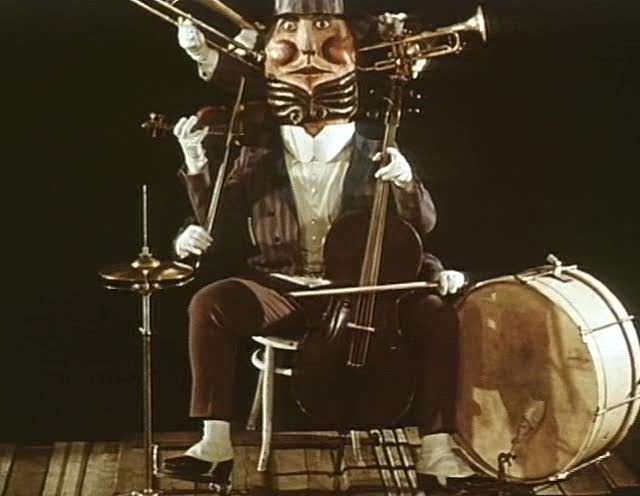 In ‘The Last Trick’ two magicians in large masks perform their impossible tricks one after another against a black, empty background.
Although they stay polite, their congratulationary handshakes between the tricks gradually become more and more violent, ending in a disastrous mutual disembodiment. The last shot is of the only really living organism inhabiting this surrealist world, a beetle, dead.
‘The Last Trick’ is Czech film maker Jan Švankmajer’s first film, and already his obsessions with puppets, body parts and death are full blown. Its humor is dark, its images are grim and its story is very unsettling. Švankmajer’s first film (which contains a little stop motion animation) is also his first masterpiece.
Watch ‘The Last Trick’ yourself and tell me what you think:
‘The Last Trick’ is available on the DVD ‘Jan Svankmajer – The Complete Short Films’


 Dr. Grob's Animation Review