
You are currently browsing the category archive for the ‘European films’ category.
Director: Paul Driessen
Release Date: 1982
Rating: ★★★★
Review:
 ‘Oh What a Knight’ is a short and funny gag film in which a knight rescues a princess from a dragon, a cyclope, a snake and a villain, only to watch her fall in love with his empty shiny armor.
Driessen’s unique animation style is most present in this cartoon. For example, the knight has an odd way of falling to pieces and reassembling himself. ‘Oh What a Knight’ is one of Driessen’s funniest films. In fact it would not be surpassed until his ‘3 Misses’ from 1998.
Watch ‘Oh What a Knight’ yourself and tell me what you think:
‘Oh What a Knight’ is avaiable on the DVD ‘The Dutch Films of Paul Driessen’
Director: Georges Schwizgebel
Release Date: 1992
Rating: ★★★★½
Review:
 ‘La course à l’abîme’ is a depiction of the final ride into hell from ‘La Damnation de Faust’ (1846) by Hector Berlioz.
The film consists of a very associative series of images, tied together by the two riders, Faust & Méphistophélès. Like in Schwizgebel’s earlier film ‘78 tours‘ (1985) we watch images changing perspective and morphing into each other, to stunning effects. All builds up to a spectacular finale, in which we see all the animation within one frame.
‘La course à l’abîme’is the first film showing Schwizgebel’s interest in classic European stories. It’s a clear precursor of later films, like ‘L’année du daim’ (1995), ‘La jeune fille et les nuages’ (2000) and ‘L’homme sans ombre’ (2004), in which he uses his stunning techniques for narrative purposes.
Watch ‘La course à l’abîme’ yourself and tell me what you think:
‘La course à l’abîme’ is available on the DVD ‘Les Peintures animées de Georges Schwizgebel’
Director: Georges Schwizgebel
Release Date: 1985
Rating: ★★★★½
Review:
 In ’78 Tours’ Schwizgebel uses his technique of rotating perspectives and metamorphosis, which he had developed in films like ‘Perspectives‘ (1975) to stunning effects.
’78 Tours’ is a short film set to accordion music, which uses circles as a leitmotiv, as well as coffee and a park. The film is completely painted, using deep colors and stark shadows. Schwizgebel’s unique virtuoso style really comes to a full bloom in this film, which must be regarded as his first masterpiece.
Watch ‘78 Tours’ yourself and tell me what you think:
’78 Tours’ is available on the DVD ‘Les Peintures animées de Georges Schwizgebel’
Director: Georges Schwizgebel
Release Date: 1982
Rating: ★★★★
Review:
 ‘Le ravissement de Frank N. Stein’ starts with very abstract images, which resolve into Frankenstein’s laboratory as depicted in the film from 1931.
After 1’40 we become the monster itself, walking through endless chambers and corridors and staircases in an almost computer animation-like long sequence of perspective animation. The rooms, initially filled with abstract shapes, become more and more complex. They contain more and more windows and human forms, and finally moving human forms, ending with multiple copies of the monster’s bride. In the end we watch the monster itself, in his depiction by Boris Karloff. he smiles at his bride, but she only screams…
This film, which is set to very nervous electronic music, is a very impressive study of perspective: we really feel we are walking. The film has a repetitive and dreamlike quality, which is enhanced by its surreal settings, reminiscent of paintings by Giorgio de Chirico.
Watch ‘Le ravissement de Frank N. Stein’ yourself and tell me what you think:
‘Le ravissement de Frank N. Stein’ is available on the DVD ‘Les Peintures animées de Georges Schwizgebel’
Director: Erica Russell
Release Date: 1989
Rating: ★★★★★
Review:
 ‘Feet of song’ is a non-narrative film about dance and Russell’s solo debut film.
It uses semi-abstract human forms, akin to those by painter Kazimir Malevich. The human forms feel both futuristic and African at the same time, and have a timeless appeal. The images get more and more abstract as the film progresses, but the sense of dance is never lost.
‘Feet of Song’ features African-sounding world music by Charlie Hart, but the music is in service to the beautiful images, not the other way round. Made for Channel 4, ‘Feet of Song’ is a prime testimony of Erica Russel’s unique style, clearly influenced by Oskar Fischinger, but firmly rooted in both her South African roots and dancer background.
Unfortunately, Russell made only two other independent films, ‘Triangle‘ in 1994, and ‘Soma’ in 2001, devoting most of her time to commissioned work (her images for example appear in the Madonna video-clip ‘Dear Jessie’ from 1989).
Watch ‘Feet of Song’ yourself and tell me what you think:
‘Feet of Song’ is available on the DVD inside the book ‘Animation Now!’
Director: Ivan Ivanov-Vano
Release Date: 1972
Rating: ★★½
Review:
 ‘Ave Maria’ is a very grim anti-Vietnam film, made in the Soviet Union.
It combines paintings of the Virgin Mary with images of war. Its darkest moment is when a soldier in a gas mask kills a Vietnamese child. The film ends with live action footage of people protesting against the Vietnam war. Clever montage suggests that the protesters are being repressed.
Despite its disturbing character the film is too blatantly propagandastic and too directionless to be a classic. It also uses little animation.
Watch ‘Ave Maria’ yourself and tell me what you think:
‘Ave Maria’ is available on the DVD box set ‘Animated Soviet Propaganda’
Director: Vladimir Tarasov
Release Date: 1977
Rating: ★★★½
Review:
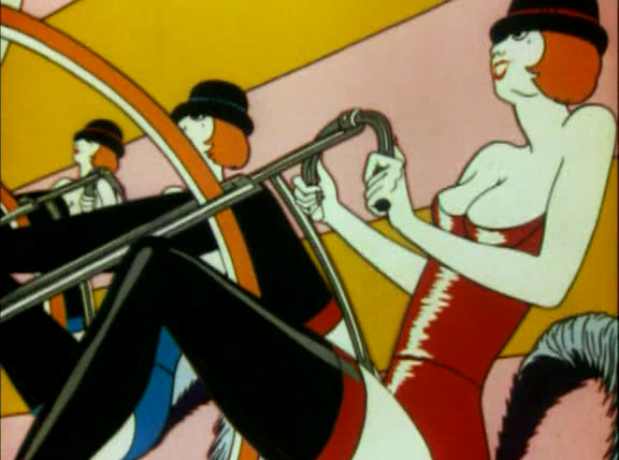 ‘Forward March Time!’ is a bold setting of a poem by soviet futurist poet Vladimir Mayakovsky (1892-1930).
The film illustrates the meandering poem with associative images of the 1905 revolution, the 1917 revolution, World War II and even a futuristic battle in space.
Using a combination of typical seventies designs (besides communist paintings) and rock music (besides an excerpt from Mahler’s fifth symphony), the film is both a markedly modern and interesting piece of soviet propaganda, if a bit too long. It shows Tarasov’s unique style, which he explored further in the much more lighthearted short ‘Contact‘.
Watch ‘Forward March, Time!’ yourself and tell me what you think:
‘Forward March, Time!’ is available on the DVD box set ‘Animated Soviet Propaganda’
Director: Ivan Aksenchuk
Release Date: 1972
Rating: ★★½
Review:
 ‘Plus Electrification’ is a commissioned film for the State Commission for the Electrification.The film propagates the electrification of the Soviet Union.
Accompanied by a folky song glorifying electricity, we watch electricity pylons march through the countryside and Soviet electricity pylons shaking hands with Czech and Polish electricity pylons.
Its use of old-fashioned communist imagery, black-and white live action footage and ridiculously heroic music makes the film extremely dated. Despite the colorful images and even a look into the future, one can hardly comprehend that this film was made in the 1970s, not the 1940s.
Watch ‘Plus Electrification’ yourself and tell me what you think:
‘Plus Electrification’ is available on the DVD box set ‘Animated Soviet Propaganda’
Director: Vladimir Pekar
Release Date: 1971
Rating: ★★
Review:
 It seems that in the early 1970s Soviet Propaganda took a rather retrograde course, being more overtly propagandistic and using images that went all the way back to the 1920s.
Films with a peaceful message, like ‘Proud Little Ship‘ (1966) or ‘We Can Do It‘ (1970) were interchanged for self-important glorifications of the Soviet Union, and its ‘heroic’ history. This period produced some of the most terrible propaganda films ever made. ‘The Adventures of the Young Pioneers’ is a prime example.
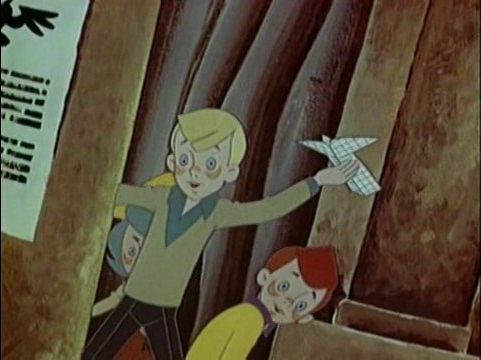
The film plays during World War Two, Russia’s Great War. When their village is occupied by some goofy Nazi Germans, three communist children decide to withstand their occupants. They are betrayed by a collaborator, however, and captured when raising a red flag. Luckily, they are saved by the red army.
This children’s film uses ugly designs and very old-fashioned looking caricatures of Nazis, while the children and especially the red army are drawn quite heroically. The result is as unappealing and unfunny as it is sickeningly propagandistic.
Watch ‘The Adventures of the Young Pioneers’ yourself and tell me what you think:
http://www.fandor.com/films/the_adventures_of_the_young_pioneers
‘The Adventures of the Young Pioneers’ is available on the DVD box set ‘Animated Soviet Propaganda’
Director: Jan Švankmajer
Release Date: 1971
Rating: ★★½
Review:
 Animated sketches of drawings by Leonardo da Vinci are alternated with excerpts from stock live action films.
Atypically for Jan Švankmajer, this film uses pencil animation only (except for a short stop motion segment of a pencil drawing a hand). The animation of Leonardo da Vinci’s drawings is both stunning and very convincing. Unfortunately, the nonsensical interruptions with stock film wear the film down, rendering a boring film with an unclear message.
Nevertheless, the Czech communist authorities responded negatively to Švankmajer’s unauthorized post-production of this film, with the incorporation of images related to daily life – presuming a hidden political message. So after ‘Leonardo’s Diary’ Švankmajer was forced to lay down his work for seven years. Only in 1979 he would make the start of a second career, in which he would produce his best films. However, Švankmajer would never return to drawn animation, and ‘Leonardo’s Diary’ remains the only testimony of his skills in this form of art.
Watch ‘Leonardo’s Diary’ yourself and tell me what you think:
‘Leonardo’s Diary’ is available on the DVD ‘Jan Svankmajer – The Complete Short Films’
Director: Jan Švankmajer
Release Date: 1971
Rating: ★★★★★ ♕
Review:
 ‘Jabberwocky’ has little to do with the poem from Lewis Carroll’s ‘Through The Looking Glass’, although we hear it being recited by a little girl during the opening sequence.
The film it is Švankmajer’s surrealistic masterpiece on the loss of childhood, depicted by several episodes, which are separated by a box of bricks, a labyrinth and a black cat crushing the box of bricks.
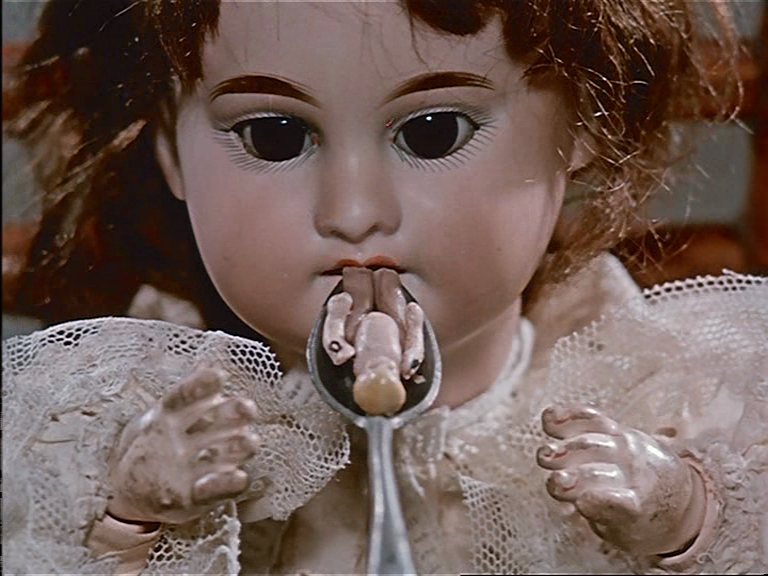
During the episodes we are treated on extremely surrealistic images of very active inanimate objects in a child’s room. First we watch a boy’s suit growing a forest in his room, defying both time and authority (symbolized by the portrait in the room). Then we watch large cannibalistic dolls grinding, ironing and eating little dolls, a china baby in a cradle destroying two tin armies, a pocket knife performing acrobatic tricks until it makes an ill-fated fall and stabs itself, and finally, schoolbooks producing paper boats and planes, which fly out of the window, while the father’s portrait produces pictures of beautiful women.
This last episode shows the child’s changing interests. In the end the labyrinth is solved, the cat – the only living thing in the entire film – is caged, and the boy’s suit is replaced by an adult one. The boy is free from his parent, but the days of imagination are over, the fantasy is gone.
For this film Švankmajer makes excellent use of 19th century imagery (sailor suit, vintage dolls and toys) to create a completely unique world. It’s the film maker’s most typical film, partly expanding on ideas explored in ‘Historia Naturae, Suita‘ (1967), and showing his fascination with fantasy, cruelty and decay, which roam freely in the child’s self-contained room. The rather morbid behavior of the everyday objects is quite unsettling and it shows how a child’s fantasy can be both imaginative and cruel.
‘Jabberwocky’ is without doubt one of Švankmajer’s most powerful films. He would only top it eleven years later, with ‘Dimensions of a Dialogue‘ (1982). Švankmajer would explore the imagination of children further in the moving ‘Down to the Cellar‘ (1983), and in his unique adaptation of Lewis Carroll’s most famous work ‘Alice‘ (1987).
Watch ‘Jabberwocky’ yourself and tell me what you think:
‘Jabberwocky’ is available on the DVD ‘Jan Svankmajer – The Complete Short Films’
Director: Jan Švankmajer
Release Date: 1970
Rating: ★★★
Review:
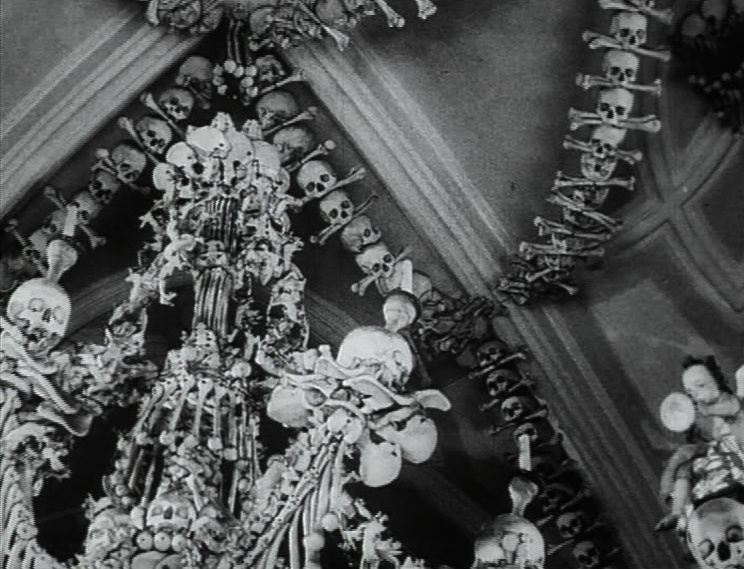 ‘The Ossuary’ is a commissioned documentary film about a Czech chapel in Sedlec, which is decorated with thousands of bones and skulls of victims of the 1318 plague and of the Hussite wars of 1421.
Two versions of this film exists: one with a soundtrack of a rather mundane guide guiding a group of children, in which she repeatedly warns not to touch the bones on a penalty of fifty crowns. Her tour is mixed with the uncanny sound of a rattling bicycle. For unclear reasons this soundtrack was considered subversive and forbidden by the Czechoslowakian regime. Therefore a second version was made using a jazz soundtrack.
In both versions the soundtrack conflicts with the morbid images, which are composed in a rhythmical way that even appeals when watched silently. The film contains no animation, but is full of Švankmajer’s idiosyncratic cinematography.
Watch ‘The Ossuary’ yourself and tell me what you think:
‘The Ossuary’ is available on the DVD ‘Jan Svankmajer – The Complete Short Films’
Director: Lev Atamanov
Release Date: 1970
Rating: ★★★★★
Review:
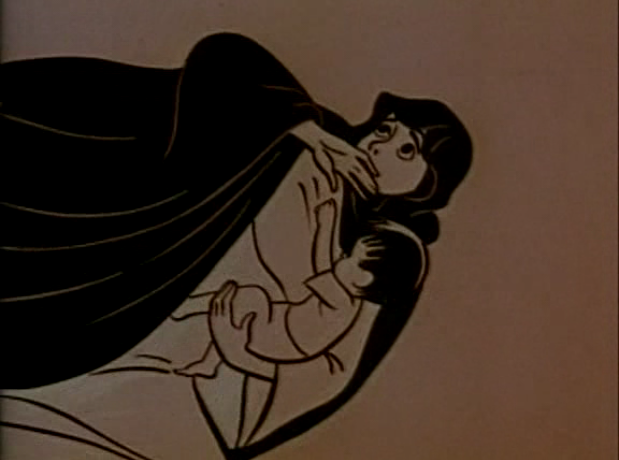 From a fascistic egg sprouts a military bird.
The young bird is fed by a capitalist and a general (who both are clearly American) with money and weapons. It grows into a huge black war-bird, which flies over the whole world, threatening loving couples in London, Paris, Moscow and Japan, and an old man, two mothers and several children in an unclear place. When the war-bird starts to attack, one mother turns Asian, Muslim and black, in order to illustrate that war can affect everybody everywhere. Eventually, however, the war-bird is overthrown by a multitude of peace doves, created by workers, writers, children, artists, musicians and pacifists.
‘We Can Do It’ is a beautiful and strikingly pacifistic film and undoubtedly one of the best propaganda films ever created in the Soviet Union. The film clearly is designed for international audiences, with its final message (the title) depicted not only in Russian, but also in German, English, Spanish and French.
Despite its anti-American sentiment, its pacifistic theme is timeless and universal. The film tells its clear message without any dialogue or voice over. Moreover, its designs are stunning and very effective, especially that of the war-bird.
Watch ‘We Can Do It’ yourself and tell me what you think:
‘We Can Do It’ is available on the DVD box set ‘Animated Soviet Propaganda’
Director: Raoul Servais
Release Date:1968
Rating: ★★★★★
Review:
 In a sinister harbor, where cranes behave like giant dinosaurs and where pterodactyli fly a young flute player brings a mermaid to life. Unfortunately, the mermaid is captured by one of the cranes and dropped to death.
‘Sirene’ is a beautiful, surrealistic film with its own creepy and somber atmosphere. Luckily, there’s also space for some dark humor when the authorities arrest an innocent fisherman and when a zoo and a hospital argue about the mermaid’s body. ‘Sirene’ definitely among Servais’s best films, arguably only equaled by ‘To Speak or not to Speak (1970) and ‘Harpya‘.
Watch ‘Sirene’ yourself and tell me what you think:
Director: Jan Švankmajer
Release Date: 1969
Rating: ★★★
Review:
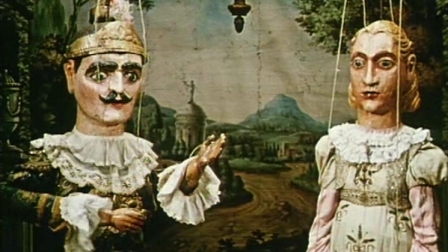 In ‘Don Juan’ Švankmajer’s retells a classic tale from the marionette theater.
The story unfolds in half an hour: Don Juan is a rogue who kills his father, the father of his beloved and his own brother, only to be taken into the depths off hell.
Oddly enough the film is enacted by people dressed as marionettes and behaving accordingly. This allows the marionettes to leave the theater and to perform in the real world, which is strangely intermingled with the marionette theater. This blend of the real and the artificial gives the film a weird and disturbing atmosphere. Švankmajer would reuse and improve upon this mix in his masterpiece, the feature film ‘Faust‘ (1994).
This film contains hardly any animation, and may therefore not be included in this blog. However, it takes a central part in Švankmajer’s oeuvre, who has always blended several different techniques into his works. It’s best to review his oeuvre as a whole, being animated or not.
Watch ‘Don Šajn’ yourself and tell me what you think:
‘Don Šajn’ is available on the DVD ‘Jan Svankmajer – The Complete Short Films’
Director: Jan Švankmajer
Release Date: 1969
Rating: ★★
Review:
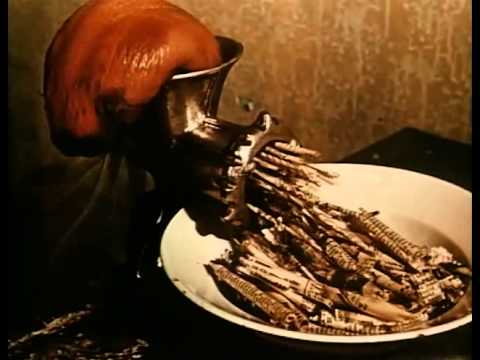 ‘A Quiet Week in the House’ is the last film in a series of four involving people facing surreal settings, which Švankmajer made in 1968-1969.
in this film a fugitive seeks shelter in an abandoned house. Every day he digs a hole in one of the doors of the corridor in which he sleeps. Every day he looks through the hole to watch weird surrealistic images of inanimate things behaving strangely. After a week he sets up a device to blow up all doors.
The live action footage is shot in black-and-white, and is accompanied by the sound of a camera. The surrealistic images, on the other hand, are shot in color and completely silent. Unfortunately, the film is too long, and it fails to be as impressive as related films like ‘The flat’ (1968) or ‘Jabberwocky‘ (1971), being neither completely disturbing nor very entertaining. ‘A Quiet Week in the House’ remains one of Švankmajer’s rare weak films.
Watch ‘A Quiet Week in the House’ yourself and tell me what you think:
http://www.dailymotion.com/video/xpfbvj_a-quiet-week-in-the-house-de-jan-svankmajer_shortfilms
‘A Quiet Week in the House’ is available on the DVD ‘Jan Svankmajer – The Complete Short Films’
Director: Inessa Kovalevskaya
Release Date: 1971
Rating: ★
Review:
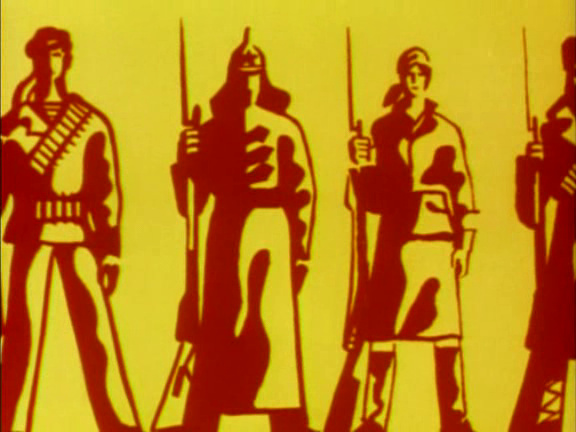 One could see ‘Songs of the Years of Fire’ as the Soviet answer to ‘Fantasia’.
This propaganda film features songs from the Russian civil war (1917-1922). These songs are accompanied by revolutionary and shamelessly patriotic images of the brave soviet army, to which the film is dedicated.
The resulting film is as graphically interesting as it is boring and sickening. It’s hard to believe such blatant propaganda could be made as late as 1971.
‘Songs of the Years of Fire’ is available on the DVD box set ‘Animated Soviet Propaganda’
Director: Perch Sarkisyan
Release Date: 1965
Rating: ★★★
Review:
 ‘A Hot Stone’ is a Soviet propaganda film from the 1960s based on a children’s book by Arkady Gaidar from 1941.
In it a boy stumbles on an old stone in the woods, which has the ability to give someone a new life again. The boy wants to help an old and lonely man with it, but the man sees no need for it as he has led a happy life. Enter the propaganda, in which the old man tells about the revolution and the civil war. This part is not much of a story. but it’s full of symbolic images, like people breaking their chains, and a giant worker slashing the double headed eagle of the czarist empire with a giant hammer.
‘A Hot Stone’ is a slow and boring film, but it’s also beautifully designed, in an original graphic style, which makes use of bold ink strokes.
Watch ‘A Hot Stone’ yourself and tell me what you think:
‘A Hot Stone’ is available on the DVD box set ‘Animated Soviet Propaganda’
Director: Grigori Lomidze
Release Date: 1959
Rating: ★★★
Review:
 Filmed in two colors, ‘Ali Baba and the Forty Thieves’ is a long puppet animation film from the Soviet Union.
The short takes half an hour to retell the famous story from One Thousand and One Arabian Nights quite faithfully. The film features the death of two characters, but the grim ending of the original story is lacking. Instead of being killed, the forty thieves are captured by the townspeople.
Interestingly, Ali Baba is not the real hero of the story, but rather his wife, a girl he bought on a slave market, unfortunately run by the very thieves he had robbed earlier. It’s this slave girl who decoys and fools the thieves to their own destruction.
The film uses a narrator who does all the voices, and a very lush score by composer Eduard Kolmanovsky. The film is quite slow and the puppet animation isn’t as sophisticated as in contemporary films by Jiří Trnka. The puppets have no facial expression whatsoever, and cannot move anything in their face, except for the gang leader, who can roll his one eye. Only occasionally their emotions become apparent. The best example of this may be the terror of Ali Baba’s neighbor when he realizes he’s trapped inside the thieves’ cave.
About the film’s director, Grigori Lomidze, little is known. He also directed the propaganda film ‘To You , Moscow‘ (1947), which combines live action and cel animation. Nothing points to a long experience in stop motion, and unfortunately, it shows. Nevertheless, ‘Ali Baba and the Forty Thieves’ is a charming film, succeeding in evoking the typical atmosphere of the Arabian Nights.
Watch ‘Ali Baba and the Forty Thieves’ yourself and tell me what you think:
Director: Jiří Trnka
Release Date: 1954
Rating: ★★★
Review:
 A young man on a motorcycle is on his way to his girl.
Along the way he stops at a bar, where a wedding is taking place. There he’s offered a drink, which he reluctantly accepts. However, one leads to another and he is quite intoxicated when leaving the bar. Driving at night he tries to speed against a car, a train and even a plane, but he finally crashes, never to see his girl.
This educational film warns us not to combine drinking with driving. In this respect the film is very dull and predictable, but Trnka’s illusion of speed and drunkenness is astonishing.
Watch ‘A Drop Too Much’ yourself and tell me what you think:
http://en.channel.pandora.tv/channel/video.ptv?ch_userid=noisypig&prgid=46485008&ref=rss


 Dr. Grob's Animation Review