You are currently browsing the category archive for the ‘Independent film makers’ category.
Director: Floor Adams
Release date: February 23, 2019
Rating: ★★★★
Review:
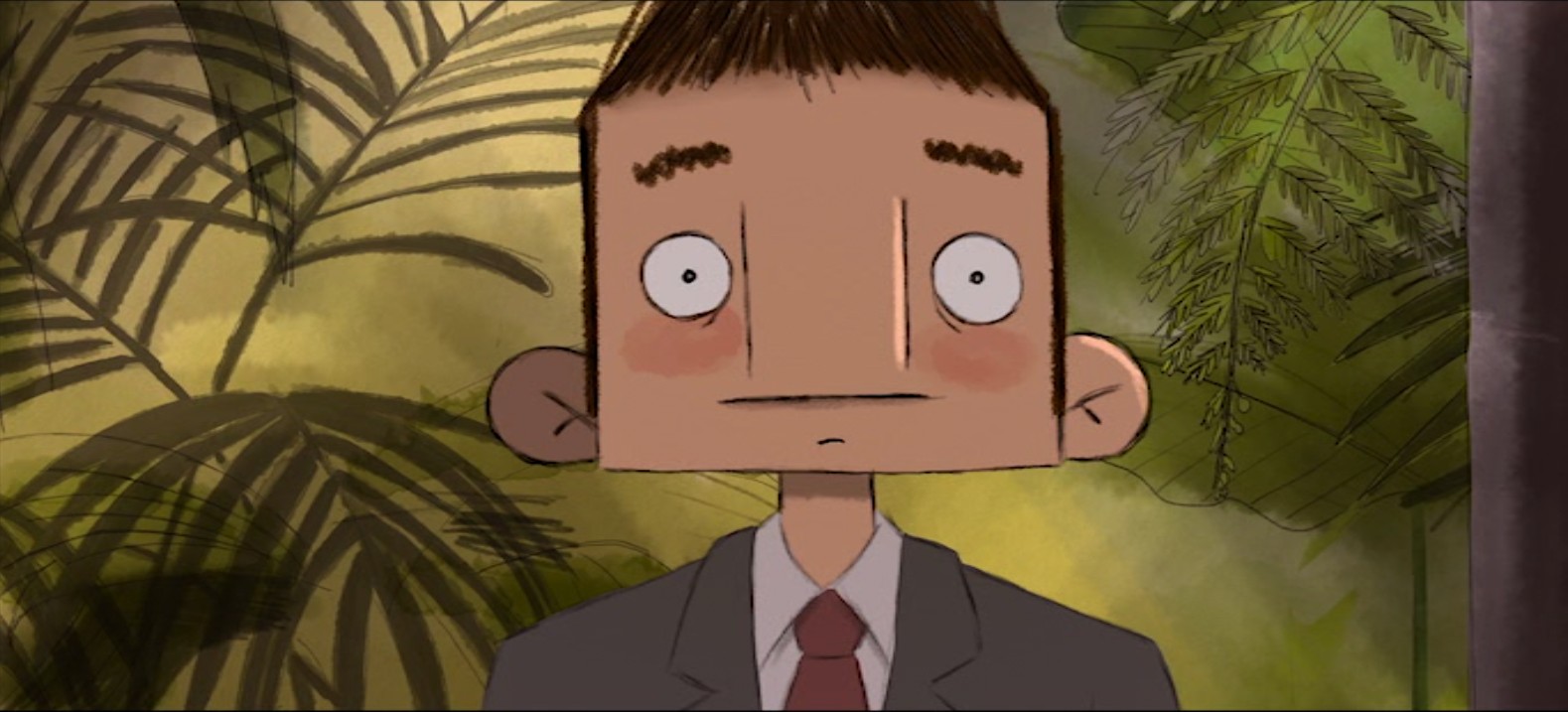
Christopher is a man on the autism spectrum, He loves his model Stuka dive bomber airplanes, but he has difficulties with social relationships. When is older brother invites him along to a party, a whole new adventure for him starts.
Christopher’s autism is shown by a homunculus inside his head who has to look up and memorize everything and thus easily gets an information overload, for example when too much is happening at the same time during the party. Christopher clearly is as sympathetic as he is social awkward, but I cannot help but admire the patience of his love interest Gwen, who has to suffer a lot through Christopher’s erratic behavior.
‘Mind My Mind’ is a nice insight in the mind of a person on the autism spectrum, but succeeds not entirely or convincingly in making the audience believe he can function easily in society.
The designs are pleasant, although I found the homunculus too sketchy a character. The animation meanwhile, is fair, and focuses on the characters’ emotions and relationships. Despite being a Dutch-Belgian co-production, the voices are in English, and thus the film can be enjoyed by a large audience.
Watch the trailer of ‘Mind My Mind’ yourself and tell me what you think:
‘Mind My Mind’ is available on DVD
Directors: Norman McLaren & Evelyn Lambart
Release date: 1965
Rating: ★★★★
Review:
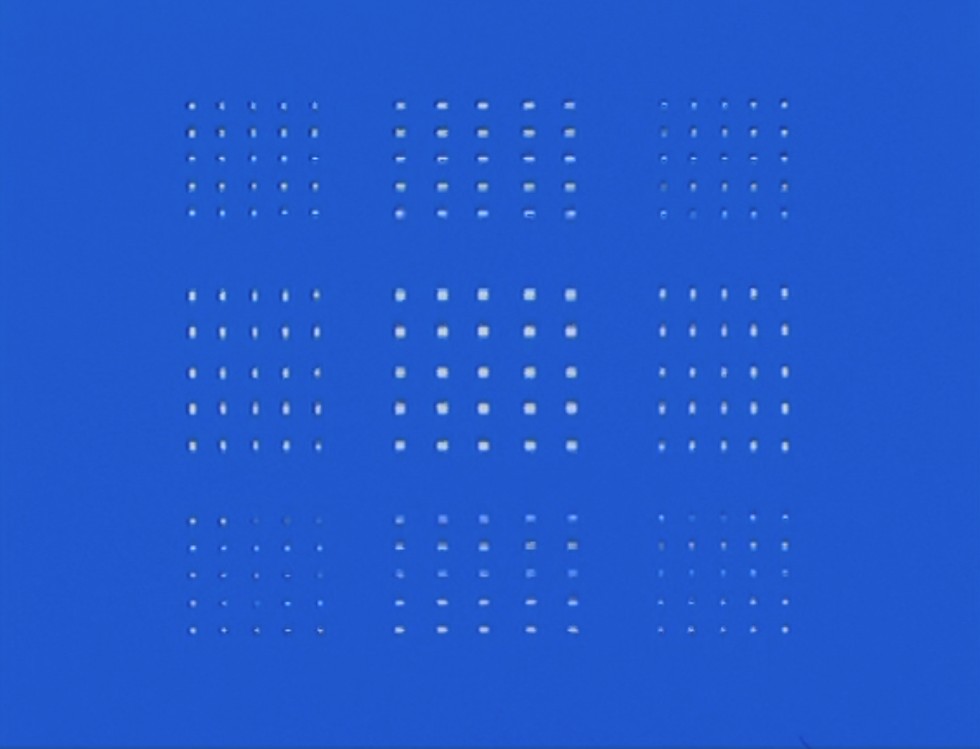
‘Mosaic’ starts with Norman McLaren himself entering an empty stage with a ball, while whistling. When he places the ball in empty air, it soon turns into a dot, which quickly splits into four dots, then nine, then sixteen and so on, until very complex patterns of dots fill the screen. The result is somewhat like a moving Piet Mondriaan painting, with the dots forming endless patterns, which change color over time.
It’s thanks to McLaren’s and Evelyn Lambart’s geniuses that this highly abstract film remains entertaining throughout, and seems to follow some inner logic. Indeed, McLaren himself said that ‘Mosaic’, like ‘Lines Vertical‘ and ‘Lines Horizontal‘ followed the structure of Hindu classical music, which also start with an easy pattern (a raga), which becomes increasingly complex and fast moving.
Watch ‘Mosaic’ yourself and tell me what you think:
‘Mosaic’ is available on the DVD-box ‘Norman McLaren – The Master’s Edition’
Directors: Norman McLaren & Evelyn Lambart
Release date: 1962
Rating: ★★★
Review:

‘Lines Horizontal’ is essentially ‘Lines Vertical‘ from 1960, but turned 90 degrees, re-colored and with a new, rather folky soundtrack by Peter Seeger. Even though the patterns are essentially the same, the result feels like a new film, especially because the horizontal lines cause some different effects to the eye, like creating non-existent triangles.
‘Lines Vertical’ and ‘Lines Horizontal’ both are extreme films in that they only use parallel lines, but Norman McLaren and Evelyn Lambart are able to turn this extreme concepts into intriguing films, thanks to their timing and overall structure, which follows an inner logic.
Watch ‘Lines Horizontal’ yourself and tell me what you think:
‘Lines Horizontal’ is available on the DVD-box ‘Norman McLaren – The Master’s Edition’
Director: Norman McLaren
Release date: 1961
Rating: ★★★½
Review:

‘New York Lightboard’ is a direct-on-film animation film that was never meant for the cinema. Instead, it was a commercial film commissioned by the Canadian Governmental Tourism Office to be projected in an endless loop on a big screen on Times Square in New York City.
The film is both in black and white and silent, but McLaren makes the commercial a very playful one, with letters bouncing and playing with each other, and metamorphosis running wild (we watch. e.g. the letters Canada change into a fish, which turns into a bird, which becomes a smiling sun, etc.).
Most of the film is pretty abstract, but there’s also some fine animation of swimming fish, a galloping horse, a man in a canoe and of Hamlet and Laertes fighting. Apart from the words Canada and ‘Dial PL 7-4917’ (for more information), the most recurring elements are animated fireworks.
The whole film seems a little too playful and too experimental for a general audience, but it certainly must have drawn attention. There’s also a short equally silent documentary called ‘New York Lightboard Record’ in which we watch the film on a screen on Times Square, and some of the responses of the audience watching it.
Watch ‘New York Lightboard’ & ‘New York Lightboard Record’ yourself and tell me what you think:
‘New York Lightboard’ and ‘New York Lightboard Record’ are available on the DVD-box ‘Norman McLaren – The Master’s Edition’
Director: Norman McLaren
Production date: March 17, 1966
Rating: ★★★
Review:
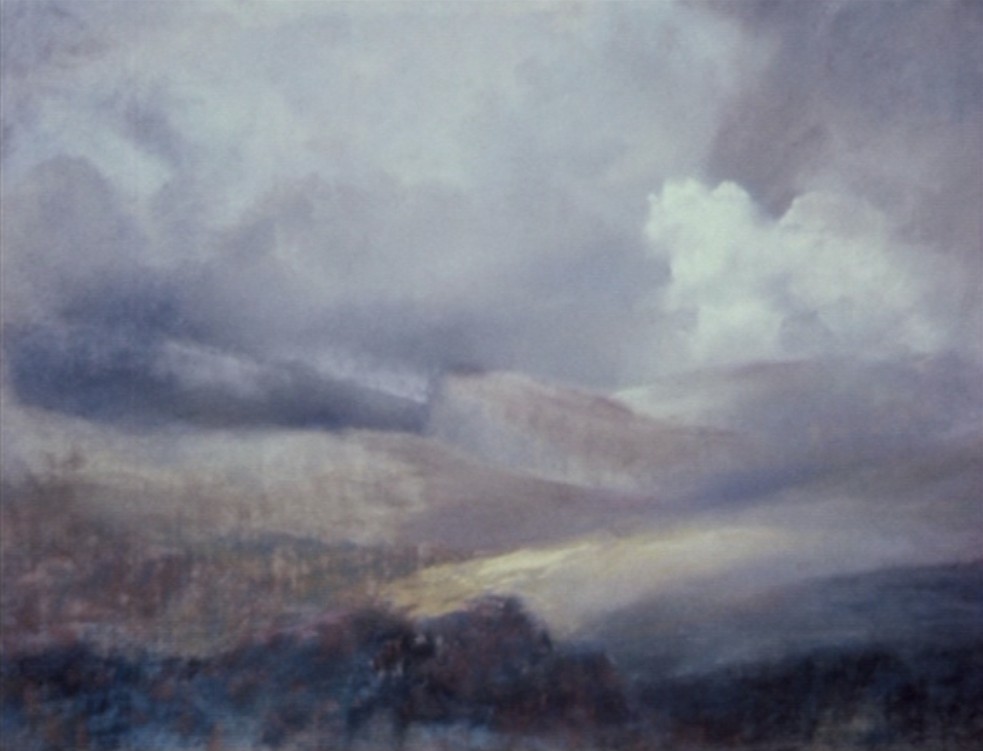
‘The Seasons’ is an unfinished film in which Norman McLaren tried to emulate the Canadian landscape in several moving paintings.
The ever changing pastel paintings never cease to amaze, with their metamorphosis of clouds, seascapes and landscapes, but McLaren deemed the film too abstract to entertain and never finished it. Thus, we are left with loose images without a soundtrack, and indeed, in this state, the result is still a little too boring to sit out, despite its short length of only four minutes. And yet, the images themselves are so beautiful it’s a pity this short never reached a final state.
‘The Seasons’ is available on the DVD-box ‘Norman McLaren – The Master’s Edition’
Director: Norman McLaren
Production date: ca. 1961
Rating: ★
Review:

This unfinished film from ca. 1961 must be the most extreme Norman McLaren ever made. In fact this is one of the most extreme films in the entire history of cinema. The film consists of a black and a white image only that are altered in different rhythms to cause a flickering effect. The electronic soundtrack matches the flickering.
It’s a testimony of McLaren’s genius that even such an extreme film contains some rhythm and variation, and even a sense of a build-up, but the idea remains too extreme to be entertaining, and the continuous stroboscope effect quickly wears done the viewer.
‘The Flicker Film’ is available on the DVD-box ‘Norman McLaren – The Master’s Edition’
Director: Ernest Pintoff
Release date: May 20, 1963
Rating: ★★★★
Review:
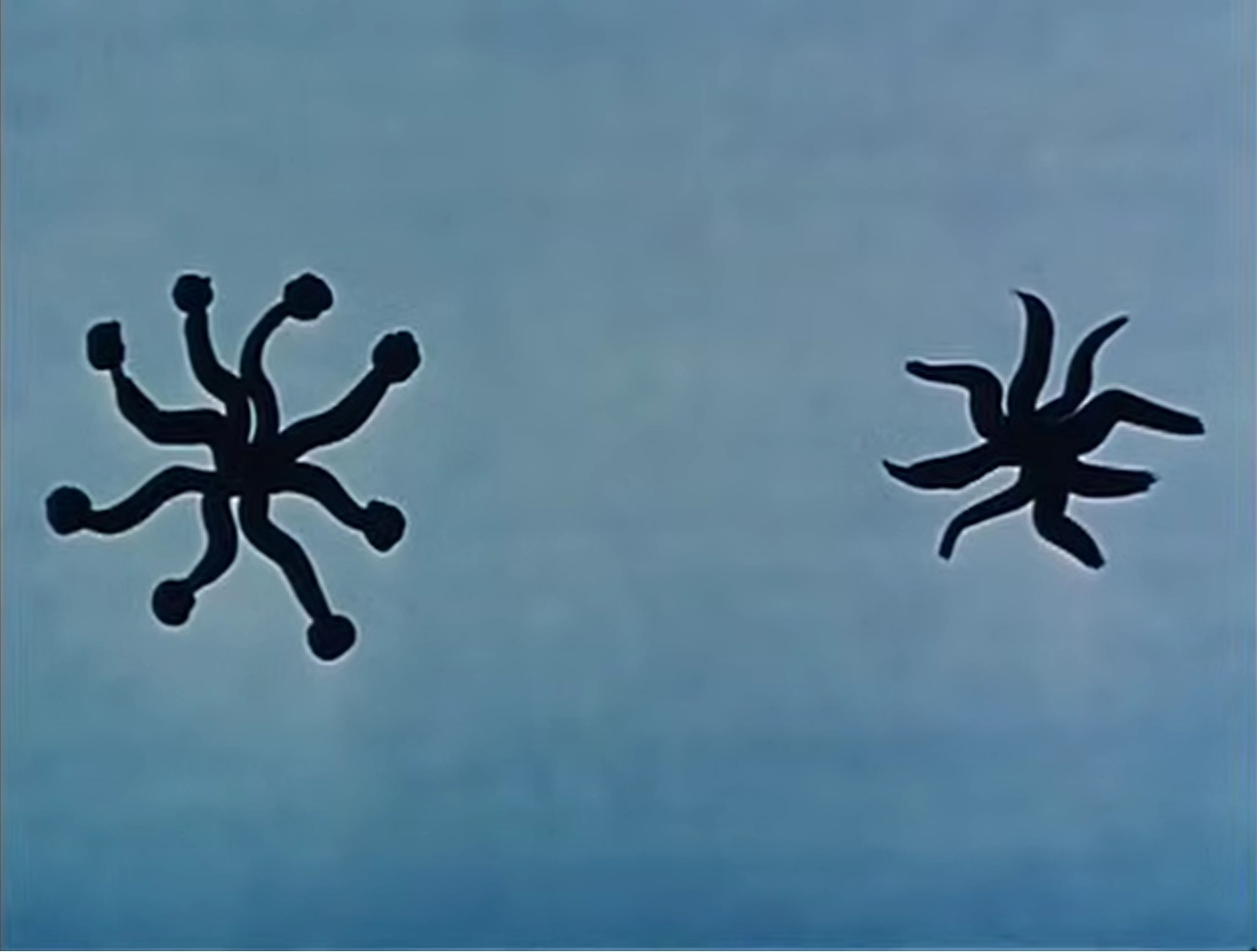
Conceived by Mel Brooks, and directed by UPA alumnus Ernest Pintoff, ‘The Critic’ is a short little unpretentious gem.
The film starts as an abstract animation film (designed and animated by Bob Heath), with several shapes appearing and moving to the baroque harpsichord music of Johann Sebastian Bach’s French Suite. But then suddenly a man starts commenting what he sees with us. The 71-year old Yiddish man of Russian decent certainly disapproves what he sees, but at the same time he seems immersed in the images on the screen, trying to make head and tale of the abstract forms.
Mel Brooks, who voices the critic, is in top form from the man’s first utterance “what the hell is this?” to his final verdict: “I don’t know much about psychoanalysis, but I’d say this is a dirty picture”. The animation seems to be a parody of the work of Norman McLaren of the time: the use of baroque music, choreography of shapes, monochrome background art. the sometimes organic forms, and the sense of narrative elements all point to that direction.Indeed, according to Wikipedia the short was inspired by a screening of a Norman McLaren film Mel Brooks attended, where he overheard a man mumbling to himself during the entire cartoon.
‘The Critic’ is an excellent bit of fun. More people must have thought so, because the short won the Academy Award for best animated short in 1964.
Watch ‘The Critic’ yourself and tell me what you think:
Director: Osamu Tezuka
Release date: November 1962
Rating: ★★★
Review:

‘Tales of a Street Corner’ was Osamu Tezuka’s first animated film, and the first production of his company Mushi productions, which Tezuka founded in 1961, after his contract ended at Toei Animations, Japan’s most important animation studio of that time.
The film immediately shows Tezuka’s high ambitions. First, ‘Tales of a Street Corner’ is of considerable length, clocking 39 minutes. Second, its designs echo the cartoon modern style of Europe, unlike anything previous in Japan. Third, Tezuka’s storytelling is highly poetical, reminiscent of Paul Grimault, avoiding tried story cliches. Fourth, the film has a strong anti-militaristic and pacificist tone, and is more than just mere entertainment.
It’s striking to note that, unlike Tezuka’s Astro Boy television series from a year later, ‘Tales of a Street Corner’ lacks any Japanese character. Instead, the film feels very European, both in its looks and in its music. Even the town in which the story takes place is clearly European, as are the poster violinist and pianist. These two characters form the heart of a romantic tale that Tezuka spins, with other protagonists being a little mouse, a moth, and even a broken lantern and a tree.
The whole tale is set in motion when a little girl drops her teddy bear in a gutter, but Tezuka’s story is anything but straightforward, and allows for some poetic moments, as well two series of silly gags involving numerous posters. The animation ranges from full animation to zooming into still images, with everything in between, and it is quite possible that Tezuka’s choices in the complexity of animation were motivated not only by its artistic value, but also by cost reduction.
‘Tales of a Street Corner’ is certainly charming, but as would later be more often the case with Tezuka, the director wants too much within one short. In fact, the short is overlong, and it’s unclear what he wanted the resulting film to be: a children’s film? A romance? A comedy? An anti-war statement? Now, the film is all this and thus none of that at the same time. Nevertheless, ‘Tales of a Street Corner’ remains a delight to look at throughout, and with this film Japan surely entered a new phase in animation, even if the film is still copying its European models.
Watch ‘Tales of a Street Corner’ yourself and tell me what you think:
‘Tales of a Street Corner’ is available on the DVD ‘The Astonishing Work of Tezuka Osamu’
Director: Milorad Krstić
Release date: August 9, 2018
Rating: ★★★½
Review:
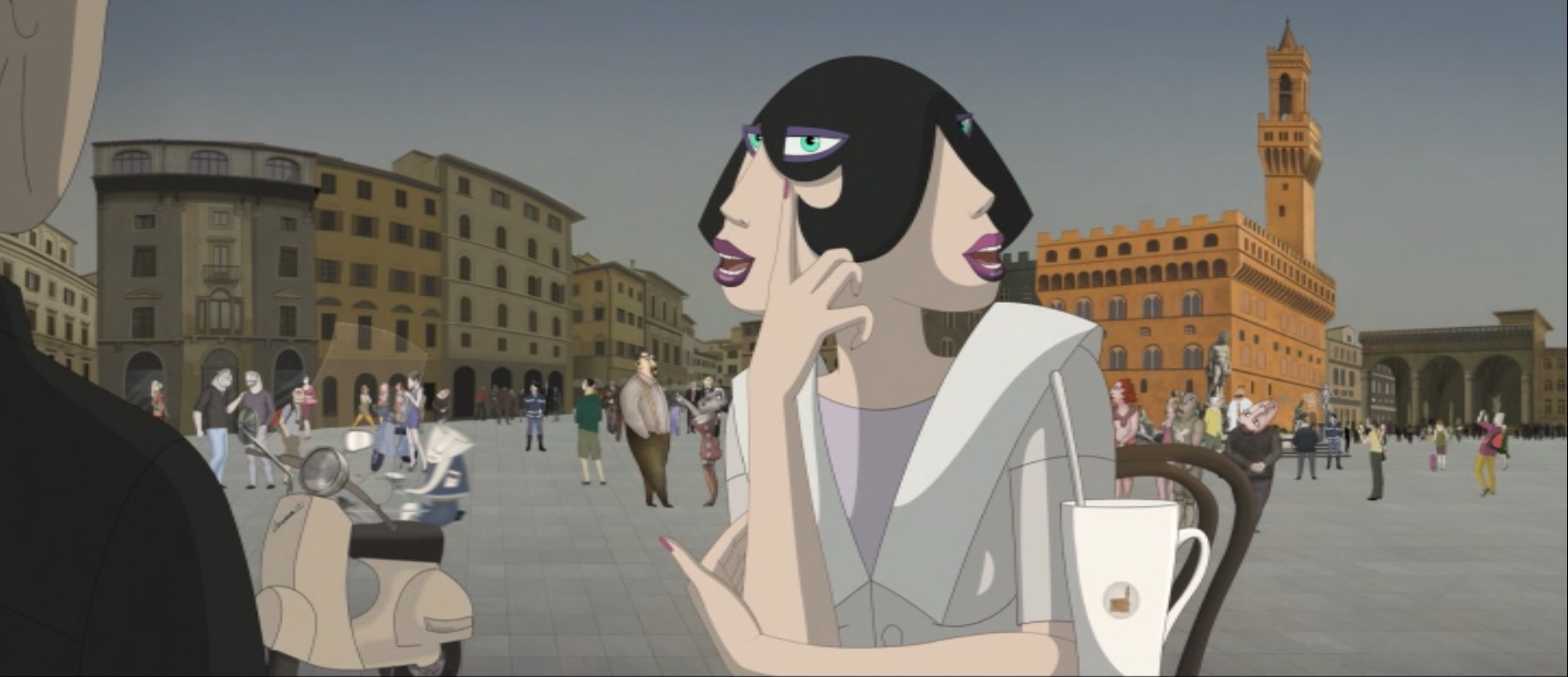
One of the more surprising and more original animated feature films from 2018 was this little gem from Hungary. Conceived and directed by Milorad Krstić, a director of Slovenian origin, ‘Ruben Brandt’ shows that one can make an adult animation film without an immature focus on sex and violence (there is violence in this feature film, because ‘Ruben Brandt’ is a crime thriller, but this violence is part of the plot, and not a gratuitous display of gore).
‘Ruben Brandt’ tells about a psychiatrist treating some criminals, who in turn help him overcome his nightmares by collecting artworks from all over the world. This plot is exciting, but on the flimsy side and as nonsensical as a James Bond movie. Moreover, the film fails to solve all the initiated plotlines, and the all too easy ending is a bit of a letdown.
Nevertheless, ‘Ruben Brandt’ remains an entertaining watch from start to finish, not only because of the surreal atmosphere, enhanced by the depiction of several of the art collector’s nightmares, but because of the film’s idiosyncratic looks.
Being a film on art, the film draws a huge inspiration from its subject, and the film breathes art in almost every frame. According to the end titles the film cites more than fifty art works, and part of the fun of watching the movie is to identify a reference in the background. Moreover, the color schemes, the designs and especially the character designs are very bold and unlike anything in any other animation film.
True, the three main characters Ruben Brandt, Kowalski and Mimi look fairly normal, even if their facial designs are already unique, but their co-stars can have two noses, eyes placed above each other, an eye placed inside an ear, three eyes, three breasts, and so forth and so on. There’s even a character with a Janus head, who is only two-dimensional, a characteristic used in the plot. The background characters are often even more bizarre, let alone the birds and fish depicted, and even if the movie were dull (which it certainly isn’t) one can enjoy the surreal imagery.
The film uses both traditional and computer animation and although the computer animation is less satisfying than the traditional animation, the mix is very well done.
In all, ‘Ruben Brandt’ is a highly authentic film that shows surrealism is far from dead, and with his grotesque designs Krstić shows that even 3D computer animation can be exciting and strikingly original.
Watch the trailer for ‘Ruben Brandt, Collector’ yourself and tell me what you think:
‘Ruben Brandt, Collector’ is available on Blu-Ray and DVD
Director: Fyodor Khitruk
Release date: 1962
Rating: ★★★★
Review:
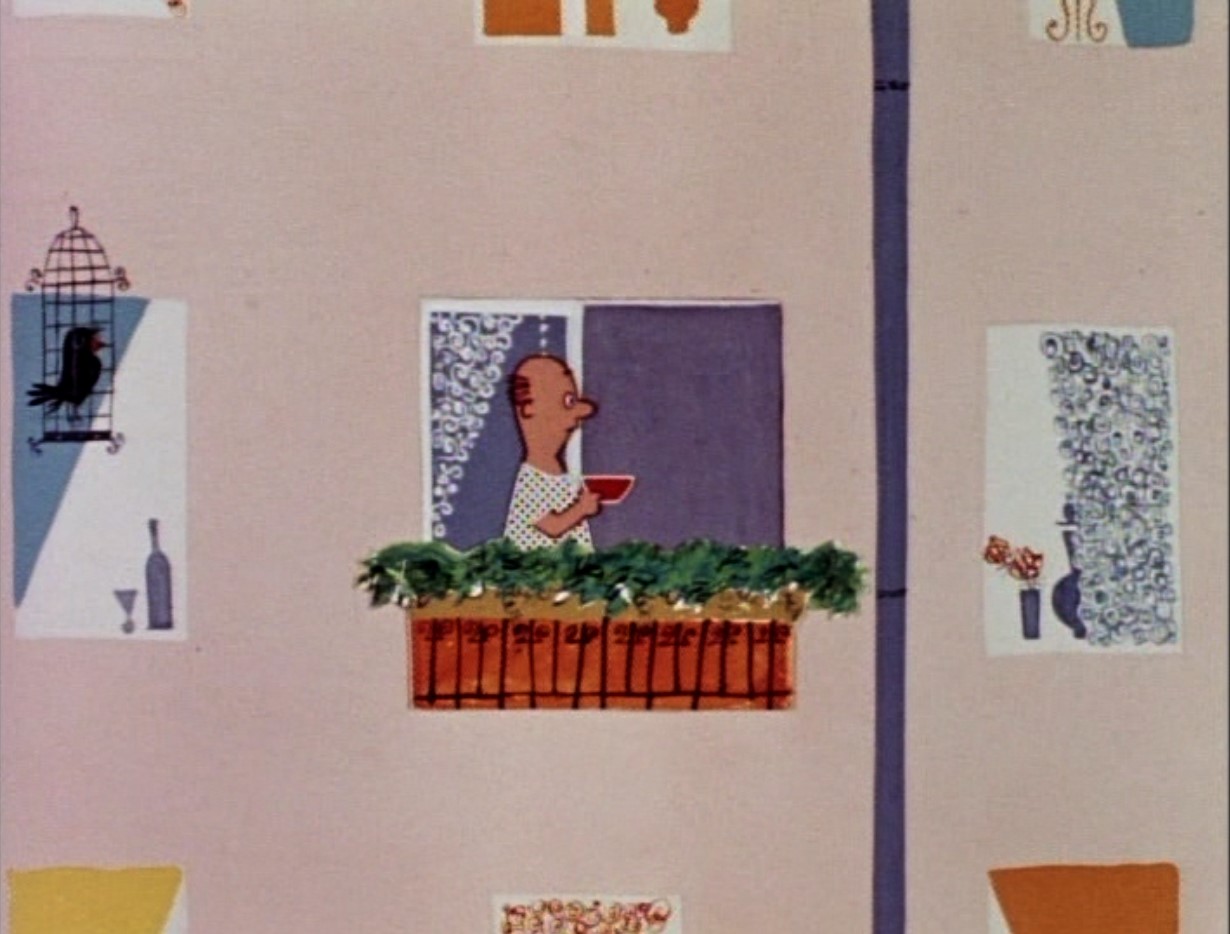
‘Story of One Crime’ was the first film directed by acclaimed film maker Fyodor Khitruk (1917-2012). Khitruk was one of the best comic talents in the Soviet era, as is already visible in this delightful early film.
The short starts with a man sneaking upon two talking ladies and hitting them with a large pan. At that point the narrator interrupts and takes us viewers 24 hours back. The rest of the film is told wordlessly, and shows the criminal, comrade Manin, to be a nice, gentle and hard working man. We watch him going to work, and working at the office.
All seems well, but as soon as he returns to his home, in an apartment block, the problems start. When he wants to rest on his balcony, he’s disturbed by ridiculously loud domino players playing in the courtyard. When he returns inside to watch some television, a neighbor turns on some loud jazz music, and later, when he tries to sleep, more neighbors deprive him of a good night’s rest in various ways. The film ends with a message to the viewers themselves, no doubt, more often than not living in such noisy apartments themselves.
Khitruk tells his tale with an understated sense of humor, and a relaxed, but effective sense of timing. The animation is limited, and far from fluent, but as Khitruk knows how to pose, very effective. The designs by Sergei A. Alimov, too, are a delight: the film is a rare example of Soviet cartoon modern design, and both characters and backgrounds are gorgeous throughout the film. They are partly made by snippets from magazines, and especially the neighbor’s gargantuan stereo installation is a great example of good cut and paste work.
With ‘Story of One Crime’ Khitruk took Soviet animation away from the classic fairy tale worlds of the 1950s into the modern age. The film contains some criticism on Soviet society, which is depicted as less than ideal, but the film was an enormous success, nonetheless.
With this short Khitruk immediately became one of the Soviet Union’s most important animation film makers, as he would prove, e.g. by delivering the world his delightful ‘Vinnie Puch’ (Winnie the Pooh) films of 1969-1972.
Watch ‘Story of One Crime” yourself and tell me what you think:
‘Story of one Crime’ is available on the DVD ‘Masters of Russian Animation Volume 1’
Director: Hermína Týrlová
Release date: 1962
Rating: ★★★
Review:
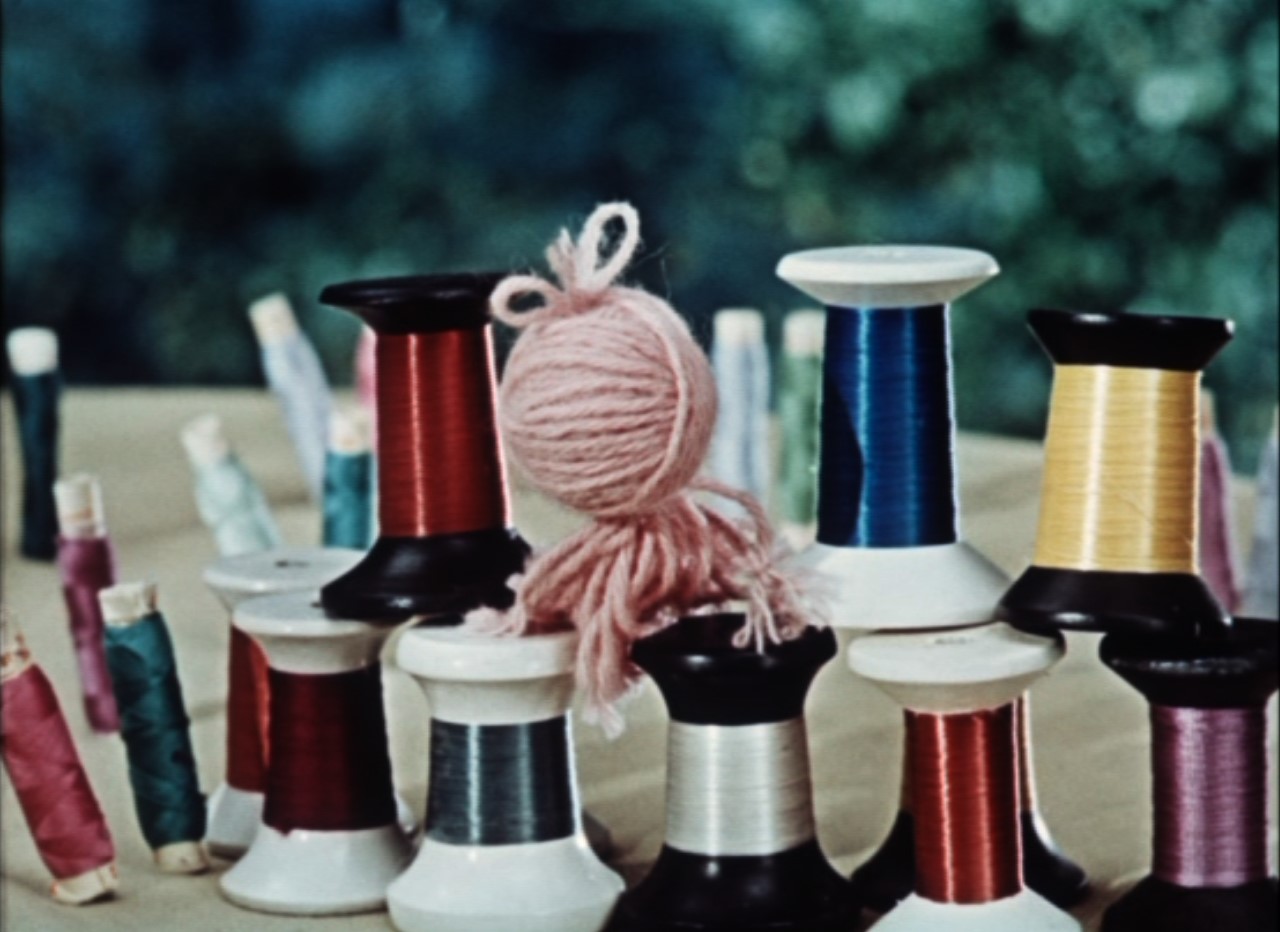
In ‘Two Balls of Wool’ the insides of a sewing box come to life, including a scissors, a measuring tape, thread spools, a horse-like pincushion, and, most importantly, two balls of wool.
The pink ball of wool turns into a girl, while the blue one turns into a boy. The boy plays the flute on a needle, charming the measuring tape, who acts like a snake. When the snake captures the girl, the boy comes to the rescue, riding the pincushion horse. The two also perform some acrobatic tricks, and accidentally unwind a knitted piece, until the scissors forces them to knit the piece back again
The film has a rather weak story, but it’s a marvel how Týrlová spins a film out of such ordinary material, making use of the properties of these objects. The animation is top notch. For example, note how Týrlová manages to turn the scissors (which can’t do anymore than the scissors in your drawer) into an authority figure, imposing on the other objects. ‘Two Balls of Wool’ thus is a charming little short, showing Týrlová’s great talent as an animator.
Watch ‘Two Balls of Wool’ yourself and tell me what you think:
https://noodlemagazine.com/watch/-167471844_456240845
‘Two Balls of Wool’ is available on the DVD box ‘Hermína Týrlová Výběr z tvorby/Selected Works’
Director: Jan Iván
Release date: 1961
Rating: ★★★
Review:
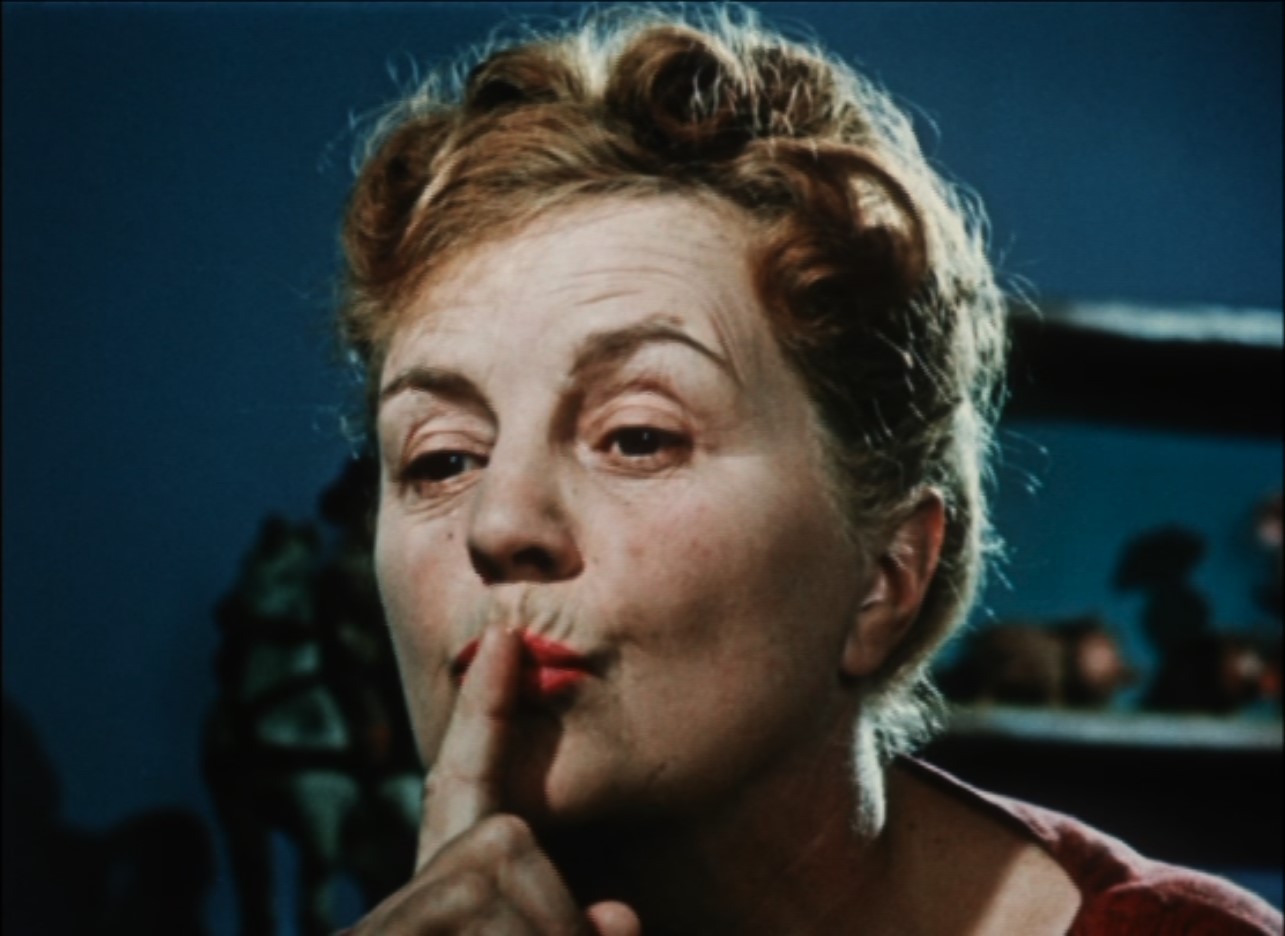
This a gentle documentary film made in honour of the Czech animation pioneer’s sixtieth birthday.
The film showcases excerpts from quite a few of Hermína Týrlová’s films, including her first, ‘Ferda the Ant’ (1944), Czechoslowakia’s first stop motion film anyhow. Other excerpts are from ‘Revolt of the Toys’ (1945), apparently an anti-fascist film, ‘The Knot in the Handkerchief’ (1958) and ‘Badly Made Toy-Man’ (1951), which is revealed as Týrlová’s favorite character.
Indeed, it’s the Badly Made Toy-Man who stars the bridging stop-motion sequences, for this documentary features quite some original animated material, made by Týrlová especially for this film. Especially, the short sequence starring the two balls of whool-characters for her upcoming ‘Two Balls of Wool’ (1962) are a delight, for this cannot be found in the final film, and is presented as a depiction of Týrlová’s imagination.
The film is narrated, and although we watch Týrlová acting out herself, e.g. recreating the painstaking ways with which she made ‘Ferda the Ant’ and interacting with children, her main audience, we do not hear her, and there are no interviews, only images. Nevertheless, the documentary succeeds in showing where Týrlová’s greatest talent lies: in creating charming animation films for children in which ordinary toys and objects come to life.
‘Hermína Týrlová’ is available on the DVD box ‘Hermína Týrlová Výběr z tvorby/Selected Works’
Director: Daniel Szczechura
Release date: 1963
Rating: ★★★
Review:

‘The Chair’ is another film subtly criticizing communist society as it was imposed on Poland at the time. Apart from the intro, the film is completely filmed from above, and features a conference.
At one point one of the conference leader’s chairs remains unoccupied, and members from the audience are invited to fill the spot. But the other audience members don’t allow each other to get to the stage, and the volunteers are hindered and blocked everywhere. Yet, one does make it, and is accepted due to his clever entrance.
The idea of ‘The Chair’ is as simple as it is well executed. Again, I am surprised the film got past the censors, as it clearly criticizes the oppressive system.
Watch ‘The Chair’ yourself and tell me what you think:
‘The Chair’ is available on the DVD-set ‘Anthology of Polish Animated Film’
Director: Witold Giersz
Release date: 1963
Rating: ★★
Review:
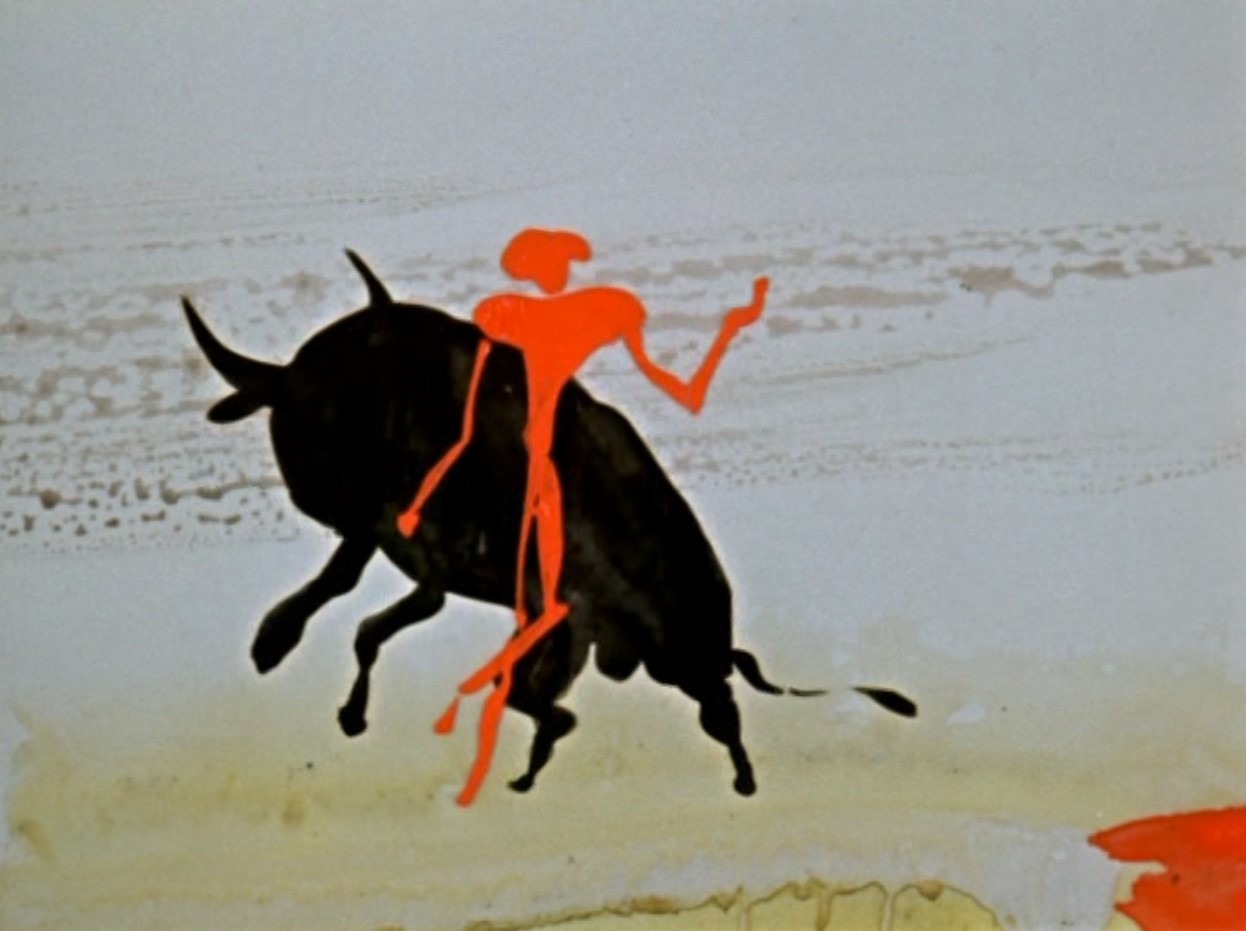
‘The Red and the Black’ is a rare attempt at a gag cartoon in a Polish studio. True, the film’s designs are no less avant-garde as that of other contemporary films from the era, this time featuring highly abstracted painted characters, but unlike his countrymen, Witold Giersz aims at laughs.
The film is an addition to a long canon of bullfighting cartoons, with the Red being the bullfighter, and the black being the bull. There are some fine gags, like the two drinking beer together, or the bull suddenly revealing the film makers, but the characters and the action remain emblematic, and Giersz has no sense of timing, so the gags all fall flat. Thus, despite some clever ideas, ‘The Red and the Black’ is a rather tiresome watch, and the film well overstays its welcome.
Watch ‘The Red and the Black’ yourself and tell me what you think:
‘The Red and the Black’ is available on the DVD-set ‘Anthology of Polish Animated Film’
Director: Kazimierz Urbański
Release date: 1962
Rating: ★★
Review:

‘Playthings’ is a film on fighting. The film knows only monochrome yellow and red backgrounds and silhouetted, abstracted human figures and weapons.
The film starts with some designs based on ancient cave paintings. We watch a group of human figures hunt a deer. When one is killed, another group of more tangram-like humans, arrives, and the fighting starts, with more and more advanced weaponry, like cannons, machine guns, tanks, bomber planes. As can be expected, in the end everybody is killed by a giant, probably nuclear explosion. The message of ‘Playthings’ is crystal clear, but the short is too one-dimensional to make a lasting impression.
Watch ‘Playthings’ yourself and tell me what you think:
‘Playthings’ is available on the DVD-set ‘Anthology of Polish Animated Film’
Director: Jan Lenica
Release date: 1961
Rating: ★★★★
Review:
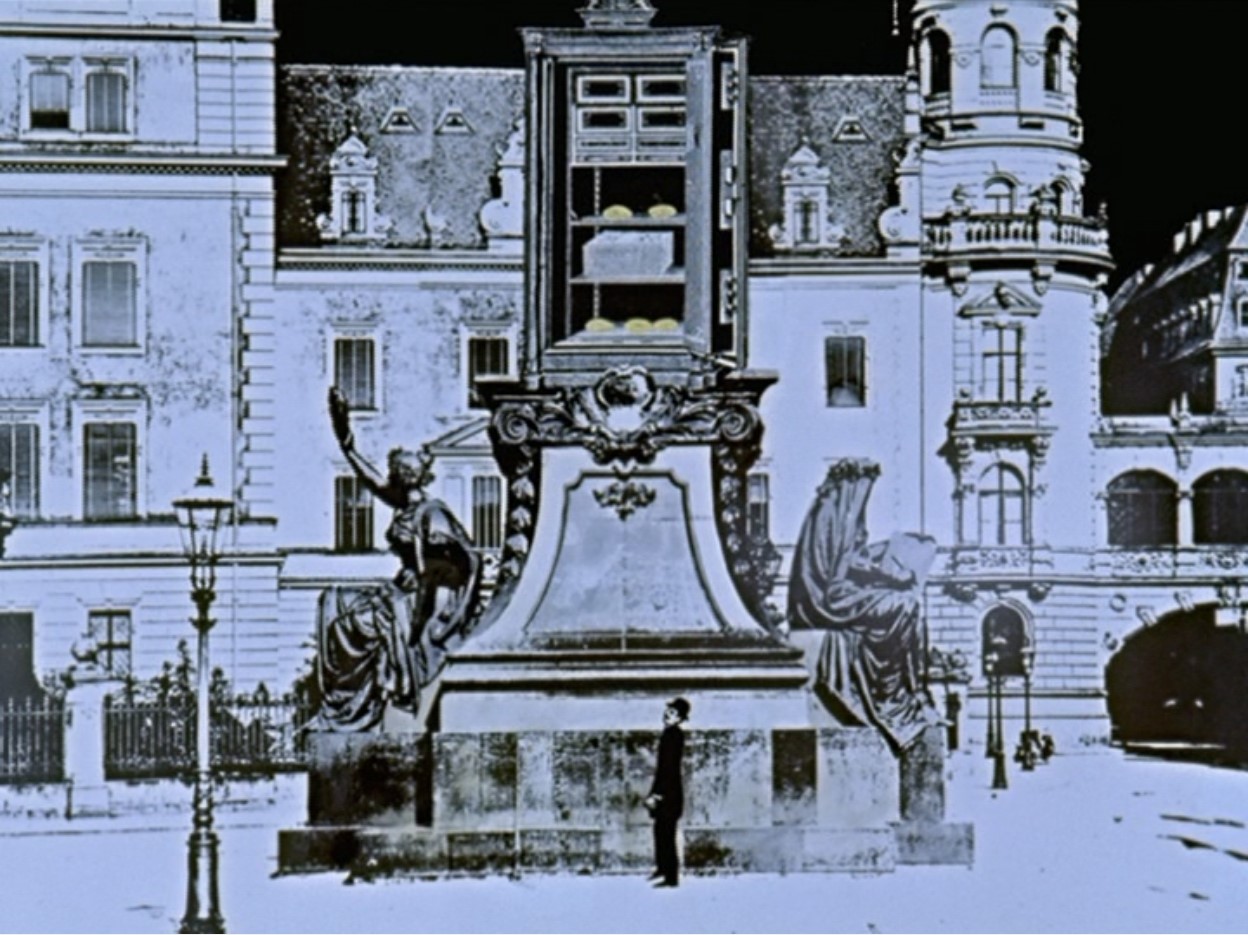
In ‘Labirynt’ a man flies into a seemingly abandoned city, only to find it to be a dangerous place, terrorized by strange creatures and machines, alike.
This is one of those rare animation films from Eastern Europe depicting what it’s like to live in an oppressive communist state. The film is highly surreal, featuring strange creatures, often mixes of animal and human parts, but I am still surprised the film got past the censors. For example, at one moment the man is captured by a bearded machine-man and thoroughly examined. At one key scene we watch is thoughts roaming freely inside his head, only to get barred by a strange contraption. The end, too, in which the man tries to escape the paranoid city is telling enough.
Jan Lenica’s world is based on partly colored old photographs and engravings. His animation is emblematic, but at one point we surely feel the man’s fear, as he tries to flee from his oppressors. The surrealist atmosphere is enhanced by Jan Radlicz’s sound design and by Włodzimierz Kotoński’s score.
Watch ‘Labirynt’ yourself and tell me what you think:
‘Labirynt’ is available on the DVD-set ‘Anthology of Polish Animated Film’
Director: Jan Švankmajer
Release date: January 26, 2018
Rating: ★★
Review:
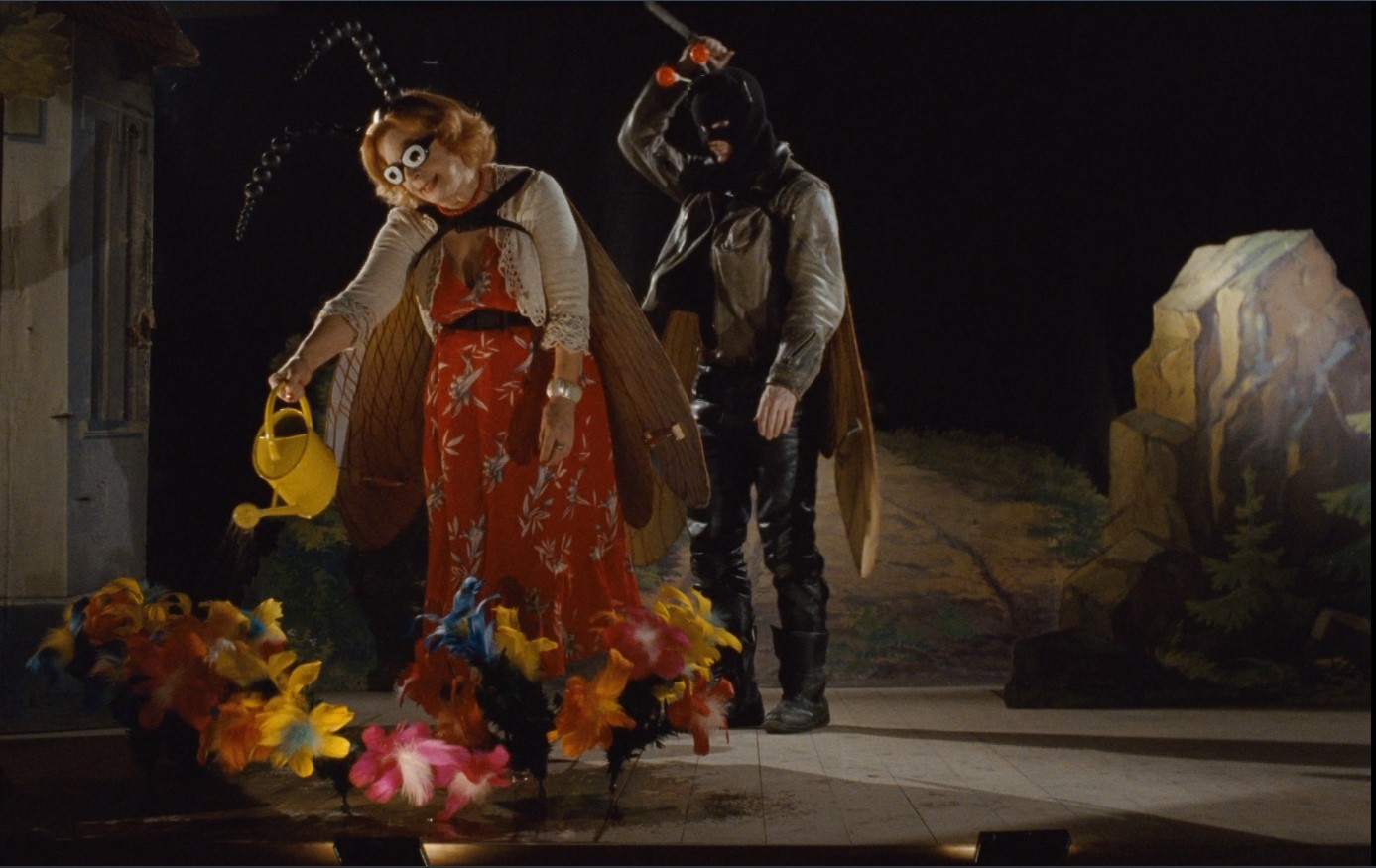
‘Insect’ is Jan Švankmajer’s last film. Even though at the time of writing the Czech master of surrealist cinema is still alive, he announced this film as such. It sure was a difficult film to make, as even crowdfunding was needed to finish the movie.
Unfortunately, the film is not a grand finale to Švankmajer’s glorious oeuvre. Sure, the film’s main story is interesting enough and shows all elements of the Czech director’s idiosyncratic style: surrealist events, morbid humor, extreme close-ups, claustrophobic spaces, a preoccupation with food, and even a splash of stop-motion and cut-out animation, rarely seen since the 1980’s.
In this story an amateur company rehearses the 1921 play ‘Pictures from the Insects’ Life’ by the Čapek brothers. Only part of the troupe is present, and the film features only six characters, who are cramped into a dark, poorly lit space, which give the film an eerie feeling the actors are trapped like insects themselves. Four actors are bullied by an overt ambitious director, while the sixth sleeps through most of the rehearsal. While the inapt actors act out a few scenes from the play, strange events start happening, like insects appearing everywhere, and a dummy coming to life, and several of the actors don’t live through the end of the rehearsing.
This story shows a strong unity of time and space, and is told by Švankmajer with gusto, while his actors delight in portraying the clumsy actors, one even worse on the stage than the other. The actor’s antics are often accompanied by the beginning of Bedřich Smetana’s overture to ‘The Bartered Bride’ (1866), the lively sounds of which contrast heavily with the bad acting on the stage. The sound design, too, is excellent, with its well-chosen unpleasant sounds, as of crawling insects.
However, apparently this main story wasn’t enough material to fill a complete feature length film, and thus the action is constantly interrupted by behind-the-scene footage, showing how the film was made, as well as the real actors telling about their dreams. These scenes often reveal the tricks involved in the film making, and thus spoil the fun of the surrealist main story. But more importantly, they greatly disrupt the main narrative, and the viewer is constantly thrown in and out of the story, which makes the film a frustrating watch, indeed. This choice of adding an extra layer to the film actually makes it a weaker product than it could have been, and although it’s nice to watch Jan Švankmajer at work, it makes the film a sad farewell to his illustrious career.
Watch the trailer for ‘Insect’ yourself and tell me what you think:
‘Insect’ is available on Blu-Ray and DVD
Director: Nina Paley
Release date: February 11, 2008
Rating: ★★★★★
Review:
Unlike the European and Japanese animation field, the American animation studio system is unkind to author films. Walt Disney’s ‘Lilo & Stitch’ (Chris Sanders, 2002) probably comes closest, apart from several feature films based on animated television series. Thankfully, some individual artists have filled this gap, most notably Bill Plympton, releasing no less than seven features. Other notable artists are Don Hertzfeldt (‘It’s Such a Beautiful Day’ from 2012), and Nina Paley. Amazingly, all these artists mostly work totally alone, which makes their accomplishments even more stunning.
Nina Paley ‘Sita Sings the Blues’ for example, is written, directed and produced by Paley alone, which took her five to six years, and which could only be finished with help from crowd-funding, being one of the first animated projects to use this type of fund raising.
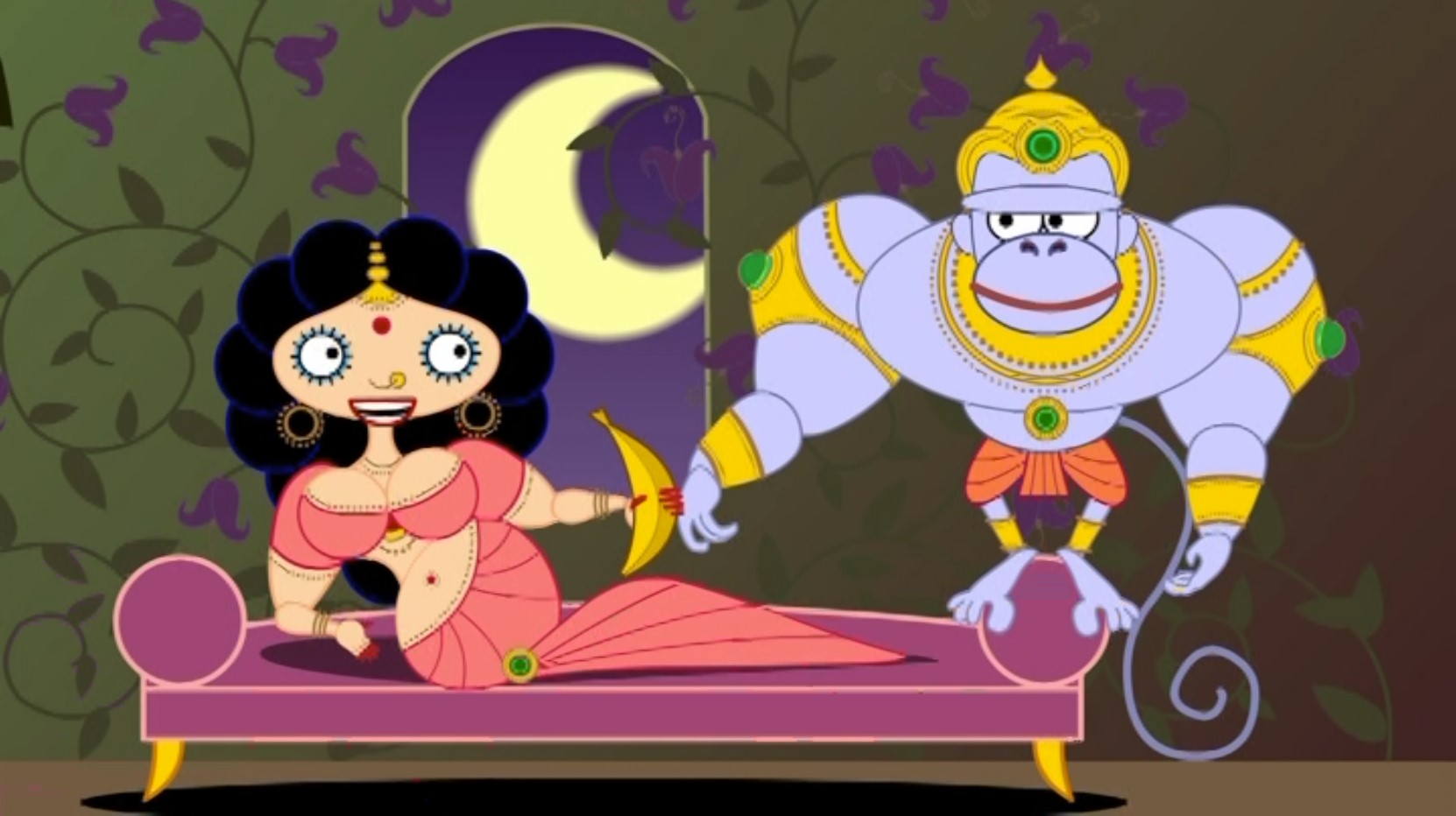
‘Sita Sings the Blues’ retells the Indian epic ‘The Ramayana’, but it’s also a personal film, in which Paley links her own situation to that of Sita, the perfect wife to the hero Rama. The most incongruous element are the eleven songs by 1920s jazz singer Annette Hanshaw, an artist sadly almost forgotten, whom Paley had discovered prior to the film making. The linking of these sweet and gentle tin pan alley songs to the Ramayana is as odd as it is effective, and the pairing certainly contributes to the uniqueness of the film.
The film uses several different animation styles: Nina Paley’s own personal story is told in a traditional scribbly animation style, with sets based on photographic material. These parts are the least attractive of the lot, even though Paley shows to be a very able animator in this classic cartoon style. The Ramayana is retold by three Indians (Aseem Chhabra, Bhavana Nagulapally and Manish Acharya) who are depicted as traditional shadow puppets of Hanuman, Sita, and Rama, respectively. The story they are telling together is shown in tongue-in-cheek cut-out animation.
The ‘official’ story is also told in cut-out animation, using very attractive recreations of traditional Indian paintings. But the best parts to look at are the songs, which are done in a most attractive cartoon modern design. In these song parts Paley reuses a lot of animation cycles, but actually she makes excellent use of the flash medium, and she makes the most of her limited animation.
Apart from these five alternating styles, there’s also a short sequence using rotoscope and a much more pop-art influenced videoclip-like filming style. All these are apparently done in Macromedia flash.
As said, ‘Sita Sings the Blues’ retells the Ramayana, reducing the huge epic to its barest elements. For example, Lakshmana is hardly mentioned, and the monkey king Sugriva not at all. Moreover, unlike the traditional poem, the focus is on Sita, not Rama, and Paley highlights the questionable parts from the original poem (one at the end of the Yuddha Kanda, and another in the Uttara Kanda), in which Rama treats Sita very unfairly indeed, just like Paley’s own partner does in real life. This makes ‘Sita Sings the Blues’ a feminist film, which sheds a welcome critical light on the traditional depiction and treatment of women, then and now.
As the story is told by three people, who remember the story differently and interpret it in different ways, this leads to some very funny moments. But Paley adds some humor, too, in the ‘official’ story part, for example when the female rakshasa (a sort of demon) Shurpanakha tells her brother Ravana about the beauty of Sita, comparing all her body parts with lotuses.
As said, the Annette Hanshaw songs boast the most attractive designs, and like traditional opera arias, they shed an emotional light on the events. However, Paley cleverly propels the story forward even during these sequences. Yet, as the songs are featured in their entirety, typically lasting ca. 3 minutes, they also drag the film down. As there are eleven of them, one tends to grow a little weary of them as the film progresses. Nevertheless, ‘Sita Sings the Blues’ does a great job in restoring interest in this almost forgotten singer. Unfortunately, the Hanshaw songs were not free from copyright, causing Paley a lot of trouble, and eventually causing her to release the film completely free from copyright.
The Annette Hanshaw songs are juxtaposed to some Indian pop music, mostly by artist Masaladosa. Particularly strong is the angry song which follows the scene in which Paley gets dumped by email. The complete soundtrack is as attractive as the film’s visual designs, and the two complement each other very well.
In all, ‘Sita Sings the Blues’ is not without its flaws, but as it is made by a single woman, it’s no less than a tour-de-force, and the result is a very interesting personal film, which makes one think. Moreover, the film shows the great power and endless possibilities of animation, and single-handedly puts Paley into the pantheon of the medium’s greats. In 2018 Paley made yet another feature called ‘Seder-Masochism’, which unfortunately has attracted much less attention.
Watch the trailer for ‘Sita Sings the Blues’ yourself and tell me what you think:
‘Sita Sings the Blues’ is available on DVD
Director: Norman McLaren
Release date: 1972
Rating: ★★
Review:

In the final stages of his career Norman McLaren apparently got interested in ballet, for three of his final films (‘Pas de deux’, ‘Ballet Adagio’ and ‘Narcissus’) are on the movements of ballet dancers.
‘Ballet Adagio’ is the most straightforward of the three: it is a documentary recording of a two and a half minute pas de deux, danced by David and Anna Marie Holmes, played on a quarter speed and set to the faux-Albinoni adagio in G minor by Remo Giazotto.
There’s no trickery, let alone animation involved – it’s just the two dancers on an empty stage doing their thing. Due to the slow motion one gets ample opportunity to watch the sheer virtuosity of the two dancers, the sometimes almost impossible stunts of the two, and their muscle movements. But, as there’s nothing else going on, the result is as fascinating as it is boring. It doesn’t really matter, for the film’s intentions were purely educational, giving ballet students an opportunity to study movement.
Watch ‘Ballet Adagio’ yourself and tell me what you think:
‘Ballet Adagio’ is available on the DVD Box ‘Norman McLaren – The Master’s Edition’
Director: Paul Driessen
Release date: 1975
Rating: ★★★
Review:
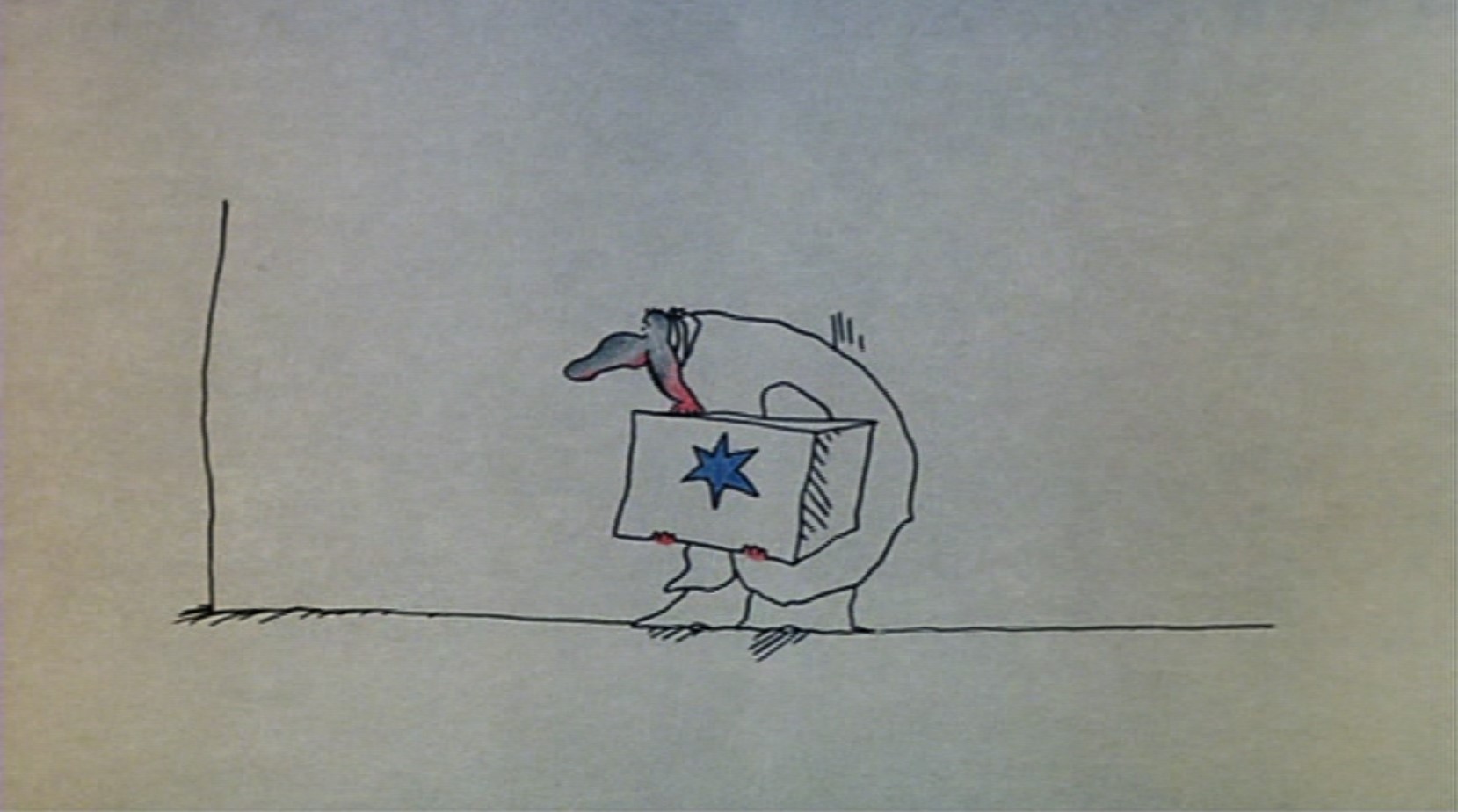
‘An Old Box’ is Paul Driessen’s own variation on the Hans Christian Andersen fairy tale ‘The Little Match Girl’.
In his own film a poor man paints an old box in order to entertain people, but he is at the wrong corner of the town, and nobody passes by, while a short distance away a county fair takes place.
In this short Driessen introduces his idiosyncratic way of showing background art only when necessary. Thus lines indicating backgrounds appear from and dissolve into nothingness as we progress from scene to scene.
Likewise, Driessen’s color use is very limited, emphasizing the most important elements. Only in the very end the animator bursts into a fantastical multi-colored perspective animation before returning to the prevailing depressing grays of the rest of the short.
Watch ‘An Old Box’ yourself and tell me what you think:
‘An Old Box’ is available on the DVD ‘Des histoires pas comme les autres’


 Dr. Grob's Animation Review