
You are currently browsing the category archive for the ‘Independent film makers’ category.
Director: Władysław Starewicz
Release Date: November 9, 1912
Rating: ★★★★★ ♕
Review:
 ‘The Cameraman’s Revenge’ is one of the earliest animation films ever made, and a very early masterpiece (it predates ‘Gertie the Dinosaur‘ by two years). Surprisingly, it’s a film about adultery involving insects.
The plot of this stop motion film is as follows: Mr. Beetle commits adultery with a dragonfly, who is a dancer at a nightclub. Unbeknownst to him his secret behavior is filmed by a rival grasshopper who happens to be a cameraman. Meanwhile, Mrs. Beetle also commits adultery, with a beetle who is also a painter. But they’re discovered by Mr. Beetle on his arrival home. Mr. Beetle chases the painter out of his house. Nevertheless he forgives his wife and takes her to the cinema. However, the film that is shown reveals his infidelity, which creates a riot and the married couple ends in jail for destroying the movie box.
‘The Cameraman’s Revenge’ is an extraordinary film, and without doubt one of the first masterpieces of animation. Unlike Émile Cohl’s stop motion, Starewicz’s animation is stunning and very convincing. The insects are very lifelike, and move surprisingly realistically. The insects’ gestures are subtle, clearly evoking their emotions. For example, there’s a beautiful and very lifelike little scene of a beetle servant lighting the fireplace, animated without any hint of overacting. On the other hand, Mr. Beetle clearly is a brute, but we can also watch him in a seductive mood.
Throughout, Starewicz’s storytelling is economical and mature. The film’s subject is highly original for an animation film, even today. It’s almost unbelievable that such a modern film was made in Czarist Russia.
Watch ‘The Cameraman’s Revenge’ yourself and tell me what you think:
‘The Cameraman’s Revenge’ is available on the DVD ‘The Cameraman’s Revenge & other Fantastic Tales’
Director: Jan Švankmajer
Release Date: 1967
Rating: ★★★★★
Review:
 ‘Historia Naturae, Suita’ is an abstract, yet morbid and disturbing film.
It uses drawings, models, skeletons, stuffed and live animals, which change into each other and which perform morbid dances. Their antics are interspersed with a close up of a man eating meat.
We see molluscs (Aquatilia, foxtrot), insects (Hexapoda, bolero), fish (Pisces, blues), reptiles (Reptilia, tarantella), birds (Aves, tango), mammals (Mammalia, menuet), monkeys (Simiae, polka) and man (Homo, waltz), successively.
It shows us that we, men, are made from the same mortal matter as the rest of the animal kingdom, which in this film appear to us only as collectibles or food. This unsettling reminder is emphasized by the last shot, in which the human is replaced by a skull, eating…
The music is a perfect match to the surrealistic imagery, with its rather abstract, uncanny and atonal renderings of the dance forms mentioned.
Watch ‘Historia Naturae, Suita’ yourself and tell me what you think:
http://www.totalshortfilms.com/ver/pelicula/379
‘Historia Naturae, Suita’ is available on the DVD ‘Jan Svankmajer – The Complete Short Films’
Director: Jan Švankmajer
Release Date: 1966
Rating: ★★★★★
Review:
 In ‘Et Cetera’ three faceless human figures demonstrate repetitive and aimless actions.
The first shows how to fly with wings, only to reach his own starting point. The second transforms himself into the animal he’s training using a whip, and the third keeps on drawing houses he cannot enter or leave.
Unlike most of Jan Švankmajer’s films, ‘Et Cetera’ uses 2d animation. It’s a clever and somehow saddening film: although the three little stories are extremely simple, they seem to tell something about the condition humaine. ‘Et Cetera’ uses great electronic music, which adds to the surrealistic atmosphere.
Watch ‘Et Cetera’ yourself and tell me what you think:
‘Et Cetera’ is available on the DVD ‘Jan Svankmajer – The Complete Short Films’
Director: Jiří Trnka
Release Date: 1965
Rating: ★★★★★ ♕
Review:
 In a self-contained world, seemingly outside space and time, an harlequin lives happily in his home.
The harlequin is an artist, a ceramist and a sculptor, making pots for his beloved plant. Unfortunately, his domestic peace is disturbed by a giant gloved hand, which orders him to sculpt a statue of a hand. As the harlequin keeps refusing, the hand uses praise, money, indoctrination, brutal force and erotics to persuade the artist to do what he’s ordered.
In the end the harlequin is caught, his hands are attached to strings worked by the hand, and he has to sculpt a giant hand in a cage. But, after finishing his works, the artist escapes and returns to his beloved home. It sadly is his own beloved plant that kills him by falling on his head, while he’s barricading the entrances to his room. The hand gives the artist a state funeral, making him posthumously part of the system.
‘The Hand’ was Czech puppet animator Jiří Trnka’s last film, and it was to be his masterpiece. Instead of diving into classic tales, he made one of his own, resulting in a most personal film and one that stands as the classic animated tale on totalitarianism.
Trnka manages to tell his tale without any dialogue. Although the puppet of the harlequin knows only one expression, his emotions are well-felt through his animation. There’s no doubt he’s symbolic for artists working in totalitarian regimes in general. The glove is a masterstroke. In its facelessness it is as scary as it is symbolic for the invisible hand of totalitarian power. The result is an equally sad and disturbing film, which shows both Trnka’s genius and the power of animation in general.
It’s no small surprise that this highly symbolic film was forbidden in communist Czechoslovakia.
‘The Hand’s message is still topical, being symbolic for artists working in oppressive regimes all over the world.
Watch ‘The Hand’ yourself and tell me what you think:
‘The Hand’ is available on the DVD ‘The Puppet Films of Jiri Trnka’
Director: Jan Švankmajer
Release Date: 1965
Rating: ★★★★
Review:
 In ‘A Game with Stones’ (also known by its German title ‘Spiel mit Steinen’) an odd construction, consisting of a clock, a tap and a bucket, produces stones by the hour. These stones form patterns to the music of a music box until the bucket is emptied, dropping the stones on the floor.
The stones’ abstract patterns are indeed game-like, but they become more and more grim, ending in a destructive game, destroying the stones, and eventually, the bucket, leaving the machine useless. The game is over. It is Švankmajer’s genius that he’s able to give this fairly abstract film a heart and an unsettling, sad ending.
‘A Game with Stones’ is Švankmajer’s first film to use stop motion animation extensively. The fourth game contains faces made of numerous small pebbles, which anticipates similar heads in ‘Dimensions of Dialogue’ (1982), a film in which Švankmajer’s stop motion techniques reach a stunning apex.
Watch ‘A Game with Stones’ yourself and tell me what you think:
‘A Game with Stones’ is available on the DVD ‘Jan Svankmajer – The Complete Short Films’
Director: Jan Švankmajer
Release Date: 1964
Rating: ★★★★★
Review:
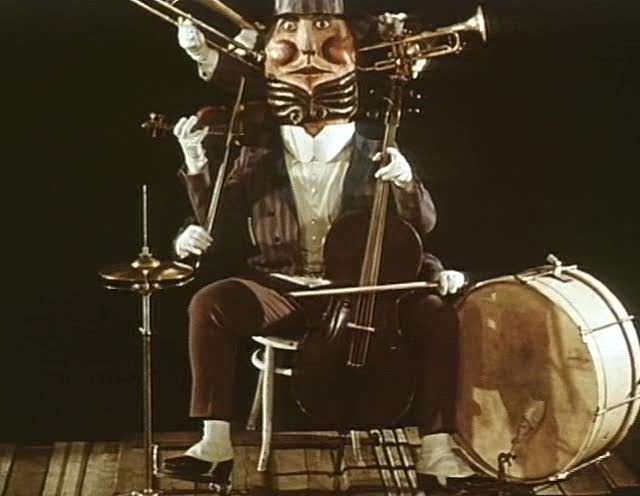 In ‘The Last Trick’ two magicians in large masks perform their impossible tricks one after another against a black, empty background.
Although they stay polite, their congratulationary handshakes between the tricks gradually become more and more violent, ending in a disastrous mutual disembodiment. The last shot is of the only really living organism inhabiting this surrealist world, a beetle, dead.
‘The Last Trick’ is Czech film maker Jan Švankmajer’s first film, and already his obsessions with puppets, body parts and death are full blown. Its humor is dark, its images are grim and its story is very unsettling. Švankmajer’s first film (which contains a little stop motion animation) is also his first masterpiece.
Watch ‘The Last Trick’ yourself and tell me what you think:
‘The Last Trick’ is available on the DVD ‘Jan Svankmajer – The Complete Short Films’
Director: Bruno Bozzetto
Release Date: October 1, 1965
Rating: ★★★
Review:
 ‘West And Soda’ has a classic Western story: an evil villain is after the land owned by the lovely Clementine. Luckily she is rescued by our cool hero, Johnny, who doesn’t talk much, but who can shoot!
‘West and Soda’ is Bruno Bozzetto’s first feature film and unfortunately, it shows. The Italian animator is at his best in short, well-timed pantomime gags, and he clearly has difficulties with this longer medium. Neither the animation nor the designs are particularly appealing, and the feature suffers a little from its length. Generously mocking almost every aspect of the classic western, ‘West and Soda’ is as silly as it is predictable. Luckily there are many throwaway gags to keep the viewer laughing from time to time.
However, Bozzetto’s comic genius really shines through in two offbeat scenes, in which Bozzetto does what he does best: like his funny short ‘I Due Castelli’ from 1963, these two scenes use a fixed long distance perspective, pantomimed action and a perfect timing, with hilarious results. The first of these two scenes shows us several failing attacks of ferocious ants on Johnny, who is buried up to his head in the desert. The second depicts the villain’s attempts to drop a huge rock on our hero.
Watch the ant scene from ‘West And Soda’ yourself and tell me what you think:
Director: Winsor McCay
Release Date: 1921
Rating: ★★★½
Review:
 ‘The Flying House’ is the last of the three ‘Dream of a rarebit fiend’ films Winsor McCay completed in 1921.
In this short the classic rarebit makes a woman dream that her man has made a flying machine out of their house. With their flying house they fly to the moon, where they’re almost swatted by a giant. When they run out of gas they circle in empty space until they’re hit by a rocket, and both fall down. At this point, of course, the woman awakes.
Compared to the other two Rarebit Fiend films, ‘Bug Vaudeville‘ and ‘The Pet‘, this cartoon uses a lot of dialogue, both in balloons and in title cards. Moreover, there’s a lot of reverse and repeated animation – thus not all movements are too convincing. Although the story does not quite delivers what it promises, it contains a few good gags. And, as always, both McCay’s drawing style and command of perspective are top notch. Especially the shots of the house flying are very impressive.
Yet the film’s most stunning sequence is when the house leaves earth to fly to the moon. In one convincingly realistic shot we see the earth rotating, the moon appearing behind it and growing larger, while the house flies towards us, orbiting the earth. This is by all means a spectacular piece of animation, especially because it was done 37 years before the space age. McCay clearly and understandably was proud of this sequence, and so he announces it with a title card.
Unfortunately, ‘The Flying House’ was to be Winsor McCay’s last completed film. His legacy is formidable, and he undoubtedly belongs to the best and most imaginative animators/animation directors of all time.
Watch ‘The Flying House’ yourself and tell me what you think:
This is Winsor McCay’s tenth and last film
To Winsor McCay’s ninth film: The Pet
Director: Winsor McCay
Release Date: 1921
Rating: ★★★★★ ♕
Review:
 ‘The Pet’ is the second of the three ‘Dream of the rarebit fiend’ films Winsor McCay released in 1921. It is arguably the best of the three, and probably the best of all Winsor McCay’s films: it combines a well-executed story with a perfect command of animation. It’s too bad it isn’t more well-known.
In ‘The Pet’ a woman dreams she adopts a small animal that grows larger and larger every day, eating the cat, everything on the table, the furniture, and later on, a tree, a car and some buildings, until it explodes. The dream is totally believable with its inner logic and its wonderful execution. The growth of the animal is shown with a very imaginative use of perspective and beautiful backgrounds. For example, when the pet grows to gigantic proportions, we see it stride behind some very high buildings, towering over our heads.
More than 25 years later Tex Avery would return to the same subject in ‘King-size Canary’ (1947).
Watch ‘The Pet’ yourself and tell me what you think:
http://www.spike.com/video/dreams-of-rarebit/2917218.
This is Winsor McCay’s ninhth film
To Winsor McCay’s eight film: Bug Vaudeville
To Winsor McCay’s tenth and last film: The Flying House
Director: Winsor McCay
Release Date: 1921
Rating: ★★★★
Review:
 After a period of unfinished projects, Winsor McCay completed a series of three related films in 1921, ‘Dreams of a Rarebit Fiend’.
These films are the animated counterparts of his comic strip of the same name, which run from 1904 to 1913. The films, like the comics, are about ordinary people having a bad dream. When they awake, they blame it on the food they’ve eaten.
The three animated Dreams of a Rarebit Fiend can be regarded as McCay’s most mature works. They’re not as revolutionary as ‘Gertie the Dinosaur‘ or ‘The Sinking of the Lusitania‘, but they display a total command of form and style, and they are flawless in their execution. It’s too bad, McCay didn’t complete any other film after these three, although he lived for another 13 years.
‘Bug Vaudeville’ is the first of the three ‘Dream of the Rarebit Fiend’ films. In this short, a man falls asleep against a tree and dreams he witnesses a bug vaudeville show. He watches the grasshopper and the ants performing acrobatics, a daddy longlegs (with beard and a a hat) dancing, a cockroach stunting on a bicycle, tumble bugs performing acrobatics, two potato bugs boxing and a butterfly on a horse-like black beetle. He awakes when he dreams that he’s been attacked by a giant spider.
‘Bug Vaudeville’ is an entertaining short, but in some respects it is the weakest of the three Dream of a Rarebit Fiend films. Its viewpoint is static: we see the same stage for the most part of the film, without any change of setting. The bugs are drawn relatively simple, and there’s no particularly outstanding animation involved, either of character or of effects. Highlight may be the cockroach on the bicycle, with its certain control of perspective.
Watch ‘Bug Vaudeville’ yourself and tell me what you think:
This is Winsor McCay’s eighth film
To Winsor McCay’s seventh, unfinished film: Flip’s Circus
To Winsor McCay’s ninhth film: The Pet
Director: Winsor McCay
Production Date: ca. 1918-1921
Stars: Flip
Rating: ★★
Review:
 With ‘Flip’s Circus’ Winsor McCay returned to one of his stars from ‘Little Nemo in Slumberland’.
This is a short and unfinished film featuring Flip performing tricks in a circus, a.o. with a large hippo-like animal called Baby. The film does not have much of a story, and is undoubtedly the weakest of McCay’s surviving films, despite the high quality of the animation.
Watch ‘Flip’s Circus’ yourself and tell me what you think:
This is Winsor McCay’s seventh film
To Winsor McCay’s sixth, unfinished film: Gertie on Tour
To Winsor McCay’s eighth film: Bug Vaudeville
Director: Winsor McCay
Production Date: ca. 1918-1921
Stars: Gertie the Dinosaur
Rating: ★★½
Review:

‘Gertie on Tour’ is but a short fragment from an unfinished and unreleased film featuring the prehistoric star from ‘Gertie the Dinosaur‘ (1914).
In this excerpt Gertie lives in the modern world: she plays with a frog and with a streetcar, then she dreams she’s back in the Mesozoic, dancing for her dinosaur friends.
‘Gertie On Tour’, like almost all sequels, cannot compare to the first film. Nevertheless, it’s nice to see slightly more footage of this sympathetic brontosaur. The dancing scene in particular catches her playful spirit. Like ‘The Centaurs‘, this short contains very beautiful and elaborate backgrounds, which, undoubtedly thanks to the invention of the cell, are a great improvement over the backgrounds in ‘Gertie The Dinosaur’, which had to be retraced over and over again for each single frame.
Watch ‘Gertie on Tour’ yourself and tell me what you think:
This is Winsor McCay’s sixth film
To Winsor McCay’s fifth, unfinished film: The Centaurs
To Winsor McCay’s seventh, unfinished film: Flip’s Circus
Director: Winsor McCay
Creation Date: ca. 1918-1921
Rating: ★★★★
Review:
 After completing four masterpieces, Winsor McCay produced three unfinished films, ‘The Centaurs’, ‘Gertie on Tour‘ and ‘Flip’s Circus‘ (all animated about ca. 1918-1921). ‘The Centaurs’ is the most interesting of the three.
This short film feels like a study. We see a female and a male centaur meeting each other, then we see the male centaur introduce his future wife to his parents, and then suddenly their baby jumps into the scene, frolicking around.
This film once again contains superb animation, rendering totally convincing centaurs. They indeed stand comparison to those of ‘Fantasia’, which were animated about twenty years later. In this short McCay also experiments with his creations moving behind his elaborate backgrounds, creating a great feel of depth.
Watch ‘The Centaurs’ yourself and tell me what you think:
This is Winsor McCay’s fifth film
To Winsor McCay’s fourth film: The Sinking of the Lusitania
To Winsor McCay’s sixth, unfinished film: Gertie on Tour
Director: Winsor McCay
Release Date: July 1918
Rating: ★★★★★ ♕
Review:
 McCay’s fourth venture into animation is even more curious than the preceding three (‘Little Nemo‘, ‘How A Mosquito Operates‘ and ‘Gertie the Dinosaur‘). It’s an almost real time report of the sinking of the passenger steamer ‘The Lusitania’ by a German submarine in May 1915.
Like McCay’s earlier films, ‘The Sinking of the “Lusitania”‘ starts with some live action footage of the artist at work, helped by one Mr. Beach who provides McCay with the details on the sinking. Yet, this live action introduction is brief, and soon we cut to the real event.
The action depicted is explained by the title cards, who tell us when and how the ship was hit by two torpedoes fired from a German U-boat. The film also tells us about the number of passengers who perished, and singles out four of them. The tone of the title cards is agitated, and angry, pointing to Germany as a cruel and merciless enemy, and ending ending with the bold sentence “And they tell us not to hate the Hun!“. This message no doubt was rather welcome in a time in which the United States joined the war effort.
McCay’s animation is of a startling realism: the rolling waves, the steamer and U-boat moving in perspective, the explosions and smoke are totally convincing, and at the same time retain their graphic quality. The impact of the images is greatly enhanced by the use of cels (‘The Sinking of the “Lusitania” is the first McCay film to do so), and lovely background art of ocean skies. Despite the fine animation, the action is on the slow side, with people sometimes falling in slow motion into the sea. Yet, the slowness adds to the terrifying experience of the cruelty depicted.
The staging is superb: McCay uses only a few ‘camera angles’, most of them possible in real life, enhancing the idea of an objective record of events. Only two shots escape the documentary style: one shot of two fish fleeing from an approaching torpedo, and a final shot of a mother with child sinking into the sea. Clearly, McCay wanted the viewer to have the feeling he was witnessing the event in real time, as if he was there. Of course, the documentary style only enhances the clear propagandistic message against Germany. The bold propaganda may not have aged very well, McCay’s images certainly have: such command of perspective, such elegance of drawing and such dramatic yet convincingly ‘realistic’ staging is still impressive, one hundred years later. ‘The Sinking of the “Lusitania”‘ thus is a great example of how animation can be used in documentaries to show events that could not or have not been put on film. Strangely, this use of animation was not seen again, until the 21st century, when ‘Waltz with Bashir’ (2008) entered the cinemas.
In all, ‘The Sinking of the “Lusitania”‘ is an astonishing film, which may be both the first animated propaganda film and the first animated documentary. It’s totally unique in its drama, and, despite the propaganda, an all time masterpiece of animation.
Watch ‘The Sinking of the “Lusitania”‘ yourself and tell me what you think:
This is Winsor McCay’s fourth film
To Winsor McCay’s third film: Gertie The Dinosaur
To Winsor McCay’s fifth, unfinished film: The Centaurs
‘The Sinking of the “Lusitania”‘ is available on the DVD ‘Winsor McCay the Master Edition’
Director: Winsor McCay
Release Date: September 14, 1914
Stars: Gertie the Dinosaur
Rating: ★★★★★ ♕
Review:
 ‘Gertie the Dinosaur’ was Winsor McCay’s third animation film, and it certainly is his most famous one, still capable of entertaining new audiences.
The film follows a same story idea similar to that of ‘Little Nemo‘: during a visit to a natural history museum Winsor McCay bets the famous comic strip artist George McManus that he can make a dinosaur move. After these long nine minutes of slow live action introduction, we finally see McCay’s creation: Gertie the dinosaur.
McCay’s dinosaur appears to be a girl dinosaur. She behaves like a trained animal: she listens to what McCay is telling her, she eats a rock and a whole tree, she bows to the camera, she lifts her feet, she’s being startled by a small mammoth, which she throws into the lake, she dances, and she lifts McCay himself on to her back.
The captions in between replace dialogue, which was part of a vaudeville act with Winsor McCay talking to Gertie and she listening to him. This vaudeville show, with which McCay toured, has been recreated in the Disneyland special ‘The Story of Animated Drawing‘, which aired on November 30, 1955, and which is available on the DVD set ‘Behind the Scenes at the Walt Disney Studio’. At the 2014 Annie Awards Ceremony Bill Farmer also reenacted McCay’s vaudeville performance (included below). The reenactment makes the experience of the original film much more vivid, and watching this version is highly recommended.
The short is impressive because of its fine animation, command of perspective and detailed background art (which had to be drawn over and over again), but what really makes the film a milestone of animation is that Gertie the Dinosaur is the first animated cartoon character with personality. She’s not just any dinosaur, she’s a female dinosaur, behaving half like a trained animal, half like a small spoiled child. She cries when being scolded by McCay, and is clearly happy when performing her little dance.
Watching the interaction between her and (the off-screen) McCay is impressive, but it’s also delightful and fun. ‘Gertie the Dinosaur’ had a huge impact at the time, and inspired a whole generation of animation film pioneers (e.g. Paul Terry, Frank Moser, Pat Sullivan, Otto Messmer and the Fleischer Brothers). The film truly is an all time classic, and enjoyable to this very day.
‘Gertie the Dinosaur’ was followed by the unfinished and much less successful film ‘Gertie on Tour‘, of which McCay completed only two scenes.
Watch ‘Gertie tThe Dinosaur’ yourself and tell me what you think:
Here’s the original vaudeville show reenacted by Bill Farmer at the 41st Annie Awards Ceremony (2014):
This is Winsor McCay’s third film
To Winsor McCay’s second film: How a Mosquito Operates
To Winsor McCay’s fourth film: The Sinking of the Lusitania
Director: Winsor McCay
Release Date: January 1912
Rating: ★★★½
Review:
 Winsor McCay’s second cartoon is about a giant mosquito who sucks a sleeping man until his body is a giant bulb. Then, suddenly aware of the audience, he performs some tricks on the man’s nose, sucks some more and explodes.
Unlike McCay’s first film, ‘Little Nemo‘, a long live action intro is absent, and more importantly, this one tells a real story. These are both great improvements on ‘Little Nemo’. Moreover, the mosquito is quite a character, arguably the first in animated history: he wears a tall hat and carries a suitcase. Besides, he’s not only a menace to the man, but also playful and a bit of a showoff. In ‘Before Mickey’ Donald Crafton tells us McCay even baptized the character ‘Steve’.
The film stands in the tradition of McCay’s ‘Dream of the Rarebit Fiend’ comics and is a rather peculiar combination of a sleeper’s nightmare and a bit of silliness. The mosquito is larger than life, and when he sticks in his long proboscis into the man’s head, it looks incredibly painful. This makes some of the action a discomforting watch, and this is perhaps the first time an animated film tries to draw on an audience’s emotions.
Unfortunately, the action is rather slow, and there’s a lot of reverse animation, in which McCay reuses the same drawings in reverse order. This may have spared drawings, but it doesn’t look convincing in its perfect symmetry of movement. Nevertheless, the realism with which the man is drawn and animated remains absolutely stunning.
Despite some flaws ‘How a Mosquito Operates’ remains an original and fresh film, and like all McCay’s films, very well animated.
Watch ‘How a Mosquito Operates’ yourself and tell me what you think:
This is Winsor McCay’s second film
To Winsor McCay’s first film: Little Nemo
To Winsor McCay’s third film: Gertie the Dinosaur
Director: Winsor McCay
Release Date: April 8, 1911
Stars: Little Nemo, Flip, The Imp
Rating: ★★★★½
Review:
 ‘Little Nemo’ was master comic artist Winsor McCay’s first animation film. It’s also one of the first drawn animation films ever made.
Indeed, one of the title cards boldly states that Winsor McCay is “the first artist to attempt drawing pictures that will move.” This is obviously untrue: Stuart J. Blackton had made the first drawn animated film five years earlier, with ‘Humorous Phases of Funny Faces‘ (1906) and since then Frenchman Émile Cohl had produced more than a hundred animated films, of which a substantial part was (at least partially) drawn. Nevertheless, McCay seems to be the first artist to pick up the glove from Blackton and Cohl.
Star of McCay’s film is his world-famous comic hero Little Nemo, the little boy who always dreamed to be in Slumberland, only to awake abruptly at the end of each comic. He’s joined by Flip, the Imp, the princess and the doctor from the same comic. Nevertheless, they’re not the stars of the narrative, because that is their creator, Winsor McCay himself.
‘Little Nemo’ is a film with two clear sections:
the first half is filmed in live action and tells in three scenes about Winsor McCay’s plan to make moving drawings. In the first scene he proposes his idea to make 4,000 drawings in only one month. This only makes his friends laugh at him. In the second scene he orders three barrels of ink and two enormous packages of drawing paper, and in the third scene he can be seen in his drawing room, between huge piles of drawings and a primitive flipbook-like apparatus to preview his film. A young man, who has come to dust the place makes the piles of drawings fall.
In all, these scenes are rather slow and only mildly funny. Above all, they look as from an era long passed. But when the result is shown, one’s opinion changes completely…
The actual animation itself, completely hand-colored, is as startling and fresh as it was almost a hundred years ago. After an infectious “watch me move!” we watch Little Nemo, Flip and the imp move in 3D, Flip and the imp stretching like distorting mirror images (a gag that has his origin in the February 2, 1908 episode of the comic), Nemo drawing the princess himself, Nemo and the princess riding a dragon that disappears into the distance (inspired by three Sunday Pages from July/August 1906), and Flip and the imp crashing with a car, landing on the doctor.
The animated part may not make any sense, it certainly makes a great watch. McCay likely had seen some of Cohl’s films, because ‘Little Nemo’ displays some of Cohl’s trademark metamorphosis techniques, especially when introducing characters: the imp is made out of falling building blocks, while several small lines finally come together to form Little Nemo. But McCay goes beyond Cohl in command of drawing: his mastery of form, perspective and movement is astonishing.
Although some of the movement is awkwardly slow (a feature the film shares with the comic strip), McCay displays a displays a tremendous control of form and material. For example, he’s the first animator to make his drawings move in perfect perspective, which he shows when Little Nemo and the princess ride off in the dragon’s mouth. After McCay no one would surpass this high quality of animation, until Walt Disney’s innovative strive to realism during the second half of the 1930s.
Watch ‘Little Nemo’ yourself and tell me what you think:
This is Winsor McCay’s first film
To Winsor McCay’s second film: How a Mosquito Operates


 Dr. Grob's Animation Review