
You are currently browsing the category archive for the ‘★★★½’ category.
Director: Jiří Trnka
Release Date: 1951
Rating: ★★★½
Review:
 ‘The Merry Circus’, is puppet-animator Trnka’s try at cut-out animation.
The film shows that Trnka was a master in this technique as well: the animation is superb: the sense of weight, muscular tensions and balance is nothing less than stunning. Moreover, the cut-outs seem to float in mid-air, casting wonderful shadows on the background.
Unfortunately, the film’s subject is not that interesting. We watch circus artists perform, among them two sea lions juggling, a girl on a horse, three trapeze acrobats and an acrobat bear balancing on a chair on a bottle on a glass. Even though some of the shown tricks are quite improbable, the only truly surrealistic act is the fish on the slack-rope.
Despite the lack of story, the film is an enjoyable watch: its visual design is beautiful and poetic, its animation fluent and convincing, and its circus atmosphere well-captured. ‘The Merry Circus’ may not be Trnka’s best film, but it’s only the high quality of some of his other films that makes this one second-rate.
Watch ‘The Merry Circus’ yourself and tell me what you think:
http://veehd.com/video/4587370_Jiri-Trnka-The-Merry-Circus-Vesely-Cirkus-1951
Director: William Hanna & Joseph Barbera
Release Date: December 8, 1951
Stars: Tom & Jerry, Spike
Rating: ★★★½
Review:
 ‘Cat Napping’ is a blackout gag cartoon, in which Tom & Jerry are fighting over a hammock on a hot summer day.
‘Cat Napping’ is certainly not among Tom & Jerry’s best cartoons. The gags are not all bad (the best one is when marching ants make the hammock resonate), but the comedy feels uninspired. Moreover, the story is less consistent than usual, and the gags are rather disjointed. However, the cartoon is especially hampered by rather appalling designs on Tom & Jerry, which are on the same low level as those in ‘His Mouse Friday’ from earlier that year.
http://www.metacafe.com/watch/9404702/tom_jerry_cat_napping/
This is Tom & Jerry cartoon No. 62
To the previous Tom & Jerry cartoon: Nit Witty Kitty
To the next Tom & Jerry cartoon: The Flying Cat
Director: William Hanna & Joseph Barbera
Release Date: October 6, 1951
Stars: Tom & Jerry, Mammy Two-Shoes
Rating: ★★★½
Review:
 When Mammy hits Tom on his head with a broom, he looses his mind and thinks he’s a mouse. This to great annoyance of Jerry, because Tom eats all his cheese and wrecks his bed.
‘Nit Witty Kitty’ is a well-told cartoon, if a little bit slow and low on gags. Highlight of the cartoon are Jerry’s attempts to deliver Tom a “sharp blow on the head”.
Watch ‘Nit-witty Kitty’ yourself and tell me what you think:
https://www.dailymotion.com/video/x2i35s0
This is Tom & Jerry cartoon No. 61
To the previous Tom & Jerry cartoon: Slicked-up Pup
To the next Tom & Jerry cartoon: Cat Napping
Director: Wilfred Jackson
Release Date: August 8, 1952
Rating: ★★★½
Review:
 Half a year after ‘Lambert the Sheepish Lion‘, voice actor Sterling Holloway returns as a narrator for a Disney cartoon.
Here he tells the story of a little house on a hill in the country side who is soon surrounded by the city and forgotten. The house’s first neighbors are arrogant and aristocratic wooden houses, which soon burn down. The second neighbors are sloppy brick houses, which are pulled down in the end. Her third neighbors are enormous skyscrapers. When the little house thinks she’s finished, she’s moved to start anew on the countryside.
This sweet little story is based on a children’s book from 1942 by Virginia Lee Burton and uses a slightly different design to remain faithful to her original illustrations. Like ‘Lambert the Sheepish Lion’, the story is very sweet, not funny. Its main attraction are the humanized houses, excavators and such.
However, the story is well-told, thanks to story man Bill Peet. It contains heart and has a strong sense of nostalgia. In fact, conservative nostalgia has rarely been put more convincingly to the screen. The film is strongly anti-urban and anti-progress, and full of longing to the peace and quiet of a bygone era. Its message is expressed at the end of the cartoon, when Holloway tells us that “the best place to find peace and happiness is in a little house on a little hill way up in the country”.
Watch ‘The Little House’ yourself and tell me what you think:
‘The Little House’ is available on the DVD ‘Walt Disney Treasures: Disney Rarities’
Director: Robert McKimson
Release Date:May 5, 1951
Rating: ★★★½
Review:
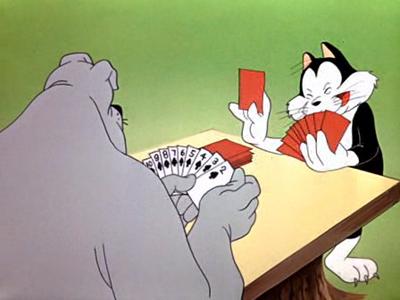 ‘Early to Bet’ introduces the ‘gambling bug’, a bug that makes people want to gamble.
The little insect infects a cat who then starts to play gin rummy for penalties with an over-confident bulldog. The bulldog wins several times, and the cat has to pay the elaborate and rather zany, yet painful penalties. In the end, however, he plays against the bug, and wins, making the bug pay a penalty.
Apart from the original and pretty funny penalties, this is a mediocre cartoon, which lacks stars or even appealing characters.
Watch ‘Early to Bet’ yourself and tell me what you think:
http://www.supercartoons.net/cartoon/681/early-to-bet.html
‘Early to Bet’ is available on the DVD set ‘Looney Tunes Golden Collection, Vol. 1’
Director: Jack Kinney
Release Date: September 23, 1949
Stars: Goofy
Rating: ★★★½
Review:
 In this short Goofy orders some home training devices to improve his condition. All his attempts fail, of course, sometimes in surprisingly long and elaborate gags, involving great situation comedy. It’s this cartoon Roger Rabbit watches in the cinema in ‘Who Framed Roger Rabbit‘ from 1988.
Together with the previous ‘Tennis Racquet‘, Goofy Gymnastics’ is a transitional Goofy cartoon: it’s the first cartoon showing the restyled Goofy as an average American citizen. Unlike ‘Tennis Racquet’, however, there’s only one Goofy in this cartoon, who even sings his own theme song ‘The world owes me a living’ again. ‘Goofy Gymnastics’ marks the last time we see Goofy in his original hat, which he only puts on after changing into his gym costume. It’s also the last of the Goofy sports cartoons. The next year, the same tired Goofy is advised to get a hobby, in ‘Hold That Pose‘.
Like the earlier great sports cartoons it uses a posh voice over, who’s completely out of tune with Goofy’s antics with his home training gear. The action is a bit slow, however, and the animators make no attempts to synchronize their character’s lip movements with the now obligate Goofy vocalizations.
Watch ‘Goofy Gymnastics’ yourself and tell me what you think:
This is Goofy cartoon No. 24
To the previous Goofy cartoon: Tennis Racquet
To the next Goofy cartoon: Motor Mania
Directors: William Hanna & Joseph Barbera
Release Date: April 8, 1950
Stars: Tom & Jerry
Rating: ★★★½
Review:
 A ferocious lion has escaped from the circus, and of course, the lion is in Tom & Jerry’s house.
He turns out to be a nervous wreck and he asks Jerry to help him out. Tom, on his guard after a warning on the radio, never finds out the lion is in his house, but he does think that Jerry suddenly has gained enormous strength. In the last scene Jerry says goodbye to the lion, who’s stuck away on an ocean liner to Africa.
‘Jerry and the Lion’ contains some nice confusion scenes, but like most ‘Jerry-befriends-an-animal- cartoons’ the cartoon is rather cute, and the comedy somewhat subdued.
Watch ‘Jerry and the Lion’ yourself and tell me what you think:
http://www.dailymotion.com/video/x1yyl23_jerry-and-the-lion-1950-with-recreated-titles_shortfilms
This is Tom & Jerry cartoon No. 50
To the previous Tom & Jerry cartoon: Texas Tom
To the next Tom & Jerry cartoon: Safety Second
Directors: James Algar, Clyde Geronimi, Jack Kinney
Release Date: October 5, 1949
Rating: ★★★½
Review:
 The Legend of Sleepy Hollow, told and sung by Bing Crosby, quite faithfully retells the story by Washington Irving.
The story tells us about the skinny schoolmaster Ichabod Crane who tries to court Katrina van Tassel, the most beautiful girl in town, while ignoring his rival Brom Bones. At Halloween Bones tells a spooky story about a headless horseman, scaring the schoolmaster to death. And when on the way home he really encounters a headless horseman, he’s never seen again…
The animation of Ichabod Crane and Katrina van Tassel both show how familiar the animators had become with the human figure. Ichabod Crane is an awkward, slender figure, but human, nonetheless. Katrina both has a sexy, graceful charm, as well as stylized moves, which make her a little abstract, like an all too beautiful woman can be in the hearts of men. Certainly, in the next feature, ‘Cinderella‘ (1950) the animators were confident enough to let human characters star a feature for the first time since ‘Pinocchio‘ (1940).
This film’s highlight, however, are the wonderful backgrounds, which were lacking in the first story, ‘The Wind in the Willows‘. In ‘The legend of Sleepy Hollow’ the backgrounds are stylized, with striking colors, and most of the times clearly inspired by Mary Blair. The background artists’ art reaches its peak in the stunning scary forest scene, an elaboration on the scary forest in ‘Snow White and the Seven Dwarfs’ (1937). This climatic scene, in which Ichabod Crane is confronted with the headless horseman, makes effective use of expressionistic coloring, like the best parts in ‘Fantasia’ (1940) and ‘Bambi‘ (1942).
These positive aspects, however, cannot rescue this film, which is rather slow, and totally devoid of sympathetic characters. In the end one has to conclude that this second part of the feature, like the first, is not particularly interesting or memorable.
Watch ‘The Adventures of Ichabod and Mr Toad’ yourself and tell me what you think:
http://www.dailymotion.com/video/x28oc6j_the-legend-of-sleepy-hollow-1949-cartoon_shortfilms
Director: Charles Nichols
Release Date: December 12, 1948
Stars: Mickey Mouse, Pluto, the little seal
Rating: ★★★½
Review:
 After visiting the seals at the zoo, Mickey accidentally brings a little seal home in his basket.
‘Mickey and the seal’ is the third cartoon to feature the little seal (the other two are ‘Pluto’s Playmate‘ from 1941 and ‘Rescue Dog‘ from 1947). And like the earlier entries featuring this cute animal, ‘Mickey and the Seal’ is charming, but not very funny.
Nevertheless, it contains a lovely scene of Mickey and the seal in bath, which is a prime example of great silent comedy. Its finale, too, arguably is the funniest of all postwar Mickey Mouse cartoons. The bath scene renders a shot of Mickey completely naked (except for his gloves).
Watch ‘Mickey and the Seal’ yourself and tell me what you think:
This is Mickey Mouse cartoon No. 121
To the previous Mickey Mouse cartoon: Mickey Down Under
To the next Mickey Mouse cartoon: R’coon Dawg
Director: ?
Release Date: May 27, 1948
Rating: ★★★½
Review:
 The last sequence of ‘Melody Time‘ is framed by the sentimental ballad ‘Blue Shadows’, sung by country & western singer Roy Rogers and The Sons of the Pioneers.
After a while, we see them sitting in a cartoon-style prairie, accompanied by two children. The boy asks Rogers why the coyotes howl at the moon, which prompts him into telling the tall tale of Pecos Bill, his horse Widowmaker and his love interest Slue Foot Sue.
Although it only becomes funny after several minutes, the story itself is quite good, the highlight being the part where the cowboys sing of the mighty deeds of Pecos Bill, who singlehanded creates the Gulf of Mexico, the Rio Grande, the gold in the hills and the painted desert.
Unfortunately the cartoon is rather slow-paced and accompanied by mostly dull country & western music, preventing it of becoming a real classic. Disney would tell other tall tales from American folklore, in ‘Paul Bunyan‘ (1958) and ‘The Saga of Windwagon Smith‘ (1961).
Watch ‘Pecos Bill’ yourself and tell me what you think:
Director: Chuck Jones
Release Date: April 10, 1948
Stars: Bugs Bunny, The Crusher
Rating: ★★★½
Review:
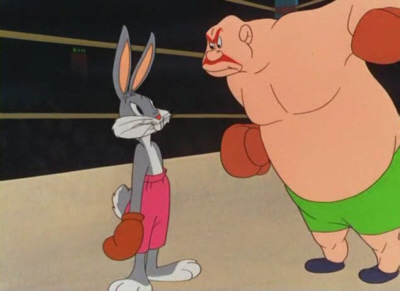 When Bugs jeers at the champion of a boxing game, he’s suddenly ‘invited’ to be in it.
The boxing game soon changes into a wrestling match with blackout gags, in which we only see round 37, 49, 73, 98 and 110. These blackout gags foreshadow the complete Road Runner series. In the last one the champ uses a train in order to ride over Bugs, but then the film abruptly breaks, a revival of a gag Jones used in ‘My Favorite Duck‘ (1942).
‘Rabbit Punch’ is one of the earliest cartoons in what we can call Chuck Jones’ mature style, which consolidated in 1949. Like in his earlier Bugs Bunny cartoons ‘Case of the Missing Hare‘ (1942) and ‘Hare Conditioned‘ (1945), Jones uses his sense of grace and deftness to portray a particularly large, human opponent to Bugs. And like in those cartoons he does that with stunning ‘camera angles’ and a cinematic approach. Bugs is pretty suave in this cartoon, acting out complete terror in the final scene, only to appear in full control, after all.
Watch ‘Rabbit Punch’ yourself and tell me what you think:
http://www.dailymotion.com/video/x2fby3f
This is Bugs Bunny cartoon No. 48
To the previous Bugs Bunny cartoon: A Feather in his Hare
To the next Bugs Bunny cartoon: Buccaneer Bunny
Director: Charles Nichols
Release Date: December 26, 1947
Stars: Pluto
Rating: ★★★½
Review:
 In ‘Pluto’s Blue Note’ Pluto tries to sing along with some birds, a bee and a grasshopper, but to no avail.
When he discovers that he can use his tail as a needle to play records with, he uses these not only to impress these animals, but also five female dogs, who fall for ‘his’ crooning, Frank Sinatra-like voice. In this short Pluto performs a very silly dance, which is only topped in outrageous animation by his facial expressions while play-backing the crooning voice.
‘Pluto’s Blue Note’ certainly is one of the more inspired Pluto cartoons of the late forties, and its story a welcome deviation from the Pluto-befriends-a-little-animal formula.
Watch ‘Pluto’s Blue Note’ yourself and tell me what you think:
This is Pluto cartoon No. 23
To the previous Pluto cartoon: Mail Dog
To the next Pluto cartoon: Bone Bandit
Director: Jack Hannah
Release Date: June 7, 1946
Stars: Mickey Mouse, Pluto, Chip and Dale
Rating: ★★★½
Review:
 ‘Squatter’s Rights’ is director Jack Hannah’s first of many cartoons starring Chip and Dale, who were introduced by Clyde Geronimi in ‘Private Pluto‘ in 1943. The two chipmunks are still interchangeable here. They would get real personalities in their next cartoon ‘Chip an’ Dale‘ (1947).
In this cartoon Chip and Dale live in a winter cottage, which is visited by Mickey and Pluto. Pluto soon discovers the jabbering duo, but Mickey never does. In the end Chip and Dale make Pluto and Mickey think Pluto’s been shot. In the final shot we can see Mickey running into the distance, carrying Pluto to a hospital, and leaving the cottage to the two little chipmunks.
‘Squatter’s ‘Rights’ is the first of only eight post-war Mickey Mouse cartoons. Mickey had had a short renaissance under director Riley Thompson in the early 1940s, but by 1946 he was once again reduced to a side character, at best co-starring with Pluto. ‘Squatter’s Rights’ is typical, with most of the screen time devoted to Pluto, Chip and Dale.
Jack Hannah would direct only one other Mickey Mouse cartoon: ‘Pluto’s Christmas Tree‘ (1952), which also features Chip ‘n Dale. Hannah’s appointed character was Donald Duck, whom he led through the last stage of his cinematic career. In this he would develop Chip n’ Dale into Donald Duck’s main adversaries.
Watch ‘Squatter’s Rights’ yourself and tell me what you think:
This is Mickey Mouse cartoon No. 118
To the previous Mickey Mouse cartoon: Pluto and the Armadillo
To the next Mickey Mouse cartoon: Mickey’s Delayed Date
Director: Charles Nichols
Release Date: April 12, 1946
Stars: Pluto, Butch
Rating: ★★★½
Review:

Pluto’s family life has been treated mysteriously in his films.
Mostly, he is on his own, but in ‘Pluto’s Quin-Puplet’s (1937) he had five children, and in ‘Pluto Junior‘ (1942) only one. In ‘Pluto’s kid Brother’, without any explanation, Pluto suddenly has a smaller brother.
The little brat is full of mischief, causing trouble with a rooster, a mean red cat and even teaming up with Butch the Bulldog to get some sausages from the butcher’s shop. But Butch is not the type to share, and in the end Pluto has to save his brother, while Butch is caught by the dog catcher. However, there’s not too much moral to this story, for Pluto, too, fancies the loot: the sausages his little brother has stolen.
‘Pluto’s Kid Brother’ uses the same story idea as the 1936 Betty Boop cartoon ‘You’re Not Build That Way’ starring Pudgy, but with better results. ‘Pluto’s Kid Brother’ is a great improvement on ‘You’re Not Build That Way’: it’s better animated, less cloying, and more entertaining. The result is a nice cartoon, if by no means among Pluto’s best. It remains unknown whether the makers even knew the Betty Boop cartoon, at all.
The red alley cat would reappear in the Figaro cartoon ‘Bath Day’, six months later. Pluto’s little brother, on the other hand, would disappear again into nothingness, never to return to the screen.
Watch ‘Pluto’s Kid Brother’ yourself and tell me what you think:
This is Pluto cartoon No. 17
To the previous Pluto cartoon: Canine Patrol
To the next Pluto cartoon: In Dutch
Director: Isadore Sparber
Release Date: December 25, 1942
Stars: Superman
Rating: ★★★½
Review:
 ‘Destruction Inc’ was Superman’s third war cartoon, after ‘Japoteurs‘ and ‘Eleventh Hour‘ from earlier that year. Like ‘Japoteurs’ it features saboteurs on American soil, a paranoid idea, well-fed by government propaganda.
This time the danger comes from the inside: some American gangster saboteurs threaten a munition plant. Lois discovers them at a factory, but she’s captured and put inside a torpedo. Luckily Superman is in the neighborhood, not as Clark Kent, but as an elderly general. However, he only arrives just in time to rescue Lois from a certain death in a short that belongs to Superman’s more entertaining films.
‘Destruction, Inc’ opens with a shot of someone being murdered. Such a shot would open the next film, ‘The Mummy Strikes‘, too.
Watch ‘Destruction, Inc.’ yourself and tell me what you think:
This is Superman film No. 13
To the previous Superman film: Eleventh Hour
To the next Superman film: The Mummy Strikes
Director: Dave Fleischer
Release Date: November 21, 1941
Stars: Superman
Rating: ★★★½
Review:
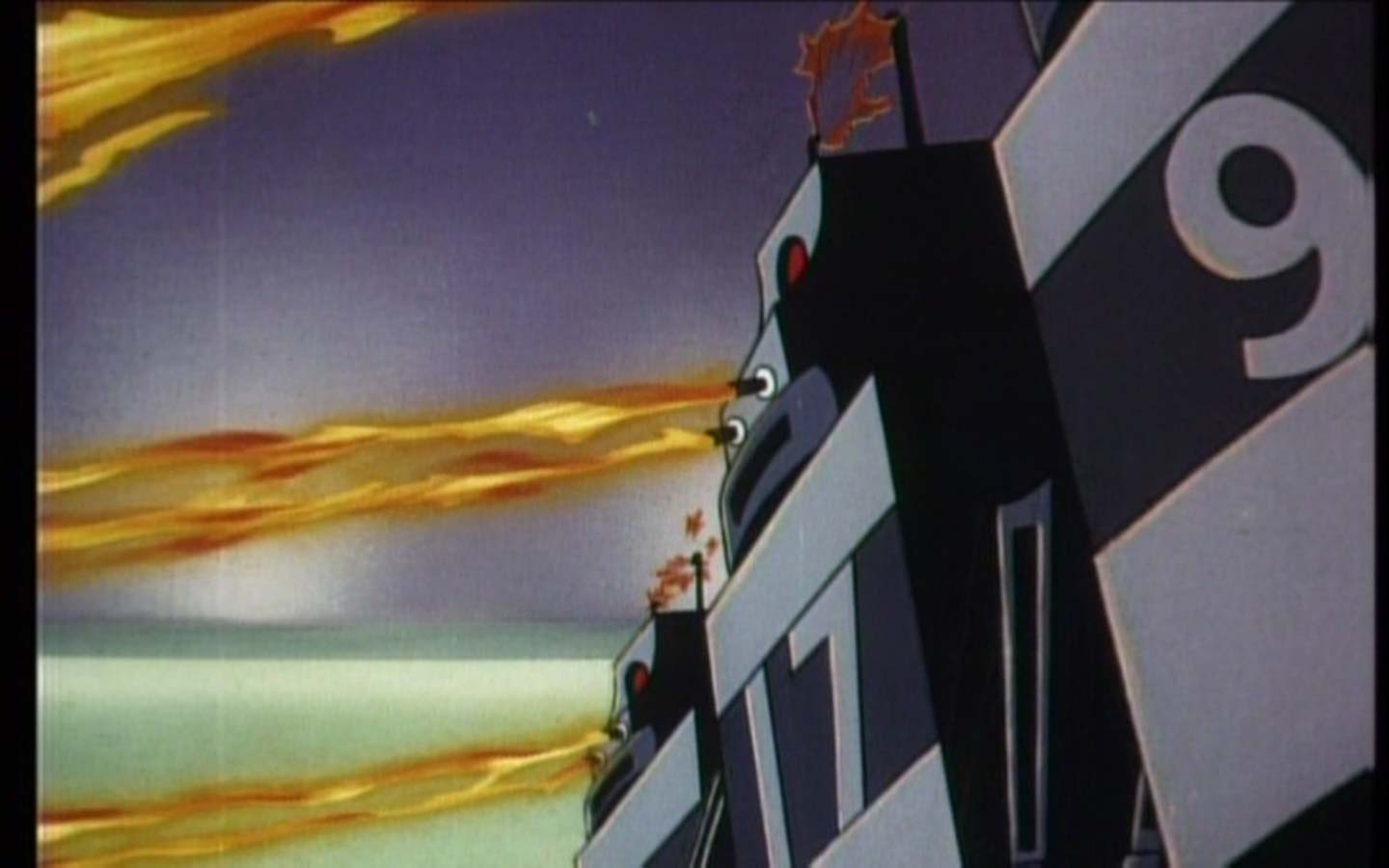 ‘The Mechanical Monsters’ was Superman’s second cartoon, and it is almost a copy of the first one.
Again, there’s an evil scientist, this time a jewel thief, who robs jewelry using huge flying robots. Again, Lois gets herself into trouble by her curiosity and, again, after Superman has saved the day, Lois and Clark discuss Lois’s article in the newspaper.
This copying of a formulaic story format is the main weakness of the Superman series, and it’s saddening to see it already happening in the second cartoon. Luckily, the execution of the formula is better than in the first cartoon. This evil scientist is drawn more realistically, and the sidekick has gone. The elaborate intro has been shortened into a few seconds, leaving more room for the story. Moreover, watching Superman knocking down giant robots is more enjoyable than watching him defeating a ray.
Watch ‘The Mechanical Monsters’ yourself and tell me what you think:
This is Superman film No. 2
To the previous Superman film: Superman
To the next Superman film: Billion Dollar Limited
Director: Tex Avery
Release Date: March 15, 1941
Stars: Bugs Bunny, Cecil Turtle
Rating: ★★★½
Review:
 ‘Tortoise Beats Hare’ starts with one of the greatest openings of all Warner Brothers cartoons: Bugs walks along the title card, reading it aloud, mispronouncing all the names (Fred a-VEry).
When he reads the title, he gets angry, tears the title card apart and immediately looks up Cecil Turtle to make a bet. Cecil Turtle accepts, but when they’ve started off, he phones all his friends and relations to be his duplicate. This trick make the humble turtle seem to appear everywhere, driving Bugs mad.
‘Tortoise Beats Hare’ is Tex Avery’s first Bugs Bunny cartoon after Bugs Bunny’s debut in ‘A Wild Hare‘ (1940). In it Tex Avery immediately does a surprising experiment to his beloved character by letting him play the role of the straight guy. In ‘Tortoise Beats Hare’ it’s the humble Cecil Turtle who gets all Bugs’s routines, like kissing the rabbit at unexpected moments and addressing the audience with a “we do this kind of stuff to him all through the picture”. As Chuck Jones writes in his book ‘Chuck Amuck’:
‘The Tortoise in fact becomes Bugs, and Bugs becomes Elmer Fudd, outwitted and outacted, thereby losing control both of the tortoise-hare race and of the picture itself’.
This experiment is not a success: watching Bugs Bunny being humiliated gives the viewer an uncomfortable feeling, and outside the Cecil Turtle cartoons it was rarely repeated. Nevertheless, Bugs’ first double take is a delight, and so is the animation on the slow hopping Cecil.
”Tortoise Beats Hare’ was only Bugs Bunny’s third screen appearance, and it shows: his design is still somewhat unsteady, and so is his voice. When Bugs addresses Cecil for the first time, it sounds like we hear many Mel Blanc voices after another.
At MGM Avery would reuse the idea of a guy popping up everywhere driving his opponent mad to greater effect, in two Droopy cartoons, ‘Dumb-Hounded‘ (1943) and ‘The Northwest Hounded Police‘ (1946). In both cartoons Avery skips the explanation how the guy could be everywhere, making the result way funnier.
Meanwhile, Cecil Turtle would return in the Bob Clampett cartoon ‘Tortoise wins by a Hare’ (1942) and in the Friz Freleng cartoon ‘Rabbit Transit’ (1947).
Watch ‘Tortoise Beats Hare’ yourself and tell me what you think:
http://www.dailymotion.com/video/x2ox5qu
This is Bugs Bunny cartoon No. 3
To the previous Bugs Bunny cartoon: Elmer’s Pet Rabbit
To the next Bugs Bunny cartoon: Hiawatha’s Rabbit Hunt
Director: Bill Justice & Bill Roberts
Release Date: November 5, 1943
Stars: The Seven Dwarfs
Rating: ★★★½
Review:
 This war time educational short tells us about public enemy no. 1. This turns out not to be Nazi Germany or Japan, but the Anopheles mosquito, which spreads malaria. The film is quite insightful in how malaria is spread and how one can prepare oneself against it.
The film features the seven dwarfs from ‘Snow White and the Seven Dwarfs’ (1937) as volunteers to give an example. Their precautionary actions are staged to an instrumental version of the song ‘Whistle While You Work’, which was originally associated with Snow White and some forest animals doing the household in ‘Snow White and the Seven Dwarfs’ (1937).
It’s a bit surreal to watch these happy-go-lucky fairy tale characters fighting a serious disease in a modern (South) American environment. Especially because some of the precautionary methods against malaria are quite disturbing. They include spraying oil on ponds and the use of the poisonous gas Paris Green, methods with devastating results for the environment. Clearly, environmentalism was not yet on the agenda in the 1940s (in fact, it only hit the political agenda after the publishing of Rachel Carson’s book ‘Silent Spring’ in 1962).
The seven dwarfs were used earlier in the war propaganda short ‘7 Wise Dwarfs‘ (1941), but that consisted mainly of reused material. ‘The Winged Scourge’ has entirely new animation on the seven dwarfs. It was the last film to feature these happy little men.
‘The Winged Scourge’ was made for the Office of the Coordinator of Inter-American Affairs. It’s the first of a few educational health shorts made especially for the Latin American countries, other examples being ‘Defense Against Invasion‘ (1943), ‘Cleanliness Brings Health’ (1945), ‘What Is Disease’ (1945), and ‘Planning for Good Eating’ (1946).
Watch ‘The Winged Scourge’ yourself and tell me what you think:
Director: Fred Beebe
Release Date: January 13, 1942
Stars: Clarabella Cow, Donald Duck, Figaro, Geppetto, Goofy, Horace Horsecollar, Huey, Dewey and Louie, Mickey Mouse, Pinocchio, Pluto, The Seven Dwarfs
Rating: ★★★½
Review:
 ‘All Together’ is the last and the shortest of the four propaganda films Disney made for the Canadian government.
In the first half we only see some Disney stars parading on patriotic march music in front of the Canadian parliament building in Ottawa. This short scene reuses animation from ‘Pinocchio‘ (Pinocchio, Geppetto and Figaro), ‘Good Scouts‘ (Donald and his nephews), ‘Bone Trouble‘ (Pluto), ‘The Band Concert‘ (Mickey and the gang), ‘Mickey’s Amateurs‘ (Goofy) and ‘Snow White and the Seven Dwarfs’ (the seven dwarfs, who are clearly singing and whistling, although their voices are not heard). ‘All Together’ is the only propaganda short to feature Pinocchio stars.
The second half uses powerful imaginary to persuade the public to buy war certificates. Of the new images, the most striking is the one of coins marching with bayonets.
‘All Together’ is image only. It doesn’t feature any kind of story, making it the least interesting of the four Canadian propaganda films.
Watch ‘All Together’ yourself and tell me what you think:
Directors: Dick Lyford & Ford Beebe
Release Date: December 12, 1941
Stars: The Seven Dwarfs
Rating: ★★★½
Review:
 ‘7 Wise Dwarfs’ is Walt Disney’s second propaganda film for the Canadian government, and it uses the same two-part formula as the first (‘The Thrifty Pig‘), this time reusing animation from Walt Disney’s most famous film of all: ‘Snow White and the Seven Dwarfs’ (1937).
The first part of ‘7 Wise Dwarfs’ reuses animation of the seven dwarfs singing the mining song and ‘Hi-ho’, but with altered lyrics and backgrounds. There is some new animation of the Dwarfs entering and leaving the bank to buy war bonds. The second part is almost the same as that of ‘The Thrifty Pig’, ending with the same powerful image of planes gunning the words ‘Invest in Victory’. The Seven Dwarfs would return in ‘The Winged Scourge‘ (1943), which features a lot of new animation on them.
Watch ‘7 Wise Dwarfs’ yourself and tell me what you think:


 Dr. Grob's Animation Review