You are currently browsing the category archive for the ‘★★★½’ category.
Director: Burt Gillett
Release Date: December 21, 1929
Stars: Mickey Mouse, Minnie Mouse
Rating: ★★★½
Review:
 In his fifteenth cartoon Mickey is a lifeguard and he saves a nearly drowning Minnie.
To comfort his sweetheart Mickey does some playing and dancing. Some animals (pinguins, sea lions, pelicans and a singing walrus) join in. This is a particularly dull sequence, Minnie cheers up, calls Mickey ‘my hero’ and kisses him. Iris out.
In this short, there’s a story at least the first half of the cartoon, making it slightly better than most of the early Mickey Mouse entries. The cartoon starts with some nice scatting by Mickey. Unfortunately, the fledgling lip-synch still accounts for some strange facial expressions on our hero. The drowning and saving part is the most interesting sequence, and contains some nice water animation, as well Mickey defying gravity by swimming through air.
‘Wild Waves’ was the first short directed by Burt Gillett. Gillett had joined Disney in April 1929. He would become the principal Mickey Mouse director of 1930 and 1931, and in 1933 he would gain fame with ‘Three Little Pigs‘. His career at Disney’s would last until 1934, when he left for the ill-fated Van Beuren Studio.
‘Wild Waves’ also was the last Walt Disney short to feature music by Carl Stalling. When Ub Iwerks left Disney in January 1930, Stalling soon followed, believing the studio had no future without this master animator. For his last film Stalling not only provided the score, but also the singing for Mickey and the Walrus. The singing walrus would be reused half a year later, in the Silly Symphony ‘Arctic Antics‘, while the dancing sea lions returned in ‘The Castaway‘ (1931).
Watch ‘Wild Waves’ yourself and tell me what you think:
This is Mickey Mouse cartoon No. 15
To the previous Mickey Mouse cartoon: The Haunted House
To the next Mickey Mouse cartoon: Just Mickey
Director: unknown
Release Date: November 1, 1924
Stars: Virginia Davis (Alice)
Rating: ★★★½
Review:
 Alice is at school singing out of tune and blowing a balloon that contains ink. When it explodes in the teacher’s face, Alice is cornered. There she falls asleep.
Alice dreams she’s making music with a cat, a dog and a donkey, until they are being attacked by a evil horned teacher and three anthropomorphized schoolbooks called ‘reading’, ‘writing’ and ‘arithmetic’. The cat invents a canon to shoot pepper with. The first shot is successful, but the second one explodes in their faces, so Alice and the gang are sneezing their heads off. At that point Alice awakes.
‘Alice Gets in Dutch’ is a rather unremarkable entry in the Alice Comedies series. None of the animation in this short is particularly noteworthy, although the animation of the cat thinking up an invention looks quite good. This cat character would eventually evolve into Alice’s main sidekick, the very Felix the Cat-like Julius. The technique of combining live action and drawings suffers in this short; at some scenes Alice is rendered so light, she’s almost invisible.
Watch ‘Alice Gets In Dutch’ yourself and tell me what you think:
‘Alice Gets In Dutch’ is available on the DVD ‘Walt Disney Treasures: Disney Rarities’
Director: Walt Disney
Production Date: 1923
Stars: Virginia Davis (Alice), Walt Disney, Hugh Harman, Rudolf Ising, Ub Iwerks, Carman Maxwell
Rating: ★★★½
Review:
 ‘Alice’s Wonderland’ is the pilot film for the Alice cartoons, which Disney made in Kansas city, before trying his luck in Hollywood.
The title card of this pilot reads: “Scenario and direction by Walt Disney. Photography by Ubbe Iwerks and Rudolf Ising. Technical direction by Hugh Harman and Carman Maxwell.”
Alice (the four year old Virginia Davis) drops by the studio and tells Walt Disney she likes to watch him drawing some funnies. Walt Disney lacks his familiar mustache in this sequence, but he is already the kind entertainer of children here, and he takes her to a sheet of paper on where a cat chases a dog out of a dog house. The rest of the studio is also populated by animators (Iwerks, Harman, Ising and Maxwell all appear in this cartoon) and toons alike. The whole crew ‘s watching a boxing match between a dog and a cat, for example.
That night Alice dreams she arrives in cartoonland by train. She’s welcomed by animals and she performs a little dance for them. Unfortunately four lions break out of Cartoonland Zoo and they chase her into a tree, into a cave, into a rabbit hole and finally, to a cliff. She falls off the cliff, and then she awakes.
This cartoon is very entertaining. The idea of a girl in a cartoon (the inverse of the idea of Fleischer’s Out of the Inkwell, a series that was around for eight years by then) works wonderfully, and the cartoon is lively. It already contains lots of music and dance, and a very rubbery animated train, besides the normal stiff animation you find in most cartoons of the twenties. The animation of the train looks forward to the flexible animation style that would later make Ub Iwerks and Walt Disney famous.
Luckily, Disney was able to sell the Alice series, starting his Hollywood career. His fledgling studio released 56 Alice Comedies in the next four years, until the series was replaced by Oswald the Lucky Rabbit in 1927. The series was quite successful, allowing Disney to expand and to improve. In that sense, ‘Alice’s Wonderland’ lay the foundation of the Disney imperium.
Watch ‘Alice’s Wonderland’ yourself and tell me what you think:
‘Alice’s Wonderland’ is available on the DVD ‘Walt Disney Treasures: Disney Rarities’
Director: Winsor McCay
Release Date: 1921
Rating: ★★★½
Review:
 ‘The Flying House’ is the last of the three ‘Dream of a rarebit fiend’ films Winsor McCay completed in 1921.
In this short the classic rarebit makes a woman dream that her man has made a flying machine out of their house. With their flying house they fly to the moon, where they’re almost swatted by a giant. When they run out of gas they circle in empty space until they’re hit by a rocket, and both fall down. At this point, of course, the woman awakes.
Compared to the other two Rarebit Fiend films, ‘Bug Vaudeville‘ and ‘The Pet‘, this cartoon uses a lot of dialogue, both in balloons and in title cards. Moreover, there’s a lot of reverse and repeated animation – thus not all movements are too convincing. Although the story does not quite delivers what it promises, it contains a few good gags. And, as always, both McCay’s drawing style and command of perspective are top notch. Especially the shots of the house flying are very impressive.
Yet the film’s most stunning sequence is when the house leaves earth to fly to the moon. In one convincingly realistic shot we see the earth rotating, the moon appearing behind it and growing larger, while the house flies towards us, orbiting the earth. This is by all means a spectacular piece of animation, especially because it was done 37 years before the space age. McCay clearly and understandably was proud of this sequence, and so he announces it with a title card.
Unfortunately, ‘The Flying House’ was to be Winsor McCay’s last completed film. His legacy is formidable, and he undoubtedly belongs to the best and most imaginative animators/animation directors of all time.
Watch ‘The Flying House’ yourself and tell me what you think:
This is Winsor McCay’s tenth and last film
To Winsor McCay’s ninth film: The Pet
Director: Winsor McCay
Release Date: January 1912
Rating: ★★★½
Review:
 Winsor McCay’s second cartoon is about a giant mosquito who sucks a sleeping man until his body is a giant bulb. Then, suddenly aware of the audience, he performs some tricks on the man’s nose, sucks some more and explodes.
Unlike McCay’s first film, ‘Little Nemo‘, a long live action intro is absent, and more importantly, this one tells a real story. These are both great improvements on ‘Little Nemo’. Moreover, the mosquito is quite a character, arguably the first in animated history: he wears a tall hat and carries a suitcase. Besides, he’s not only a menace to the man, but also playful and a bit of a showoff. In ‘Before Mickey’ Donald Crafton tells us McCay even baptized the character ‘Steve’.
The film stands in the tradition of McCay’s ‘Dream of the Rarebit Fiend’ comics and is a rather peculiar combination of a sleeper’s nightmare and a bit of silliness. The mosquito is larger than life, and when he sticks in his long proboscis into the man’s head, it looks incredibly painful. This makes some of the action a discomforting watch, and this is perhaps the first time an animated film tries to draw on an audience’s emotions.
Unfortunately, the action is rather slow, and there’s a lot of reverse animation, in which McCay reuses the same drawings in reverse order. This may have spared drawings, but it doesn’t look convincing in its perfect symmetry of movement. Nevertheless, the realism with which the man is drawn and animated remains absolutely stunning.
Despite some flaws ‘How a Mosquito Operates’ remains an original and fresh film, and like all McCay’s films, very well animated.
Watch ‘How a Mosquito Operates’ yourself and tell me what you think:
This is Winsor McCay’s second film
To Winsor McCay’s first film: Little Nemo
To Winsor McCay’s third film: Gertie the Dinosaur
Director: Friz Freleng
Release Date: April 10, 1937
Rating: ★★★½
Review:
 ‘She Was an Acrobat’s Daughter’ is a cartoon about an evening at the cinema.
It makes very clear that in the 1930s the experience of going to the movies was way more elaborate than nowadays: we watch newsreels, the audience singing to the title song and a feature, ‘The Petrified Florist’, a satire of the Warner Brothers film ‘The Petrified Forest’ (1936), with caricatures of its stars Leslie Howard and Bette Davis. During the cartoon we’re confronted with several movie theater annoyances, like people changing seats, people passing by in the middle of a film, popcorn sellers and bad front row seats.
In this cartoon, Friz Freleng really caught up with the new spirit at Warner Brothers induced by the coming of Tex Avery and Frank Tashlin in 1936. Gone is any resemblance to cuteness or children stars. Instead, there is an annoying duckling asking questions in an irritable voice, and causing havoc in the cinema. There’s no story, just gags, and the film ends rather unexpectedly. But the whole film is a sheer delight, aimed at laughs, and succeeding in it, too. Also featured is an early caricature of Adolf Hitler.
Watch ‘She Was an Acrobat’s Daughter’ yourself and tell me what you think:
http://www.supercartoons.net/cartoon/757/she-was-an-acrobats-daughter.html
Director: Dave Fleischer
Release Date: April 6, 1934
Stars: Betty Boop
Rating: ★★★½
Review:
 Late at night, Betty Boop is making a jigsaw puzzle with a picture of Alice in Wonderland on it.
When the clock says it’s time for bed, the rabbit jumps out of the puzzle, and through the mirror. Betty follows him, and the mirror changes her more or less into a sexy Alice, with long curly hair, which becomes her very well.
In Wonderland, the Mad Hatter’s hat pulls out several characters from ‘Alice in Wonderland’ and ‘Through the Looking Glass’, a.o. Humpty Dumpty, the Duchess, the Mad Hatter, the Walrus and the Carpenter, the Gryphon and the Mock Turtle. Betty sings “How Do You Do” to them, before being kidnapped by the evil Jabberwock. Of course, the creatures come to her rescue, accompanied by Franz Liszt’s Second Hungarian Rhapsody, but when she falls off a cliff, she awakes.
‘Betty in Blunderland’ is a sweet, albeit a bit uninspired cartoon that fails to deliver its promises. It features wonderful designs of the Wonderland characters, many of which are clearly based on the original illustrations by Sir John Tenniel. However, the Fleischers don’t do anything interesting with them. We watch Tweedledee and Tweedledum fighting, the duchess doing a boring dance, and the Gryphon and the Mock Turtle shooting craps. None of these scenes is remotely interesting. Moreover, one grows tired of creatures kidnapping Betty, something that happens in several cartoons from the era, e.g. ‘Mother Goose Land‘ and ‘Parade of the Wooden Soldiers‘ (both 1933).
Two years later Betty was followed by Mickey who, too, dreamed stepping through the mirror into Wonderland, in ‘Thru the Mirror’ from 1936, which is by all means a much more memorable cartoon.
Watch ‘Betty in Blunderland’ yourself and tell me what you think:
This is Betty Boop cartoon No. 27
To the previous Betty Boop cartoon: Ha! Ha! Ha!
To the next Betty Boop cartoon: Betty Boop’s Rise to Fame
‘Betty in Blunderland’ is available on the French DVD Box Set ‘Betty Boop Coffret Collector’
Director: David Hand
Release Date: April 18, 1936
Stars: The Three Little Pigs
Rating: ★★★½
Review:
 ‘Three Little Wolves’ follows ‘The Big Bad Wolf”, being the third cartoon in the ‘Three Little Pigs’ series.
Penned by Joe Grant & Bill Cottrell, it introduces the Wolf’s three sons, who anticipate Huey, Dewey and Louie (who would make their cinema debut two years later, in ‘Donald’s Nephews‘). They even speak in a similar way. The wolf, on the other hand, suddenly has an inexplicable German accent.
In this cartoon he dresses up ridiculously again, this time as Bo-Beep, but he does manage to lure two of the little pigs to his house. When he closes the door, the pigs turn red and say ‘why, Bo-Beep!’, as if they’re being seduced. Of course, the wise pig comes to the rescue, this time using an elaborate Rube Goldberg machine, called the ‘wolf pacifier’.
The three little wolves would return in the last ‘three little pigs’-cartoon, ‘The Practical Pig’ (1939), but in the subsequent comic strip only one would remain, and he eventually would befriend the pigs, contrary to his lookalikes in this cartoon, who are even more aggressive than their father.
The end-shot of this cartoon was later reused in the propaganda film ‘Food will win the War‘ (1942).
Watch ‘Three Little Wolves’ yourself and tell me what you think:
This is Silly Symphony No. 60
To the previous Silly Symphony: Elmer Elephant
To the next Silly Symphony: Toby Tortoise Returns
Director: Ben Sharpsteen
Release Date: September 28, 1935
Stars: Donald Duck, Goofy, Mickey Mouse, Minnie Mouse, Pluto
Rating: ★★★½
Review:
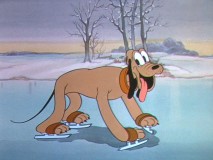 On Ice is the first of Disney’s ‘ensemble cartoons’.
Everyone is in it: Mickey, Minnie (in her color debut), Donald, Goofy, Pluto and even, albeit very briefly, Horace Horsecollar and Clarabelle Cow. ‘On Ice’ introduces two story ideas that would be used again much later: Pluto’s problems on ice in ‘Bambi’ (1942) and the idea of skating near a waterfall in the ‘Once upon a Wintertime’ sequence of ‘Melody Time’ (1948), although this latter idea first appears in the Popeye cartoon ‘Season’s Greetinks!‘ from 1933.
Apart from this, ‘On Ice’ has been very important in the development of Goofy. He’s been completely restyled, has more body to his looks and a much more distinct personality. All these important improvements on the character are attributed to Art Babbitt, one of the greatest animators of all time. Goofy sings ‘The world owes me a living’ from ‘The grasshopper and the ants’ (1934). The song naturally becomes his theme song. No wonder, for the grasshopper and Goofy share the same voice: that of Pinto Colvig. Also of note is Goofy’s original fishing style, using chew to catch fish.
Watch ‘On Ice’ yourself and tell me what you think:
This is Mickey Mouse cartoon No. 79
To the previous Mickey Mouse cartoon: Pluto’s Judgement Day
To the next Mickey Mouse cartoon: Mickey’s Polo Team
Director: Burt Gillett
Release Date: November 25, 1933
Stars: Mickey Mouse, The Orphan Mice
Rating: ★★★½
Review:
 Mickey tells the story of Jack and the Beanstalk to his numerous nephews with him in the starring role.
These nephews come out of nowhere, even though they had appeared in ‘Mickey’s Nightmare‘ (1932), where they were, indeed, part of a nightmare. In ‘Giantland’ they’re real alright, and they would star in five other Mickey Mouse cartoons of the 1930s.
In his story Mickey meets the first giant of his career. This giant is very well drawn, with great use of perspective and realistic details, especially in the hands. This must have been the closest the studio could come to the human form in 1933. The cartoon also contains many shadows. Both features are a testimony of Disney’s urge to master more naturalism in his cartoons.
Nevertheless, one can see that the animators were still struggling with such elaborate designs. The giant is not drawn very consistently, and some sequences are more convincing than others. The best and most beautiful scene is when Mickey ends up inside the Giant’s mouth. This is an original scene by all means, and one that could almost only be done in animation.
Notably, the cartoon emphasizes that the story is a fantasy, with Mickey only telling it. Mickey was slowly becoming more settled, and while he’s still the hero of this cartoon, as the years progressed his quieter nature meant that he lost more and more screen time to less timid characters, like Pluto, Donald Duck and Goofy.
Mickey would deal with giants again in ‘Brave Little Tailor’ (1938) and in ‘Fun and Fancy Free’ (1947), a re-telling of the same fairy tale. ‘Gulliver Mickey’ from six months later follows the same story line as ‘Giantland’, but now in reverse, with Mickey himself being the giant, while Floyd Gottfredson retold the story of ‘Giantland’ in his Sunday Mickey Mouse comics from March 11 to April 29, 1934.
Watch ‘Giantland’ yourself and tell me what you think:
This is Mickey Mouse cartoon No. 62
To the previous Mickey Mouse cartoon: The Pet Store
To the next Mickey Mouse cartoon: Shanghaied
Director: Wilfred Jackson
Release Date: April 8, 1933
Rating: ★★★½
Review:
 The biblical story of Noah has been quite popular with the Disney Studio: it has retold the story three times on film .
‘Father Noah’s Ark’ is its first version, the others are a stop motion film from 1959 (‘Noah’s Ark‘) and a sequence from ‘Fantasia 2000’ featuring Donald Duck.
This cartoon belongs to Disney’s operetta phase (see also ‘King Neptune‘) and tells the age old story as a musical, including some gospel singing. The story is quite straightforward and the short contains only a few mild gags, the best of which are in the building sequence, e.g. the wives using an assembly line of porcupines and some monkeys using a rhinoceros to make planks out of a log.
The designs seem to be halfhearted: Father Noah’s sons look ridiculously cartoony, wearing Mickey Mouse type gloves, for instance. His sons’ wives, on the other hand, are designed in art deco fashion.
The animals, too, are in different stages of naturalism, but the cows portrayed are much more realistic than the ones featured in the Mickey Mouse shorts of the same time. Moreover, when the animals flee into the ark, we see some unprecedentedly realistic giraffes, sealions and lions.
The most stunning naturalism is found in the animation of the sea when the ark is at the mercy of the waves. This is a spectacular scene by any standards. The storm part also features a complex scene of several animals rolling from side to side. There’s a good sense of weight in this sequence, with the elephant moving last.
Watch ‘Father Noah’s Ark’ yourself and tell me what you think:
This is Silly Symphony No. 35
To the previous Silly Symphony: Birds in the Spring
To the next Silly Symphony: Three Little Pigs
Director: Burt Gillett
Release Date: November 25, 1931
Stars: Mickey Mouse, Minnie Mouse, Pluto
Rating: ★★★½
Review:
 ‘Mickey Cuts Up’ can be summarized as ‘Mickey Steps Out’ set in a garden.
The first part of the cartoon consists of a quite tiring song-and-dance-routine (with Mickey dancing as a turtle as a minor highlight). Like in ‘Mickey Steps Out’ there’s some whistling with the birds, with Mickey impersonating one. Later the two perform the 1921 hit song ‘Ain’t We Got Fun’ on harmonicas.
Only after five minutes, the second part starts. This hilarious sequence is devoted to Pluto chasing a cat and causing havoc, just like he did in ‘Mickey Steps Out’. The contrast with the first half couldn’t be greater: suddenly the gags come fast and plenty. There’s even an early running gag in which Mickey gets wet in various ways. The second half is of a stunning speed, and a real tour de force in its string of gags leading to other gags, and to the grand finale. This half makes the cartoon a stand out of the era, and one that looks forward to things to come.
Watch ‘Mickey Cuts Up’ yourself and tell me what you think:
This is Mickey Mouse cartoon No. 35
To the previous Mickey Mouse cartoon: The Beach Party
To the next Mickey Mouse cartoon: Mickey’s Orphans
Director: Burt Gillett
Release Date: July 10, 1931
Stars: Mickey Mouse, Minnie Mouse, Pluto
Rating: ★★★½
Review:
 ‘Mickey Steps Out’ is the first of a few Mickey Mouse cartoons that are half musical numbers half story.
This was a plot structure used in many Mickey Mouse cartoons from 1931 to 1933, with ‘The Pet Store‘ being the last example. This half-baked structure was soon replaced by stories filling the complete cartoons.
In ‘Mickey Steps Out’, Mickey visits Minnie, but Pluto, who should have stayed in, is following him, dragging his dog house along to Minnie’s place. First, Mickey and Minnie perform their usual song-and-dance-routine (this time based on ‘Sweet Georgia Brown’), but when Pluto is chasing a cat, their music is interrupted and followed by a fast sequence of gags of Pluto and the cat ruining the house culminating in a blackface gag.
‘Mickey Steps Out’ arguably contains the first well-constructed finale in Disney history. It’s at least the first of a series of cartoons that end in complete destruction. Pluto would again cause havoc in ‘Mickey Cuts Up’ (1931) and ‘The Grocery Boy’ (1932). Later, destruction would be caused by little kittens (a.o. ‘Mickey’s Orphans‘, 1931) and orphan mice (a.o. ‘Mickey’s Nightmare‘, 1932). ‘Mickey Steps Out’ reuses footage of ‘The Birthday Party’ of Mickey with a fishbowl on his head.
Almost secretly, the film introduces another novelty: the first attempt at a realistically drawn animal: Minnie’s canary is in no sense cartoony, behaving like a real bird. It’s a major advance when compared to the Silly Symphony ‘Birds of a Feather‘ from six months earlier. The canary only plays a small part in the cartoon, but is the testimony of Disney’s ultimate ambitions, even at this stage. It’s these innovations, better story arcs and a strive towards better, more realistic animation that propelled the Disney cartoons forward, leaving their contemporaries far behind.
Watch ‘Mickey Steps Out’ yourself and tell me what you think:
This is Mickey Mouse cartoon No. 30
To the previous Mickey Mouse cartoon: The Delivery Boy
To the next Mickey Mouse cartoon: Blue Rhythm
Director: Walt Disney
Release Date: March 28, 1929
Stars: Mickey Mouse
Rating: ★★★½
Review:
 Unlike its predecessor, ‘The Barn Dance‘, ‘The Opry House’ relies heavily on sound and music.
Mickey is the sole performer in a local theater where he dances and plays music. He even dresses up as a female belly dancer, dancing the hoochie coochie dance.
With its many musical gags, this cartoon is the first step in the development of the ‘concert cartoon’. An orchestra plays George Bizet’s Carmen way out of tune, and Mickey performs the Hungarian Rhapsody by Franz Liszt on the piano. This sequence is particularly important for two reasons: first, Mickey here gains his famous gloves, and second, this is the first time that Liszt’s famous work is featured in an animated cartoon. It would remain a cartoon classic and many years later, Bugs Bunny would perform the same piece on the piano in ‘Rhapsody Rabbit‘ (1946), and Tom and Jerry in ‘The Cat Concerto‘ (1947). Already in this cartoon, Liszt’s piece is the source of several musical gags, as Mickey plays the piano in the most original ways, even clobbering it with his fists, until his stool kicks him.
Watch ‘The Opry House’ yourself and tell me what you think:
This is Mickey Mouse cartoon No. 5
To the previous Mickey Mouse cartoon: The Barn Dance
To the next Mickey Mouse cartoon: When The Cat’s Away
Director: Burt Gillett
Release Date: April 14, 1934
Stars: the three little pigs, the big bad wolf
Rating: ★★★½
Review:
 ‘The Big Bad Wolf’ was Disney’s very first sequel.
It was undoubtedly made to satisfy the masses who, after the huge success of ‘Three Little Pigs‘ (1933), demanded for ‘more pigs’. As one can expect, it’s not as great as ‘Three Little Pigs’, but it’s fun to watch.
The title card shows the main characters as if they were playing their parts. The cartoon, however, is named after the wolf, and deservedly so, because not only is he drawn better than in the original cartoon, he’s also the star of this sequel. Clearly being the greatest actor, he not only impersonates grandma, but also “Goldilocks the fairy queen” in a ridiculous and aimless costume, and even Jimmy Durante! Furthermore, he alone shows to be aware of the audience: he often looks into the camera, and even addresses the audience with a Mae West-like “how’m I doing?”.
After this cartoon, the demand for pigs apparently still wasn’t satisfied, for it was followed by even two more sequels: ‘Three Little Wolves‘ in 1936 and ‘The Practical Pig‘ in 1939.
‘The Big Bad Wolf’ might be the first “fairy-tales mixed up” cartoon. It may very well have inspired Tex Avery to make similar, yet more hilarious cartoons like ‘The Bear’s Tale’ (1940) and ‘Swing Shift Cinderella’ (1945), both starring Little Red Riding Hood.
Watch ‘The Big Bad Wolf’ yourself and tell me what you think:
This is Silly Symphony No. 44
To the previous Silly Symphony: Funny Little Bunnies
To the next Silly Symphony: The Wise Little Hen


 Dr. Grob's Animation Review