
You are currently browsing the category archive for the ‘★★★★★’ category.
Director: Burt Gillett
Release Date: September 10, 1932
Rating: ★★★★★
Review:
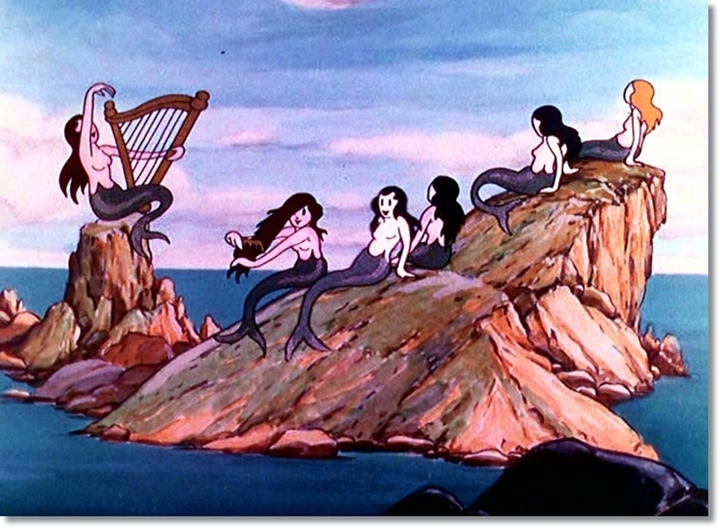
King Neptune is a merry sea giant, who gets angry when a bunch of horny pirates capture one of his topless(!) art deco mermaids. This leads to a war at sea, complete with an aircraft carrier whale and sea creature dive bombers.
‘King Neptune’ introduces a new concept to the Silly Symphonies, that of operetta. No longer the characters act silently to music, now they actually sing in operatic fashion. In the mid-thirties operetta was very popular in Hollywood, and in 1933 the operetta format would spread through the series, and it even shortly invaded Mickey Mouse films, like ‘The Mad Doctor‘, ‘Ye Olden Days‘ and ‘The Mail Pilot‘ (all 1933).
This trend led to curious mini-musicals, like ‘Father Noah’s Ark‘ and ‘The Pied Piper‘ (both 1933). The style reached its apex with ‘The Goddess of Spring’ (1934), in which the singing in all its seriousness became downright ridiculous. The operetta style survived into 1935, after which it disappeared from the Disney cartoons. However, Walt Disney’s first feature, ‘Snow White and the Seven Dwarfs’ (1937), clearly uses the operetta-style, probably because it already had been conceived at the end of 1933.
King Neptune is kind of a stock character. In many ways he’s just Old King Cole from ‘Mother Goose Melodies‘ (1931) in an updated form – rather awkwardly still wearing gloves. This character would resurface as Santa in the next Silly Symphony ‘Santa’s Workshop‘ (1932), as Noah in ‘Father Noah’s Ark‘ (1933), and as King Midas in ‘The Golden Touch’ (1935).
The pirates and mermaids are nowhere near realism, yet they’re designed and animated much better than the hunters in ‘The Fox Hunt‘ (1931), showing that Disney was making fast strides to realistic human designs already at this stage .
‘King Neptune’ is only the second Silly Symphony in color, yet unlike the first, ‘Flowers and Trees‘, it was made with color in mind from the start, and it shows. What a lush, elaborate, colorful and stunningly beautiful short this is! The cartoon simply bursts with color. Nevertheless, at several points the artists were still struggling with the new language of color. For example, one fighting scene on deck is almost rendered in reds only, in another scene the turtles have almost the same color as their background rock, failing to stand out. However, two color Silly Symphonies later, in ‘Santa’s Workshop‘, these problems appeared to have been solved, for that cartoon juxtaposes the most vibrant colors in all its scenes.
Apart from the use of color, ‘King Neptune’ is astounding because of its astonishingly elaborate animation. It’s packed with special effects, and complex and beautiful animation. The opening shots alone, in which King Neptune introduces himself, contain excessive, complex cycles of bubbles and fish. But the short’s highlight is the epic battle, which contains scenes of unprecedented complexity.
More impressive Silly Symphonies were soon to follow, but ‘King Neptune’ itself already is no less than a masterpiece. All previous Silly Symphonies literally pale compared to this one, let alone contemporary cartoons of other studios.
Watch ‘King Neptune’ yourself and tell me what you think:
This is Silly Symphony No. 30
To the previous Silly Symphony: Flowers and Trees
To the next Silly Symphony: Bugs in Love
Director: Wilfred Jackson
Release Date: April 13, 1932
Stars: Clarabelle Cow, Horace Horsecollar, Mickey Mouse, Minnie Mouse, Pete
Rating: ★★★★★
Review:
 As the title implies, there’s a great sports event at the barn.
Mickey is joining a cross country race that involves running, rowing and cycling (which is beautifully animated). His main opponent is a rather unrecognizable Pete, who looks like just a big mean cat without a peg leg.
‘Barnyard Olympics’ was inspired by the upcoming Summer Olympics in Los Angeles in 1932. It’s a brilliant gag cartoon: it’s fast, consistent and exciting, and without doubt one of Mickey’s finest. It immediately starts with an excellent gag when a spectator suddenly discovers he’s being filmed and waves at ‘the camera’.
In a way ‘Barnyard Olympics’ marks Goofy’s debut. He’s not seen at all, but during a boxing match his characteristic laughter, provided by story man Pinto Colvig, can already be heard. In Mickey’s next film, ‘Mickey’s Revue‘, Goofy would appear on the screen himself.
With ‘Barnyard Olympics’ Mickey entered the zenith of his career. His films from 1932-1934 are his best. Almost all portray him as the little, but brave underdog fighting the odds, and importantly, in these films Mickey still is the star himself. After 1934 Mickey became more and more of a straight man, losing screen time to Pluto, Donald and Goofy. Yes, the Mickey Mouse films from the second half of the 1930s are also great, but by then Mickey’s own stardom was in a clear decline. But in ‘Barnyard Olympics’, like the other films from 1932-1934, he’s still in top form as the greatest cartoon star of his era.
Watch ‘Barnyard Olympics’ yourself and tell me what you think:
This is Mickey Mouse cartoon No. 40
To the previous Mickey Mouse cartoon: The Mad Dog
To the next Mickey Mouse cartoon: Mickey’s Revue
Director: Dave Fleischer
Release Date: December 26, 1930
Stars: Betty Boop, Bimbo
Rating: ★★★★★
Review:

Bimbo is the uncanny phantom-like Mysterious Mose, who visits a frightened Betty Boop at night.
The cartoon has a jazzy score, using the St. James Infirmary Blues. Like ‘Barnacle Bill‘, it is wildly surrealistic, with all kinds of animals appearing out of nowhere and disappearing into nothingness again, and during the title song there’s metamorphosis all over the place.
‘Mysterious Mose’ is the third cartoon featuring Betty Boop, and the first with her in the starring role. She’s still unnamed here, but her development as as sex object is pushed further, when her night shirt flies off twice, leaving her naked in bed. She’s also animated much better than in her earlier two films, ‘Dizzy Dishes‘ and ‘Barnacle Bill‘. Her looks and moves are more stable, more feminine, and thus, more sexy.
Watch ‘Mysterious Mose’ yourself and tell me what you think:
This is Talkartoon No. 14
To the previous Talkartoon: Up to Mars
To the next Talkartoon: The Ace of Spades
‘Mysterious Mose’ is available on the French DVD Box Set ‘Betty Boop Coffret Collector’
Director: Dave Fleischer
Release Date: August 31, 1930
Stars: Betty Boop
Rating: ★★★★★
Review:
‘Barnacle Bill’ is a literal visual illustration of the folk song of the same name, made famous by Hoagy Carmichael’s 1930 recording.
Barnacle Bill (another version of early Bimbo) is visiting Betty Boop, who’s called Nancy Lee in this cartoon and who apparently is the Captain’s love. All neighbors gossip about it, and when the captain arrives, he chases Barnacle Bill into the sea, where the latter dances with some remarkably humanized mermaids.
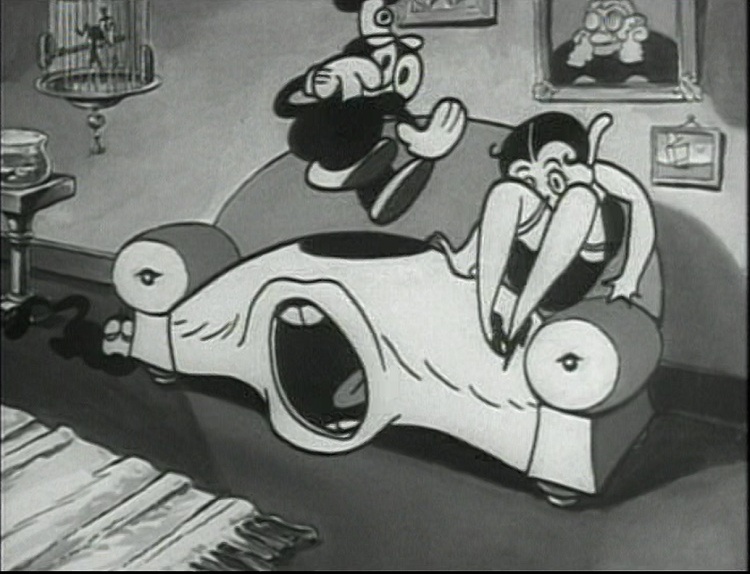
‘Barnacle Bill’ is the second cartoon featuring Betty Boop, and it introduces the strong sexual overtones, associated with the character in her early years. One example is Betty’s dress that rolls itself up, exposing her legs. There’s also a couch that itself replaces several chairs when Betty invites Barnacle Bill inside.
‘Barnacle Bill’ uses musical dialogue almost exclusively. It contains some odd perspectives and flexible animation, but most important of all, it is wildly surrealistic, creating a completely original world of utter weirdness. For example, when Barnacle Bill threatens to bust in the door, the door shrinks and hides under the welcome mat. Later, we watch Barnacle Bill swim through the air, and dive into the couch. And when he leaves Nancy Lee’s apartment block, he sails one of the stairs. Touches like these make watching the cartoon a mind-blowing experience. I don’t think it’s considered a classic, but to me it should be.
Watch ‘Barnacle Bill’ yourself and tell me what you think:
This is Talkartoon No. 9
To the previous Talkartoon: Dizzy Dishes
To the next Talkartoon: Swing, You Sinners!
‘Barnacle Bill’ is available on the French DVD Box Set ‘Betty Boop Coffret Collector’
Director: unknown
Release Date: May 27, 1925
Stars: Dawn O’Day (Alice), Julius
Rating: ★★★★★
Review:
 In ‘Alice’s Egg Plant’ Alice and Julius have a chicken farm, but a Russian spy chicken named ‘Little red Henski’ makes their chicken strike. Clever Alice then organizes a cock fight with a one egg admission fee.
‘Alice’s Egg Plant’ marks Dawn O’Day’s only appearance as Alice. She was supposed to be the second Alice after Virginia Davis, who quit after some arguments about her salary. But Disney’s salary offer proved to be too low for O’Day, as well. The next Alice would be Margie Gay, who would serve as Alice during 1925 and 1926
In ‘Alice’s Egg Plant’ one can already see the transition from emphasis on live action to animation. The shots of Alice are minimized in this cartoon and there are no close ups. The animation on the other hand begins to look more flexible and lifelike. Add the clever and entertaining story with its many gags, and here’s an Alice Comedy that still is entertaining today. It would also be prophetic, because Disney himself would face a frustrating strike in 1941, also led by an agitator from outside the company, Herbert K. Sorrell…
Watch ‘Alice’s Egg Plant’ yourself and tell me what you think:
‘Alice’s Egg Plant’ is available on the DVD ‘Walt Disney Treasures: Disney Rarities’
Director: Dave Fleischer
Release Date: May 14, 1937
Stars: Betty Boop, Pudgy
Rating: ★★★★★
Review:
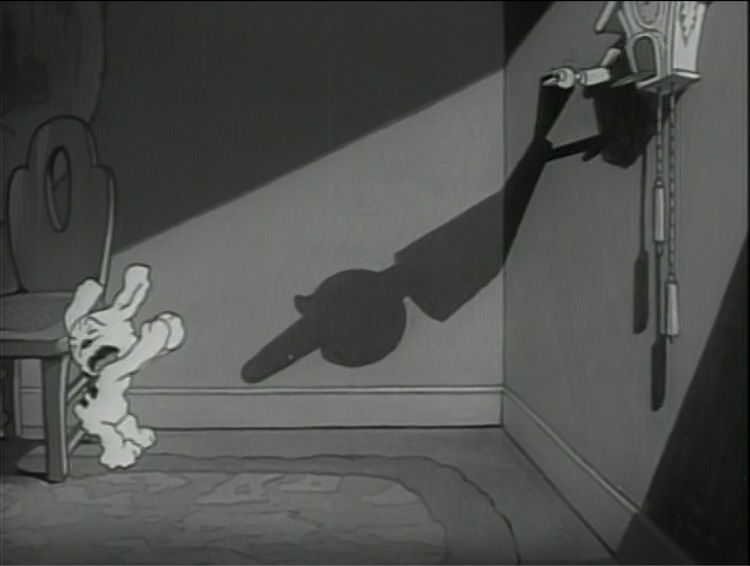 Betty has bought a fox. Pudgy, jealous of the lifeless animal, starts a fight, but after knocking his enemy down, he thinks he has killed it.
What follows is a great depiction of his feeble attempts to revive his foe, and then his genuine horror when he realizes he has killed the animal. His feeling of guilt turns his surroundings into a nightmare.
‘Pudgy picks a Fight’ is undoubtedly the most inspired of all Pudgy cartoons, the nightmare sequence being particularly imaginative. Its theme of guilt and imagination running away with it would be revisited by Disney in ‘Donald’s Crime’ (1945) with equally impressive results.
Watch ‘Pudgy Picks A Fight’ yourself and tell me what you think:
This is Betty Boop cartoon No. 63
To the previous Betty Boop cartoon: Pudgy Takes a Bow-Wow
To the next Betty Boop cartoon: The Impractical Joker
‘Pudgy Picks A Fight’ is available on the French DVD Box Set ‘Betty Boop Coffret Collector’
Director: Dave Fleischer
Release Date: January 5, 1934
Stars: Betty Boop, Fearless Freddie
Rating: ★★★★½
Review:
 Betty is the star in a melodrama with an evil landlord and a classic hero.
Arguably the first Betty Boop cartoon with a clear plot, ‘She Wronged Him Right’ marks the debut of Fearless Freddie, who seems to be designed as Betty’s new suitor (Bimbo, being an animal, was no longer accepted in a Hollywood dominated by the puritan Hays Code). His stay would be short, however, because very soon Betty would lose interest in men altogether, taking the Code even further.
Only nine months later the formula of this cartoon was repeated with less successful results in ‘Betty Boop’s Prize Show’. ‘She Wronged Him Right’ still contains some wonderful metamorphosis gags and some inanimate objects speaking or suddenly growing hands, preserving some of Fleischer’s famous surrealism.
The very idea of Betty performing in a melodrama may have been borrowed from Disney, who had released the comparable ‘Mickey’s Mellerdrammer‘ in 1933.
Watch ‘She Wronged Him Right’ yourself and tell me what you think:
This is Betty Boop cartoon No. 24
To the previous Betty Boop cartoon: Parade of the Wooden Soldiers
To the next Betty Boop cartoon: Red Hot Mamma
‘She Wronged Him Right’ is available on the French DVD Box Set ‘Betty Boop Coffret Collector’
Director: Wilfred Jackson
Release Date: March 13, 1937
Rating: ★★★★★
Review:
 ‘Woodland Café’ returns to the origin of the Silly Symphony series: music.
This enjoyable gem depicts a Harlem-like nightclub for bugs, in which blackface grasshoppers perform hot jazz, led by a Cab Calloway-like bandleader. All bugs swing to it as soon as they enter the club.
After a remarkably erotic act played by a spider and a fly the cartoon climaxes in the jazz song ‘Truckin’, recorded by both the Mills Blue Rhythm Band and Duke Ellington in 1935, and celebrating a dance style that was fashionable around ca. 1935-1938. The main feature of trucking is the shoulders which rise and fall as the dancers move towards each other while the fore finger points up and wiggles back and forth like a windshield wiper. At this point in the short even some astonishing effect animation joins in, delivering totally convincing glitter ball effects and beautiful descending fluffy flowers.
Both charming and entertaining, the whole mood of this delightful cartoon is one of sheer joy.
Watch ‘Woodland Café’ yourself and tell me what you think:
This is Silly Symphony No. 66
To the previous Silly Symphony: More Kittens
To the next Silly Symphony: Little Hiawatha
Director: Wilfred Jackson
Release Date: August 22, 1936
Stars: Max Hare, Toby Tortoise, The Three Little Pigs
Rating: ★★★★★
Review:
 One of the few sequels in Disney’s pre-video era, ‘Toby Tortoise Returns’ features the two stars of ‘The Tortoise and the Hare’ from 1935.
In this cartoon, written by Ward Kimball and featuring his typically zany style of humor, Max Hare (who’s still a bragging bully) and Toby Tortoise combat each other in a boxing match, which – of course – Toby eventually wins, albeit by means of Max’s own trickery.
Apart from Toby Tortoise and Max Hare there are many cameos of other Silly Symphony stars, among them the three little pigs, Dirty Bill (from ‘The Robber Kitten’), Jenny Wren and the Cuckoo from ‘Who Killed Cock Robin?’ and, Elmer Elephant and Tilly Tiger (from ‘Elmer Elephant’), as if all Silly Symphonies were taking place in the same space and time.
This makes ‘Toby Tortoise Returns’ akin to the earlier ‘Mickey’s Polo Team’ from the same year. The whole atmosphere is rather like that of a future Warner Brothers-cartoon, and one can sense the sheer joy the makers had in bringing all these characters together in a cartoon which sole reason of existence seems to be pure fun.
Notice the black bunny and the black turtle that are Max’s and Toby’s helpers, respectively.
Watch ‘Toby Tortoise Returns’ yourself and tell me what you think:
This is Silly Symphony No. 61
To the previous Silly Symphony: Three Little Wolves
To the next Silly Symphony: Three Blind Mouseketeers
Director: David Hand
Release Date: August 31, 1935
Stars: Mickey Mouse, Pluto
Rating: ★★★★★
Review:
 Although this cartoon is part of the Mickey Mouse series, Pluto is its star.
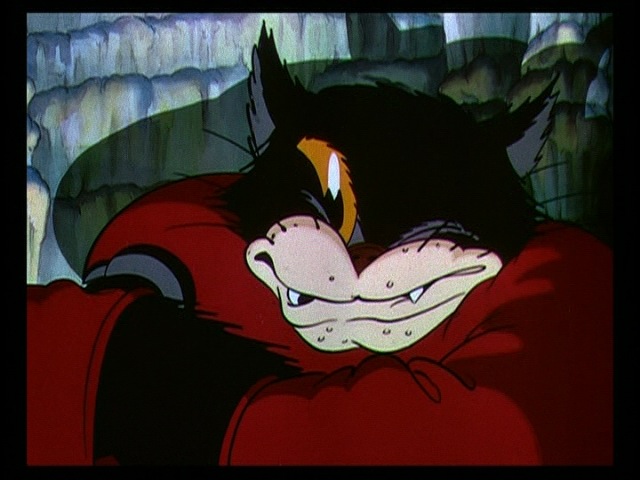
After he has chased a little kitten, he dreams that his Judgement Day has come and that he’s put on trial by a number of cheating cats.
Like most of Disney’s dream-cartoons this one contains wonderful backgrounds, characters and ideas, thanks to story men Joe Grant and Bill Cottrell. The dream sequence is executed in a Silly Symphony-like fashion with lots of rhyme and song and very beautiful animation. The prosecutor, animated by Bill Roberts, is particularly well done: he’s an impressive figure, whose stature anticipates Stromboli from ‘Pinocchio‘ (1940).
Pluto now is a fully developed character who easily carries the complete cartoon on his own. Mickey’s part, on the other hand, is reduced to that of a cameo, something that would occur more and more in the years to come.
Watch ‘Pluto’s Judgement Day’ yourself and tell me what you think:
This is Mickey Mouse cartoon No. 78
To the previous Mickey Mouse cartoon: Mickey’s Fire Brigade
To the next Mickey Mouse cartoon: On Ice
Director: Ben Sharpsteen
Release Date: August 3, 1935
Stars: Clarabelle Cow, Donald Duck, Goofy, Mickey Mouse
Rating: ★★★★★
Review:
 ‘Mickey’s Fire Brigade’ is the second of the classic trio cartoons featuring Mickey, Donald and Goofy, and the first of its kind in color.
When one compares this cartoon to the similar ‘The Fire Fighters’ from 1930, one can see what stunning progress the Disney studio had made in a mere five years: the backgrounds, the camera angles, the character animation, the effect animation: everything has improved considerably.
What’s more, its gags are faster, more clever and better constructed, and they build up to a wonderful finale. Among the numerous brilliant ideas are a burning title card, water splashing against ‘the camera’ and a bathing Clarabelle Cow who is not amused when saved by our heroes.
This cartoon is both Goofy’s first color appearance as the last time he’s seen in the design he got in ‘The Whoopee Party’ about three years before. In this film he’s got a particularly goofy cuckoo theme song, while some of the anthropomorphized flames play ‘who’s afraid of the big bad wolf’ from ‘Three Little Pigs‘ on the piano.
Watch ‘Mickey’s Fire Brigade’ yourself and tell me what you think:
This is Mickey Mouse cartoon No. 77
To the previous Mickey Mouse cartoon: Mickey’s Garden
To the next Mickey Mouse cartoon: Pluto’s Judgement Day
Director: David Hand
Release Date: January 21, 1933
Stars: Mickey Mouse, Pluto
Rating: ★★★★★
Review:
 ‘The Mad Doctor’ is Mickey’s third horror cartoon and easily his best (the other two are ‘The Haunted House’ from 1929 and ‘The Gorilla Mystery’ from 1930).
The plot is simple: it’s night, the weather is foul and Pluto is kidnapped by an evil scientist called Dr. XXX, who takes him into his laboratory, which is reminiscent of that of Frankenstein in James Whales’ film of the same name, 1931. Mickey follows Pluto’s tracks into a creepy castle, entering it in a scene which reuses some footage of ‘Egyptian Melodies‘ from 1931. Inside the castle he has to deal with several skeletons, including a ridiculous hybrid of a skeleton and a spider. Soon, he’s captured, too, and about to be killed by a chainsaw. Fortunately, it turns out to be all just a dream…
Besides the horror, this cartoon also features elaborate designs and loads of special effects. Especially beautiful is its shadowing on the characters. It also has a strong musical element, as the mad scientist sings all his lines. Some of the gags are quite surreal and reminiscent of the Fleischer style, like a lock locking itself or the scientist cutting off Pluto’s shadow. The cartoon also features a gag with many doors in one doorpost. This gag would be reused and improved by Tex Avery in ‘The Northwest Hounded Police’ from 1946.
Watch ‘The Mad Doctor’ yourself and tell me what you think:
This is Mickey Mouse cartoon No. 52
To the previous Mickey Mouse cartoon: Building a Building
To the next Mickey Mouse cartoon: Mickey’s Pal Pluto
Director: David Hand
Release Date: November 17, 1934
Stars: Donald Duck, Fifi, Mickey Mouse, Minnie Mouse, Pete
Rating: ★★★★★
Review:
 Mickey and Donald (in his third appearance) are policemen hunting Pete who has ‘dognapped’ Minnie’s dog Fifi. The chase, which includes a lot of gunfight, ends in a sawmill where all three have to cope with a runaway circular saw.
The cartoon is outstanding for its fast pace and high content of gags. Mickey and Donald are staged as a duo, but, like in ‘Orphan’s Benefit’, Donald Duck is given the last shot. ‘The Dognapper’ would remain Mickey’s and Donald’s only genuine duo cartoon, but it set the stage for the famous trio outings of the late thirties in which Mickey, Donald and Goofy would fight the odds together. Goofy, the only missing element, would join Mickey and Donald a few months later, in ‘Mickey’s Service Station’ (1935).
Watch ‘The Dognapper’ yourself and tell me what you think:
This is Mickey Mouse cartoon No. 70
To the previous Mickey Mouse cartoon: Mickey Plays Papa
To the next Mickey Mouse cartoon: Two-Gun Mickey
Director: Wilfred Jackson
Release Date: December 12, 1931
Rating: ★★★★★
Review:
 This is the first of two versions of ‘The Ugly Duckling’ made by Disney.
Unlike the latter, more familiar version, this ugly duckling is a real duck, accidentally born to a chicken. He’s rejected until he saves his chick brothers and sisters from drowning in a long, fast and exciting action scene, involving both a tornado and a waterfall.
Although looking crude and primitive when compared to the 1939 short, this first version of The Ugly Duckling is a milestone in Disney’s storytelling: while the earlier Silly Symphonies contain a lot of repetitive animation and dance routines, The Ugly Duckling is the first Silly Symphony to tell a coherent story from the beginning to the end. Even the Mickey Mouse films of that time are not that consistent. There still is some rhythmic movement, especially at the beginning, but most of the animation is there to tell the story.
The duckling (who repeatedly looks to the audience for sympathy – not unlike Oliver Hardy) is a real character who transforms from an outcast to a hero, and gains its well-earned sympathy at last. Its best scenes are when it feels rejected, not only by his ‘family’, but also by a cow, a dog and a frog. There’s some genuine feeling of loneliness and unhappiness in these scenes, unparalleled in any other animated film of the time.
This short, which is neither about gags nor about moving to music, would be the first testimony of Disney’s ambitions in storytelling.
Watch ‘The Ugly Duckling’ yourself and tell me what you think:
This is Silly Symphony No. 25
To the previous Silly Symphony: The Fox Hunt
To the next Silly Symphony: The Bird Store
Directors:Clyde Geronimi, Wilfred Jackson and Hamilton Luske
Release Date: February 15, 1950
Rating: ★★★★★
Review:
 ‘Cinderella’ was Disney’s first fairy tale movie since ‘Snow White and the Seven Dwarfs’ (1937) and Disney’s first real feature animation film in eight years.
With its classic fairy tale story featuring a heroine, whose unhappy fate is turned, Cinderella seems to be like ‘Snow White and the Seven Dwarfs’, Disney’s only million seller feature up to that point, and, indeed, ideas for this film go back as far as 1938. However, it is very clear many things had changed for the studio since then:
First: Gone are the lush water color backgrounds. They’re replaced by way more stylized oil backgrounds, based on the colors and styling of designers Mary Blair and John Hench, who both favored bright and unrealistically vivid colors. Mary Blair’s influence is particularly strong in the dreamlike ‘So This Is Love’ sequence and the chase of Cinderella’s pumpkin couch: here the stunningly beautiful backgrounds lose all sense of realism, in favor of emotional storytelling.
Second: The animation of humans, hardly mastered in 1937, now looks fluent, convincing and even easy. It’s also striking how very realistic humans (Cinderella, the prince, the evil stepmother) blend easily and convincingly with more caricatured humans (the king, the grand duke and the two stepsisters) and anthropomorphic animals. The Disney studio clearly had matured.
Indeed, the animation studio had been greatly streamlined in the forties. Gone were the experimental, time consuming and costly work methods of ‘Snow White’, ‘Pinocchio‘ and ‘Fantasia’. For his new feature Disney would take no chances: all human scenes would be filmed first with live action actors, in order to perfect the staging before it went into animation. Only one short scene with outrageously colored soap bubbles evokes some of the earlier experimentalism.
Disney’s animation unit was now led by a group of younger, highly talented animators, who had matured their skills in the forties, and whom Walt Disney affectionately called his ‘Nine Old Men’. In Cinderella these Nine Old Men are all credited as supervising animators (alongside, like a ghost from the past, pioneer animator Norm Ferguson [see ‘Frolicking Fish‘ and ‘Playful Pluto‘], although his contribution remains unclear). The Nine Old Men would be responsible for Disney Feature animation way up to ‘The Rescuers‘ (1978). The fluent and confident animation in ‘Cinderella’ clearly shows why.
Especially the stepmother (animated by Frank Thomas) is a wonderful character: she’s very nasty, but her evilness is acted out in the subtlest way. She’s only indirectly responsible for the most dramatic scene of the film, in which the two stepsisters tear Cinderella’s dress from her body. The horror of this scene is heartfelt, especially because we had seen that this dress was made for her by some friendly birds and mice in an earlier scene .
These animals star a huge subplot with leading roles for a keen mouse called Jaq, a fat, dumb mouse called Gus, and a mean old cat called Lucifer (all animated by Ward Kimball, who went berserk on the outrageous animation of Lucifer). This subplot provides a funny counterpoint to the familiar fairytale and even completely dominates the first twenty minutes of the film.
Cinderella was a huge success and paid the studio well. Once again Disney’s attention and reputation rested with animated features and the studio would dominate the scene up to the 1980s, being practically the monopolist on animated features in the United States.
In a time when TV would cause the decline and fall of the animated cartoon industry, this was no luxury, at all.
Watch an excerpt from ‘Cinderella’:


 Dr. Grob's Animation Review