
You are currently browsing the category archive for the ‘★★★★★’ category.
Director: Zhou Keqin & Ah Da
Release Date: 1981
Rating: ★★★★★
Review:
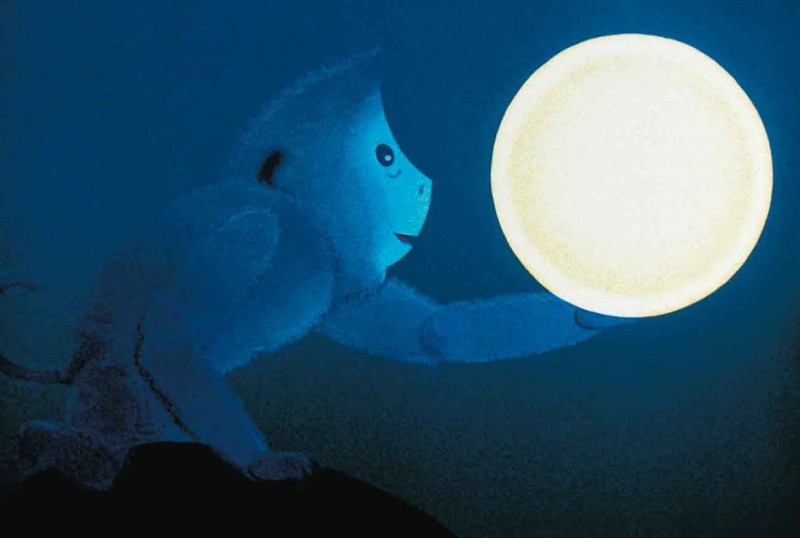 ‘Monkeys Fish the Moon’* tells about a troupe of monkeys who try to catch the moon.
When they finally succeed to catch its reflection in a bowl, they drop it, only to discover that the moon still is in the sky.
‘The Monkeys who tried to catch the moon’ is, like many other Chinese films, based on an ancient fable. And, like many others it uses silent acting to tell its story. Nevertheless, the film is also a little atypical. Its elegant designs are not inspired by ancient painting, but more akin to Lotte Reiniger’s films. Moreover, the movements are not really naturalistic and the film doesn’t use Chinese music. Instead we have a lush and colorful forest world accompanied by rich film music. The cut-out models of the monkeys are soft and subtle in design, and there’s a striking use of light.
The result is one of the most beautiful Chinese animation films ever made.
Watch ‘Monkeys Fish the Moon’ yourself and tell me what you think:
‘Monkeys Fish the Moon’ is available on the French DVD ‘Impression de montagne et d’eau’
* this film is also known by its French title: ‘les singes qui veulent attraper la lune’
Directors: Pinto Colvig, Walt Pfeiffer & Ed Penner
Release Date: April 17, 1937
Stars: Mickey Mouse, Donald Duck, Clarabella Cow, Clara Cluck, Goofy
Rating: ★★★½
Review:
 Mickey is only the straight man while hosting an amateur night at the theater.
We watch Donald trying to recite ‘Twinkle Twinkle Little Star’ while forgetting the words, Clarabella Cow and Clara Cluck performing an operatic song, and Goofy with an automatic one man band that goes haywire.
Donald surprises not only his but also the modern audience by drawing a tommy gun to shoot at the audience(!). However, it’s Goofy’s silly musical machine which draws the biggest laughs in a hilarious sequence, with particularly silly animation.
‘Mickey’s Amateurs’ ends with Donald getting caught in the closing end circle. Self-awareness gags like this were rare at Disney’s (another example is the burning title card in ‘Mickey’s Fire Brigade‘ from 1935), but would become standard repertoire at Warner Bros. and in Tex Avery’s cartoons at MGM.
Watch ‘Modern Inventions’ yourself and tell me what you think:
This is Mickey Mouse cartoon No. 94
To the previous Mickey Mouse cartoon: Moose Hunters
To the next Mickey Mouse cartoon: Modern Inventions
Director: Ben Sharpsteen
Release Date: January 9, 1937
Stars: Donald Duck
Rating: ★★★★★
Review:
 After co-starring with Pluto in ‘Donald and Pluto‘ (1936), Donald really comes to his own in ‘Don Donald’. In this cartoon he only shares screen time with a new character, Donna Duck, a predecessor of Daisy with a temper that matches Donald’s own.
In this film, we watch Donald in a Mexican setting featuring a surprisingly Krazy Kat-like palm in the background. He wears a large sombrero and tries to woo Donna, but his donkey spoils his efforts. Donald trades his donkey for a car (the small red car we would become so familiar with). The car makes a deep impression on Donna, and both go for a ride.
The animation of the car ride is a great showcase of animation of speed, while the hilarious sequence in which Donald tries to restart the motor again is a wonderful example of rubbery animation. The film ends marvelously, when Donna produces a unicycle out of her handbag and rides off into the distance. But the whole film is one of sheer delight and one of the classics of the 1930s.
Despite Mickey’s absence, ‘Don Donald’ is still part of the Mickey Mouse series. Only with ‘Donald’s Ostrich‘ from December 1937 Donald would get his own series.
Watch ‘Don Donald’ yourself and tell me what you think:
This is Mickey Mouse cartoon No. 91
To the previous Mickey Mouse cartoon: The Worm Turns
To the next Mickey Mouse cartoon: Magician Mickey
Director: Paul Driessen
Release Date: 1985
Rating: ★★★★★
Review:
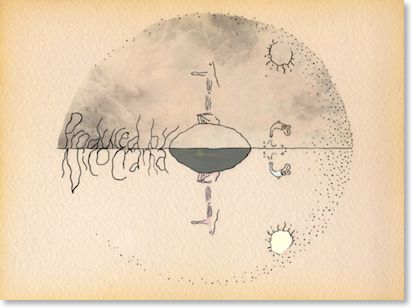 ‘Spiegeleiland’ is a short and stylized animation film, which uses one scene and one perspective only.
We watch a castaway on an island and his reflection. The castaway is visited by a female companion and rescued by a ship. Or is he? The reflection tells another tale…
This simple story is told without dialogue and with the greatest economy. Like ‘Ei om zeep’ (The Killing of an Egg’) and ‘Het treinhuisje’ (Home on the Rails) we watch a single tableau. In ‘Spiegeleiland’ Driessen takes this format even further, limiting his action to a circle with only a tiny island within.
The result is without doubt one of Driessen’s strongest and most poetic films. Driessen would reuse this method of parallel depiction of reality and fantasy to a great effect in the tragic ‘The Boy Who Saw the Iceberg’ from 2000.
Watch ‘Spiegeleiland’ yourself and tell me what you think:
‘Spiegeleiland’ is available on the DVD ‘The Dutch Films of Paul Driessen’
Director: Erica Russell
Release Date: 1989
Rating: ★★★★★
Review:
 ‘Feet of song’ is a non-narrative film about dance and Russell’s solo debut film.
It uses semi-abstract human forms, akin to those by painter Kazimir Malevich. The human forms feel both futuristic and African at the same time, and have a timeless appeal. The images get more and more abstract as the film progresses, but the sense of dance is never lost.
‘Feet of Song’ features African-sounding world music by Charlie Hart, but the music is in service to the beautiful images, not the other way round. Made for Channel 4, ‘Feet of Song’ is a prime testimony of Erica Russel’s unique style, clearly influenced by Oskar Fischinger, but firmly rooted in both her South African roots and dancer background.
Unfortunately, Russell made only two other independent films, ‘Triangle‘ in 1994, and ‘Soma’ in 2001, devoting most of her time to commissioned work (her images for example appear in the Madonna video-clip ‘Dear Jessie’ from 1989).
Watch ‘Feet of Song’ yourself and tell me what you think:
‘Feet of Song’ is available on the DVD inside the book ‘Animation Now!’
Director: Lev Atamanov
Release Date: 1970
Rating: ★★★★★
Review:
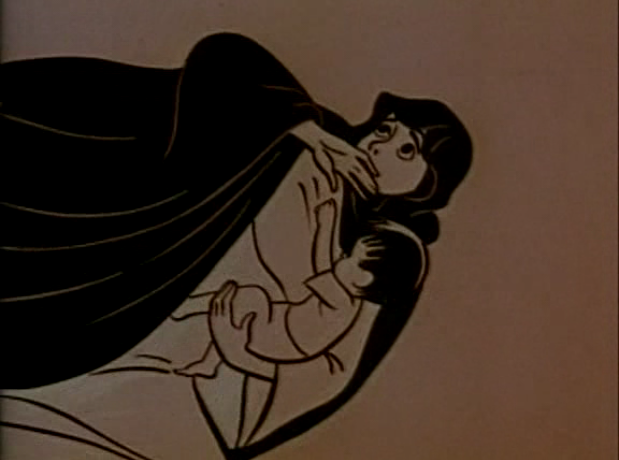 From a fascistic egg sprouts a military bird.
The young bird is fed by a capitalist and a general (who both are clearly American) with money and weapons. It grows into a huge black war-bird, which flies over the whole world, threatening loving couples in London, Paris, Moscow and Japan, and an old man, two mothers and several children in an unclear place. When the war-bird starts to attack, one mother turns Asian, Muslim and black, in order to illustrate that war can affect everybody everywhere. Eventually, however, the war-bird is overthrown by a multitude of peace doves, created by workers, writers, children, artists, musicians and pacifists.
‘We Can Do It’ is a beautiful and strikingly pacifistic film and undoubtedly one of the best propaganda films ever created in the Soviet Union. The film clearly is designed for international audiences, with its final message (the title) depicted not only in Russian, but also in German, English, Spanish and French.
Despite its anti-American sentiment, its pacifistic theme is timeless and universal. The film tells its clear message without any dialogue or voice over. Moreover, its designs are stunning and very effective, especially that of the war-bird.
Watch ‘We Can Do It’ yourself and tell me what you think:
‘We Can Do It’ is available on the DVD box set ‘Animated Soviet Propaganda’
Director: Raoul Servais
Release Date:1968
Rating: ★★★★★
Review:
 In a sinister harbor, where cranes behave like giant dinosaurs and where pterodactyli fly a young flute player brings a mermaid to life. Unfortunately, the mermaid is captured by one of the cranes and dropped to death.
‘Sirene’ is a beautiful, surrealistic film with its own creepy and somber atmosphere. Luckily, there’s also space for some dark humor when the authorities arrest an innocent fisherman and when a zoo and a hospital argue about the mermaid’s body. ‘Sirene’ definitely among Servais’s best films, arguably only equaled by ‘To Speak or not to Speak (1970) and ‘Harpya‘.
Watch ‘Sirene’ yourself and tell me what you think:
Director: Jiří Trnka
Release Date: 1949
Rating: ★★★★★
Review:
 With ‘The Song of the prairie’ Trnka’s both made a parody of and a homage to the classic Western.
The film uses all the cliches of the genre: a stagecoach, masked bandits, a damsel in distress, a hero with a white hat, a villain fancying the girl, and a climax on a cliff.
Trnka’s animation has much improved since ‘The Emperor’s Nightingale‘: the cinematography is excellent, and particularly the illusion of speed is astonishing. The film is wonderfully tongue-in-cheek and full of brilliant silent comedy, showing Trnka’s then unsurpassed mastery in stop-motion. ‘The Song of the Prairie’ is one of Trnka’s most enjoyable films, and deserves a more classic status.
Watch ‘The Song of the Prairie’ yourself and tell me what you think:
Director: Peter Lord & David Sproxton
Release Date: 1978
Rating: ★★★★★
Review:
 ‘Down & out’ is the first film in Aardman’s ‘animated conversations’ series and the British studio’s first masterpiece.
The very idea of using dialogue from real life is revolutionary enough, but to use it for clay animation with lip-synch is a masterstroke. Moreover, the animation of the plasticine figures is startling: it lacks the exaggerations of normal animation, but uses small gestures and real movements, like scratching one’s nose or belly, instead. The animation continues realistically even when not supported by the soundtrack. The result is uncannily realistic, making the drama of an old, confused man asking for food and shelter, but being turned down at an Salvation army office, extra tragic.
With this film Aardman single-handedly invented the ‘animated documentary’, a genre which would lead to fantastic films like ‘Ryan’ and ‘Waltz with Bashir’ in the 2000s.
‘Down & Out’ is available on the DVD ‘Aardman Classics’
Director: Paul Driessen
Release Date: 1981
Rating: ★★★★★
Review:
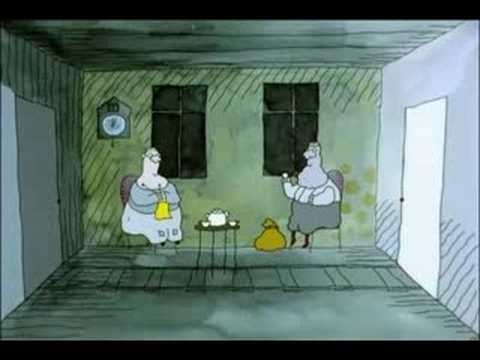 ‘Het treinhuisje’ is one of Paul Driessen’s most beautiful films.
This short builds on the surreal concept of a home built right on a railway track. The daily life of the couple living in the house is dominated by a train passing right through their home at certain times.
With simple and direct storytelling Driessen sets the drama, in which this very train ruins the life of the couple. All the time we stick inside the couple’s home. Only when the man tells of his misfortunes, we shortly cut to the outside world. Ironically, it’s the railway itself that ruins the couple’s life.
The story is told without dialogue, and supported by beautiful country music. The emotions of the couple are depicted well, and are very subtle. However, the film also shows Driessen’s typical animation style at its most radical: the film’s surrealism is enhanced by strange disappearances of the characters when they cross the room and by a ghostly avant-image of the train before it really enters the house.
The film also shares the trademark morbid humor with other Driessen films, especially in the cuckoo clock and in the persistent fly bugging the characters throughout the picture. Nevertheless, the melancholy atmosphere dominates, and its the film’s drama that impresses the viewer time and time again.
Watch ‘Het treinhuisje’ yourself and tell me what you think:
‘Het treinhuisje’ is available on the DVD ‘The Dutch Films of Paul Driessen’
Director: Jack Hannah
Release Date: November 21, 1952
Stars: Mickey Mouse, Pluto, Chip ‘n Dale
Rating: ★★★★★
Review:
 Mickey chops Chip ‘n Dale’s tree down to use as a Christmas tree.
By doing so he accidentally brings the two little chipmunks home. Pluto soon discovers the duo, but Mickey only does so in the very end. The cartoon ends with a cameo of Goofy, Donald and Minnie singing Christmas carols in Mickey’s garden.
The cartoon’s overall atmosphere is cute, adorable and full of charm, making ‘Pluto’s Christmas Tree’ one of the most delightful Mickey Mouse cartoons from the post-war period. This short is the second of two Mickey Mouse cartoons directed by Jack Hannah, the other being ‘Squatter’s Rights’ from 1946. These are the only two cartoons to feature Mickey and Chip ‘n Dale. It’s also the third of Mickey’s four Christmas cartoons, the others being ‘Mickey’s Orphans‘ from 1931, ‘Mickey’s Good Deed‘ from 1932 and ‘Mickey’s Christmas Carol‘ from 1983.
Watch ‘Pluto’s Christmas Tree’ yourself and tell me what you think:
This is Mickey Mouse cartoon No. 124
To the previous Mickey Mouse cartoon: Pluto’s Party
To the next Mickey Mouse cartoon: The Simple Things
Director: William Hanna & Joseph Barbera
Release Date: January 12, 1952
Stars: Tom & Jerry
Rating: ★★★★★
Review:
 In ‘The Flying Cat’ Jerry teams up with a canary, whom Tom wants to eat.
The chase routine that follows, gets an unexpected twist when Tom accidentally acquires some wings (out of a corset) and becomes a flying cat. It makes him a real threat to the two little creatures.
Unlike the contemporary Tom & Jerry cartoons, the ugly ‘His Mouse Friday‘ and ‘Cat Napping’, ‘The Flying Cat’ uses the simplified character designs to great effects. The cartoon is fast and full of gags, many of which involving great and inspired deformations of Tom.
Watch an excerpt from ‘The Flying Cat’ yourself and tell me what you think:
This is Tom & Jerry cartoon No. 63
To the previous Tom & Jerry cartoon: Cat Napping
To the next Tom & Jerry cartoon: Duck Doctor
Director: Chuck Jones
Release Date: January 3, 1953
Stars: Sam Sheepdog & Ralph Wolf
Rating: ★★★★★
Review:
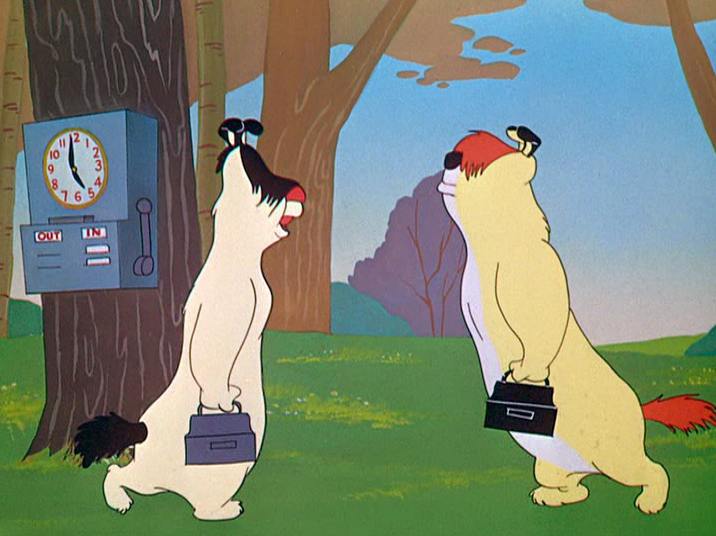 ‘Don’t Give up the Sheep’ is the first cartoon in a series of seven cartoons featuring the excellent duo Sam Sheepdog and Ralph Wolf.
In their first entry Sam Sheepdog is called Ralph, while Ralph remains yet unnamed. Sam goes to work, relieving his colleague Fred in attending the sheep. He has to counter the attacks by Ralph the wolf, who looks like Wile E. Coyote’s scruffy cousin. The cartoon is full of excellent, Road Runner-like blackout cartoons. In his silliest attempt the wolf dresses up as the God Pan to lull the sheepdog to sleep. To no avail, of course.
In this cartoon the backgrounds (by Carlos Manriquez) are becoming more stylized, although they still look like real nature. Sam and Ralph would never become major characters, but their miniseries is a little delight within the Warner Brothers canon.
Watch ‘Don’t Give up the Sheep’ yourself and tell me what you think:
http://www.wimp.com/hilariouscartoon/
‘Don’t Give up the Sheep’ is available on the DVD set ‘Looney Tunes Golden Collection, Vol. 1’
Director: Friz Freleng
Release Date: February 3, 1951
Stars: Sylvester
Rating: ★★★★★
Review:
 In this cartoon Sylvester is the cat of a couple, who go on a holiday to California for two weeks, leaving Sylvester behind and locked indoors.
Sylvester runs into agony when he discovers this, until he finds a kitchen-cupboard full of tins of fish. Unfortunately, a mouse has the can opener. This leads to perfectly timed blackout gags, in which Sylvester makes several attempts to get the can opener. When he finally succeeds, he discovers that the particular cupboard is locked, while the mouse has the key.
Due to its cat-and-mouse-routine ‘Canned Feud’ has similarities to the Tom & Jerry cartoons, although it has a distinct Friz Freleng style. Unlike Jerry, the mouse is completely blank, and its motives remain unclear, but Freleng’s comedy works nonetheless. In fact, this film is better than most contemporary Tweety and Sylvester cartoons.
Watch ‘Canned Feud’ yourself and tell me what you think:
Directors: William Hanna & Joseph Barbera
Release Date: March 3, 1951
Stars: Tom & Jerry
Rating: ★★★★★
Review:
 Tom’s listening to the radio where a french cook is telling about a fish recipe. Tom immediately tries to cook the goldfish in various ways, but Jerry, who’s the goldfish’s friend, rescues him again and again.
Unlike most Jerry-and-a-friend cartoons, ‘Jerry and the Goldfish’ is not cute, but fast and funny, with great gags coming in plenty, many of which involving deformations of Tom’s body. This makes ‘Jerry and the Goldfish’ easily one of the best Tom & Jerry cartoons using this theme. In 1966 Abe Levitow used the same story theme in the late Tom & Jerry cartoon ‘Fillet Meow‘, unfortunately with appalling results.
Watch an excerpt from ‘Jerry and the Goldfish’ yourself and tell me what you think:
This is Tom & Jerry cartoon No. 56
To the previous Tom & Jerry cartoon: Casanova Cat
To the next Tom & Jerry cartoon: Jerry’s Cousin
Directors: William Hanna & Joseph Barbera
Release Date: January 6, 1951
Stars: Tom & Jerry, Meathead, Toodles
Rating: ★★★★★
Review:
 In ‘Casanova Cat’ Tom is visitingToodles, who has inherited a million dollars and who now lives in a classy apartment downtown.
Tom brings Jerry along as a present, who is forced to dance with a blackface on a hot plate, a scene which is probably censored on many copies. The annoyed Jerry invites alley cat Meathead, too, and a feud starts between the two rivaling cats. However, in the end it’s Jerry who’s the lucky one, driving off with Toodles into the distance and kissing her.
‘Casanova Cat’ doesn’t cover any new grounds, but it combines the themes of earlier romance cartoons ‘Puss ‘n’ Toots’ (1942) and ‘Springtime for Thomas’ (1946) with great and remarkably fresh results.
Watch ‘Casanova Cat’ yourself and tell me what you think:
https://www.dailymotion.com/video/x2mvuxy
This is Tom & Jerry cartoon No. 55
To the previous Tom & Jerry cartoon: Cueball Cat
To the next Tom & Jerry cartoon: Jerry and the Goldfish
Directors: William Hanna & Joseph Barbera
Release Date: September 16, 1950
Stars: Tom & Jerry
Rating: ★★★★★
Review:
 Only a year after Chuck Jones’ Bugs Bunny cartoon ‘Long-Haired Hare‘ the Hollywood Bowl is visited by cartoon characters again in ‘Tom and Jerry in The Hollywood Bowl’.
This short is Tom & Jerry’s second concert cartoon (the first being ‘The Cat Concerto‘ from 1947). This time Tom is a conductor, conducting an orchestra of cats in Johann Strauss Jr.’s overture to ‘Die Fledermaus’. Jerry wants to conduct, too, but Tom doesn’t allow him. This leads to a battle between the two with a great finale in which Jerry makes the complete orchestra disappear, so Tom has to play all the instruments himself. Jerry, who conducts him shares the applause with an exhausted Tom, before the cat vanishes into a hole, too.
During the complete cartoon the feud between the two conductors is perfectly timed to the music. ‘Tom and Jerry in the Hollywood Bowl’ is not as good as ‘The Cat Concerto’, but still very funny. Its only drawback are the designs on Tom and Jerry, which both look poorer than usual, looking forward to the leaner designs of their later cartoons.
Watch ‘Tom and Jerry in the Hollywood Bowl’ yourself and tell me what you think:
https://www.dailymotion.com/video/x3nlyp0
This is Tom & Jerry cartoon No. 52
To the previous Tom & Jerry cartoon: Safety Second
To the next Tom & Jerry cartoon: The Framed Cat
Director: Jack Kinney
Release Date: November 30, 1950
Stars: Goofy
Rating: ★★★★★
Review:
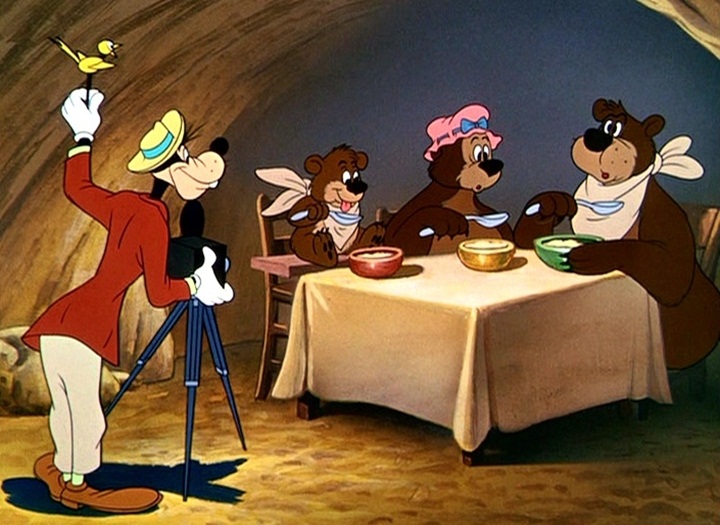 This cartoon starts with the opening shot of a tired Goofy dragging himself into his own home from ‘Goofy Gymnastics‘ from the previous year.
This time, however, the voice over advises Goofy to get a hobby, for example photography. This leads to several great photography gags, especially when Goofy tries to make pictures of a bear, which results in a long, fast and gag-packed chase sequence involving a funfair. It also reuses a gag involving a cab from ‘Baseball Bugs‘ (1946), showing Jack Kinney’s interest in the gag language of Disney’s rivals.
‘Hold that pose’ is one of Goofy’s funniest shorts, and certainly one of his best cartoons of the fifties.
Watch ‘Hold That Pose’ yourself and tell me what you think:
This is Goofy cartoon No. 26
To the previous Goofy cartoon: Motor Mania
To the next Goofy cartoon: Lion Down
Director: Charles Nichols
Release Date: June 9, 1950
Stars: Pluto, Milton
Rating: ★★★★★
Review:
 Pluto has a relatively small part in this very zany cartoon, penned by Goofy-storymen Dick Kinney and Milt Schaffer. It stars two alley cats trying to invade a garden full of milk, birds and fish, but guarded by our hero.
The comedy between the two cats is brilliant and the short is full of fine gags, the best of which is a bizarre fishing scene, in which one of the cats uses a milk bottle for a helmet. The larger cat is a dumb character reminiscent of George in Tex Avery’s George and Junior cartoons, and of Junior Bear in Chuck Jones’ three bear cartoons. However, unlike those shorts, the comic interplay between the two characters is devoid of dialogue. Only in the beginning they exchange some meows. The whole cartoon is a showcase of silent comedy.
‘Puss-cafe’ undoubtedly is one of Pluto’s wildest cartoons, on par with ‘Pluto at the Zoo‘ (1942) and ‘Springtime for Pluto‘ (1944), and it belongs to his all-time best. In fact, the two cats were such wonderful characters that it is hard to understand that they were only used once. Nevertheless, one of them would return as ‘Milton’ in Pluto’s last two cartoons: ‘Plutopia‘ and ‘Cold Turkey‘ from 1951, with equally funny results.
Watch ‘Puss-Cafe’ yourself and tell me what you think:
This is Pluto cartoon No. 37
To the previous Pluto cartoon: Primitive Pluto
To the next Pluto cartoon: Pests of the West
Directors: William Hanna & Joseph Barbera
Release Date: March 11, 1950
Stars: Tom & Jerry
Rating: ★★★★★
Review:
 Tom somehow is a cowboy at the ‘Dude Ranch’ in Texas.
This ranch is visited by a sexy kitten in cowboy dress, and Tom tries to impress her: first, by an outrageously cool smoking of a cigarette, then by singing to a record player and courting her at the same time. This is a wonderful scene and undoubtedly the highlight of this cartoon, which is highly enjoyable throughout, anyway.
The record player is an early testimony of the introduction of 331⁄3 and 45 rpm records two years earlier, for it is able to play with variable speeds. The cartoon also features a long bull chase, and ends with Jerry kissing the girl, and riding Tom into the sun set .
Tom and Jerry would return to the West four years later in ‘Posse Cat’, with much less funny results.
Watch ‘Texas Tom’ yourself and tell me what you think:
https://www.dailymotion.com/video/x4g58gt
This is Tom & Jerry cartoon No. 49
To the previous Tom & Jerry cartoon: Saturday Evening Puss
To the next Tom & Jerry cartoon: Jerry and the Lion


 Dr. Grob's Animation Review