
You are currently browsing the category archive for the ‘★★★★★’ category.
Directors: William Hanna & Joseph Barbera
Release Date: February 22, 1947
Stars: Tom & Jerry, Spike
Rating: ★★★★★
Review:
 Tom goes fishing in a no-fishing area, guarded by Spike. He uses Jerry as a live bait to catch an enormous pike.
The humor of this perfectly timed cartoon follows logically from the clever interplay between these four characters, it’s highlight being the sequence where Tom tries to land a big fish, which turns out to be Spike. The result is one of the most perfect Tom & Jerry cartoons ever.
Watch ‘Cat Fishin’’ yourself and tell me what you think:
This is Tom & Jerry cartoon No. 27
To the previous Tom & Jerry cartoon: Solid Serenade
To the next Tom & Jerry cartoon: Part Time Pal
Director: Jack Hannah
Release Date: March 8, 1946
Stars: Goofy
Rating: ★★★★★
Review:
 ‘A Knight for a Day’ is one of four Goofy cartoons directed by Jack Hannah, while Goofy’s usual director, Jack Kinney, was busy working on feature films ‘Make Mine Music’ and ‘Fun and Fancy Free‘.
Hannah, who shares Kinney’s love for fast and nonsensical cartoons, adopts the use of a jabbering sports reporter-like voice over, but applies it to a medieval setting, with hilarious results. Unlike Kinney’s Goofy cartoons however, Hannah’s cartoon consists of a real story with identifiable characters, splitting Goofy’s personality into various different ones.
During a medieval tournament, Cedric, a young squire, has to replace his master, Sir Loinsteak, when he falls with his head on an anvil, blocking him out. He has to face the champion, Sir Cumference, an evil opponent, who rides a black horse, smokes cigars and has a shield of bricks. Cedric wins the tournament, however, earning kisses from the ‘beautiful’ princess Esmeralda, who is another Goofy-like character.
‘A Knight for a Day’ is a fast and fervid cartoon, which is over before you know it.
Watch ‘A Knight for a Day’ yourself and tell me what you think:
This is Goofy cartoon No. 18
To the previous Goofy cartoon: Hockey Homicide
To the next Goofy cartoon: Double Dribble
Director: Friz Freleng
Release Date: November 1, 1947
Stars: Bugs Bunny, Elmer Fudd
Rating: ★★★★★
Review:
 In ‘Slick Hare’ Elmer works as a waiter in a restaurant full of celebrities.
Humphrey Bogart (voiced by Dave Barry) is one of the costumers, and he tells Elmer to bring him a rabbit or else… By chance, Elmer discovers Bugs in his kitchen and what follows is a wild chase involving more celebrities, like The Marx Brothers and Carmen Miranda.
‘Slick Hare’ is a hilarious cartoon. Highlights are a well-timed pie throwing sequence and a a great dance routine by Bugs on an irresistible samba, animated with gusto by Gerry Chiniquy. The cartoon contains some more caricatures of Hollywood stars, like Leopold Stokowski, Frank Sinatra and at the end, Bogart’s wife, Lauren Bacall.
Watch ‘Slick Hare’ yourself and tell me what you think:
This is Bugs Bunny cartoon No. 45
To the previous Bugs Bunny cartoon: Easter Yeggs
To the next Bugs Bunny cartoon: Gorilla My Dreams
Director: Robert McKimson
Release Date: June 28, 1947
Stars: Bugs Bunny, Elmer Fudd
Rating: ★★★★★
Review:
 McKimson’s second Bugs Bunny cartoon is way funnier than his first one, ‘Acrobatty Bunny‘ (1946).
In ‘Easter Yeggs’, Bugs Bunny encounters a lethargic Easter Bunny who makes Bugs replace him, because he has ‘sore feet’. Bugs ends up delivering Easter eggs in some slum, where he’s troubled by an unbelievably annoying little red-haired kid. In his next attempt he encounters Elmer Fudd, who’s only after Easter bunny stew.
Penned by Warren Foster, ‘Easter Yeggs’ is a hilarious cartoon, and without doubt among both Robert McKimson’s and Bugs Bunny’s all time best. Its highlight may be Bugs’ performance as a magician conducting a misguided trick with Elmer’s watch.
Watch ‘Easter Yeggs’ yourself and tell me what you think:
This is Bugs Bunny cartoon No. 44
To the previous Bugs Bunny cartoon: A Hare Grows in Manhattan
To the next Bugs Bunny cartoon: Slick Hare
Director: Friz Freleng
Release Date: March 27, 1948
Stars: Elmer Fudd, Sylvester
Rating: ★★★★★
Review:
 In ‘Back Alley Oproar’ a sleepy Elmer Fudd is kept awake by Sylvester’s singing in his back alley.
Sylvester turns out to be a rather talented alley cat. His performance is quite infectious, and includes the famous Largo al factotum aria from Gioachino Rossini’s ‘Il barbiero di Seviglia’, Liszt’s second Hungarian Rhapsody (which he performs by stamping with heavy boots on the staircase), “You Never Know Where You’re Goin’ Till You Get There” and “Moonlight Bay”.
At last, Elmer tries to blow Sylvester to smithereens, but they are both killed, and on his way to heaven, Elmer is disturbed by Sylvester’s nine lives singing the Sextet from Gaetano Donizetti’s ‘Lucia di Lammermoor’.
‘Back Alley Oproar’ is one of director Friz Freleng’s cartoons in which he spreads his own love for music. He does so in a very entertaining way.
The cartoon was the first of only four Elmer Fudd-Sylvester pairings. Only Freleng coupled these two characters, although they did co-star in Chuck Jones’ ensemble film ‘The Scarlet Pumpernickel‘ (1950).
Watch an excerpt from ‘Back Alley Oproar’ yourself and tell me what you think:
Director: Friz Freleng
Release Date: December 30, 1944
Stars: Bugs Bunny, Elmer Fudd
Rating: ★★★★★
Review:
 In ‘Stage Door Cartoon’, the forest scene, in which Elmer is “fishing’ for a certain rabbit”, is soon replaced by an urban environment, where Bugs flees into a stage door. From then on, the action takes place in the theater.
The numerous gags involve a great tap dance by Bugs, a spectacular dive by Elmer from a ridiculously high ladder into an “ordinary glass of water” and Elmer watching a Bugs Bunny cartoon. ‘Stage Door Cartoon’ does not make any sense, but it’s full of gags, resulting in one of the funniest of all Bugs Bunny cartoons.
‘Stage Door Cartoon’ also features a Southern Sheriff who looks and sounds like an early version of Yosemite Sam, a Friz Freleng character who would make his debut only four months later.
Watch ‘Stage Door Cartoon’ yourself and tell me what you think:
http://www.dailymotion.com/video/x301jyk
This is Bugs Bunny cartoon No. 29
To the previous Bugs Bunny cartoon: The Old Grey Hare
To the next Bugs Bunny cartoon: Herr Meets Hare
Director: Dan Gordon
Release Date: April 26, 1943
Stars: Superman
Rating: ★★★★★
Review:
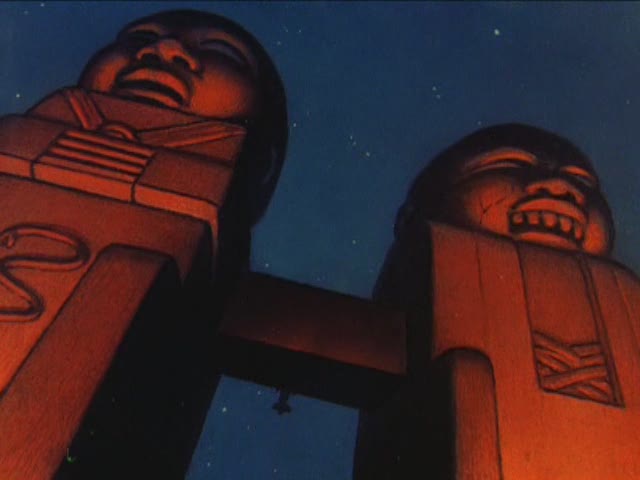 The Superman cartoon ‘Jungle Drums’ blends the war theme with the adventure setting of ‘The Mummy Strikes‘.
This time the setting is a vague African island, populated by scary natives who are under control of some mysterious Nazis. They shoot an American plane out of the sky, which contains Lois and some secrets concerning the American fleet. While the natives try to burn Lois, Clark Kent/Superman only arrives just in time to save her.
Superman beats the Nazis, while Lois warns the US Air Force against Nazi submarines threatening the fleet. The last shot is that of an angered Hitler listening to the radio how his plans were frustrated.
Although this short, like most Superman cartoons, contains a weak and badly built story, it stands out for its great shots of scary natives, with their original camera angles, stark color designs and large shadows. The end result is arguably Superman’s best film.
Watch ‘Jungle Drums’ yourself and tell me what you think:
This is Superman film No. 15
To the previous Superman film: The Mummy Strikes
To the next Superman film: Underground World
Director: Friz Freleng
Release Date: December 18, 1943
Stars: Bugs Bunny
Rating: ★★★★★
Review:
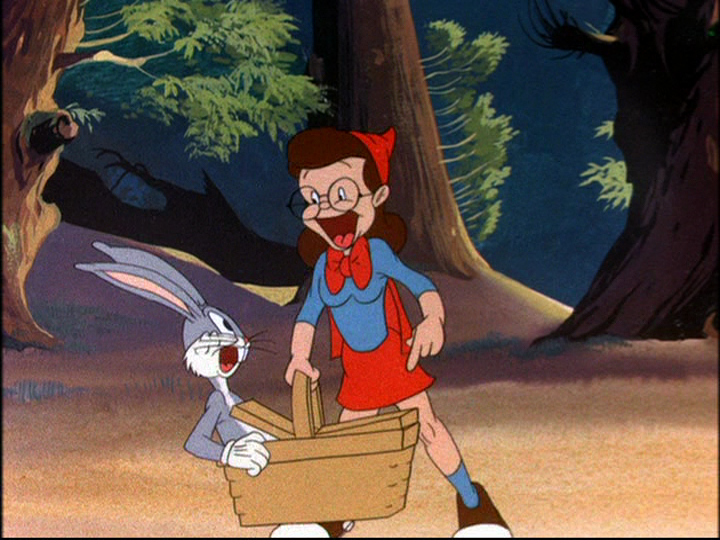 In this wacky take on the classic tale of ‘Little Red Riding Hood’, Red Riding Hood is a bespectacled, loud-voiced teenager taking Bugs in her basket to her Grandma, while singing Cole Porter’s ‘The Five O’Clock Whistle’ in her own idiosyncratic way (voiced by Bea Benadaret).
The wolf sends Red Riding Hood on a long and winding road across a mountain, while he takes a shortcut to grandma’s house, which appears to be just two meters away. The wolf doesn’t need to get rid of grandma, who’s “working swing shift at Lockheed’ (a typical war era reference), but oddly enough he has to get rid of some other wolves waiting in bed.
When Red Riding Hood arrives at grandma’s place, the wolf quickly disposes of the unappealing girl, and gets into a chase routine with Bugs, involving a marvelous door sequence, worked out perfectly in Friz Freleng’s typical timing.
However, at several points they’re interrupted by Red Riding Hood, who insists on asking her familiar questions. In the end, Bugs gets so annoyed that he punishes her instead of the wolf.
‘Little Red Riding Rabbit’ is one of the most successful of all fairy tale-inspired cartoons. It’s loaded with funny gags and one of the early highlights in the Bugs Bunny catalog.
Watch ‘Little Red Riding Rabbit’ yourself and tell me what you think:
http://ulozto.net/live/xRipWpf/bugs-bunny-little-red-riding-rabbit-1944-avi
This is Bugs Bunny cartoon No. 21
To the previous Bugs Bunny cartoon: Falling Hare
To the next Bugs Bunny cartoon: What’s Cookin’, Doc?
Director: Jack Kinney
Release Date: July 30, 1943
Stars: Goofy, Pluto (cameo)
Rating: ★★★★★
Review:
 ‘Victory Vehicles’ is the only entirely war-themed Goofy short (although the end of ‘How to be a Sailor’ (1944) refers to the war, too). It’s no army cartoon, however. Instead, the cartoon parodies propagandistic shorts of the time, using a patriotic voice over and dealing with the (real) problem of rubber shortage.
‘Victory Vehicles’ introduces various silly inventions that should replace the car as a form of transportation. The solution finally settles on the pogo-stick: “the answer to a nation’s needs”.
‘Victory Vehicles’ is a very enjoyable cartoon in its silly satire. It’s also a nice window to the shortage problems of World War II America. The film contains a very catchy theme song called ‘Hop on your Pogo Stick’, and a short cameo by Pluto.
‘Victory Vehicles’ is an important landmark in the Goofy series, because it marks Goofy’s graduation from single character to the prototypical everyman. In this short various types of Goofies can be seen, including women and children. They are provided with different voice overs, emphasizing that every Goofy we see is a different one.
Of all evolutions of a cartoon star, this is the most remarkable one. The thirties Goof, with his all too recognizable character traits has been transformed into an everyman who could be anybody, and, at the same time, still be Goofy.
Other directors would return to the original Goofy in cartoons like ‘Foul Hunting‘ (Jack Hannah, 1947) and ‘The Big Wash‘ (Clyde Geronimi, 1948), but Jack Kinney would stick to the everyman Goofy, making the most hilarious cartoons with this character.
This is Goofy cartoon No. 10
To the previous Goofy cartoon: How to Fish
To the next Goofy cartoon: How to be a Sailor
Director: Jack Kinney
Release Date: October 23, 1942
Stars: Goofy
Rating: ★★★★★
Review:

With ‘How To Swim’ director Jack Kinney really hit his stride. The film perfectly blends educational information with total nonsense.
The result is one of the best of Goofy’s ‘how to’ shorts, ‘How to swim’ starts off hilariously, when Goofy practices various strokes on a piano stool, unknowingly crossing the street while doing so. Other gags involve Goofy trying to change in a remarkably small beach locker and his attempts to bath in the surf.
The best part, however, is the diving sequence. Here, a great story device is introduced: the chart-like figure, borrowed from the educational shorts Disney made for the war effort at that time. The diving sequence also features the use of the ‘slow motion camera’, which was introduced in the ‘How to ride a horse’ sequence within ‘The reluctant Dragon‘ (1941). The combination of the slow motion camera’s ridiculously elaborate animation and the perfection of the chart figure is deadly funny.
It’s characteristic for the high quality standards at the Disney Studio that even regular gag cartoons contain beautiful and convincing effect animation, like the tidal waves in ‘How to Swim’.
Watch ‘How To Swim’ yourself and tell me what you think:
This is Goofy cartoon No. 8
To the previous Goofy cartoon: The Olympic Champ
To the next Goofy cartoon: How to Fish
Director: Dick Lundy
Release Date: January 29, 1943
Stars: Donald Duck
Rating: ★★★★★
Review:
 In the vibrant opening scene of ‘Donald’s Tire Trouble’ we watch Donald zooming with his car through the mountains with an incredible speed. Then he suddenly gets a flat tire.
In trying to fix it, practically everything goes wrong that can go wrong: Donald has trouble with the jack, the tire patch, the tire itself, and the wheel. Miraculously, he finally manages to fix the one, but then all his tires go flat…
‘Donald’s Tire Trouble’ is without doubt one of the best Donald Duck shorts dealing with Donald’s struggle with inanimate objects, and arguably Dick Lundy’s best Donald Duck cartoon. Instead of milking one gag, like he did in ‘The Village Smithy‘ and ‘Donald’s Garden‘ from 1942, he continuously proceeds from one gag to another, which leads to an impressive string of gags unseen in his earlier cartoons. Moreover, most car drivers will relate to Donald’s frustrations, which will be way more familiar than his problems in the earlier cartoons. The result is an exuberant short, more fit to the World War II era.
Watch ‘Donald’s Tire Trouble’ yourself and tell me what you think:
This is Donald Duck cartoon No. 39
To the previous Donald Duck cartoon: Der Fuehrer’s Face
To the next Donald Duck cartoon: Flying Jalopy
Director: Clyde Geronimi
Release Date: November 20, 1942
Stars: Pluto
Rating: ★★★★★
Review:
 With ‘Pluto at the zoo’ director Clyde Geronimi delivers his most successful Pluto short.
In this short Pluto carries a tiny bone when he discovers a huge bone at the Lion’s cave. He decides to steal it, but this causes him lots of trouble with the lion, a kangaroo, a gorilla and several crocodiles.
Pluto’s pantomime is wonderful in this cartoon, and, unlike most of the previous entries directed by Geronimi, there’s an absence of sentimentality, which is nicely replaced by absurdism, with the simply hilarious gorilla sequence as a highlight within the whole series.
Watch ‘Pluto at the Zoo’ yourself and tell me what you think:
This is Pluto cartoon No. 9
To the previous Pluto cartoon: T-Bone for Two
To the next Pluto cartoon: Private Pluto
Director: Władysław Starewicz
Release Date: 1922
Rating: ★★★★★
Review:
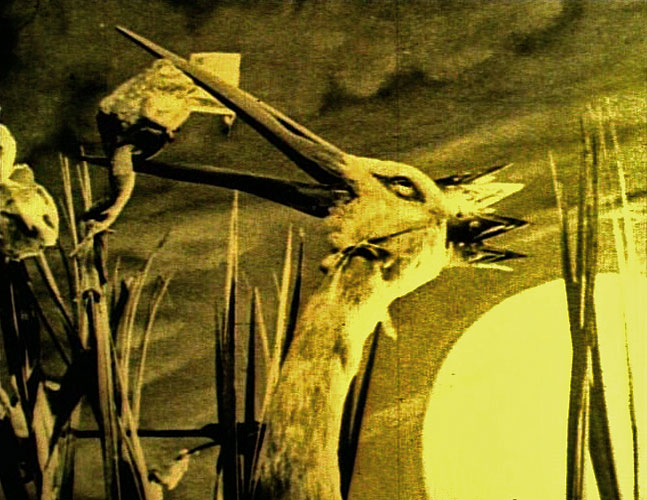 After the October revolution, Władysław Starewicz fled to France, where he continued to make stop motion films until his death in 1965. ‘The Frogs Who Wanted a King’ is the fourth film he made in France, and probably his most political.
The film is based on one of Aesop’s fables. Some frogs ask Jupiter for a king. Jupiter sends them one, but the king looks like a tree and does nothing at all. The frogs don’t like him, so Jupiter sends them a stork, who, naturally, eats the unfortunate amphibians.
The message may be that it’s better to have a dull government than one that kills you, a message Starewicz could certainly relate to, being forced to exile by the oppressing communist regime in Russia.
Once again, Starewicz’ animation is top notch. The film has a particularly fable-like character, taking place in its own, very convincing universe.
Watch ‘The Frogs Who Wanted a King’ yourself and tell me what you think:
Director: Hawley Pratt
Release Date: May 17, 1967
Stars: The Pink Panther, The Little Guy
Rating: ★★★★★
Review:
 In ‘Pink of the Litter’, the Pink Panther is punished for littering by the little guy, who, in this cartoon, stars as a cop, a judge, a ranger, a fireman and a mayor. The Pink Panther has to clean ‘Litterburg’ from its rubbish. His methods include ‘instant shrink’ and making a giant paper plane out of the litter.
This is an original cartoon with a great story using blackout gags, building up to a great finale. The very idea of the little guy appearing in different functions is brilliant. In short, ‘Pink of the Litter’ is easily one of the best Pink Panther cartoons.
Watch ‘Pink of the Litter’ yourself and tell me what you think:
Director: Chuck Jones
Airing Date: December 18, 1966
Rating: ★★★★★
Review:
 ‘How The Grinch Stole Christmas’ is a wonderful Christmas cartoon. The Christmas of a little town called the Whoville is threatened by a green character called the Grinch, who disapproves of Christmas, and particularly the noise involved. He decides to ‘steal’ Christmas from the little creatures, but then he discovers that Christmas is not restricted to objects.
This special, lasting 26 minutes, is one of Chuck Jones’s productions for MGM television. It’s a very faithful and beautiful reading of the classic Dr. Seuss children’s book, keeping Dr. Seuss’s rhymes and faithfully reproducing its designs, but extending those by long and beautiful silent comedy scenes and Jones’s wonderful facial expressions, to even better results.
Especially the Grinch himself is a wonderfully expressive character. In him Jones’ mastery of facial expression reaches its apex. Particularly amazing is the scene in which the Grinch thinks up his evil plan, making his face curl with wickedness.
The story is told by Boris Karloff’s grim voice, and it contains two songs: a rather annoying Christmas song sung by the Whos and an odd song describing the meanness of the Grinch. While we hear this song, we see the Grinch steal every Christmas item in Whoville.
All in all, it’s a classic. It’s arguably the best Dr. Seuss adaptation ever, and certainly one of the best Christmas cartoons ever made. It’s certainly better than the rather annoying live action remake from 2000.
Watch ‘How The Grinch Stole Christmas’ yourself and tell me what you think:
https://myspace.com/171601491/video/how-the-grinch-stole-christmas/47941731
Director: Jan Švankmajer
Release Date: 1967
Rating: ★★★★★
Review:
 ‘Historia Naturae, Suita’ is an abstract, yet morbid and disturbing film.
It uses drawings, models, skeletons, stuffed and live animals, which change into each other and which perform morbid dances. Their antics are interspersed with a close up of a man eating meat.
We see molluscs (Aquatilia, foxtrot), insects (Hexapoda, bolero), fish (Pisces, blues), reptiles (Reptilia, tarantella), birds (Aves, tango), mammals (Mammalia, menuet), monkeys (Simiae, polka) and man (Homo, waltz), successively.
It shows us that we, men, are made from the same mortal matter as the rest of the animal kingdom, which in this film appear to us only as collectibles or food. This unsettling reminder is emphasized by the last shot, in which the human is replaced by a skull, eating…
The music is a perfect match to the surrealistic imagery, with its rather abstract, uncanny and atonal renderings of the dance forms mentioned.
Watch ‘Historia Naturae, Suita’ yourself and tell me what you think:
http://www.totalshortfilms.com/ver/pelicula/379
‘Historia Naturae, Suita’ is available on the DVD ‘Jan Svankmajer – The Complete Short Films’
Director: Jan Švankmajer
Release Date: 1966
Rating: ★★★★★
Review:
 In ‘Et Cetera’ three faceless human figures demonstrate repetitive and aimless actions.
The first shows how to fly with wings, only to reach his own starting point. The second transforms himself into the animal he’s training using a whip, and the third keeps on drawing houses he cannot enter or leave.
Unlike most of Jan Švankmajer’s films, ‘Et Cetera’ uses 2d animation. It’s a clever and somehow saddening film: although the three little stories are extremely simple, they seem to tell something about the condition humaine. ‘Et Cetera’ uses great electronic music, which adds to the surrealistic atmosphere.
Watch ‘Et Cetera’ yourself and tell me what you think:
‘Et Cetera’ is available on the DVD ‘Jan Svankmajer – The Complete Short Films’
Director: Jan Švankmajer
Release Date: 1964
Rating: ★★★★★
Review:
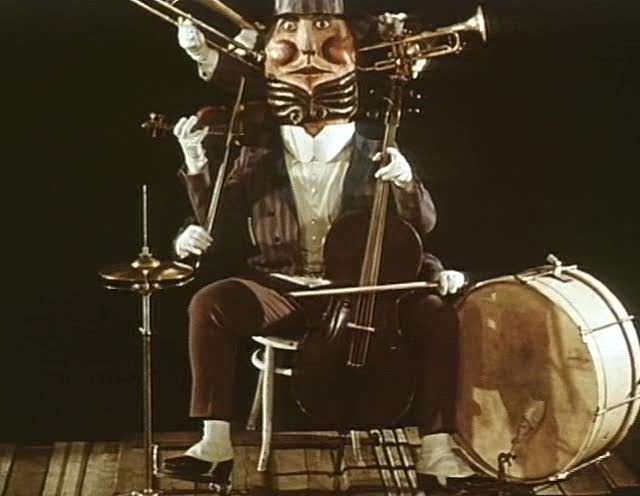 In ‘The Last Trick’ two magicians in large masks perform their impossible tricks one after another against a black, empty background.
Although they stay polite, their congratulationary handshakes between the tricks gradually become more and more violent, ending in a disastrous mutual disembodiment. The last shot is of the only really living organism inhabiting this surrealist world, a beetle, dead.
‘The Last Trick’ is Czech film maker Jan Švankmajer’s first film, and already his obsessions with puppets, body parts and death are full blown. Its humor is dark, its images are grim and its story is very unsettling. Švankmajer’s first film (which contains a little stop motion animation) is also his first masterpiece.
Watch ‘The Last Trick’ yourself and tell me what you think:
‘The Last Trick’ is available on the DVD ‘Jan Svankmajer – The Complete Short Films’
Director: Friz Freleng
Release Date: August 25, 1965
Stars: The Pink Panther
Rating: ★★★★★
Review:
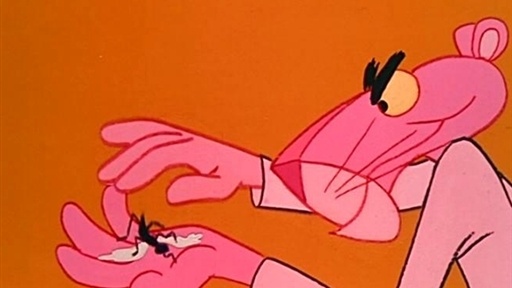 After a long evening of watching television, a tired Pink Panther tries to sleep, but he’s hindered by a small but annoying mosquito.
‘The Pink Tail Fly’ is one of the better entries in the Pink Panther series, and a worthy addition to the sleeplessness cartoon canon, being able to compete with cartoons like the Woody Woodpecker cartoon ‘Coo-Coo Bird‘ and the Donald Duck cartoon ‘Sleepy Time Donald’ (both from 1947). It contains several good gags, which build up to a great finale. The highlight may be the gag in which the Pink Panther tries to kill the mosquito using karate.
‘The Pink Tail Fly’ was the last Pink Panther film to be directed by Friz Freleng himself.
Watch ‘The Pink Tail Fly’ yourself and tell me what you think:
Director: Friz Freleng
Release Date: March 17, 1965
Stars: The Pink Panther
Rating: ★★★★★
Review:
 ‘Dial “P” for Pink’, the Pink Panther’s fourth film, has nothing to do with calling on a phone. Instead, we see a burglar trying to crack a safe. Oddly enough, this safe is in habited by the Pink Panther.
This extraordinary, but very simple idea is worked out perfectly into a tight plot (by Bob Kurtz), which matches that of ‘The Pink Phink‘ (1964).
‘Dial “P” For Pink’ is the first Pink Panther film to use music from the Pink Panther live action film ‘A shot in the dark’ (1964). Besides the familiar Pink Panther theme, this would become the background music for practically every Pink Panther short to come.
Watch ‘Dial “P” For Pink’ yourself and tell me what you think:


 Dr. Grob's Animation Review