
You are currently browsing the category archive for the ‘★★★’ category.
Director: Wolfgang Reitherman
Release Date: November 8, 1973
Rating: ★★★
Review:
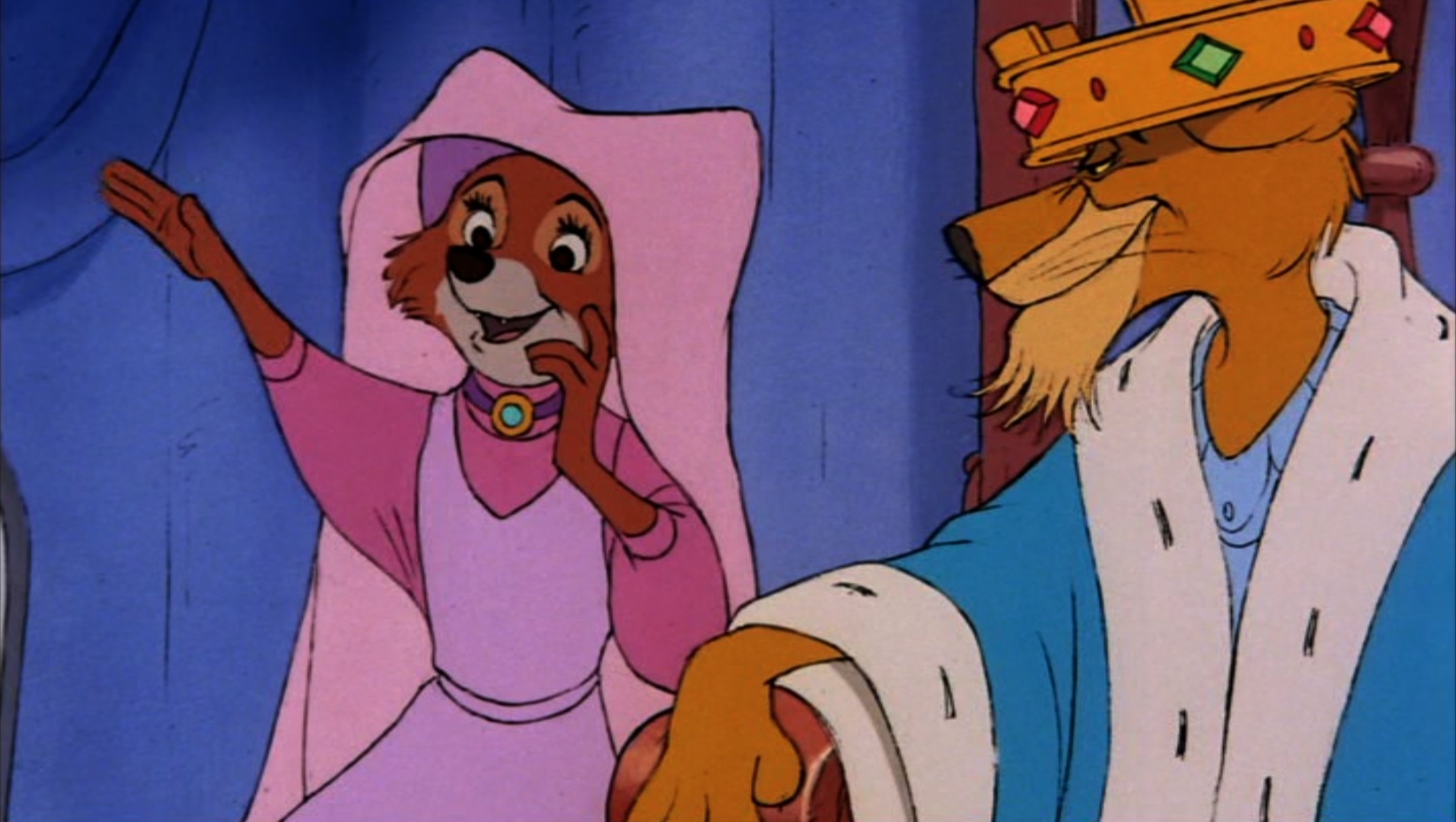
‘Robin Hood’ was Walt Disney studio’s 21st feature. The film’s story and designs lean heavily on the 1938 feature ‘The Adventures of Robin Hood’, starring Errol Flynn.
But by now the characters are portrayed as animals, a relic of an abandoned feature film project about Reynard the fox called ‘Chanticleer’. This great idea doesn’t lead to a great film, however. Despite the fine character designs, the strong voice cast (a nice mix of British and American accents) and the often superb animation, Robin Hood must be placed among the weaker Disney features.
Many of the character designs are so reminiscent of those in ‘Jungle Book’, the film almost feels like a rip-off. There’s a bear, voiced by Phil Harris, the voice of Baloo, there’s a snake with the power of hypnosis and there are some funny vultures. The story evolves at a remarkably slow pace, taking almost half an hour to introduce the characters (first Robin and Little John, then Prince John and Sir Hiss, followed by the Sheriff, and in another scene Maid Marian and Lady Kluck), before some sort of plot sets in.
More than any earlier Disney feature ‘Robin Hood’ seems particularly aimed at children: both great drama and great comedy are absent and danger is never really felt, save for two very short moments. The great finale is anything but that, and King Richard serves as an off-stage deus ex machina, putting an equally welcomed as unsatisfying end to the film.
In a 1973 letter to animator Larry Ruppel, cited in John Canemaker’s book ‘Walt Disney’s Nine Old Men & The Art of Animation’, animator Frank Thomas expressed the film’s shortcomings:
“We obviously decided to keep it on the ‘fun’ side, but I have worried that the audiences would feel it was too flimsy – that we were not being quite serious enough with our characters. For instance, does anyone really fear Prince John? Is Robin ever worried about his ability to achieve something or even how it should be done? Did winning Maid Marian make any difference in Robin’s behavior. In real life it would have.”
The rather tinned music doesn’t help, either. What’s more, the film’s three forgettable songs are all presented within a twelve minutes period of the film (0’46-0’58), with which the film reaches dead waters after the tournament scene, which was less spectacular than it could be in the first place. Even worse, the dance scene blatantly reuses complete dance animation sequences from ‘Snow White and the seven dwarfs’ (1937), ‘Jungle Book’ (1967) and ‘Aristocats’ (1970). All these aspects give the film a cheap feel. It frustrated younger animators like Don Bluth, who thought the film lacked both quality and soul, and it indirectly led to Bluth’s departure in 1979, during the production of ‘The Fox and the Hound‘ (1981).
The film’s best moments are the opening song ‘Oo-De-Lally’, sung by Roger Miller (as Alan-a-Dale), sir Hiss flying around with his head in a balloon and propelling himself like a helicopter, and King John as a whole. This is by all means a marvelous character, perfectly voiced by Peter Ustinov, and animated with gusto. Because of the film’s strong visuals (after all, it’s the only Robin Hood film starring foxes), the film fares better in memory than by actually watching it.
In all, Robin Hood is a timid, rather lifeless and all too safe feature, which makes painfully clear that in the seventies Disney’s glory days lay years behind. Indeed, it would take the studio another fifteen years to crawl out of the uncertain times the studio went through after Walt Disney’s death.
Watch the trailer for ‘Robin Hood’ and tell me what you think:
‘Robin Hood’ is available on Blu-Ray and DVD
Directors: William Hanna & Joseph Barbera
Release Date: March 21, 1953
Stars: Tom & Jerry
Rating: ★★★
Review:
 ‘Johann Mouse’ is the story of a waltzing mouse, who inhabits the home of Johann Strauss jr. in Vienna.
The mouse (Jerry) only comes out to waltz when the master plays, so when he’s out of town, the cat (Tom) learns to play waltzes to make the mouse waltz. This novelty leads to the two performing for the Austrian emperor.
‘Johann Mouse’ is a cute little fairy tale, told by a quasi-German voice over. However, the cartoon is hampered by all too economic animation. Especially Jerry’s design has become very streamlined and rather stiff in this cartoon, making his dance movements less impressive than in earlier entries.
Watch ‘Johann Mouse’ yourself and tell me what you think:
This is Tom & Jerry cartoon No. 75
To the previous Tom & Jerry cartoon: Jerry and Jumbo
To the next Tom & Jerry cartoon: That’s My Pup
Director: Charles Nichols
Release Date: April 18, 1953
Stars: Mickey Mouse, Pluto
Rating: ★★★½
Review:
 ‘The Simple Things’ was to be Mickey’s and Pluto’s last theatrical cartoon (Pluto’s own series had stopped two years earlier).
Unfortunately it is a rather uninspired goodbye. The cartoon returns to the elongated situation comedy of the thirties. There are only two plots here, which hardly build up to a finale. First: Pluto’s encounters with a humanized clam and second, Mickey and Pluto’s fight with a hungry seagull. Both parts are executed routinely, without inspiration.
This makes ‘The Simple Things’ a sad ending to a career that started so phenomenally well, changing the course of animation, 25 years earlier. It would take Mickey another thirty years to return to the movie screen in ‘Mickey’s Christmas Carol‘ from 1983. Meanwhile, Mickey & Pluto director Charles Nichols would direct three Donald Duck cartoons, and one special, ‘The Saga of Windwagon Smith‘, before leaving Disney for Hanna-Barbera in 1962.
Watch ‘The Simple Things’ yourself and tell me what you think:
This is Mickey Mouse cartoon No. 125
To the previous Mickey Mouse cartoon: Pluto’s Christmas Tree
To the next Mickey Mouse cartoon: Mickey’s Christmas Carol
Directors: William Hanna & Joseph Barbera
Release Date: September 8,1951
Stars: Tom & Jerry, Spike & Tyke
Rating: ★★★
Review:
 While chasing Jerry Tom makes Tyke dirty.
Spike threatens Tom he’ll tear him limb for limb, when he makes Tyke dirty again. So Tom does his best to keep Tyke clean. To no avail, because, as expected, Jerry takes advantage of the situation. ‘Slicked-up Pup’ is based on a routine that goes all the way back to Tom & Jerry’s very first film (‘Puss gets the Boot‘ from 1940). Unfortunately, it has all been done before, even with cleaning (‘Mouse Cleaning‘ from 1948), and with Spike & Tyke (‘Love That Pup‘ from 1949). The result is less amusing than any of the previous films. The best gag may be when Tom pretends Tyke to be a chicken.
Watch ‘Slicked-up Pup’ yourself and tell me what you think:
This is Tom & Jerry cartoon No. 60
To the previous Tom & Jerry cartoon: His Mouse Friday
To the next Tom & Jerry cartoon: Nit-witty Kitty
Director: Friz Freleng
Release Date: September 22, 1951
Stars: Tweety & Sylvester, Granny
Rating: ★★★
Review:
 Sylvester is down in the dumps and hungry, foraging a harbor, when he discovers Tweety on a ship.
He climbs aboard, and what follows are several gags involving glasses and sea sickness. The best gag is when Sylvester paints Tweety on Granny’s glasses. Most of the other gags, however, are mediocre, and feel routinized. For example, Tweety reuses a sea sickness gag from Tex Avery’s ‘The Screwball Squirrel’ (1944), but much less well executed.
Watch ‘Tweety’s S.O.S.’ yourself and tell me what you think:
http://www.dailymotion.com/video/x1z27d9_sylvester-the-cat-ep-25-tweety-s-s-o-s_fun
‘Tweety’s S.O.S.’ is available on the DVD set ‘Looney Tunes Golden Collection, Vol. 1’
Director: Robert McKimson
Release Date: December 12, 1951
Stars: Bugs Bunny
Rating: ★★★
Review:
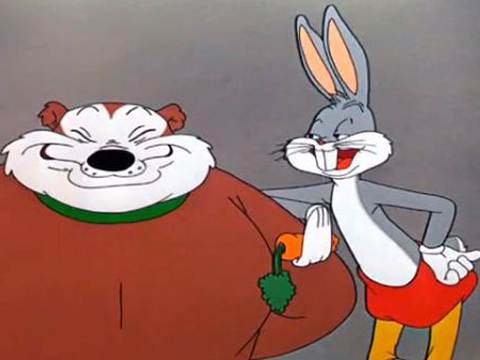 Five years after his first Bugs Bunny cartoon, ‘Acrobatty Bunny‘ (1946), McKimson returns to the circus setting.
This time Bugs is the new acrobat partner of an egotistical star acrobat bear called Bruno. This “Slobokian bear” is not a good sport and tries to get rid of Bugs, but of course, the reverse happens.
‘Big Top Bunny’ is better than ‘Acrobatty Bunny’, but it still suffers: it’s worn down by the high amount of rather unfunny dialogue and its slow pace. Nevertheless, the cartoon builds up nicely, and its best gags come in last: first there’s a great cycling gag, then there’s a superb gag in which Bugs and Bruno compete in the most daring high diving act. This is quickly followed by the frantic finale in which Bugs disposes of the bear once and for all.
Watch ‘Big Top Bunny’ yourself and tell me what you think:
https://www.dailymotion.com/video/x2fg9zb
‘Big Top Bunny’ is available on the DVD set ‘Looney Tunes Golden Collection, Vol. 1’
This is Bugs Bunny cartoon No. 86
To the previous Bugs Bunny cartoon: Ballot Box Bunny
To the next Bugs Bunny cartoon: Operation: Rabbit
Director: Friz Freleng
Release Date: June 2, 1951
Stars: Tweety & Sylvester, Granny
Rating: ★★★
Review:
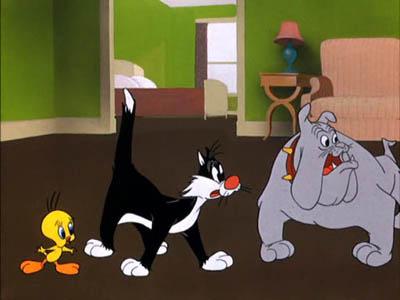 Granny sneaks Tweety into a hotel where no pets are allowed.
Another old lady sneaks Sylvester in, who inhabits the room next to Tweety. Like in ‘All a bir-r-r-d‘ Sylvester encounters a vicious bulldog, too. The cartoon contains a classic corridor-with-doors-gag, but the cartoon’s greatest joy is its great twist on the chase routine, provided by a pet inspector who at times interrupts the chase of the three animals.
‘Room and bird’ is the first of four 1951 Warner Brothers cartoons featuring music by Eugene Poddany instead of Carl Stalling.
Watch ‘Room and Bird’ yourself and tell me what you think:
http://www.dailymotion.com/video/x1z26hv_sylvester-the-cat-ep-24-room-and-bird_fun
Director: Friz Freleng
Release Date: July 23, 1949
Stars: Tweety & Sylvester
Rating: ★★★
Review:
 ‘Bad Ol’ Putty Tat’ is only the third of the Tweety and Sylvester shorts, but it already feels routine.
The short opens with Tweety’s birdhouse all wrapped in barbed wire and a wrecked Sylvester sitting below, thinking how to reach the bird. Friz Freleng and his team waste no time and immediately start with Sylvester’s attempts in blackout gags involving a fake female bird and a badminton game.
In this short Sylvester does manage to swallow Tweety, but the little bird takes control of his head, steering the cat like a train into a stone wall.
Watch ‘Bad ol’ Putty Tat’ yourself and tell me what you think:
http://www.dailymotion.com/video/x1z1w1q_sylvester-the-cat-ep-14-bad-ol-putty-tat_fun
Director: Jack Kinney
Release Date: January 5, 1951
Stars: Goofy, the mountain lion
Rating: ★★★
Review:
 In this short Goofy inhabits a house on the top floor of a large apartment block. He needs an extra tree for his hammock, so he fetches one from a forest nearby.
Unfortunately, he’s visited by the tree’s former owner, the mountain lion from the Donald Duck short ‘Lion Around‘ (1950), and together they fight over the hammock.
The gag routine is laid out well, involving many ringings of doorbells and falls from great heights, resulting in an extraordinarily long falling sequence. However, the comedy is hampered by irritating vocal sounds by both Goofy and the mountain lion, and by a slightly sloppy timing. This is too bad, for a possibly very funny cartoon now only becomes average.
In 1952 the mountain lion would reappear again in the Goofy short ‘Father’s Lion’.
Watch ‘Lion Down’ yourself and tell me what you think:
This is Goofy cartoon No. 27
To the previous Goofy cartoon: Hold That Pose
To the next Goofy cartoon: Home Made Home
Director: Charles Nichols
Release Date: May 19, 1950
Stars: Pluto
Rating: ★★★
Review:
 Pluto is sleeping at ‘Mickey’s outdoor reserve’, a forest reserve deep in the mountains, which is shown in a beautiful pan opening shot. There the howling of the wolves, a.k.a. the call of the wild awakes “his primitive instinct”, which takes the shape of a little blue wolf character.
The instinct tries to make Pluto give up his easy life to hunt some meat outdoors. But Pluto turns out to be a lousy tracker, and when he’s bullied by both a rabbit and a bear he rushes home, only to discover that the little wolf has eaten his bread and milk meal.
‘Primitive Pluto’ is a nice cartoon, if not among Pluto’s best. It shows how far Pluto had come from his roots as a tracking bloodhound as shown in ‘The Chain Gang‘ (1930). Like Mickey, Donald and Goofy, Pluto had become urbanized and settled over the years. It’s nice to watch the animators play with this fact.
Watch ‘Primitive Pluto’ yourself and tell me what you think:
This is Pluto cartoon No. 36
To the previous Pluto cartoon: Wonder Dog
To the next Pluto cartoon: Puss-cafe
Directors: William Hanna & Joseph Barbera
Release Date: December 10, 1949
Stars: Tom & Jerry, Meathead
Rating: ★★★
Review:
 Tom and Meathead are having a tennis match, first against each other, then against Jerry. There’s no fair play involved, however, as all rules are broken, including the laws of nature.
‘Tennis Chumps’ is one of the most violent of all Tom & Jerry cartoons, and none of the three protagonists is sympathetic in it. It’s perhaps because of this that the humor of ‘Tennis Chumps’ never comes off, despite its fast timing and abundance of Tex Averyan gags.
The inspiration of the subject of ‘Tennis Chumps’ may have come from the otherwise very different Goofy short ‘Tennis Racquet‘ from four months earlier.
Watch ‘Tennis Chumps’ yourself and tell me what you think:
This is Tom & Jerry cartoon No. 46
To the previous Tom & Jerry cartoon: Jerry’s Diary
To the next Tom & Jerry cartoon: Little Quacker
Directors: Bill Jones, Jeff Simpson & Ben Timlett
Release Date: November 2, 2012
Stars: Graham Chapman
Rating: ★★★
Review:
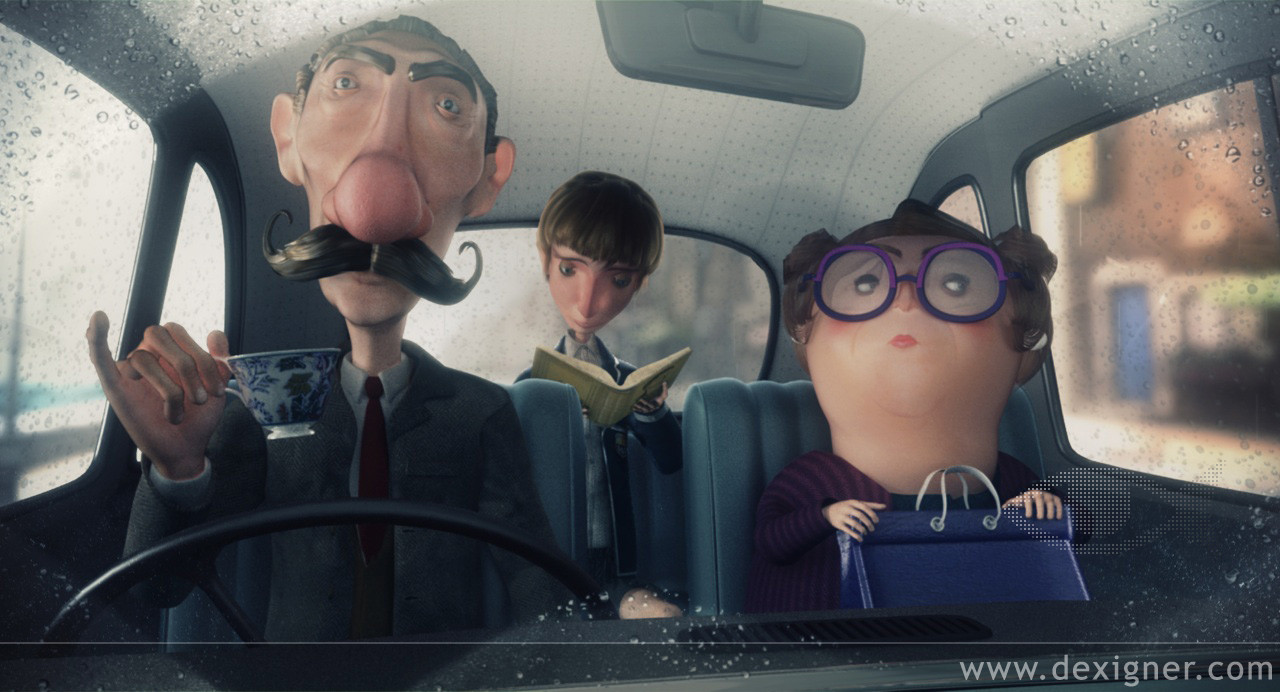 ‘A Liar’s Autobiography: The Untrue Story of Monty Python’s Graham Chapman’ is a film adaptation of Graham Chapman’s own nonsensical autobiography.
At first the film appears to follow Chapman’s book closely, using his own voice over from a audiobook recording. In fact, apart from one song all of Chapman’s vocalizations are by Graham Chapman himself, using various sources. Other former Monty Python members provide some voices, too.
The film adaptation of Chapman’s book is excellent, perfectly blending his dry humor with tongue-in-cheek images. However, the film makers want to make the film a biopic, leaving the book half way and adding some chapters of their own. At this point the film starts to drag. It becomes less humorous and more wandering, with lots of images drenched in sex and alcohol. And so, the film fades out ingloriously, leaving less an impression than it did when it started.
‘A Liar’s Autobiography’ was made by no less than fourteen different animation studios, and the overall array of styles is refreshing and at times mesmerizing. At the same time it can become a bit tiring to watch a changing of style at every scene, and sometimes the design is subpar, or downright ugly. The result is a moderately entertaining film that remains shallow and unmoving, nonetheless.
Watch the trailer of ‘A Liar’s Autobiography: The Untrue Story of Monty Python’s Graham Chapman’ yourself and tell me what you think:
Director: Robert McKimson
Release Date: August 6, 1949
Stars: Bugs Bunny
Rating: ★★★
Review:
 Bugs Bunny is at the dog races , where he falls in love with the mechanical bunny leading the dogs.
Bugs disposes of the dogs, having a hard time on number seven. But when he can finally kiss his sweetheart, the results are electrifying!
‘The Greyhounded Hare’ shows some of the flaws that were creeping into the McKimson cartoons around this time: there is a lot of excess animation, especially on Bugs Bunny; but worse, there is a surplus of dialogue, even though Bugs Bunny is the only talking character. Unfortunately, this leads to a cartoon in which the idea is sillier than its execution, despite a short Tex Averyan doubletake and another surprisingly Tex Averyan dynamite gag.
Watch ‘The Grey Hounded Hare’ yourself and tell me what you think:
http://www.dailymotion.com/video/x19d399_the-grey-hounded-hare_fun
This is Bugs Bunny cartoon No. 63
To the previous Bugs Bunny cartoon: Knights Must Fall
To the next Bugs Bunny cartoon: The Windblown Hare
Director: Friz Freleng
Release Date: October 7, 1950
Stars: Tweety & Sylvester, Granny
Rating: ★★★
Review:
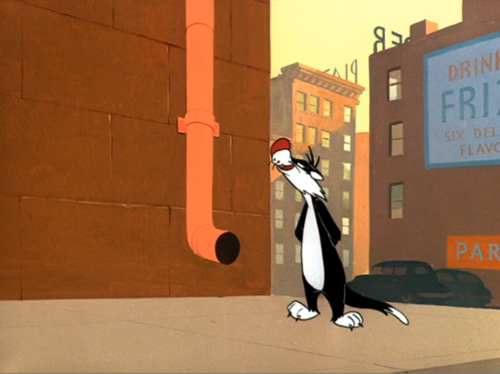 ‘Canary Row’ has absolutely nothing to do with John Steinbeck’s novel ‘Cannery Row’.
Instead, it is the sixth Tweety and Sylvester cartoon, and the first to feature Granny as Tweety’s owner. In this short Sylvester tries to capture Tweety, who lives in on a top floor in a hotel in which no cats are allowed. But Tweety and his owner Granny give Sylvester a hard time.
The takes on Sylvester are superb: he’s well animated and his gags are excellently timed, showing Freleng’s craftsmanship. However, Tweety and Granny are hardly as funny, and their appearances wear the comedy down.
If not necessarily for its comedy,’Canary Row’ is noteworthy for its beautiful urban backgrounds, painted by Paul Julian, who would soon join UPA to elevate his background art to even greater heights.
Watch ‘Canary Row’ yourself and tell me what you think:
http://www.dailymotion.com/video/x1z226r_sylvester-the-cat-ep-19-canary-row_fun
‘Canary Row’ is available on the DVD set ‘Looney Tunes Golden Collection, Vol. 1’
Directors: James Algar, Clyde Geronimi, Jack Kinney
Release Date: October 5, 1949
Rating: ★★★
Review:
 ‘The Wind in the Willows’ is the first of the two stories that make up the compilation feature ‘The Adventures of Ichabod and Mr Toad‘.
This story had originally been conceived in 1938 as a possible feature film, before it was shelved in 1942. The 1949 version is clearly truncated, and it shows. This story tells only an episode from ‘The wind in the Willows’ starring the enthusiastic Toad, whose love for chariots and cars causes a lot of trouble for himself and his quiet, all too British friends Water rat, Mole and Badger. The story is quite unfaithful to the book, giving a large role to one Cyril the horse and containing both a long scene at the court and a long sequence in which our four friends try to steal a document from a gang of weasels.
Although the English feel is retained, this version of ‘The Wind in the Willows’ completely lacks the poetry so typical for the book. Sure, Toad’s intoxicating character has been transferred to the screen very well, but the characters beside him never really come off. Moreover, the story is told too unevenly to be either exciting or endearing, and the interplay between animals and humans remains unconvincing. The backgrounds are uninspired, especially when compared to those in ‘The Legend of Sleepy Hollow‘, except for those in the winter train sequence. The weasels, which are animated excellently with broad comedy, anticipate those in ‘Who Framed Roger Rabbit?‘ (1988).
Watch the trailer for ‘The Adventures of Ichabod and Mr Toad’ yourself and tell me what you think:
‘The Adventures of Ichabod and Mr Toad’ is available on DVD
Directors: James Algar, Clyde Geronimi, Jack Kinney
Release Date: October 5, 1949
Rating: ★★★
Review:
 The adventures of ‘Ichabod and Mr. Toad’ was the last of the Disney compilation features so typical of the 1940s.
Like ‘Fun and Fancy Free‘ (1947) it consists of only two stories, this time both drawn from literature. Both use a narrator, which gives the films a feeling of moving illustrations. Neither of the stories is particularly endearing: the story of Mr. Toad lacks the poetry of the original story, the story of Sleepy Hollow lacks speed. It would be a happy return to direct story telling (opposed to using voice overs) in ‘Cinderella‘, the next year.
The six directing animators of this feature all belong to the group of ‘nine old men’.
‘The Adventures of Ichabod and Mr Toad’ consists of the following two episodes, which I will discuss in more detail elsewhere:
1. The Wind in the Willows
2. The Legend of Sleepy Hollow
Watch ‘The Adventures of Ichabod and Mr Toad’ yourself and tell me what you think:
Director: Chuck Jones
Release Date: December 18, 1948
Stars: Porky Pig, Sylvester
Rating: ★★★
Review:
 Chuck Jones was the only director to pair Porky Pig with Sylvester.
His Sylvester is very different from the one in Freleng’s Tweety cartoons. In Jones’s shorts he’s a cowardly cat that cannot speak. In all Porky-Sylvester cartoons Porky tries to stay asleep unaware of the real dangers around him. Sylvester, on the other hand, sees them all, but fails completely in convincing his master of the dangers.
The aptly titled ‘Sacredy Cat’ was the first of a series of three. In this cartoon Porky and his cat Sylvester enter their new mansion, which has genuine horror allure, scaring Sylvester to death. And for a good reason, because this mansion is inhabited by homocidal Hubie and Bertie-like mice who make several attempts to murder Sylvester and Porky.
Only when Porky discovers the mice, too, who lead him to a certain death, Sylvester rediscovers his courage and chases all the mice out of the house, except for the headsman mouse, who knocks the cat down, and reveals to be a caricature of comedian Lew Lehr (1895-1950), exclaiming a twist on the comedian’s catchphrase: “pussycats is the craziest people!”. An odd ending to a sometimes rather unsettling cartoon.
Porky and Sylvester would reunite six years later in an all too similar cartoon called ‘Claws for Alarm’ (1954), and again in ‘Jumpin’ Jupiter‘ (1955).
Watch ‘Scaredy Cat’ yourself and tell me what you think:
http://www.dailymotion.com/video/x1z1upl_sylvester-the-cat-ep-12-scaredy-cat_fun
‘Scaredy Cat’ is available on the DVD set ‘Looney Tunes Golden Collection, Vol. 1’
This is Porky Pig cartoon no. 121
To the previous Porky Pig cartoon: Riff Raffy Daffy
To the next Porky Pig cartoon: Awful Orphan
Directors: William Hanna & Joseph Barbera
Release Date: February 26, 1949
Stars: Tom & Jerry, Mammy Two-Shoes
Rating: ★★★
Review:
 Mammy orders Tom to go out, in the pouring rain, so Tom fakes a cold to be able to stay inside bullying Jerry.
But Jerry elaborates on the idea, drawing polka dots on Tom, making him think he’s really ill, so the mouse can put extreme treatments on the cat. When Tom finally discovers the truth, they both really get the measles.
‘Polka Dot Blues’ is a nice cartoon, albeit not among Tom & Jerry’s best. It contains some mild Tex Averyan takes, and a story line akin to the Donald Duck short ‘Donald’s Off Day’ (1944). Jerry’s ‘treatments’ form the highlight of the cartoon.
Watch an excerpt from ‘Polka Dot Puss’ yourself and tell me what you think:
This is Tom & Jerry cartoon No. 39
To the previous Tom & Jerry cartoon: Mouse Cleaning
To the next Tom & Jerry cartoon: The Little Orphan
Directors: William Hanna & Joseph Barbera
Release Date: June 1, 1948
Stars: Tom & Jerry
Rating: ★★★
Review:
 Jerry teams with a canary to withstand Tom’s attempts to eat them both. Unfortunately, this first of several Jerry-and-a-bird-cartoons adds nothing to the elementary chase formula.
Jerry would team several birds after this one, the most famous being Little Quacker, a talkative little duck. These teamings would lead to very cute cartoons, but these are not Tom & Jerry’s funniest. At least ‘Kitty Foiled’ isn’t, despite a frantic pace (the first quiet scene only enters after 2:30!). It even would be one of the more forgettable Tom & Jerry cartoons, were it not for a marvellous scene in which Tom thinks he’s been shot.
Watch ‘Kitty Foiled’ yourself and tell me what you think:
This is Tom & Jerry cartoon No. 34
To the previous Tom & Jerry cartoon: The Invisible Mouse
To the next Tom & Jerry cartoon: The Truce Hurts
Directors: William Hanna & Joseph Barbera
Release Date: March 15, 1947
Stars: Tom & Jerry, Mammy Two-Shoes
Rating: ★★★
Review:
 Mammy threatens Tom he goes out if he doesn’t catch ‘that mouse’.
In the chase Tom accidentally gets drunk, which changes him into Jerry’s best pal and rebellious against Mammy. This can’t go well, and in the end we see Mammy chasing a hiccuping Tom in a moonlit landscape.
The animation of the drunken Tom is very well done and a delight to watch. However, somehow, ‘Part Time Pal’ also seems to be the most inspirational cartoon to the Czech studio Gene Deitch led for his Tom and Jerry cartoons (1961-1962), because Tom’s design in this cartoon is remarkably similar to those later, way more poorly animated cartoons.
Watch ‘Part Time Pal’ yourself and tell me what you think:
http://www.dailymotion.com/video/x2mfpnw
This is Tom & Jerry cartoon No. 28
To the previous Tom & Jerry cartoon: Cat Fishin’
To the next Tom & Jerry cartoon: The Cat Concerto


 Dr. Grob's Animation Review