
You are currently browsing the category archive for the ‘★★★’ category.
Director: Friz Freleng
Release Date: May 22, 1947
Stars: Bugs Bunny
Rating: ★★★
Review:
 ‘A Hare Grows in Manhattan’ starts with a great premise: Bugs is a Hollywood star who has it made.
He is visited by one “Lola Beverley” (only a voice over) who asks him to tell of his humble origin. Next we watch a youthful Bugs in East-side, New York encountering a group of tough street dogs led by a rather dumb bulldog wearing a bowler hat.
Unfortunately, this section remains an ordinary chase sequence, which does not differ from an ordinary Bugs Bunny cartoon. Three years later, McKimson would reuse the idea of Bugs reminiscing his origins in ‘What’s Up Doc?‘, with much better results.
‘A Hare Grows in Manhattan’ contains a ‘little piggy’ gag which was to be repeated by Tweety in ‘Who Framed Roger Rabbit‘ (1988).
Watch ‘A Hare Grows in Manhattan’ yourself and tell me what you think:
http://www.dailymotion.com/video/x2zql38
This is Bugs Bunny cartoon No. 43
To the previous Bugs Bunny cartoon: Rabbit Transit
To the next Bugs Bunny cartoon: Easter Yeggs
Director: Charles Nichols
Release Date: February 2, 1947
Stars: Pluto, Butch, The Little Turtle
Rating: ★★★
Review:
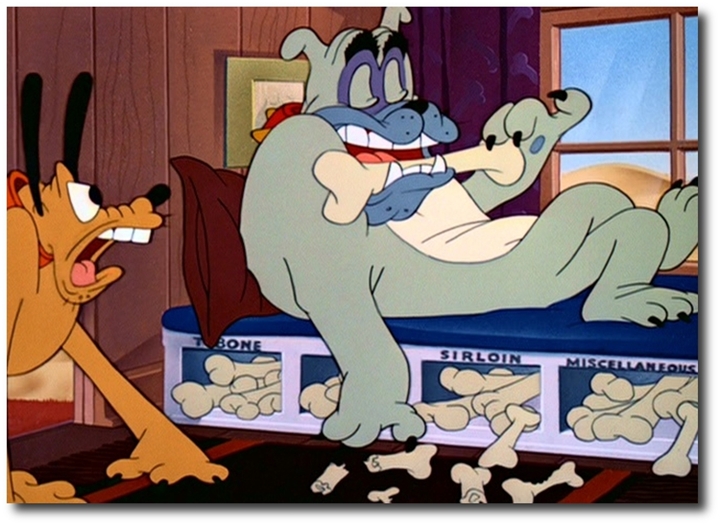 In ‘Pluto’s Housewarming’ Pluto’s got a new and very fancy home at the beach, but even before he moves in, it’s occupied by the little turtle from ‘Canine Patrol‘ (1945).
Pluto manages to dispose of the little fellow, but then bulldog Butch squats his house. Butch chases Pluto away, but he himself is chased away by the little turtle. In return, Pluto allows the little fellow to live in his mansion, too.
‘Pluto’s Housewarming’ is one of those numerous Pluto cartoons from the forties in which Pluto befriends a little animal, which he doesn’t like at first. The addition of Butch, however, brings in a new dimension. Nevertheless, this is cartoon is still rather cute than funny.
The little turtle would reappear in the equally cute and unfunny ‘Pluto’s Surprise Package‘ from 1949.
Watch ‘Pluto’s Housewarming’ yourself and tell me what you think:
This is Pluto cartoon No. 20
To the previous Pluto cartoon: The Purloined Pup
To the next Pluto cartoon: Rescue Dog
Director: Dan Gordon
Release Date: November 20, 1942
Stars: Superman
Rating: ★★★
Review:
 ‘Eleventh Hour’ is Superman’s second war cartoon, after ‘Japoteurs‘ from earlier that year. It’s one of the earliest World War II cartoons dealing with Japan.
In this short Superman himself is the saboteur, destroying ships, bridges, airports and tanks in Yokohama, Japan. The furious Japanese capture Lois, who stays with Clark Kent in Japan, and threaten Superman to execute her if he doesn’t stop his sabotage.
Superman reads this ultimatum all but too late and he’s only just in time to rescue Lois from the firing squad. Lois returns home, but Clark Kent stays behind, implying that Superman keeps on doing his sabotage work, a message that must have been comforting to the home-front.
The story of this cartoon is quite original, if not very well-constructed. Unfortunately, by now Superman has been reduced to an expressionless figure, making him a boring character to watch.
Watch ‘Eleventh Hour’ yourself and tell me what you think:
This is Superman film No. 12
To the previous Superman film: Showdown
To the next Superman film: Destruction, Inc.
Director: Dave Fleischer
Release Date: August 26, 1942
Stars: Superman
Rating: ★★★
Review:
 In ‘Terror on the Midway’ Lois is reviewing something as mundane as a circus, when a small monkey accidentally releases a titanic gruesome gorilla.
The gorilla follows her, while Superman’s busy putting other animals back into their cages. He rescues Lois and captures the gorilla, but it remains unclear how he stops the fire that has started, too.
‘Terror in the Midway’ is one of those fortunate Superman shorts without a villain (see also ‘The Arctic Giant’ and ‘Volcano‘ from the same year). However, it also shows Fleischer’s ambivalent realism: it contains some generic Fleischer thirties children designs, which by 1942 really look old-fashioned, but there are also some rare close-ups of Lois and Superman, which add to the drama. The staging, too, is superb, with some spectacular shots.
The gorilla looks like a typical King Kong-like monster, despite the fact that its model sheet was partly based on rotoscoped movements of real gorillas. Apparently, Bambi-like naturalism was wasted on the Fleischers animators.

gorilla modelsheet from ‘Terror on the midway’
Unfortunately, ‘Terror on the Midway’ would be the last Superman cartoon made by the Fleischer studios, before Paramount stole their crew to form their own Famous Studios. Indeed, it was the very last film the Fleischer brothers made together, ending an era that had begun 27 years earlier.
Watch ‘Terror on the Midway’ yourself and tell me what you think:
This is Superman film No. 9
To the previous Superman film: Volcano
To the next Superman film: Japoteurs
Director: Dave Fleischer
Release Date: July 17, 1942
Stars: Superman
Rating: ★★★
Review:
 In the aptly titled short ‘Volcano’, a dormant volcano is starting to erupt again on the island of Monokoa.
Daily Planet reporters Lois and Clarke are present, but Lois steals Clark’s press pass to work alone. She sneaks away to visit the volcano by herself, but when she’s up on the volcano, it suddenly erupts. Superman saves her and the village below by redirecting the lava to the other side.
Together with ‘The Arctic Giant’ and ‘Terror on the Midway‘, ‘Volcano’ is noteworthy for featuring no villain, let alone an evil scientist. Moreover, this Superman short probably contains the most spectacular effect animation within the series in its terrifying depiction of floating lava.
Watch ‘Volcano’ yourself and tell me what you think:
This is Superman film No. 8
To the previous Superman film: Electric Earthquake
To the next Superman film: Terror on the Midway
Director: Dave Fleischer
Release Date: September 26, 1941
Stars: Superman
Rating: ★★★
Review:
 ‘Superman’ is the first Superman cartoon, the very first cartoon series to feature realistic characters, and the Fleischer Studio’s most ambitious cartoon series.
Superman, of course, was based on the comic strip hero who made his debut in 1938. For his screen debut, the studio made a long introduction of the character, which lasts almost two minutes.
After this intro a very simple story develops, which contains many elements to be reused in later Superman cartoons, becoming a routine all too soon:
1) an evil scientist
2) something big to beat (in this cartoon a deadly ray, which Superman ridiculously punches away)
3) Lois getting intro trouble due to her curiosity, and
4) an ending with Lois and Clarke reading a newspaper article written by Lois Lane.
Despite elaborate shadows and special effects, this first realistic theatrical cartoon (not counting the works by Winsor McCay) hasn’t aged very well. The scientist is still half cartoony, and he has an animal sidekick, which mimics his moves.
The rest of the characters are drawn realistically, but also stiff and expressionless. They look forward to the wooden realistic cartoons of the TV era. The character was very popular, however, and inspired a couple of parodies, most notably the Bugs Bunny cartoon ‘Super Rabbit’ (1943). It’s ironic that after Popeye the Fleischer again had to rely on a character created elsewhere to achieve success. Unfortunately, this meant they couldn’t exploit Superman’s popularity as much as they could have with a character of their own.
Superman would star in seventeen cartoons, all from 1941-1943, nine by the Fleischer Studios, and eight by its successor, Famous studios. In 1943 the series was dropped because it was too costly to produce.
Watch ‘Superman’ yourself and tell me what you think:
This is Superman film No. 1
To the next Superman film: The Mechanical Monsters
Director: Chuck Jones
Release Date: June 12, 1943
Stars: Hubie and Bertie
Rating: ★★½
Review:
 The aristo-cat is the pet of a rich lady. He nags the butler so much that the latter quits. Not knowing how to get food himself, the cat panics, until he learns from a book titled ‘the behavior of cats’ that cats eat mice.
He immediately sets out to get one, but when he encounters one (Hubie) he doesn’t recognize it and he’s scared to death. Hubie and Bertie take advantage of the situation to convince the cat that Rover, a vicious bulldog next door, is a mouse. This leads to several chase routines, until it is revealed that it was all a dream.
‘The Aristo-Cat’ is only moderately funny, and the aristo-cat has a rather ugly voice. But the cartoon’s highly stylized backgrounds are beautiful and an attraction on their own. They are based on layouts by John McGrew, who did some innovative work in a couple of Chuck Jones cartoons from 1942 and 1943, e.g. ‘Conrad the Sailor‘, ‘The Dover Boys‘, and ‘Flop Goes The Weasel’. The backgrounds in ‘The Aristo-Cat’ arguably form the apex of McGrew’s art with their expressionistic angles and patterns, supporting the cat’s agony and fear. In fact, such daring designs would not be seen again before the advent of UPA.
‘The Aristo-Cat’ marks the debut of the mischievous mouse duo Hubie and Bertie. Strangely enough, they were shelved for three years, although Hubie had one solo-outing in 1944 with ‘From hand to Mouse’. The duo returned in 1946 to star five more cartoons: ‘Roughly Squeaking’ (1946), ‘House Hunting Mice’ (1948), ‘The Hypo-Chondri-Cat’ (1950), ‘Cheese Chasers’ (1951) and the greatest of them all, ‘Mouse Wreckers‘ (1949).
Watch ‘The Aristo-Cat’ yourself and tell me what you think:
Director: Ford Beebe
Release Date: January 11, 1942
Stars: Donald Duck
Rating: ★★★
Review:
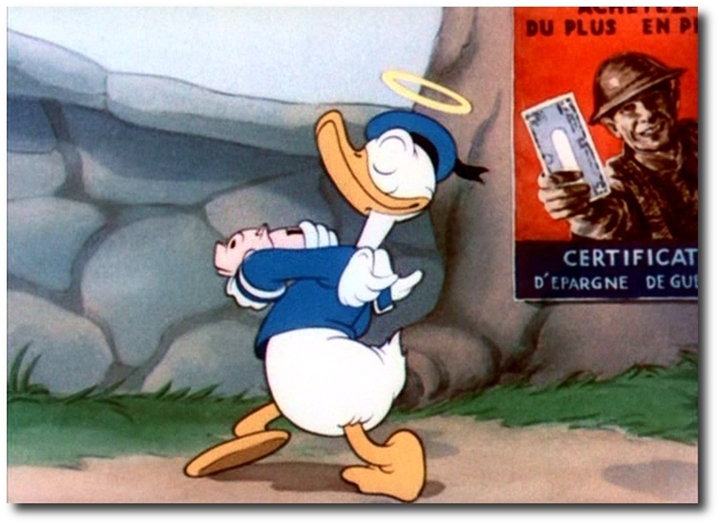 ‘Donald’s Decision is Walt Disney’s third short to persuade the Canadian public to buy war certificates.
This film has the same two-part formula as ‘The Thrifty Pig‘ and ‘7 Wise Dwarfs‘ from 1941. The first half combines reused footage from two Donald Duck shorts from 1938: ‘Self Control‘ and ‘Donald’s Better Self‘, but with altered voices. The second half resembles that of ‘The Thrifty Pig‘ and ‘7 Wise Dwarfs‘.
The result is less convincing than in the earlier two cartoons, probably because the source material is weaker. Neither ‘Self Control’ nor ‘Donald’s Better Self’ belong to Donald Duck’s best. Besides, Donald only reluctantly does his part, in great contrast to the optimistic pigs and dwarfs from the earlier shorts. Indeed, when Disney had to convince the American public for government purposes, the studio came up with completely new animation for its biggest star (in ‘The New Spirit‘ and ‘The Spirit of ’43‘).
Watch ‘Donald’s Decision’ yourself and tell me what you think:
Director: Jack Kinney
Release Date: September 4, 1942
Stars: Goofy
Rating: ★★★
Review:
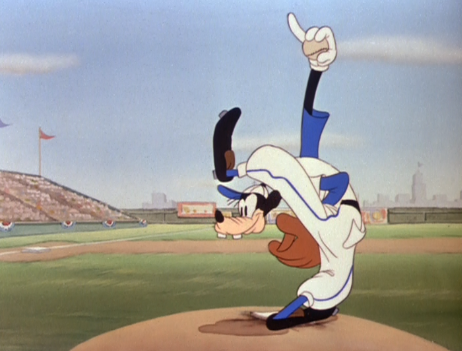 ‘How to Play Baseball’ is the third of Goofy’s sport cartoons, and the first with a title beginning with ‘How to’ (following the ‘How to Ride a Horse’ sequence in ‘The Reluctant Dragon‘ (1941).
The short forms the next and final step in Goofy’s evolution after the duplication of Goofies in the previous cartoon, ‘The Art of Self Defense‘: now multiple Goofies are together the stars of the cartoon. The character remains unique in the cartoon canon in this ability to duplicate himself and remain Goofy throughout, nonetheless.
The short has a highly entertaining way to explain baseball, ending with an exciting finale of the World championship. The gags come fast and plenty, depicting a lot of nonsense. Nevertheless, the cartoon is not only funny, it’s also surprisingly educational.
In the years following ‘How to Play Baseball’ baseball would return to the animated screen in the Woody Woodpecker cartoon ‘The Screwball’ (1943) and in the Bugs Bunny cartoon ‘Baseball Bugs‘ (1944).
Watch ‘How To Play Baseball’ yourself and tell me what you think:
This is Goofy cartoon No. 6
To the previous Goofy cartoon: The Art of Self Defence
To the next Goofy cartoon: The Olympic Champ
Director: Jack King
Release Date: July 30, 1942
Stars: Minnie Mouse, Pluto
Rating: ★★★
Review:
 ‘Out of the Frying Pan into the Firing Line’ is a short propaganda film aimed at American housewives.
In this propaganda short, Minnie is just about to give Pluto some hot bacon grease, when the narrator interrupts, telling housewives of America to save their kitchen fats in order to deliver them at a “neighborhood meat dealer, who is patriotically cooperating”. The fats are apparently used to make glycerine, which is used in ammunition.
This short contains a rare picture of Mickey as a soldier at the front. Otherwise, Mickey was left out of the propaganda, leaving that role to Donald Duck.
‘Out of the Frying Pan into the Firing Line’ is an interesting example of how the American government tried to make every citizen help in the war effort. It shows how World War II entered the life of the average citizen: even kitchen grease could be useful… It offers no one-liner, however, at the likes of the contemporary slogans ‘Save Your Scraps to Bomb the Japs’ or ‘Is Your Trip Really Necessary?”
Watch ‘Out of the Frying Pan into the Firing Line’ yourself and tell me what you think:
Directors: Valentina Brumberg, Zinaida Brumberg, Aleksandr Ivanov, Olga Khodataeva and Ivan Ivanov-Vano
Release Date: 1941
Rating: ★★★
Review:
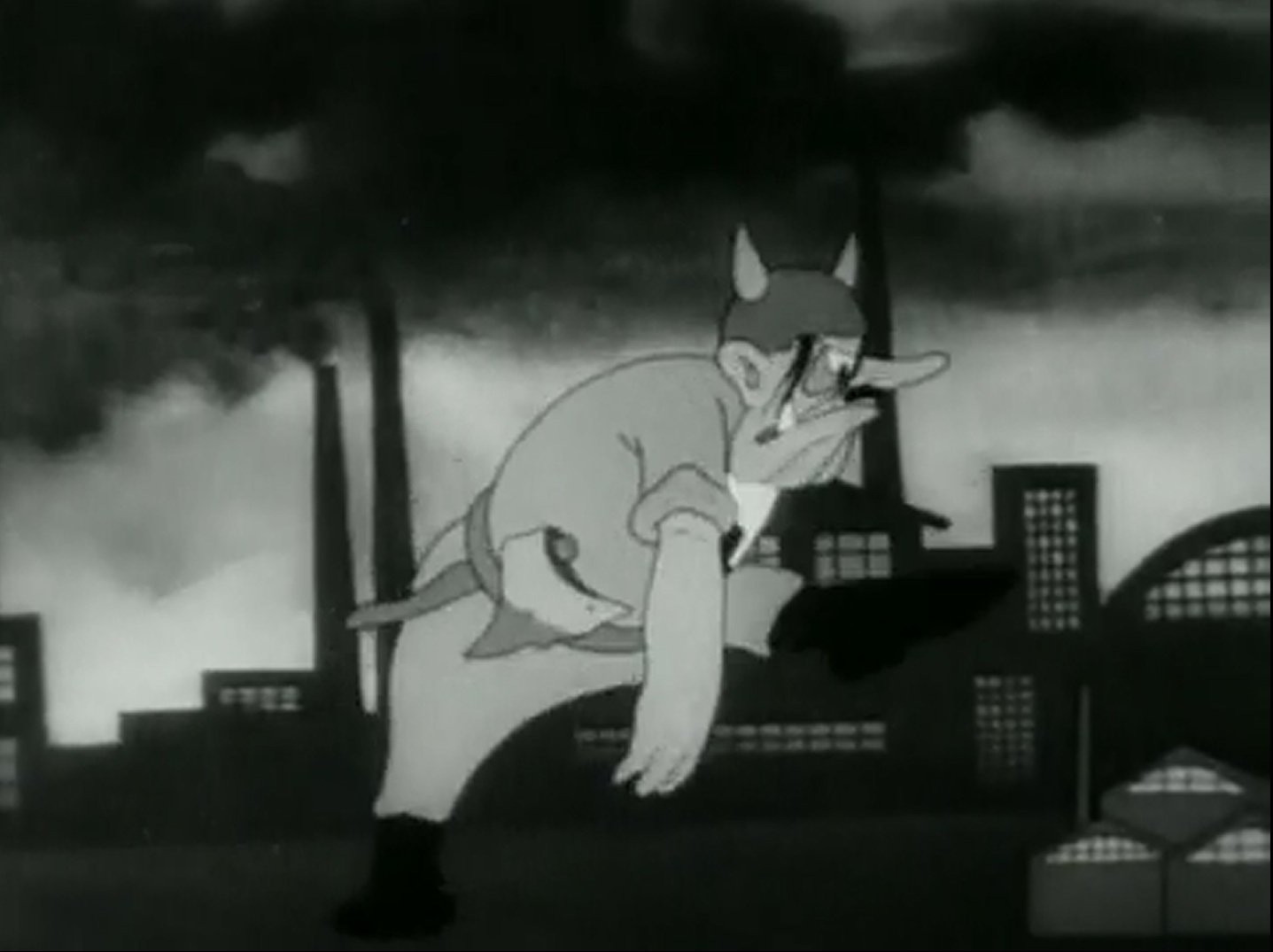 The Soviet propaganda film ‘4 Newsreels’ consists of four so-called ‘political posters’, which are as blatant as propaganda can get.
The first, ‘What Hitler wants’, shows us an extremely ugly and vicious caricature of Hitler marching towards the Soviet Union until he is pierced by the Soviet bayonet.
In the second, ‘Beat the fascist pirates’, sea serpent-like German submarines are defeated by the Soviet fleet.
The third, ‘Strike the Enemy on the front and at home’, is typical for the paranoid society Stalinist Russia was, warning against treacherous fascist spies, foreign agents and saboteurs: “Be vigilant! Remember, our enemy is cunning!”.
The fourth, ‘A mighty handshake’, tells us about the union between England and the Soviet Union against Nazi Germany, showing two mighty giant soldiers shaking hands and crushing a tiny rat-like Hitler in doing so.
Obviously, Germany’s invasion of the Soviet Union left no room for subtleties.
‘4 Newsreels’ was directed by five veterans of animated Soviet propaganda. All had made animated films since the 1920s. Of the five, Ivan Ivanov-Vano (1900-1987) would become the most successful, directing animated films up to the 1970s. Luckily, he and Olga Khodataeva would be able to show a gentler side in numerous animated fairy tale films for children.
Watch ‘4 Newsreels’ yourself and tell me what you think:
‘4 Newsreels’ is available on the DVD box set ‘Animated Soviet Propaganda’
Director: Clyde Geronimi
Release Date: December 27, 1940
Stars: Pluto
Rating: ★★★
Review:
 Surprisingly, in this film Pluto is not Mickey’s dog, but owned by an Afro-American lady, who seems to be the exact copy of Tom & Jerry’s Mammy Two-Shoes, who made her debut in February of that year. However, it was the Disney studio itself who had introduced the Mammy character in ‘Three Orphan Kittens‘ (1935).
In ‘Pantry Pirate’ Mammy puts Pluto outside, but he sneaks into the kitchen trying to steal her roast beef. Hindered by an ironing-board, several tea cups and a bucket of soapy water, he doesn’t succeed, but he does escape Mammy’s wrath by quickly returning to his dog house, pretending to be asleep. Here the cartoon abruptly ends.
‘Pantry Pirate’ is the first of seven Pluto cartoons directed by Clyde Geronimi. It’s also one of his best, with gags leading to more gags in excellent pantomimed and physical situation comedy. This cartoon contains some remarkably flexible animation of Pluto, especially during the ironing-board scene. Pluto’s design, however, seems to be stubbier than usual. The Mammy character would return in ‘Figaro and Cleo‘ (1943).
Watch ‘Pantry Pirate’ yourself and tell me what you think:
This is Pluto cartoon No. 3
To the previous Pluto cartoon: Bone Trouble
To the next Pluto cartoon: Pluto’s Playmate
Director: Vyacheslav Kotyonochkin
Release Date: 1967
Rating: ★★★
Review:
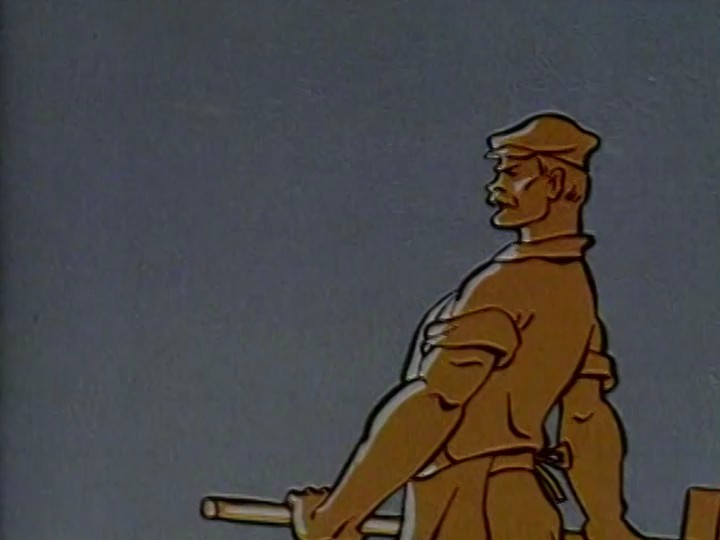 ‘Prophets and Lessons’ is a Soviet propaganda film. It tells us how every time the Western world predicted the Soviet Union to fail, but that these predictions never came true.
Its chapters are all conceived in the same order: first we see animated capitalist predict something, then we see a giant Soviet blacksmith strike his mighty hammer and finally we see live action footage of the Soviet Union’s successes.
The separate chapters are the Soviet revolution, the civil war, the five year plans, the Second World War, the reconstruction after the war and the Soviet space program. The action is silent, and the imagery rather outdated (more like that of the 1920s than of the 1960s).
‘Prophets and Lessons’ is one of the most obviously propagandistic animation films ever made in the Soviet Union. Its overtly propagandistic message, its repetitive character, and its outdated symbolism make it rather tiresome to watch.
Surprisingly, two years later, the director of this humorless film, Vyacheslav Kotyonochkin, would launch a successful series of comic cartoons, called ‘Ну, Погоди!’ (‘Just Wait!’), featuring a very cartoony wolf.
Watch ‘Prophets and Lessons’ yourself and tell me what you think:
‘Prophets and Lessons’ is available on the DVD box set ‘Animated Soviet Propaganda’
Director: Hawley Pratt
Release Date: May 18, 1967
Stars: The Pink Panther, The Little Guy
Rating: ★★★
Review:
 In ‘In The Pink’, weirdly enough, the Pink Panther is getting fat. So, our pink hero tries his luck at the gym, where he hinders the little guy a great deal.
‘In the Pink’ is an average Pink Panther cartoon, consisting of blackout gags, the most bizarre one being a chicken hatching a punching ball. The opening sequence reuses animation from ‘Pink Panic’ from earlier that year.
Watch ‘In the Pink’ yourself and tell me what you think:
Director: Chuck Jones & Ben Washam
Release Date: April 28, 1966
Stars: Tom & Jerry
Rating: ★★★
Review:
 Tom gives Jerry to his beloved, but she takes pity on the poor little mouse and protects him against Tom.
Jerry takes advantage of the situation, however, never stopping at putting the blame on Tom. Then, in the end, the puss’s love changes into hunger…
This is a very Chuck Jonesy cartoon, with loads of his wonderful trademark elegant designs and strong facial expressions. These solely make this cartoon one of the better entries in the series.
Watch ‘Love, Love My Mouse’ yourself and tell me what you think:
This is Tom & Jerry cartoon No. 147
To the previous Tom & Jerry cartoon: Jerry-Go-Round
To the next Tom & Jerry cartoon: Puss ‘n’ Boats
Director: Hawley Pratt
Release Date: May 25, 1966
Stars: The Pink Panther, The Little Guy
Rating: ★★★
Review:
 In ‘Pink, Plunk, Plink’ the Pink Panther spoils a performance of Beethoven’s fifth symphony by trying to play his own theme music, much to dismay of the conductor (the little guy).
The Pink Panther finally succeeds to replace the conductor, but there appears only to be one man in the audience, Henry Mancini, composer of the Pink Panther’s theme music, himself (live action footage).
‘Pink, Plunk, Plink’ is not one of the best concert cartoons ever made, but the little guy’s frustrations are wonderfully animated.
Watch ‘Pink, Plunk, Plink’ yourself and tell me what you think:
Director: Hawley Pratt
Release Date: December 14, 1965
Stars: The Pink Panther
Rating: ★★★
Review:
 In ‘Bully for Pink’, the Pink Panther wants to be a bull fighter and so he steals a magical cape to use it as a red sheet.
‘Bully for Pink’ is slightly funnier than contemporary Pink Panther cartoons, but it doesn’t come near the heights of bullfight cartoons like Tex Avery’s ‘Señor Droopy’ (1949) or Chuck Jones’s ‘Bully for Bugs’ (1953).
Watch ‘Bully for Pink’ yourself and tell me what you think:
Director: Chuck Jones
Release Date: December 22, 1965
Stars: Tom & Jerry
Rating: ★★★
Review:
 Jerry orders a bulldog to help him against Tom. The bulldog turns out to be very tiny, but he’s ferocious nonetheless.
Unfortunately this nice idea leads to a slow and weak story, despite a clever gag with Tom and the little bulldog swapping doors.
The little bulldog, however, was a character to remember, and he would return in Tom & Jerry’ very last theatrical release, ‘Purr-chance to a Dream‘ (1967).
Watch an excerpt from ‘The Cat’s Me-ouch’ yourself and tell me what you think:
This is Tom & Jerry cartoon No. 143
To the previous Tom & Jerry cartoon: The Year of the Mouse
To the next Tom & Jerry cartoon: Duel Personality
Director: Chuck Jones
Release Date: May 19, 1965
Stars: Tom & Jerry
Rating: ★★★
Review:
 In ‘Of Feline Bondage’ Jerry, whose life is made miserable by the sadistic Tom, is visited by a mouse fairy who gives him a potion that makes him invisible.
Jerry uses his invisibility to hunt Tom around the house with some scissors, cutting up Tom. However, he gets the same treatment from Tom when he gets visible again. The results are so ridiculous, the two laugh their heads off. Fade out…
‘Of Feline Bondage’ is a rather weak cartoon, despite some nice typical Chuck Jones expressions on both Tom and Jerry.
Watch ‘Of Feline Bondage’ yourself and tell me what you think:
https://www.dailymotion.com/video/x49xmhr
This is Tom & Jerry cartoon No. 140
To the previous Tom & Jerry cartoon: I’m Just Wild About Jerry
To the next Tom & Jerry cartoon: Tom Thump
Director: Chuck Jones
Release Date: March 24, 1965
Stars: Tom & Jerry
Rating: ★★★
Review:
 Not to be confused with the 1941 Tex Avery cartoon ‘The Haunted Mouse’, this cartoon interrupts the string of chase cartoons by featuring a real story: Jerry is visited by his cousin(?), a Mandrake-like magician, who easily defeats Tom.
Less funny than the remotely similar ‘Jerry’s Cousin‘ (1951), this rather slow cartoon nevertheless features a hilarious scene in which the magician mouse remains an über-cool, deadpan expression while being caught by a sardonically laughing Tom. It also features some rather Dr. Seuss-like rabbits.
Watch ‘Haunted Mouse’ yourself and tell me what you think:
http://www.220.ro/desene-animate/Tom-And-Jerry-Haunted-Mouse/f6HoGrlyGO/
This is Tom & Jerry cartoon No. 138
To the previous Tom & Jerry cartoon: The Brothers Carry-Mouse-Off
To the next Tom & Jerry cartoon: I’m Just Wild About Jerry


 Dr. Grob's Animation Review