You are currently browsing the category archive for the ‘★★’ category.
Director: Norman McLaren
Release date: 1972
Rating: ★★
Review:

In the final stages of his career Norman McLaren apparently got interested in ballet, for three of his final films (‘Pas de deux’, ‘Ballet Adagio’ and ‘Narcissus’) are on the movements of ballet dancers.
‘Ballet Adagio’ is the most straightforward of the three: it is a documentary recording of a two and a half minute pas de deux, danced by David and Anna Marie Holmes, played on a quarter speed and set to the faux-Albinoni adagio in G minor by Remo Giazotto.
There’s no trickery, let alone animation involved – it’s just the two dancers on an empty stage doing their thing. Due to the slow motion one gets ample opportunity to watch the sheer virtuosity of the two dancers, the sometimes almost impossible stunts of the two, and their muscle movements. But, as there’s nothing else going on, the result is as fascinating as it is boring. It doesn’t really matter, for the film’s intentions were purely educational, giving ballet students an opportunity to study movement.
Watch ‘Ballet Adagio’ yourself and tell me what you think:
‘Ballet Adagio’ is available on the DVD Box ‘Norman McLaren – The Master’s Edition’
Director: John Musker
Release date: 1977
Rating: ★★
Review:
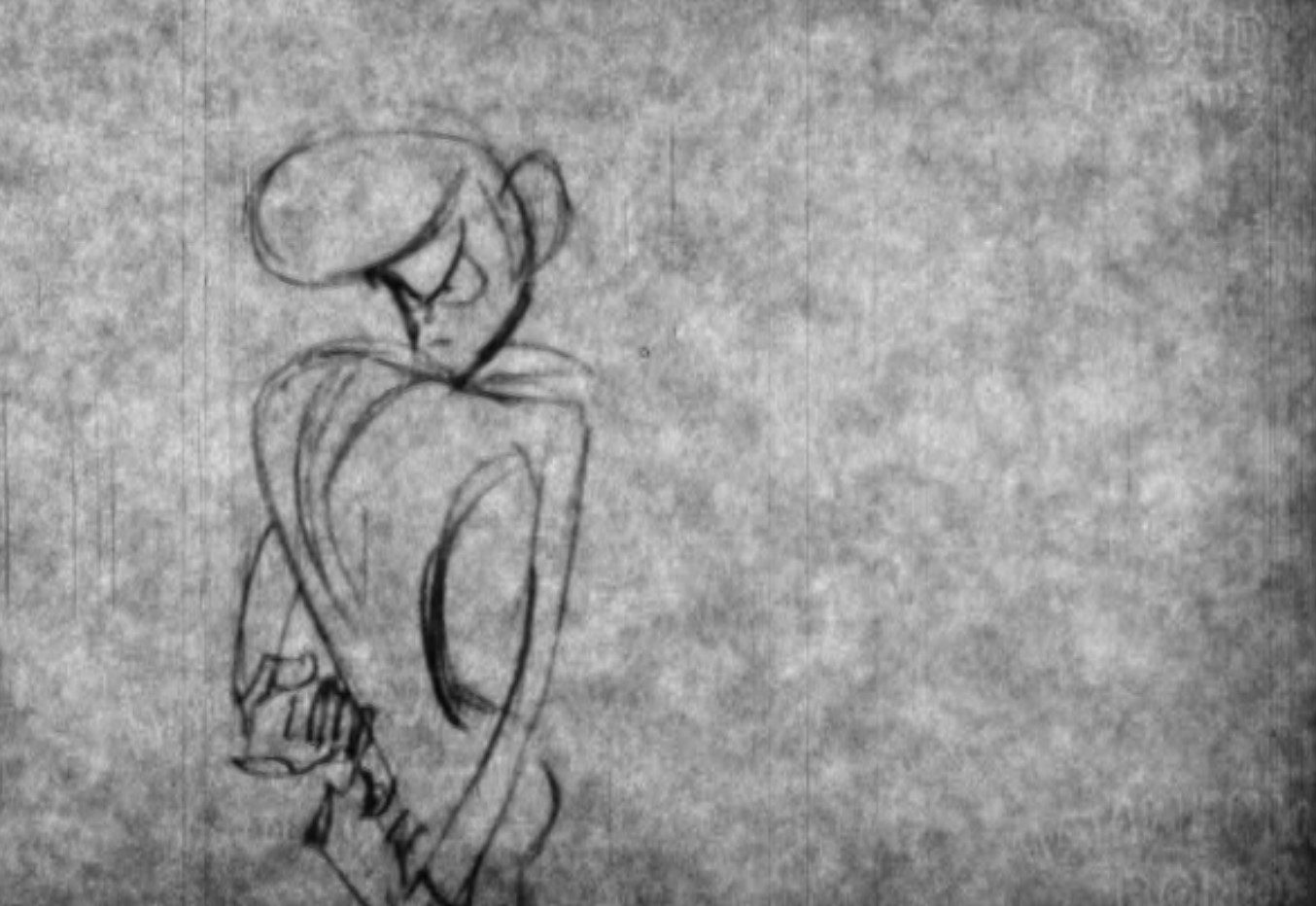
‘Little Darlin” is a short animation film that apparently never transcended the pencil test phase. Made by John Musker (of later e.g. ‘The Little Mermaid, ‘Aladdin’ and ‘Moana’ fame) at CalArts, the film immediately shows Musker’s great talent as an animator. All classic animation techniques can be found in this short film, and all are done with the virtuosity of a great talent.
Unfortunately, the film’s designs and story are much less appealing, and the overacting of all three protagonists is tiresome, not funny.
‘Little Darlin” is available on the DVD ‘Giants’ First Steps’
Director: Ron Clements
Date: 1972
Rating: ★★
Review:

Ron Clements, of later e.g. ‘The Little Mermaid’, ‘Aladdin’ and ‘Moana’ fame, turns out to be influenced by cheap television animation in his early short ‘Shades of Sherlock Holmes’.
His cartoon features generic designs, limited animation, a lot of dialogue and a rather Scooby Doo-like plot. Absolutely nothing in this short indicates a great talent, and the film is as generic as it is boring. The bad sound mixing doesn’t help either. Luckily, Clements turned out fine, and became one of the most famous directors in feature animation.
‘Shades of Sherlock Holmes’ is available on the DVD ‘Giants’ First Steps’
Director: Ralph Bakshi
Release date: August 8, 1973
Rating: ★★
Review:
Ralph Bakshi arrived on the scene when American classic studio animation was in steady decline, reaching its low point in the 1970s and early 1980s. In this dry period, Bakshi tried to reinject classic animation with new energy, most notably by ripping it of its association with children. Now, in the golden age animation never had been solely associated with children, but due to the advent of the Saturday-morning cartoon in the mid-1960s American animation more and more became something just for kids.
Bakshi, on the other hand, saw the full potential of the medium, and enriched the animation world with several animated features aimed at adult audiences, thus bypassing the middle ground of the family film, which was Disney’s monopoly at the time, anyway. Thus, Bakshi is sometimes seen as the savior of animation during the medium’s dark ages, but I find it hard to subscribe to that opinion, and that’s because his films are sadly just not good.
Now, I will not talk about the abysmal ‘The Lord of the Rings’ (1977), which is a disgrace to the medium, but even ‘Heavy Traffic’, his supposed masterpiece, fails on several key features.
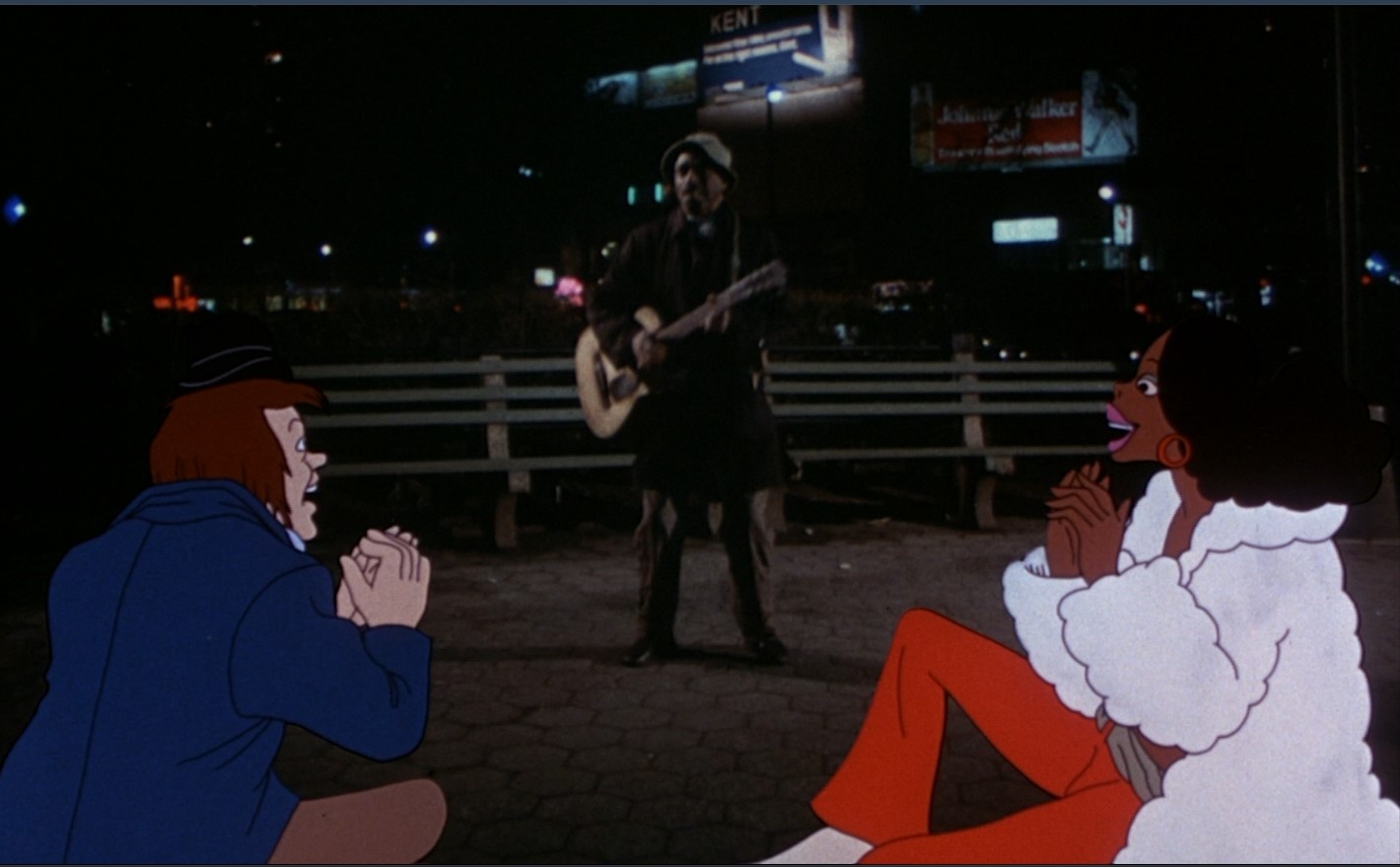
‘Heavy Traffic’ was written by Bakshi himself and has strong autobiographical elements. Set in New York the feature film tells of Michael Corleone, a young and aspiring underground cartoonist, who stills live with his quarreling parents (a Jewish mother and an Italian father), and who dates a black girl called Carole.
The film uses a voice over and the images of a pinball machine as bridging elements, but this cannot hide the fact that the film is a loose bag of scenes, and hardly goes anywhere. Sure, the film is depressing and draws a dark picture of the Big Apple, but its fourteen scenes have little to do with each other and are more about atmosphere than storytelling.
It certainly doesn’t help that none of the characters are remotely sympathetic. Even Michael himself, our supposed hero, is more of a self-centered jerk than anything else. For example, the comics he shows a publisher, wouldn’t interest anyone with a sane mind.
Worse, ‘Heavy Traffic’ falls for the misguided idea that making a film for an adult audience means it must contain sex and violence. ‘Heavy Traffic’ was not the first film to fall into this trap, and certainly not the last one (the unappealing ‘Sausage Party’ from 2016 comes to mind), but Bakshi clearly indulges in both, not only in this film, but also in ‘Fritz the Cat’ from the year before, ‘Wizards’ (1977) and ‘Cool World’ (1992), to name a few, which, to me, only proofs his immaturity. In ‘Heavy Traffic’, for example, bare breasts pop up from everywhere, with little other purpose than arousing the male audience.
Bakshi’s character designs are a mixed bag, sometimes reminiscent of the work of Mort Walker, as in the design of Michael’s father, at other times very cartoony, and reminiscent of DePatie-Freleng (e.g. the gay drag queen Snowflake), at other times quasi-realistic (Carole). Especially ill-conceived is Michael himself, whose quasi-realistic design is as mediocre as it is unappealing.
The background art too is a strange mix of drawings and photographs to a gritty effect. There are even some real live action footage elements from old films, like ‘Red Dust’ (1932) and ‘The Gang’s All Here’ (1943). In the end, the characters change into their live action counterparts, and suddenly one asks himself why this gritty film was not filmed in live action in the first place, as Bakshi’s animation adds surprisingly little.
Now, ‘Heavy Traffic’’s animator list features such illustrious names like Tom Ray, Carlo Vinci, Irv Spence, Manny Gould and Dave Tendlar, and it’s admirable that Bakshi kept these animation greats at work, but I doubt how many people watch ‘Heavy Traffic’ for its beautiful animation, for there’s hardly any. There’s manic animation, there’s outrageous animation, there’s fair animation, and there’s a lot of rotoscoping, but I’d prefer ‘Robin Hood’ from the same year anytime, even if that is the poorest of all classic Disney features.
For a supposed masterpiece, ‘Heavy Traffic’ feels like a sad affair, wasting a lot of animation talent on an egotistical document too heavy-handed for its own good, a film that is as depressing as it is boring and unappealing.
No, to me, Bakshi was more like the wrong guy at the right time: he could not save animation, for he lacked both the talent and the vision to do so. His films never transcend the dark ages, but are firmly rooted in them, and because of Bakshi’s limited view on what an adult film can be, the whole concept never really took off in the United States. This is an infinite pity, for this is one of the reasons we still must deal with the narrowminded view of animation being equal to family entertainment, today.
Watch the theatrical trailer for ‘Heavy Traffic yourself and tell me what you think:
‘Heavy Traffic’ is available on Blu-Ray and DVD
Director: Phil Roman
Airing date: February 1, 1974
Stars: Snoopy, Woodstock
Rating: ★★
Review:

‘It’s a Mystery, Charlie Brown’ is the first Peanuts special not to be directed by Bill Melendez. Instead, Phil Roman takes the director’s seat, after co-directing the previous episode, ‘A Charlie Brown Thanksgiving‘ with Melendez.
There’s little wrong with Roman’s directing, except for an odd staging here and there, but ‘It’s a Mystery, Charlie Brown’ is one of the weakest of the Peanuts episodes. Its story is incredibly straightforward, and lacks the little drama of the other episodes. This is mostly because the story is concentrated on Woodstock and Snoopy, instead of the children.
The episode starts with Woodstock trying to build a nest, and it’s this nest that drives the plot. The best parts of the episode deal with the power of imagination: Woodstock almost drowning in the bird bath and Woodstock riding an imaginary elevator. Also great is Snoopy as Woodstock’s attorney, issuing letters full of nonsensical Latin.
But the running gag in which Woodstock gets repeatedly wet falls rather flat, and one senses that more could have been made out of it. Also, the episode’s closing feels rather forced. In fact, the best aspect of the episode is its groovy soul-jazz music, which is a delight throughout the episode.
Watch ‘It’s a Mystery, Charlie Brown’ yourself and tell me what you think:
‘It’s a Mystery, Charlie Brown’ is available on the DVD-set ‘Peanuts 1970’s Collection Vol. 1’
Director: Zlatko Plavinic
Release date: 1973
Rating: ★★
Review:

This is another very short gag cartoon from the Zagreb studio. In this short a man and a woman haggle for paid sex, or are they?
This cartoon features a monochrome ochre background, cartoonish designs, and dialogue in gibberish and loud nos. The single gag unfortunately is too lame for words.
‘Okay!’ is released on the DVD ‘The Best of Zagreb Film: Be Careful What You Wish For and The Classic Collection’
Director: Daniel Szczechura
Release date: 1971
Rating: ★★
Review:

‘If You Spot a Cat Flying Through the Air’ is a strange little film in bold seventies design and with an avant-garde jazz score by W. Pażyński to tell us that If You Spot a Cat Flying Through the Air, it’s a cat who love birds. These words reappear a few times in the short itself.
Unfortunately, both animation and movement are rather limited, and the short is more interesting as an experiment than entertaining to watch.
Watch ‘If You Spot a Cat Flying Through the Air’ yourself and tell me what you think:
‘If You Spot a Cat Flying Through the Air’ is available on the DVD-set ‘Anthology of Polish Children’s Animation’
Directors: Charlie Bean, Paul Fisher & Bob Logan
Release date: September 22, 2017
Rating: ★★
Review:

One of the biggest feature animation surprises of 2014 was ‘The Lego Movie’. On paper this joint venture between Warner Animation and the famous toy company from Denmark should have been something terrible. After all, it was based on an existing toy line, a recipe for disaster. But the opposite happened and ‘The Lego Movie’ turned out to be one of the funniest, most sophisticated, and deepest animation film of the 21st century. The film was followed in 2017 by the equally funny ‘The Lego Batman Movie’, deepening the title character as he appeared in ‘The Lego Movie’. Warner Animation and Lego were clearly on a roll.
Or were they? Appearing in the very same year as ‘The Lego Batman Movie’, ‘The Lego Ninjago Movie’ uses several of the ingredients of the previous films, but with a remarkably disappointing result. True, there are some good gags, especially those referring to the characters being made of Lego, but more often such gags feel like they have been done before, and better. Even worse, compared to the two earlier films, both the story, the world and the characters are very weakly developed. Apparently, the film was based on a long-lasting television series, but the film hardly betrays that fact. Instead, the movie feels as only half-baked, and assembled too quickly for its own good.
The problems of ‘The Lego Ninjago Movie’ are legion. The film uses elements of both wuxia and mecha films, but can’t satisfy lovers of either genre, as the film makers do very little with these elements. The whole setting of Lloyd being both the leader of the Ninjago squad and the son of Garmadon, the very nemesis they continually combat, is preposterous to start with. That these Ninjago warriors are also some teenager friends at a high school (even though one is a robot) only adds to the implausibility. So does the fact that Garmadon has four hands. The plot gets particularly silly when ‘the monster’ arrives, but when the Ninjago squad goes on a quest in a forest, the film seriously starts to drag. The son-dad relationship becomes a tried and tiresome cliché, and halfway one realizes he doesn’t care for these characters, at all. And then the overlong finale must start, yet…
On the top side the film starts with Jackie Chan, who is always pleasant to watch, even though he’s completely wasted in this film. And the textures of the Lego elements are surprisingly good, rendering them very tactile, indeed. Moreover, the film makes some surprising and rather silly choices in its use of pop music. But it should be clear that none of this can rescue a sloppy, lazy film that seriously lacks the heart and attention given to the first two Lego movies.
Watch the trailer for ‘The Lego Ninjago Movie’ yourself and tell me what you think:
‘The Lego Ninjago Movie’ is available on Blu-Ray and DVD
Director: Andrei Khrjanovsky
Release date: 1970
Rating: ★★
Review:
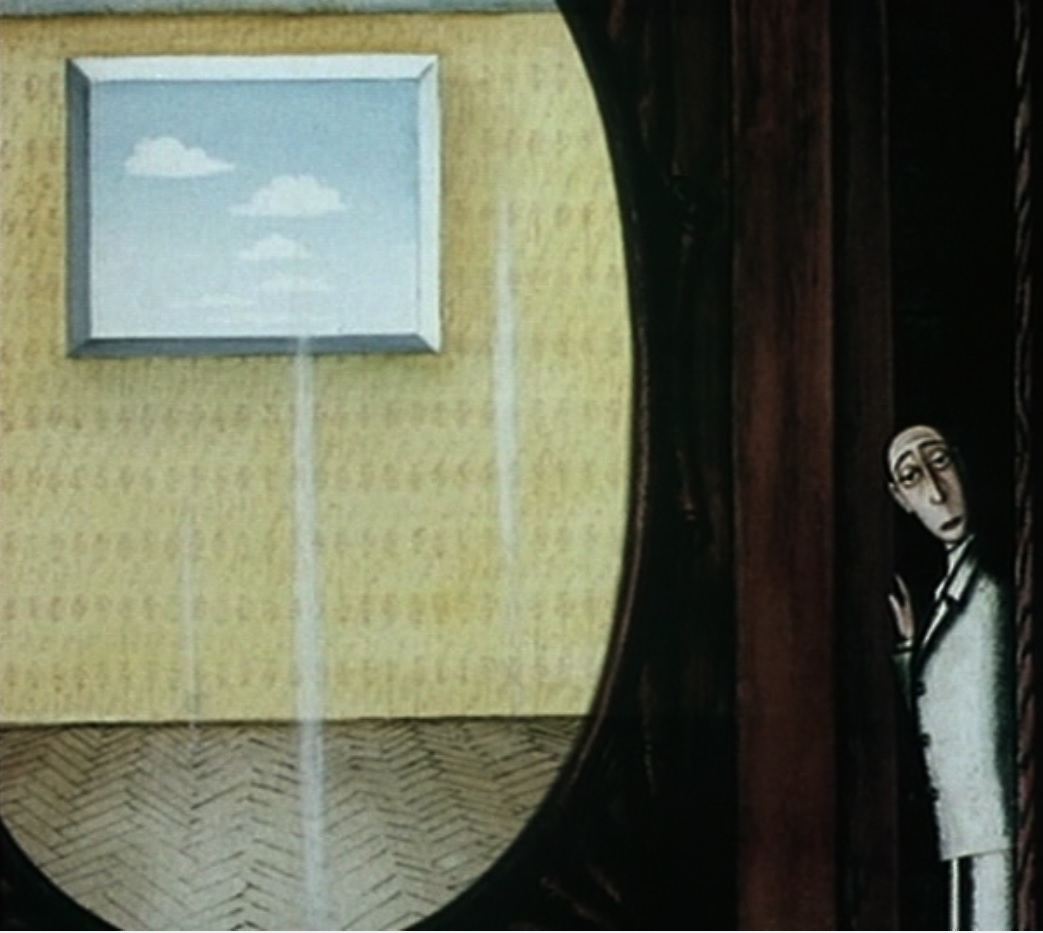
‘Armoire’ is an enigmatic cut-out animation film about a man in an apartment who puts an enormous cupboard into his room. Once inside, he starts to put all his belongings into the cupboard, until he can live inside it. In the end it’s revealed that even his tiny room is inside another cupboard.
Several shots of depressing apartment blocks suggest that this is a critical satire on the living conditions inside the Soviet Union, but I’m not sure. ‘Armoire’ is as avant-garde as was possible in the Soviet-Union, especially Alfred Schnittke’s score is very modernistic. But because the film is just the illustration of one puzzling idea, and because the one protagonist is as phlegmatic as Buster Keaton, the film fails to make a lasting impression.
Watch ‘Armoire’ yourself and tell me what you think:
‘Armoire’ is available on the DVD ‘Masters of Russian Animation Volume 2’
Director: Valentin Karavaev
Release date: 1970
Rating: ★★
Review:

‘A Lesson Not Learned’ is a rather blatant and vicious Soviet propaganda film suggesting that West Europe is led by fascists trying to restore the Germany of old.
The film starts with images from World War II, accompanied by the sounds of bombs and gunfire. Then we cut to an old Nazi in sheep’s clothing, who seeks refuge in the American-British zone. Accepted and retired, the old Nazi preaches ‘revanchism’, in order to restore Germany’s borders from before World War II. However, he is stopped by the Berlin wall and the peace treaty signed between the USSR and the DDR, in which the current borders are accepted.
This film uses a satirical style more reminiscent of the forties than of the seventies, rendering an old-fashioned imagery. The best idea is the little Hitler angel helping the old Nazi. There’s no dialogue. For example, when the old Nazi starts to speech, we only hear the sound of guns. There’s pretty little animation and the message is emphasized with writings as in political cartoons.
It’s hard to watch a film so full of lies, which shows that up to its very end the Soviet Union partly based its legitimation on the idea that its existence was the only way to stop fascism. And the saddest thing is that the current Russian regime has revived this falsehood to defend its current war in the Ukraine.
Watch ‘A Lesson Not Learned’ yourself and tell me what you think:
‘A Lesson Not Learned’ is available on the DVD set ‘Animated Soviet Propaganda’
Director: Rob Gibbs
Release date: November 1, 2011
Rating: ★★
Review:
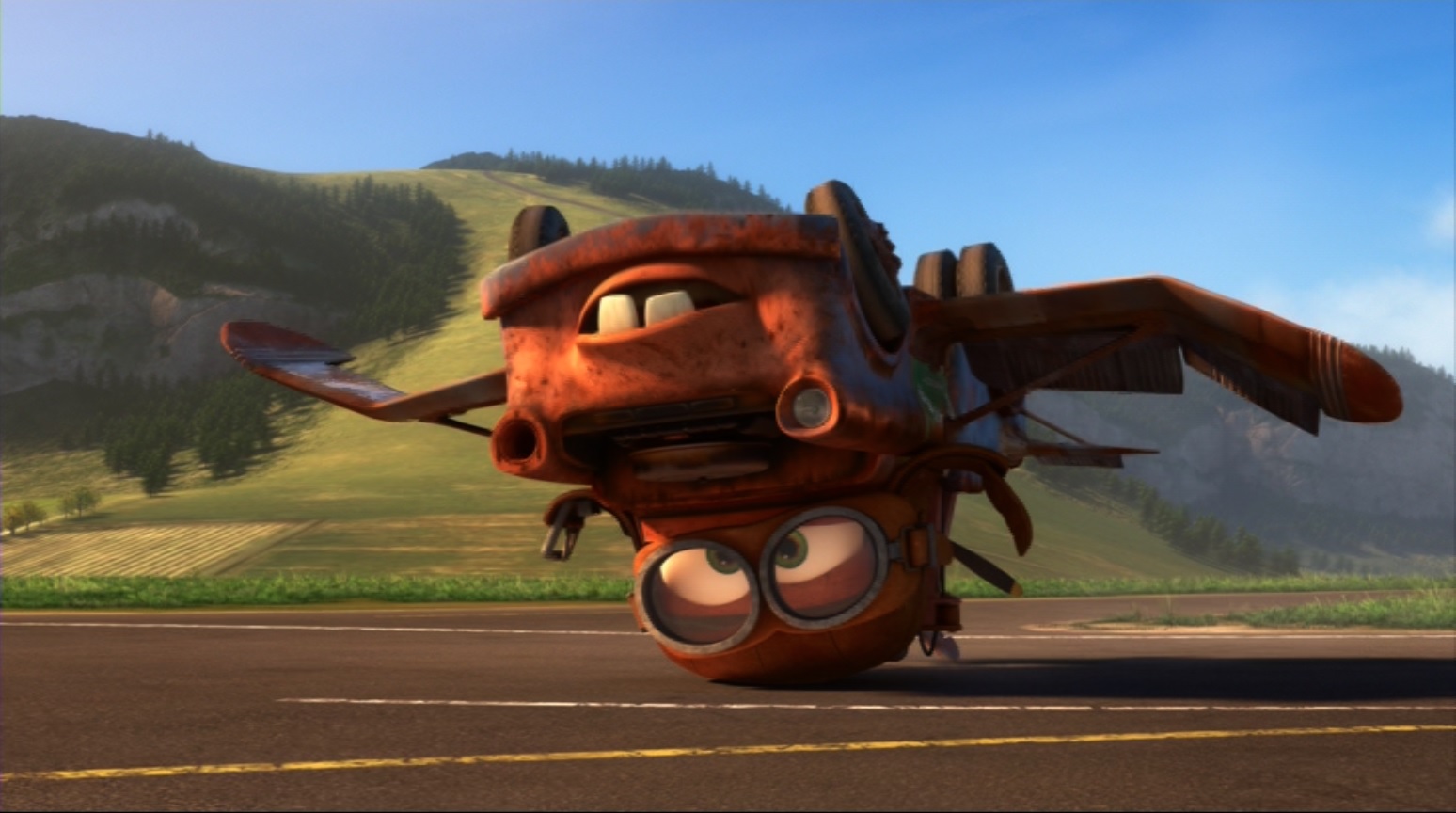
‘Air Mater’ is a late addition to ‘Mater’s Tall Tales’, being aired a year (minus a day) after the ninth episode. In this episode Mater visits a town of planes and takes the air.
Mater’s tall tale is amusing, if very shallow and completely forgettable. Worse, the whole film seems an exercise for the ‘Planes’ feature, released by Disney (not Pixar) in 2013, and feels like an advertisement.
Watch an excerpt from ‘Air Mater’ and tell me what you think:
‘Air Mater’ is available on the Blu-Ray/DVD of ‘Cars 2’ and on the Blu-Ray/DVD ‘Pixar Short Films Collection Volume 2’
Director: Tomer Eshed
Release date: June 23, 2011
Rating: ★★
Review:

‘Flamingo Pride’ tells about a flamingo who’s apparently the only straight guy at an enormous gay dance festival. Then he falls in love with a female stork flying by…
‘Flamingo Pride’ turns the tables around, making being straight the minority. That is, in the flamingo community, because outside their own festival all birds seem to be straight and having classic role patterns.
It’s not very clear what the film tries to tell us. For starters it is a bit confusing that apparently all flamingos are gay, and none of the other birds is. Moreover, the gay flamingos pretty much look like gay stereotypes. None of them, not even ‘our hero’ has a grain of personality.
At least the film isn’t as funny as it was meant to be. The short is hampered by some ugly designs (the flamingos have teeth, for example), and odd camera movements, which distract from instead of enhance the main protagonist’s emotions. More problematical was that I couldn’t quite follow its story: the role of the two tigers is puzzling, as is the flamingo’s subsequent move.
I’m afraid I find ‘Flamingo Pride’ to be a rather immature and mediocre animation film about sex with some unwelcome gay stereotyping.
Watch ‘Flamingo Pride’ yourself and tell me what you think:
‘Flamingo Pride’ is available on The Animation Show of Shows DVD Box Set 8
Director: Carlos Saldanha
Release Date: March 22, 2011
Rating: ★★
Review:

I will get down to business at once: I didn’t like this movie. It’s not so easy to pinpoint what’s wrong with it, though, and clearly most people rank this film higher than I do (it gets a pretty solid 6,9 on IMDb for example), but I’ll try to unravel what I think is wrong with this picture.
‘Rio’ tells about Blu, a blue macaw who by chance ends up with little girl Linda in Moose Lake, Minnesota (Wikipedia says Blu is a Spix’s Macaw, but I’m pretty sure the film makers intended Blu to be a fantasy species). A short sequence shows us how Linda and Blu grow up together as inseparable friends. Linda even names her bookshop after her pet. Then ornithologist Túlio comes along, telling Linda that Blu may be the last male of his species, and that he wants him to mate with a newly found female in Rio de Janeiro, Brazil. Linda reluctantly agrees, and the rest of the film takes part in Rio de Janeiro, where the two birds get stolen, and Linda and Túlio have a hard time getting them back…
Now, from the outset it becomes clear that Blu and Jewel, the wild female, are meant for each other, despite their obvious differences and life histories, but the film also immediately couples Linda and Túlio in a far from subtle fashion. And when little boy Fernando declares he’s an orphan, and we follow him for a little while in his loneliness, we know where he will end up at the conclusion of the film.
In other words, utter predictability is one of Rio’s main flaws. Outside of that it never deviates from familiar tropes. There are the two inept henchmen, there’s your obligate break-up scene, there are two birds whose sole existence seems to be comic relief. Everything in ‘Rio’ is tried and done. Even worse, in ‘Rio’ it isn’t done so well. For example, the two comic relief birds, Pedro and Nico are hardly funny and both have very shallow personalities.
The latter is the problem of all personas in ‘Rio’. Even main star Blu is hardly defined. An early scene with some Canadian geese suggests he’s a bit of a nerd, but during most of the film Blu’s actions follow from the facts that he has been a pet whole his life, and that he cannot fly. These can hardly be called character traits. During the break-up scene he even acts like a complete jerk, for no apparent reason. Voice actor Jesse Eisenberg has difficulties in breathing some sympathy into Blu, anyway.
Even worse fairs Linda, of whom I can only say she loves Blu and that she feels out of place in Brazil, and Túlio, who’s depicted as a quirky, not to say rather loony scientist. Why does he have to be loony, why can’t he just be a devoted scientist, for @#% sake!
Because Linda and Túlio hardly have a story arc together their bonding feels forced. Because Blu and Linda are forced to spend some time together, their bonding feels more natural, even if it follows all predictable patterns.
Another problem I have with the story is that it lacks a strong villain. Sure, the cockatoo Nigel is evil enough, but in the end he’s only a henchman of some petty crime thieves. In the all too quick and easy round up at the end of the film all visible criminals are punished, except for the mysterious off-screen buyer of the two rare birds. A very unsatisfying ending, indeed!
‘Rio’ isn’t a musical, but Nigel sings one of two songs that suddenly emerge. The song gives Nigel some background story, but he doesn’t need one and the song is completely superfluous. The other song is an R&B song by Pedro (musician will.i.am of Black Eyed Peas fame) and Nico (actor Jamie Foxx). Curiously, the two actors are black, not Latino. In fact, only Rodrigo Santoro, who voices Túlio, is a Brazilian, and George Lopez (Rafael) the only other Latino among the main characters.
And this brings me to another problem with ‘Rio’: Rio de Janeiro is well-depicted visually, but aurally little is done with the rich musical tradition of Brazil. True, the film opens and ends with an English language samba, and the toucan Rafael shortly sings ‘The girl of Ipanema’, but the two original songs mentioned above have no grain of Brazil in them, nor does the rest of the soundtrack, which consists of rather standard and uninteresting action fare. Likewise, the film fails to convey the magic of the Brazilian carnival. The parade is wisely chosen as the place of the grand finale, but unfortunately this is cut short in favor of one taking place on a plane. This makes sense in forcing Blu to fly (but nonetheless his sudden ability to do so feels more magical than natural), but also feels like a missed opportunity.
Apart from all story problems, ‘Rio’ also suffers from all too generic designs. Nothing in the film breathes particularly ‘Blue Sky’ and the film has none of the character ‘Ice Age’ (2002) and ‘Dr. Seuss’ Horton Hears a Who!’ (2008) had. Moreover, the human designs and animation are surprisingly weak in this film. I particularly disliked the design of Linda, and the animation of Fernando, which looked disappointingly wooden. These straight characters fair less well than the broad comic ones, like the two henchmen Tipa and Armando, who are much more delightful to watch.
In all, ‘Rio’ is a too mediocre and too generic film to become an all-time classic. Instead, the film is a good example of the lazy, trope-driven plots and more and more common designs that started to overtake American animated feature film making during the 2010s.
Watch the trailer for ‘Rio’ yourself and tell me what you think:
‘Rio’ is available on Blu-Ray and DVD
Airing Date: December 11, 1996
Way of the Dee Dee
Directors: Paul Rudish & Genndy Tartakovsky
Stars: Dexter
Rating: ★★★
Review:

In ‘The Way of the Dee Dee’ Dee Dee shows Dexter that he has become out of touch with nature, so Dexter begs her to show him ‘the way of the Dee Dee’.
With Dee Dee as his guru Dexter steps leaves not only his lab, but dares to go outside. What follows are some antics in the backyard, but for the final challenge Dee Dee takes Dexter back to the lab for some self expression…
‘The Way of the Dee Dee’ plays with the themes of gurus and enlightenment. The scene in which Dexter steps into the light, accompanied by sitar music is the episode’s highlight in that respect.
The Justice Friends: Say Uncle Sam
Director: Genndy Tartakovsky
Stars: The Justice Friends
Rating: ★★
Review:

Major Glory’s Uncle Sam will come to visit, so Major Glory teaches his friends how to behave, much to the latter’s distress.
Highlight of this otherwise dragging episode is the scene in which Major Glory calls his justice friends to assemble, accompanied by some particularly heroic music.
Tribe Called Girl
Directors: Rob Renzetti & Genndy Tartakovsky
Stars: Dexter
Rating: ★★
Review:
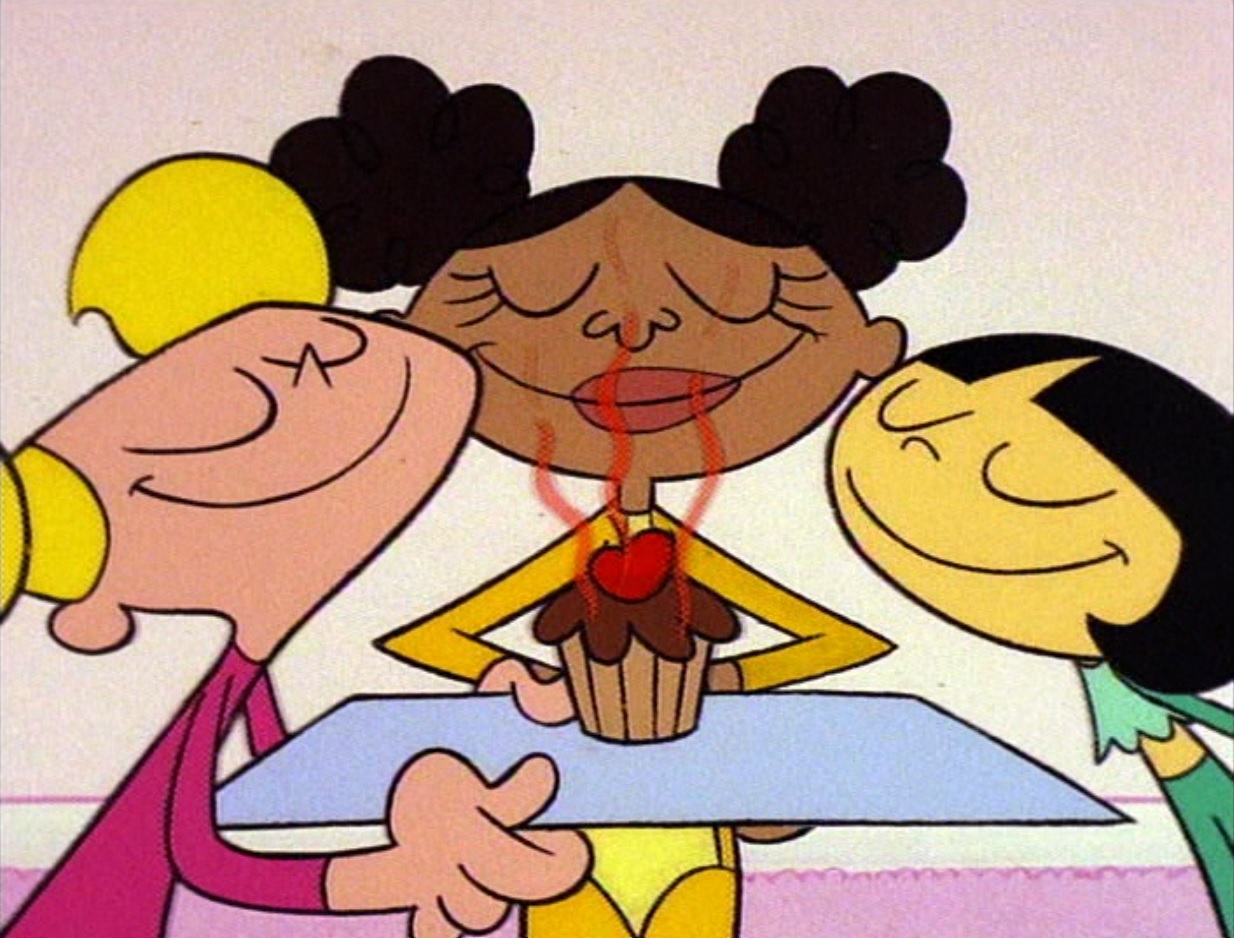
‘Tribe Called Girl’ is an episode like ‘Dee Dee’s Room‘ and ‘Dollhouse Drama‘, without adding much.
Once again, Dexter goes to Dee Dee’s room, this time to observe the behavior of girls. But then he’s discovered by Dee Dee and her friends Lee Lee and Mee Mee…
Dexter is presented as being completely unable to communicate with the girls, who, in one scene, treat him like a shy animal.
‘Way of the Dee Dee/The Justice Friends: Say Uncle Sam/Tribe Called Girl’ is available on the DVD ‘Dexter’s Laboratory Season One: All 13 Episodes’
Airing Date: November 27, 1996
Babysitter Blues
Directors: Craig McCracken & Rob Renzetti
Stars: Dexter
Rating: ★★★
Review:

‘Babysitter Blues’ immediately makes clear that Dexter is in love with his babysitter. The scene in which he prepares the room for her arrival is priceless, with its strong posings on the little boy.
But when Lisa, the babysitter, arrives, it quickly turns out she has a boy friend, prompting Dexter to think out a devilish scheme.
Dexter is far from sympathetic in this cartoon, and the love theme with ca. ten years age difference between Dexter and Lisa is a little bit uncomfortable, but the episode still is great fun. Apart from the opening scene highlight of this episode is Dee Dee looking for something without knowing for what.
The Justice Friends: Valhallen’s Room
Director: Genndy Tartakovsky
Stars: Justice Friends
Rating: ★
Review:

‘The Justice Friends: Valhallen’s Room’ starts with Major Glory calling the others for breakfast. When Valhallen doesn’t show up, he and Krunk enter his room…
This episode contains some nice references to Norse mythology, but otherwise is very tiresome and not even remotely funny. Most enjoyable of this otherwise forgettable short are the dramatic poses of Major Glory and his American themed breakfast.
Dream Machine
Directors: Rob Renzetti & Genndy Tartakovsky
Stars: Dexter
Rating: ★★
Review:

This episode starts with Dexter having a nightmare. Apparently he has had many lately, so Dexter builds himself a dream machine, which requires Dee Dee as its operator.
The premise of this scheme is all too predictable, and after Dexter’s initial dream there’s little to enjoy. Even Dexter’s second dream doesn’t really deliver, and most frustratingly, the episode ends abruptly and inconclusively.
‘Babysitter Blues/The Justice Friends: Valhallen’s Room/Dream Machine’ is available on the DVD ‘Dexter’s Laboratory Season One: All 13 Episodes’
Airing Date: May 25, 1996
Jurassic Pooch
Directors: Craig McCracken & Genndy Tartakovsky
Stars: Dexter
Rating: ★★
Review:
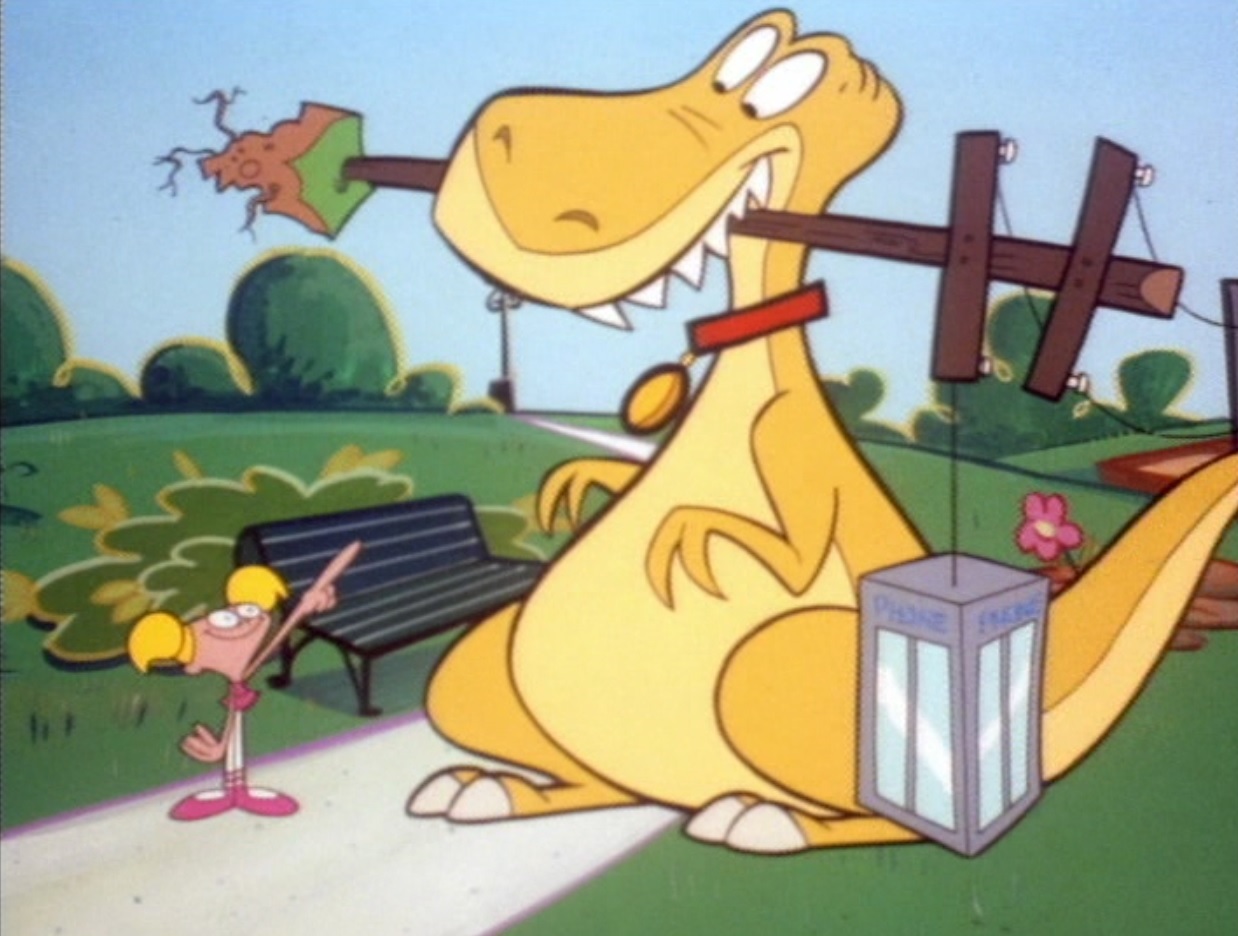
‘Jurassic Pooch’ clearly takes its inspiration from ‘Jurassic Park’: Dexter tries to revive a dinosaur from ancient DNA trapped inside amber.
Unfortunately and rather unscientifically, he’s missing the genes for the heart and the brain, which he takes from his dog. The result is a Tyrannosaur with dog characteristics.
Compared to the other characters, the dinosaur isn’t designed very well, and looks surprisingly like standard Hanna-Barbera fare. The humor, too, mostly falls flat, as the episode milks ‘giant dog’ gags to the max. The best gag may be the one in which Dexter’s cool jet plane turns into a bicycle.
Dial M for Monkey: Orgon Grindor
Directors: Paul Rudish & Genndy Tartakovsky
Stars: Dial M for Monkey
Rating: ★
Review:
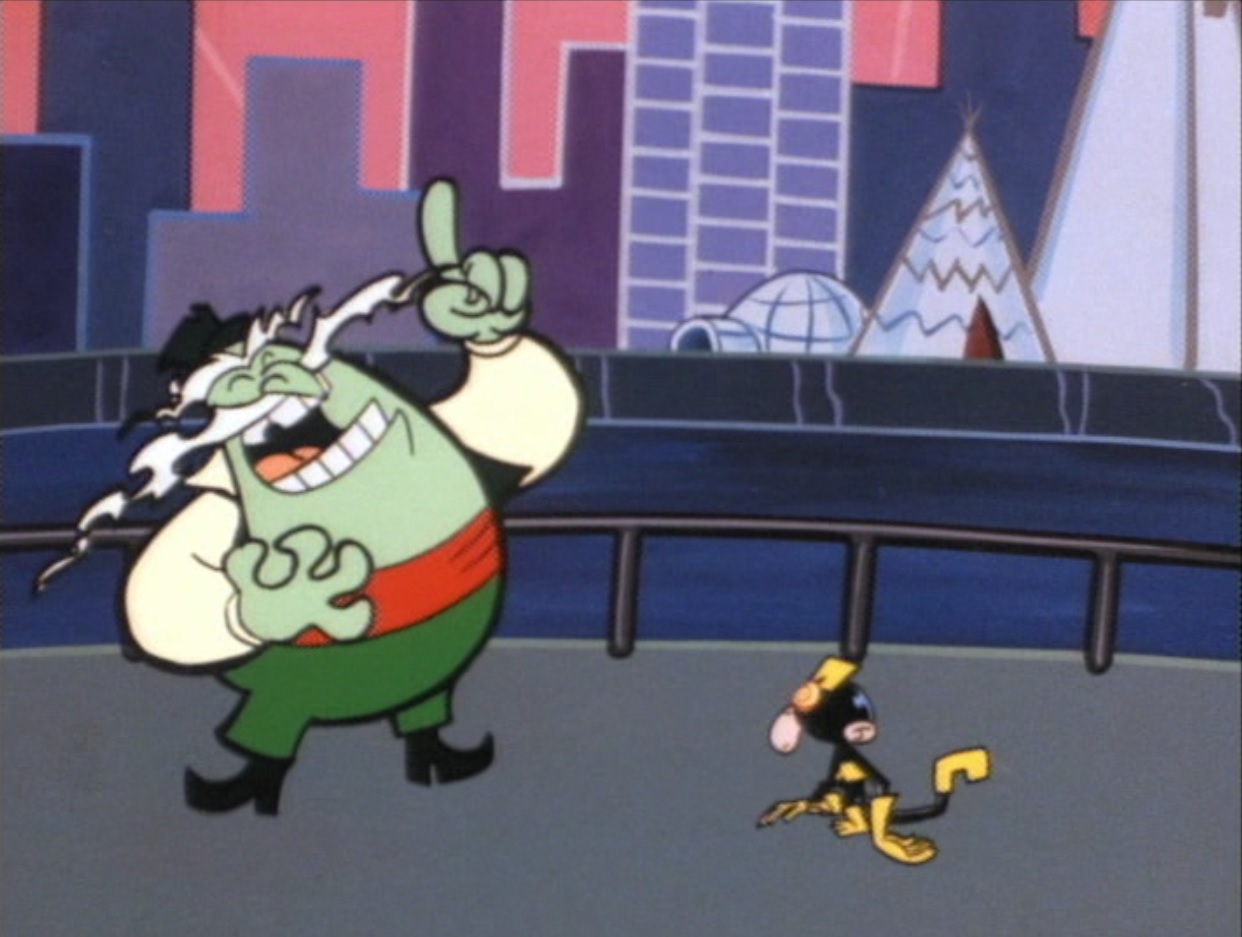
The Dial M for Monkey were the least interesting parts of the Dexter’s Laboratory show, and ‘Dial M for Monkey: Orgon Grindor’ is no exception.
In this boring episode monkey gets hypnotized by some intergalactic gypsy called Orgon Grindor. This pale-green villain looks like a blast from the past: he’s dressed like an organ grinder cliché from the 1930s, he speaks mock-Italian, and partly sings his dialogue, e.g. on the opera aria melodies of Giuseppe Verdi’s ‘La donna e mobile’ and Ruggero Leoncavallo’s ‘Ridi, Pagliacci’.
Much more interesting is the deepening of the relationship between Monkey and Agent Honeydew, who, for once, saves the day instead of Monkey. The two are depicted as being lovers in a rather risqué inter-species relationship.
Dimwit Dexter
See the post devoted to this episode
‘Jurassic Pooch/Dial M for Monkey: Orgon Grindor/Dimwit Dexter’ is available on the DVD ‘Dexter’s Laboratory Season One: All 13 Episodes’
Director: Steve Box
Release Date: November 9, 1997
Rating: ★★
Review:

‘Steve Box had joined Aardman in 1992 and was one of the animators on ‘The Wrong Trousers‘ (1993) and ‘A Close Shave‘ (1996).
‘Stage Fright’, his own short, is a short melodrama about a shy ‘dog juggler’ who is bullied by a mean silent cinema actor. The film uses designs reminiscent of the Wallace and Gromit films, excellent stop motion animation, and some atmospheric lighting, but it immediately becomes clear that Steve Box is no Nick Park.
Box’s way of non-linear story telling is confusing and heavy-handed. Because they’re not introduced properly we don’t care about the characters one bit. Worse, throughout the film the relationship between the three characters remains sketchy and trite. Add way too much dialogue, and the result is as disappointing as it is boring. The only interesting part is Box’s emulation of silent cinema using his clay characters.
Watch ‘Stage Fright’ yourself and tell me what you think:
‘Stage Fright’ is available on the DVD ‘Aardman Classics’
Director: Peter Lord
Release Date: April 10, 1996
Rating: ★★
Review:
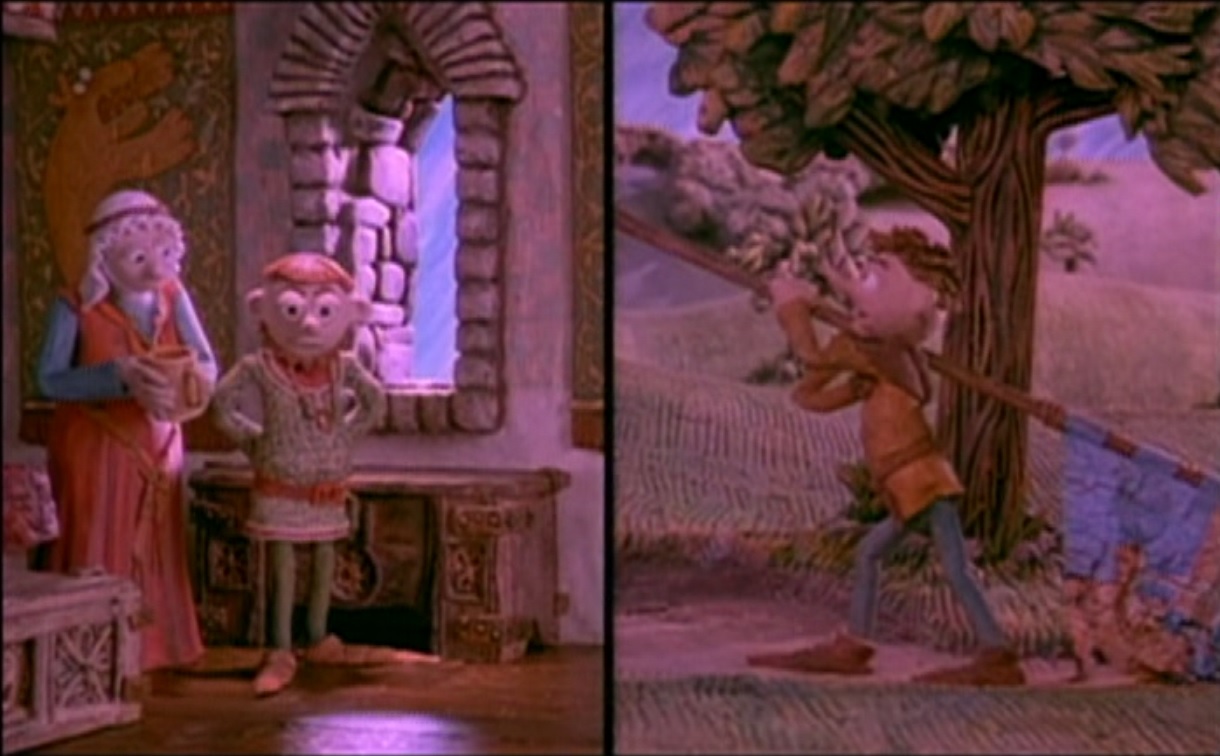
Aardman founder Peter Lord penned and directed this medieval story for children about two royal twin brothers who get separated. One remains royal, the other becomes an ordinary peasant. But when their country is threatened by an enemy, the tables are turned, or not?
This film features silent comedy, with very little dialogue (only ‘me?’ and ‘hello?’ are uttered). More interesting is the returning use of a split screen. The animation and sets are both of a high quality, but Lord’s story is as rambling as it is boring, and completely fails to fulfil its promise. The film ends rather sudden and inconclusive, leaving us with Andy Price’s attractive quasi-medieval music. In fact, I’m surprised the film even got an Academy Award nomination.
Watch ‘Wat’s Pig’ yourself and tell me what you think:
‘Wat’s Pig’ is available on the DVD ‘Aardman Classics’
Director: Raymie Muzquiz
Airing Date: April 20, 1996
Stars: Duckman
Rating: ★★
Review:
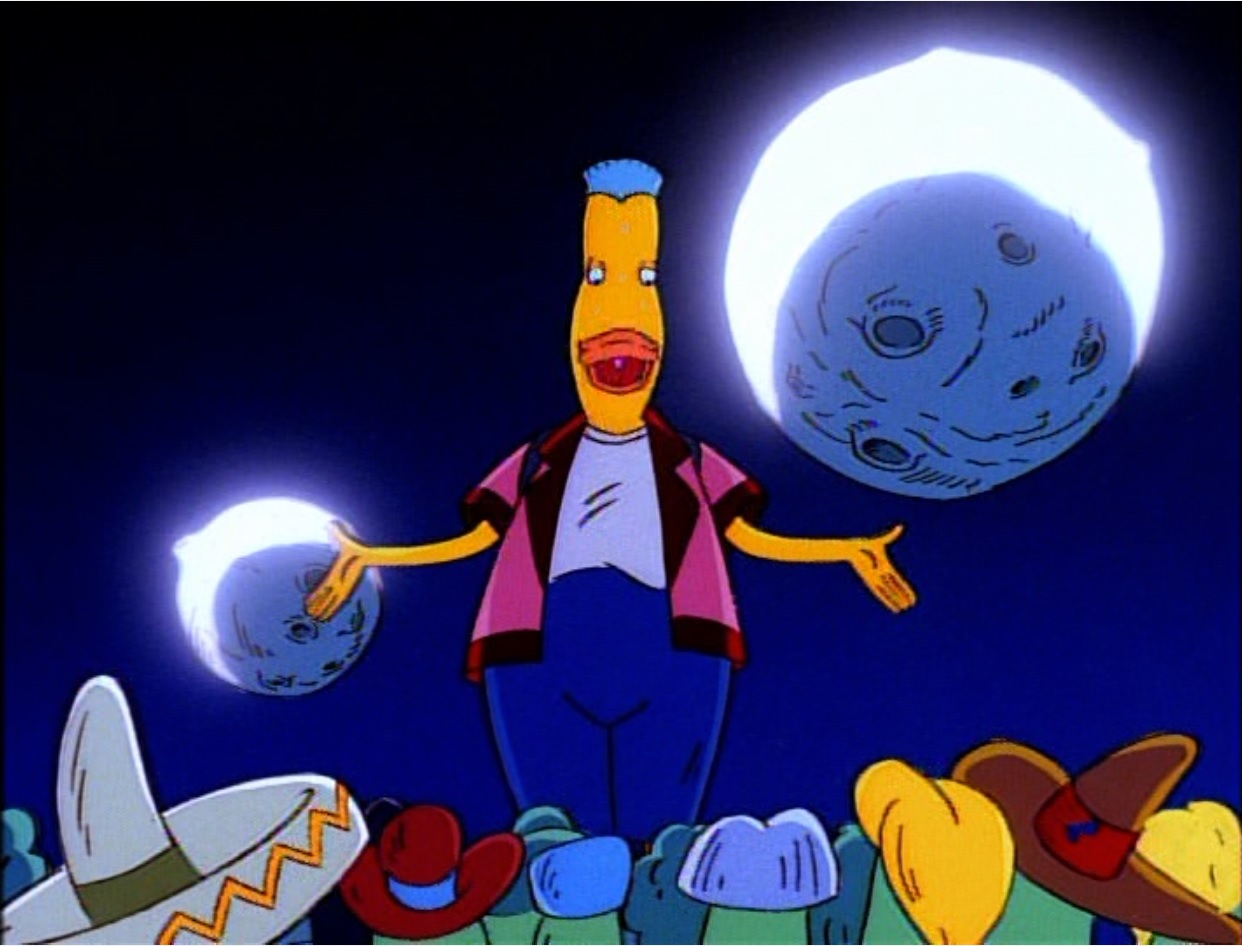
In ‘The One with Lisa Kudrow in a Small Role’ Duckman wants to be alone, so he sends his son Ajax out on the street. Ajax gets abducted by hillbilly aliens from the planet Betamax, and revered as a prophet by the backward planet. But everything goes wrong when Ajax plays them the tape his father gave him, and the planet takes the word of ‘Dod’ literally.
‘The One with Lisa Kudrow in a Small Role’ is violently anti-religion, connecting dogmatism with violence and destruction. The satire is rather blunt and in your face, and therefore actually fails to hit its mark. Meanwhile this is one of those many Duckman episodes tiringly playing with Duckman’s complete ignorance of his own offspring. The result is rather exhausting.
Most enjoyable are Ajax’s semi-profound remarks and the rather Dr. Seuss-like background art of planet Betamax.
Watch ‘The One with Lisa Kudrow in a Small Role’ yourself and tell me what you think:
This is Duckman episode no. 35
To the previous Duckman episode: The Once and Future Duck
To the next Duckman episode: Aged Heat
‘The One with Lisa Kudrow in a Small Role’ is available on the DVD-box ‘Duckman – The Complete Series’
Director: Raymie Muzquiz
Airing Date: February 24, 1996
Stars: Duckman
Rating: ★★
Review:
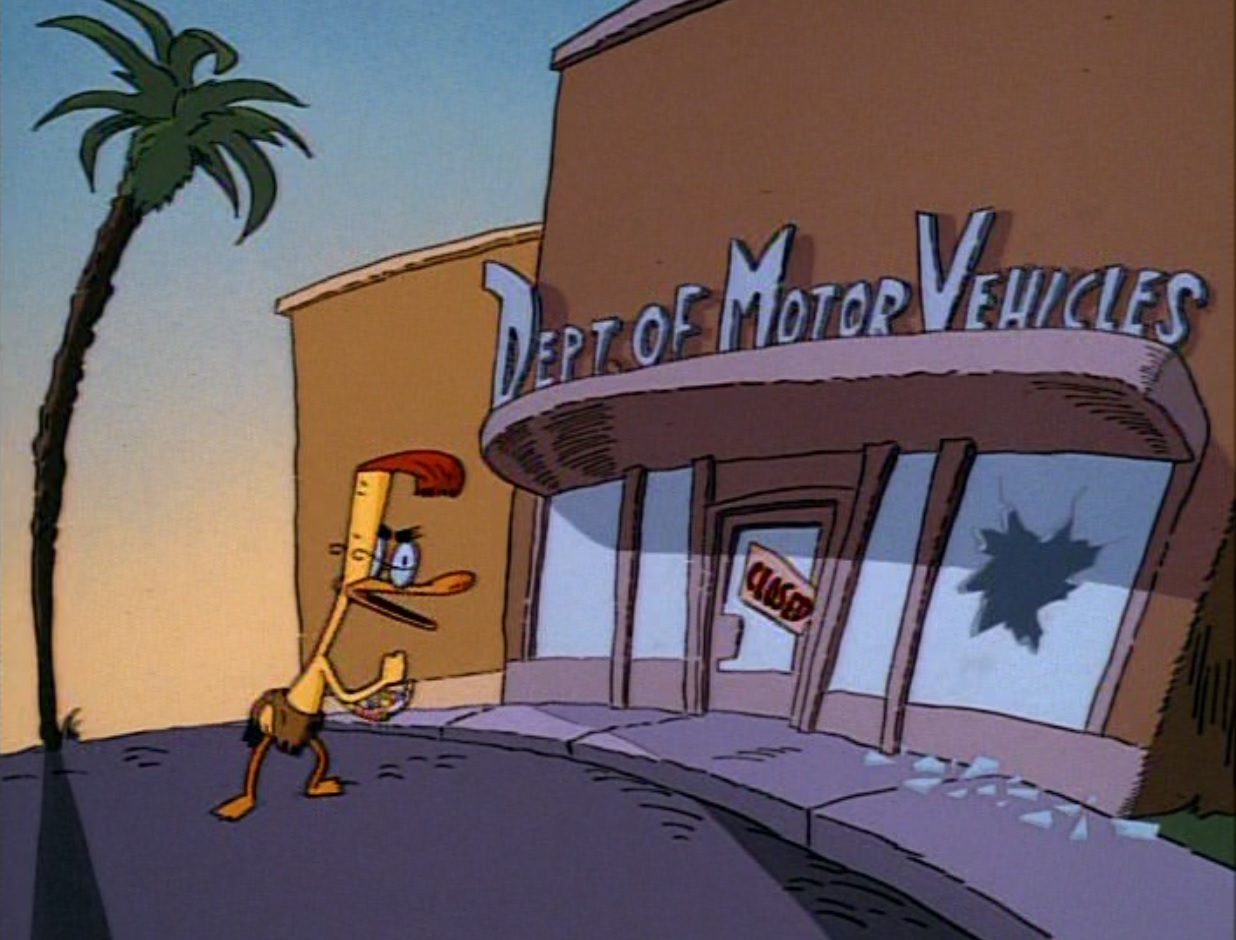
‘Apocalypse Not’ is an obvious spoof of disaster and monster movies.
When the whole town goes for an emergency drill led by Aunt Bernice, Duckman remains the only person behind, thinking he is the sole survivor of some apocalyptic event.
Many movie tropes can be found in this episode, including the killing of auxiliary personas and Duckman spraining his ankle. Unfortunately, on the way Duckman’s persona becomes practically a caricature of itself, behaving rather over-the-top. And thus the episode’s highlight remains it opening credits, in which something big causes havoc in the city…
Watch ‘Apocalypse Not’ yourself and tell me what you think:
This is Duckman episode no. 29
To the previous Duckman episode: A Room with a Bellevue
To the next Duckman episode: Clear and Presidente Danger
‘Apocalypse Not’ is available on the DVD-box ‘Duckman – The Complete Series’


 Dr. Grob's Animation Review