
You are currently browsing the category archive for the ‘★★’ category.
Directors: Harry Bailey & John Foster
Release Date: November 23, 1930
Stars: Milton Mouse, Rita Mouse
Rating: ★★
Review:
 ‘The Office Boy’ is yet another Van Beuren cartoon featuring Milton Mouse and Rita Mouse, Van Beuren’s sloppy copies of Mickey and Minnie Mouse, indirectly showing the mouse’s enormous popularity.
This time Milton is an office boy, where Rita is a secretary. The story involves Milton getting jealous of Rita when the boss flirts with her. So Milton invites the boss’s wife to catch her husband red-handed. In the end we watch Milton and Rita jumping into a painting on a train to sing their end duet.
The designs and animation of Milton and Rita are terrible, but too close for comfort, and some of Mickey’s mannerisms have clearly been copied. As was the case in ‘Circus Capers‘, Milton and Rita are more vulgar than their Disney counterparts, despite the similar looks, and most of the fun of the cartoon lies in the rude behavior of these pseudo-Mickey and Minnie. The cartoon’s best gag, however, is when Rita starts typing frantically even when her boss hasn’t really dictated anything.
But Milton’s and Rita’s days were numbered. In 1931 Disney sued the Van Beuren company, and on April 30, 1931 the federal court prohibited the Van Beuren studio to display any of his Mickey Mouse-lookalikes. The Walt Disney company never asked for money, however. They simply wanted the plagiarism to stop.
Watch ‘The Office Boy’ yourself and tell me what you think:
‘The Office Boy’ is available on the DVD ‘Uncensored Animation from the Van Beuren Studio’
Directors: Mannie Davis & John Foster
Release Date: November 9, 1930
Stars: Waffles and Don
Rating: ★★
Review:
 ‘Gypped in Egypt’ is a cartoon set in Egypt. It predates Disney’s ‘Egyptian Melodies‘, which covers similar grounds, by nine months.
This cartoon was the last of four to feature Waffles and Don. The duo had finally reached distinct personalities in this short: Waffles, the tall cat, is constantly afraid, while Don, the small dog, keeps calm and unimpressed.
In the opening shot we watch the duo traveling through the desert on a camel. When the camel dies, a nightmarish scene starts, featuring a sphinx, pyramids and more camels. This brings our heroes inside an Egyptian tomb, where they encounter dancing skeletons and hieroglyphs. Suddenly, there are skeletons everywhere, and Don plays the piano with one of them. The cartoon ends abruptly with Waffles and Don running from a giant hypnotizing sphinx face.
‘Gypped in Egypt’ features several elements that were reused in Disney’s ‘Egyptian Melodies’: dancing hieroglyphs, nightmarish scenes, and even a corridor scene. However, Van Beuren’s cartoon is much cruder and more disjointed than Disney’s latter cartoon. Its greatest feature is it hallucinating character. Unfortunately, it is not retained throughout the picture, and the whole cartoon suffers from all too sloppy storytelling and ditto timing.
Watch ‘Gypped in Egypt’ yourself and tell me what you think:
‘Gypped in Egypt’ is available on the DVD ‘Aesop’s Fables – Cartoon Classics from the Van Beuren Studio’
Director: Frank Moser
Release Date: 1930
Rating: ★★
Review:
 ‘Family Album’ is a commercial by Charles W. Barrell for the Western Electric Company, glorifying the telephone, and its ‘offspring’: other inventions that are derived from telephone technology, including the microphone and the speaker.
The film reuses the character Talkie from Fleischer’s earlier film ‘Finding his voice‘ (1929), but its star is an anthropomorphized telephone, talking about his family. Although quite educational, the film is less interesting than Fleischer’s film. The animation, by veterans Paul Terry and Frank Moser, is rather poor and limited. There’s no rubbery animation whatsoever, and the designs are still in 1920s style.
‘Family Album’ is available on the DVD ‘Cultoons! Rare, Lost and Strange Cartoons! Volume 2: Animated Education’
Director: Jan Švankmajer
Release Date: 1980
Rating: ★★
Review:
 Jan Švankmajer retells this famous story by Edgar Allen Poe using a narrating voice over and black and white images of several different objects.
The images, some of which are animated, are sometimes quite disturbing, and are at points even able to evoke the horror of the story. However, most of the time they seem totally unrelated to the narration, and their visual power in fact often distracts from the voice over, making the story very hard to follow, indeed.
‘The House of Usher’ is a daring experiment in cinematographic storytelling, but not really a successful one, and Švankmajer would not repeat it. Nevertheless, three years later, the Czech film maker would return to Edgar Allen Poe, in ‘The Pendulum, the Pit and Hope‘, with much better results.
Watch ‘The Fall of the House of Usher’ yourself and tell me what you think:
‘The Fall of the House of Usher’ is available on the DVD ‘Jan Svankmajer – The Complete Short Films’
Director: Henk Kabos
Release Date: 1943
Rating: ★★
Review:
 ‘Das musikalische Auto’ is a Toonder studio film commissioned by Nazi Germany.
It’s a strange little tale of a man who ‘improves’ an old car into a musical instrument. He tours around the countryside, until his car crashes against a tree.
The soundtrack of this film has been lost, so we don’t know how the musical car sounds, but the film feels uninspired: the story lacks any logic, and the animation is primitive and raw. It contains some elements both 1930s Fleischer and Disney, without reaching either peaks.
In his autobiography Marten Toonder states that the idea of this cartoon had its origins in the German UFA studio, who wanted a story on a tumble toy. Toonder soon gave the tumble toy arms and legs, but he and his studio only halfheartedly worked on this ill-conceived idea, and it shows. Nevertheless, some of the designs are quite charming: the backgrounds have an unmistakable Toonder-touch, and the animals in the cartoon do look good.
‘Das musikalische Auto’ is available on the DVD inside the Dutch book ‘De Toonder Animatiefilms’
Director: Dan Gordon
Release Date: August 7, 1942
Stars: Popeye
Rating: ★★
Review:
 ‘You’re a Sap, Mr. Jap’ is the first Popeye short by the Famous studio, after Paramount had taken over business from the Fleischer Brothers.
This film is immediately the most vicious propaganda film in Popeye’s career, and one of the most extreme cartoons of the entire World War II era. In it Popeye encounters some vicious caricatures of Japanese who doublecross him while suggesting to want to make peace. Their small boat turns out to be on top of a giant battleship which Popeye defeats singlehandedly. The cowardly admiral then commits suicide by drinking nitroglycerin and eating firecrackers, destroying the whole ship.
‘You’re a sap, Mr. Jap’ is as propagandistic as it is ferocious. In the Fleischer’s ‘Fleets of Stren’th’ from five months earlier, the enemy was still rather abstract, but in ‘You’re a sap, Mr. Jap’ the Japanese people themselves are attacked. The film was the first, but not the only one to feature extreme caricatures of Japanese, which in this cartoon are killed by the dozen. Later, cartoons like ‘Bugs Bunny Nips the Nips’ and ‘Commando Donald’ (both 1944) would follow suit.
These cartoons mark a clear difference between the two enemies: the Germans and the Japanese. While the Nazis were always portrayed as silly, the German people were almost never seen in cartoons, and when shown, they were regarded as victims of their leaders, like in ‘Education for Death‘ (1943). The Japanese, on the other hand, with their less visible regime, were treated as one and the same, from the military top to the average soldier. No doubt, a sizable dose of racism accompanied this view. And it’s views like this that resulted in the arrest and internment of American Japanese, something that also happened to Germans living in the United States, but on a much smaller scale…
In ‘You’re a sap, Mr. Jap’ the anti-Japanese sentiment results in a remarkably unfunny cartoon, and the short is more famous for its lack of politic correctness than for its humor.
Watch ‘You’re a Sap, Mr. Jap’ yourself and tell me what you think:
This Popeye film No. 109
To the previous Popeye film: Baby Wants a Bottleship
To the next Popeye film: Alona on the Sarong Seas
Director: Clyde Geronimi
Release Date: February 28, 1942
Stars: Pluto
Rating: ★★
Review:
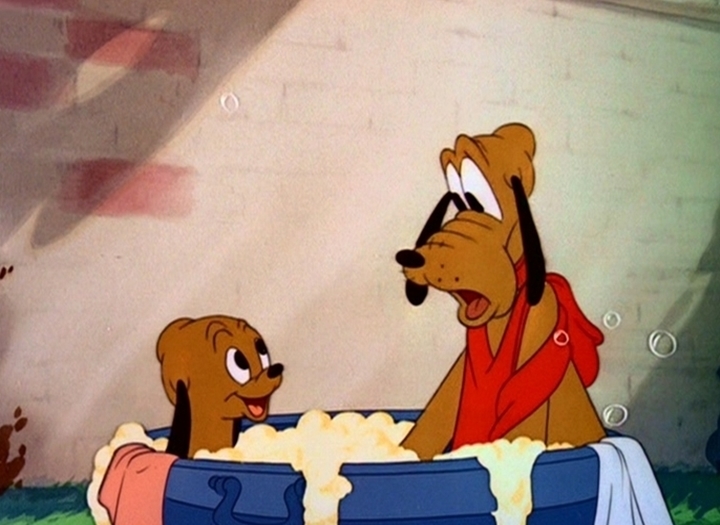 In this cartoon Pluto has only one son (instead of five as in ‘Pluto’s Quin-Puplets’ from 1937).
We watch this pup playing with a ball, a balloon, a caterpillar and a bird, which leads him into a distressful position on a clothes-line. Only then Pluto, who had been asleep all the time, comes into action. Pluto rescues his son and both fall into a wash-tub.
The best sequence of the cartoon involves Pluto’s antics on the clothes-line. It’s clear that he is a far funnier character than his son, which is only cute. Indeed, after this cartoon Pluto jr. was never seen again.
Watch ‘Pluto Junior’ yourself and tell me what you think:
This is Pluto cartoon No. 5
To the previous Pluto cartoon: Pluto’s Playmate
To the next Pluto cartoon: The Army Mascot
Director: Walter Lantz
Release Date: April 13, 1942
Rating: ★★
Review:
 Mother Goose on the Loose’ stands in a long tradition of nursery rhyme cartoons, from the Felix the cat cartoon ‘Felix in Fairyland’ (1923) via the Silly Symphony ‘Mother Goose Melodies‘ (1931) and ‘Mother Goose Land‘ starring Betty Boop (1933), to Disney’s ‘Mother Goose Goes to Hollywood’ (1938) featuring caricatures of Hollywood stars.
Unfortunately, ‘Mother Goose on the Loose’ is weaker than any of these, hampered by a slow timing, corny gags and an obnoxious voice over. Even a jazzy tune, setting in after five boring minutes, cannot rescue the cartoon. Its only attraction is its obsession with dames, which are literally all over the cartoon. This makes ‘Mother Goose on the Loose’ a typical cartoon of the World War II era.
Director: Jack Kinney
Release Date: March 23, 1951
Stars: Goofy
Rating: ★★
Review:
 In ‘Home Made Home’ Goofy tries to build his own house.
‘Home Made Home’ features the updated design of Goofy, introduced in ‘Tennis Racquet‘ (1949). Nevertheless, this cartoon has an old-fashioned feel to it. Like the sports cartoons from the 1940s, it uses a pompous narrator, and Goofy’s original voice. Moreover, the cartoon consists of three elongated situation gags in a style we had not seen since the 1930s. In the first Goofy is trapped in a blueprint, in the second he has to deal with a glass panel with a will of his own, recalling the piano from ‘Moving Day‘ (1937), and in the third he has to battle a snake-like paint-gun.
The gags are clever at times. Nevertheless, this short is rather slow and unfunny and only a shadow of the 1930s cartoons, the style of which it seems to try to evoke.
Watch ‘Home Made Home’ yourself and tell me what you think:
This is Goofy cartoon No. 28
To the previous Goofy cartoon: Lion Down
To the next Goofy cartoon: Cold War
Director: George Scribner
Release Date: November 13, 1988
Rating: ★★
Review:
 Oliver and Company’ is the Walt Disney studio’s third film about dogs, after ‘Lady and the Tramp‘ (1955) and ‘One Hundred and One Dalmations’ (1961). Three of the first film’s characters, Peggy, Jock and Trusty, even have a cameo during Dodger’s song.
‘Oliver and Company’ contains some nice and easy looking dog animation, but it is hardly a worthy successor of the two classics. The opening scenes of ‘Oliver & Company’ introduces Oliver, a cute little orange cat to us, in a scene set to an ugly 1980s song. Oliver teams up with a cool dog called Dodger, who appears to be part of a dog gang. Only when the gang’s owner, the poor tramp Fagin (excellently voiced by Dom DeLuise) is visited by the film’s villain, Sykes, some kind of drama begins. By then the film already is 18 minutes underway.
During a totally incomprehensible framing act Oliver is taken sway by a little rich girl called Jenny, much to the dismay of her house’s star dog, poodle Georgette (voiced by Bette Midler). The gang ‘rescues’ Oliver, which leads to the only continuous and songless story part of the complete film. Surprisingly, the upper class world of Jenny and Georgette and the lower class world of Fagin and his dogs don’t seem to clash at all in this film. As soon Jenny is kidnapped, Georgette naturally teams up with the dog gang. The film ends with a wild and totally unbelievable chase, killing Sykes.
Although released five months after ‘Who Framed Roger Rabbit‘ it’s difficult to regard ‘Oliver & Co.’ as part of the Disney renaissance. It’s not as bleak as ‘The Fox and the Hound‘ or as misguided as ‘The Black Cauldron‘, but the film still feels as a continuation of the 1960s and 1970s, instead of something new, making it part of animation’s dark ages.
There are several reasons for this: first, the use of xerox, first used in ‘One Hundred and one Dalmations’ (1961), and defining Disney’s graphic style up to this film. Second, the equally graphic backgrounds, which are uninspired, dull and ugly, as are the all too angular and unappealing cars and machines. Third, the animation, which is erratic and at times downward poor, with the animation of the little girl Jenny, a far cry from the endearing Penny from ‘The Rescuers‘ (1977), being the low point. Fourth, the human designs, which apart from the main characters, look the same as in any generic animated television series from the 1980s. And fifth, the story, which, vaguely based on Charles Dickens’s ‘Oliver Twist’, is ramshackle and formulaic. Moreover, the attempt to ‘modernize’ Disney by moving the setting to contemporary New York is forced, and only a change of setting. There’s no new spirit to the film. And finally, the anonymous 1980s songs have aged the film very quickly.
There are some highlights: the dogs are all good, if not particularly inspired and owing much to ‘Lady and the Tramp’, Jenny’s butler Jenkins is well animated, as is Fagin when he struggles to give Oliver back to Jenny. But overall the film fails to entertain: Oliver himself is not particularly interesting, he is just the straight man, the little girl Jenny is too bland to gain sympathy, the songs are generic and the story (penned by no less than thirteen people) is too erratic to suck the viewer in.
Luckily, ‘Oliver and Company’ was not part of a new era, but the last convulsion of an old one. With its next film, ‘The Little Mermaid’ (1989) Disney would really enter its renaissance.
Watch Dodger’s song from ‘Oliver & Company’ yourself and tell me what you think:
Director: Chuck Jones
Release Date: September 2, 1950
Stars: Daffy Duck, Porky Pig
Rating: ★★
Review:
 Chuck Jones is famous for directing cute characters, but throughout his career he directed some extraordinarily cruel cartoons, like ‘Fresh Airedale’ (1945), ‘Scaredy Cat‘ (1948) and ‘Chow Hound’ (1951). ‘The Ducksters’ is probably the cruelest of the lot, and in this cartoon the cartoon violence feels more painful than funny.
In ‘The Ducksters’ Daffy Duck is a quizmaster and Porky the unlucky contestant in the radio quiz ‘Truth or Aaagh’, an extreme take on the radio (and later television) show ‘Truth or Consequences’, which had been around since 1940. The cartoon violence starts immediately, as the opening shot features a tied-up Porky slowly approaching a sawmill. A few scenes later, Daffy shoots someone in the audience.
Throughout the picture Daffy remains the ultra-violent trickster, until the tables are turned in the end. However, Daffy is neither loony nor misguided, being in the midst of a transition of character, which renders him ‘just cruel’, and very unsympathetic, indeed.
Luckily, Chuck Jones knew a better a use for the duck, using him as a misguided hero (e.g. ‘The Scarlet Pumpernickel‘ (1950) and ‘Drip-along Daffy‘ (1951), or playing him against the cleverer Bugs Bunny (e.g. ‘Rabbit Fire‘, 1951 and ‘Rabbit Seasoning’, 1952). These cartoons are all far funnier than ‘The Ducksters’.
Watch ‘The Ducksters’ yourself and tell me what you think:
http://www.dailymotion.com/video/x1ylkhn_daffy-duck-ep-59-the-ducksters_fun
This is Porky Pig cartoon no. 134
To the previous Porky Pig cartoon: Golden Yeggs
To the next Porky Pig cartoon: The Wearing of the Grin
This is Daffy Duck cartoon No. 54
To the previous Daffy Duck cartoon: Golden Yeggs
To the next Daffy Duck cartoon: Rabbit Fire
‘The Ducksters’ is available on the DVD-set ‘Looney Tunes Golden Collection Volume One’
Director: Friz Freleng
Release Date: August 5, 1950
Stars: Daffy Duck, Porky Pig
Rating: ★★
Review:
 1950 was a transitional year for Daffy Duck: director Robert McKimson still retained Daffy’s old loony self in ‘Boobs in the Woods‘, but Chuck Jones introduced a new version of the character, as the anti-hero in ‘The Scarlet Pumpernickel‘.
However, two other shorts from the same year, ‘Golden Yeggs’ and ‘The Ducksters‘, show that the directors were uncertain where to go with the character. In Friz Freleng’s ‘Golden Yeggs’ a goose lays a golden egg (24 karat solid gold) at Porky’s poultry farm, but she blames Daffy for doing it. Daffy plays along, but the news soon attracts a gang of gangsters, led by Rocky, in his debut*. The gangsters kidnap Daffy, forcing him to lay more eggs.
Daffy Duck is quite an empty character in this cartoon, more a victim than in control. He has lost his loony character traits completely, but his later greed and foul play haven’t entered, yet, leaving the character pretty much in limbo. The result is an erratic cartoon, weak in its comedy, and uncertain in its delivery, despite some great gags, like Daffy opening a ‘door’ which consists of a gangster.
Watch ‘Golden Yeggs’ yourself and tell me what you think:
http://www.b99.tv/video/golden-yeggs/
This is Porky Pig cartoon no. 133
To the previous Porky Pig cartoon: An Egg Scramble
To the next Porky Pig cartoon: The Ducksters
This is Daffy Duck cartoon No. 53
To the previous Daffy Duck cartoon: The Bitter Half
To the next Daffy Duck cartoon: The Ducksters
‘Golden Yeggs’ is available on the DVD-set ‘Looney Tunes Golden Collection Volume One’
* The Rocky in ‘Racketeer Rabbit’ (1946) was a different character, being a caricature of Edward G. Robinson)
Director: Robert McKimson
Release Date: November 19, 1949
Stars: Sylvester, Hippety Hopper
Rating: ★★
Review:
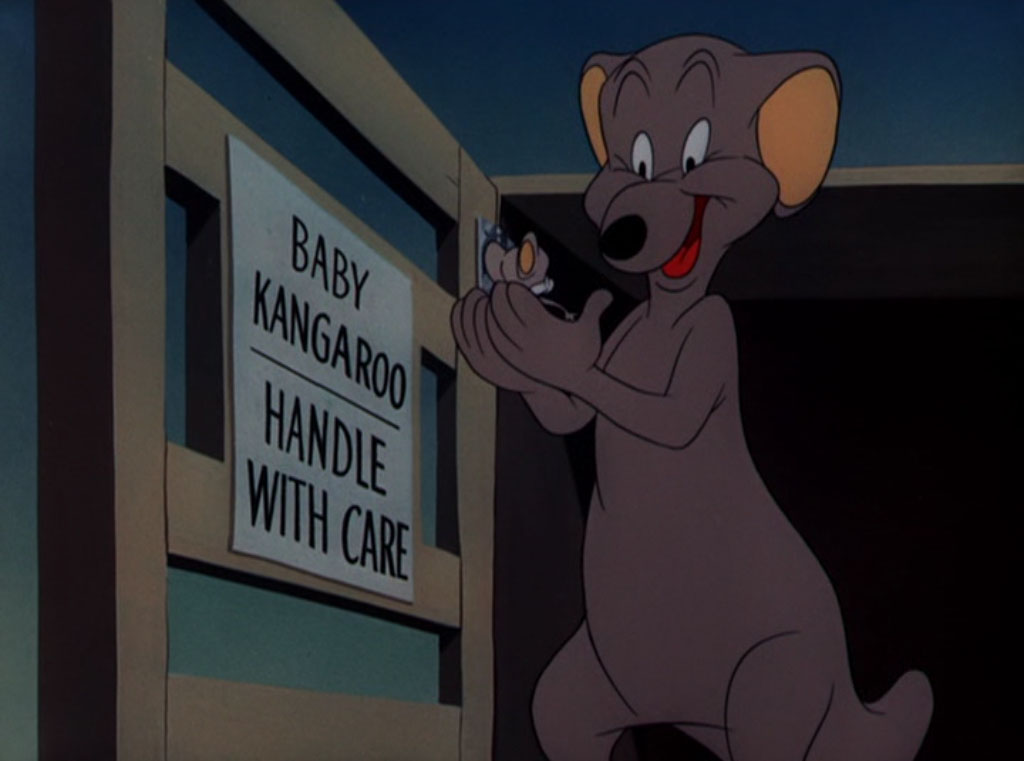 ‘Hippety Hopper’ introduces the kangaroo of the same name, and its only function during its entire career: being mistaken for a mouse.
The cartoon starts gloomily enough, with a misty harbor scene, where a mouse is trying to commit suicide. He’s rescued by Hippety Hopper, however, and together they face the mouse’s terror: Sylvester the cat. The mouse makes Sylvester think he can grow tall, and lets Hippety Hopper beat him out of the house. The best comedy comes from a bulldog who keeps pushing Sylvester back inside.
Hippety Hopper himself is a silent character with a friendly smile and absolutely no personality. He’s easily the least funny recurring star in the Warner Brothers cartoon catalog before the 1960s. Even in this first cartoon his appearance is tiresome. Nevertheless, he would star in twelve other cartoons, lasting even till 1964. The mouse, on the other hand, would disappear after this cartoon. No wonder: he’s designed and animated rather uglily.
Watch ‘Hippety Hopper’ yourself and tell me what you think:
http://www.dailymotion.com/video/x7b04w_merrie-melodies-hippity-hopper-1949_shortfilms
Director: Jack Hannah
Release Date: November 25, 1949
Stars: Donald Duck, The Bee
Rating: ★★
Review:
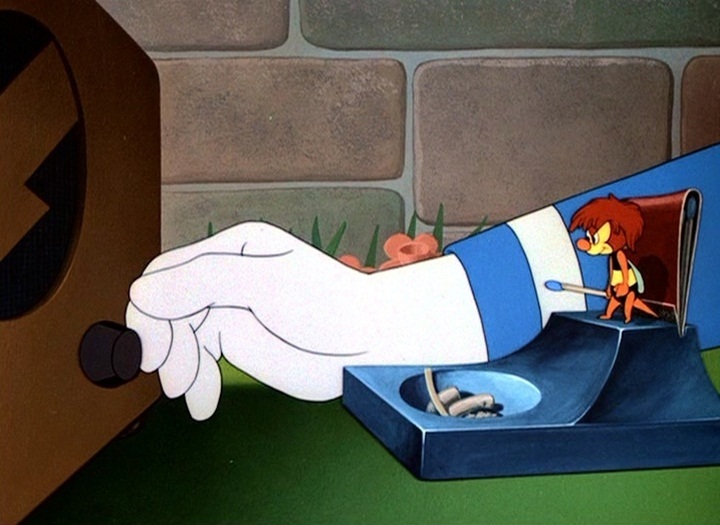 After his move into the Donald Duck series three months earlier in ‘Honey Harvester’, the bee returns. This time as a classical music lover competing with Donald over the radio.
While the bee wants to listen to classical music, Donald wants to listen to a world series baseball match.
The most inspired gags involve Donald and the bee reenacting the match in Donald’s garden. But the bee is hardly a funnier character than Bootle Beetle, and the cartoon never comes off: the violence remains restrained, the bee remains cute. Donald is reduced to a simply annoying character, a bully who is rightly ‘sent to the showers’.
Watch ‘Slide, Donald, Slide’ yourself and tell me what you think:
This is Donald Duck cartoon No. 81
To the previous Donald Duck cartoon: The Greener Yard
To the next Donald Duck cartoon: Toy Tinkers
Director: Mikhail Kamenetsky
Release Date: 1984
Rating: ★★
Review:
 Mikhail Kamenetsky (1924-2006) was a director of numerous puppet films made between 1965 to 1995, almost all featuring animals.
In his ‘Wolf and Calf’ an old wolf steals a calf to eat, but he starts to like it and raises it like his own son. In the end, when a hungry bear, a vixen and a boar try to steal his loot, he is saved by the calf itself, which has turned into a strong bull.
‘Wolf and Calf’ is a fable-like children’s film with an old-fashioned look. The designs of the protagonists look like they have come from a 1950’s toy shop. Kamenetsky’s puppet animation is elaborate, and actually quite good, if erratic, but the film suffers from an excess of dialogue, which not always seems to correspond with the animated characters themselves.
Moreover, the film’s world is rather inconsistent, stretching its believability: the wolf, like all other animals, is highly anthropomorphic and even lives in a house, alongside humans, who are afraid of him nonetheless. The calf, on the other hand, remains on all fours, and stays an animal, even though it is able to speak.
Watch ‘Wolf and Calf’ yourself and tell me what you think:
Director: Eduard Nazarov
Release Date: 1979
Rating: ★★
Review:
 This Soviet animation film starts when a boy enters a hunting shop.
When he looks at a photo of a hunter on top of a dead lion, his imagination starts to wander. He imagines himself in a forest, and on a Savannah, full of wildlife. When encountering the lion, he prevents the hunter from shooting. Unfortunately, he’s awoken by the shop owner.
‘Hunt’ is a silent film, told with realistic images, strong 1970s designs, and dated electronic music. The film’s opening is probably its best: we’re watching images of busy and indifferent city life, before zooming in on the boy. The film clearly celebrates life, especially in the Savannah scenes, which form a rich contrast to the dull city life images. Nevertheless, the film feels traditional and naive, and more as a product of its time than as a timeless classic.
Watch ‘Hunt’ yourself and tell me what you think:
Director: Albert Barillé
Airing date: January1?, 1983
Rating: ★★
Review:
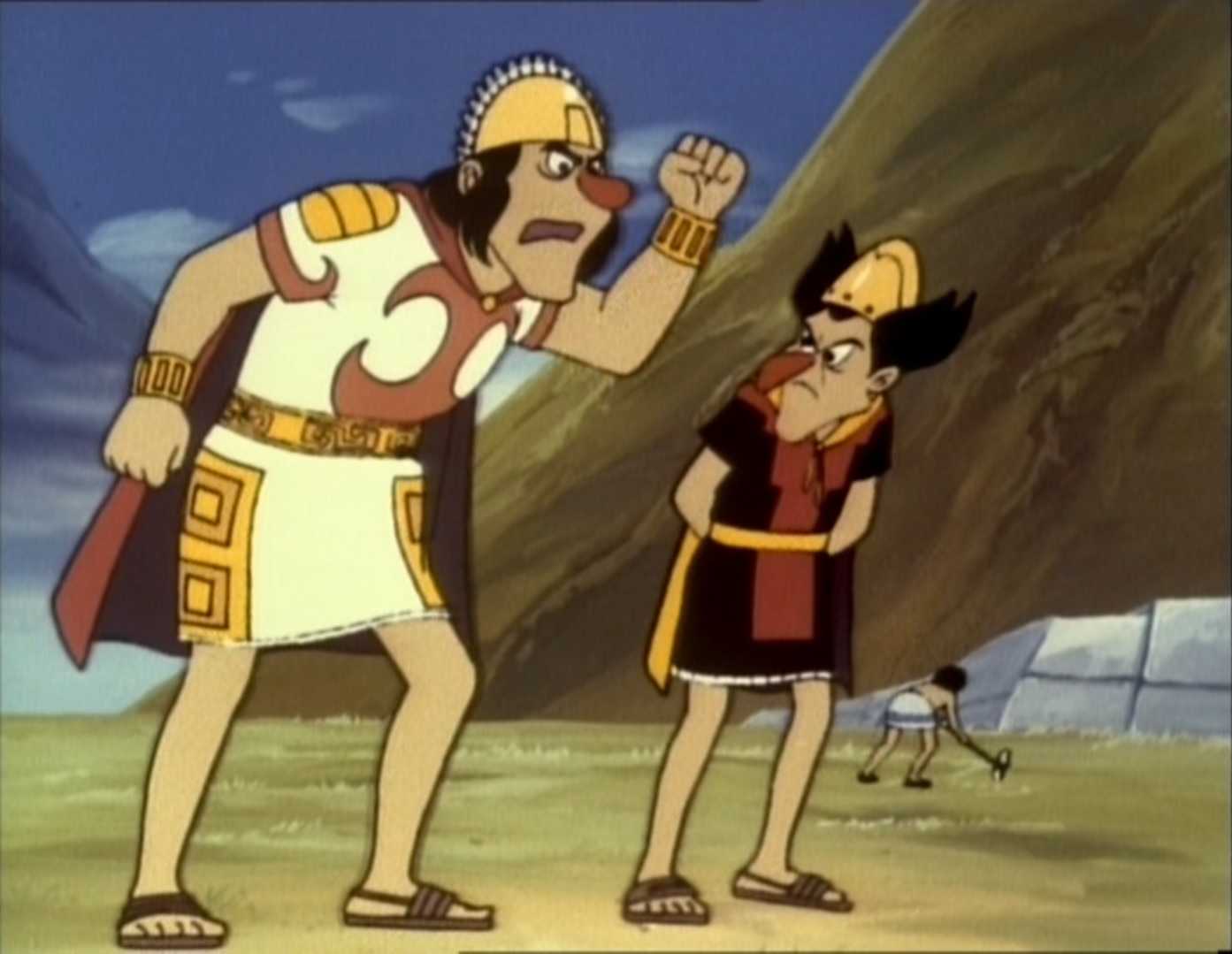 ‘Les Incas’ is the second of three adjacent episodes from ‘Il était une fois… l’espace’ that are more educational than entertaining, and which have nothing to do with the main story.
This time, Pierrot, Psi, Metro, Legros and Maestro visit a planet on which the people live like Incas. Thus Barillé is able to tell us about the Inca society, which he does at great lengths. Only after three-fifths a story kicks in, when the friendly Inca society is about to be attacked by an unseen neighboring people, and our heroes refuse to help them in the battle. The Inca’s own Teigneux and Nabot trick our heroes to get hold of their weapons, but Metro once again saves the day.
This slow and tiresome episode also features an Erich von Däniken-like story about earlier visitors, Astronauts, who turned into Gods, just like in ‘La planète Mytho‘.
Watch ‘Les Incas’ yourself and tell me what you think:
This is the 13th episode of ‘Il était une fois… l’espace’ (Once Upon a Time… Space)
To the 12th episode: Les géants (The Giants)
To the 14th episode: Chez les dinosaures (In the Land of the Dinosaurs)
Director: Albert Barillé
Airing date: November 20?, 1982
Rating: ★★
Review:
 In this seventh episode of ‘Il était une fois… l’espace’ our heroes Pierrot, Psi and Metro land on a planet, where the survivors of a stranded spaceship play Gods.
This episode toys with Erich von Däniken’s ideas about the gods having been astronauts (Barillé would revisit that idea in ‘Les Incas‘). The stranded people are like the gods of the ancient Greek, sharing their names and habits.
The commander of the ship, Zeus, is a strong and valiant man, but he is also selfish, autocratic, and paternalistic. He keeps the mortals, the original humans populating the planet, ignorant and miserable. Pierrot and Psi disagree with the commander’s choice, and secretly give the humans bricks, the wheel, the sail, music and fire, thus turning them into some Prometheus and Athena, and showing Barillé’s personal political view.
Unlike its predecessor, ‘La révolte de robots‘, ‘La planète Mytho’ is more or less a stand-alone episode. It is also vaguely educational, telling kids a little about Greek mythology, although this is much easier to understand and to enjoy by the educated viewer than by the intended audience.
Apart from the Gods, Barillé shows us three Greek myths: Peleus and Thetys, Pan and Syrinx, and Eris’s apple of discord. The bronze giant Talos is transformed into a robot.
Because of the use of Greek mythology, the overall episode is inconsistent, hard to follow and slow. One wonders what Barillé’s aim was with this entry: did he want to educate or did he want to tell about political ethics?
Watch ‘La planète Mytho’ yourself and tell me what you think:
This is the 7th episode of ‘Il était une fois… l’espace’ (Once Upon a Time… Space)
To the 6th episode: La révolte des robots (The Revolt of the Robots)
To the 8th episode: Le long voyage (The Long Voyage)
Director: John Halas
Release date: 1981
Rating: ★
Review:
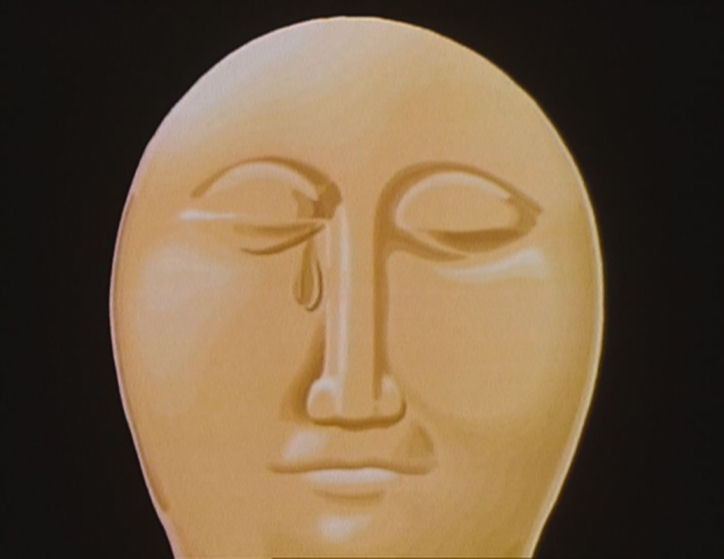 ‘Dilemma’ is one of the earliest computer animation films ever, and probably the first fully digitally produced one.
Unfortunately it is a rather vague, non-narrative film, which seems to try to tell us that we could better use the human mind for art and science than for violence and war.
‘Dilemma’ doesn’t make any use of 3D effects, but stays in a very graphic 2D design style. The only clear additions of the computer are the very primitive morphing sequences. Outside these, the animation is very limited. The film uses the same static head over and over again to illustrate the human mind.
The designs are rather ugly, and so is the synthesizer music. Moreover, the filmmakers seem to want to tell us too much, resulting in a rather tiresome film, in spite of its avant-gardism. It was to other film makers to use the full potential of the new technique of computer animation.
Watch ‘Dilemma’ yourself and tell me what you think:
‘Dilemma’ is available on the DVD inside the book ‘Halas & Batchelor Cartoons’
Director: Abe Levitow
Release date: February 24, 1967
Stars: Tom & Jerry
Rating: ★★
Review:
 In a cartoon that looks forward to ‘2001 A Space Odyssey’ (which would be released the following year), Tom and Jerry inhabit a roulette-like space station.
Here they fight each other using modern technology, including a robot cat. In the end, Tom manages to shoot Jerry to the moon, but luckily for Jerry, it turns out to be made out of cheese.
This cartoon contains nice settings and some original ideas, but none of them are executed well, resulting in yet another mediocre Tom and Jerry cartoon produced by Chuck Jones. Tom & Jerry’s next cartoon, ‘Guided Mouse-ille‘, also has a science fiction setting. Interestingly, both these shorts were penned by story man John Dunn.
Watch ‘O-Solar-Meow’ yourself and tell me what you think:
http://www.dailymotion.com/video/x47z0hx
This is Tom & Jerry cartoon No. 154
To the previous Tom & Jerry cartoon: Cat and Dupli-cat
To the next Tom & Jerry cartoon: Guided Mouse-ille


 Dr. Grob's Animation Review