
You are currently browsing the category archive for the ‘★★’ category.
Director: Jack Hannah
Release date: April 27, 1956
Stars: Humphrey Bear
Rating: ★★
Review:
 In 1956 Jack Hannah directed two Cinemascope cartoons starring Humphrey the bear and the park ranger, without Donald Duck.
‘Hooked Bear’ is the first one. In this short the park is visited by fishermen. Humphrey, of course, wants to join in, trying to catch some fish, but he is entirely unsuccessful.
Even though Humphrey is a well developed and likable character, ‘Hooked Bear’ does not rank among Hannah’s most inspired cartoons. The short marks only Humphrey’s fifth appearance, but some routine already has sneaked in, and none of the gags ever seem to pay off satisfactorily.
Watch ‘Hooked Bear’ yourself and tell me what you think:
‘Hooked Bear’ is available on the DVD ‘Walt Disney Treasures: Disney Rarities’
Director: Jack Kinney
Release date: October 15, 1954
Rating: ★★
Review:
 In this narrated short a lion deliberately gets himself caught to scare the people in New York. Unfortunately, he’s all but unnoticed there.
‘Social Lion’ was the last of three ‘special cartoons’ Jack Kinney directed in 1954, after his own Goofy series had stopped. It is, unfortunately, not a very successful cartoon. Its narration is trite, its timing poor and its animation, by veteran Norm Ferguson, heterogeneous: the full animation of the lion is awkwardly out of contact with the highly stylized animation of the humans.
Unfortunately, ‘Social Lion’ would be the great animator’s last statement. the Disney studio fired Ferguson in July 1953. He died four years later of a heart-attack, at the premature age of 45.
The cartoon reuses the weird safari song from Kinney’s earlier, way more successful short ‘African Diary’ (1945).
Watch ‘Social Lion’ yourself and tell me what you think:
‘Social Lion’ is available on the DVD ‘Walt Disney Treasures: Disney Rarities’
Director: Jack Hannah
Release Date: May 21, 1948
Stars: Donald Duck, Daisy Duck
Rating: ★★
Review:
 Donald is a travelling salesman trying to sell brushes, but nobody understands him.
He then discovers Ajax voice pills, which give him a smooth voice. Soon he sells all his brushes, and he dreams of asking Daisy to marry him, but the pills only work for a short while and soon only one is left…
Like ‘Donald’s Dilemma‘ from 1947, ‘Donald’s Dream Voice’ is built on a strong idea around Donald’s voice. Unfortunately, in both cartoons the idea is funnier than the execution. In ‘Donald’s Dream Voice’ much time is wasted on Donald trying to retrieve his last pill.
Watch ‘Donald’s Dream Voice’ yourself and tell me what you think:
This is Donald Duck cartoon No. 69
To the previous Donald Duck cartoon: Daddy Duck
To the next Donald Duck cartoon: The Trial of Donald Duck
Director: Jack King
Release Date: July 11 1947
Stars: Donald Duck, Daisy Duck
Rating: ★★
Review:
 Daisy tells an off-screen psychiatrist that a flower pot has changed her boyfriend Donald into a crooner with a beautiful, Frank Sinatra-like voice.
We hear Donald singing ‘When You Wish Upon a Star’ from ‘Pinocchio‘ (1940), and watch him becoming world famous instantly. Unfortunately he forgets about Daisy’s existence, as well.
This cartoon is actually about Daisy, who for the first time gets star billing. Despite its great premise, the cartoon is hampered by Daisy’s jabbering voice over, its sparsity of gags and an all too predictable finale. Like Donald’s other voice cartoon, ‘Donald’s Dream Voice‘ (1948), the idea is way stronger than the execution.
Watch ‘Donald’s Dilemma’ yourself and tell me what you think:
This is Donald Duck cartoon No. 63
To the previous Donald Duck cartoon: Clown of the Jungle
To the next Donald Duck cartoon: Bootle Beetle
Directors: Ted Berman, Richard Rich & Art Stevens
Release Date: July 10, 1981
Rating: ★★
Review:
 ‘The Fox and the Hound’ tells about a young adopted fox called Tod and a young hound dog called Copper, who become friends, but later enemies, partly due to their nature.
‘The Fox and the Hound’ was the feature in which the last of the nine old men, Frank Thomas and Ollie Johnston, passed on their knowledge and their legacy to a younger generation of animators. In this respect it’s the most transitional film in Disney history. And unfortunately, it shows, because it’s neither an old classic, nor does it have the spirit of a film by young Turks, despite most of the animation being nothing less than great.
On the contrary, the end product is a tame, slow moving and rather tiresome movie more belonging to a time long past than to the 1980s, the decade in which it was made. Its main flaws are in storytelling: none of the actions of the protagonists are very well motivated, the villains are hardly threatening and a lot of screen time is spent on the totally non-related antics of a sparrow called Dinky and a loony, rather annoying woodpecker called Boomer trying to catch a caterpillar. These birds, like the friendly old female owl Big Mama (voiced by black jazz singer Pearl Bailey), do nothing more than watching the main action.
The songs do not propel the action forward, either, but tend to drag the film down. And in the scenes in which Tod tries to survive in the forest, it becomes very difficult to see him interact with birds and furry animals. How he’s going to survive in the forest without killing animals remains unexplained. Finally, at the end of the film, a bear appears out of nowhere, like a deus ex machina, to be the sole reuniter of the two friends.
In fact, the only appeal of ‘The Fox and the Hound’ lies in the quality of the animation itself, and in the film’s beautiful backgrounds. Because of its out-of-time setting the film can be regarded timeless, but a timeless classic it ain’t.
Watch the fight scene from ‘The Fox and the Hound’ and tell me what you think:
Director: Chuck Jones
Release Date: 1957
Stars: Ralph Phillips
Rating: ★★
Review:
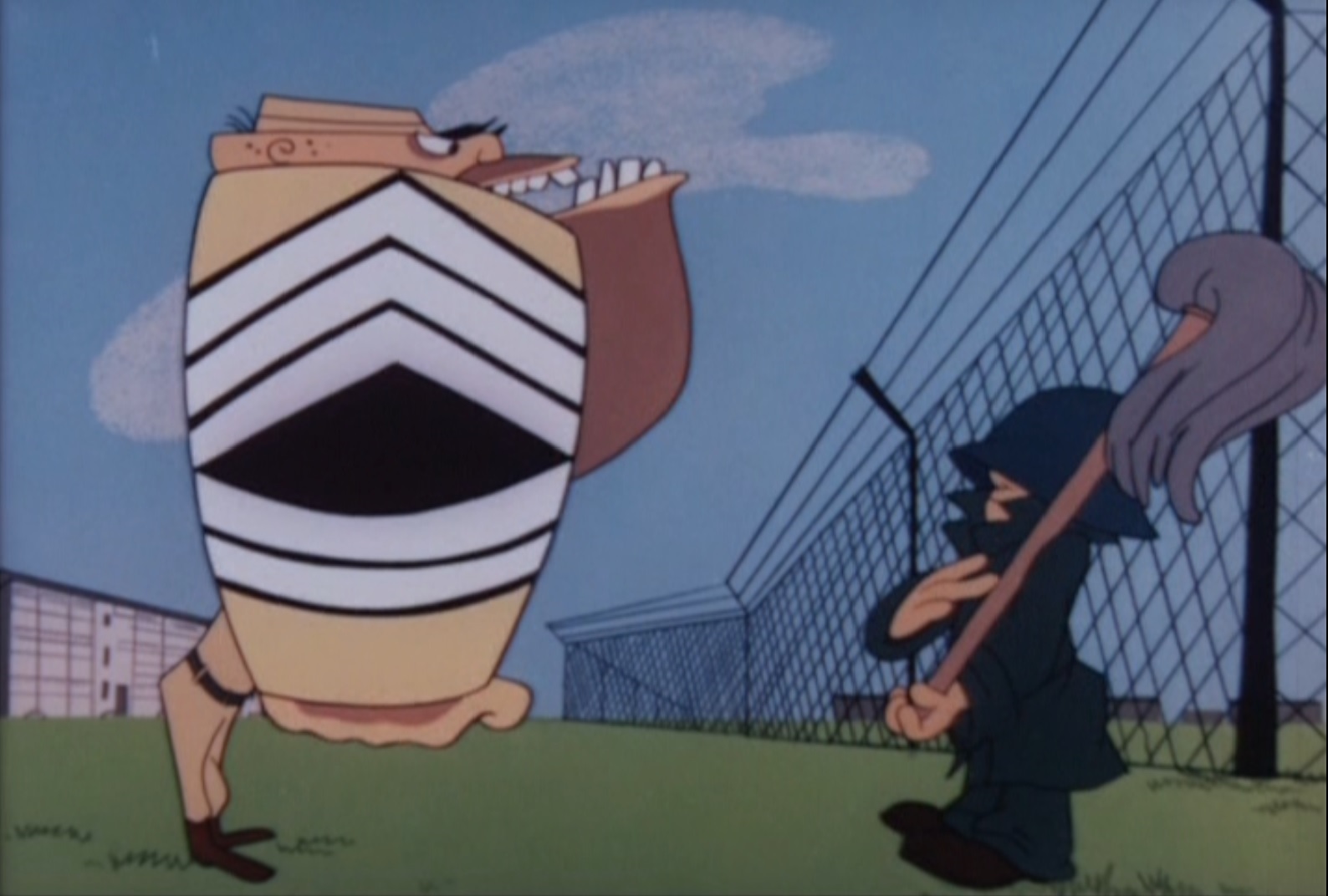 ‘Drafty, isn’t it’ is the second of two propagandistic advertisement shorts Chuck Jones made for the US Army in the late 1950s.
Like its predecessor, ‘90 Days of Wondering‘ (1956), it stars a young adult form of dreamer boy Ralph Phillips. In this short Ralph Phillips has nightmares about all his ideas of adventure being blocked by a giant shadow of a soldier beckoning him. Then he’s visited by an army pixie who elists some fictions and facts about the army. The cliches, of course, are the most hilarious. This short also contains a very Tex Avery-like running gag in which he pixie repeatedly has to put Ralph’s dog to sleep by singing it a fast lullaby.
‘Drafty, Isn’t It?’ is a well-made and beautiful film, and it would have been more enjoyable were it not so sickeningly propagandistic.
Watch ‘Drafty, Isn’t It?’ yourself and tell me what you think:
Director: Chuck Jones
Release Date: March 2, 1940
Stars: proto-Bugs Bunny, Elmer Fudd
Rating: ★★
Review:
 In this slow and only moderately funny cartoon Elmer tries to photograph nature, but he’s hindered by a predecessor of Bugs Bunny.
This goofy rabbit is not quite Bugs, even though he behaves very calmly and does a Bugs-style death act. His looks and sounds are those of the crazy rabbit in ‘Hare-um Scare-um‘ (1939) and he still has the Woody Woodpecker-style laugh introduced in ‘Porky’s Hare Hunt‘ (1938). Jones has toned this loony fellow down, but it was to Tex Avery to introduce a really cool rabbit in ‘A Wild Hare‘ from four months later.
No, the importance of ‘Elmer’s Candid Camera’ lies in the fact that it marks Elmer’s debut. Although he’s still wearing an Egghead suit (the character from which he evolved), he lacks Egghead’s goofiness, and he has received his distinctive voice provided by Arthur Q. Bryan. Moreover, he utters his famous line “wabbit twacks” for the first time here.
Unfortunately, ‘Elmer’s Candid Camera’ is more historically interesting than entertaining, and outside its historical importance, the cartoon is quite forgettable.
Watch ‘Elmer’s Candid Camera’ yourself and tell me what you think:
http://ulozto.net/live/xzv5WBh/bugs-bunny-elmers-candid-camera-1940-avi
This is the last of four cartoons featuring a Bugs Bunny forerunner
To the first Bugs Bunny cartoon: A Wild Hare
To the previous proto-Bugs Bunny cartoon: Hare-um Scare-um
Director: Bruno Bozzetto
Release Date: 1983
Rating: ★★
Review:
 ‘Sigmund’ is a very short cartoon, commissioned for the 1984 Olympic Games in Los Angeles.
The cartoon consists of one scene in a blue room in which a bespectacled little boy imagines himself as the sport stars he watches on television. The little boy’s imagination is shown by metamorphosis: we watch him change into the sport stars, growing with every metamorphosis.
‘Sigmund’ is a sweet short, but neither memorable, funny or one of Bozzetto’s best.
Watch ‘Sigmund’ yourself and tell me what you think:
Director: Hu Jinqing
Release Date: 1985
Rating: ★★
Review:
 ‘The Straw Man’* is yet another example of China’s typical preoccupation with nature, water and fishermen.
Based on an ancient proverb (which one could translate into ‘it’s dogged as does it’), this film tells about a fisherman who is disturbed by two pelicans and who disguises himself as a scarecrow to catch the two birds.
The cut-out animation of the birds is very naturalistic, yet the backgrounds, based on paintings from the Tang dynasty, are are very graphical. Unfortunately, compared to the stunning animation of the animals, the animation of the fisherman is very crude and primitive, and the film suffers a little from a slow pace and all too present music.
Watch ‘The Straw Man’ yourself and tell me what you think:
‘The Straw Man’ is available on the French DVD ‘Impression de montagne et d’eau’
* this film is also known by its French title: ‘l’épouvantail’
Director: Nick Mackie
Release Date: 1999
Rating: ★★
Review:
 ‘Minotaur & Little Nerkin’ is a curious 2d computer animation, which looks like it is designed for children.
However, its story is rather black. The film features a minotaur who lurks a duck into his home to eat a captivated human hand, only in order to eat the duck himself. Remarkable for its morbid humor and original technique, it is nonetheless an ugly and unfunny film, that fails to entertain, let alone impress the viewer.
Watch ‘Minotaur & Little Nerkin’ yourself and tell me what you think:
‘Minotaur & Little Nerkin’ is available on the DVD ‘Aardman Classics’
Director: Osvaldo Cavandoli
Release Date: 1991
Stars: La Linea
Rating: ★★
Review:
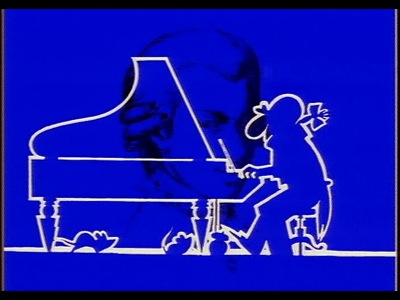 Trazom, A.W. Is W.A. Mozart spelled backwards and it’s Cavandoli’s hommage to the composer.
We watch La Linea dressed like an 18th century composer playing Mozart’s K545 sonata on the grand piano. Meanwhile he encounters several animals and people.
Unfortunately, the cartoon is slow, repetitive and rather unfunny. La Linea’s irresistible voice is hardly heard and this cartoon lacks the brazen humor of the earlier entries. And it completely pales when compared to classic piano concerto cartoons like ‘Rhapsody Rabbit‘ (1946) or ‘The Cat Concerto‘ (1947).
‘Trazom, A.W.’ is available on the DVD ‘La Linea 3’
Director: René Laloux
Release Date: 1988
Rating: ★★★★½
Review:
 ‘La Prisonnière’ is a short, rather surrealistic science fiction film about two children.
They visit an extraterrestrial monastery and witness a rescue of a prisoner by naked women who step out of a stranded whale.
The film looks like an animated version of designer Caza’s source comic, Équinoxe (which can be found here), and contains only a limited amount of animation. In his designs Caza’s style is very reminiscent of that of his fellow french comic artist Moebius.
‘La prisonnière’ seems like an etude for Laloux’s and Caza’s much bigger project, the feature film ‘Gandahar‘ (1988). The atmosphere of the short is poetic, if completely incomprehensible.
Watch ‘La Prisonnière’ yourself and tell me what you think:
‘La Prisonnière’ is available on the DVD ‘Gandahar’
Director: Peter Lord & David Sproxton
Release Date: 1986
Rating: ★★
Review:
 ‘Babylon’ is an early Aardman film criticizing weapon trade. Unfortunately, despite its sympathetic message, it’s not a successful film.
In it we watch a meeting of weapon dealers. During this gathering one of the guests, a bald Russian-looking guy, is growing in statue to a gargantuan size until it explodes into a flood of blood, destroying all the other guests.
‘Babylon’ impresses with its many detailed human-like plasticine puppets, its virtuoso stop motion animation and its elaborate set. But it suffers from slowness, ugly sound design and a very bad soundtrack, involving an all too long speech by the chairman of the weapon dealers. The end result is too tiresome and too vague to impress.
Watch ‘Babylon’ yourself and tell me what you think:
‘Babylon’ is available on the DVD ‘Aardman Classics’
Director: Vladimir Pekar
Release Date: 1971
Rating: ★★
Review:
 It seems that in the early 1970s Soviet Propaganda took a rather retrograde course, being more overtly propagandistic and using images that went all the way back to the 1920s.
Films with a peaceful message, like ‘Proud Little Ship‘ (1966) or ‘We Can Do It‘ (1970) were interchanged for self-important glorifications of the Soviet Union, and its ‘heroic’ history. This period produced some of the most terrible propaganda films ever made. ‘The Adventures of the Young Pioneers’ is a prime example.
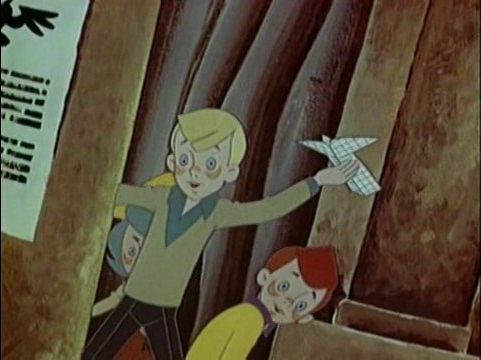
The film plays during World War Two, Russia’s Great War. When their village is occupied by some goofy Nazi Germans, three communist children decide to withstand their occupants. They are betrayed by a collaborator, however, and captured when raising a red flag. Luckily, they are saved by the red army.
This children’s film uses ugly designs and very old-fashioned looking caricatures of Nazis, while the children and especially the red army are drawn quite heroically. The result is as unappealing and unfunny as it is sickeningly propagandistic.
Watch ‘The Adventures of the Young Pioneers’ yourself and tell me what you think:
http://www.fandor.com/films/the_adventures_of_the_young_pioneers
‘The Adventures of the Young Pioneers’ is available on the DVD box set ‘Animated Soviet Propaganda’
Director: Jan Švankmajer
Release Date: 1969
Rating: ★★
Review:
 ‘A Quiet Week in the House’ is the last film in a series of four involving people facing surreal settings, which Švankmajer made in 1968-1969.
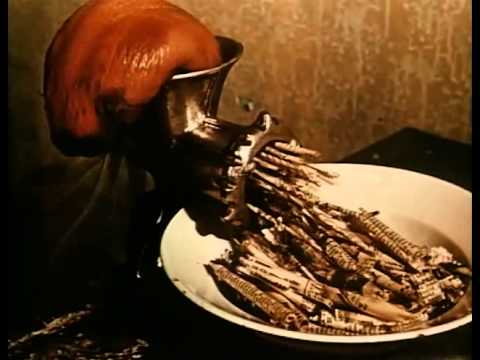
in this film a fugitive seeks shelter in an abandoned house. Every day he digs a hole in one of the doors of the corridor in which he sleeps. Every day he looks through the hole to watch weird surrealistic images of inanimate things behaving strangely. After a week he sets up a device to blow up all doors.
The live action footage is shot in black-and-white, and is accompanied by the sound of a camera. The surrealistic images, on the other hand, are shot in color and completely silent. Unfortunately, the film is too long, and it fails to be as impressive as related films like ‘The flat’ (1968) or ‘Jabberwocky‘ (1971), being neither completely disturbing nor very entertaining. ‘A Quiet Week in the House’ remains one of Švankmajer’s rare weak films.
Watch ‘A Quiet Week in the House’ yourself and tell me what you think:
http://www.dailymotion.com/video/xpfbvj_a-quiet-week-in-the-house-de-jan-svankmajer_shortfilms
‘A Quiet Week in the House’ is available on the DVD ‘Jan Svankmajer – The Complete Short Films’
Director: Perch Sarkisyan
Release Date: 1965
Rating: ★★★
Review:
 ‘A Hot Stone’ is a Soviet propaganda film from the 1960s based on a children’s book by Arkady Gaidar from 1941.
In it a boy stumbles on an old stone in the woods, which has the ability to give someone a new life again. The boy wants to help an old and lonely man with it, but the man sees no need for it as he has led a happy life. Enter the propaganda, in which the old man tells about the revolution and the civil war. This part is not much of a story. but it’s full of symbolic images, like people breaking their chains, and a giant worker slashing the double headed eagle of the czarist empire with a giant hammer.
‘A Hot Stone’ is a slow and boring film, but it’s also beautifully designed, in an original graphic style, which makes use of bold ink strokes.
Watch ‘A Hot Stone’ yourself and tell me what you think:
‘A Hot Stone’ is available on the DVD box set ‘Animated Soviet Propaganda’
Director: Victor Gromov
Release Date: 1949
Rating: ★★
Review:
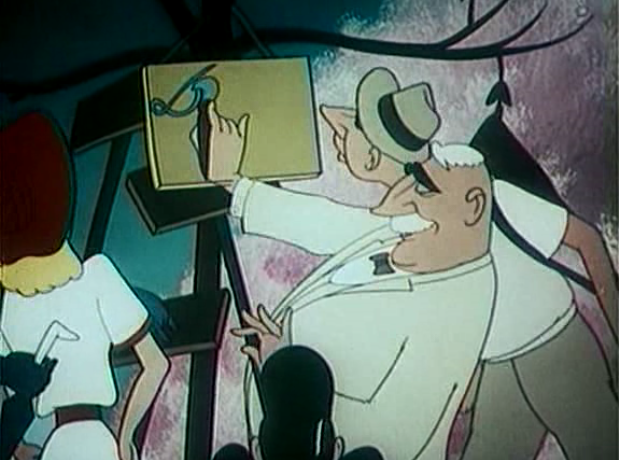 Mr. Wolf is a Russian propaganda film. The film is an oddball in director Gromov’s small animation output. His other seven films are fantastic fairy tales and children’s films
The film tells about Mr. Wolf, a rich American, who is fed up with weapons and war. He retreats with his unwilling family to a peaceful island. But then oil is discovered on the island. Immediately, Mr. Wolf and his family are overpowered by greed, and the American only too gladly drops his pacifism.
‘Mr Wolf’ is based on a comedy by Evgeny Petrov. Although drowned in caricature, this blatant propaganda film is hardly funny: its animation is elaborate, but painstakingly slow, and too excessive. Moreover, it is not too clear what the message is. Are all Westerners blinded by greed? Is pacifism senseless in a world of war? Are oil and peace at odds with eachother? I’ve no idea.
Watch ‘Mr. Wolf’ yourself and tell me what you think:
‘Mr. Wolf’ is available on the DVD box set ‘Animated Soviet Propaganda’
Director: Peter Lord & David Sproxton
Release Date: 1978
Rating: ★★
Review:
 ‘Confessions of a Foyer Girl’ is the second film in Aardman’s revolutionary ‘Animated Conversations’ series.
Like its predecessor, ‘Down & Out‘, the film uses recorded dialogue. This time we hear two foyer girls chatting in a cinema. The dialogue is hard to understand and the lip-synch is not as good as in ‘Down & out’. Moreover, the animation is associated with seemingly unrelated stock live action footage, which leads to a film, which is both experimental and vague. The result never quite works and the result must be called a failure.
‘Confessions of a Foyer Girl’ is available on the DVD ‘Aardman Classics’
Director: Chuck Jones
Release Date: January 19, 1952
Stars: Bugs Bunny, Wile E. Coyote
Rating: ★★
Review:
 The second appearance of the Coyote after his debut film ‘Fast and Furry-ous‘ (1949) was, surprisingly, not another Road Runner cartoon.
Instead, director Chuck Jones decided to place his still fresh carnivore character against Bugs Bunny, a character increasingly in need of worthy opponents.
in ‘Operation: Rabbit’ Wile E. Coyote gets his name (in the Road Runner cartoons he’s never called that way). Wile E. introduces himself to Bugs as ‘genius’, and suddenly he is a talking character, speaking with an eloquent, vaguely British voice. The experiment is not successful. The coyote’s ability to speak floods the action with a lot of superfluous dialogue, and he almost totally lacks the sympathetic frustration so wonderfully demonstrated in the Road Runner cartoons. Moreover, there’s hardly any chemistry between the two overconfident characters, which leads to remarkably unfunny gags, with only the one involving a flying saucer being able to create a chuckle.
Despite the shortcomings, Jones would make Bugs Bunny and Wile E. Coyote co-star in three more cartoons: ‘To Hare is Human’ (1956), ‘Rabbit’s Feat’ (1960), and ‘Compressed Hare’ (1961). Meanwhile the Coyote would have a much more interesting career in the Road Runner cartoons, with the second one, ‘Beep Beep’, appearing four months after ‘Operation Rabbit’.
Watch ‘Operation: Rabbit’ yourself and tell me what you think:
This is Bugs Bunny cartoon No. 87
To the previous Bugs Bunny cartoon: Big Top Bunny
To the next Bugs Bunny cartoon: 14 Carrot Bunny
Director: Charles Nichols
Release Date: August 10, 1951
Stars: Mickey Mouse, Pluto
Rating: ★★
Review:
 This cartoon starts with a Texan voice-over telling about raccoon hunting. Enter Mickey and Pluto who are exactly doing that.
Pluto’s pursuit is hindered, however, by the raccoon’s clever decoys and sidetracks. In his final trick the raccoon fools Mickey and Pluto by pretending having a baby, using Mickey’s coonskin cap.
Mickey has pretty little screen time in this cartoon, which is essentially Pluto’s. His visualisations of what he’s smelling are the highlights of this gentle if not very remarkable film.
Watch ‘R’Coon Dawg’ yourself and tell me what you think:
This is Mickey Mouse cartoon No. 122
To the previous Mickey Mouse cartoon: Mickey and the Seal
To the next Mickey Mouse cartoon: Pluto’s Party


 Dr. Grob's Animation Review