
You are currently browsing the category archive for the ‘★’ category.
Director: Cy Young
Release Date: 1930
Rating: ★
Review:
 ‘A Desert Dilemma’ is a short commercial for a car insurance, made by Cy Young (misspelled as Sy Young in the opening titles).
The cartoon is still rooted in the 1920s: its animation is from the silent era, and the designs are old-fashioned. The story is rather incomprehensible, and one wonders whether this commercial has ever been a success. However, it has a lively jazzy score to enjoy.
Nothing in this film indicates a rare talent, but a year later Cy Young would make a very early color short called ‘Mendelssohn’s Spring Serenade’, which is miles ahead from this short. Soon after he was hired by Walt Disney, and became a star effects animator at the Disney studio, providing stunning special effects for the studio’s first five features. Young left Disney in 1941, after the strike, and worked for the US Air Force. He ended his own life in 1964.
‘A Desert Dilemma’ is available on the DVD ‘Cultoons! Rare, Lost and Strange Cartoons! Volume 2: Animated Education’
Director: John Foster
Release Date: October 11, 1929
Stars: Farmer Al Falfa
Rating: ★
Review:
 Of all American animation studios from the 1930s the Van Beuren Studio must be the least known.
This is no small wonder, for it was not only short-lived, lasting nine years, it was also the weakest studio of the lot, never reaching the heights of Max Fleischer or Walt Disney, and with only a few great cartoons in its entire catalog.
Thanks to Steve Stanchfield and his Thunderbean company, however, quite a sample of this studio’s output has been made available on DVD, so everybody can enjoy them (and incidentally making the Columbia/Screen Gem studio the least known studio – as its films remain utterly unavailable).
Before 1928 Van Beuren’s cartoons were made by Paul Terry, but in November 1928 the success of Disney’s ‘Steamboat Willie‘ prompted Amadee J. Van Beuren to announce that his studio would make the switch to sound, too. This led to a clash with Terry, who left mid-1929, leaving most of the staff and the studio’s main character, the bland Farmer Al Falfa, until Paul Terry reclaimed him in 1930.
The Van Beuren studio was more or less forced into the area of sound, and its crew totally unprepared, lacking experience. Indeed, ‘Summer Time’, Van Beuren’s 16th sound cartoon, is a strange blend of silent film and sound film: words and sound expressions are still visible on the screen, and while there’s music, there’s no rhythmical movement. Moreover, both design and animation are still firmly rooted in the 1920’s and there’s practically no plot, only three unrelated scenes.
The most interesting aspect of this film is Gene Rodemich’s music score, which still sounds fresh. In fact, Rodemich’s scores turned out to be the only constant quality within Van Beuren’s output, being among the best of all 1930s cartoon scores.
The three scenes of ‘Summer Time’ are 1) a frog and a monkey playing some music, waking up an angry owl. 2) A mouse playing in a fat woman’s shadow, attracting other mice, and scaring the woman away, and 3) Farmer Al Falfa being hot and making himself a drink. This story contains a weird scene in which the sun zooms into the camera to visit farmer Al Falfa at his own doorstep. This is the only interesting piece of animation in the entire film.
The cartoon ends with a moral, like many Aesop’s Fable cartoons before it. However, this practice was soon abandoned in 1930.
Watch ‘Summer Time’ yourself and tell me what you think:
‘Summer Time’ is available on the DVD ‘Aesop’s Fables – Cartoon Classics from the Van Beuren Studio’
Director: Walt Disney
Release Date: November 15, 1929
Stars: Mickey Mouse
Rating: ★
Review:
 ‘Jungle Rhythm’ opens with Mickey playing the harmonica while riding an elephant, the design of which is still rooted in the silent era.
Mickey shoots a vulture, but misses and is soon threatened by a bear and a lion. Luckily at that moment a monkey and a parrot start playing a tune on his harmonica, and a long dance routine can begin…
First we watch Mickey dancing with the lion and the bear, then two monkeys. Then Mickey plays the saxophone with two ostriches dancing. Mickey plays the whiskers of a little leopard like a harp, while a lion dances the hula, and he even returns to ‘Turkey in the Straw’, the tune that made him famous in his first sound cartoon ‘Steamboat Willie‘ (1928). After playing’Yankee Doodle’ on five tigers, a number of apes and a lion, the crowd applauds, and the cartoon ends.
‘Jungle Rhythms’ is easily one of the most boring entries among the early Mickey Mouse shorts: there’s no plot, no dialogue, no song, and the dance routines resemble the worst in contemporary Silly Symphonies. In fact, to me, ‘Jungle Rhythm’, together with ‘When The Cat’s Away‘ and ‘The Castaway‘ (1931), forms the worst trio of all Mickey Mouse cartoons. Luckily, weak cartoons like these remained a rarity within the series.
Watch ‘Jungle Rhythm’ yourself and tell me what you think:
This is Mickey Mouse cartoon No. 13
To the previous Mickey Mouse cartoon: The Jazz Fool
To the next Mickey Mouse cartoon: The Haunted House
Director: Nicole van Goethem
Release Date: 1985
Rating: ★
Review:
 ‘A Greek Tragedy’ won an Academy Award and the first prize at the Annecy Inernational Film Festival. I remain puzzled why.
‘A Greek Tragedy’ was Van Goethem’s first own film. It’s a classic gag cartoon featuring three living, scarcely clad female caryatids supporting an old ruin. When the ruin crumbles, and they’re finally free, we watch them dancing into the distance.
The designs are trite, the synthesizer music is ugly, the humor is poor, and the story forgettable. If this short has a hidden, perhaps feminist message, it’s lost on me. And then to imagine, that one of the short’s competitors for the Oscars was ‘Luxo jr.’, a far more convincing and rewarding film in every respect!
Watch ‘Een Griekse tragedie’ yourself and tell me what you think:
‘Een Griekse tragedie’ is available on the DVD Box Set ‘Annecy – Le coffret du 50e Anniversaire’
Director: Isadore Sparber
Release Date: September 4, 1942
Stars: Popeye, Bluto, Olive Oyl
Rating: ★
Review:
 Popeye and Bluto are on a battle cruiser stationed somewhere in the South Seas.
There they meet a ‘princess Alona’ (Olive Oyl in a sarong). Her parrot warns the two suitors that if the princess get’s harmed, the volcano will erupt. In the end all turns out to be just a dream.
In this cartoon the comedy is mostly silent, and princess Alona doesn’t speak at all. Unfortunately, Jack Mercer’s jabbers are absent, too, and they are certainly missed. The result is the weakest Popeye cartoon in years.
Watch ‘Alona on the Sarong Seas’ yourself and tell me what you think:
This Popeye film No. 110
To the previous Popeye film: You’re a Sap, Mr. Jap
To the next Popeye film: A Hull of a Mess
Director: Friz Freleng
Release Date: May 23, 1942
Rating: ★
Review:
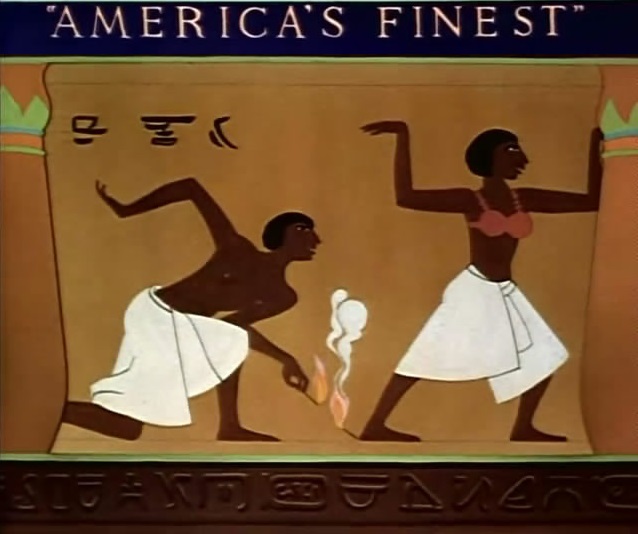 From the early 1930s to the early 1940s Warner Bros. released several cartoons in which books, magazines etc. come to life. Of all these cartoons, ‘Lights Fantastic’ is probably the most extreme and the most dated.
It opens with a real life shot of Times Square in New York, and all sequences after that supposedly take place in neon billboards on this square. This results in little movement, a few gags on Chinese and no laughs.
Present day viewers like me don’t even have a clue how many of these billboards were based on real and familiar ones. I personally could only recognize Mr. Peanut (from Planters). No doubt most of the fun disappeared with the familiarity of the pictured advertising. However, I seriously doubt whether this cartoon has ever been a winner, for its few gags are lame, and don’t build up to a finale, at all.
Watch an excerpt from ‘Lights Fantastic’ yourself and tell me what you think:
Director: Dick Lundy
Release Date: September 27, 1952
Stars: Droopy, The Wolf
Rating: ★
Review:
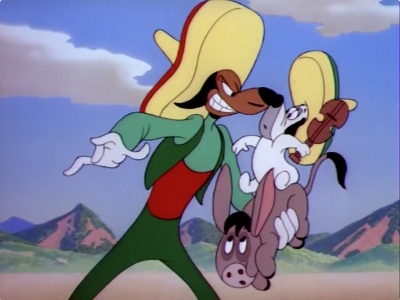 In 1950 Tex Avery left MGM for a sabbatical, most probably due to overwork. Dick Lundy was hired to replace him, and the first cartoon he directed at MGM was ‘Caballero Droopy’.
This short’ is strangely reminiscent of the cartoons of Lundy’s former employer, Walter Lantz, with which it shares a lesser quality: both the designs and the animation are sub-par. It’s really as if this cartoon was made at Walter Lantz instead of at MGM.
For ‘Caballero Droopy’ Lundy revived the wolf, gave him a mustache and placed him into a Mexican setting, in which he tries to outdo Droopy in serenading the phlegmatic dog’s girl. The cartoon is full of Tex Averyanisms, but due to its low production quality it never takes off.
‘Caballero Droopy’ remained the only Droopy cartoon Lundy directed. He moved on to the ailing Barney Bear series, before he had to leave MGM on Tex Avery’s return in October 1951.
Watch ‘Caballero Droopy’ yourself and tell me what you think:
Director: Jack Hannah
Release Date: October 14, 1949
Stars: Donald Duck, Bootle Beetle
Rating: ★
Review:
 ‘The Greener Yard’ is the third cartoon starring the annoyingly unfunny Bootle Beetle.
In this short there are in fact two Bootle Beetles: an older one and his son, who doesn’t like to eat beans and who longs for greener pastures. But the older Bootle Beetle tells him how the grass always looks greener at the other side, but isn’t. He apparently has learned this lesson in Donald’s garden, where is given a hard time by Donald, his chickens and two bluebirds.
‘The Greener Yard’ is slow, boring and moralistic, and forms a low point in Donald Duck’s canon. Luckily, it was the last Donald Duck short to feature this boring insect. Nevertheless, the elderly Bootle Beetle and his younger counterpart would return to the screen one last time, in ‘Morris, the Midget Moose‘ (1950).
Watch ‘The Greener Yard’ yourself and tell me what you think:
This is Donald Duck cartoon No. 80
To the previous Donald Duck cartoon: All in a Nutshell
To the next Donald Duck cartoon: Slide, Donald, Slide
Director: Jack Hannah
Release Date: April 8, 1949
Stars: Donald Duck, Bootle Beetle
Rating: ★
Review:
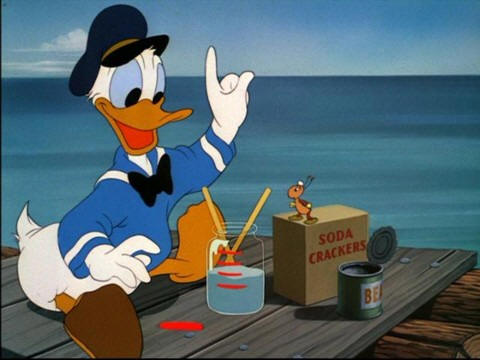 Bootle Beetle, introduced in ‘Bootle Beetle‘ from 1947, returns to tell us about his relationship with ‘the captain’, and old seafaring version of Donald Duck. He relates how he and ‘the captain’ were shipwrecked and stranded on a desert island.
Bootle Beetle never was a funny character, and this cartoon, too, suffers: Bootle beetle is simply too cute. Moreover, his relationship to Donald is never explained, nor the fact why Donald is suddenly a captain. To make things worse, the cartoon is painstakingly slow. For example, it contains a very long gag on a coconut, unfavorably reminiscent of the overlong gags of the earliest character animation-based cartoons of the mid-1930’s, like ‘Mickey Plays Papa‘ (1934) or ‘Moving Day‘ (1936).
Watch ‘Sea Salts’ yourself and tell me what you think:
This is Donald Duck cartoon No. 76
To the previous Donald Duck cartoon: Donald’s Happy Birthday
To the next Donald Duck cartoon: Winter Storage
Directors: Tony Benedict, Gerry Chiniquy, Art Davis, David Detiege & Friz Freleng
Airing Date: April 1, 1980
Stars: Daffy Duck, Foghorn Leghorn, Miss Prissy, Sylvester, Speedy Gonzales
Rating: ★
Review:
 ‘Daffy Duck’s Easter Egg-Citement’ is an Easter-themed Looney Tunes television special produced by DePatie-Freleng.
Unlike Chuck Jones in ‘Bugs Bunny in King Arthur’s Court‘ Friz Freleng doesn’t attempt to tell one long story in the 25 minutes he’s got. Instead, we have three: the first evolves around Miss Prissy, who, in Foghorn Leghorn’s egg farm, lays a golden egg. Daffy and Sylvester find it, and fight eachother for it. This episode contains the only fine piece of animation of the whole special: the depiction of a paranoid Daffy in a car.
In the second episode Daffy is a guard at a chocolate bunny factory, protecting it against Speedy Gonzales, and in the third Daffy tries to go south, trying several options, including a horse. This part reuses the horse from the Pink Panther cartoon ‘Pinto Pink’ (1967) and some of its gags, too.
These stories are framed with Daffy in a very ‘Duck Amuck‘-like setting. Like ‘Bugs Bunny in King Arthur’s Court’ ‘Daffy Duck’s Easter Egg-citement’ suffers from bad designs (especially Foghorn Leghorn, who’s not a Freleng character, is badly drawn), can music, slow timing and excessive dialogue.
Director: Chuck Jones
Airing Date: February 23, 1978
Stars: Bugs Bunny, Daffy Duck, Porky Pig, Elmer Fudd, Yosemite Sam
Rating: ★
Review:
 The Looney Tunes Television Specials were a series of 25 minute long television programs running from 1976 to 1989 and revisiting the classic Warner Brothers characters in all new material. They were produced by either Chuck Jones’ studio or De Patie-Freleng.
‘Bugs Bunny in King Arthur’s Court’ is the fourth within the series, and produced and directed by Chuck Jones. The story is loosely based on Mark Twain’s ‘A Connecticut Yankee in King Arthur’s Court’ from 1889, as Jones readily admits in the opening titles. It features Bugs Bunny as himself, Elmer Fudd as a knight, Daffy Duck as a very unlikely King Arthur, Yosemite Sam as Merlin, and Porky Pig as an anonymous soldier.
Although Jones’s mastery shines through at times, the episode is a sad caricature of the old cartoons. Just nothing seems right. The designs are weak, especially that of Yosemite Sam (not a Jones character), who is too small compared to the others. Moreover, the timing is remarkably slow, and there’s way too much dialogue, slowing down the animation. The gags are further hampered by Dean Elliott’s terrible, partly electronic music. Even Mel Blanc’s voices are poor: his imitation of Arthur Q. Bryan’s voice of Elmer Fudd is nothing like the real thing, and Porky Pig simply stutters too much.
The episode’s trite story is expanded over 24 minutes, while, considering its flaws, it would already have been difficult to remain interesting within seven minutes. The result is a 24 minute long bore. The 1970s were the middle ages of animation, indeed…
Watch ‘Bugs Bunny in King Arthur’s Court’ yourself and tell me what you think:
Director: Albert Barillé
Airing date: January 8?, 1983
Rating: ★
Review:
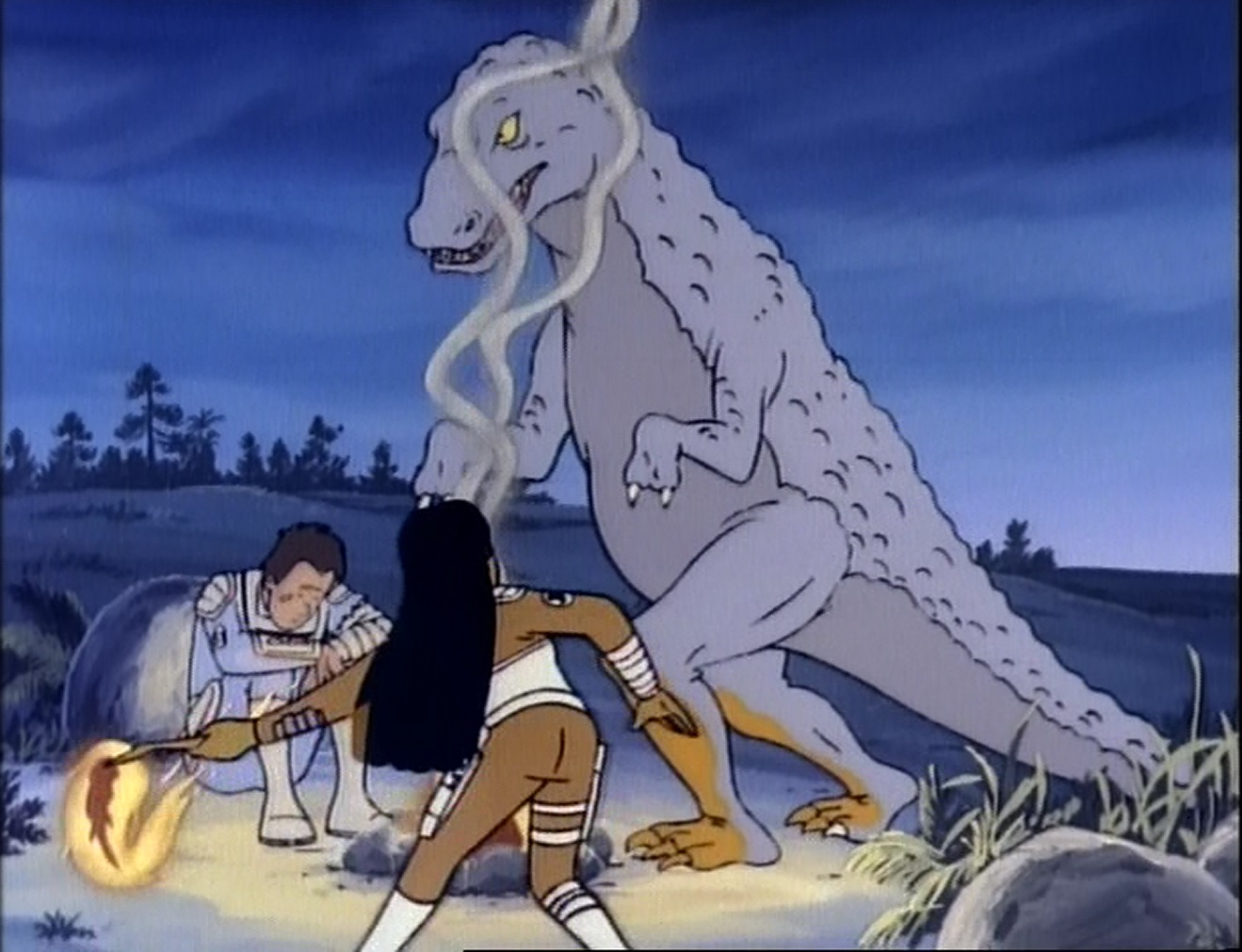 ‘Chez les dinosaures’ is the last of three vaguely educational episodes. It’s also one of the weakest episodes in the series.
Pierrot, Psi and Metro now visit a planet inhabited by dinosaurs from the Jurassic period. Its educational value, however, is doubtful: Barillé’s theories on the end of the dinosaurs are no less than ridiculous, and the dinosaurs are designed and animated terribly.
Furthermore, one grows tired of all these earth-like planets, populated by the same creatures that have roamed the earth, too (such planets occur also in ‘La Planète verte‘, ‘Les Cro-Magnons‘, ‘La planète Mytho‘, ‘Les géants‘ and ‘Les Incas‘). As if everywhere in space the same history occurs over and over again.
Luckily, this was the last so-called ‘educational’ episode. With the next episode, Barillé would go back to the main story without leaving it again. Indeed, even ‘Chez les dinosaures’ contributes to it, as Pierrot gets injured during this episode, leaving Psi on her own in the next one, with dramatic results…
Watch ‘Chez les dinosaures’ yourself and tell me what you think:
This is the 14th episode of ‘Il était une fois… l’espace’ (Once Upon a Time… Space)
To the 13th episode: Les Incas (The Incas)
To the 15th episode: Les anneaux de Saturne (The Rings of Saturn)
Director: Albert Barillé
Airing date: December 25?, 1982
Rating: ★
Review:
 ‘Les géants’ is the first of three adjacent and vaguely education episodes that have nothing to do with the main story.
In ‘Les géants’ Pierrot, Psi and Metro visit a huge planet, which, like almost every other planet in the Barillé universe, is an exact copy of earth, this time only bigger. On this planet our heroes encounter huge animals, like a giant caterpillar, a monstrous spider and a very cartoony rat.
Most of the episode, however, they are trapped in a termite colony. Thus, Barillé is able to tell us more about these little insects, which he does mostly through a lecturing Metro. There’s practically no story, and most of the time Pierrot and Psi are trying to get out of the colony. This fact and the lectures render one of the most boring episodes of Il était une fois… L’espace.
It seems this and the following two episodes were made to sell the series as an educational one. However, ‘Il était une fois… l’espace’ remains far less educational than the previous ‘Il était une fois… l’homme’ or indeed, the subsequent ‘Il était une fois… la vie’, and its charm lies mainly in Barillés story. Unfortunately, ‘Les géants’, ‘Les Incas‘ and ‘Chez les dinosaurs‘ are no part of that and form the low point of the entire series.
Watch ‘Les géants’ yourself and tell me what you think:
This is the 12th episode of ‘Il était une fois… l’espace’ (Once Upon a Time… Space)
To the 11th episode: Les naufragés de l’espace (Shipwrecked in Space)
To the 13th episode: Les Incas (The Incas)
Director: Albert Barillé
Airing date: October 16?, 1982
Rating: ★
Review:
 In this second episode of ‘Il était une fois… l’espace’ the feisty little robot Metro gets his name.
Metro joins Pierrot and Petit Gros on their first mission. The trio explores a Jurassic planet inhabited by large iguana-like people who communicate by telepathy.
If anything, this episode shows how differences between cultures can lead to aversions and misunderstandings. Nevertheless, it is one of the slowest and weakest episodes of the series.
Watch ‘Les Sauriens’ yourself and tell me what you think:
This is the 2nd episode of ‘Il était une fois… l’espace’ (Once Upon a Time… Space)
To the 1st episode: La planète Omega (The Planet Omega)
To the 3rd episode: la planète verte (The Green Planet)
Director: Ben Washam
Release date: September 8, 1967
Stars: Tom & Jerry
Rating: ★
Review:
 ‘Purr-Chance to Dream’ was Tom & Jerry’s very last theatrical cartoon.
It marks the rather welcome end to the Chuck Jones era, which, despite a few highlights, was a very disappointing age for the cat and the mouse. ‘Purr-Chance to Dream’ is no exception. In this short, Tom is haunted by nightmares about large bulldogs. But when Jerry has acquired a tiny bulldog, this reality is even worse.
The tiny bulldog is the same as was featured in ‘The Cat’s Me-ouch‘ (1965), and so ‘Purr-Chance to Dream’ reuses quite a lot of animation from the earlier cartoon. The good news is that this results in better designs of Tom and Jerry than usual in their 1967 cartoons. Carl Brandt’s music, however, is terrible, and so are the gags, making ‘Purr-Chance to Dream’ anything but enjoyable.
Watch ‘Purr-Chance to Dream’ yourself and tell me what you think:
http://www.dailymotion.com/video/x2ecuvh_tom-and-jerry-purr-chance-to-dream_fun
This is Tom & Jerry 162nd and last theatrical cartoon
To the previous Tom & Jerry cartoon: Advance and Be Mechanized
Director: Ben Washam
Release date: August 25, 1967
Stars: Tom & Jerry
Rating: ★
Review:
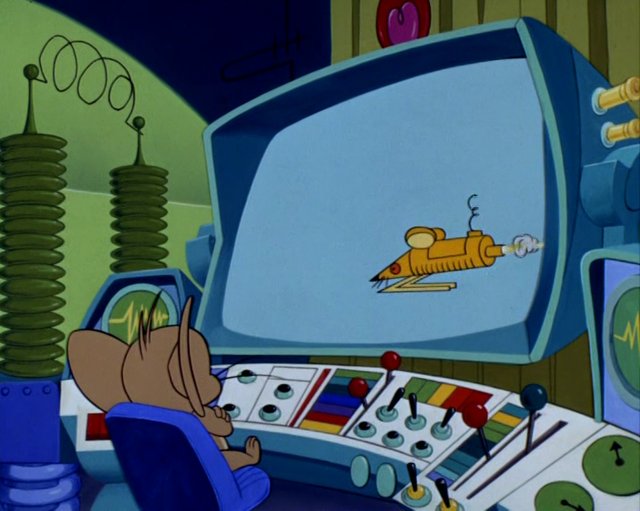 ‘Advance and Be Mechanized’ is the third of three science fiction cartoons starring Tom & Jerry, released in 1967, the others being ‘O Solar Meow‘ and ‘Guided Mouse-ille‘.
In their third science fiction short Jerry’s stealing cheese from a ‘cheese mine’ protected by police officer Tom. Both use the robots from ‘Guided Mouse-ille’ to fight each other. The film uses a whole scene twice and reuses a complete scene from ‘Guided Mouse-ille’, adding to a very cheap feel.
The end is particularly depressing when the two robots turn Tom & Jerry themselves into mindless robots… They could hardly be further removed from their glory days than in this cartoon.
Watch ‘Advance and Be Mechanized’ yourself and tell me what you think:
This is Tom & Jerry cartoon No. 161
To the previous Tom & Jerry cartoon: Shutter Bugged Cat
To the next Tom & Jerry cartoon: Purr-Chance to Dream
Director: Tom Ray
Release date: June 23, 1967
Stars: Tom & Jerry
Rating: ★
Review:
 ‘Shutter Bugged Cat’ is the fifth and last of Tom & Jerry’s compilation cartoons.
In this short Tom is playing 8mm films of his own injuries, while Jerry is watching, too. This compilation cartoon, like all others, makes exclusively use of Hanna & Barbera material. It is atypical, however, in its execution: the excerpts are much shorter and from many more films than earlier compilations, and many of them we see in reverse, as well, when Tom plays his 8mm films back.
The designs of Tom and Jerry in the framing story are different from those in other Chuck Jones Tom & Jerry cartoons, probably to match them more with the Hanna & Barbera designs. Unfortunately, the result turns out to be particularly bad, making Tom & Jerry look almost as bad as in their Gene Deitch films.
Watch ‘Shutter Bugged Cat’ yourself and tell me what you think:
https://www.dailymotion.com/video/x47z2tl
This is Tom & Jerry cartoon No. 160
To the previous Tom & Jerry cartoon: Surf-Bored Cat
To the next Tom & Jerry cartoon: Advance and Be Mechanized
Director: Chuck Jones
Release date: April 14, 1967
Stars: Tom & Jerry
Rating: ★
Review:
 Chuck Jones returns to direct one final Tom & Jerry cartoon. Based on a story of his own, ‘Cannery Rodent’, like ‘Much Ado About Mousing‘ (1964) and ‘Cat and Duplicat’ (1967) is set in a harbor. Tom’s adversary this time is a large, purple shark, which looks like it has been borrowed from a Hanna-Barbera television series.
Unfortunately, Jones doesn’t seem to be inspired and the film is not a success, but just another boring entry in Tom & Jerry’s last theatrical series.
Watch ‘Cannery Rodent’ yourself and tell me what you think:
http://www.dailymotion.com/video/x2n6igd
This is Tom & Jerry cartoon No. 157
To the previous Tom & Jerry cartoon: Rock ‘n’ Rodent
To the next Tom & Jerry cartoon: The Mouse from H.U.N.G.E.R.
Director: Abe Levitow
Release date: March 10, 1967
Stars: Tom & Jerry
Rating: ★
Review:
 After ‘O-Solar-Meow‘ Tom and Jerry immediately return to the science fiction setting in ‘Guided Mouse-ille’.
The time is 2565 AD and again, Tom and Jerry fight each other with modern technology, including the robot cat from ‘O Solar Meow’. In the end, our heroes are inexplicably blown to the prehistory, where they continue their chase.
Written by story man John Dunn (as was O-Solar-Meow), ‘Guided Mouse-ille’ is a very bad and terribly unfunny cartoon. Luckily, Tom & Jerry’s next short would be much more fun…
Watch ‘Guided Mouse-ille’ yourself and tell me what you think:
This is Tom & Jerry cartoon No. 155
To the previous Tom & Jerry cartoon: O-Solar-Meow
To the next Tom & Jerry cartoon: Rock ‘n’ Rodent
Director: Chuck Jones
Release date: January 20, 1967
Stars: Tom & Jerry
Rating: ★
Review:
 The harbor was a popular setting in Chuck Jones’s Tom & Jerry series. Like the earlier ‘Much Ado About Mousing‘ (1964) and the later ‘Cannery Rodent‘ (1967), ‘Cat and Duplicat’ is set in a harbor.
Here Tom fights a rather dog-like cat over Jerry. The timing of this cartoon is remarkably slow and terrible, especially in an all too elaborate mirror routine. Eugene Poddany’s awfully sounding music wears down the action, like always.
Watch ‘Cat and Dupli-cat’ yourself and tell me what you think:
http://www.dailymotion.com/video/x2fjrl1
This is Tom & Jerry cartoon No. 154
To the previous Tom & Jerry cartoon: Catty Cornered
To the next Tom & Jerry cartoon: O-Solar-Meow


 Dr. Grob's Animation Review