
You are currently browsing the category archive for the ‘Silent films’ category.
Director: Unknown
Release date: May 7, 1920
Stars: Judge Rummy
Rating: ★★★★
Review:
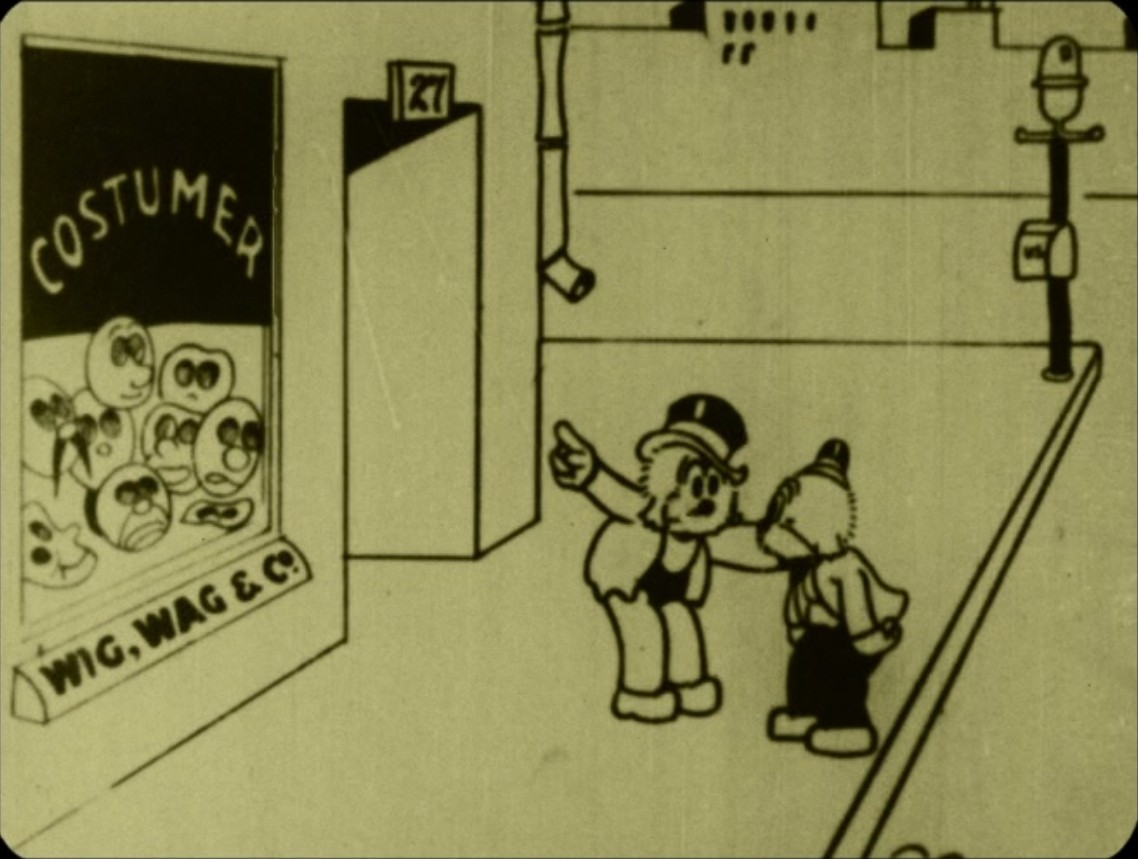
Tad Dorgan’s Judge Rummy was a comic strip that run from 1910 to 1922. Between 1918 and 1922 it was also an animated cartoon series, directed by the likes of Jack King, Burt Gillett and Grim Natwick, who would all become animation legends, and, surprisingly, Gregory La Cava, later director of live action comedies like ‘My Man Godfrey’ (1936) and ‘Stage Door’ (1937).
I’ve no idea who’s responsible for ‘A Fitting Gift’ but the animator has a very pleasant animation style, with unexpected touches of metamorphosis, original staging, and surprising movements.
In this short Judge Rummy wants to buy a gift for a girl he admires. His friend Silk Hat Harry suggest a corset, but Judge Rummy is too bashful to enter, so Silk Hat Harry suggests the two dress as women themselves, but then Judge Rummy’s wife appears. The gags themselves in this cartoon, one including a homosexual stereotype, are pretty trite, but as said, the execution is much fun, making this short a pleasant watch.
Watch ‘A Fitting Gift’ yourself and tell me what you think:
‘A Fitting Gift’ is available on the Blu-Ray-DVD combo ‘Cartoon Roots: The Bray Studios Animation Pioneers’
Director: Walter Lantz
Release date: March 9, 1920
Stars: Jerry on the Job
Rating: ★★★
Review:

Jerry is on a job at a train station, where his boss is plagued by a mosquito. Jerry knows just the way to get rid of the little pest, or does he?
‘The Tale of the Wag’ is a nice little cartoon based on one simple idea. The animation is full of surprising details, like Jerry using his crest as an arm to scratch himself, or Jerry shaking hands with the thought balloon that contains his idea. These little touches rescue an otherwise rather run of the mill short.
Watch ‘The Tale of a Wag’ yourself and tell me what you think:
‘The Tale of a Wag’ is available on the Blu-Ray-DVD combo ‘Cartoon Roots: The Bray Studios Animation Pioneers’
Director: Vernon Stallings
Release date: March 3, 1920
Stars: Krazy Kat
Rating: ★
Review:

Compared to other cartoonists working at the Bray studio, the work of Vernon Stallings is certainly subpar. His Krazy Kat cartoons are crude and simple, and lack the sophisticated animation of an Earl Hurd or the inventiveness of Walter Lantz.
‘The Best Mouse Loses’ is a very short cartoon in which Ignatz Mouse goes into a ringed boxing match. Arbiter Krazy Kat lets him win, much to Ignaz’s chagrin. Both the premise and the execution of this cartoon are poor, and the animation is only interesting because of some strange body elongations not seen elsewhere.
Watch ‘The Best Mouse Loses’ yourself and tell me what you think:
‘The Best Mouse Loses’ is available on the Blu-Ray-DVD combo ‘Cartoon Roots: The Bray Studios Animation Pioneers’
Director: Wallace Carlson
Release date: September 6, 1919
Stars: Dreamy Dud, Wallace Carlson, John Randolph Bray
Rating: ★★★★
Review:

Young Wallace Carlson parodies his own work in a short funny film starring himself.
If anything the film shows that animating a cartoon is a lot of work. Most telling is the scene in which Carlson photographs a huge pile of animation drawings. The intertitle ’48 hrs later… ‘ says it all.
The cartoon itself, ‘Dreamy Dud’, which Carlson plays to an unimpressed John Randolph Bray , is not half as funny as the live action sequences, and only demonstrates that Carlson belongs to the lesser gods of animation. His animation style is crude and formulaic, with little sense of timing.
Watch ‘How Animated Cartoons Are Made’ yourself and tell me what you think:
‘How Animated Cartoons Are Made’ is available on the Blu-Ray-DVD combo ‘Cartoon Roots: The Bray Studios Animation Pioneers’
Director: Earl Hurd
Release date: April 23, 1919
Stars: Bobby Bumps and Fido
Rating: ★★★
Review:

‘Bobby Bumps’ Pup Gets the Flea-Enza’ is a funny take on the devastating Spanish Flu epidemic of 1918-1920. In this cartoon Bobby Bumps and Fido both think Fido’s got the influenza, while he only got a flea (depicted as a black devilish little man).
The humor is mild, but Earl Hurd once again demonstrates to be one of the best animators of the era. Every shot and move look smooth and elegant. The best gag may be the visit to the horse doctor.
‘Bobby Bumps’ Pup Gets the Flea-Enza’ is available on the Blu-Ray-DVD combo ‘Cartoon Roots: The Bray Studios Animation Pioneers’
Director: Otto Messmer
Release date: October, 1919
Stars: Charlie Chaplin
Rating: ★★
Review:

‘Charley at the Circus’ is an entry in Pat Sullivan’s Charlie Chaplin animated cartoon series.
As the title implies, the complete film takes place in a circus, and involves gags with Kewpie the Strong Woman, Mitzi the fat lady, a flea circus and a bearded lady, and Pauline the noseless goat. Notice the throwaway gag on the upcoming prohibition.
As with the other Charlie Chaplin shorts, the animation is crude and stiff, but at least this film profits from a running gag of a heavy guy chasing Charlie Chaplin. Nevertheless, there is no hint of greatness in this cartoon, and it’s clear that animator Otto Messmer still had to find his vibe.
‘Charley at the Circus’ is available on the Blu-Ray ‘Cartoon Roots: Otto Messmer’s Feline Follies’
Director: Otto Messmer
Release date: October, 1919
Stars: Charlie Chaplin
Rating: ★
Review:
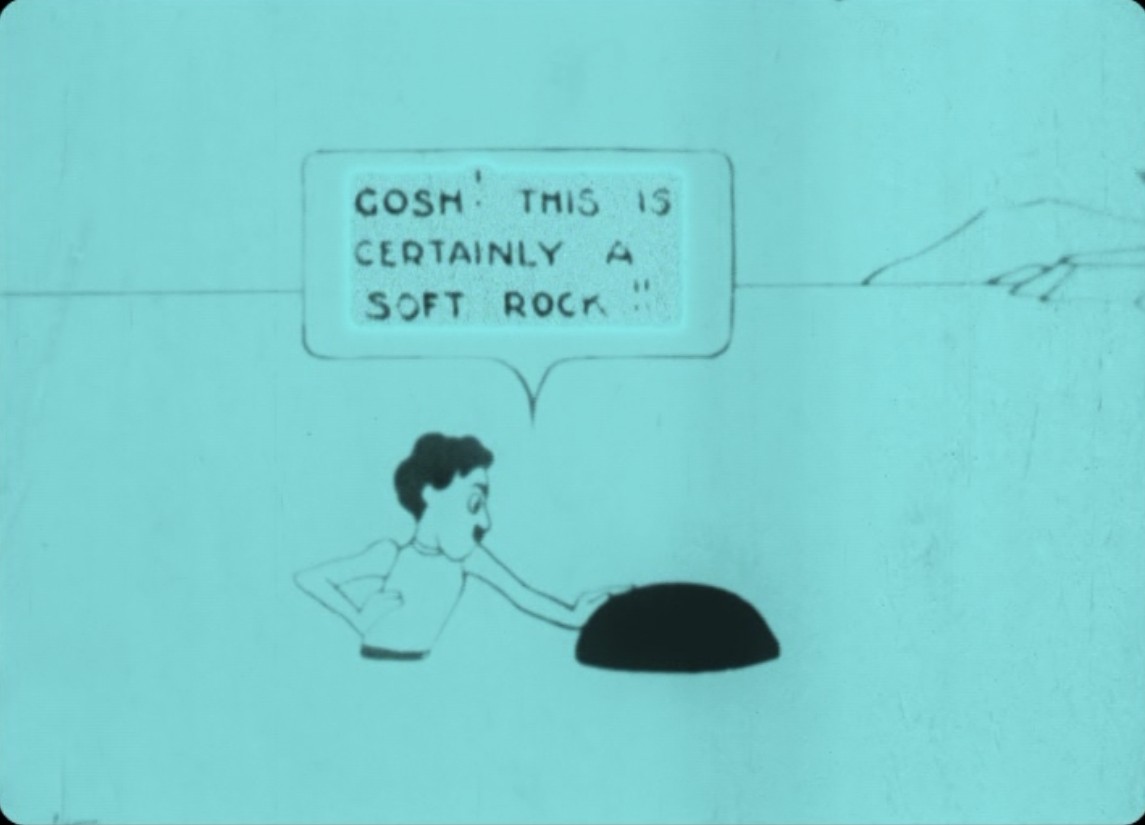
Pat Sullivan’s Charlie Chaplin animated shorts were a short lived series, spanning only two years (1918-1919) and about 16 films. ‘Charley at the Beach’ is one of the last and shows that some Charlie Chaplin’s mannerisms were transferred surprisingly well to the animated screen.
Indeed, Pat Sullivan’s Charlie Chaplin shorts were supported by the great comedian himself. Chaplin gave the animators thirty or forty photographs of himself in different poses and with these the animators could copy several of his movements. Sullivan’s prime animator was of course Otto Messmer, who a month later would create Felix the Cat.
According to Messmer his work on the Chaplin cartoons greatly influenced his work on Felix (Felix – The Twisted Tale of the World’s Most Famous Cat, p. 38), but to be honest, compared to the later Felix the cat cartoons, the animation on Charlie Chaplin is remarkably stiff and primitive. Moreover, in these Messmer makes a lot of use of text balloons, even when the images could speak for themselves, like in the hot dog scene.
‘Charley at the Beach’ is little more than a string of unrelated gags at the beach. Messmer even goes for some throwaway gags on fish. Unfortunately, several of the gags are misogynistic (Charlie Chaplin is a peeping Tom, and there’s some fat shaming) and one is even racist: when Charlie discovers a girl he fancies is black, he quickly swims away. The result is a pretty tiresome and boring film, and nowhere we can detect Messmer’s great talent, yet.
‘Charley at the Beach’ is available on the Blu-Ray ‘Cartoon Roots: Otto Messmer’s Feline Follies’
Director: Max Fleischer
Release date: October 14, 1919
Stars: Max Fleischer, Koko the Clown
Rating: ★★★
Review:

Max en Dave Fleischer were two true animation pioneers. In 1915 they invented the rotoscope, which they patented that year. With rotoscope they could capture live action movement as drawings on paper. Their first rotoscope tests featured Dave Fleischer in a clown suit, and these were the origin of Koko the Clown, star of ‘Out of the Inkwell’ series.
The two brothers started to make these shorts for J.R. Bray from 1919 on, but they only became a real series in 1920, and Koko got his name much later, in 1923. ‘The Tantalizing Fly’ is but the second ‘Out of the Inkwell’ short, yet it already shows the merit of rotoscope and the brothers’ imaginative way of storytelling.
In ‘The Tantalizing Fly’ Max Fleischer is hindered by a fly while drawing Koko. He tries to swat it, but hits Koko instead. Then it’s Koko’s turn. He tries to lure the fly by drawing a bald sitting man, but only manages in hitting the man instead of the fly.
The idea of an animator drawing a character is as old as animation itself, and clocking less than four minutes ‘The Tantalizing Fly’ is frustratingly short, leaving room for just a few gags, but Fleischer’s mix of animation, rotoscope and live action is fun to watch, and shows that the two brothers were among the most interesting animation film makers of their time.
Watch ‘The Tantalizing Fly’ yourself and tell me what you think:
‘The Tantalizing Fly’ is available on the Blu-Ray ‘Cartoon Roots: The Bray Studios Animation Pioneers’ and on the DVD-set ‘Popeye the Sailor 1933-1938’
Director: Earl Hurd
Release date: December 4, 1918
Stars: Bobby Bumps and Fido
Rating: ★★★½
Review:

In ‘Bobby Bumps Puts a Beanery on the Bum’ Bobby Bumps and Fido answer to an ad ‘boy wanted in to help in kitchen’ from the ‘Quick Lunch Beanery’.
What follows is a rather aimless string of gags, most remarkable of which is one in which Fido makes a cat eat its words by rolling up the cat’s speech balloon and shovel it down its throat. The cartoon ends all too abruptly, when Bobby pours ink over the cook who chased him out of the beanery.
More interesting than anything of this, however, is the opening scene in which a hand draws Bobby Bumps lying down in perfect perspective. Bobby Bumps helps the hand coloring him, only then follows Fido and the scenery. The Bobby Bumps cartoons were drawn elegantly anyhow, making them stand out of the 1910s crowd, and even though ‘Bobby Bumps puts a Beanery on the Bum’ isn’t the best entry in the series, in this respect it’s now exception.
Watch ‘Bobby Bumps Puts a Beanery on the Bum’ yourself and tell me what you think:
‘Bobby Bumps Puts a Beanery on the Bum’ is available on the DVD-set ‘Popeye the Sailor 1933-1938’
Director: Earl Hurd
Release Date: January 28, 1923
Stars: Bobby Bumps & Fido
Rating: ★★★★★ ♕
Review:

I was already impressed with ‘Fresh Fish’, but Earl Hurd’s next Bobby Bumps picture, ‘Chicken Dressing’ is even better.
Earl Hurd, jr. again is a director at a “large film company”, in which Bobby Bumps and Fido co-star a live action cat, rabbit and chicken. These real animals interact marvelously with the cartoon starts, and one immediately believes they’re movie stars, as well.
Only after 4 minutes the ‘real’ picture starts, with Bobby Bumps and Fido being firefighters, rushing to the fire on a live action-rabbit pulled cart, and assisted by the real life cat, while the chicken plays the damsel in distress. Highlight is when Bobby Bumps takes out one of the smoke drawings, handles it as if it were a spring, and complains to the director about this badly drawn smoke.
Soon some real smoke enters the picture, making Bobby faint. The director asks Bobby whether he wants to go to a real life hospital or a cartoon hospital. After imagining the first (also starring two live action children as a doctor and nurse, respectively) , Bobby wisely chooses the latter. In the end the whole cartoon appears to have been the chicken’s dream.
‘Chicken Dressing’ is an absolute delightful cartoon, mixing live action and animation to a satisfying end, and providing some great gags along the way. Earl Hurd makes great use of the animals, sometimes superimposing drawings on them. This cartoon shows that Earl Hurd should be counted among the animation greats, and not only remembered for his cel patent.
Watch ‘Chicken Dressing’ yourself and tell me what you think:
‘Chicken Dressing’ is available on the Blu-Ray/DVD-combo ‘Cartoon Roots: Bobby Bumps and Fido’
Director: Earl Hurd
Release Date: August 26, 1922
Stars: Bobby Bumps & Fido
Rating: ★★★★½
Review:

Earl Hurd left Paramount for Educational Pictures, and with this move his style changed from pure cartooning to a very inventive and entertaining blend of live action and animation, starring his own little son as a live action director directing the cartoon stars Bobby and Fido.
‘Fresh Fish’ is a perfect example. The opening title card is already promising, reading “Bobby Bumps Film co. Feetures & Comydies. No admitence. Aplie at Offis.” Inside, we watch Hurd jr. filming Bobby and Fido, who are on a fishing boat. First the cartoon concentrates on the cartoon gags, e.g. with Fido pitying the poor fish, before the fish tantalizes the poor dog. This sequence ends when a live action cat catches the fish and runs away with it.
But then Bobby accidentally stands on the water, a fact Hurd jr. has to point out to him. At this point Bobby falls into the water after all. The idea that gravity only works when one is aware it should work is of course a familiar cartoon trope, but this is the oldest instance of this gag type I know of.
After the fall, Bobby blames the poor scenery, which, indeed, hardly indicates the presence of water. Thus, the young director places the scenery in a tub. At first Bobby and Fido are very pleased with the added realism, but they almost drown in it.
This cartoon features quite some very effective special effects, making us easily believe the cartoon Bobby and Fido are in the same room as the cat and the director. Especially the water splashing when Bobby and Fido jump into the tub is very convincing. The result is no less than delightful, and ‘Fresh Fish’ should be regarded as one of the highlights from the silent cartoon era.
‘Fresh Fish’ is available on the Blu-Ray/DVD-combo ‘Cartoon Roots: Bobby Bumps and Fido’
Director: Earl Hurd
Release Date: August 21, 1921
Stars: Bobby Bumps & Fido
Rating: ★★★
Review:

In ‘Hunting an’ Fishing’ Bobby Bumps does exactly that, and in an area where it’s prohibited, too. But how he’s supposed to know? He has blasted off the ‘no’ from a ‘no hunting allowed’ sign while trying to hit a rabbit. In any case, soon the gamekeeper is on his tail…
‘Hunting an’ Fishing’ looks uncommonly cheap for a Bobby Bumps cartoon: the background art is extremely limited, and Hurd uses quite some animation cycles. More interesting is the fact that this short seems like a very early ancestor of the chase cartoon. A great deal of the cartoon features the gamekeeper chasing Bobby, and Bobby and Fido trying to get rid of the fellow in various ways.
Yet, the best gag is reserved for a completely different set of characters: a bird and a frog using a sleeping rabbit’s stomach to rock themselves to sleep as well. This is an inventive, unique and surprisingly well staged gag.
‘Hunting an’ Fishing’ is available on the Blu-Ray/DVD-combo ‘Cartoon Roots: Bobby Bumps and Fido’
Director: Earl Hurd
Release Date: November 9, 1919
Stars: Bobby Bumps & Fido
Rating: ★★★½
Review:

In this short film, little boy Bobby Bump jumps out of the inkwell, together with his dog Fido, and calls his master, who hasn’t arrived at work, yet, on the phone.
Their creator Earl Hurd invites them at his home. What follows is a funny smoke gag, but shortly after Bobby and Fido start packing, the cartoon ends, cutting short a promising premise.
As ever with the Bobby Bump cartoons, the designs are very appealing, but the animation is very limited and a bit crude. Yet, the simple gags have their own charm, and this cartoon is particularly interesting for starring the master Earl Hurd, himself.
Watch ‘Their Master’s Voice’ yourself and tell me what you think:
‘Their Master’s Voice’ is available on the Blu-Ray/DVD-combo ‘Cartoon Roots: Bobby Bumps and Fido’
Director: Earl Hurd
Release Date: January 24, 1919
Stars: Bobby Bumps & Fido
Rating: ★★★
Review:

‘Bobby Bumps’ Last Smoke’ starts with Earl Hurd’s hand drawing Bobby Bumps, tickling him on the way. Then finished he gives the boy a cigarette, and immediately the scenery sets in.
Bobby starts smoking enthusiastically, but soon gets dizzy and throws the cigarette away. The cigarette smoke transfers him and Fido to a sultan’s palace in a 1001 Arabian night version of Turkey. The duo rescue a lady from the Sultan’s dungeons, with Bobby knocking out all the guards, and some lions, with the lady’s former ball and chain. He earns the damsel’s kiss in reward, which turns out to be Fido licking him.
Now, one would suspect that ‘Bobby Bumps’ Last Smoke’ is a typical anti-smoking cartoon, with Bobby giving up smoking after this trippy experience. But no, the one thing he’ll never do again isn’t smoking, but “insulting a sultan”. And so, with this pun, the short ends.
‘Bobby Bumps’ Last Smoke’ boasts elaborate human designs and intricate background art, but as with most animated cartoons from the 1910s, the animation is limited and jumpy.
‘Bobby Bumps’ Last Smoke’ is available on the Blu-Ray/DVD-combo ‘Cartoon Roots: Bobby Bumps and Fido’
Director: Władysław Starewicz
Release Date: 1920
Rating: ★★★★
Review:

In ‘Dans les griffes de l’araignée’ Starewicz tells his own, quite elaborated version of the classic ‘Spider and the Fly’ tale.
In Starewicz’s version the fly is called Dame Aurélie, a simple fly living at the countryside with her uncle, Beetle Anatole, and being in love with a longhorn beetle. One day a famous Paris star, a butterfly called Phalène, crashes in the fly’s village, and stays at her home. Phalène paints an all too rosy picture of Parisian life, and soon after her departure, Aurélie goes to the capital, as well.
First all goes well, as Aurélie works as Phalène’s house maid. But when she’s fired because of seeing a secret lover, things go downhill, indeed. The tale ends rather gruesomely with quite a spectacular finale, and in the epilogue we watch Aurélie returning to the village…
‘Dans les griffes de l’araignée’ is quite a tragic tale, but it’s hard to call it very engaging. Starewicz’s puppets are quite sophisticated, e.g. capable of rolling their eyes, but they don’t transgress the emotions very well, which remains emblematic. The emotional scenes are augmented by close-ups of the insect characters, in which live action puppets are used. Most spectacular is the finale, in which the title cards make place for a long action scene. The surviving print is gorgeous with its hand-painted colors, which certainly add to the film’s unique atmosphere.
‘Dans les griffes de l’araignée’ is available on the DVD-box ‘Starewitch 1882-1965 DVD Cinquantième anniversaire’
Directors: Max & Dave Fleischer
Release Date: July 6, 1920
Stars: Ko-Ko the Clown
Rating: ★★★½
Review:

‘The Clown’s Little Brother’ is one of the Fleischer brothers’ earliest films, when they were still working at Bray Studio.
The film stars Max Fleischer as the artist drawing Ko-Ko the clown, who’s only known as ‘the inkwell clown’ in this cartoon. Interestingly, as soon as Max tries to draw the character, his pen fails and Ko-Ko jumps out of the glass in which Max washes his pen. Immediately thereafter Max gets his mail, which strangely enough contains a live kitten. The Inkwell Clown gets a letter, too, stating that his kid brother arrives in another mail package. But Ko-Ko’s kid brother turns out to be a cheeky brat and Max leaves.
Undeterred, Ko-Ko tries to entertain the little kid with his antics, but the boy easily outperforms the clown, not in the least because he’s 100% animated, while Ko-Ko is partly rotoscoped. Thus the kid’s movements are wilder, less realistic and more impossible than Ko-Ko’s. At one point Ko-Ko falls off the piece of paper, and on the kitten, who plays with the poor cartoon character. At that point the kid brother shows his kinder side, and rescues Ko-Ko from the clutches of the feline foe. Yet, their antics end when Max returns, and the bottle of ink falls on the floor.
‘The Clown’s Little Brother’ is by all means an action rich and entertaining short, and shows that the Fleischers brothers were very competent players in the field. Fleischer’s inkwell clown was a sensation back then because of his fluid movements, based on Max Fleischer’s rotoscope invention. But in this cartoon Max Fleischer shows to be a competent animator without the aid of rotoscope, as well. For example, when the kid brother tries to pull Ko-Ko out of the inkwell, one can sense some pulling force.
Watch ‘The Clown’s Little Brother’ yourself and tell me what you think:
‘The Clown’s Little Brother’ is available on the DVD-set ‘Popeye the Sailor 1941-1943’
Director: Max Fleischer
Release Date: 1920
Rating: ★★★★½
Review:
‘All Aboard for a Trip to the Moon’ is a very early educational animation short. The short was animated by Max Fleischer at the Bray Studios, and apparently part of a series called ‘Goldwyn Bray Pictograph – The Magazine on the Screen’. For this short Fleischer got assistance of the Popular Science Monthly for the scientific details.
In less than 8 minutes ‘All Aboard for a Trip to the Moon’ tells about a hypothetical trip to the moon, telling us how far the moon is, and how to overcome the Earth’s gravity by using a radium-propelled rocket. Fleischer depicts quite a hard, bouncing landing of the rocket on the moon, and it’s never revealed how the vessel would be able to return to Earth, but we get some nice and convincing shots of the moon’s landscape and earth from the moon itself.
Fleischer’s drawings and animations are combined with live action footage, e.g. of a man handling radium, and another one getting dressed for the trip. Apparently in 1920 the scientists deemed a thick fur coat and a gas mask enough protection in outer space…
The short also states that radium alone can create the force to overcome the Earth’s gravity, while the Saturn V rockets that eventually would put man on the moon were fueled by a modified form of kerosene, and in 1920 kerosene itself was already well-known…
Anyhow, scientific errors aside, ‘All Aboard for a Trip to the Moon’ is an entertaining piece of infotainment. It not only predates Disney’s similar futurist television specials, like ‘Man and the Moon‘ (1955) with a staggering 35 years, it also gives an insight look in how space travel was perceived in the 1920s.
‘All Aboard for a Trip to the Moon’ is available on the Thunderbean Blu-Ray ‘Fleischer Rarities’
Director: Walter Lantz
Release Date: February 27, 1920
Stars: Jerry on the Job
Rating: ★★★★
Review
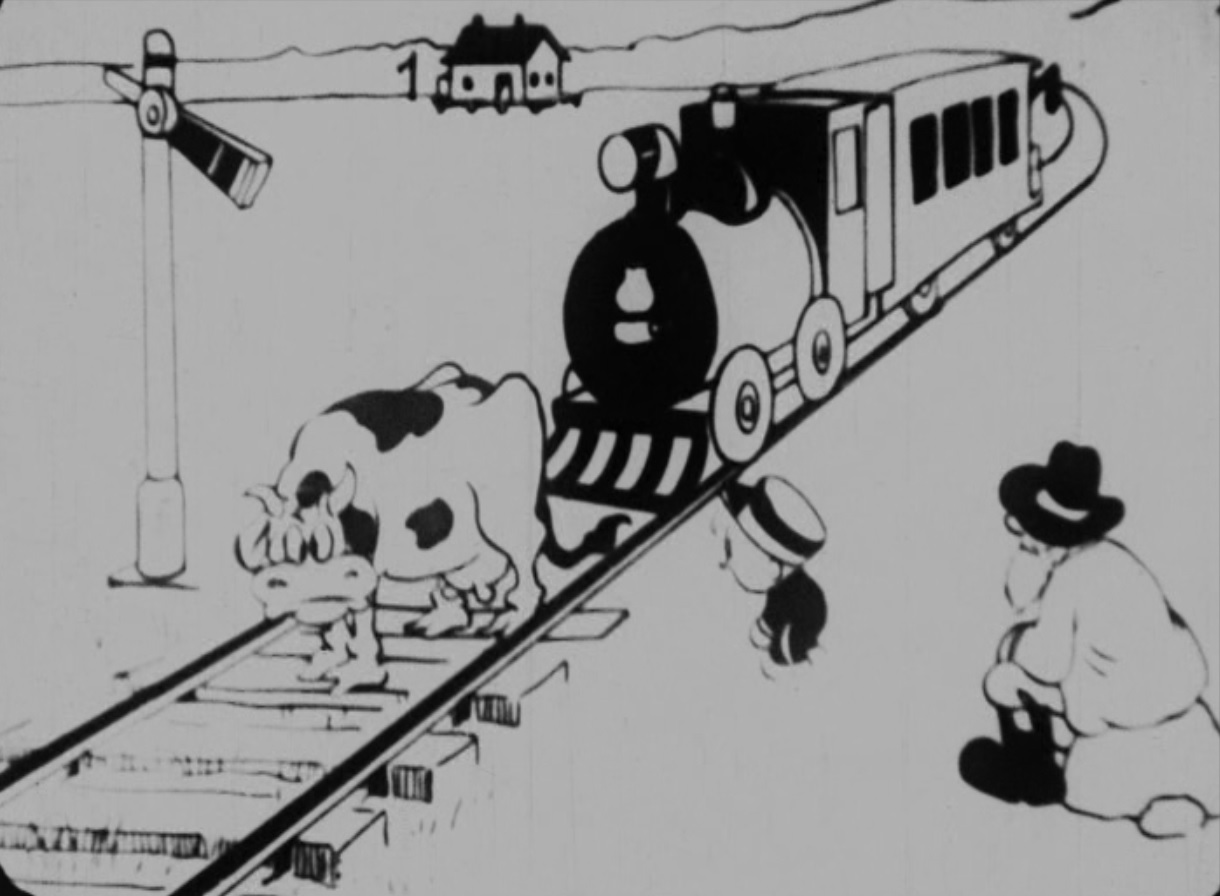
‘The Wrong Track’ is a short gag cartoon featuring ‘Jerry on the Job’, apparently a little kid doing all kinds of jobs.
In this short he’s a train engineer, who’s scolded by his boss of killing too many animals on the train track. And indeed, only a few seconds after leaving the train station Jerry encounters a cow, which after some action is killed.
The short features quite some funny gags and ends with a great punchline. The designs are simple, but pleasant and Walter Lantz’s animation is fair and effective. ‘The Wrong Track’ may not be a masterpiece, it’s a fun bit of early animation, and certainly one of the better shorts from this era.
The Wrong Track’ is available on the Thunderbean Blu-Ray/DVD-combo ‘Technicolor Dreams an Black & White Nightmares’
Director: Howard S. Moss
Release Date: 1917
Rating: ★
Review

‘Dolly Doings’ is an entry in the ‘Motoy Comedies’ series, which was apparently based on the book series ‘Motoys in Life’.
The short mixes live action and stop motion to tell the story of a little girl who dreams that her dolls come to life. One particularly mischievous doll called Jimmy taunts the others with a needle.
The dolls lack any character and are very poorly animated, not exceeding the amateur level. The action is hard to comprehend, and the ‘story’ too trite to be of any interest. The intertitles, too, are painfully unfunny. I’ve no idea how many Motoy Comedies have been made, but based on the judgement of this entry this series can’t hardly have been successful.
Dolly Doings’ is available on the Thunderbean Blu-Ray/DVD-combo ‘Techicolor Dreams an Black & White Nightmares’
Director: Dick Huemer?
Release Date: July 14, 1918
Stars: Mutt and Jeff
Rating: ★★★½
Review:

In this Dick Huemer-animated short Mutt and Jeff appear to own a lunchroom. Mutt is the waiter, and Jeff the cook.
There are essentially three gags: a bearded customer wants some ox-tail soup, another costumer some pie, and the third, a beautiful woman, the best flapjacks they have. When she notes that the flapjacks don’t look so good, Mutt places one on the grammophone player and promptly starts to dance with her to the music. The dance ends when a policeman shows up, knocking out both Mutt and Jeff, but taking the dance with the beautiful dame himself.
While seating the lady looks like from another picture, when compared to the cartoony design of Jeff, but this feeling vanishes during the dance scene, and one must admit Dick Huemer does quite a good job in animating this particular scene. Another fine piece of early character animation are Mutt’s deft hand movements while handling the second customer.
Watch ‘The Extra-Quick Lunch’ (Flapjacks) yourself and tell me what you think:
‘The Extra-Quick Lunch’ (Flapjacks) is available on the DVD ‘Mutt and Jeff – The Original Animated Odd Couple’


 Dr. Grob's Animation Review