You are currently browsing the category archive for the ‘Stop motion films’ category.
Director: Chris Butler
Release date: April 7, 2019
Rating: ★★★★½
Review:
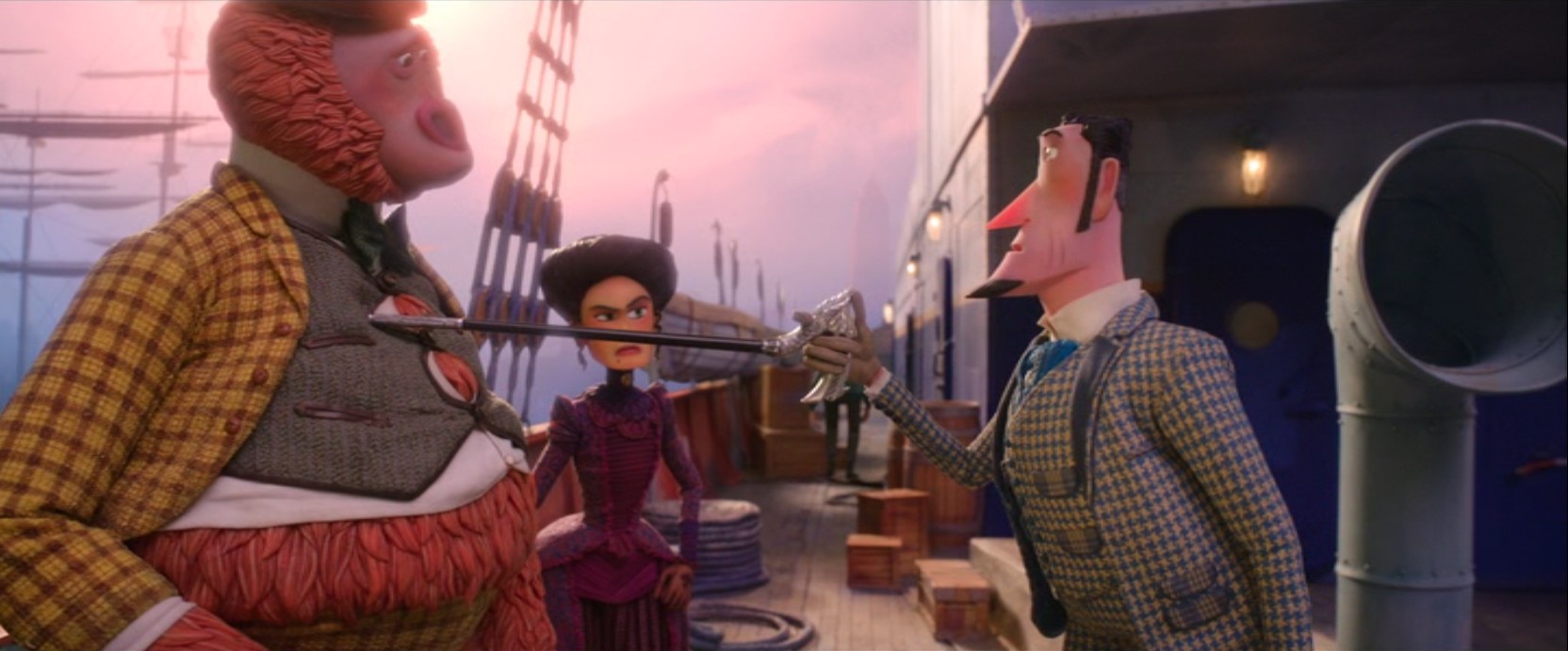
Laika’s ‘Missing Link’ is the second of the three animated yeti features of 2018-2019, the other two being Warner Bros.’ ‘Smallfoot’ from 2018 and Dreamworks’ ‘Abominable’ from 2019. ‘Missing Link’ easily is the best of the three. The stop motion animation is much more interesting than the rather generic computer animation of the other two studios, and the story much less predictable.
The originality already starts with the fact that not yetis but a bigfoot, christened ‘Mr. Link’ from Washington state is the central character of the film. We follow him, his ‘discoverer’ Sir Lionel Frost and Frost’s former love interest and widow of a fellow explorer, Adelina Fortnight, on an unusual quest.
The year is 1886 (we know that because we see the Statue of Liberty being under construction), the year before the European powers would divide Africa between them on the Berlin conference , while in North America the once extremely abundant passenger pigeons were being killed in huge numbers to certain extinction.
This age, in which discovery equaled oppression and slaughter, is exemplified by Sir Lionel Frost’s adversary, Lord Piggot-Dunceby, head of a club of explorers Sir Lionel Frost desperately wants to join, despite the fact all members despise him. This club represents the world of white supremacy and male chauvinism, but Sir Lionel Frost shows he’s made from different material, and the whole film sends a message of love and respect for our fellow creatures, being man or animal, man or woman, or whatever.
‘Missing Link’ does not score high on believability. First, we must accept that Sir Lionel Frost is more interested in discovering than in really studying his findings, despite his few tendencies to do so. Second, we must accept that the giant ape-like Mr. Link can wander through the world unnoticed, simply because he has put on some clothes. Third, we must accept the great lengths to which Lord Piggot-Dunceby goes to thwart Sir Lionel Frost’s plans, not only hiring an assassin, but even completely discarding a huge discovery which could have made him famous if he would steal it from Frost. Fourth, there’s an exciting vertigo scene, which unfortunately throws all plausibility out of the window. In this single scene our heroes should have died multiple times. The film makers don’t even show us how our heroes survive their predicament.
But what the film lacks in believability it makes up in characters and story telling. Both Sir Lionel Frost and Mr. Link are interesting characters, with Mr. Link being instantly likeable, while Adelina Fortnight defies the normal love interest cliches, being much more of an independent woman, steering her own course. There isn’t even a breakup scene in sight, that obligatory staple scene of American animation films of the 2010s.
The characters are much helped by great voice acting. Hugh Jackman (Sir Lionel Frost), Zoe Saldana (Adelina Fortnight), Stephen Fry (Lord Piggot-Dunceby), Timothy Olyphant (the assassin Willard Stenk) and Emma Thompson (whose character I won’t reveal here) all do an excellent voice job, but it’s Zach Galifianakis who stands out as Mr. Link, making him both polite, shy, naïve, enthusiastic, gentle, sweet and open at the same time, without forgetting to make him funny, too.
Being a Laika film, the stop-motion animation is, of course, of the highest quality. Especially the character animation should be mentioned as outstanding, but also impressive are the action scenes, highlight being a long chase scene on a rocking boat.
Understandably for a film showing such wide vistas as the Ocean and the forests of Washington State there’s a large dose of computer animation and computer-generated background art involved, which unfortunately make the film’s looks a little more generic than desired. But the film surprises most in its sunny color palette. ‘Missing Link’ is so much more colorful than all former Laika films, perhaps because it has discarded all horror elements, otherwise so omnipresent in their filmography. Thus, the film has very pleasant looks, and is a joy to watch from start to end (yes, even the end titles are lovely). I certainly hope the studio will retain this direction of more colorful tales and sceneries.
Watch the trailer of ‘Missing Link’ yourself and tell me what you think:
‘Missing Link’ is available on Blu-Ray and DVD
Director: Walerian Borowczyk
Release date: December 1963
Rating: ★★★★★ ♕
Review:
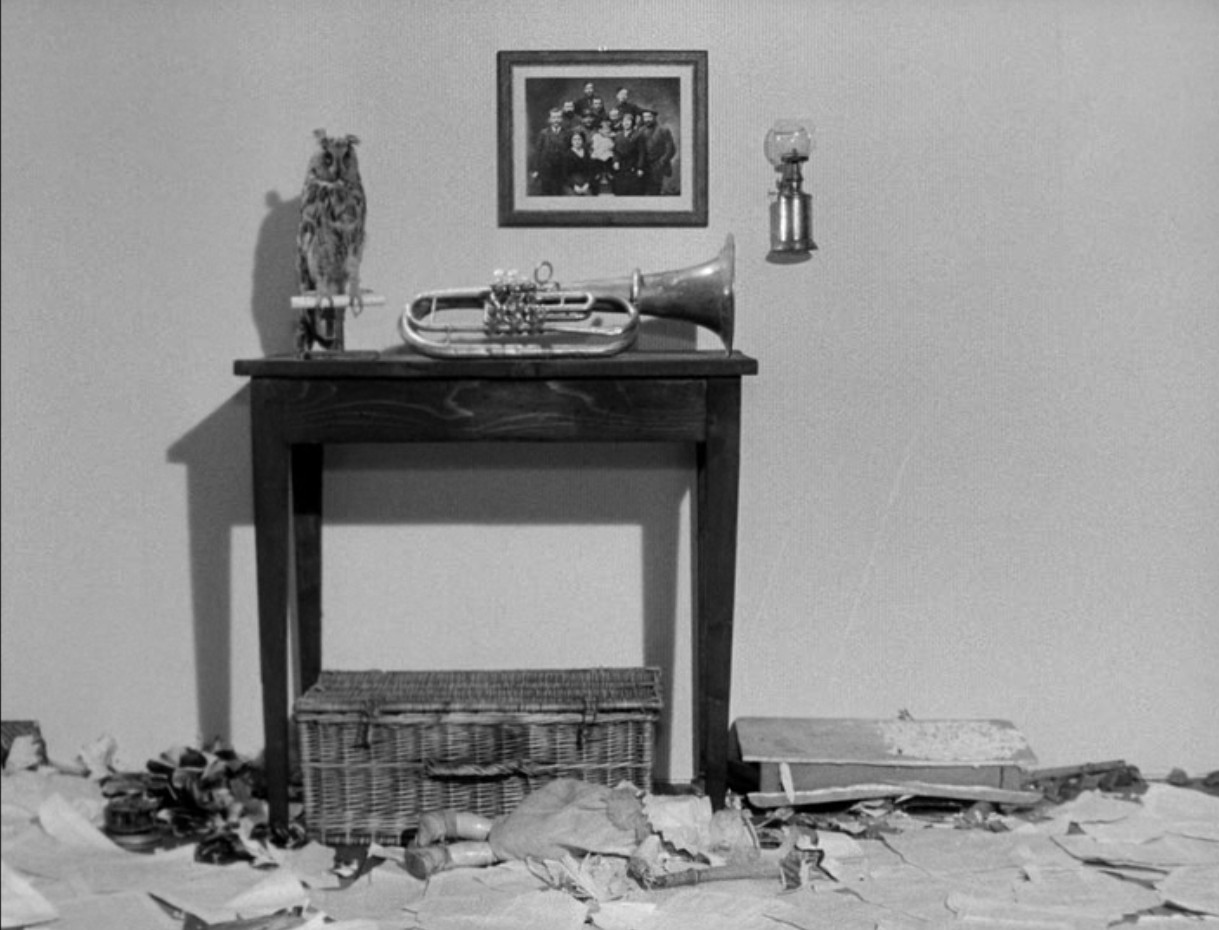
‘Renaissance’ must be counted among Walerian Borowczyk’s best and most powerful works. Instead of the silliness of ‘Les Astronautes‘ and ‘Encyclopédie de Grand-Maman‘, ‘Renaissance’ is a powerful stop-motion film on destruction.
The short starts bleak enough with the scene of a completely destroyed chamber. But then the objects in the room start to reassemble themselves…
Borowczyk’s command of stop-motion and reverse film making is astonishing, and although the tricks used are as old as cinema itself, these are used to an impressive effect, greatly enhanced by the soundtrack with all its crystal clear sounds. The whole surreal atmosphere looks forward to Jan Švankmajer’s stop-motion works, as does the morbid atmosphere.
Watch ‘Renaissance’ yourself and tell me what you think:
‘Renaissance’ is available on the Blu-Ray/DVD set ‘Walerian Borowczyk: Short Films and Animation’
Director: Bill Justice
Release date: December 1962
Stars: Ludwig von Drake
Rating: ★★★★★
Review:
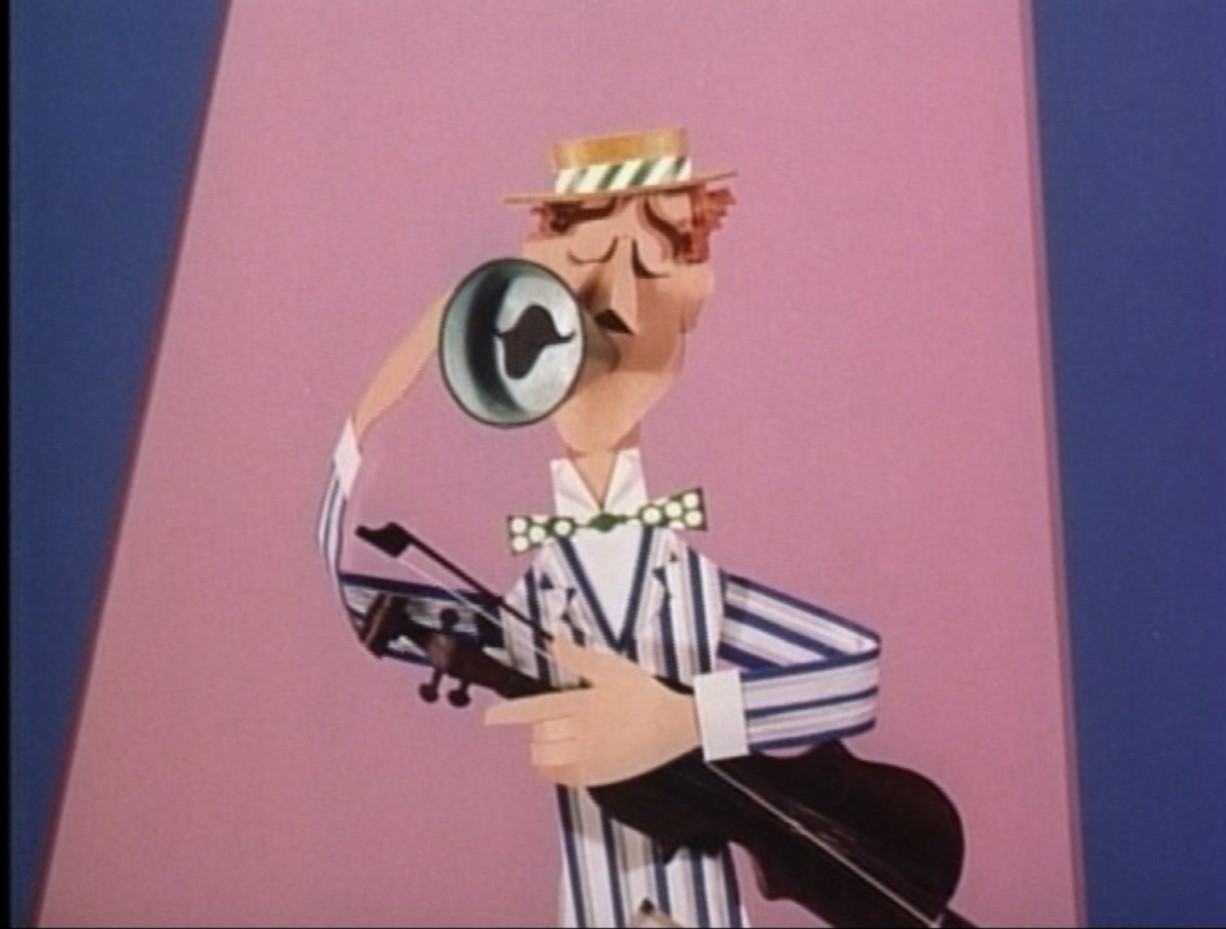
‘A Symposium on Popular Songs’ is the only theatrical cartoon to star Ludwig von Drake. This looney professor was created in 1961 when the Disney television series needed a new host, due to their move from ABC to NBC.
Voiced by an inspired Paul Frees, Von Drake is a wonderful character: he’s very talkative, often saying wrong things and correcting himself, and he has very lively hand gestures. Moreover, his talking is accompanied by all sorts of little sight gags, which makes his ‘lecture’ a delight to watch.
In ‘A Symposium on Popular Songs’ Von Drake leads the viewer along seven of his ‘greatest hits’, which are all wonderfully conceived parodies of 20th century popular music from ragtime to rock ‘n roll. All these hits were penned by the Sherman brothers, and it’s obvious that the two had a great time writing this spoof music, the highlight probably being their parody on the boogie-woogie of the Andrew Sisters.
Von Drake himself is traditionally animated, but his songs are accompanied by delighftul stop-motion and cut-out animations, designed by Xavier Atencio and animated by Bill Justice. In the first song, ‘Rutabaga Rag’, the two indulge in traditional stop-motion of vegetables dancing to the music. But in the subsequent songs the two favor a more sophisticated blend of cut-out and stop-motion, both attractively designed and well-animated.
After the ragtime we get a Charleston (‘Charleston Charlie’, sung by a flapper girl), an Al Jolson-like post-1929-crash song called ‘Although I Dropped a Hundred Thousand in the Market, Baby (I Found a Million Dollars in Your Smile)’, a Bing Crosby-like crooner song called ‘I am blue for you’, in which the crooner (no more than a head with a rudimentary armless stick-body) figures as a bouncing ball illustrating the lyrics, the aforementioned Andrews Sisters-like boogie-woogie song titled ‘The Boogie Woogie Bakery Man’, a doo-wop song called ‘Puppy Love’, and finally a wild rock ‘n’ roll song called ‘Rock, Rumble and Roar’, which is the only one delivered by Ludwig von Drake in person, but it figures excerpts from all six earlier songs.
The result is a wonderful cartoon that is both nonsensical, entertaining and educational.
Watch ‘A Symposium on Popular Songs’ yourself and tell me what you think:
‘A Symposium on Popular Songs’ is available on the DVD ‘Walt Disney Treasures: Disney Rarities’
Director: unknown
Production date: ca. 1962
Stars: The Marx Brothers
Rating: ★★★
Review:
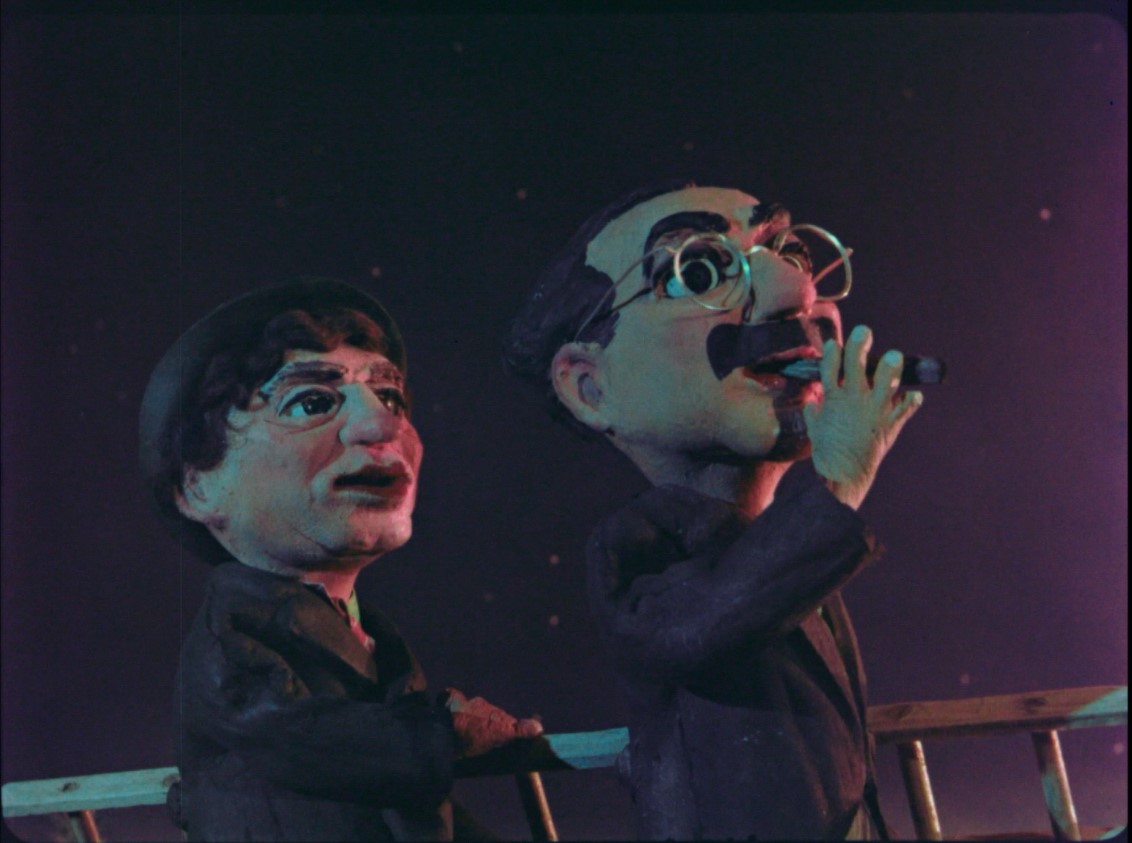
‘The Marx Brothers’ is an odd curiosity unearthed by the ever amazing Steve Stanchfield, who specializes in discovering animated oddities. Apparently this is a pilot from the early sixties by Screen Gems for a Marx Brothers cartoon series, curiously done in stop-motion (more cartoon plans were made at the time, see Jim Korkis’s excellent article on this).
The short involves the three Marx Brothers, and a stout woman called Hortense. The puppets are immediately recognizable as the Marx Brothers, but also crude and on the ugly side. The least well-done is Chico, whose puppet falls short both in looks and voice, and he hardly has any gags. Harpo should translate easier to the cartoon medium, but due to the poor timing he more comes over as an obligatory additional clown than the great comedian he could be in the live action films.
The fun comes mostly from Groucho and his side-cracks, but there’s hardly anything done with the powers of animation, the pacing is slow, and the animation not beyond fair. Moreover, the ‘story’ amounts to nothing. Most striking is a close-up of the magazine called ‘Babes’ Groucho is reading in the opening scene, which shows real nudity.
Watch ‘The Marx Brothers’ yourself and tell me what you think:
Steve Stanchfield put this short on his private DVD release ‘Top Shelf Scans (Goosed)’
Director: Hermína Týrlová
Release date: 1962
Rating: ★★★
Review:

In ‘Two Balls of Wool’ the insides of a sewing box come to life, including a scissors, a measuring tape, thread spools, a horse-like pincushion, and, most importantly, two balls of wool.
The pink ball of wool turns into a girl, while the blue one turns into a boy. The boy plays the flute on a needle, charming the measuring tape, who acts like a snake. When the snake captures the girl, the boy comes to the rescue, riding the pincushion horse. The two also perform some acrobatic tricks, and accidentally unwind a knitted piece, until the scissors forces them to knit the piece back again
The film has a rather weak story, but it’s a marvel how Týrlová spins a film out of such ordinary material, making use of the properties of these objects. The animation is top notch. For example, note how Týrlová manages to turn the scissors (which can’t do anymore than the scissors in your drawer) into an authority figure, imposing on the other objects. ‘Two Balls of Wool’ thus is a charming little short, showing Týrlová’s great talent as an animator.
Watch ‘Two Balls of Wool’ yourself and tell me what you think:
https://noodlemagazine.com/watch/-167471844_456240845
‘Two Balls of Wool’ is available on the DVD box ‘Hermína Týrlová Výběr z tvorby/Selected Works’
Director: Jan Iván
Release date: 1961
Rating: ★★★
Review:
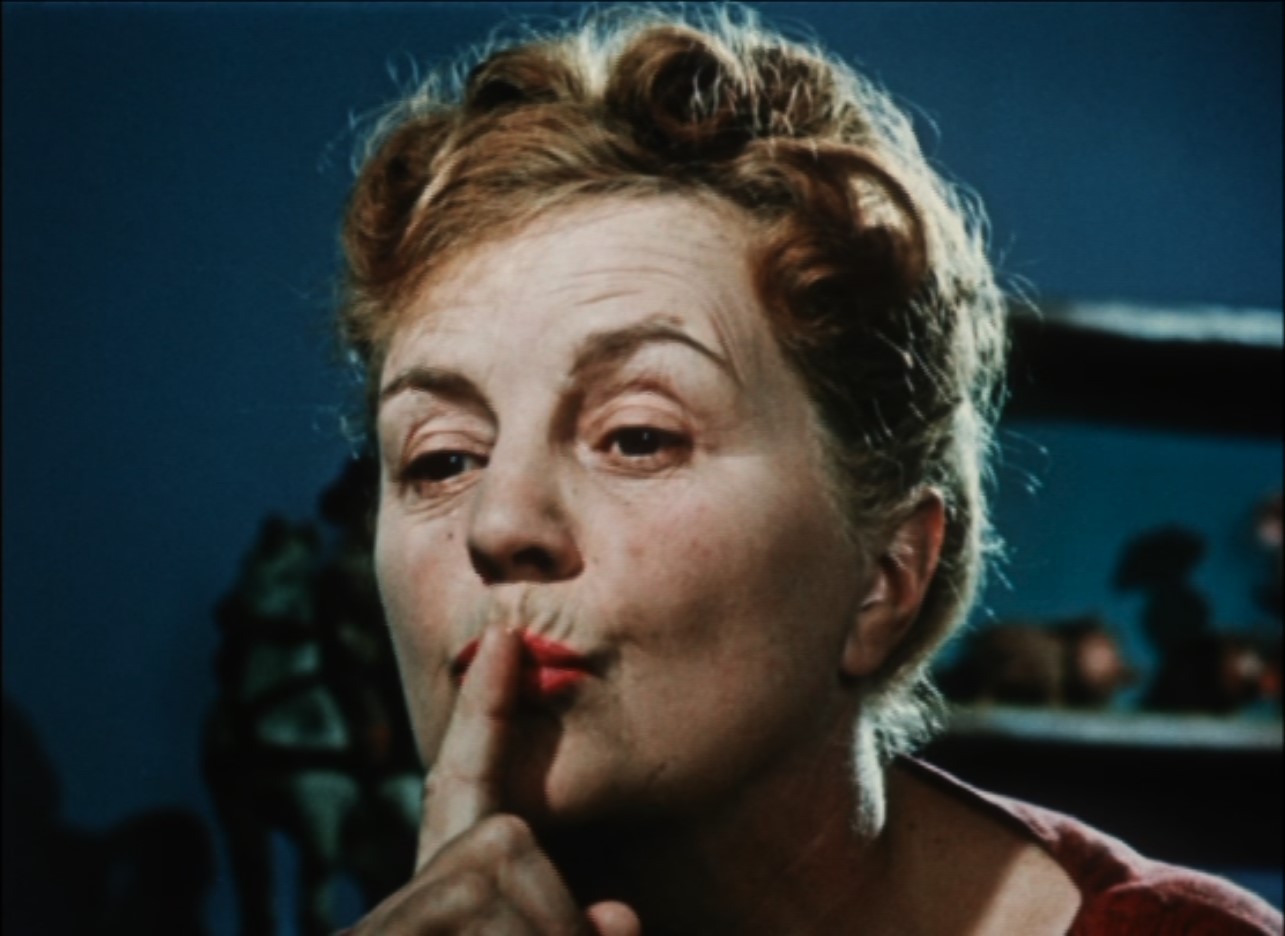
This a gentle documentary film made in honour of the Czech animation pioneer’s sixtieth birthday.
The film showcases excerpts from quite a few of Hermína Týrlová’s films, including her first, ‘Ferda the Ant’ (1944), Czechoslowakia’s first stop motion film anyhow. Other excerpts are from ‘Revolt of the Toys’ (1945), apparently an anti-fascist film, ‘The Knot in the Handkerchief’ (1958) and ‘Badly Made Toy-Man’ (1951), which is revealed as Týrlová’s favorite character.
Indeed, it’s the Badly Made Toy-Man who stars the bridging stop-motion sequences, for this documentary features quite some original animated material, made by Týrlová especially for this film. Especially, the short sequence starring the two balls of whool-characters for her upcoming ‘Two Balls of Wool’ (1962) are a delight, for this cannot be found in the final film, and is presented as a depiction of Týrlová’s imagination.
The film is narrated, and although we watch Týrlová acting out herself, e.g. recreating the painstaking ways with which she made ‘Ferda the Ant’ and interacting with children, her main audience, we do not hear her, and there are no interviews, only images. Nevertheless, the documentary succeeds in showing where Týrlová’s greatest talent lies: in creating charming animation films for children in which ordinary toys and objects come to life.
‘Hermína Týrlová’ is available on the DVD box ‘Hermína Týrlová Výběr z tvorby/Selected Works’
Director: Wes Anderson
Release date: February 15, 2018
Rating: ★★★★★
Review:
The 21st century saw a few live action directors and film makers crossing over to animation, often with original films that were welcome deviations from the standard family fare of Pixar, Dreamworks, Sony, Illumination and the like. One of these directors was Wes Anderson, whose live action films already have a very distinct flavor, let alone his animation work.
In 2009 Wes Anderson brought us ‘Fantastic Mr. Fox’, his own quirky take of the classic children’s book by Roald Dahl, adding some ‘The Royal Tenenbaums’-like flavor to it. It seemed a one off, like all other animation adventures by live action directors, but in 2018 Wes Anderson surprised everyone by making yet another animation movie, this time with a completely original story of his own.
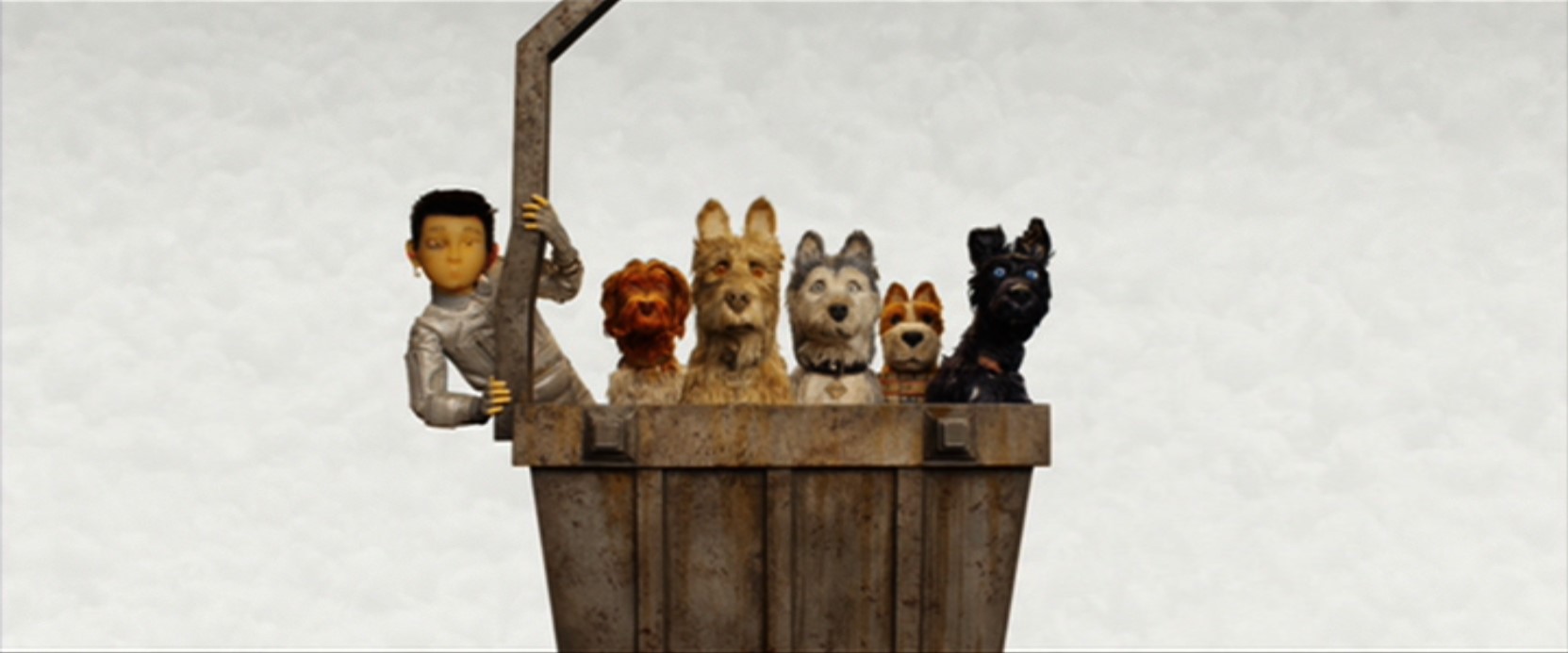
‘Isle of Dogs’ is a sort of fantasy-dystopia film set in Japan. Surprisingly, much of the dialogue is in Japanese, and not always translated, adding to the film’s idiosyncrasy. The film tells about the cat-loving Kobayashi clan who wants to get rid of all the dogs. When a Kobayashi mayor gets into power in the fictive town of Megasaki, he banishes all dogs to a garbage dump island…
The film knows quite a lot human characters, but uses mostly a dog-viewpoint and is even narrated by a dog (voiced by Courtney B. Vance). The film focuses on a stray dog called Chief, whose life changes when a young boy arrives on the island, looking for his own former pet, Spots.
Where all other film makers would make the boy and the dogs be able to talk with each other, Anderson keeps their languages strictly separated, with the dogs not getting a thing the boy says, and vice versa. As the boy speaks Japanese, we, the audience, too, cannot always follow what the boy tries to say – a bold move.
The dog communication is all in English, and Anderson makes use of a lot of familiar names to voice his animated creatures, like Edward Norton, Jeff Goldblum, Bill Murray and Scarlett Johansson, just to name a few. Even Yoko Ono has a small role as a scientist of the same name.
Like ‘Fantastic Mr. Fox’ ‘Isle of Dogs’ is a stop motion film, and a very virtuoso one, too. The animation, directed by Mark Waring, is superb throughout and there are crowd scenes with tens to hundreds of puppets, and both dog and human characters are very intricately designed. Like in Anderson’s first animated film, all animals have a rather scruffy look, giving the film a very individual look. There are some typical quirks in the animation, like dogs sneezing at random moments. I also like Anderson’s use of cartoony fight clouds. As far as I know he’s the first to use those in a stop-motion film.
As with his other films Anderson employs a very typical use of the camera, often showing symmetrical images, and sometimes using close ups in a rather Spaghetti Western-like fashion. There’s also a little 2D animation to depict events on television. The background art, too, is unique. Apart from elaborate sets, the film uses rather flat background art, with a typical cut-out look. The quasi-Japanese score by Alexandre Desplat, an Anderson favorite, adds to the film’s unique atmosphere.
The film’s story says something about populism, and how misleading information can lead to unjust decisions, but the film is too silly to emphasize this point. Likewise, the film’s heart lies with Chief, but much more interesting than his development are the dry dialogues, and the running gag of one dog hearing a rumor the others never heard of. In fact, apart from the film’s looks, the dialogues form the film’s main attraction, as they are often very funny.
Unfortunately, the film’s finale is not the best part, and the defeat of the villains a little too easy, but otherwise ‘Isle of Dogs’ is a real treat, and with its unique style a very welcome diversion from the often run-of-the-mill fare of American studio animation.
Watch the trailer for ‘Isle of Dogs’ yourself and tell me what you think:
‘Isle of Dogs’ is available on Blu-Ray and DVD
Director: Nick Park
Release date: January 20, 2018
Rating: ★★
Review:
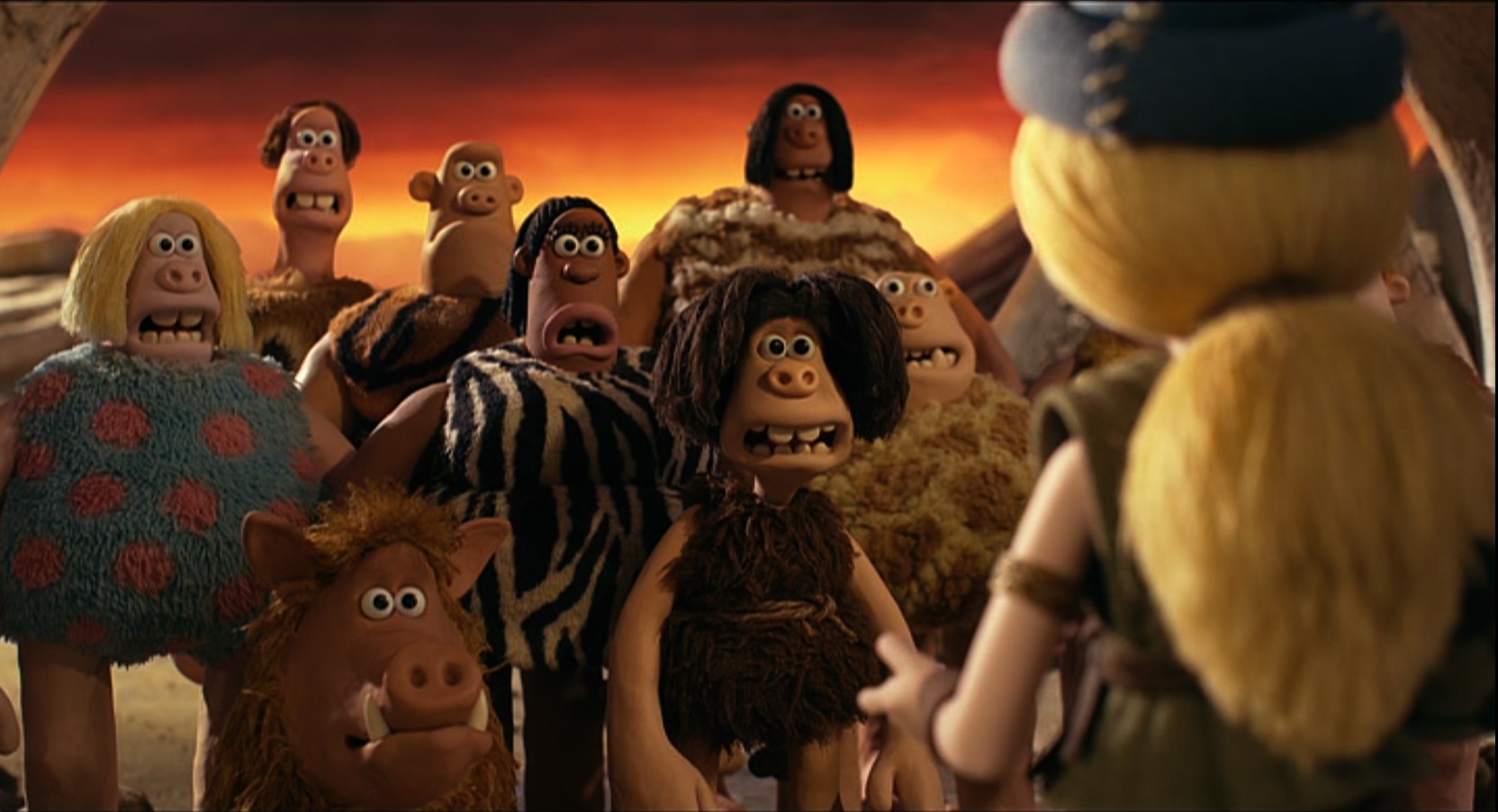
In ‘Early Man’ some cavemen have to play a soccer match to save their village from oblivion. ‘Early Man’ was Aardman’s seventh feature film, and the fifth using the studio’s trademark Claymation, but when compared to the wonderful movies ‘Wallace & Gromit: The Curse of the Were-Rabbit’ (2005) or ‘Shaun the Sheep Movie’ (2015) ‘Early Man’ is frustratingly lackluster.
Sure, the film is wonderfully made, and clearly with a lot of love, and has the charm of fingerprints being visible on the clay puppets. Moreover, by now, the Aardman studio clearly makes its animation style look easy. Then there are the typical Aardman quirks, like the way replays are shown, or some funny side remarks, the best of which is “Sliced bread? That’s the best thing since… well, ever!”. I particularly liked the idea of the message bird, which not only repeats all that is said to him, but all the accompanying actions, as well. These little touches at times made me laugh out loud.
Unfortunately, the story is not half as good: it’s one long sum of cliches, never venturing into new or surprising story ideas, making the film surprisingly dull. Especially, the football match ticks all the familiar boxes of the sports film, and there are team effort scenes and unconventional training scheme scenes as we had seen already a thousand times, most recently in ‘Kung Fu Panda 3’ (2016) and ‘Cars 3’ (2017), which were both also frustrating affairs story-wise. The characters, too, are in no sense original, and feel emblematical, instead of rounded. Even the main hero Dug is appallingly onedimensional.
As said, ‘Early Man’ especially follows the sports film trope of the underdog winning against all odds but it does so in the laziest way. For example, at one point Goona makes clear to the cavemen that they may have a chance because they can be a team while their opponents are just a bunch of individuals. Now, there’s a chance to make the cavemen’s win believable. And what is done with this idea? Absolutely nothing. As soon as the real match starts, the so-called big difference between the behavior of the star players and the cavemen team on the field disappears. It’s disheartening to watch this saving element being left unused.
The world-building, too, leaves a lot to be desired. ‘Early Man’ doesn’t really play in the stone age, or the bronze age, or whatever. It is set in some fantasy sword-and-sorcery world with bare rocks and active volcanoes. Even the time period of the prologue makes no sense, set in the non-existing ‘Neo-Pleistocene’ and showing us cavemen living next to dinosaurs (in a nice little nod to Willis O’Brien, although the two creatures were apparently called Ray and Harry after that other great stop motion monster animator, Ray Harryhausen).
By the time the main story starts, the dinosaurs have disappeared, but some Flintstones-like gags remain, like little crocodiles as clothespins and a beetle as an electric razor. But then the studio adds some creatures that in no world make any sense whatsoever, like a giant woodlouse, a giant spider, a giant duck with teeth and some giant caterpillars. With these the film makers lost all consistency and believability of a world that was rather shaky to start with.
For example, the only green spot in this world is where ages ago a meteorite struck, but it’s in this world the cavemen live. How the other people survived in the highly hostile environment of the rest of the planet remains an utter mystery. It doesn’t help that most of this world is rendered in the ugliest and laziest computer animation, which contrasts greatly with the fine Claymation.
It seems the film makers too much wanted to make a football (soccer) movie, and got blind for the film’s flaws, which are instantly recognizable to any viewer. Instead, they should have thought things over, both about their story and their world, because the final film is a formulaic drag, and, not surprisingly, became a box office bomb.
Watch the trailer for ‘Early Man’ yourself and tell me what you think:
Director: Ivan Ivanov-Vano
Release date: 1969
Rating: ★★½
Review:

‘Seasons’ is a very poetic stop-motion film set to music by Pyotr Ilyich Tchaikovsky.
The film tells about two lovers through the seasons, although we see mostly images of autumn (the two riding together through a forest) and winter (a lengthy sleigh ride), with summer being reduced to a reminiscence of happier times, and spring hardly identifiable, at all.
The film is directed by Ivan Ivanov-Vano, but co-directed by Yuri Norstein, and already contains several elements of the later director’s mature style: the stop-motion is close to cut-out animation, there are plenty multi-plane effects, and the filming of the images has a soft, poetic edge to it. The designs are extraordinary beautiful, especially that of the crystalline forest, but as practically nothing happens during the entire film, the result is as enchanting as it is boring.
Watch ‘Seasons’ yourself and tell me what you think:
‘Seasons’ is available on the DVD ‘Masters of Russian Animation Volume 2’
Director: Carlo Vogele
Release date: June 4, 2012
Rating: ★★★
Review:

A fish sings his last aria with the voice of Enrico Caruso, in a 1904 recording of the sad aria ‘una furtiva lagrima’ from Gaetano Donizetti’s opera ‘L’Elisir d’amore’. We see the fish at the fish market and on the way to his last destination: the frying pan, singing all the time.
The film is very well made and blends stop-motion with live action quite effortlessly (even though at one point some threads are visible). Unfortunately, this is a one idea film, with nothing surprising happening in the few minutes the short lasts.
Watch ‘Una furtiva lagrima’ yourself and tell me what you think:
‘Una furtiva lagrima’ is available on the The Animation Show of Shows Box Set 7
Director: Jan Švankmajer
Release Date: August 1996
Rating: ★★★½
Review:
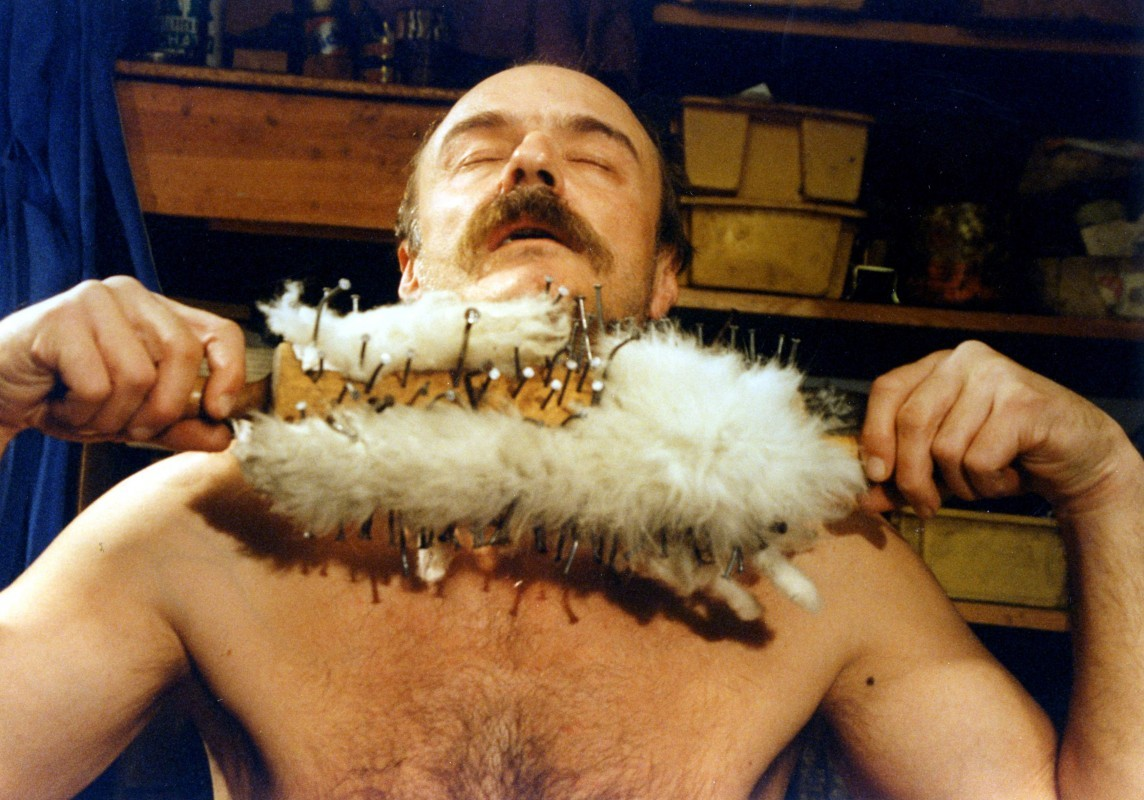
Although the move from animation to live action clearly was a gradual one (after all, ‘Alice‘ contained quite a bit of live action, while ‘Faust‘ was a live action film augmented with puppetry and animation), ‘Spiklenci slasti’ (Conspirators of Pleasure) can be regarded Jan Švankmajer’s first non-animated film, even if it stills contains a few bits of stop-motion and pixilation.
The change of technique doesn’t mean a change of style, however. The film is 100% Švankmajer throughout, with its complete lack of dialogue, its sound design (which is very reminiscent of that of animated films, indeed, with its emphatic sounds – we even hear the nonexistent sound of blinking of eyes), its idiosyncratic use of music (each individual has his/her own accompanying piece of music), its extreme close-ups, its sets of old buildings in a state of decay, and of course, a high dose of surrealism.
‘Spiklenci slasti (Conspirators of Pleasure)’ is an erotic film without sex. The titles are shown on a background of 18th century pornography, but the movie itself contains very little nudity, which is male only.
Main protagonist of the film is an unnamed bearded bachelor (played by Petr Meissel and identified as Mr. Pivoňka by Švankmajer). The film starts with him buying a sex magazine, but soon the magazine makes way for far more disturbing and puzzling acts of pleasure, involving a cupboard and a chicken. Mr. Pivoňka’s antics are interlaced with that of a postwoman, a mustached man, his lonely and abandoned wife, who’s a newsreader (Anna Wetlinská, who really was a newsreader), and the shop owner from the first scene, who’s secretly in love with Anna Wetlinská, and who builds an elaborate contraption around the television set she appears on.
The first 45 minutes are one big build-up to the pleasure acts themselves, and this is the most satisfying part of the film, because Švankmajer keeps the viewer puzzled where all the efforts of these people go to. Unfortunately, the acts of pleasure themselves are less compelling, as they’re not necessarily perverse as well as weird, and maybe this section is a bit overlong.
The shopkeeper’s machine is the absolute highlight, but the postwoman’s actions are absolutely grotesque, and that of Mr. Pivoňka and his neighbor, Mrs. Loubalová, sadomachistic, very violent and even morbid. Their acts involve the most animation, as their acts involve animated stuff dolls coming to life. But by now one could argue that the animation is more of a special effect than an element of style, although the pixilation still is used as a mean of surrealist story telling.
As the film comes to a finale, the boundary between reality and fantasy gets crossed. Anna Wetlinská seemingly takes over the shopkeeper’s machine, and comes to a climax herself. In the end the people’s fetishes get mixed, while Mr. Pivoňka’s mysterious ritual appears to have severe real life consequences indeed…
Nevertheless, one would like to know more about the postwoman and her incomprehensible rituals, as she seems to be some kind of facilitator of the desires of others. Also Anna Wetlinská’s bad marriage deserved a little bit more attention.
‘Conspirators of Pleasure’ is a very original and entertaining movie, but the film remains on the shallow side and lacks the layered surrealism of ‘Alice’ or ‘Faust’.
Watch the trailer for ‘Conspirators of Pleasure’ yourself and tell me what you think:
‘Conspirators of Pleasure’ is available on Blu-Ray and DVD
Director: Henry Selick
Release Date: April 12, 1996
Rating: ★★★½
Review:

Based on the children’s book by Roald Dahl from 1961 ‘James and the Giant Peach’ is, in fact, a hybrid, starting and ending as a live action movie, with the middle forty minutes (ca. half the movie) being done entirely in stop-motion.
The opening scenes set ‘James and the Giant Peach’ as one of the great fantasy films of the nineties. The sets and atmosphere are magical and dreamlike, with no attempt at reality. James’s horrific aunts, too, are grotesque and deeply rooted in caricature. They are excellently played by British actresses Miriam Margolyes and Joanna Lumley, who are allowed to play their personas as broadly as possible. Young James, in contrast, remains perfectly normal, and Paul Terry’s performance is on the brink of boring.
Despite the great opening scenes, the real fun starts when James descends into the giant peach. During this scene he transforms into his puppet self, and inside he meets a sextet of giant ‘insects’ (in fact, three of them are insects, the others being a myriapod, an arachnid and an annelid), with whom he decides to fly to New York, cleverly using sea gulls to propel the peach into the air.
Except for the all too bland glowworm, the arthropods are delightful characters: there is a very American sounding boastful and bragging centipede (Richard Dreyfuss), a motherly ladybug (Jane Leeves), an aristocratic and knowledgeable grasshopper (Simon Callow), an anxious and gloomy earth worm (David Thewlis), and a femme fatale-like but friendly French female spider (Susan Sarandon). The design of these is less eccentric than that of the protagonists in ‘The Nightmare Before Christmas’, but still have some freaky touches, most notably Miss. Spider’s eyes, which each consist of two yellow eyeballs. Moreover, they all have the correct number of legs, with Miss Spider’s eight legs all ending in elegant boots. The animation, too, retains some creepy-crawly quality, and Miss Spider remains a little scary, despite her friendliness.
The voice cast is excellent, and most of the humor originates from the interplay between these characters, but there is plenty of action anyway, with the bugs having to battle a mechanical shark, defend themselves against a ghost ship, and fight starvation.
Unfortunately, after 59 minutes we return to live action, when James and his friends land in New York. True, this New York remains a fantasy-product, with very stagy and crooked sets, but lasting a staggering 30 minutes this finale turns out to be overlong and weak. It does not really help that the film makers decide to make the aunts survive the crushing of their car and to follow James into New York, an idea not in the book. Believability is certainly breached in these scenes, because of the fake character of the sets, some wooden action of the crowds, and the strange interplay between the grotesque aunts and the more down-played Americans. Moreover, the insects are mostly absent from these scenes, which only show that young actor Paul Terry cannot carry these scenes on his own, which seem to drag without inspiration.
Another letdown of this film are the four songs by Randy Newman. All four are weak and forgettable. Even worse, they are clearly superfluous, and they threaten to stall the action instead of helping the story forward. Luckily, there are only four of them, making ‘James and the Giant Peach’ much more tolerable as a film than ‘The Nightmare Before Christmas’ was, but nevertheless I regard this film yet another victim of the unwritten rule that every animation film should be a musical, which was prevalent in the 1980s and 1990s.
The overlong finale and unwelcome songs prevent ‘James and the Giant Peach’ to become an all-time classic, and certainly it was not well received back then, becoming a box office bomb. With this the short Disney adventure into stop motion ended. This is pity because the stop motion animation is excellent and delightful to watch throughout.
There is also a fair deal of computer animation, surprisingly executed by Sony Pictures Image works, who did an excellent job on the rhinoceros, some dancing clouds, and the mechanical shark. The latter, especially, is a great piece of computer animation, as it blends surprisingly well with the stop-motion and never loses its fantastical character.
Disney thus may have stopped making stop motion films, but both Tim Burton and Henry Selick continued to follow this path, with Tim Burton making ‘Corpse Bride’ in 2005 and ‘Frankenweenie’ (again for Disney) in 2012, while Henry Selick joined Will Vinton’s LAIKA studio in 2005 to make the widely acclaimed ‘Coraline’ (2009).
Watch the trailer for ‘James and the Giant Peach’ yourself and tell me what you think:
‘James and the Giant Peach’ is available on Blu-Ray and DVD
Director: Steve Box
Release Date: November 9, 1997
Rating: ★★
Review:

‘Steve Box had joined Aardman in 1992 and was one of the animators on ‘The Wrong Trousers‘ (1993) and ‘A Close Shave‘ (1996).
‘Stage Fright’, his own short, is a short melodrama about a shy ‘dog juggler’ who is bullied by a mean silent cinema actor. The film uses designs reminiscent of the Wallace and Gromit films, excellent stop motion animation, and some atmospheric lighting, but it immediately becomes clear that Steve Box is no Nick Park.
Box’s way of non-linear story telling is confusing and heavy-handed. Because they’re not introduced properly we don’t care about the characters one bit. Worse, throughout the film the relationship between the three characters remains sketchy and trite. Add way too much dialogue, and the result is as disappointing as it is boring. The only interesting part is Box’s emulation of silent cinema using his clay characters.
Watch ‘Stage Fright’ yourself and tell me what you think:
‘Stage Fright’ is available on the DVD ‘Aardman Classics’
Director: Sam Fell
Release Date: 1996
Rating: ★
Review:
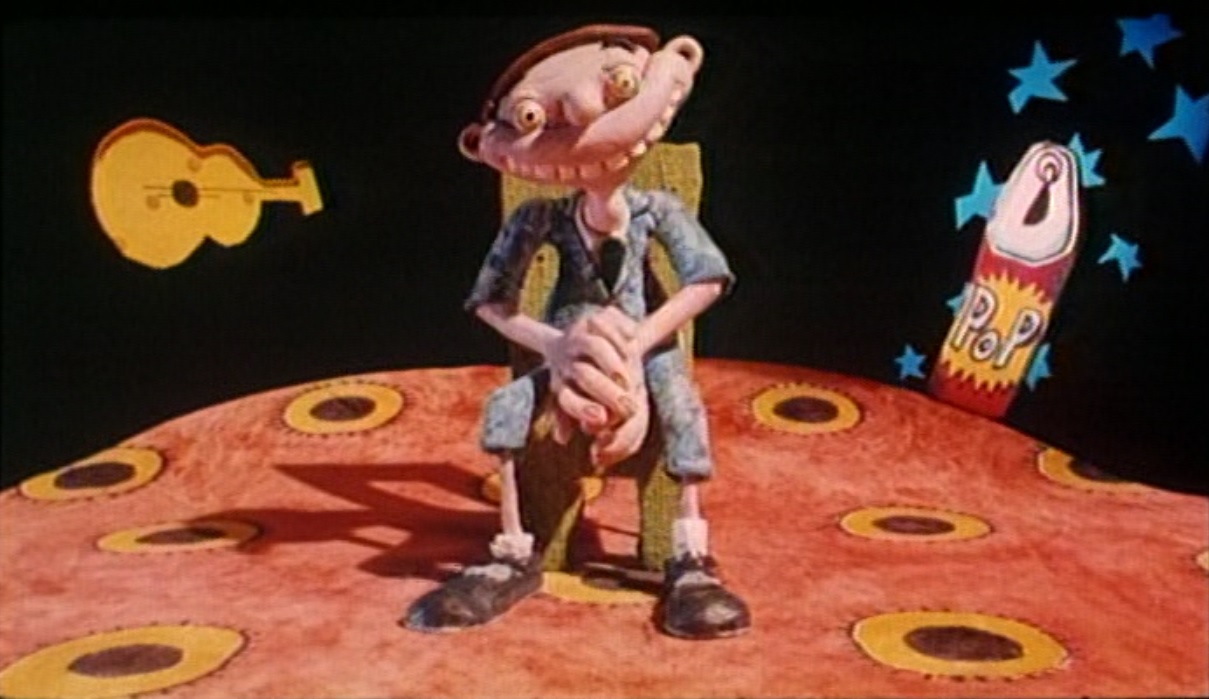
While Aardman produced masterpieces of stop motion like ‘The Wrong Trousers‘ (1993) and ‘A Close Shave‘ (1996), the studio also funded much smaller works by independent artists at their studio.
‘Pop’ is one of those. In this short a young man opens a can of soda, which makes his head explode. His goldfish (which has the same face as the young man) replaces him.
‘Pop’ makes no sense whatsoever, and is as ugly as it is unfunny. It feels like an amateurish student project and it probably wouldn’t have been on DVD if it were not an Aardman production. Unfortunately, it may have been the worst, but certainly not the only mediocre product by Aardman of the time , for subsequent films from the nineties like ‘Stage Fright, ‘Owzat‘, ‘Al Dente‘ and ‘Minotaur & Little Nerkin‘ are all very weak. The only exception is the hilarious ‘Humdrum’ from 1998.
Watch ‘Pop’ yourself and tell me what you think:
‘Pop’ is available on the DVD ‘Aardman Classics’
Director: Peter Lord
Release Date: April 10, 1996
Rating: ★★
Review:
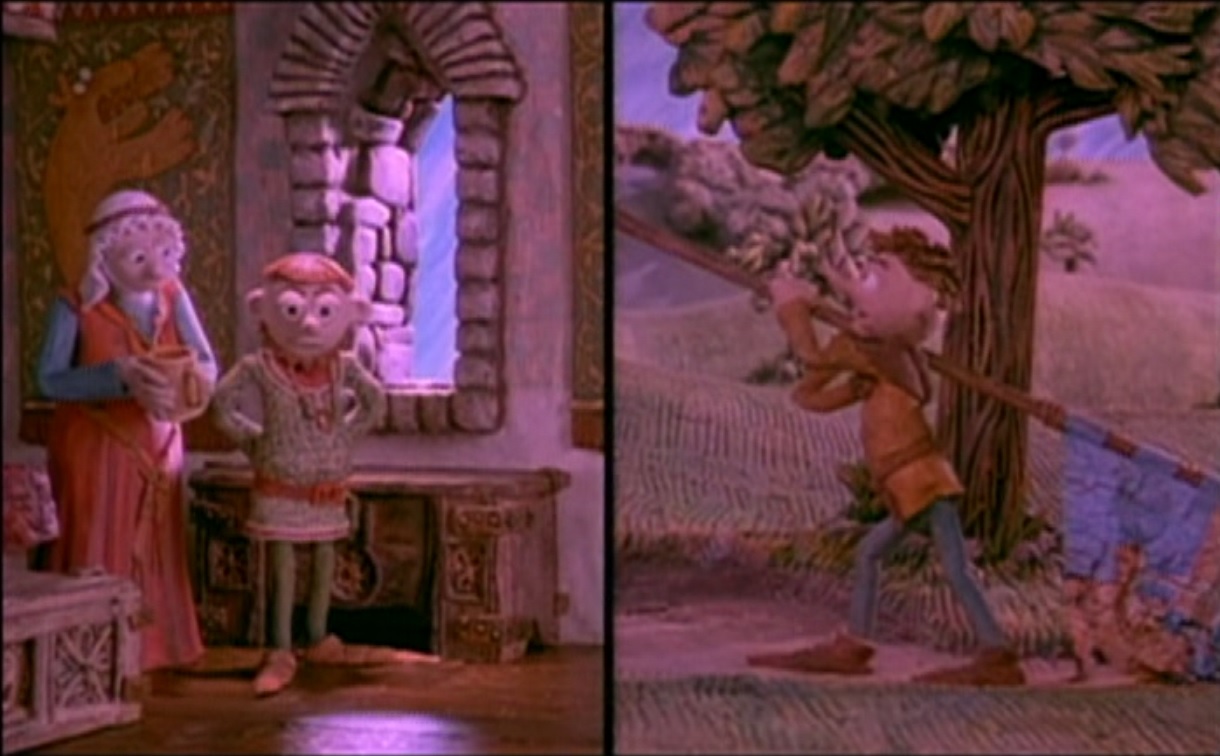
Aardman founder Peter Lord penned and directed this medieval story for children about two royal twin brothers who get separated. One remains royal, the other becomes an ordinary peasant. But when their country is threatened by an enemy, the tables are turned, or not?
This film features silent comedy, with very little dialogue (only ‘me?’ and ‘hello?’ are uttered). More interesting is the returning use of a split screen. The animation and sets are both of a high quality, but Lord’s story is as rambling as it is boring, and completely fails to fulfil its promise. The film ends rather sudden and inconclusive, leaving us with Andy Price’s attractive quasi-medieval music. In fact, I’m surprised the film even got an Academy Award nomination.
Watch ‘Wat’s Pig’ yourself and tell me what you think:
‘Wat’s Pig’ is available on the DVD ‘Aardman Classics’
Director: Peter Peake
Release Date: January 7, 1995
Rating: ★★½
Review:

‘Pib and Pog’ starts off as a typical cartoon for preschoolers. It stars two clay characters wearing shoes with flowers on them in a white set with only two props.
The two only make unintelligible sounds, but interact with the voice over (Ionna Wake), who retains an upbeat preschool attitude until the very end of the cartoon. But her remarks get more and more at odds with the visuals. For when Pib craves a shell that Pog apparently has found on the beach, a startlingly violent struggle between the two characters evolves, including the use of a gun, chloric acid and a cannon.
Meanwhile the voice over keeps on blabbering in a childish manner, neglecting the violence on the screen for what it is. ‘Pib & Pog’ thus is disturbing, and it seems to say something about cartoon violence in general, but funny it is not, and the short is further hampered by its very trite ending. Nevertheless, in 2006 the film would sprout five sequels. Earlier, in 1998 director Peter Peake would make a much better and certainly hilarious little film called ‘Humdrum’, which is much more recommended.
Watch ‘Pib and Pog’ yourself and tell me what you think:
‘Pib and Pog’ is available on the DVD ‘Aardman Classics’
Director: Tyron Montgomery
Release Date: April 1996
Rating: ★★½
Review:
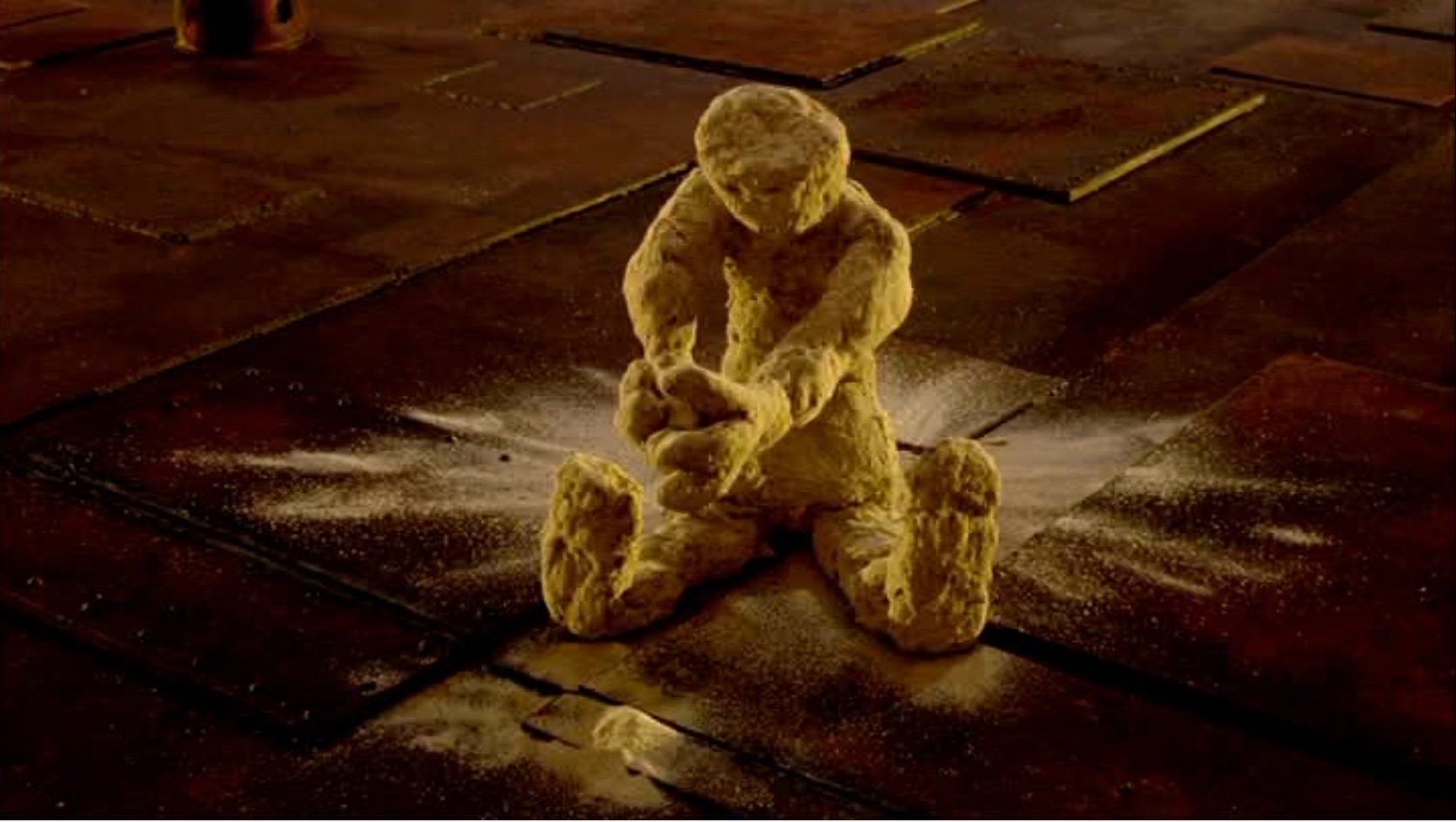
A sand man lies in the desert with his water bottle, empty. When he hears the sound of water he starts digging and before soon falls into another world…
Made by Tyron Montgomery (direction, photography & screenplay) and Thomas Stellmach (production, animation & story) at the University of Kassel, Germany, ‘Quest’ is a gloomy stop-motion film, depicting worlds of sand, paper, stone and metal. Especially the metal world is well-done, both frightening and fascinating.
There are some comic elements in the acting of the sand man, but the film is neither as funny nor as disturbing as it could be. Part of the problem is the mediocre acting: the sand man’s feelings and thoughts are acted out schematically, more like Fritz the Cat than like post-Disney character animation.
‘Quest’ certainly is interesting, and a very accomplished film for a student film, but in the end Montgomery’s and Stellmach’s tale is too shallow to become a real classic. But that’s only my opinion, because this German short won many prizes, including the Academy Award for best animated short in 1997.
Watch ‘Quest’ yourself and tell me what you think:
‘Quest’ is available on the The Animation Show of Shows Box Set 5
Directors: Sam Fell & Chris Butler
Release Date: August 3, 2012
Rating: ★★★★★
Review:

Laika’s ‘ParaNorman’ is the first of no less than three horror-themed American animated features released in 2012. It was followed in September by Disney’s ‘Frankenweenie’ and Sony’s ‘Hotel Transylvania’. For the Laika Studios this was familiar terrain, as both the earlier ‘Corpse Bride’ (2005) and ‘Coraline’ (2009) had been horror themed.
For a while the studio even seemed to be a sort of one-trick pony in that respect (but this notion was ultimately defied by the very different ‘Kubo and the Two Strings’ from 2016 and especially the surprisingly colorful ‘Missing Link’ from 2019).
‘ParaNorman’ plays with horror tropes from the start, beginning with opening credits, rendered in a 1950s horror movie style. And in the first scene we see Norman watching a cheap horror movie on television. We soon learn that Norman shares an ability with Cole from ‘The Sixth Sense’ (1999): he can see dead people. Perhaps this ability explains the boy’s preoccupation with horror and science fiction, which is exemplified by ca. all objects in his room.
But then we learn that the fictional Massachusetts town in which he lives, Blithe Hollow (a clear reference to ‘Sleepy Hollow’ of the early horror story by Washington Irving), has its own preoccupation with witchcraft. Its city slogan is ‘a great place to hang’ and features a stunningly morbid picture of a witch hanging from a gallows pole. It’s this hanging of a witch and the witch’s curse that becomes central to the film’s story.
The film is very well-told and pleasantly concise, taking place over a period of only two days. As soon as some zombies appear that everybody can see the film becomes a rollercoaster ride that remains exciting to the very end. A deadline (no pun intended) adds to the suspense. The only dud is a rather forced break-up scene around 55 minutes of a type that seemed to be almost obligatory in animated studio cinema of the time (see e.g., ‘Up’ from 2009, ‘The Pirates! In an Adventure with Scientists!’ from 2012 or ‘The Secret Life of Pets’ from 2016).
There’s some pretty morbid humor involved (e.g., when Norman tries to retrieve a book from his dead uncle), but the film makers manage to keep the horror light to permeate every scary scene with some goofiness. But the witch is genuinely scary, with help of added computer animation. Despite the horror and the excitement, the film’s message is surprisingly profound and mature, and its finale very moving. It’s very refreshing to watch the whole distinction between good and bad, between heroes and villains, being quite blurred in this movie.
‘ParaNorman’ is by all means a film made at the highest artistic level. The art, the handicraft, the animation, the cinematography – they’re all extremely virtuoso, and awe-inspiring. Most importantly ‘ParaNorman’ can boast the most original art design we’ve seen in ages in an American animated studio feature. Especially Heidi Smith’s character design should be mentioned. The puppets have a very distinct and surprisingly asymmetrical design that is both daring and refreshing, but still communicating and appealing. Especially stunning are the lips, with have a certain watery gloss, and the ears, which are a little translucent, just like real lips and ears. The sets and props, too, are angular and crooked, and are the perfect backgrounds for the idiosyncratic dolls to move in. Especially the family’s car is a delight to watch in that respect. And I’d like to add that even the end credits are very appealing.
‘ParaNorman’ is not the best animated feature of 2012, that distinction must go to Don Hertzfeldt’s ‘It’s Such a Beautiful Day’, but of all American studio productions the film is certainly the most satisfying, and must be counted among Laika’s best works, together with ‘Coraline’ (2009) and ‘Missing Link’ (2019).
Watch the trailer for ‘ParaNorman’ yourself and tell me what you think:
‘ParaNorman’ is available on Blu-Ray and DVD
Director: Tim Burton
Release Date: September 20, 2012
Rating: ★★★½
Review:

‘Frankenweenie’ was the third horror-themed animated feature of 2012, after ’ParaNorman’ and ’Hotel Transylvania’. Based on a short live action film director Tim Burton made way back in 1984 when still working at Disney, Again made at Disney, the new ‘Frankenweenie’ is obviously an ode to classic horror cinema, and to ‘Frankenstein’ from 1931 in particular.
Indeed, the references to other films are all over the place, and as horror is not my specialty, I’m sure I have not nearly caught half of them. It already starts with the town’s name, ‘New Holland’, which is a direct reference to the Dutch settlement in which Irving Washington’s tale of horror ‘The Legend of Sleepy Hollow’ (1820) takes place.
Main protagonist Victor’s surname is Frankenstein. His eccentric science teacher takes after horror actor Vincent Price, while Edgar, one of his school mates, looks like the hunchbacked Fritz in ‘Frankenstein’. Another school mate looks like a mix between Buster Keaton and the monster of Frankenstein, and so on and so forth. In the finale Burton even throws references to 1950s movie monsters into the mix, unfortunately diluting the theme on the way.
In any case ‘Frankenweenie’ suffers from a lack of focus. Not only can’t Burton stick to the Frankenstein theme, but his film is also stuffed with ideas that lead nowhere. For example, there’s an evil neighbor, whose role is hardly played out. He lives up to a festival day called ‘Dutch Day’, but again very little is done with the concept. This neighbor guards one Elsa van Helsing (yes, there’s another reference), a probable love interest to Victor, but this story idea isn’t developed beyond conception. Then there’s the father who worries Victor becomes too weird – and again, this story idea is only used to get the story at the point at which Victor can revive his deceased dog, after which this subplot never returns.
There’s a particularly large number of villains in this film: the neighbor is evil, Edgar is evil, Toshiaki (yet another of Victor’s schoolmates) is evil, but like the other story elements their particular stories are touched, not played out. We mostly learn that reviving animals apparently is deadly easy. Best of the oddball characters that fill the film is a wide-eyed girl with a cat that prophecies in its poo.
Tim Burton certainly has indulged in stuffing his film with references, but what he wanted to tell with his story is less clear. There’s even a completely idiotic message (voiced by Victor’s science teacher) that science can only succeed when you put your heart into it. Really?! If you’d believe this, you’d believe science is more like magic than a method.
Despite the weak story, the film’s finale consists of twenty minutes of pure action and excitement, ending in a burning windmill (yes, echoing ‘Frankenstein’). This sequence is full of stunning cinematography and complex sets. There’s even a moment of real horror, including a scare moment. Unfortunately, after the action sequence the films ends forced and cliché with e.g., an applauding crowd, missing an opportunity for a more intelligent and daring ending.
It’s a shame ‘Frankenweenie’ doesn’t deliver story-wise, for the film’s looks are a delight. In design ‘Frankenweenie’ is clearly the successor of Burton’s earlier and similarly horror-themed stop-motion films, ‘The Nightmare Before Christmas’ (1993) and, more obviously, ‘Corpse Bride’ (2005). Like in those earlier films, the puppets are top-heavy, with long slender limbs. But unlike these two earlier films, ‘Frankenweenie’ is no musical, and Burton made the bold move to film this movie in black and white, enhancing the classic feel. The cinematography is at times no less than marvelous, like in the reviving scene, or the scenes at the graveyard.
The animation is fine, but sometimes on the bland side, especially on Victor’s parents and secondary characters, whose expressions are too often rather empty gazes. Moreover, nowhere do the animators manage to blow genuine feelings into the puppets (most of the characters are just weird anyway), and the film lacks proper emotion, even in its most desperate scenes.
‘Frankenweenie’ is not a bad film, it’s too well crafted for that, but when compared to Burton’s earlier movie ‘Corpse Bride’ or to Laika’s contemporary and comparable ‘ParaNorman’ it just falls short on its potential. Especially ‘ParaNorman’ does well what ‘Frankenweenie’ does not: staying focused, spinning a tale with a clear message, building characters you care for, and giving the film a surprising twist. At least we should be thankful that 2012 brought us no less than two stop motion features, keeping the old technique alive and kicking in a sea of computer animation.
Watch the trailer for Frankenweenie’ yourself and tell me what you think:
’Frankenweenie’ is available on Blu-Ray and DVD
Director: Joel Simon
Release Date: July 5, 2012
Rating: ★★★★
Review:

‘Macropolis’ was commissioned by the ‘Unlimited Programme’, part of the London 2012 Cultural Olympiad, and dedicated to deaf and disabled arts and culture.
The short stars a toy cat, who’s rejected from the factory because he’s only got one eye. He teams up with a little toy dog with only one leg. The cat gives the dog a leg prosthesis, the dog gives the cat an eye patch and together they try to catch the truck which delivers all the other toys to the toy store.
‘Macropolis’ is a gentle little film which succeeds in moving the audience without any dialogue. The stop motion is mixed with pixillation and live action, and filmed partly outdoors. A nice touch is that the film makers don’t hide the fact that stop motion takes a lot of time, and the background is buzzing with movement as the two little animals wander the streets.
Watch ‘Macropolis’ yourself and tell me what you think:
‘Macropolis’ is available on the Belgian DVD ‘Haas & Hert en andere verhaaltjes’


 Dr. Grob's Animation Review