You are currently browsing the category archive for the ‘Stop motion films’ category.
Director: Jan Švankmajer
Release Date: 1989
Rating: ★★★★
Review:
 ‘Flora’ is an ultra-short film made for MTV. It only lasts 30 seconds.
In it we watch a woman who’s tied down to a hospital bed. She apparently consists partly of vegetables, which are quickly rotting away, as if life is leaving her by the seconds. There’s a relieving glass of water nearby, but out of her reach. This is a puzzling and rather unsettling image, which knows no release.
Flora was the Roman goddess of flowers, and her features resemble that of a Giuseppe Arcimboldo-character, another homage by Švankmajer to the Renaissance-master, after ‘Dimensions of Dialogue‘ (1982). But how did the goddess come into this setting of utter distress? Watching her decaying alive is painful, even within this short time-frame.
Watch ‘Flora’ yourself and tell me what you think:
‘Flora’ is available on the DVD ‘Jan Svankmajer – The Complete Short Films’
Director: Jan Švankmajer
Release Date: 1989
Rating: ★★★★★
Review:
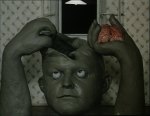 In ‘Darkness Light Darkness’ we watch several body parts entering a small room in order to assemble a complete man.
Together with ‘The Death of Stalinism in Bohemia’ (1990), ‘Darkness Light Darkness’ is Švankmajer’s last classic animated short film before he embarked on a career of directing features, which featured less and less animation.
‘Darkness Light Darkness’ is on the same level of virtuosity as ‘Dimensions of Dialogue‘ (1982): its stop motion animation, by star animator Bedřich Glaser, and its sound design, by Ivo Špalj, are both no less than perfect. However, it’s much lighter of tone than the earlier film. In this short film Švankmajer and Bedřich Glaser use a particularly cartoony type of animation. For example, the entry of the genitalia is a hilarious highlight.
Nevertheless, even this film has a darker side: when the man is complete, he completely fills the room, which is way too small for him. We hear him breathing heavily, and can assume he his in great pain in his cramped position. The cartoon ends with this claustrophobic image before darkness enters again. So, somehow, even this enjoyable film tells something about the human condition, how during our lifetimes we can develop ourselves only to end in the eternal dark again…
Because of its unity of space and time, and because of its unique inner logic, ‘Darkness Light Darkness’ is one of the best told animated shorts ever. It shows Švankmajer’s mastery. In that respect it’s unfortunate that in the 1990s he moved on to live action films.
Watch ‘Darkness Light Darkness’ yourself and tell me what you think:
‘Darkness Light Darkness’ is available on the DVD ‘Jan Svankmajer – The Complete Short Films’ and on the DVD ‘Alice’
Director: Jan Švankmajer
Release Date: September 1988
Rating: ★★★★
Review:
 ‘Another Kind of Love’ is a beautiful result of the glory days of MTV: A video clip by Jan Švankmajer!
Švankmajer treats Hugh Cornwell’s charming if rather forgettable song in his own typical way: the setting is one windowless room, he films the ex-Stranglers singer’s mouth a lot in close-up, there are objects with tongues (in this case singing shoes) and there’s a beautiful clay woman, who shares features with the woman in ‘Dimensions of Dialogue‘ (1982), apparently because the same template has been used.
Highlights form the deformations of the singer’s head, whose features have been reproduced very well in the clay model, and the clip’s finale, in which the woman emerges from the wall to embrace the singer, and drawing him into the wall, leaving the room empty.
Watch ‘Another Kind of Love’ yourself and tell me what you think:
‘Another Kind of Love’ is available on the DVD ‘Jan Svankmajer – The Complete Short Films’
Director: Jan Švankmajer
Release Date: 1988
Rating: ★★★★½
Review:
 Švankmajer’s films in the communist years preceding the velvet revolution of 1989 show a lighter tone than his earlier films. It’s like one can breath some of the thawing atmosphere in Czechoslovakia during the Perestroika years.
‘Virile games’ is a typical example. Although the film contains some very graphic violence, the film remains a rather cartoony atmosphere, and its end is rather tongue-in-cheek.
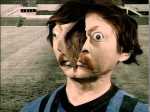
In ‘Virile Games’ we follow a mustached man watching a football match on the television. It’s a very weird soccer match, however: all players have the spectator’s face, and scoring happens by killing the opponents. These killings occur in the most bizarre ways, all deforming the opponent’s head till the player drops dead. One opponent for example is killed with cake forms, another by toy train….
In the second half the football match moves to the spectator’s own home, and the killing continues with the man’s own kitchen tools. However, tied to his screen, the man keeps watching the television set, not noticing that the violence occurs just around him.
In this film Švankmajer blends live action, stop motion, rather Terry Gilliam-like cut-out animation and pixilation with the stunning self-assurance of a mature film maker. Especially the clay-animation is top-notch. Like Georges Schwizgebel’s ‘Hors-jeu‘ (1977) the film directly couples soccer to violence, a clear indication of the author’s worries about growing football hooliganism. Apart from that, the film shows the maker’s trademark ingredients, like his obsession with food.
Watch ‘Virile Games’ yourself and tell me what you think:
‘Virile Games’ is available on the DVD ‘Jan Svankmajer – The Complete Short Films’
Director: Tim Burton
Release Date: October 1, 1982
Rating: ★★★★
Review:
 ‘Vincent’ a is short film, which director Tim Burton made while still working at Disney.
The short is as typical for Tim Burton as it is atypical for Disney. First, it’s a stop-motion film, something the studio was not famous for, at all. The only other stop-motion film ever released by the studio was ‘Noah’s Ark‘ from 1959. Second, the film is in black and white, and third, it has a genuine horror theme, miles away from the child friendly worlds of contemporary Disney films, like ‘The Fox and the Hound‘ (1981) or ‘Mickey’s Christmas Carol‘ (1983).
The film uses the deep voice of classic horror star Vincent Price to tell the story of Vincent in rather Dr. Seuss-like rhyme. Vincent is a little seven year old boy, who wants to be like, well… Vincent Price. Because his mind has become twisted by reading stories by Edgar Allen Poe, Vincent imagines himself a madman haunted by his deceased wife, and locked in by a cursed house. In the end his imagination runs haywire, taking hold of him.
Burton does an excellent job mixing horror with silliness. The result is a rather twisted version of ‘Gerald McBoingBoing’ – equally weird, equally expressionistic, but much darker. In ‘Vincent’ you find much of the Tim Burton to come. It’s not hard to see the link between this wonderful short and ‘The Nightmare Before Christmas‘ (1993), ‘Corpse Bride‘ (2005) or with his live action films like ‘Beetlejuice’ (1988) or ‘Sleepy Hollow’ (1999).
Interestingly, in the same year, Vincent Price would also lend his voice to the Michael Jackson song ‘Thriller’.
Watch ‘Vincent’ yourself and tell me what you think:
Director: Jan Švankmajer
Release Date: 1983
Rating: ★★★★★
Review:
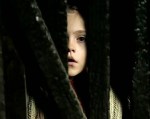 In ‘Down to the Cellar’ Jan Švankmajer explores the fears of a child.
The film’s story is pretty straightforward: we watch a little girl (engagingly played by young Monika Belo-Cabanová) descending the stairs. She has to fetch some potatoes in a deep, dark cellar. However, her task will not be an easy one. Already her way down the stairs to the cellar is frightening, when she’s hindered by two adults who regard her all too knowlingly.
In the cellar, the girl sees strange things happening, like old shoes fighting over her croissant, and a cat growing to gigantic proportions. Even the potatoes won’t cooperate, rolling back into the case she picked them from. Worse, the cellar appears to be inhabited by the same two adults, who perform strange rites for her very eyes. Their invitations to the girl are dubious, and luckily the girl declines. Unfortunately, at the end of the short, she has to face her fears, once again.
‘Down to the Cellar’ contains a hard to define, but strong and disturbing threat of child abuse. The short is mostly shot in live action, and contains only a little stop motion animation. However, it’s arguably Švankmajer’s most moving film. Švankmajer keeps the child’s perspective throughout the movie, and we immediately sympathize with the little girl and her plight, sharing her state of wonder, fear and despair.
Švankmajer would explore the film’s theme again in his fourth feature film, ‘Otesánek’ (2000).
Watch ‘Down the Cellar’ yourself and tell me what you think:
https://vk.com/video5061134_164400011
‘Down the Cellar’ is available on the DVD ‘Jan Svankmajer – The Complete Short Films’
Director: Jan Švankmajer
Release Date: 1982
Rating: ★★★★★ ♕
Review:
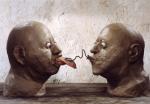 Together with ‘Jabberwocky‘ (1971), ‘Dimensions of a Dialogue’ can be considered Švankmajer’s masterpiece. It mixes excellent design with virtuoso animation and astonishingly original story material.
With ‘Dimensions of a Dialogue’ Švankmajer defined a style he would maintain into the early 1990s, resulting in most of his best films, including the feature lengths ‘Alice‘ (1987) and ‘Faust‘ (1994). ‘Dimensions of a Dialogue’ contains three different ‘dialogues’, without using any real dialogue in the soundtrack. These three dialogues are pure visual encounters, making this film very universal.
Like in all his films, Švankmajer’s visual language is highly surreal. Yet, the three dialogues follow their own inescapable inner logic, with disturbing results. The film does not as much feature dialogue as well as rather violent clashes. It seems to show the inability of humans to communicate.
The first, ‘Factual dialogue’, is the most violent of the three episodes. It shows three heads moving in a 2-dimensional space. The three heads are clearly inspired by renaissance painter Giuseppe Arcimboldo and consist of food, household tools and office equipment, respectively. The heads devour eachother, destroying their parts more and more before spitting them out. Like ‘Et Cetera‘ (1966) there is a sense of pointlessness in this endless string of violence, which tells something about humanity.
The second part, ‘A passionate dialogue’, is the most virtuoso episode of the three. ‘In this part Švankmajer and his animating collaborator Vlasta Pospíšilová introduce a new level in claymation. The film features a stunningly realistic human couple made out of clay. The man and woman are animated beautifully when they embrace passionately, until they become one moving lump of clay of pure desire. When they part again, however, there’s some leftover: a little lump of formless clay yearning for affection. Unfortunately, neither of the two lovers accepts this petty piece of clay, and the innocent leftover brings the couple to rage. In their conflict they once again become a clay lump, but now one of utter destruction…
The third part, ‘An exhausting dialogue’, is the most comical one, and seems to portray a discussion going haywire. It features two realistic heads on a table, producing a toothbrush and toothpaste, bread and butter, a shoe and a shoelace and a pencil and a sharper in more and more absurd combinations to the exhaustion of both. The soundtrack is perfect throughout the picture, but exceptionally so in this third part in its combination of Jan Klusák’s music and train sounds.
‘Dimensions of a Dialogue’ is inexplicable, but communicates on a subconscious level, like all great surreal art. It perfectly shows the power of animation in showing the human condition using the very outskirts of imagination. The result is no less than one of best animation films ever.
Watch ‘Dimensions of Dialogue’ yourself and tell me what you think:
‘Dimensions of Dialogue’ is available on the DVD ‘Jan Svankmajer – The Complete Short Films’ and on the DVD ‘Annecy – Le coffret du 50e Anniversaire’
Director: Jan Švankmajer
Release Date: 1980
Rating: ★★
Review:
 Jan Švankmajer retells this famous story by Edgar Allen Poe using a narrating voice over and black and white images of several different objects.
The images, some of which are animated, are sometimes quite disturbing, and are at points even able to evoke the horror of the story. However, most of the time they seem totally unrelated to the narration, and their visual power in fact often distracts from the voice over, making the story very hard to follow, indeed.
‘The House of Usher’ is a daring experiment in cinematographic storytelling, but not really a successful one, and Švankmajer would not repeat it. Nevertheless, three years later, the Czech film maker would return to Edgar Allen Poe, in ‘The Pendulum, the Pit and Hope‘, with much better results.
Watch ‘The Fall of the House of Usher’ yourself and tell me what you think:
‘The Fall of the House of Usher’ is available on the DVD ‘Jan Svankmajer – The Complete Short Films’
Director: Joop Geesink?
Release Date: 1943
Rating: ★★★
Review:
 ‘Serenata nocturna‘, Marten Toonder’s and Joop Geesink’s first stop motion film, did raise interest of Philips, and the Dutch electronics company commissioned another short to advertise the Philishave, an electronic razor. This resulted in ‘Phi-garo in het woud’.
in ‘Phi-garo in het woud’ a bearded gnome tries to impress a female elf, but she rejects him. The gnome gets a shave at the local barber, but the elf still rejects him. Then a witch shows him the Philips Philishave, which does the trick.
‘Phi-Garo in het woud’ is less entertaining than ‘Serenata nocturna’, its story less logical, and its designs more generic than in the earlier cartoon. The animation, however, is a little more assured. More commissions were now to follow.
Watch ‘Phi-garo in het woud’ yourself and tell me what you think:
‘Phi-garo in het woud’ is available on the DVD inside the Dutch book ‘De Toonder Animatiefilms’
Director: Joop Geesink
Production Date: September 1942
Rating: ★★★★
Review:
 ‘Serenata nocturna’ is the first collaboration between two Dutch animation film pioneers, Marten Toonder and Joop Geesink.
The collaboration results in a charming little advertising film about a Mexican who tries to serenade his love, to no avail. He tries several instruments, without success. But then he magically produces a Philips Radio, and finally his love is impressed.
The puppet animation in this short is very reminiscent of that of George Pal, the Hungarian animator, who had an important puppet film studio in Eindhoven in the late 1930s, and who had made several films for Dutch electronics company Philips himself. Pal, however, had exchanged The Netherlands for the United Kingdom, and finally emigrated to the United States in December 1939, leaving The Netherlands without any animation studio of importance. Now, Toonder and Geesink tried to fill this gap. Perhaps, Philips would be interested to commission films from them.
However, the inexperience of both animators shows: the animation still looks primitive, with a lot of excessive movement. The short’s story, however, is funny and still entertaining today. Indeed, Philips saw potential, and would become an important commissioner to both film makers.
Toonder would soon abandon stop motion, but Geesink would continue in the field, creating one of the most successful stop motion animation studios of the post-war era.
Watch ‘Serenata nocturna’ yourself and tell me what you think:
‘Serenata nocturna’ is available on the DVD inside the Dutch book ‘De Toonder Animatiefilms’
Director: Mikhail Kamenetsky
Release Date: 1984
Rating: ★★
Review:
 Mikhail Kamenetsky (1924-2006) was a director of numerous puppet films made between 1965 to 1995, almost all featuring animals.
In his ‘Wolf and Calf’ an old wolf steals a calf to eat, but he starts to like it and raises it like his own son. In the end, when a hungry bear, a vixen and a boar try to steal his loot, he is saved by the calf itself, which has turned into a strong bull.
‘Wolf and Calf’ is a fable-like children’s film with an old-fashioned look. The designs of the protagonists look like they have come from a 1950’s toy shop. Kamenetsky’s puppet animation is elaborate, and actually quite good, if erratic, but the film suffers from an excess of dialogue, which not always seems to correspond with the animated characters themselves.
Moreover, the film’s world is rather inconsistent, stretching its believability: the wolf, like all other animals, is highly anthropomorphic and even lives in a house, alongside humans, who are afraid of him nonetheless. The calf, on the other hand, remains on all fours, and stays an animal, even though it is able to speak.
Watch ‘Wolf and Calf’ yourself and tell me what you think:
Director: Ideya Garanina
Release Date: 1981
Rating: ★★½
Review:
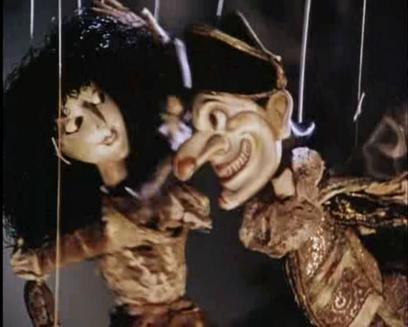 Based on plays by Federico García Lorca, Cabaret (a better translation would be ‘farce’) is a puppet animation film, using puppets in a puppet theater.
The film is something of a musical and tells about the love between Donna Rosita and Don Cristobál. The music, by world famous composer Sofia Gubaidulina is odd and rather unconvincing in its avant-garde version of the musical genre.
The film falls into two parts: the first part looks most like an ordinary puppet play: it’s fast, hectic, humorous, and even vulgar, with a strong sense of eroticism. Halfway the film, however, the mood changes drastically. Don Cristobál gets rid of his strings and tears off his grotesque mask to reveal a more noble face. With that the film enters the second part, a dreamlike, lyrical one. Unfortunately, the narrative gets lost in this part, and in the end the film suffers from its length, from its meandering music and beautiful, but vague imagery.
‘Cabaret’ was Garanina’s Fourth film, and her third after she had joined Soyuzmultfilm in 1976. In 1988 Garanina and Gubaidulina would work together again on “The Cat That Walked by Itself”, a feature film based on Rudyard Kipling’s ‘Just So Stories’. Unfortunately she came to a tragic end, as she was murdered in her own house in 2010.
Watch ‘Cabaret’ yourself and tell me what you think:
http://www.dailymotion.com/video/x27btal_08-ideya-garanina-1981-cabaret_shortfilms
Director: Keith Griffiths, Quay Brothers
Airing Date: 1984
Rating: ★★★★
Review:
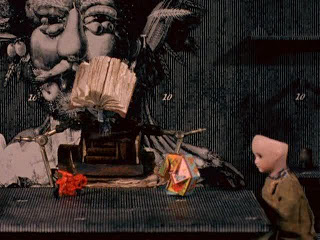 ‘The Cabinet of Jan Svankmajer’ is a documentary about the Czech master of surrealism.
It was made by the Quay Brothers with the sole purpose of being able to watch Švankmajer’s films themselves. Advertised to the BBC as a documentary on French and Czech surrealism, the film is rather highbrow, featuring artists and art historians, whose remarks are sometimes very difficult to grasp, indeed.
Unfortunately, the master himself refused to be interviewed and he is not shown at all. Luckily, Švankmajer’s strong images speak for themselves, and the documentary undoubtedly helped to raise interest in Švankmajer’s films in the West.
The documentary shows excerpts from Švankmajer’s films ‘Dimensions of a Dialogue‘ (which de facto is shown in its entirety), ‘The Last Trick‘, ‘The Flat’, ‘Et Cetera‘, ‘Jabberwocky‘, ‘Historia Naturae, Suita‘, ‘The Ossuary‘, ‘Games with Stones‘, ‘Punch and Judy’, ‘Don Juan‘ and ‘The Fall of the House of Usher‘.
However, ‘The Cabinet of Jan Svankmajer’ is also interesting for animation buffs, even for the one who have seen all Jan Švankmajer’s films, for its original interludes, which are animated by the Quay brothers. These interludes have a truly Švankmajer-like atmosphere, highlighted by the reuse of music from Švankmajer’s films. They feature a Švankmajer-like teacher, made of household objects, and his apprentice, a doll, whose head is emptied in order to let him experience the world anew.
These interludes are no less than wonderful and form an animation short in itself, which is both a great homage to the Czech master and a showcase of the Quay brothers’ own art. In fact, the Quay Brothers compiled the interludes and these are available and widely known under the same name as the complete documentary, which is, in fact, eclipsed by the animated short version.
Watch the animated interludes from ‘The Cabinet of Jan Svankmajer’ yourself and tell me what you think:
‘The Cabinet of Jan Svankmajer’ is available on the DVD ‘Jan Svankmajer – The Complete Short Films’
Director: Tim Burton & Mike Johnson
Release Date: September 23, 2005
Rating: ★★★★
Review:
 The shy Victor and Victoria are forced by their unsympathetic parents to marry each other.
Luckily, they actually like each other, but then Victor accidentally marries the deceased Emily who takes him to a world underground, while Victoria is forced to marry the evil lord Barkis…
‘Corpse Bride’ is a typical Tim Burton film, especially in its art direction, in its 19th century, gothic setting, in its dark humor, and in its jolly portrait of death. Because the film is also a Danny Elfman-penned musical, it feels like a successor to ‘The Nightmare before Christmas‘ (1993). Nevertheless, it is far more enjoyable than that sometimes tiresome film: ‘Corpse Bride’ features only three songs, two of which help to tell the story. So, even though one could do without the musical element, it doesn’t dominate the complete film.
Also, the art of ‘Corpse Bride’ is a great improvement on ‘Nightmare before Christmas’. The dull greys and blues of the living world contrast greatly with the vivid colors of the underworld, which is clearly more fun to ‘live’ in. The designs of the puppets are extreme, and their almost flawless animation is jawdroppingly rich and expressive. The story is lean, and focuses on the three protagonists, Victor, Victoria and Emily, who all three are very likable characters. The voice cast is impressive, and includes Johnny Depp (Victor), Emily Watson (Victoria), Helena Bonham Carter (Emily) and Christopher Lee (Pastor Gallswells).
All this make ‘Corpse Bride’, together with that other stop-motion film ‘Wallace and Gromit: the Curse of the Were-Rabbit‘, the best animated feature of 2005/2006, surpassing all computer animated films of those years. It proves that traditional animation is still viable and relevant in the computer age.
Watch the tailer for ‘Tim Burton’s Corpse Bride’ yourself and tell me what you think:
Directors: Nick Park & Steve Box
Release Date: September 4, 2005
Stars: Wallace & Gromit
Rating: ★★★★★
Review:
 After three excellent two-reelers British animation heroes Wallace and Gromit were ready for their first feature film.
‘The Curse of the Were-Rabbit’ elaborates primarily on the themes of ‘A Close Shave‘: love and horror. This time Wallace and Gromit are after a giant rabbit threatening the crops breeds for a vegetable contest in the village.
The stop motion animation in this film is practically flawless, elevating the century old technique to the highest standards possible. Indeed, both this film and ‘Tim Burton’s Corpse Bride‘, another stop motion film, were far superior to any computer animated feature film released in 2005 or 2006.
‘The Curse of the Were-Rabbit’ is not only a great animation film, it is great cinema, with excellent camera work, a flawless story, wonderful characterization and lean storytelling that builds to a spectacular climax. Especially the animation of Gromit is stunning, because his acting is completely silent throughout the picture and uses only the eyes to suggest emotion.
Watch ‘Wallace & Gromit: The Curse of the Were-Rabbit’ yourself and tell me what you think:
Director: Alain Ughetto
Release Date: June 10, 2013
Rating: ★★½
Review:
 After ‘Persepolis’ (2007) ‘Jasmine’ is the second animation film about the Iranian revolution of 1979.
In his strongly autobiographical film Ughetto rediscovers his love relationship with Jasmine, a young woman from Iran, whom he visited during the turmoils of 1978/1979, and whom he left behind, to return to France, alone.
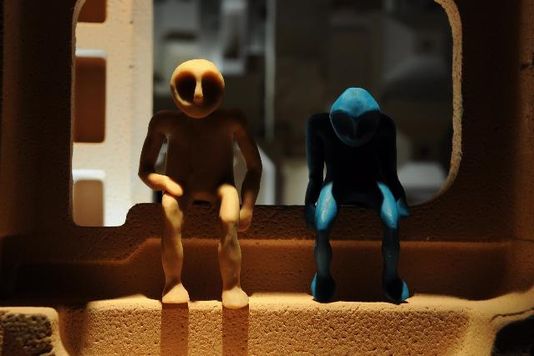
Ughetto doesn’t spare himself, and realizes leaving her was a big mistake on his part. To tell his story he uses love letters from the time, 8mm film images he shot during the Iran revolution and clay animation. He also shows the clay animation process, his elaborate sets made from styrofoam packaging material and collections of clay figures.
Unfortunately, Ughetto’s clay animation is very limited. His plasticine figures are devoid of any facial expression, and they all look the same. The only difference between the Alain and Jasmine puppets is their color (caramel vs. blue – reflecting the color of her eyes). There’s only a limited amount of animation, and little of it is expressive.
Because of this, the film relies heavily on the voice overs, Alain telling his story, a woman reading Jasmine’s love letters. Without the soundtrack the film becomes utterly incomprehensible. Only at one point in the film, the animation images leave a strong impression themselves: when the oppressive forces of the new Islamic regime strike down and kill the former revolutionaries. This is shown by giant floating turbans suddenly falling down and crushing discussing people.
‘Jasmine’ is an intimate, very personal and honest film, and the story of the Iranian revolution and its effects on the everyday lives of people remains moving. But ‘Jasmine’ is no ‘Persepolis’ and in the end falls short as an animation film. It could easily have been a live action film, a documentary, or even a novel, instead.
Watch the trailer for ‘Jasmine’ and tell me what you think:
Director: Rémi Vandenitte
Release Date: June 8, 2013
Rating: ★★★
Review:
 ‘Betty’s Blues’ is Vandenitte’s ode to the country blues, and its origins in the South of the United States.
The film is a frame story, with two distinct styles. The framing story is told in stop-motion. We watch a young black blues singer perform in a small and empty bar near a metro line (we hear the cars rattling by from time to time). The singer tells his audience the story of Betty’s Blues. Enter the drawn animation.
The story itself is about a blues singer who loses his girl to the K.K.K. and becomes blind himself. In return for his blindness he receives the gift to make everybody dance to his guitar playing. When he meets the K.K.K. again, his revenge is sweet. The film ends with the audience shocked with horror by this rather violent story.
Both Vandenitte’s stop-motion and 2D animation are of a high quality. His stop-motion puppets have a delightfully gritty texture, and Vandenitte’s animation of guitar playing is wonderfully convincing. In the 2D sequences Vandenitte makes use of a technique simulating wood carving, combined with bold and evocative coloring, sometimes mimicking the color palette of that great cinematic ode to the musical South, ‘O Brother Where Art Thou’. The result is a gorgeous film, if a little shallow in the end.
Watch the teaser for ‘Betty’s Blues’ yourself and tell me what you think:
Director: Boris Kossmehl
Release Date: 1993
Rating: ★★★★
Review:
 When she hasn’t paid her washing machine, a girl’s aunt has to go to hell.
However, she soon returns as a zombie to fetch her handbag. The devil tries to take her once again, this time disguised as the handbag.
Atypical for the Aardman studios, ‘Not Without My Handbag’ features puppet animation and hardly any clay animation. It’s a highly designed film, using stark colors, extreme camera angles and expressionistic decors. Its unique style is somewhat akin to that of Tim Burton, but is even more idiosyncratic. Despite its horror theme, the film is more lighthearted than the earlier Aardman films ‘Adam‘ (1991) or ‘Loves Me, Loves Me Not‘ (1992), because of its zany humor and matter-of-fact dialogue. For example, when her aunt returns as a zombie, the girl suddenly turns to camera and says proudly: “My auntie is a zombie from hell!”.
‘Not Without My Handbag’ is a modest masterpiece: it’s unpretentious, but it combines originality with virtuosity. The animation of the evil handbag is particularly good. Director-animator Boris Kossmehl later moved to 3D computer animation, performing character animation for Dreamworks’ ‘Antz’ and ‘Shrek’.
Watch ‘Not Without My Handbag’ yourself and tell me what you think:
‘Not Without My Handbag’ is available on the DVD ‘Aardman Classics’
Director: Jeff Newitt
Release Date: 1992
Rating: ★★★
Review:
 A gentleman uses a flower to determine whether his girl loves him or not.
The contrasts between happiness (she loves him) and pain (she loves him not) get more and more extreme during the film, providing unsettling images of terror.
Like ‘Adam‘, ‘Loves Me, Loves Me Not’ is an example of dark humor, typical for the Aardman Studios at the time. The dark humor is typified by the screams of pain the flower exclaims, when its petals are removed, by the highly disturbing soundtrack and by the images of suicide and threat.
Combining virtuoso clay animation with some cel animation, the film is a technical masterpiece. It also features some great silent comedy, and especially the deft gestures of the Clark Gable-like gentleman are nicely done.
Watch ‘Loves Me, Loves Me Not’ yourself and tell me what you think:
‘Loves Me, Loves Me Not’ is available on the DVD ‘Aardman Classics’
Director: Peter Lord
Release Date: 1991
Rating: ★★★½
Review:
 A giant hand creates a man on a tiny planet.
His creator orders the man around, but the man soon discovers his barren sphere is too small to do anything, and that he is stuck to it. Luckily, in the end the creator grands him a companion, which turns out to be a penguin (iris out).
‘Adam’ exploits the dark humor typical for the early Aardman films. Its claustrophobia feels real and disturbing, and the film raises inevitable questions about existence and purpose of life. And though ‘Adam’ contains great silent comedy gags, the film is rather unsettling overall. Unfortunately, the film’s comedy is hampered by Stuart Gordon’s rather ugly electronic music. However, Lord’s animation is superb throughout, and a prime example of the more comedy-driven animation style the Aardman studio took from 1989 on.
Watch ‘Adam’ yourself and tell me what you think:
‘Adam’ is available on the DVD ‘Aardman Classics’


 Dr. Grob's Animation Review