
You are currently browsing the category archive for the ‘Walt Disney films’ category.
Director: Jack Kinney
Release Date: January 5, 1951
Stars: Goofy, the mountain lion
Rating: ★★★
Review:
 In this short Goofy inhabits a house on the top floor of a large apartment block. He needs an extra tree for his hammock, so he fetches one from a forest nearby.
Unfortunately, he’s visited by the tree’s former owner, the mountain lion from the Donald Duck short ‘Lion Around‘ (1950), and together they fight over the hammock.
The gag routine is laid out well, involving many ringings of doorbells and falls from great heights, resulting in an extraordinarily long falling sequence. However, the comedy is hampered by irritating vocal sounds by both Goofy and the mountain lion, and by a slightly sloppy timing. This is too bad, for a possibly very funny cartoon now only becomes average.
In 1952 the mountain lion would reappear again in the Goofy short ‘Father’s Lion’.
Watch ‘Lion Down’ yourself and tell me what you think:
This is Goofy cartoon No. 27
To the previous Goofy cartoon: Hold That Pose
To the next Goofy cartoon: Home Made Home
Director: Jack Kinney
Release Date: November 30, 1950
Stars: Goofy
Rating: ★★★★★
Review:
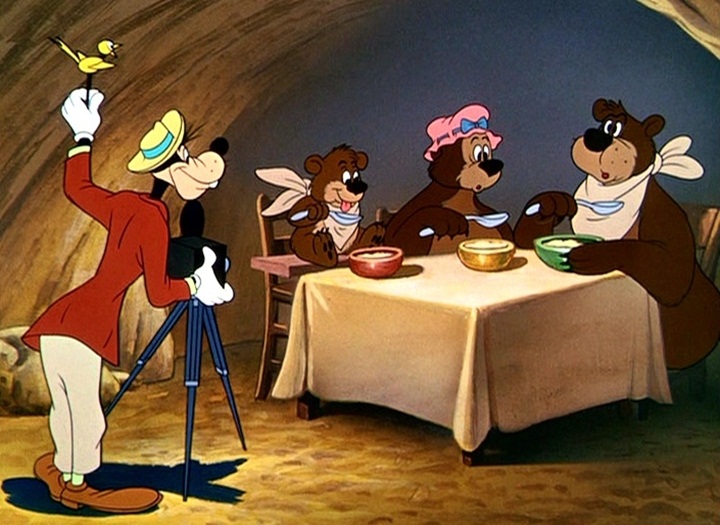 This cartoon starts with the opening shot of a tired Goofy dragging himself into his own home from ‘Goofy Gymnastics‘ from the previous year.
This time, however, the voice over advises Goofy to get a hobby, for example photography. This leads to several great photography gags, especially when Goofy tries to make pictures of a bear, which results in a long, fast and gag-packed chase sequence involving a funfair. It also reuses a gag involving a cab from ‘Baseball Bugs‘ (1946), showing Jack Kinney’s interest in the gag language of Disney’s rivals.
‘Hold that pose’ is one of Goofy’s funniest shorts, and certainly one of his best cartoons of the fifties.
Watch ‘Hold That Pose’ yourself and tell me what you think:
This is Goofy cartoon No. 26
To the previous Goofy cartoon: Motor Mania
To the next Goofy cartoon: Lion Down
Director: Jack Kinney
Release Date: June 30, 1950
Stars: Goofy
Rating: ★★★★★ ♕
Review:
 In this cartoon a particularly civilized type of Goofy, an “average man” called Mr. Walker, changes into a Mr. Hyde-like wildman called Mr. Wheeler, once he sits behind the wheel of his car.
‘Motor mania’ is a quite disturbing film about road manners, it even becomes nightmarish when we watch cars bark at a helpless pedestrian. It is as moralistic as it is funny. And it remains somehow strikingly relevant today, making it an original classic within the Goofy series.
‘Motor Mania’ is the only Goofy cartoon in which our hero is depicted as an unsympathetic and even evil character. But by now Goofy had lost all his former persona. He had changed into a random citizen, so it works very well.
‘Motor Mania’ forms another step in the evolution of Goofy into the American everyman. By now Goofy had replaced Donald Duck as a representative of the American citizen. Donald Duck had been the average citizen in the 1940s, but at the end of the decade his role had been diminished, evolving into a straight man for the antics of Chip ‘n Dale, the little bee and such. Jack Kinney’s Goofy took over, cumulating in the typical 1950s everyman, George Geef, in ‘Cold War‘ from the next year.
Watch ‘Motor Mania’ yourself and tell me what you think:
This is Goofy cartoon No. 25
To the previous Goofy cartoon: Goofy Gymnastics
To the next Goofy cartoon: Hold That Pose
Director: Jack Kinney
Release Date: September 23, 1949
Stars: Goofy
Rating: ★★★½
Review:
 In this short Goofy orders some home training devices to improve his condition. All his attempts fail, of course, sometimes in surprisingly long and elaborate gags, involving great situation comedy. It’s this cartoon Roger Rabbit watches in the cinema in ‘Who Framed Roger Rabbit‘ from 1988.
Together with the previous ‘Tennis Racquet‘, Goofy Gymnastics’ is a transitional Goofy cartoon: it’s the first cartoon showing the restyled Goofy as an average American citizen. Unlike ‘Tennis Racquet’, however, there’s only one Goofy in this cartoon, who even sings his own theme song ‘The world owes me a living’ again. ‘Goofy Gymnastics’ marks the last time we see Goofy in his original hat, which he only puts on after changing into his gym costume. It’s also the last of the Goofy sports cartoons. The next year, the same tired Goofy is advised to get a hobby, in ‘Hold That Pose‘.
Like the earlier great sports cartoons it uses a posh voice over, who’s completely out of tune with Goofy’s antics with his home training gear. The action is a bit slow, however, and the animators make no attempts to synchronize their character’s lip movements with the now obligate Goofy vocalizations.
Watch ‘Goofy Gymnastics’ yourself and tell me what you think:
This is Goofy cartoon No. 24
To the previous Goofy cartoon: Tennis Racquet
To the next Goofy cartoon: Motor Mania
Director: Jack Kinney
Release Date: August 26, 1949
Stars: Goofy
Rating: ★★★★
Review:
 After four years of working on feature films, Jack Kinney returns as a director of Goofy shorts to remain Goofy’s sole director until the series’ end in 1953.
Kinney’s first Goofy film in four years, ‘Tennis Racquet’ is a transitional film: together with the next Goofy short, ‘Goofy Gymnastics‘, it’s firmly rooted in the 1940s Goofy tradition, being a sports cartoon, similar in content to ‘How to Play Football‘ (1944) and ‘Hockey Homicide‘ (1945). Moreover, in the first scene we hear one of the Goofy characters (the cartoon contains several of them) singing Goofy’s own theme song “the world owes me a living”, and in the end we can hear the typical Goofy yell, introduced in ‘The Art of Skiing‘ (1941). The short even features a slow motion gag, not seen since ‘How to swim‘ (1942).
On the other hand, it can also be seen as the first entry of Goofy’s second series, for the character has been completely redesigned. The next year this new, redesigned Goofy would turn into Mr. Geef, the everyman.
Like ‘How to Play Football’ and ‘Hockey Homicide’, ‘Tennis Racquet’ has no educational value: the cartoon consists of one frantic tennis match between two Goofy characters. It’s a fast and funny cartoon, full of silly gags. The highlight may be the running gag of the stoic gardener, who enters the game at several points, undisturbed by the frantic action around him.
Watch ‘Tennis Racquet’ yourself and tell me what you think:
This is Goofy cartoon No. 23
To the previous Goofy cartoon: The Big Wash
To the next Goofy cartoon: Goofy Gymnastics
Director: Charles Nichols
Release Date: June 9, 1950
Stars: Pluto, Milton
Rating: ★★★★★
Review:
 Pluto has a relatively small part in this very zany cartoon, penned by Goofy-storymen Dick Kinney and Milt Schaffer. It stars two alley cats trying to invade a garden full of milk, birds and fish, but guarded by our hero.
The comedy between the two cats is brilliant and the short is full of fine gags, the best of which is a bizarre fishing scene, in which one of the cats uses a milk bottle for a helmet. The larger cat is a dumb character reminiscent of George in Tex Avery’s George and Junior cartoons, and of Junior Bear in Chuck Jones’ three bear cartoons. However, unlike those shorts, the comic interplay between the two characters is devoid of dialogue. Only in the beginning they exchange some meows. The whole cartoon is a showcase of silent comedy.
‘Puss-cafe’ undoubtedly is one of Pluto’s wildest cartoons, on par with ‘Pluto at the Zoo‘ (1942) and ‘Springtime for Pluto‘ (1944), and it belongs to his all-time best. In fact, the two cats were such wonderful characters that it is hard to understand that they were only used once. Nevertheless, one of them would return as ‘Milton’ in Pluto’s last two cartoons: ‘Plutopia‘ and ‘Cold Turkey‘ from 1951, with equally funny results.
Watch ‘Puss-Cafe’ yourself and tell me what you think:
This is Pluto cartoon No. 37
To the previous Pluto cartoon: Primitive Pluto
To the next Pluto cartoon: Pests of the West
Director: Charles Nichols
Release Date: May 19, 1950
Stars: Pluto
Rating: ★★★
Review:
 Pluto is sleeping at ‘Mickey’s outdoor reserve’, a forest reserve deep in the mountains, which is shown in a beautiful pan opening shot. There the howling of the wolves, a.k.a. the call of the wild awakes “his primitive instinct”, which takes the shape of a little blue wolf character.
The instinct tries to make Pluto give up his easy life to hunt some meat outdoors. But Pluto turns out to be a lousy tracker, and when he’s bullied by both a rabbit and a bear he rushes home, only to discover that the little wolf has eaten his bread and milk meal.
‘Primitive Pluto’ is a nice cartoon, if not among Pluto’s best. It shows how far Pluto had come from his roots as a tracking bloodhound as shown in ‘The Chain Gang‘ (1930). Like Mickey, Donald and Goofy, Pluto had become urbanized and settled over the years. It’s nice to watch the animators play with this fact.
Watch ‘Primitive Pluto’ yourself and tell me what you think:
This is Pluto cartoon No. 36
To the previous Pluto cartoon: Wonder Dog
To the next Pluto cartoon: Puss-cafe
Director: Charles Nichols
Release Date: April 7, 1950
Stars: Pluto, Butch, Dinah
Rating: ★★★★½
Review:
 In ‘Wonder Dog’ Pluto tries to impress Dinah, but she’s in love with ‘Prince, the wonder dog’, a circus dog featured on a poster.
Pluto imagines himself to be a circus dog too, but his attempts all fail, much to the amusement of a watching Butch. When Pluto nags Butch, and the latter chases him, he accidentally and unwillingly turns into the acrobat he wanted to be, gaining Dinah’s love once more.
‘Wonder Dog’ is a wonderful cartoon, with some great comedy. Its story, by Bill Peet & Milt Banta, has a surprisingly natural flow, without becoming cliche. Like ‘Pluto’s Heart Throb‘ from earlier that year it illustrates that the trio of Pluto, Dinah and Butch could inspire some excellent comedy. Unfortunately, ‘Wonder Dog’ marks Dinah’s last screen appearance, after a mere four cartoons.
Watch ‘Wonder Dog’ yourself and tell me what you think:
This is Pluto cartoon No. 35
To the previous Pluto cartoon: Pluto and the Gopher
To the next Pluto cartoon: Primitive Pluto
Director: Charles Nichols
Release Date: February 10, 1950
Stars: Pluto, Minnie Mouse
Rating: ★★½
Review:
 Pluto encounters a gopher in Minnie’s garden.
Minnie accidentally brings the gopher inside, where the chase continues, until the gopher is literally launched outside. It’s inside the house where the cartoon blossoms. However, the cartoon remains a little slow, and it is uncertain with whom we have to sympathize, for neither Pluto nor the Gopher is particularly endearing. The best scene is the one in which the gopher discovers that he’s trapped inside a foreign environment. His panic is both funny and heartfelt.
Watch ‘Pluto and the Gopher’ yourself and tell me what you think:
This is Pluto cartoon No. 34
To the previous Pluto cartoon: Pluto’s Heart Throb
To the next Pluto cartoon: Wonder Dog
Director: Charles Nichols
Release Date: January 6, 1950
Stars: Pluto, Butch, Dinah
Rating: ★★★★
Review:
 It seems that at the end of the Pluto series, the animators had found new inspiration, for most of Pluto’s best cartoons were made in the series’ last two years. In fact, almost every Pluto cartoon from 1950/1951, Pluto’s last two solo years, is a winner.
‘Pluto’s Heart Throb’ is a good example. In this rather weird short both Butch an Pluto fall in love with Dinah (whom we hadn’t seen since ‘In Dutch‘ from 1946). They’re acting like rivals, but they have to pretend to be friends when she’s watching. When Pluto saves Dinah from drowning, he gains her love and Butch makes a sad retreat.
Penned by Roy Williams, one of the most original of the Disney story men, this short is stuffed with silly ideas, starting with the silly little pink dog cupid, who makes Pluto and Dinah fall in love with each other. The animation is extremely flexible, with wonderful expressions on all three characters. The excellent silent comedy is further enhanced by a very lively score. In all, ‘Pluto’s Heart Throb’ is a great improvement on the earlier in-love-with-Dinah-cartoon: ‘Canine Casanova’ from 1945.
Watch ‘Pluto’s Heart Throb’ yourself and tell me what you think:
This is Pluto cartoon No. 33
To the previous Pluto cartoon: Sheep Dog
To the next Pluto cartoon: Pluto and the Gopher
Directors: James Algar, Clyde Geronimi, Jack Kinney
Release Date: October 5, 1949
Rating: ★★★½
Review:
 The Legend of Sleepy Hollow, told and sung by Bing Crosby, quite faithfully retells the story by Washington Irving.
The story tells us about the skinny schoolmaster Ichabod Crane who tries to court Katrina van Tassel, the most beautiful girl in town, while ignoring his rival Brom Bones. At Halloween Bones tells a spooky story about a headless horseman, scaring the schoolmaster to death. And when on the way home he really encounters a headless horseman, he’s never seen again…
The animation of Ichabod Crane and Katrina van Tassel both show how familiar the animators had become with the human figure. Ichabod Crane is an awkward, slender figure, but human, nonetheless. Katrina both has a sexy, graceful charm, as well as stylized moves, which make her a little abstract, like an all too beautiful woman can be in the hearts of men. Certainly, in the next feature, ‘Cinderella‘ (1950) the animators were confident enough to let human characters star a feature for the first time since ‘Pinocchio‘ (1940).
This film’s highlight, however, are the wonderful backgrounds, which were lacking in the first story, ‘The Wind in the Willows‘. In ‘The legend of Sleepy Hollow’ the backgrounds are stylized, with striking colors, and most of the times clearly inspired by Mary Blair. The background artists’ art reaches its peak in the stunning scary forest scene, an elaboration on the scary forest in ‘Snow White and the Seven Dwarfs’ (1937). This climatic scene, in which Ichabod Crane is confronted with the headless horseman, makes effective use of expressionistic coloring, like the best parts in ‘Fantasia’ (1940) and ‘Bambi‘ (1942).
These positive aspects, however, cannot rescue this film, which is rather slow, and totally devoid of sympathetic characters. In the end one has to conclude that this second part of the feature, like the first, is not particularly interesting or memorable.
Watch ‘The Adventures of Ichabod and Mr Toad’ yourself and tell me what you think:
http://www.dailymotion.com/video/x28oc6j_the-legend-of-sleepy-hollow-1949-cartoon_shortfilms
Directors: James Algar, Clyde Geronimi, Jack Kinney
Release Date: October 5, 1949
Rating: ★★★
Review:
 ‘The Wind in the Willows’ is the first of the two stories that make up the compilation feature ‘The Adventures of Ichabod and Mr Toad‘.
This story had originally been conceived in 1938 as a possible feature film, before it was shelved in 1942. The 1949 version is clearly truncated, and it shows. This story tells only an episode from ‘The wind in the Willows’ starring the enthusiastic Toad, whose love for chariots and cars causes a lot of trouble for himself and his quiet, all too British friends Water rat, Mole and Badger. The story is quite unfaithful to the book, giving a large role to one Cyril the horse and containing both a long scene at the court and a long sequence in which our four friends try to steal a document from a gang of weasels.
Although the English feel is retained, this version of ‘The Wind in the Willows’ completely lacks the poetry so typical for the book. Sure, Toad’s intoxicating character has been transferred to the screen very well, but the characters beside him never really come off. Moreover, the story is told too unevenly to be either exciting or endearing, and the interplay between animals and humans remains unconvincing. The backgrounds are uninspired, especially when compared to those in ‘The Legend of Sleepy Hollow‘, except for those in the winter train sequence. The weasels, which are animated excellently with broad comedy, anticipate those in ‘Who Framed Roger Rabbit?‘ (1988).
Watch the trailer for ‘The Adventures of Ichabod and Mr Toad’ yourself and tell me what you think:
‘The Adventures of Ichabod and Mr Toad’ is available on DVD
Directors: James Algar, Clyde Geronimi, Jack Kinney
Release Date: October 5, 1949
Rating: ★★★
Review:
 The adventures of ‘Ichabod and Mr. Toad’ was the last of the Disney compilation features so typical of the 1940s.
Like ‘Fun and Fancy Free‘ (1947) it consists of only two stories, this time both drawn from literature. Both use a narrator, which gives the films a feeling of moving illustrations. Neither of the stories is particularly endearing: the story of Mr. Toad lacks the poetry of the original story, the story of Sleepy Hollow lacks speed. It would be a happy return to direct story telling (opposed to using voice overs) in ‘Cinderella‘, the next year.
The six directing animators of this feature all belong to the group of ‘nine old men’.
‘The Adventures of Ichabod and Mr Toad’ consists of the following two episodes, which I will discuss in more detail elsewhere:
1. The Wind in the Willows
2. The Legend of Sleepy Hollow
Watch ‘The Adventures of Ichabod and Mr Toad’ yourself and tell me what you think:
Director: Charles Nichols
Release Date: November 4, 1949
Stars: Pluto, Bent-Tail & Bent-Tail junior
Rating: ★★★★
Review:
 In this follow-up to ‘The Legend of Coyote Rock’ (1945), Pluto is a sheep dog bothered by two coyotes, Bent-Tail and his not too clever son (in his debut), who want to steal his sheep.
In the end Bent-tail finally succeeds in stealing one, but it turns out to be his own son in disguise.
Like ‘Pluto’s Sweater‘ of the same year, ‘Sheep Dog’ plays more on gags than on cuteness, which results in one of Pluto’s best cartoons. Especially the interplay between Bent-Tail and his son is a delight to watch. Indeed, the duo was successful enough to return the following year in the equally entertaining ‘Pests of the West‘ and ‘Camp Dog’.
Watch ‘Sheep Dog’ yourself and tell me what you think:
This is Pluto cartoon No. 32
To the previous Pluto cartoon: Bubble Bee
To the next Pluto cartoon: Pluto’s Heart Throb
Director: Charles Nichols
Release Date: June 24, 1949
Stars: Pluto, The Bee
Rating: ★★
Review:
 While playing with a ball in a city park, Pluto encounters a bubblegum collecting bee, who, oddly enough, lives on his own in a wasp’s nest.
Pluto ruins the bee’s home and swallows all his bubblegum. The bee takes revenge of course, which leads to quite original, but remarkably unfunny gags with bubbles.
‘Bubble Bee’ is the only short in which Jack Hannah’s bee, introduced in ‘Inferior Decorator’ (1948), acts without Donald Duck.
Watch ‘Bubble Bee’ yourself and tell me what you think:
This is Pluto cartoon No. 31
To the previous Pluto cartoon: Pluto’s Sweater
To the next Pluto cartoon: Sheep Dog
Director: Charles Nichols
Release Date: April 29, 1949
Stars: Figaro, Minnie Mouse, Pluto
Rating: ★★★★½
Review:
 Minnie has knitted a sweater for a very unwilling Pluto, to much hilarity of Figaro and the neighboring dogs.
While trying to get rid of it, Pluto falls into the water, making the sweater shrink. Minnie is in all tears, when she discovers the sweater is ruined. But wait! This tiny sweater perfectly fits the equally unwilling Figaro! So, Pluto has the last laugh.
This cartoon was to be Figaro’s sixth and last cartoon appearance. It’s undoubtedly one of the funniest Pluto films, if not hilarious. The best part is the long scene in which Pluto tries to get the sweater off. Like in the best Donald Duck cartoons this leads to nonsensical antics with the inanimate object, which deforms almost beyond recognition.
The short’s opening shot is also noteworthy: the film opens with the viewer looking straight into Pluto’s eyes, an effect that goes all the way back to ‘The Skeleton Dance‘ (1929).
Watch ‘Pluto’s Sweater’ yourself and tell me what you think:
http://www.toontube.com/video/2746/Plutos-Sweater-1949
This is Pluto cartoon No. 30
To the previous Pluto cartoon: Pluto’s Surprise Package
To the next Pluto cartoon: Bubble Bee
Director: Charles Nichols
Release Date: March 4, 1949
Stars: Pluto
Rating: ★
Review:
 In this cartoon Pluto inexplicably lives in a lodge in the mountains.
Here he receives a package that jumps. It shows to contain a little turtle. Pluto has a hard time delivering the mail and the turtle in his original package, but in the end it’s the turtle which delivers the letters.
This sweet and slow cartoon is the third starring the cute little turtle from ‘Canine Patrol‘ (1945) and ‘Pluto’s Housewarming‘ (1947). It uses the Pluto-befriends-a-little-animal-story formula of Pluto first being hostile to this new animal, then becoming friends, and it has a distinct routine feel to it. Clearly, this story formula was running out of steam badly. Luckily, ‘Pluto’s Surprise Package’ was the last Pluto cartoon using it.
This short’s best scene is when Pluto tries to retain three letters and the little turtle inside its package, troubled by wind and the turtle’s constant urge to move.
Watch ‘Pluto’s Surprise Package’ yourself and tell me what you think:
This is Pluto cartoon No. 29
To the previous Pluto cartoon: Pueblo Pluto
To the next Pluto cartoon: Pluto’s Sweater
Director: Charles Nichols
Release Date: January 14, 1949
Stars: Mickey Mouse, Pluto
Rating: ★
Review:
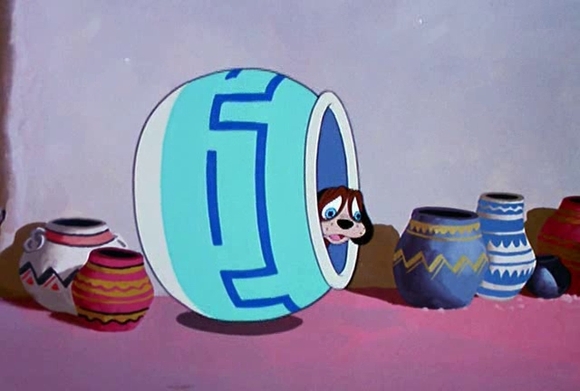 In Pueblo Pluto” Mickey’s a tourist visiting a Pueblo village with Pluto.
Here, Pluto meets the small dog with the droopy eyes from ‘The Purloined Pup’ (1946), who tries to steal Pluto’s buffalo bone. When Pluto finally has his bone secured, he discovers he’s trapped inside a circle of cacti. Of course, it’s the little dog who saves him in this all too typical story.
Like the other Pluto-befriends-a-little-animal-cartoons, this short is as cute as it is dull. Its most interesting feature are the rather stylized backgrounds by Brice Mack, who has used a particularly large amount of pink.
Watch ‘Pueblo Pluto’ yourself and tell me what you think:
This is Pluto cartoon No. 28
To the previous Pluto cartoon: Pluto’s Fledgling
To the next Pluto cartoon: Pluto’s Surprise Package
Director: Charles Nichols
Release Date: December 12, 1948
Stars: Mickey Mouse, Pluto, the little seal
Rating: ★★★½
Review:
 After visiting the seals at the zoo, Mickey accidentally brings a little seal home in his basket.
‘Mickey and the seal’ is the third cartoon to feature the little seal (the other two are ‘Pluto’s Playmate‘ from 1941 and ‘Rescue Dog‘ from 1947). And like the earlier entries featuring this cute animal, ‘Mickey and the Seal’ is charming, but not very funny.
Nevertheless, it contains a lovely scene of Mickey and the seal in bath, which is a prime example of great silent comedy. Its finale, too, arguably is the funniest of all postwar Mickey Mouse cartoons. The bath scene renders a shot of Mickey completely naked (except for his gloves).
Watch ‘Mickey and the Seal’ yourself and tell me what you think:
This is Mickey Mouse cartoon No. 121
To the previous Mickey Mouse cartoon: Mickey Down Under
To the next Mickey Mouse cartoon: R’coon Dawg
Director: Charles Nichols
Release Date: March 19, 1948
Stars: Mickey Mouse, Pluto
Rating: ★
Review:
 ‘Mickey Down Under’ features Mickey and Pluto in some Australian banana plantation.
Pluto has troubles with a boomerang, while Mickey encounters an ostrich. Even though the animation of Pluto is inspired, ‘Mickey Down Under’ is a boring cartoon, and one of the weakest entries in the Mickey Mouse series. Apart from the boomerang, the setting can hardly be called Australian. On the contrary, the cartoon depicts some flora and fauna not indigenous to Australia: toucans, bananas and ostriches. The title music is that of a Pluto cartoon.
Watch ‘Mickey Down Under’ yourself and tell me what you think:
This is Mickey Mouse cartoon No. 120
To the previous Mickey Mouse cartoon: Mickey’s Delayed Date
To the next Mickey Mouse cartoon: Mickey and the Seal


 Dr. Grob's Animation Review