You are currently browsing the category archive for the ‘Walt Disney films’ category.
Director: Jack Hannah
Release Date: August 22, 1947
Stars: Donald Duck, Bootle Beetle
Rating: ★★★
Review:
 In the postwar era Jack Hannah introduced three adversaries of Donald Duck: Bootle Beetle, Chip ‘n Dale*, and a little bee. Bootle Beetle, a little insect, was the first and surely the cutest of the lot.
In his first film Bootle Beetle, who resembles Jiminy Cricket a little, is introduced here as a rare species. In fact, we’re watching two Bootle Beetles, with the elderly one telling a younger one about his meeting with bug collector Donald Duck, who, in some scenes, is depicted as an enormous giant. These scenes with a humongous Donald are the highlights of a cute and gently cartoon, which is unfortunately low on gags.
Bootle Beetle would return in two 1949 Donald Duck cartoons, ‘Sea Salts‘ and ‘The Greener Yard‘. The little insect never became funny, and Hannah dropped him as Donald’s adversary after these three cartoons. His last role was as a narrator in ‘Morris, the Midget Moose‘ (1950).
Watch ‘Bootle Beetle’ yourself and tell me what you think:
This is Donald Duck cartoon No. 64
To the previous Donald Duck cartoon: Donald’s Dilemma
To the next Donald Duck cartoon: Wide Open Spaces
* Chip ‘n Dale actually made their debut in the war short ‘Private Pluto‘ (1943), directed by Clyde Geronimi, but it was Hannah who turned the two chipmunks into two different characters and made them opponents of Donald Duck.
Director: Jack King
Release Date: July 11 1947
Stars: Donald Duck, Daisy Duck
Rating: ★★
Review:
 Daisy tells an off-screen psychiatrist that a flower pot has changed her boyfriend Donald into a crooner with a beautiful, Frank Sinatra-like voice.
We hear Donald singing ‘When You Wish Upon a Star’ from ‘Pinocchio‘ (1940), and watch him becoming world famous instantly. Unfortunately he forgets about Daisy’s existence, as well.
This cartoon is actually about Daisy, who for the first time gets star billing. Despite its great premise, the cartoon is hampered by Daisy’s jabbering voice over, its sparsity of gags and an all too predictable finale. Like Donald’s other voice cartoon, ‘Donald’s Dream Voice‘ (1948), the idea is way stronger than the execution.
Watch ‘Donald’s Dilemma’ yourself and tell me what you think:
This is Donald Duck cartoon No. 63
To the previous Donald Duck cartoon: Clown of the Jungle
To the next Donald Duck cartoon: Bootle Beetle
s.Director: Jack Hannah
Release Date: June 20 1947
Stars: Donald Duck, The Aracuan Bird
Rating: ★★★★★
Review:
 ‘Clown of the Jungle’ reintroduces the Aracuan bird from ‘The Three Caballeros‘ (1944), now hindering Donald’s attempts to photograph birds.
The Aracuan bird is a surreal character, defying all laws of nature. For example, it can cycle in mid-air, duplicate itself and draw a door on a rock, and enter it. These abilities are very rare for a Disney character, and there’s no doubt that the Aracuan bird was inspired by the more absurd humor from the Warner Bros. and Tex Avery’s MGM cartoons.
Director Jack Hannah handles this type of humor remarkably well, delivering the gags in a fast pace and with an excellent timing, making ‘Clown of the Jungle’ not only the most surreal, but also one of the wildest and funniest Disney cartoons from the postwar era.
Being such a wonderful character, The Aracuan bird would return once more the following year, in the sequence ‘Blame it on the Samba‘ from ‘Melody Time‘ (1948). Unfortunately, the character remained alone in its zaniness within the Disney canon, and other Disney postwar cartoons remained much more conventional.
Watch ‘Clown of the Jungle’ yourself and tell me what you think:
This is Donald Duck cartoon No. 62
To the previous Donald Duck cartoon: Sleepy Time Donald
To the next Donald Duck cartoon: Donald’s Dilemma
Directors: Ted Berman, Richard Rich & Art Stevens
Release Date: July 10, 1981
Rating: ★★
Review:
 ‘The Fox and the Hound’ tells about a young adopted fox called Tod and a young hound dog called Copper, who become friends, but later enemies, partly due to their nature.
‘The Fox and the Hound’ was the feature in which the last of the nine old men, Frank Thomas and Ollie Johnston, passed on their knowledge and their legacy to a younger generation of animators. In this respect it’s the most transitional film in Disney history. And unfortunately, it shows, because it’s neither an old classic, nor does it have the spirit of a film by young Turks, despite most of the animation being nothing less than great.
On the contrary, the end product is a tame, slow moving and rather tiresome movie more belonging to a time long past than to the 1980s, the decade in which it was made. Its main flaws are in storytelling: none of the actions of the protagonists are very well motivated, the villains are hardly threatening and a lot of screen time is spent on the totally non-related antics of a sparrow called Dinky and a loony, rather annoying woodpecker called Boomer trying to catch a caterpillar. These birds, like the friendly old female owl Big Mama (voiced by black jazz singer Pearl Bailey), do nothing more than watching the main action.
The songs do not propel the action forward, either, but tend to drag the film down. And in the scenes in which Tod tries to survive in the forest, it becomes very difficult to see him interact with birds and furry animals. How he’s going to survive in the forest without killing animals remains unexplained. Finally, at the end of the film, a bear appears out of nowhere, like a deus ex machina, to be the sole reuniter of the two friends.
In fact, the only appeal of ‘The Fox and the Hound’ lies in the quality of the animation itself, and in the film’s beautiful backgrounds. Because of its out-of-time setting the film can be regarded timeless, but a timeless classic it ain’t.
Watch the fight scene from ‘The Fox and the Hound’ and tell me what you think:
Director: Les Clark
Release Date: August 1, 1958
Rating: ★★★
Review:
 ‘Paul Bunyan’ belongs to a group of Disney specials that retell tall tales from the West, following ‘The Legend of Johnny Appleseed‘ and ‘Pecos Bill‘ from ‘Melody Time‘ (1948).
The short is told by three “eye witnesses”, who tell us about the great deeds of the mighty lumberjack Paul Bunyan, who was “63 axe handles high”, and his equally gigantic ox Babe. The best part describes how Bunyan and Babe have reshaped the American landscape: their footsteps turn into the land of 10,000 lakes (in Minnesota), and they themselves build landmarks like the Missouri River, Pikes Peak in Colorado, and the Grand Tetons and Yellowstone Falls in Wyoming.
Eyvind Earle supervised the color schemes, while Tom Oreb designed the characters, like they did for ‘Sleeping Beauty‘ (1959). Their designs are very bold and angular, and the background art, painted by Eyvind Earle and Walt Peregoy, is a delight to watch. Composer George Bruns composed a catchy theme song for the giant hero, which is sung several times throughout the short.
Unfortunately, the short is hampered by a remarkable slowness and a terrible lack of good gags, which make it at 17 minutes too long to remain entertaining. In the end ‘Paul Bunyan’ is more interesting for its looks than for its story.
‘Paul Bunyan’ was the only non-educational short directed by Disney veteran Les Clark, who had been with Disney since the birth of his own studio in 1928.
Watch ‘Paul Bunyan’ yourself and tell me what you think:
‘Paul Bunyan’ is available on the DVD ‘Walt Disney Treasures: Disney Rarities’
Director: Jack Kinney
Release Date: February 24, 1956
Stars: Donald Duck, Chip ‘n Dale
Rating: ★★★
Review:
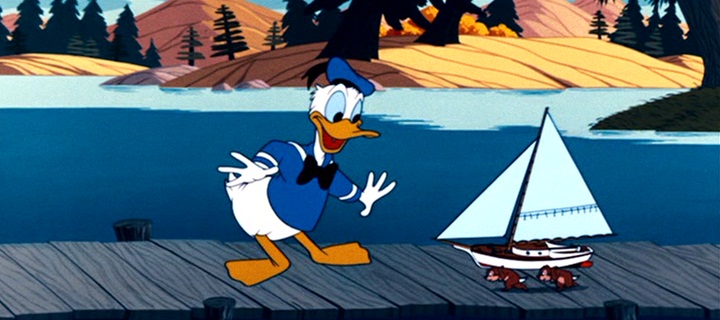 This Cinemascope cartoon is one of finals. It was the last screen appearance of Chip ‘n Dale, it was the last non-educational Donald Duck short and it was the last cartoon directed by Goofy director Jack Kinney, whose own Goofy series had stopped three years earlier.
The short features a quite ordinary battle between Chip ‘n Dale and Donald. This time the squirrels steal Donald’s miniature boat to sail to an island full of acorns. Highlights are Donald acting out a thunderstorm and Dale’s deadpan reactions to Donald’s attempts to persuade them into various boats.
By 1956 Jack Kinney, the greatest director of comedy the Disney studio had ever seen, had been out of favor for some time, and on March 13, 1958 he was fired. He continued animating during the dark ages of animation, in which animation was only seen in light of expenses. He worked on UPA’s first feature, ‘1001 Arabian Nights’ and on Popeye films for television, besides several small and often unfinished projects with his own animation company. In 1988 he wrote his highly entertaining and richly illustrated autobiography ‘Walt Disney and Assorted other Characters’. Jack Kinney passed away on February 9, 1992, 82 years old.
Watch ‘Chips Ahoy’ yourself and tell me what you think:
This is Donald Duck cartoon No. 114
To the previous Donald Duck cartoon: Up a Tree
To the next Donald Duck cartoon: How to Have an Accident in the Home
Director: Clyde Geronimi
Release Date: December 17, 1943
Rating: ★★★★★
Review:
 This Disney short is an original take on the classic fable. It has a clear war message, even though there’s no direct visible link to World War II.
The villain, Foxy Loxy, uses a psychology book, from which he quotes, to lure the inhabitants of a poultry farm into his cave. The inhabitants of the poultry farm are clear representations of contemporary American society, including the upper class (turkeys), female middle class (chicken), male working class (ducks) and the youth (chickens and roosters, whom we see dancing to hot jazz in a short scene).
Foxy Loxy chooses a simpleton called Chicken Little as his main object, making him believe the sky is falling and encouraging him to spread the rumor. Originally, Foxy Loxy was to read from Adolf Hitler’s book ‘Mein Kampf’. It is not likely that the quotes are really from ‘Mein Kampf’, but they do contain surprisingly true lessons in how to manipulate the masses and how to undermine the present authority.
The film’s clear war message is not to fall for rumors and not to join mass hysteria. The film’s ending is as grim as there ever was one in a classic cartoon. In fact, the vision of a graveyard full of chicken bones is only topped by the similar ending in ‘Education for Death’ from the same year.
‘Chicken Little’ remains a little known Disney film, but its message is surprisingly fresh, and is probably even more valid today in an era in which propaganda and false rumors roam the internet and social media than it was during World War II.
‘Chicken Little’ was to be the last short directed by Clyde Geronimi before his dull comeback in ‘The big wash’ (1948). The Disney studio revisited the fable in 2005 in the feature film ‘Chicken Little’, which has ca. nothing in common with this far more interesting and disturbing short.
Watch ‘Chicken Little’ yourself and tell me what you think:
Director: Charles Nichols
Release Date: December 7, 1945
Stars: Pluto, The Little Turtle
Rating: ★
Review:
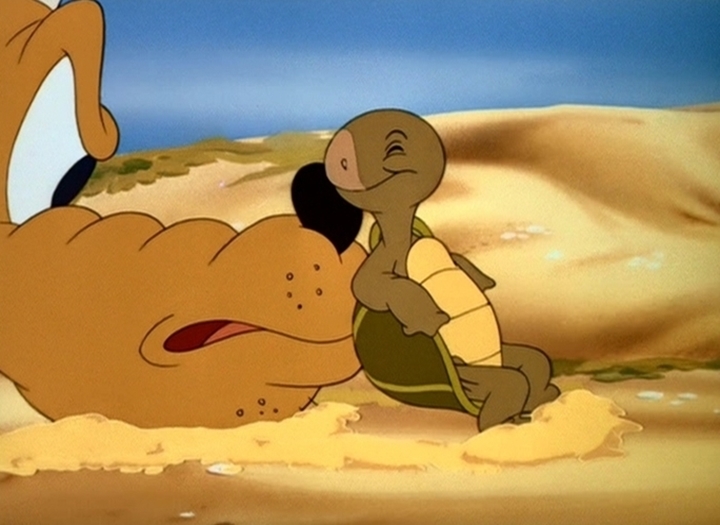 In this cartoon Pluto is a guard dog at the beach, trying to prevent a little cute turtle from swimming. After the little turtle saves Pluto from quicksand, the two become friends.
‘Canine Patrol’ is a cute, but slow and boring cartoon. It introduces the little turtle, the most popular of all animals Pluto befriended in his solo career. The turtle indeed is cute, but it hardly extracts any comedy out of its interactions with Pluto. Nevertheless, it would reappear in two more Pluto cartoons: ‘Pluto’s Housewarming‘ (1947) and ‘Pluto’s Surprise Package’ (1949), which both have all too similar stories.
Watch ‘Canine Patrol yourself and tell me what you think:
This is Pluto cartoon No. 16
To the previous Pluto cartoon: The Legend of Coyote Rock
To the next Pluto cartoon: Pluto’s Kid Brother
Director: Charles Nichols
Release Date: September 22, 1944
Stars: Pluto, Figaro, Minnie Mouse
Rating: ★★½
Review:
 After a cartoon with Cleo, Pinocchio‘s kitten Figaro was coupled to Pluto to co-star in three cartoons, of which ‘First Aiders’ is the first.
In this short both pets want to help Minnie while she’s practicing first aid. Pluto pushes little Figaro away to be the first, a move he regrets when he’s all put in plints and Figaro starts to taunt him.
Even though some of the animation is pretty outlandish, this is a cute, not a funny short. Most interesting are some of the backgrounds, which are kept deliberately vague during the chase scenes. Figaro and Pluto would be together again in ‘Cat Nap Pluto’ (1948) and ‘Pluto’s Sweater’ (1949). Both cartoons are more enjoyable than ‘First Aiders’.
Watch ‘First Aiders’ yourself and tell me what you think:
This is Pluto cartoon No. 12
To the previous Pluto cartoon: Springtime for Pluto
To the next Pluto cartoon: Dog Watch
Director: Hamilton Luske
Release Date: January 7, 1944
Rating: ★★★½
Review:
 Monte (a pelican) and Video (or Viddy, a snipe) live on top of a lighthouse in Montevideo, Uruguay (hence their names).
Viddy tries to prevent Monte, who’s crazy about the practicing war planes nearby, from ‘sleep-flying’. Unfortunately to no avail…
‘The Pelican and the Snipe’ probably is the cutest cartoon relating to World War II. Told by Sterling Holloway, its story is simple and short, and about friendship instead of sex or violence. Typical in its South American setting, it was originally intended for ‘The Three Caballeros‘,released later that year.
‘ The Pelican and the Snipe’ marks Sterling Holloway’s debut as a voice over artist in a Disney short, after appearing in ‘Dumbo‘ (Mr. Stork, 1941) and ‘Bambi‘ (adult Flower, 1942). Holloway would become Disney’s most favorite voice actor, providing voices and voice overs for Disney cartoons up to the late 1970s. In fact, he will be most remembered as the voice of Winnie the Pooh (1966-1974).
Watch ‘The Pelican and the Snipe’ yourself and tell me what you think:
‘The Pelican and the Snipe’ is available on the DVD ‘Walt Disney Treasures: Disney Rarities’
Director: Jack King
Release Date: December 1943
Rating: ★★★½
Review:
 ‘Defense Against Invasion’ is an educational short for the Office of the Coordinator of Inter-American Affairs, the governmental institution, which tried to secure Latin America from the influence of the Axis powers.
The office commissioned quite a few films from Disney, apart from ‘Defense Against Invasion’ e.g. ‘The Grain that built a Hemisphere’ and’The Winged Scourge‘ (both 1943).
Despite its title, ‘Defense Against Invasion’ is not about war, but about vaccination. It uses a voice over to narrate the silent live action sequences of three boys entering a doctor’s office to get vaccinated. This live action part is a little boring, but the principle of vaccination is told with animated sequences in which the human body is depicted as a large city. Here we watch blood cells, ‘little workers’, fight disease (depicted as black creepy crawlers) with modern warfare. Oddly enough, it is the red blood cells, not the white blood cells (who are strangely absent), who are fighting disease.
Despite its peaceful message, the short contains many war metaphors in its fighting sequences, which all have a very science fiction-like look. This makes the short a typical World War II cartoon, after all. The animated sequences are very beautiful. Especially the backgrounds are at times no less than gorgeous.
With its depiction of the body as inhabited by little creatures ‘Defense Against Invasion’ predates Albert Barillé’s successful television series ‘Il était une fois… la vie’ (Once upon a Time… Life, 1987) by over forty years.
Watch ‘Defense Against Invasion’ yourself and tell me what you think:
Director: Bill Roberts
Release Date: August 27, 1943
Rating: ★★★★★
Review:
 ‘Reason and Emotion’ is a rather odd propaganda short, telling us about Reason and Emotion, who are depicted as two little characters living inside our heads.
The short ‘demonstrates’ where uncontrolled emotion can lead to: a man gets slapped in the face by a woman, while the woman eats too much. This makes ‘Reason and Emotion’ one of the first cartoons about weight and diets.
Then the short shows how reason is destroyed by Adolf Hitler (in an extraordinarily vicious, but wonderfully animated caricature), who uses fear, sympathy, pride and hate to indoctrinate the Nazi mind. This is one of the propaganda shorts, which treat the Germans as victims of their Nazi leaders (see also ‘Education for Death‘ from the same year). This contrary to the Japanese, who, in WWII animated propaganda films, were all treated as despicable, mean and low. The film also warns against panic and falling for false rumors.
Emotion is depicted as a rough, dumb, but fun-loving caveman, while Reason is a bespectacled thin and rather boring character. One cannot resist to love the Emotion-type, especially in its female form, as depicted in the woman’s head. This female character is animated with gusto by Ollie Johnston.
Watch ‘Reason and Emotion’ yourself and tell me what you think:
Directors: Dean DeBlois & Chris Sanders
Release Date: June 21, 2002
Rating: ★★★★★
Review:
 Stitch is a genetic experiment (called ‘experiment 6-2-6’) designed to destroy, but sentenced into exile by an intergalactic councel.
All too soon our fluffy little mutant escapes and he ends at the Hawaiian island of Kauai, where he befriends lonely little Lilo, who lives a difficult life with her older sister Nani after the death of their parents. Here Stitch learns to tone down his inclination to destruction and how to love and care.
‘Lilo & Stitch’ is a very appealing film. Its designs, based on Chris Sanders’ idiosyncratic story drawings, are round, cuddly and original. Adding to the friendly atmosphere are the lush watercolor backgrounds, the first in a Disney feature since ‘Bambi‘ (1942). The animation is superb throughout, and Lilo, Stitch and Nani are round and instantly likable characters, who have nothing of the wisecracking arrogance of many other animated characters from the era. The film’s familiar family theme never gets cloying and is countered by a lot of humor. The result is a film full of love and joy.
Probably, because it was made in Orlando, Florida, far from the main company, the film also eschews the rather tiresome Disney musical convention, and features an original soundtrack featuring Elvis Presley songs and Hawaiian chants, instead. True, the plot borrows freely from ‘Men in Black’ (1997), and the science fiction setting feels a little awkward in a Disney film, but the story of loneliness, love and acceptance is well-told, and equally appealing to the young and old.
Moreover, the film proves that one can perfectly well make a good movie out of original and typical elements. A film maker like Hayao Miyazaki knows this, off course. But unfortunately, this message has been lost on the American animation studios, as very few of the subsequent American feature films succeeded in displaying this level of originality in characterization, soundtrack and design. Thus ‘Lilo & Stitch’ remains as Disney’s best attempt at an ‘author film’ (not counting the almost forgotten ‘Teacher’s Pet’ from 2004).
Unfortunately, ‘Lilo & Stitch’ seemed to be Disney’s last masterpiece of traditional animation. Even though it was followed by yet two other 2D animation features, it marked an end of an era lasting 65 years. Disney soon jumped the computer animation band wagon with rather mediocre results, arguably only hitting their stride in 2010 with ‘Tangled‘. Luckily, in 2009 the studio made a surprising, but unfortunately isolated return to the traditional medium with the excellent ‘The Princess and the Frog’.
Watch the trailer for ‘Lilo & Stitch’ yourself and tell me what you think:
Director: Unknown
Release Date: April 30, 1928
Stars: Oswald the Lucky Rabbit, Peg Leg Pete
Rating: ★★★½
Review:
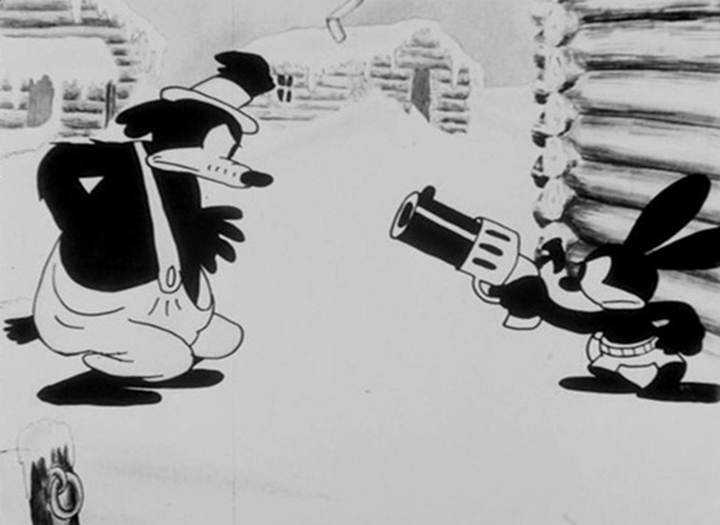 Oswald is a mounted police officer in charge of catching Peg Leg Pete, who, in spite of his name, has two legs here.
Oswald follows Pete on a mechanical horse, but in the end they’re both chased by a bear. Oswald, however, manages to get both Pete and the bear into prison.
‘Ozzie of the Mounted’ feels rather routine, and is less remarkable than say ‘Rival Romeos‘ or ‘Oh, What a Knight‘. The chase scene fills a large part of the cartoon, but contains few clever gags. Nevertheless, the animation of Oswald swinging around on his mechanical horse’s loose spring is still fascinating to watch. It’s also interesting to point out that Oswald’s mechanical horse looks far more mechanical than his mechanical cow in ‘The Mechanical Cow‘ from seven months earlier. This shows the subtle but steady progress the Walt Disney studio was making in animation, even before it became famous for that.
Watch ‘Ozzie of the Mounted’ yourself and tell me what you think:
This is Oswald the Lucky Rabbit cartoon No. 18
To the previous surviving Oswald the Lucky Rabbit cartoon: Bright Lights
To the next Oswald the Lucky Rabbit cartoon: Hungry Hoboes
Director: Unknown
Release Date: March 19, 1928
Stars: Oswald the Lucky Rabbit
Rating: ★★★½
Review:
 Although broke, Oswald tries to enter a vaudeville theater where Mademoiselle Zulu performs her shimmy dancing.
After we watch some cat chorus girls dancing the can-can, Mll. Zulu, a female cat character, is shown doing her erotic shimmy dance, probably inspired by Josephine Baker. Oswald manages to enter the theater by hiding beneath a man’s shadow(!), but he is discovered. He tries to hide in a cage, which contains a fierce leopard. When the leopard breaks loose, and later a couple of lions, the whole theater is emptied.
This rather plotless, yet entertaining short contains many surreal gags and a very flexible use of body parts. Oswald’s body is deformed even more than normal, and in one scene we watch him without his pants on.
The best scene is when Oswald pantomimes his love for Mlle. Zulu. This scene is acted out very well, and this embryonic character animation is far more sophisticated than the animation surrounding it.
Watch ‘Bright Lights’ yourself and tell me what you think:
This is Oswald the Lucky Rabbit cartoon No. 15
To the previous Oswald the Lucky Rabbit cartoon: Rival Romeos
To the next surviving Oswald the Lucky Rabbit cartoon: Ozzie of the Mounted
Director: Unknown
Release Date: March 5, 1928
Stars: Oswald the Lucky Rabbit, Honey, Pete
Rating: ★★★★½
Review:
 In this gag-packed cartoon Oswald and Pete compete over Honey, a female cat character, who was Oswald’s girlfriend in 1928.
Pete and Oswald both ride in their cars to her house in a scene looking forward to the early Mickey Mouse cartoon ‘The Barn Dance‘ from later that year. Oswald serenades her until a goat eats all his sheet music and even his banjo. Then he turns the animal into a hurdy gurdy, like Mickey would do later that year in ‘Steamboat Willie‘. When Pete arrives, he and Oswald fight over Honey, almost tearing her apart. Honey gives them the cold shoulder and leaves with a third guy into the distance. Then our rivals kick each other in remorse, like Donald Duck and Peter Pig would do six years later in ‘Wise Little Hen‘ (1934).
As you may notice, ‘Rival Romeos’ contains quite a lot of embryonic gags that Walt Disney would reuse later in other cartoons. Because of these prophetical gags ‘Rival Romeos’ is a highlight among Disney’s Oswald cartoons.
Watch ‘Rival Romeos’ yourself and tell me what you think:
This is Oswald the Lucky Rabbit cartoon No. 14
To the previous Oswald the Lucky Rabbit cartoon: Africa Before Dark
To the next Oswald the Lucky Rabbit cartoon: Bright Lights
Director: Unknown
Release Date: November 14, 1927
Stars: Oswald the Lucky Rabbit, Peg Leg Pete
Rating: ★★★½
Review:
 Oswald joins a plane race from New York to Paris (inspired by Charles Lindbergh’s flight on May 20-21 that year).
Oswald is introduced as the dark horse and enters the race disguised as a pantomime horse. One of his competitors is an early version of Peg Leg Pete. Pete is the obvious villain, gluing Oswald’s plane to the ground with chewing gum. Luckily, Oswald manages to make a new, rather improbable plane out of a dachshund and two balloons.
Meanwhile, Pete misleads all the other competitors by turning an absurdly high direction indicator. Somehow, Oswald isn’t misled and he and Pete compete to be the first. Pete shoots Oswald out of the air, but it’s Oswald who wins the day. What became of the falling dachshund, however, we’ll never know… [UPDATE: Thanks to David Gerstein we do know: see his comment for the cartoon’s lost end gag]
‘The Ocean Hop’ is a clear forerunner of ‘Plane Crazy‘ (1928), Mickey Mouse’s debut cartoon. Both were inspired by Charles Lindbergh’s historical transatlantic flight. Oswald’s cartoon is not as consistent as Mickey’s, however, and features less spectacular scenes. In one way the differences between the two cartoons show that Walt Disney and Ub Iwerks were constantly improving themselves even at this early stage of their careers.
Watch ‘The Ocean Hop’ yourself and tell me what you think:
This is Oswald the Lucky Rabbit cartoon No. 6
To the previous Oswald the Lucky Rabbit cartoon: All Wet
To the next surviving Oswald the Lucky Rabbit cartoon: Empty Socks
Director: Unknown
Release Date: October 31, 1927
Stars: Oswald the Lucky Rabbit
Rating: ★★★★
Review:
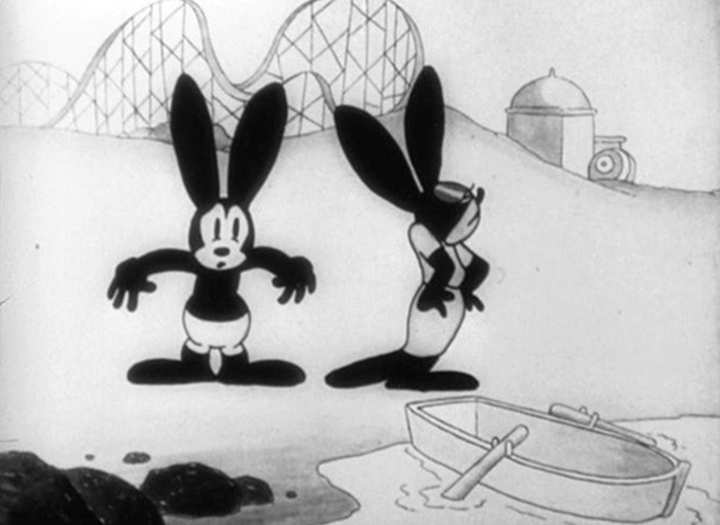 In his fifth film Oswald is a hot dog vendor at the beach.
At one point his girlfriend drops by, only to give him the cold shoulder, so Oswald pretends to be a lifeguard. The girl in turn pretends to drown, but then she really get suck into the ocean by a giant fish. Oswald comes to the rescue and earns a passionate kiss.
Although this film still contains some stiff animation and designs from the early 1920s (for example the dog customer), most of the animation is very flexible and lively, especially that of Oswald and the sea. Many of the hot dog gags were reused in the Mickey short ‘The Karnival Kid‘ (1929).
Watch ‘All Wet’ yourself and tell me what you think:
This is Oswald the Lucky Rabbit cartoon No. 5
To the previous Oswald the Lucky Rabbit cartoon: Great Guns
To the next Oswald the Lucky Rabbit cartoon: The Ocean Hop
Director: Unknown
Release Date: October 17, 1927
Stars: Oswald the Lucky Rabbit
Rating: ★★★
Review:
 War has broken out. This leads to a surprisingly cheerful crowd of people happily volunteering to be a soldier. As if The Great War had never happened.
Oswald volunteers too, after a long goodbye to his girlfriend. In the trenches, he’s still kissing her portrait, until it is bombed by a mouse. This leads to an air battle between Oswald and the little rodent, which ends with Oswald beating up the mice, until he’s confronted by an angry officer. Oswald and the officer get into a bombing duel, in which Oswald uses an elephant, which explodes. In the end even Oswald himself is literally blown to pieces, but he’s revived by his girlfriend who’s a red cross nurse.
The depiction of war in this cartoon is surprisingly positive, and there are a lot of gags. Real danger is never felt, but the cartoon does feature some startling images of huge cannons swooping into the camera. Four years later Hugh Harman, who did some of the animation, would reuse elements of ‘Great Guns’ in his own World War I film ‘Bosko the Doughboy‘ (1931).
Watch ‘Great Guns’ yourself and tell me what you think:
This is Oswald the Lucky Rabbit cartoon No. 4
To the previous Oswald the Lucky Rabbit cartoon: The Mechanical Cow
To the next Oswald the Lucky Rabbit cartoon: All Wet
Director: Unknown
Release Date: October 3, 1927
Stars: Oswald the Lucky Rabbit
Rating: ★★★
Review:
 In his fifth film Oswald has a mechanical cow to deliver milk with.
When his girlfriend gets kidnapped by a mob of gangsters, the cow helps him to rescue her. The gangsters come to a surprisingly cruel end, when they fall off a cliff and are eaten by sharks.
The cow behaves anything but mechanical. On the contrary, it is very rubbery, and even lazy and sleepy in the first scene, and its animation is not different from that of any of the other characters.
Watch ‘The Mechanical Cow’ yourself and tell me what you think:
This is Oswald the Lucky Rabbit cartoon No. 3
To the previous Oswald the Lucky Rabbit cartoon: Oh, Teacher
To the next Oswald the Lucky Rabbit cartoon: Great Guns


 Dr. Grob's Animation Review