You are currently browsing the category archive for the ‘Warner Bros. films’ category.
Director: Rudolf Ising
Release Date: October 31, 1931
Stars: Piggy, Fluffy
Rating: ★★★★½
Review:
 With Foxy gone, Harman and Ising conceived a new star, Piggy, who, like Foxy is exactly Mickey Mouse (including the trousers), but now in Pig form. As with his predecessor, the plagiarism is most visible in Piggy’s girlfriend Fluffy, who is as Minnie as Piggy is Mickey.
Piggy was even more short-lived than Foxy, lasting only two cartoons, of which this is the first. In it we watch Piggy and Fluffy visiting a theater. At a certain point Piggy hits the stage to perform ‘Silver Threads Among The Gold’, a 1873 hit song that by 1931 had become synonymous with old-fashionedness. No wonder he’s booed away. At that point three drunkards burst into the title song. Piggy gets drunk, too, and leaves the theater and his girlfriend.
Outside he provides his car with some booze, a story idea borrowed from ‘Traffic Troubles‘ (Mickey Mouse) and ‘The New Car’ (Flip the Frog) from earlier that year. Unlike the earlier two films, though, this leads to a wonderfully drunken scene, in which the whole background becomes wobbly. This is one of the most memorable scenes of all early Warner Bros. cartoons, making ‘You Don’t Know What You’re Doin’!’a must-see, despite the rather mediocre scenes preceding it. Moreover, the cartoon features some particularly hot jazz music, provided by Gus Arnheim’s Brunswick Recording Orchestra.
Watch ‘You Don’t Know What You’re Doin’!’ yourself and tell me what you think:
‘You Don’t Know What You’re Doin’!’ is available on the DVD ‘Looney Tunes Golden Collection Volume Six’
Director: Rudolf Ising
Release Date: October 3, 1931
Stars: Foxy
Rating: ★★★½
Review:
 ‘One More Time’ is an aptly titled short, as it marks the third and last cartoon to star Foxy, Warner Bros.’ fox-like Mickey Mouse rip-off.
In this cartoon he’s a police officer, fining a hippo lady for driving too fast, and rescuing his Minnie Mouse-like girlfriend from some thugs. He does so riding a mechanical horse, a relic from the Oswald the Lucky rabbit cartoons (e.g. ‘Ozzie of the Mounted‘, 1927), on which Harman and Ising had worked previously. Strangely enough, Foxy is machine-gunned by one of the gangsters in the end. Perhaps this is why he never returned to the animated screen…
The short has a strong urban setting, uncommon in the Hollywood cartoons of the time, and it features some dazzling perspective animation, but otherwise it’s just another mediocre entry in the early Merrie Melodies canon.
Watch ‘One More Time’ yourself and tell me what you think:
‘One More Time’ is available on the DVD ‘Looney Tunes Golden Collection Volume Six’
Director: Rudolf Ising
Release Date: September 5, 1931
Stars: Foxy
Rating: ★★★
Review:
 ‘Smile, Darn Ya, Smile!’, the second of the Merrie Melodies, is also the second to feature that short-lived early star of Warner Bros., Foxy.
The film is practically a remake of Oswald’s first cartoon, ‘Trolley Troubles’ (1927), on which Harman and Ising had worked themselves: Foxy rides a trolley, inviting his very, very Minnie Mouse-like girlfriend along. Like in the former Oswald film, the ride ends with Foxy losing control of the trolley, which leads to some spectacular perspective animation. Unlike the earlier film, however, ‘Smile, Darn ya, Smile!’ ends rather cornily, when it’s revealed it was all a dream.
The title song is sung several times during the cartoon, e.g. by four hobos. It was revived more than fifty years later in ‘Who Framed Roger Rabbit‘ (1988), when Eddie Valiant enters Toontown.
Watch ‘Smile, Darn Ya, Smile’ yourself and tell me what you think:
‘Smile, Darn Ya, Smile’ is available on the DVD ‘Looney Tunes Golden Collection Volume Six’
Director: Hugh Harman
Release Date: October 17, 1931
Stars: Bosko
Rating: ★★★
Review:
 In ‘Bosko the Doughboy’ Bosko is a soldier during World War one.
The cartoon opens spectacularly with several war scenes, including an enemy soldier firing his automatic gun at the audience. The cartoon is completely plotless, and Bosko actually only does three things:
- trying to cook a meal and kissing the picture of his sweetheart, before both are bombed (echoing the Oswald cartoon ‘Great Guns‘ from 1927 on which Hugh Harman had worked as an animator);
- helping an officer to get rid of his flees;
- saving a hippo, who has swallowed a bomb, by zipping its body open.
The cartoon is remarkably violent, and there’s a lot of killing going on. For example, we watch literally a dog being shot to pieces. Because all the animals involved still have mechanical bodies (a legacy of Harman and Ising’s work on Oswald the Lucky Rabbit), pain is never suggested, and the violence remains cartoony. For example, the dog, after being shot, just walks away much shorter, while a bird with a hole in his body only collapses because he’s supposed to, not because he’s in pain.
Nevertheless, there’s little to enjoy in Bosko’s World War I cartoon, and even when fought out by practically invulnerable animals, it remains a disturbing event.
Watch ‘Bosko the Doughboy’ yourself and tell me what you think:
‘Bosko the Doughboy’ is available on the DVD ‘Looney Tunes Golden Collection Volume Six’
Director: Neil McGuire
Release Date: December 1930
Rating: ★
Review:
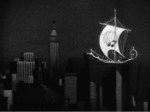 ‘Cryin’ for the Carolines’ was the first of the so-called Spooney Melodies, a short-lived series, produced by Leon Schlesinger, using semi-abstract images set to organ music.
Only five are known, and only this one has survived. The short features Milton Charles, ‘the singing organist’, singing and playing the sugary tune. Neil McGuire provides the classy, but static art deco art, e.g. of a sailing ship and a city skyline.
There’s practically no animation involved, although there is some movement on the screen. The images have an avant-garde quality, but as almost nothing happens, the complete film fails to satisfy. Schlesinger followed the series with the much more successful Merrie Melodies.
Watch ‘Cryin’ for the Carolines’ yourself and tell me what you think:
‘Cryin’ for the Carolines’ is available on the DVD ‘Looney Tunes Golden Collection Volume Six’ and the Blu-Ray ‘Looney Tunes Platinum Collection: Volume 2’
Directors: Hugh Harman & Rudolf Ising
Release Date: October 1930
Stars: Bosko
Rating: ★★½
Review:
 ‘Congo Jazz’, Bosko’s second official cartoon, is Harman and Ising’s answer to Disney’s ‘Jungle Rhythm‘ (1929).
Like Disney’s cartoon, it hasn’t aged very well. The cartoon opens with Bosko wearing a pith helmet and exploring a supposedly African jungle. When confronted by a tiger (a species not endemic to Africa), Bosko immediately loses the pith helmet.
He appeases the tiger with music, and then kicks it over a cliff. Then he has to sooth a large ape, which he does by giving it some chewing gum. Together they play some plucking string music with their gums, while a few monkeys dance. Soon, other animals join in, e.g. a kangaroo, another rather un-African animal. Bosko directs all the animals into an upbeat tune.
The cartoon is low on gags and feels endless, especially during the musical part. The most extraordinary scene is that of a palm tree shimmying to Bosko’s music as if it were a woman. The animation of Bosko is still very rooted in the Oswald-era: Bosko’s body is very flexible, and almost mechanical.
Watch ‘Congo Jazz’ yourself and tell me what you think:
‘Congo Jazz’ is available on the DVD ‘Looney Tunes Golden Collection Volume Six’
Director: Hugh Harman
Release Date: September 19, 1931
Stars: Bosko
Rating: ★★★
Review:
 ‘Bosko Shipwrecked!’ opens with a great cartoon gag, in which the title card is washed away to show us a stormy scene, with Bosko at the rudder.
In the next scene Bosko is washed ashore a tropical island. When fleeing from a lion, Bosko enters a cannibal settlement. Luckily our hero can escape certain death by climbing on a rhino in a lake.
‘Bosko Shipwrecked!’ is hampered by long scenes, which are surprisingly low on gags. The animation, on the other hand, is fluent, and at times no less than outstanding, with the lion chase scene as a particular highlight. The film’s best gag is when out of the cooking pot a skeleton appears to shake hands with Bosko: “Come on in, the water is fine!“.
Watch ‘Bosko Shipwrecked!’ yourself and tell me what you think:
‘Bosko Shipwrecked!’ is available on the DVD ‘Uncensored Animation 2: Cannibals!’
Director: Rudolf Ising
Release Date: August, 1931
Stars: Foxy
Rating: ★★★½
Review:
 After twelve Looney Tunes, all starring Bosko, Harman and Ising started a new cartoon series for Warner Bros. with the clearly Silly Symphonies-inspired name ‘Merrie Melodies’.
Unlike the Looney Tunes, the Merrie Melodies would be one-off cartoons, each one promoting a different song from the Warner Bros. song catalog. Indeed, the Merrie Melodies should at least feature one complete chorus of a Warner Bros.-owned tune. This rule continued until the end of the 1930s, and rather hampered the series, for the obligate song sequence would often stop the action of the cartoon.
‘Lady Play Your Mandolin’ is the very first of the Merrie Melodies. It features the title song, which is sung twice during the cartoon. Without explanation, the cartoon features a Mexican cafe setting, which is visited by the hero, Foxy, who was to be Warner Bros.’ answer to Mickey Mouse.
Although not as blatant an imitation as Van Beuren’s Milton Mouse (see ‘Circus Capers‘ and ‘The Office Boy‘), Foxy clearly is Mickey Mouse but with pointed ears and a fluffy tail. Indeed, when watching this cartoon my girlfriend thought it was an early forerunner of Mickey. Foxy never came near Mickey’s popularity, however, and was abandoned after a mere three cartoons.
‘Lady Play Your Mandolin’ is the character’s great testimony. The film is completely plotless, but simply bursts with joy. The short features a lot of flexible animation and everyone moves to Frank Marsales’s peppy music (played by Abe Lyman’s Brunswick Recording Orchestra), including the tables, the cacti, the trees and the cafe itself. There are plenty of gags all around, the most extraordinary one being Foxy’s drunken horse playing its own head as a trombone.
Foxy also started a long Warner Bros. tradition of Al Jolson imitations, when singing the main melody, while his girlfriend (Minnie Mouse but with pointed ears) boop-oop-a-doops. None of the cartoon makes any sense, but its sheer joy makes watching it a highly entertaining experience.
Watch ‘Lady, Play Your Mandolin’ yourself and tell me what you think:
‘Lady, Play Your Mandolin’ is available on the DVD ‘Little Caesar’
Director: Hugh Harman & Rudolf Ising
Release Date: April 19, 1930
Stars: Bosko, Honey
Rating: ★★
Review:
 Harman & Ising’s pilot ‘Bosko the Talk-ink Kid‘ led to a succesful contract with Leon Schlesinger, and in April 1930, the young studio could release their first film for Warner Bros.: ‘Sinkin’ in the Bathtub’.
‘Sinkin’ in the Bathtub’ is the very first of the Looney Tunes, Harman and Ising’s first of three series which name was an all too obvious variation on Walt Disney’s successful Silly Symphonies. In 1931 they would launch the Merrie Melodies, and in 1934, when at MGM, the Happy Harmonies.
Schlesinger had sold the series to Warner Bros. with the prospect of selling their sheet music, and music would be an important part of both the Looney Tunes and Merrie Melodies until the end of the 1930s. Apart from the title song, one can hear ‘Forever Blowing Bubbles’ when Honey turns her bath tub into Bosko’s saxophone, making him blowing bubbles with his instrument.
Animated by Friz Freleng, ‘Sinkin’ in the Bathtub’ features Bosko, the star of ‘Bosko the Talk-ink Kid’, and Warner Bros.’ sole star from 1930 to 1933. Bosko invites his girlfriend Honey for a ride in his anthropomorphized car (which he finds on the toilet(!)). On their journey they experience problems with a cow and a steep hill. The ride ends in a pool.
The cartoon is well-animated and cheerful, but surprisingly boring at the same time, even though it lacks the endless song-and-dance-routines of contemporary Mickey Mouse cartoons. Bosko and his girl behave like Oswald and his girlfriend, and are only different in design, being clearly black stereotypes. They are totally devoid of any personality. In fact, Bosko would never develop one, and eventually it became even unclear what Bosko actually was, as exemplified by the following anecdote from Jack Zander, quoted by Leonard Maltin in ‘Of Mice and Magic’ (page 225):
“One Day a porter at the studio said to young animator Jack Zander, “I want to ask you something about that character you’ve got. I know Mickey Mouse, and Krazy Kat, and Oswald the Rabbit… but Bosko the what?”
Watch ‘Sinkin’ in the Bathtub’ yourself and tell me what you think:
‘Sinkin’ in the Bathtub’ is available on the DVD ‘Looney Tunes Golden Collection Volume Three’ and on the Blu-Ray ‘Looney Tunes Platinum Collection: Volume 2’
Directors: Hugh Harman & Rudolf Ising
Production Date: May 1929
Stars: Bosko, Rudolf Ising
Rating: ★★★
Review:
 In 1928 Charles Mintz had hired away virtually Walt Disney’s complete staff and main cartoon character, Oswald the Lucky Rabbit. These animators now came to work for a studio, set up by George and Margaret Winkler to produce more Oswald cartoons. However, ca. one year later Universal, who owned Oswald, broke with the Winklers, gave Oswald to Walter Lantz, and left the former Disney animators out of work.
Hugh Harman and Rudolph Ising now tried to set up a studio of their own, and following the overnight success of ‘Steamboat Willie‘, they knew they had to come up with a character fit for sound. This new star was Bosko, a little negro, who, in his first appearance, had a remarkably low voice, provided by animator Max Maxwell. Bosko is introduced in ‘Bosko the Talk-ink Kid’, Harman and Ising’s pilot film, made to sell their new studio.
The film starts with Rudolf Ising drawing Bosko and talking with him. Then Bosko performs a little dance, imitates a stereotypical Jew, and plays the piano. He then starts to sing ‘Sonny Boy’, but unfortunately with an awful voice, which prompts Ising to put the cartoon character back into the pen and the ink pot. But Bosko returns from the inkwell to say the very first version of that famous Warner Bros. line: “So long folks!“.
Bosko is not really an endearing character and the film is a little bit slow, yet it’s easy to see why this pilot film sold: the interplay between the animator and the cartoon character, although by 1929 far from new, still looks fresh, and the dialogue adds a new dimension to the trick. This dialogue is way more sophisticated than anything made at Disney at the time. Bosko jabbers along, with a lot of lip-synchronization, which is not always perfect, but mesmerizing, nonetheless. Mickey would go lip-synch only two months later, in ‘The Karnival Kid‘, but even then his facial expressions were to be less natural than Bosko’s in this little short. Thus ‘Bosko the Talk-ink Kid’ is an absolute milestone in animation history, and a rare film in which Harman and Ising were in fact ahead of their former employer.
The animation on Bosko, on the other hand, looks very, very Disney-like and is almost an exact copy of Ub Iwerks’s animation style. This would become a Harman-Ising trademark: combining sophistication with copycatting. This unfortunately would often prevent their films from being entirely new or original.
Anyhow, ‘Bosko the Talk-ink Kid’ raised the interest of Leon Schlesinger, a newcomer in the animation field, who sold the idea of a new cartoon series to Warner Bros., with the argument that the animated shorts could be used to promote Warner Bros. songs. Thus, the famous Warner Bros. animation studio was born!
Watch ‘Bosko the Talk-ink Kid’ yourself and tell me what you think:
‘Bosko the Talk-ink Kid’ is available on the DVD set ‘Looney Tunes Golden Collection, Vol. 1’ and the Blu-Ray ‘Looney Tunes Platinum Collection: Volume 2’
Director: Friz Freleng
Release Date: April 21, 1945
Stars: Bugs Bunny, Yosemite Sam
Rating: ★★★★½
Review:
 ‘Hare Trigger’ introduces that tiny yet explosive adversary to Bugs Bunny, Yosemite Sam.
His introduction music is Franz Schubert’s Erlkönig, and train robbery is his profession. However, on the train he encounters Bugs, who gives the short-tempered bandit a hard time.
The cartoon contains a shot of an über-cool Bugs rolling a cigarette, a gag repeated and improved on in ‘Bugs Bunny Rides Again‘ (1948). The short also contains live action footage in the ‘club bar’ wagon. The gun drawing scene is a highlight, as is Yosemite Sam’s death scene, which bugs invokes with ketchup. The cartoon ends brilliantly with a tongue-in-cheek cliffhanger.
According to Freleng he needed a stronger adversary to Bugs than Elmer Fudd ever was, and Yosemite Sam perfectly fitted the job. He was a delightful opponent to Bugs Bunny, and he became Friz Freleng’s favorite bad guy, lasting until 1964, and starring 31 cartoons in total, nearly all with Bugs Bunny. Perhaps Freleng was so fond of the character because he was partly based on Freleng himself.
In any case, he soon took Sam out of his Western origin, making him a.o. a pirate (‘Buccaneer Bunny‘, 1948), a foreign soldier (‘Bunker Hill Bunny‘, 1950) and a sheik (‘Sahara Hare’, 1955). Free from his Western origins Yosemite Sam could be Bugs Bunny in every country and every period of time, and in this respect he anticipates the Little Guy, the Pink Panther’s adversary, who also sprouted from Friz Freleng’s imagination.
Watch ‘Hare Trigger’ yourself and tell me what you think:
http://www.dailymotion.com/video/x2fbv22
This is Bugs Bunny cartoon No. 32
To the previous Bugs Bunny cartoon: Unruly Hare
To the next Bugs Bunny cartoon: Hare Conditioned
Director: Chuck Jones
Release Date: January 9, 1943
Stars: Daffy Duck, Elmer Fudd
Rating: ★★★½
Review:
 In ‘To Duck or not to Duck’ Elmer Fudd shoots Daffy out of the sky. The duck then challenges the ‘sportsman’ for a boxing match, something which takes place immediately for a crowd of ducks. Needless to say, the match is far from fair.
‘To Duck or not to Duck’ is the first Warner Bros. cartoon to star both Daffy and Elmer. The poor hunter is good fowl for the foul-playing duck and his brethren. When Elmer gets his revenge in the end, we’re almost surprised.
The cartoon knows some good gags, but Jones’s timing is still sloppy, and not every gag hits the screen well. Highlight may be Daffy’s ridiculously haughty humphing at Elmer Fudd’s apology for shooting him.
Note the surprisingly empty backgrounds in this cartoon.
Watch ‘To Duck or not to Duck’ yourself and tell me what you think:
This is Daffy Duck cartoon No. 17
To the previous Daffy Duck cartoon: My Favorite Duck
To the next Daffy Duck cartoon: The Wise Quacking Duck
‘My Favorite Duck’ is available on the DVD-set ‘Looney Tunes Golden Collection Volume Six’
Director: Chuck Jones
Release Date: December 5, 1942
Stars: Daffy Duck, Porky Pig
Rating: ★★★★
Review:
 ‘My Favorite Duck’ is Chuck Jones’s third try on Daffy Duck (after ‘Daffy Duck and the Dinosaur‘ from 1939 and ‘Conrad the Sailor‘ from 1942), and his first cartoon starring both Daffy and Porky Pig.
In this cartoon he finally manages to get grip of Daffy’s wacky character: Daffy’s antics are not only annoying, they’re also funny, and well-timed, and Porky is much more sympathetic victim to his antics than Caspar Caveman and Conrad ever were.
When Porky goes camping, the duck nags him, protected by the law which forbids Porky to harm any duck. Nonetheless, in the end, the tables are turned and Porky has his revenge. However, at that point the film breaks, and Daffy tells us ‘what happened’, or does he?
The film break gag first appeared in Max Fleischer’s Popeye cartoon ‘Goonland‘. Six years later Jones reused this wonderful film break gag in ‘Rabbit Punch‘ (1948).
Like in other Chuck Jones cartoons from this era, the beautifully stylized backgrounds are a highlight on their own.
Watch ‘My Favorite Duck’ yourself and tell me what you think:
http://www.dailymotion.com/video/xzm9wc_daffy-duck-my-favorite-duck-video_shortfilms
This is Porky Pig cartoon no. 98
To the previous Porky Pig cartoon: Porky’s Cafe
To the next Porky Pig cartoon: Confusions of a Nutzy Spy
This is Daffy Duck cartoon No. 16
To the previous Daffy Duck cartoon: The Daffy Duckaroo
To the next Daffy Duck cartoon: To Duck or Not to Duck
‘My Favorite Duck’ is available on the DVD-set ‘Looney Tunes Golden Collection Volume Six’
Director: Tex Avery
Release Date: July 5, 1941
Stars: Bugs Bunny, Willoughby
Rating: ★★★★★
Review:
 The dumb dog Willoughby was a minor Warner Brothers character, created by Tex Avery, and starring a few cartoons in the early 1940s.
The dog kept changing names, and that’s probably one of the reasons he never got famous. ‘The Heckling Hare’ was his third cartoon, and in it he remains nameless. Tex Avery puts him against his much more famous creation, Bugs Bunny. Penned by Michael Maltese, the result is an inspired cartoon, full of gags.
Willoughby swaps places with Elmer Fudd in hunting rabbits. He’s of course no more successful than Elmer, and Bugs tricks him a lot. The best scene is when Bugs makes the dumb dog making faces, while he puts forward a sign to the audience reading “Silly, isn’t he?”.
However, the cartoon is most famous for its finale: for it ends with a lengthy fall from a cliff by both characters. This scene is obviously cut short in the final version. Producer Leon Schlesinger didn’t like the original ending, which apparently involved no less than two other falls, and ordered the cut. Rumors have it that this was the reason for Tex Avery to leave Warner Bros. This isn’t true. Tex Avery wanted to do a series combining live action animals with animated mouths. Schlesinger wasn’t interested, so Avery ended up doing this series, Christened ‘Speaking of the Animals’ at Paramount. However, this was not a success, and by September 1941 Avery was making cartoons again, now at MGM, where he would direct his greatest shorts.
In his book ‘Chuck Amuck’ Chuck Jones argues that ‘The Heckling Hare’ was the cartoon that re-established Bugs Bunny’s character, after three somewhat misguided cartoons by himself, Tex Avery and Friz Freleng. Bugs Bunny certainly is much more himself and in any of the previous cartoons. In any case, he would meet Willoughby again in the dog’s very last cartoon, ‘Hare Force’ (1944), directed by Friz Freleng, in which the dog is called ‘Sylvester’.
Watch ‘The Heckling Hare’ yourself and tell me what you think:
https://www.dailymotion.com/video/x612jad
This is Bugs Bunny cartoon No. 5
To the previous Bugs Bunny cartoon: Hiawatha’s Rabbit Hunt
To the next Bugs Bunny cartoon: All This and Rabbit Stew
Director: Friz Freleng
Release Date: May 23, 1942
Rating: ★
Review:
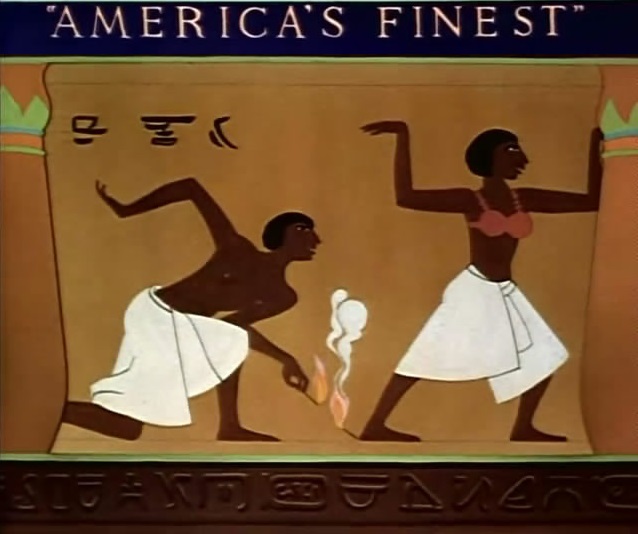 From the early 1930s to the early 1940s Warner Bros. released several cartoons in which books, magazines etc. come to life. Of all these cartoons, ‘Lights Fantastic’ is probably the most extreme and the most dated.
It opens with a real life shot of Times Square in New York, and all sequences after that supposedly take place in neon billboards on this square. This results in little movement, a few gags on Chinese and no laughs.
Present day viewers like me don’t even have a clue how many of these billboards were based on real and familiar ones. I personally could only recognize Mr. Peanut (from Planters). No doubt most of the fun disappeared with the familiarity of the pictured advertising. However, I seriously doubt whether this cartoon has ever been a winner, for its few gags are lame, and don’t build up to a finale, at all.
Watch an excerpt from ‘Lights Fantastic’ yourself and tell me what you think:
Director: Bob Clampett
Release Date: April 11, 1942
Rating: ★★★★★ ♕
Review:

‘Horton Hatches The Egg’ is a unique film within Bob Clampett’s oeuvre, and indeed the complete Warner Bros. canon: it’s the studio’s only book adaptation, it lacks sex and violence, and there is nothing of the zany and extreme animation so typical of Clampett’s unit.
Instead, we’re treated on a surprisingly faithful adaptation of Dr. Seuss’s children’s book to the screen. The cartoon uses most of Dr. Seuss’s rhymes, with adding only a little dialogue of its own, which is easily identifiable because of the lack of rhyme. Dr. Seuss’s designs, too, are wonderfully transferred to the animated screen. Especially Horton and the other forest animals have a distinctive Dr. Seuss character.
The Warner Bros. team departs from Dr. Seuss’s drawings, however, in the human designs. The three hunters are rather bland in Dr. Seuss’s children’s book, but Clampett made them a very funny trio in the cartoon. Moreover, some of the wild Warner Brothers humor has crept into the cartoon, most typically two movie star references, which, unfortunately, date the film a little: Lazy Mayzie imitates Katharine Hepburn, and there’s a fish with Peter Lorre’s features, who, after seeing Horton on a ship, shoots itself, exclaiming “Now I’ve seen everything!”.
Today, a gag like this is regarded inappropriate for children, and it might be this gag that is responsible for the little screen time the cartoon gets today. This is very unfortunate, because this animated adaptation of a Dr. Seuss book is not only the first of all, it is also one of the best, being second only to Chuck Jones’s ‘How The Grinch Stole Christmas‘ from 1966.
Watch ‘Horton Hatches the Egg’ yourself and tell me what you think:
http://www.metatube.com/en/videos/195775/Horton-Hatches-the-Egg-Cartoon-1942/
Director: Bob Clampett
Release Date: September 25, 1943
Stars: Bugs Bunny, Porky Pig, Elmer Fudd, Daffy Duck?
Rating: ★★★★★ ♕
Review:
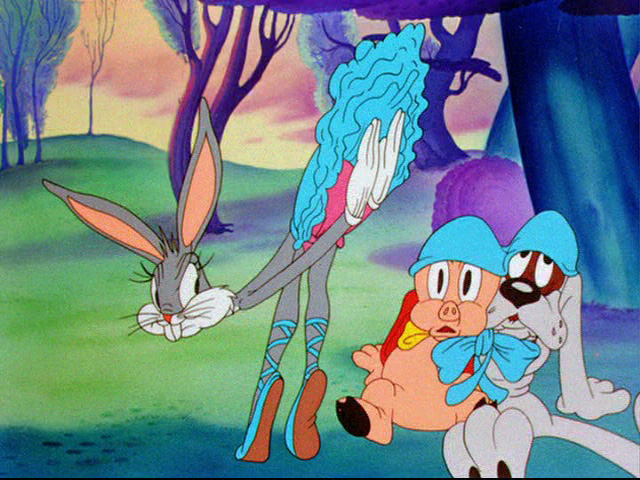 ‘A Corny Concerto’ is a two part spoof on Disney’s most ambitious feature, ‘Fantasia’ (1940), using two waltzes by Johann Strauss jr.
The cartoon features a very Fantasia-like opening, with Elmer Fudd as a clear caricature of Deems Taylor. He announces ‘Tales from the Woods’, which tells about Porky Pig and a dog hunting Bugs Bunny. Porky fills the role of Elmer Fudd in this sequence, and it’s the only cartoon in we can watch him hunting Bugs Bunny. This first part is a classic Bugs Bunny routine, complete with death scene, but now timed to music and acted in pantomime. With its overt mix of high culture and silliness this part is a direct ancestor to Chuck Jones’s later ‘What’s Opera, Doc?‘ (1957).
The second part is a story on ‘The Blue Danube’. It opens with flowers dropping on water, just like in the Nutcracker Suite sequence in Fantasia. This part tells about a little black duck, an infant version of Daffy Duck, trying to join a family of swans, and finally saving them from a vulture by destroying him with TNT. As this story is some kind of inverse of ‘The Ugly Duckling‘ (another acclaimed Disney masterpiece), this could be considered to be a parody within a parody.
Apart from Elmer Fudd’s speeches, the cartoon is completely pantomimed, and full of the wild and zany animation so typical of Bob Clampett’s unit. The backgrounds are lush and colorful, and reminiscent of the the Pastoral Symphony sequence in the original Fantasia. Their designs become overtly ridiculous in ‘The Blue Danube’, with Greek columns placed randomly in the water.
The result is a highly original mix of style and nonsense, and a great testimony of what Leon Schlesinger’s studio could do on a limited budget. In all, the cartoon is an undisputed classic, and very enjoyable, even if you don’t know its topic of parody.
Watch ‘A Corny Concerto’ yourself and tell me what you think:
This is Bugs Bunny cartoon No. 19
To the previous Bugs Bunny cartoon: Wackiki Wabbit
To the next Bugs Bunny cartoon: Falling Hare
This is Porky Pig cartoon No. 102
To the previous Porky Pig cartoon: Porky’s Pig’s Feat
To the next Porky Pig cartoon: Tom Turk and Daffy
Director: Bob Clampett
Release Date: October 3, 1942
Rating: ★★★★★
Review:
 ‘The Hep Cat’ was the first Looney Tune made in color. As the Merrie Melodies already were in color, this cartoon heralded a full color era for the Leon Schlesinger studio.
In ‘The Hep Cat’ the dog Rosebud (Willoughby but with another name) tries to catch a ‘hep cat’, a feline womanizer who, on his turn, tries to get a girl, a.o. by speaking with a deep french voice, anticipating the romancing skunk Pepe Le Pew by three years. Rosebud succeeds to seduce the jive cat by using a sexy kitten-like hand puppet. He looses the chase however, and in the last shot we can see the hep cat stroking the hand puppet, saying, with a Jerry Colonna voice ” I can dream, can’t I?”.
‘The Hep Cat’ does not have much of a story, but who cares? It’s an intoxicating and jazzy cartoon, and from the moment the Hep Cat starts singing ‘Java Jive’ with alternate lyrics, you’re lost. The short is fast and funny, full of uninhibited sex and violence gags and throughout the picture one keeps marveling at the extreme and amazingly flexible animation from Bob Clampett’s unit.
Watch ‘The Hep Cat’ yourself and tell me what you think:
Director: Friz Freleng
Release Date: May 18, 1940
Stars: Daffy Duck, Porky Pig, Leon Schlesinger
Rating: ★★★★★ ♕
Review:
 ‘You Ought to Be in Pictures’ is the very first cartoon to bridge two ideas of animation film figures being ‘real’.
First, the idea that cartoon figures can come alive from the drawing board into the real world, an idea that hauls all the way back to Max Fleischer’s first ‘Out of the Inkwell’ cartoons (1915). The second idea is that of cartoon figures being real Hollywood stars, explored in cartoons such as ‘Felix in Hollywood’ (1923), ‘Movie Mad‘ (1931), ‘Mickey’s Gala Premier‘ (1933) and especially ‘The Autograph Hound‘ (1939), with which ‘You Ought to Be in Pictures’ has most in common. ‘You Ought to Be in Pictures’ synthesizes these two ideas, making it a direct ancestor of ‘Who Framed Roger Rabbit‘ (1988).
‘You Ought to Be in Pictures’ was one of the first films director Friz Freleng made after his return from an ill-fortuned move to MGM, and as Jerry Beck points out in the audio commentary track, one can see this film somehow as autobiographical.
In any case, this short marks is Freleng’s first take on Daffy Duck, and he places him firmly as Porky’s rival. In this cartoon Daffy is not necessarily zany, like in Tex Avery’s and Bob Clampett’s cartoons, but overconfident and sneaky, with a tendency to show off; character treats that would be explored more from 1950 on, especially by Chuck Jones. However, by then the relation between Porky and Daffy would be changed completely.
In ‘You Ought to Be in Pictures’ Porky is still an innocent, cute and Boyish character. In the opening scene we watch him being drawn by animator Fred Jones on the drawing board. When all animators have rushed off to lunch (reused footage from a Leon Schlesinger Christmas Party film), Daffy, framed on the wall, addresses the Porky drawing. He convinces Porky to leave Leon Schlesinger’s studio to get a real job in the business of feature films. Leon Schlesinger lets Porky go, saying into the camera “he’ll be back!”. While Porky has a hard time in the neighboring live action studio, Daffy tries to get his plays at Warner Bros. But Porky returns and beats the hell out of the double-crosser.
‘You Ougt to Be in Pictures’ is a lovely cartoon. It mixes animation and live action, partly from other Warner Bros. features, to great effects. The scene in which Porky talks to Leon Schlesinger is very convincing, and Porky’s drive back no less than breathtaking. Besides Leon Schlesinger, the film stars writer Michael Maltese as a guard, animator Gerry Chiniquy as a director, and executive producer Henry Binder as a sound man. However, as the live action footage was shot silently, all are voiced by Mel Blanc, except for Leon Schlesinger who does his own voice.
Watch ‘You Ought to Be in Pictures’ yourself and tell me what you think:
http://www.dailymotion.com/video/x1ykibb_daffy-duck-ep-12-you-ought-to-be-in-pictures_fun
This is Porky Pig cartoon No. 73
To the previous Porky Pig cartoon: Porky’s Poor Fish
To the next Porky Pig cartoon: The Chewin’ Bruin
This is Daffy Duck cartoon No. 9
To the previous Daffy Duck cartoon: Wise Quacks
To the next Daffy Duck cartoon: A Coy Decoy
‘You Ought To Be In Pictures’ is available on the DVD-sets ‘The Looney Tunes Golden Collection Volume Two’, ‘Porky Pig 101’, and the Blu-Ray ‘Looney Tunes Platinum Collection: Volume 2’
Director: Chuck Jones
Release Date: November 17, 1951
Stars: Daffy Duck, Porky Pig
Rating: ★★★★★
Review:
 Following the premise of ‘The Scarlet Pumpernickel’ (1950), Chuck Jones launched a series of cartoons starring Daffy as a misguided hero and Porky as his calm side-kick. ‘Drip-along Daffy’ is the first of this excellent series, with the others being ‘Duck Dodgers in the 24 1/2th Century‘ (1953), ‘My Little Duckaroo’ (1954), ‘Rocket Squad’ (1956), ‘Deduce You Say’ (1956) and ‘Robin Hood Daffy‘ (1958).
In ‘Drip-along Daffy’ Daffy is a typical Western hero, clad in white, riding a well-groomed horse, with an unshaven (!) Porky as ‘comic relief’, riding a donkey. Daffy wants to clean up ‘Lawless Western Town’, which lawlessness is depicted in a series of Tex Averyan gags. However, Daffy finds a heavy adversary in the villain Nasty Canasta…
‘Drip-along Daffy’ is a delightful and gag-rich cartoon, highlight being the strong drink scene, an elaboration on a gag Avery had made in ‘The Shooting of Dan McGoo‘ (1945). Also noteworthy is the high noon scene, in which Jones and his team indulge in numerous camera angles depicting Daffy and Canasta approaching each other. Such original and devoted cinematography had rarely been seen since the Frank Tashlin days.
Nasty Canasta who would return in two more cartoons: ‘My Little Duckaroo’ from 1954 and ‘Barbary Coast Bunny’ from 1956.
Watch ‘Drip-along Daffy’ yourself and tell me what you think:
https://www.dailymotion.com/video/x6em0i8
This is Porky Pig cartoon no. 136
To the previous Porky Pig cartoon: The Wearing of the Grin
To the next Porky Pig cartoon: Dog Collared
This is Daffy Duck cartoon No. 56
To the previous Daffy Duck cartoon: Rabbit Fire
To the next Daffy Duck cartoon: The Prize Pest
‘Drip-along Daffy’ is available on the Blu-Ray ‘Looney Tunes Platinum Collection: Volume 2’ and on the DVD-set ‘Looney Tunes Golden Collection Volume One’


 Dr. Grob's Animation Review