Director: Rudolf Ising Release Date: August 26, 1933 Rating: ★★★★ Review:
‘We’re in the Money’ is entirely built around the catchy opening tune of the Warner Bros. musical ‘Gold Diggers of 1933’.
The joyous song, with its anti-Great Depression theme is entertaining enough to carry the whole cartoon. It is played and sung by toys and dolls in an apartment store at night. Even coins from a cashier join in, singing ‘we are the money’. There’s also a doll doing a Mae West imitation.
Composer Frank Marsales is on the loose here, and plays endless variations on the title song. There’s absolutely no story, whatsoever, but the cheerful mood is captivating, and despite the lack of real action, the cartoon will leave you with a smile.
Watch ‘We’re in the Money’ yourself and tell me what you think:
Even though Harman and Ising would never surpass Walt Disney, partly because of a lack of vision, partly because of lack of budget, there’s no denying that by 1933 their films had become the best-looking cartoons of the era, except for Disney’s.
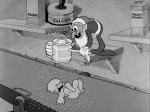
‘Shuffle off to Buffalo’ is a prime example. Based on the hit song from the Warner Bros. musical ’42nd Street’ from three months earlier, the short shows how babies are distributed all over the world. It includes a long assembly line sequence with gnomes washing, drying, powdering and feeding babies. This scene resembles a similar one in Disney’s ‘Santa’s Workshop‘ (1932) and can compete with it in its inventiveness and rhythmic action.
The title song is sung by the babies themselves, including a Maurice Chevalier one, and a Joe E. Brown one. Later an Eddie Cantor gnome recaptures the song, and also does an Ed Wynn impersonation. There’s absolutely no story, but there’s constant action, the animation is top notch throughout, and the joyous atmosphere is undeniably catchy.
‘Shuffle off to Buffalo’ is a cartoon of great quality, and shows that the Disney style of animation could be copied quite successfully.
Watch ‘Shuffle off to Buffalo’ yourself and tell me what you think:
‘Shuffle off to Buffalo’ is available on the DVD-set ‘Looney Tunes Golden Collection Volume Six’ and the DVD-set ‘The Busby Berkeley Collection’
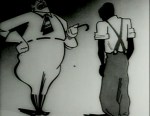
Of all animated Soviet propaganda films, ‘Black & White’ certainly is one of the most powerful. The film is essentially silent, but it’s accompanied by the beautiful negro spiritual “Sometimes I Feel Like a Motherless Child” sung in a deep mournful voice.
The film is based on a poem of the same name from 1925 by Vladimir Mayakovsky, who wrote the poem during a trip to Cuba. Like the poem, the film shows American racism and the exploitation of black people. We watch them being oppressed by the white, as if they were still slaves, and kept quiet by religion. The images are strong and very stylized. Each image of the film is staged wonderfully to the best effect. A most impressive image is that of numerous blacks in prison, but the bleakest of them all is the final shot of a car passing a lawn with a black man hanging on each tree.
The overall mood of the film is absolutely depressing, especially when one realizes that for once the Soviet propagandists were not too far from the truth. Nevertheless, the Soviet solution, “Lenin”, may be a little too short-sighted, and I doubt whether this film has ever been watched by its intended audience, and if it struck any international chord at all. Who knows? At least, Cuba has been the only country in the Americas to experience a Marxist regime…
Anyhow, despite its abrupt and inapt Lenin-ending, ‘Black & White’ is one of the darkest and strongest of all animated films of the 1930s, and certainly the most interesting animation film to come from the Soviet Union in that decade.
Watch ‘Black & White’ yourself and tell me what you think:
‘Black & White’ is available on the DVD-set ‘Animated Soviet Propaganda’
Director: James Tyer Release Date: October 27, 1933 Stars: The Little King Rating: ★★ Review:
Of all animation films dealing with the Great Depression, the Oswald cartoon ‘Confidence‘ and the Little King short ‘Marching Along’ are the most obvious ones.
‘Marching Along’ opens with the kingdom of the Little King in dire straits. The song describes its miserable state, which we can watch with our own eyes: everybody’s broke, roads and buildings are broken and even the Little King himself is robbed of his furniture and clothes, because he can’t pay his debts.
Then the queen announces the N.R.A., lifting everybody’s spirit. Soon everything works again (composer Gene Rodemich quotes Jack Hylton’s optimistic 1930 hit song ‘Happy Days are here Again’ during this section), and the cartoon closes with the Little King bombarding an angry mob with food.
The N.R.A. stands for National Recovery Act, an important part of fresh president Franklin D. Roosevelt’s New Deal. It was raised to stop a competitive race to the bottom, and negotiated with the industry to have minimum prizes, minimum wages and maximum weekly working hours. Unfortunately it also endorsed monopolies and cartels, and it was poorly administrated.
The National Recovery Act lasted until 1935, when it was declared unconstitutional by the Supreme Court. By 1935 it had achieved little of its promises, and it’s generally viewed as a failure, making its high praise in ‘Marching Along’ extra sour in hindsight.
‘Marching Along’ is even more removed from Otto Soglow’s source material than its predecessor ‘The Fatal Note‘ was. The designs are a mixed bag, sometimes copying Soglow’s style, at other times being genuinely Van Beuren. The Little King himself has only a small part in the story, which is slow and tiring, and in fact only interesting because of its historical value.
Watch ‘Marching Along’ yourself and tell me what you think:
‘Marching Along’ is available on the DVD ‘The Complete Animated Adventures of Otto Soglow’s The Little King’
Director: unknown Release Date: September 29, 1933 Stars: The Little King Rating: ★★½ Review:
After two films featuring Sentinel Louey, the Van Beuren studio turned to Otto Soglow’s greatest creation: The Little King.
It was clearly the studio’s intention to cash in on this charming character. But unlike the two Sentinel Louey cartoons, which copied Soglow’s silent comedy style very well, ‘The Fatal Note’ is much less faithful to the source material. For example, it starts with an elaborate song, not unlike Walt Disney’s ‘Father Noah’s Ark’ from earlier that year.
Apart from the Little King it also stars a cloaked terrorist, whose design has nothing to do with Soglow’s style, but which is the Van Beuren studio’s most ambitious attempt at human design, yet – another example of the studio’s attempts to keep up with Disney in human design. The terrorist introduces himself in song, but the rest of the cartoon is done in silent comedy.
The villain tries to kill the Little King, e.g. with a bomb inside a piano, a gag that gives the film its title. Eightteen years later Friz Freleng would use the same gag for the Bugs Bunny film ‘Ballot Box Bunny’ (1951), but with much, much funnier results. In ‘The Fatal Note’ the gag is just one of the terrorist’s numerous attempts to kill the king, which involves numerous bombs, anyway. The chase partly takes place on a spectacularly animated spiral staircase, which must have been the animators’ pride scene, as it is used no less than three times in the cartoon.
Because it lacks the charm of the source material, it is difficult to call ‘The Fatal Note’ a success, but it’s a great testimony of the studio’s ambitions even before Disney-alumnus Burt Gillett came along.
Watch ‘The Fatal Note’ yourself and tell me what you think:
‘The Fatal Note’ is available on the DVD ‘The Complete Animated Adventures of Otto Soglow’s The Little King’
Director: Harry Bailey Release Date: May 5, 1933 Stars: Sentinel Louey Rating: ★★★★ Review:
‘A Dizzy Day’ was the second of only two animated cartoons featuring Otto Soglow’s lesser known character Sentinel Louey.
Like ‘A.M. to P.M.’ it’s only a string of newspaper comics gags transferred to the movie screen, with an absurd rescue plot being the longest gag of all. Surprisingly, Sentinel Louey is less than sympathetic in this film, knocking down a woman , and later trying to drown a cat.
Like Soglow’s comic strip, there’s only visual comedy. Soglow’s graphic style is copied beautifully, although there’s one bird that looks more like a traditional Van Beuren character than like a Soglow creation.
Like ‘A.M. to P.M.’ ‘A Dizzy Day’ is only mildly funny, but charming. Its real treat, however, lies in its gorgeous score, although it’s very unlikely this score is original. It’s certainly not by Van Beuren’s house composer Gene Rodemich, and very likely it’s not by any American composer, at all. On the contrary, the score sounds genuinely European, and from a later era (ca. late 1940s, early 1950s), cartoonier, but otherwise similar to scores by Matyas Seiber for ‘Magic Canvas’ (1948) and George Auric’s score for ‘Kermesse fantastique’ (1951). So, this lovely score must be of a later date, and has likely been produced for a British post-war release of the film.
Watch ‘A Dizzy Day’ yourself and tell me what you think:
‘A Dizzy Day’ is available on the DVD ‘The Complete Animated Adventures of Otto Soglow’s The Little King’
Director: Harry Bailey Release Date: January 20, 1933 Stars: Sentinel Louey Rating: ★★★★ Review:
In search of new characters The Van Beuren studios signed a contract with Otto Soglow to produce twelve animated cartoons based on his characters.
Ten feature his most famous creation The Little King, but the series starts with two featuring Soglow’s lesser known character Sentinel Louey, a British guard, complete with large bearskin hat. Unlike the Little King films, these first two cartoons are very faithful to the source material. Not only do they contain a string of gags that are undoubtedly directly transferred from the comic strip, they also capture Sloglow’s idiosyncratic graphic style remarkably well. This style is much more appealing and original than anything the studio did before, making both ‘A. M. to P. M.’ and ‘A Dizzy Day’ visually among the most beautiful animated films of the entire 1930s.
Unfortunately, because ‘A.M. to P.M.’ is a compilation of newspaper comics gags, there’s no story whatsoever. Moreover, Soglow’s humor is one of charm and wonder, not one for loud laughs, and as a result ‘A.M. to P.M.’ moves past at a leisurely speed without leaving much impression besides the extraordinarily beautiful images.
‘A.M. to P.M.’ is available on the DVD ‘The Complete Animated Adventures of Otto Soglow’s The Little King’
Directors: Frank Sherman & George Rufle Release Date: July 31, 1933 Stars: Tom and Jerry Rating: ★★★ Review:
‘The Phantom Rocket’ starts with a stereotype homosexual announcer announcing that Tom and Jerry will man a dangerous flight on a new rocket.
Unfortunately, an escaped convict climbs along. While the convict holds up Tom and Jerry inside the machine, the rocket goes haywire, creating havoc in the whole neighborhood, before diving into the sea. It finally crashes on top of a prison, and the cartoon ends with Tom and Jerry earning the reward.
With ‘The Phantom Rocket’ the Van Beuren studio joined the Walt Disney studio in its operetta phase. Following the Silly Symphony ‘Father Noah’s Ark‘ and the Mickey Mouse cartoon ‘The Mail Pilot‘ in particular, the short opens with several people singing an introduction song, including engineers, scientists, photographers and Tom and Jerry themselves. Gene Rodemich’s score is very lively throughout, and the gags come in fast and plenty.
Nevertheless ‘The Phantom Rocket’ was the merry duo’s very last cartoon. Since then they’ve gone into oblivion, and it’s true that only a few of their 26 cartoons are enjoyable enough to justify resurrection (to me ‘Wot a Night‘, ‘Pots and Pans‘, ‘Jolly Fish’ and ‘Pencil Mania‘ are the best candidates). The Van Beuren studio replaced Tom and Jerry with new, but equally unsuccessful stars like Cubby the Bear and The Little King.
Although the rocket itself is nicely animated, Tom and Jerry’s last stand suffers the same problems as their earlier outings: sloppy designs, erratic animation and a total lack of character. Nevertheless, it’s interesting to compare ‘The Phantom Rocket’ to the earlier ‘Rocketeers‘ (1932), which covers similar grounds. It shows that even this sloppy studio had grown with the years.
Watch ‘The Phantom Rocket’ yourself and tell me what you think:
This is the 26th and last Tom & Jerry cartoon
To the previous Tom & Jerry cartoon: Doughnuts
‘The Phantom Rocket’ is available on the DVD ‘The Complete Animated Adventures of Van Beuren Studio’s Tom and Jerry’
Directors: Frank Sherman & George Rufle Release Date: July 10, 1933 Stars: Tom and Jerry Rating: ★★★ Review:
‘Doughnuts’ takes place at a bakers’ convention.
Tom and Jerry are doughnut bakers, competing with a.o. two stereotypical Jewish matzos bakers, and two stereotypical gays, baking ‘pansy cakes’. Unfortunately, the public isn’t interested in any of them, and head right to the beer stand (since the end of March 1933, it was allowed to sell low alcohol beer again, after thirteen years of prohibition). Only when a drunken sailor accidentally enriches Tom and Jerry’s dough with his liquor, the crowd storms their stand, and in the end we watch the duo marching with the first prize.
‘Doughnuts’ is an interesting cartoon as it comments on the repeal of the prohibition. The cartoon is only moderately funny, but it’s enjoyable for its cheerful mood, helped by Gene Rodemich’s wonderful and lively score.
Watch ‘Doughnuts’ yourself and tell me what you think:
This is Tom & Jerry cartoon No. 25
To the previous Tom & Jerry cartoon: In the Park
To the next Tom & Jerry cartoon: The Phantom Rocket
‘Doughnuts’ is available on the DVD ‘The Complete Animated Adventures of Van Beuren Studio’s Tom and Jerry’
Directors: Frank Sherman & George Rufle Release Date: May 26, 1933 Stars: Tom and Jerry Rating: ★ Review:
‘In the Park’ takes place in a park, literally.
The short opens with Tom and Jerry reading the newspaper on a park bench. Somewhere else, a policeman seduces a sexy babysitter. Of course, the baby escapes, following a plot all too similar to the Fleischer Screen Song ‘Let Me Call You Sweetheart‘ (1932). Tom and Jerry more or less adopt the little brat, going at lengths in trying to comfort the little kid. In the end the baby is restored to its baby-sitter, and the cop kisses its behind. The cartoon ends with Tom and Jerry laughing at the policeman.
There’s little to enjoy in the rather run-of-the-mill ‘In the Park’, except for Gene Rodemich’s lively score. The designs are remarkably heterogeneous: the baby-sitter is remarkably well-drawn, Tom, Jerry and the policeman have generic early 1930’s designs, while the brat seems stuck in the 1920’s era.
Watch ‘In the Park’ yourself and tell me what you think:
This is Tom & Jerry cartoon No. 24
To the previous Tom & Jerry cartoon: Hook & Ladder Hokum
To the next Tom & Jerry cartoon: Doughnuts
‘In the Park’ is available on the DVD ‘The Complete Animated Adventures of Van Beuren Studio’s Tom and Jerry’
Directors: George Stallings & Frank Tashlin Release Date: April 28, 1933 Stars: Tom and Jerry Rating: ★ Review:
In ‘Hook & Ladder Hokum’ Tom and Jerry are fire fighters.
The cartoon opens with the two playing checkers and preparing for bed. As soon as they’ve lain down, the fire alarm rings, and the two rush to the burning house. However, Tom, Jerry and their horse are remarkably incompetent in extinguishing the fire, and the horse even manages to destroy the house completely.
‘Hook & Ladder Hokum’ marks Frank Tashlin’s first and only direction billing at Van Beuren. Tashlin had been an animator and story man at the studio. Tashlin later would improve cartoon directing at Warner Bros., and would become a successful live action director for e.g. Jane Mansfield, and Martin and Lewis comedies. It’s very difficult to detect any of his talent in this cartoon, as most of the action is still silent as if it had been made in the silent era. For example, there’s a scene in which Tom & Jerry gesture the horse to hurry, and later the flames spell the words ‘help’ and ‘hurry’.
In some of the close-ups the duo look better designed than normal, however. This just may be Frank Tashlin’s influence, but who knows? In any case, ‘Hook & Ladder Hokum’ compares unfavorably to the Mickey Mouse cartoon ‘The Fire Fighters‘, even though the Disney short is three years older.
Watch ‘Hook & Ladder Hokum’ yourself and tell me what you think:
This is Tom & Jerry cartoon No. 23
To the previous Tom & Jerry cartoon: Puzzled Pals
To the next Tom & Jerry cartoon: In the Park
‘Hook & Ladder Hokum’ is available on the DVD ‘The Complete Animated Adventures of Van Beuren Studio’s Tom and Jerry’
Director: Walter Lantz Release Date: October 9, 1933 Stars: Pooch the Pup, Dopey Dick Rating: ★★★★ Review:
‘She Done Him Right’ was the last of thirteen cartoons starring Pooch the Pup, a Walter Lantz character that was virtually Oswald the lucky Rabbit, but with different ears.
The cartoon is an obvious spoof of the Paramount Mae West vehicle ‘She Done Him Wrong’ from earlier that year. Like the feature, the cartoon is set in the 1890’s, and it features a nightclub singer called Poodles, who’s dressed and talks like West. Inside Joe’s Beer Garden a man sings the 1908 music hall song ‘Has Anybody Here Seen Nelly?’, but Poodles has a much more modern song to offer: Cab Calloway’s 1932 hit song ‘Minnie the Moocher’s Wedding Day’. Then a villain kidnaps Poodles, and Pooch the Pup comes to the rescue.
Pooch the Pup himself is utterly forgettable, but this cartoon is packed with wonderful and weird gags, and features great jazz music. ‘Minnie the Moocher’s Wedding Day’ is sung with a great voice, which makes one wonder who the particular voice artist is. The cartoon also marks the first appearance of a fat character called Dopey Dick, who is remarkably similar to Wellington Wimpy, who only hit the screen ten days before ‘She Done Him Right’.
Watch ‘She Done Him Right’ yourself and tell me what you think:
‘She Done Him Right’ is available on the DVD ‘The Woody Woodpecker and Friends Classic Cartoon Collection Volume 2’
Director: Bill Nolan Release Date: September 18, 1933 Stars: Oswald, Honey Rating: ★★★★★ Review:
‘Five and Dime’ is a cartoon devoted to the 1931 hit song ‘ I Found A Million Dollar Baby’.
The short opens with Oswald being caught in a rainstorm (featuring the storm music from Gioachino Rossini’s overture William Tell). He rushes into a warehouse, where he sings ‘I Found A Million Dollar Baby’ for Honey, one of the employees.
‘Five and Dime’ is one of the most Merry Melodies-like Lantz cartoons: not only is it made around one hit song, it also features caricatures of Hollywood stars as dolls. Thus we watch caricatures of Charlie Chaplin, Laurel and Hardy and Jimmy Durante. The latter is a jack-in-the-box, just like he was in ‘Mickey’s Good Deed‘ from 1932. During the song there are numerous random gags, including one in which a goldfish swallows a complete cat. I suspect this particular gag was one by Tex Avery, who worked on this cartoon.
The finale of ‘Five and Dime’ is particularly noteworthy, as we watch Oswald and Honey march into and out of several stores to get dressed for their wedding, then in and out of a church to get married, and finally into their new home, on top of which the stork is already waiting… This sequence has great rhythm, enhanced by the joyful song, and is one of the best finales of any Walter Lantz cartoon.
Watch ‘Five and Dime’ yourself and tell me what you think:
Director: Bill Nolan Release Date: October 10, 1932 Stars: Oswald, Honey, Peg Leg Pete Rating: ★★ Review:
‘Carnival Capers’ takes place at the beach and at a carnival.
We watch Oswald and Honey trying to enjoy themselves, but being bullied by Peg Leg Pete. Oswald finally disposes of Pete, with help of a fence, a lobster, a cat, a dog and a goat.
‘Carnival Capers’ looks pretty old-fashioned by 1932 standards. It recalls the Mickey Mouse cartoon ‘The Karnival Kid‘ (1929) in its setting, and the silent Oswald cartoons with its love triangle. At one point Pete is cut into two – a familiar gag in the 1920s, but by 1932 a rare one, as by then cartoon characters had gained more consistency. Overall, the animation and the vocalizations are rather erratic.
A young Tex Avery worked on this cartoon, and perhaps he came up with the gag of a phlegmatic dog making milkshakes with help of a shimmy dancer, which is arguably the best gag in the whole cartoon.
Watch ‘Carnival Capers’ yourself and tell me what you think:
‘Carnival Capers’ is available on the DVD ‘The Woody Woodpecker and Friends Classic Cartoon Collection Volume 2’
Director: Mannie Davis Release Date: July 7, 1933 Stars: Cubby the Bear Rating: ★★ Review:
In ‘Indian Whoopee’ Cubby reads about Captain John Smith and Pocahontas before falling asleep.
Our hero soon dreams he’s John Smith himself, camping in the woods. He’s soon discovered by an Indian, however, and threatened by the whole tribe, including a pretty funny gay one. After a chase scene, Cubby is captured and about to be executed, despite the pleas of the little Pocahontas girl. Then, of course, he awakes.
‘Indian Whoopee’ is pretty boring, especially the chase scene is surprisingly low on gags, and lasts way too long. The best gag may be the little Fleischer-like gag of tent pegs pulling Cubby’s tent down, when he almost snores it away.
Watch ‘Indian Whoopee’ yourself and tell me what you think:
‘Indian Whoopee’ is available on the DVD ‘The Complete Adventures of Cubby Bear’, the Blu-Ray ‘The Complete Animated Adventures of Cubby Bear’ and the Blu-Ray/DVD ‘ Technicolor Dreams and Black & White Nightmares’
Penned by Sid Marcus and animated by Art Davis, ‘Technoracket’ is one of those cartoons inspired by rumors of robots taking over, like Fleischer’s ‘The Robot‘ from 1932, and ‘Mickey’s Mechanical Man‘ from one month later.
Unlike those boxing-themed cartoons ‘Technoracket’ is surprisingly prophetical. In this cartoon Scrappy has a farm, in which Oopy does all the work, with help of the farm animals. But when Scrappy reads about the new age of technocracy he fires all animals, switching to robots, instead. Because it’s a cartoon, even the cows and chickens become robots, with the cows producing bottles of milk instantly. There’s also a scene in which a robots plants bolts to grow plants of canned tomatoes.
At one stage, however, Oopy sneaks into Scrappy’s house and destroys his controls, making the robots go wild. This leads to some nightmarish scenes. There’s for example a robot which devours a pig to spit out hams, another robot brutalizes a mechanical chicken forcing it to produce numerous eggs. Soon the robots create havoc in Scrappy’s home, and he himself removes the controls, which explode in the backyard, destroying all robots.
‘Technoracket’ illustrates the 1930’s fear of work replacement by robots very well. Nevertheless, its predictions have somewhat become true, albeit in a less cartoony fashion, as farms are all but mechanized factories, today…
Ted Esbaugh was one of the very few American animators operating independently during the 1930s.
With ‘The Wizard of Oz’ Esbaugh could make use of Technicolor’s three-way process, if only outside the U.S., as Walt Disney had the exclusive rights to its use in the States themselves.
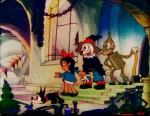
With this film Esbaugh was the first to bring Frank L. Baum’s famous fantasy to the film screen in full color. Like the latter, much more familiar live action version from 1939, Esbaugh paints the Kansas opening in sepia tones, and unleashes full color only in the land of Oz.
Lasting only eight minutes, the film’s plot is simple, and only superficially taken from the book: when Dorothy plays with Toto, a tornado takes her to Oz, where she lands on the scarecrow. Together they walk through the forest, where they encounter the tin man. The quartet (the lion is nowhere to be found) walk into the emerald city, where they’re taken to the wizard of Oz.
In Esbaugh’s version, the wizard of Oz is a real wizard, and he performs some tricks for our heroes, e.g. eight dolls dancing in a Busby Berkeley ballet-like fashion, and an egg growing into gigantic proportions, threatening our heroes, until it explodes, revealing a tiny chicken.
‘The Wizard of Oz’ boasts music by Carl Stalling, who’s in top form here, while the colorful images splash from the scene, and the animation can compete with contemporary cartoons by Warner Bros. and Disney in quality. However, the short’s story is hardly gripping, and although enjoyable, more forgettable than one would expect.
Because of Disney’s deal with Technicolor, Esbaugh’s film was never seen in the United States, and only shown in Canada and the UK, and it never received the fame it could have had otherwise.
Watch ‘The Wizard of Oz’ yourself and tell me what you think:
‘The Wizard of Oz’ is available on the Blu-Ray/DVD-set ‘Technicolor Dreams and Black & White Nightmares’
Directors: John Foster & George Stallings Release Date: February 7, 1933 Stars: Tom and Jerry Rating: ★★★★ Review:
‘The Magic Mummy’ is one of those typical nightmarish cartoons of the early 1930s.
It opens happily enough, when Tom and Jerry, as policemen, listen to the police radio, which broadcasts two rather gay officers singing and playing the piano. The merry song is soon interrupted, however, when a mummy has been stolen from the museum. Tom and Jerry soon discover the thief and follow him into the graveyard and into a grave. There the thief, a magician, unwinds the mummy, revealing it to be a woman whom he orders to sing and to perform for a skeleton audience. She does so with a Betty Boop-like voice, which starts a jazzy score. In the end Jerry runs off with the mummy’s coffin, only to discover it contains Tom inside.
‘The Magic Mummy’ is one of the more enjoyable of the Tom and Jerry cartoons in its delightful lack of pretense, its rather surreal images, and joyful atmosphere.
Watch ‘The Magic Mummy’ yourself and tell me what you think:
This is Tom & Jerry cartoon No. 20
To the previous Tom & Jerry cartoon: Tight Rope Tricks
‘The Magic Mummy’ is available on the DVD ‘The Complete Animated Adventures of Van Beuren Studio’s Tom and Jerry’ and the Blu-Ray/DVD-set ‘Technicolor Dreams and Black & White Nightmares’
‘Three Little Pigs’ is one of the most successful, most famous and most perfect cartoons ever made. It was hugely popular when it was released, with people associating its catchy theme song ‘Who’s Afraid of the Big Bad Wolf’ with an optimism with which one could fight the haunting effects of the Great Depression.
Norm Ferguson and Fred Moore were the principle animators on the film. Norm Ferguson animated the wolf in his typical broad vaudeville acting style, which comes to full bloom in this film. The wolf is a great character, with his glances at the public. He’s a real villain, but somehow too sympathetic as an actor to be really threatening. Unfortunately, his design is not very consistent. Especially his eyes are unsteady and a bit wobbly. One can clearly watch the wolf’s design improving during the film, as if it was animated chronologically. And this may very well be possible.
However, it’s Fred Moore’s animation that made the deepest impression on the animation field. Because of his animation on the three pigs, ‘Three Little Pigs’ is regarded as the first animated cartoon to feature so-called character animation. The three pigs form the key to character animation: although the three are drawn the same, the sensible pig behaves differently from the other two: he’s clearly a different character, not by design, but by animation. This was a great step forward in the evolution in animation, and one admired by the whole animation industry.
Apart from that the pigs’ designs, by the highly influential concept artist Albert Hurter, are highly appealing. Hurter had joined Disney in June 1931, first as an animator, but soon he switched to concept art, and he had a tremendous influence on the looks of Disney’s films in the 1930s. It must have been around this time that Disney started to think of an animated feature – a daring project which would dominate the studio during 1934-1937. For this ambitious project Moore would design no less than seven similar, yet different characters, while Hurter would indulge in elaborate sets, full of little details.
‘Three Little Pigs’ was a success not only within the animation industry, but with the American public, as well. The audiences took the film and its catchy song ‘Who’s Afraid of the Big Bad Wolf’ (sung by Mary Moder, Dorothy Compton and Pinto Colvig) as a sign of comfort and hope in the dark days of the Great Depression era. And even after more than eighty years, Frank Churchill’s song is still extremely catchy, even though it’s never heard in its entirety during the short. After a while the cartoon became no less than a sensation, lasting weeks in some theaters, and spawning a great deal of merchandise, like alarm clocks and jigsaw puzzles. In 1934 it won the Academy Award for best animated short film. In 1941 it was still famous enough to be changed into Disney’s first war propaganda film: ‘The Thrifty Pig‘.
The film undoubtedly was Walt Disney’s most famous and most successful short, and the first Silly Symphony to spawn sequels – due to the pressure by distributor United Artists. These sequels (‘The Big Bad Wolf‘ from 1934, ‘Three Little Wolves‘ from 1936, and ‘The Practical Pig‘ from 1939) were, of course, much less successful than the original, and are all but forgotten today. As Walt Disney himself said “You can’t top pigs with pigs’.
The film also raised director Burt Gillett’s fame, and soon he was lured away by the ailing Van Beuren studios to repeat this immense success. However, at Van Beuren it soon became clear that ‘Three Little Pigs’ was not a success because of Burt Gillett’s genius, but because of the ambitious group effort of the Disney studio, and Gillett never managed to come near his most successful films at Disney again.
For ‘Three Little Pigs’ was a true collective effort, with Hurter, Churchill, Ferguson and Moore showing their best work thus far, but also through contributions by e.g. Art Babbitt, Dick Lundy and Jack King, who also animated some sequences, voice artist Pinto Colvig, the voice of the practical pig, and story man Ted Sears, who both contributed to the cartoon’s theme song, and Carl Stalling, who provided the practical pig’s piano-playing.
The film has easily stood the test of time: not only are the characters still appealing, its backgrounds are gorgeous, its music catchy, and its storytelling extraordinarily economical and effective, probably because ‘Three Little Pigs’ may have been the first animated cartoon with a complete storyboard. The short’s joy is still infectious today. And although one will always remember the short’s cheerfulness, it contains some black humor, too: look for the portraits of dad and Uncle Tom in the wise pig’s house.
By the way, present-day viewers see an altered version of the film. The original featured a sequence in which the wolf dressed as a stereotyped Jewish door-to-door salesman. For its video release in the early 1980s this sequence was completely redrawn, to remove all Jewish references.
Watch ‘Three Little Pigs’ yourself and tell me what you think:
This is Silly Symphony No. 36
To the previous Silly Symphony: Father Noah’s Ark
To the next Silly Symphony: Old King Cole
Director: Burt Gillett
Release Date: November 19, 1932 Rating:★★★ Review:
‘Babes in the woods’ is a free adaptation of the fairy tale of ‘Hansel and Gretel’.
In Disney’s version the two lost children encounter some merry dwarfs before they meet the witch. The witch takes them for a ride on her flying broom to her gingerbread house.
Once inside the witch’s abode the cartoon takes a nightmarish turn. in the dark and gloomy inside the witch reveals she turns little children in newts, rats, spiders and bats. We watch the with turn a cat into stone, which immediately falls down and brakes. Then she turns the boy into a spider. When she wants to turn the girl into a rat, she’s interrupted by the dwarfs, who have come to the rescue. While she’s fleeing for the squadrons of gnomes firing arrows at her, the girl discovers a potion to turn the spider and all other animals present in the witches house into children again. In the end the witch is turned into stone by falling into her own potion.
This re-telling of Grimm’s classic tale introduces some story ideas that made it into ‘Snow White and the Seven Dwarfs’ five years later: there’s a scary forest with trees looking like monsters and there are of course the witch and the dwarfs. Indeed, concept artist Albert Hurter was responsible for most of the looks of both this Silly Symphony as one of the chief designers for Disney’s first feature.
The storytelling is economical, with a lot happening in the mere seven minutes. As soon as the witch enters the scene, the action is relentless. The pretty scary scene inside the Witch’s house is particularly gripping. The short also contains a small dance routine, reminiscent of, but a great improvement on ‘The Merry Dwarfs‘ from 1929. The children’s designs of this particular film became stock designs in most studios in the rest of the 1930’s, in which more and more films would take a childish character, anyway.
With ‘Babes in the Woods’ embarked on a series of Silly Symphonies that were adaptations of familiar fairy tales and fables. Other examples are ‘Three Little Pigs‘ and ‘The Pied Piper‘ from 1933, ‘The Grasshopper and the Ants‘ from 1934 and ‘The Tortoise and the Hare’ from 1935.
‘Babes in the Woods’ is a stunning tour-de-force for 1932, but four days before its release Disney had started its first in-house art class, hosted by Don Graham. With these twice-weekly art classes Disney’s animators got better and better, and all subsequent Disney films clearly show that, with the Silly Symphonies in particular showing an enormous growth during the rest of the 1930’s.
One trivial remark: Hansel and Gretel are wearing traditional costumes typical for some Dutch fishing-villages. However, the landscape looks anything but Dutch (in fact, it looks pretty Mid-European). Talking about being lost!
Watch ‘Babes in the Woods’ yourself and tell me what you think:
This is Silly Symphony No. 32
To the previous Silly Symphony: Bugs in Love
To the next Silly Symphony: Santa’s Workshop
Animation Backgrounds
A blog dedicated to background paintings from animation films. Kept until 2016.
Animation Scoop
Animation historian Jerry Beck’s animation film news blog.
Cartoon Brew
Topical blog on animation film, led by animation historian Amid Amidi.
Cartoon Modern
Amid Amidi’s blog on modern design cartoon art from the forties, fifties and sixties.
Cartoon Research
THE site on classic animation research, hosted by cartoon historian Jerry Beck.
Cartoons Theory
Frank Beef analyzes classic cartoons. Kept until 2020.
Century Film Project
Michael reviews films of 100 years old and older, roughly in chronological order.
Classic Cartoons
A similar blog featuring many stills and comic strips. Kept until 2012.
Comet over Hollywood
Jessica Pickens reviews classic Hollywood films, especially musicals.
Deja View
Top ex-Disney animator Andreas Deja’s own blog.
Disney History
Esteemed Disney historian Didier Ghez on the latest books on Disney history.
Feeling Animated
Paul Astell brings us thorough reviews of animated features.
Flickers in Time
Short and to the point reviews of classic films (lately mostly pre-code talkies) by an anonymous retired Foreign Service Officer from California