Director: Dave Fleischer
Release Date:
 March 21, 1931
Rating: ★★★
Review:

In My Merry Oldsmobile © Max Fleischer‘In My Merry Oldsmobile’ is a rather odd commercial for Oldsmobile, done in Screen Song fashion. The cartoon will be familiar of readers of Leonard Maltin’s ‘Of Mice and Magic’, for his book features several stills from this film.

The film starts weird to begin with. We watch an evil male character sneak upon a woman undressing(!). Luckily she reveals countless dresses under each other. The creepy guy sneaks into her home and asks the terrified woman for a ride, which she unsurprisingly refuses. Then suddenly a little guy arrives offering her a ride in his Oldsmobile outside. This section uses a lot of dialogue, but no lip synch whatsoever.

The little guy’s invitation for a ride prompts the barbershop title song (a hit song from 1905) and the bouncing ball, so typical of Fleischer’s Screen Songs. The song is accompanied by images of a couple riding an Oldsmobile Curved Dash from 1904, the car celebrated in the song. Then we watch the cartoon characters riding this car, and suddenly there’s a lot of metamorphosis of words into the car etc. The film ends as oddly as it started: when the couple gets married, they’re immediately in a boxing match, indicating that marriage is one long fight.

One wonders how such a story would help Oldsmobile selling more cars. Moreover, none of their latest models is featured in the cartoon, only their first model, which by 1931 was of course extremely outdated.

Watch ‘In My Merry Oldsmobile’ yourself and tell me what you think:

‘In My Merry Oldsmobile’ is available on the DVD ‘Fleischer Classics featuring Gulliver’s Travels’

Director: Dave Fleischer
Release Date:
 May 23, 1931
Stars: Bimbo, Betty Boop
Rating: ★★★
Review:

Silly Scandals © Max FleischerIn ‘Silly Scandals’ Bimbo wants to visit a theater, where Betty Boop performs.

Unfortunately he’s broke, but he finally succeeds in sneaking into the theater by walking backwards along the leaving crowd. Inside we watch Betty singing the 1930 hit song ‘You’re driving me crazy’. Like in ‘Mysterious Mose‘ her sexiness is well explored, as her dress falls off during the performance, revealing her bra.

After Betty’s performance, Bimbo ends up being hypnotized by a magician, who makes our unfortunate hero dance against his will. The cartoon ends in a short, but zany and nightmarish dream sequence.

‘Silly Scandals’ is a transitional cartoon that shows the potential of Fleischer’s fledgling cartoon star Betty Boop, but failing to explore it to the max, still focusing on the rather bland Bimbo. We hear her name for the very first time. Yet, Bimbo is still the only billed star of the cartoon. But the Fleischers were quick learners, and with almost every subsequent Talkartoon Betty’s star would rise, and her screen time increase.

Watch ‘Silly Scandals’ yourself and tell me what you think:

This is Talkartoon No. 21
To the previous Talkartoon: Twenty Legs under the Sea
To the next Talkartoon: The Herring Murder Case

‘Silly Scandals’ is available on the French DVD Box Set ‘Betty Boop Coffret Collector’

Director: Dave Fleischer
Release Date:
 April 3, 1931
Stars: Bimbo, Betty Boop
Rating: ★★½
Review:

The Bum Bandit © Max FleischerBimbo is a train robber who holds up a train. Unfortunately for him, his stout wife, Betty Boop (called Nan McGrew in this cartoon), is also on this train.

She confronts him and in the end Bimbo unwillingly reunites with his wife, fleeing with her into the distance on the locomotive.

‘The Bum Bandit’ lacks the wild surrealism of earlier Talkartoons, like ‘Barnacle Bill‘ and ‘Mysterious Mose‘ (both 1930), and is thus less interesting to watch. The best scene is when Bimbo practices shooting, e.g. shooting a cow from the sky. There is also some nice and flexible animation on the riding train. Betty Boop has a distinctly different voice here, which was not repeated after this cartoon.

Watch ‘The Bum Bandit’ yourself and tell me what you think:

This is Talkartoon No. 18
To the previous Talkartoon: The Cow’s Husband
To the next Talkartoon: The Male Man

‘The Bum Bandit’ is available on the French DVD Box Set ‘Betty Boop Coffret Collector’

Director: Wilfred Jackson
Release Date:
July 28, 1931
Rating: ★★★½
Review:

The Cat's Out © Walt DisneyA cat is put out. When he tries to catch a bird, he falls down and gets knocked unconscious by a wind-flower.

Enter a nightmarish sequence, in which the cat imagines his lives are fleeing him, and that he’s being attacked by giant birds, hooting owls, bats, giant spiders and hollow trees. Luckily, in the morning it all appears to have been a dream.

‘The Cat’s Out’ is not devoid of dance routines (there are two dance scenes featuring scarecrows and a bat), but it has a surprisingly clear story, unmatched by earlier Silly Symphonies. It is arguably the first Silly Symphony with such a clear story, anticipating the straightforward storytelling of ‘The Ugly Duckling‘ of the end of the same year. This makes the short one of the most interesting Silly Symphonies of 1931.

Watch ‘The Cat’s Out’ yourself and tell me what you think:

This is Silly Symphony No. 20
To the previous Silly Symphony: The Busy Beavers
To the next Silly Symphony: Egyptian Melodies

‘The Cat’s Out’ is available on the DVD ‘Walt Disney Treasures: More Silly Symphonies’

Director: Burt Gillett
Release Date:
 December 16, 1930
Rating: ★★★★½
Review:

Playful Pan © Walt DisneyWith his double pipe, Pan makes all animals and plants, yes, even trees and clouds move and dance. The latter cause a fire with their lightning, but Pan lures the flames away to the lake, as if he were the pied piper.

Like ‘Springtime‘ (1929) ‘Playful Pan’ can be regarded as a forerunner of Disney’s groundbreaking cartoon ‘Flowers and Trees‘ (1932). The short is especially interesting for the introduction of the anthropomorphized flames, so typical of cartoons about fire. ‘Playful Pan’ is more entertaining than earlier Silly Symphonies, because half way the dance routine gives way to some kind of story, in which fire threatens the forest. This fire sequence is actually rather exciting. The fire itself is well animated, and the flames form a real threat: they do kill a humanized tree, and make all the animals flee.

The story formula of ‘Playful Pan’, in which the second half has some kind of story, was explored in many more Silly Symphonies from 1931 (e.g. ‘Birds of a Feather‘, ‘The China Plate‘. ‘The Busy Beavers‘). One had to wait until ‘The Ugly Duckling‘, from the end of that year, to watch a Silly Symphony to feature a concise story from start to end.

Watch ‘Playful Pan’ yourself and tell me what you think:

This is Silly Symphony No. 15
To the previous Silly Symphony: Winter
To the next Silly Symphony: Birds of a Feather

‘Playful Pan’ is available on the DVD ‘Walt Disney Treasures: More Silly Symphonies’

Director: Burt Gillett
Release Date:
 October 22, 1930
Rating:
Review:

Winter © Walt DisneyAmong the earliest Silly Symphonies there was a cycle devoted to the four seasons. ‘Winter’ is the last of these four season cartoons.

Following the artistic success of ‘Autumn‘, ‘Winter’ is unfortunately as dull and plotless as the earlier ‘Springtime‘ or ‘Summer‘. The cartoon both starts an ends with a winter storm. In between we watch animals skating and dancing on Emile Waldteufel’s Skaters’ Waltz. This scene features some deer, which are a far cry from ‘Bambi‘ (1942), but who are more comfortable on ice than Bambi would ever be twelve years later. The cartoon ends when a groundhog sees his shadow again, and cold and snowy winds drive the animals back to their hiding places.

Luckily, ‘Winter’ formed the end of an era. Already with the next Silly Symphony, ‘Playful Pan‘ the Disney studio would aim to exchange the endless dance routines for more experiment, and this level of experiment would only increase from 1931 onwards…

Watch ‘Winter’ yourself and tell me what you think:

This is Silly Symphony No. 14
To the previous Silly Symphony: Monkey Melodies
To the next Silly Symphony: Playful Pan

‘Winter’ is available on the DVD ‘Walt Disney Treasures: More Silly Symphonies’

Director: Burt Gillett
Release Date:
 September 2, 1930
Rating: ★★
Review:

Monkey Melodies © Walt Disney

The Silly Symphonies were to be a series of great innovation, but in 1930 this was not so clear, yet, as the entries of that year were mostly preoccupied with dance routines.

The ‘innovation’ of ‘Monkey Melodies’, for example, is the embryonic story of its second half. But only with ‘Playful Pan‘ from the end of the year, some real experimentation was to kick in.

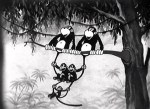
‘Monkey Melodies’ opens with monkeys, apes and parrots frolicking in the jungle in a long dance routine. After several minutes we follow two monkeys in love, who frolic to the tune of Rudy Wiedoeft’s Narcissus. The two go on a boat ride on a log, and manage to escape a crocodile, a hippo, a snake and a leopard.

‘Monkey Melodies’ is a very standard Silly Symphony, typical of 1930, the ‘story’ of the second half notwithstanding, and to be frank, the short is rather dull. Its highlight may be the effect animation of a crocodile swimming under water.

Watch ‘Monkey Melodies’ yourself and tell me what you think:

This is Silly Symphony No. 13

To the previous Silly Symphony: Midnight in a Toy Shop
To the next Silly Symphony: Winter

‘Monkey Melodies’ is available on the DVD ‘Walt Disney Treasures: More Silly Symphonies’

Director: Wilfred Jackson
Release Date:
 July 28, 1930
Rating: ★★
Review:

Midnight in a Toy Shop © Walt Disney

1930 saw a string of Silly Symphonies featuring animals performing endless dance routines. In ‘Midnight in a Toy Shop’, however, the dancing is being done by toys and dolls. Not that it makes a difference…

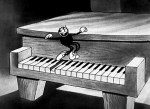
‘Midnight in a Toy Shop’ introduces the small spider, who would also be the hero of ‘Egyptian Melodies‘. To escape the freezing cold the spider enters a toy shop. First he’s afraid of everything, but when he’s playing the piano, the dolls and toys come to life, dancing to his tunes. This results in a very, very long dance routine, rendering ‘Midnight in a Toy Shop’ a rather dull short. However, in the first scene the spider leads the viewer into the scenery, and we as an audience, explore the toy shop with him. This story idea would be perfected in the intro of ‘Pinocchio‘ (1940), of which the intro of ‘Midnight in a Toy Shop’ is an embryonic version.

‘Midnight in a Toy Shop’ contains a strange mixture of primitive and more advanced designs and animation. It starts with some stunning effect animation of snow, and ends when a candle lights some fireworks, making the spider flee the shop.

Watch ‘Midnight in a Toy Shop’ yourself and tell me what you think:

This is Silly Symphony No. 12
To the previous Silly Symphony: Arctic Antics
To the next Silly Symphony: Monkey Melodies

‘Midnight in a Toy Shop’ is available on the DVD ‘Walt Disney Treasures: More Silly Symphonies’

Director: Ub Iwerks
Release Date:
 January 31, 1931
Stars: Flip the Frog
Rating:
Review:

The Village Smitty © Ub IwerksIn this cartoon Flip the Frog is a blacksmith in a farm-like setting.

Flip replaces a horseshoe of a horse that belongs to a female cat character. This kitten looks exactly like Honey, who was Oswalds’s girlfriend in the 1927-1928 Oswald the Lucky Rabbit cartoons, which Disney and Iwerks had made together. When the horse gets stung by a mosquito he runs off with “Honey” helpless in her carriage. Luckily, Flip saves the day, and wins “Honey”’s kiss.

‘The Village Smitty’ is much more interesting on paper than on the animated screen. Its even pace and its scarcity of gags makes the cartoon virtually endless.

Nevertheless, ‘The Village Smitty’ profits from Carl Stalling’s inspired music. Stalling had left Disney together with Iwerks, thinking that without Iwerks the Disney studio would have no future. After a while he joined Iwerks in his new studio. Stalling would stay with Iwerks until the studio collapsed in 1936. He then moved to Warner Bros., where he would become the most famous cartoon composer of all time.

Watch ‘The Village Smitty’ yourself and tell me what you think:

This is Flip the Frog cartoon No. 8
To the previous Flip the Frog cartoon: The Soup Song
To the next Flip the Frog cartoon: Laughing Gas

‘The Village Smitty’ is available on the DVD ‘Cartoons That Time Forgot – The Ub Iwerks Collection Vol. 1’

Director: Ub Iwerks
Release Date:
 January 31, 1931
Stars: Flip the Frog
Rating:
Review:

The Soup Song © Ub IwerksIn ‘The Soup Song’ Flip works at a café, although his real occupation there remains rather obscure.

We watch him as a bandleader (imitating Paul Whiteman), as a purser, a cloakroom boy, a waiter and a cook. He dances with a cat on stage (who looks very much like Oswald’s girlfriend, Honey), while a hungry customer eats his cutlery, a gag clearly stolen from the Max Fleischer cartoon ‘Dizzy Dishes’, released five months earlier. In ‘The Soup Song’ the gag is much less well executed however, and it lacks the zany imagination of the Fleischer cartoon. In no sense ‘The Soup Song’ is a classic, and although the animation is good, the cartoon pales even when compared to ‘Dizzy Dishes’, which isn’t all too remarkable itself.

Watch ‘The Soup Song’ yourself and tell me what you think:

This is Flip the Frog cartoon No. 7
To the previous Flip the Frog cartoon: Little Orphan Willie
To the next Flip the Frog cartoon: The Village Smitty

‘The Soup Song’ is available on the DVD ‘Cartoons That Time Forgot – The Ub Iwerks Collection Vol. 1’

Director: Ub Iwerks
Release Date:
 September 27, 1930
Stars: Flip the Frog
Rating: ★★★
Review:

The Village Barber © Ub IwerksAfter two films Flip the Frog was redesigned to be a sort of a young man, living in town. Thus in his fourth cartoon Flip is a barber.

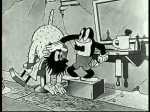
This cartoon contains only two scenes: in the first scene we watch Flip polishing his barber pole, which is then stolen and replaced by Flip out of a cat’s tail. In the second scene Flip cuts a hairy dog customer, accompanied by a nail polisher and a shoe polisher. The four of them sing a song together, with which the cartoon ends.

‘The Village Barber’ is typical for the early Ub Iwerks cartoons, in which everything is sparked with life. Even the chair, the razor, and the furnace are autonomous beings, dancing to the musical beat. The Ub Iwerks shorts lack the metamorphosis and spontaneous generation so typical of contemporary Fleischer Talkartoons (e.g. ‘Barnacle Bill‘ and ‘Mysterious Mose‘). Yet, together with the rhythmical Disney-like animation, the abundance of life give the Flip the Frog cartoons a very distinct character. Unfortunately, ‘The Village Barber’ is as low on gags as other Flip the Frog cartoons, and a little boring.

Nevertheless, it’s cartoons like these that ultimately sold the Flip the Frog series to MGM, making it the lion studio’s first venture in cartoon business. Iwerks’s contract with MGM lasted until 1934, when the company exchanged Ub Iwerks for Harman & Ising.

Watch ‘The Village Barber’ yourself and tell me what you think:

This is Flip the Frog cartoon No. 4
To the previous Flip the Frog cartoon: Flying Fists
To the next Flip the Frog cartoon: The Cuckoo Murder Case

‘The Village Barber’ is available on the DVD ‘Cartoons That Time Forgot – The Ub Iwerks Collection Vol. 1’

Director: Ub Iwerks
Release Date:
 December, 1930
Stars: Flip the Frog
Rating: ★★½
Review:

Puddle Pranks © Ub IwerksAlthough released after four other cartoons, ‘Puddle Pranks’ is Flip the Frog’s second cartoon. It was made before Pat Powers had sold the series, and it’s the last in which he’s portrayed as a real frog, small in size and acting in nature. Powers was dissatisfied with this version of Flip, and in the subsequent films he would, like Mickey Mouse, be boy-sized and living in towns.

‘Puddle Pranks’ starts with a very Mickey Mouse-like scene, in which Flip drops by his girlfriend’s house to take her for a ride in a grasshopper-chariot. Soon they’re followed by a pelican, which eats the grasshopper(!), and threatens to eat the two frogs. Flip disposes of the pelican, and the two go for a swim. But suddenly, the pelican is back, and they are only rescued because the pelican is eaten by a large fish.

‘Like ‘Fiddlesticks‘, Flip’s first cartoon, ‘Puddle Pranks’ is well animated and joyful, but low on gags and rather boring. The short is almost evenly paced, which makes it rather tiresome to watch.

Watch ‘Puddle Pranks’ yourself and tell me what you think:

This is Flip the Frog cartoon No. 2
To the previous Flip the Frog cartoon: Fiddlesticks
To the next Flip the Frog cartoon: Flying Fists

‘Puddle Pranks’ is available on the DVD ‘Cartoons That Time Forgot – The Ub Iwerks Collection Vol. 1’

Director: Ub Iwerks
Release Date:
 August 16, 1930
Stars: Flip the Frog
Rating: ★★
Review:

Fiddlesticks © Ub IwerksIn January 1930 Pat Powers, Walt Disney’s distributor, hired away Disney’s star animator, Ub Iwerks, the man who had created Mickey Mouse.

Iwerks was to set up his own studio, with animators quickly hired with help of a newspaper ad. ‘Fiddlesticks’ was his pilot film, launching Iwerks’s own new star, Flip the Frog. According to David Gerstein in ‘Animation Art’ the origin of Flip can be found in the Silly Symphony, ‘Night’, which features a dancing frog. Apparently, Iwerks wanted to make a star out of this frog, but this idea was vetoed by Walt Disney. Now, with his own studio, he could launch Flip the Frog as his sole new star, which the likable if bland amphibian remained until 1933.

Surprisingly enough, ‘Fiddlesticks’, was made in Technicolor, making it the first sound cartoon in color, predating Walt Disney’s first color cartoon, ‘Flowers and Trees‘, by two years. A milestone, one would say, if Walter Lantz had not already made a Technicolor cartoon sequence for the feature ‘The King of Jazz’, released in April. Moreover, in 1930 Technicolor was still a two-color system, only showing greens and reds, and Iwerks fails to do anything with the colors, which are less impressive than the later full color technicolor, anyway. Indeed, the following Flip the Frog cartoons were all in black-and-white.

Not only does ‘Fiddlesticks’ fail as a color cartoon, it is also disappointingly boring. The animation is good, and there’s a lot of rhythmical movement, perfectly synchronized to the soundtrack, but the cartoon is devoid of any story, and low on gags. The main body of the cartoon features a concert performance with Flip dancing and playing the piano, while a rather Mickey Mouse-like mouse plays the violin. The duet reuses some gags from earlier Mickey Mouse cartoons, like ‘The Jazz Fool‘ (1929) and ‘Just Mickey‘ (1930).

Unfortunately, ‘Fiddlesticks’ shows the problems of many Flip the Frog cartoons to follow: the animation is fine and the atmosphere is joyful, but  the cartoons are surprisingly low on gags and the stories never really come off, mainly due to sloppy timing and the absence of a build-up.

Watch ‘Fiddlesticks’ yourself and tell me what you think:

This is Flip the Frog cartoon No. 1
To the next Flip the Frog cartoon: Puddle Pranks

‘Fiddlesticks’ is available on the DVD ‘Cartoons That Time Forgot – The Ub Iwerks Collection Vol. 1’

Director: Burt Gillett
Release Date:
 November 20, 1930
Stars: Mickey Mouse, Minnie Mouse
Rating: ★★½
Review:

Pioneer Days © Walt DisneyIn ‘Pioneer Days’ Mickey and Minnie are pioneers travelling in a caravan through the Midwest.

After an all too long sing-and-dance-routine they are attacked by vicious wolf-like Indians. These bring in some spectacular animation: a dance with long shadows around a bonfire, a complex attack scene, and an impressive shot taken from one of the horses circling the encampment, showing a moving background of wagons in perfect perspective.

Most spectacular is the fight between Mickey and a horrible Indian, who has kidnapped Minnie. The fight is shown in close-up, and contains quite some complex movements between the two. It’s scenes like these that show that Disney kept taking the lead in the animation field, ever pressing forward.

Of course, our hero saves the day: when he and Minnie pretend to be the cavalry all the Indians flee.

‘Pioneer Days’ is Mickey’s first of only a few films clearly set in another time period, and thus the precursor of ‘Ye Olden Days‘ and ‘The Nifty Nineties’. The film recycles some footage from ‘The Fire Fighters‘ of two dogs holding a bed to catch falling people.

Watch ‘Pioneer Days’ yourself and tell me what you think:

This is Mickey Mouse cartoon No. 24
To the previous Mickey Mouse cartoon: The Picnic
To the next Mickey Mouse cartoon: The Birthday Party

‘Pioneer Days’ is available on the DVD ‘Walt Disney Treasures: ‘Mickey Mouse in black and white’

Director: Burt Gillett
Release Date:
 August 18, 1930
Stars: Mickey Mouse, Peg Leg Pete, (Pluto)
Rating: ★★½
Review:

The Chain Gang © Walt DisneyIn ‘Gallopin’ Gaucho‘ Mickey had been depicted as a bandit, but it still comes as a surprise to see him being a prisoner in ‘The Chain Gang’. We’re sure some injustice has been done, and that Mickey is in fact innocent…

Mickey is imprisoned in a mixed prison (one of the inmates is a cow), where Peg Leg Pete is one of the guards. When Pete goes to sleep Mickey brings out his harmonica, like he did in ‘The Shindig‘ one month earlier, and starts playing Vernon Dalhart’s 1924 hit ‘The Prisoner’s Song’.

This leads to an unremarkable sing-and-dance-routine, which abruptly ends in a massive jailbreak. Mickey escapes, but is followed by two bloodhounds, possibly the most elaborately designed dogs hitherto. Animated by Norm Ferguson, these bloodhounds would become the prototype of Pluto later on. Indeed, the animation of the blood hound approaching and sniffing into the camera was reused for Pluto as late as 1939 for ‘The Pointer’. The real Pluto would appear on the screen two months later in ‘The Picnic‘, and even then he still was called ‘Rover’.

The ‘birth’ of Pluto is the single most important feature of this cartoon, although it’s also noteworthy for the presence of gags involving recurring characters (something pretty new at the time), and for the chase scenes, which contain some nice perspective effects.

Watch ‘The Chain Gang’ yourself and tell me what you think:

This is Mickey Mouse cartoon No. 21
To the previous Mickey Mouse cartoon: The Shindig
To the next Mickey Mouse cartoon: The Gorilla Mystery

‘The Chain Gang’ is available on the DVD ‘Walt Disney Treasures: ‘Mickey Mouse in black and white’

Director: Burt Gillett
Release Date:
 June 20, 1930
Stars: Mickey Mouse, Minnie Mouse, Horace Horsecollar
Rating: ★★★★★
Review:

The Fire Fighters © Walt DisneyIn ‘The Fire Fighters’ Mickey is a fire chief who rushes to a burning building, losing almost his complete team on the way.

Together with Horace Horsecollar he rather pitifully tries to extinguish the fire. But he saves the day when he rescues Minnie from the flames.

‘The Fire fighters’ is the first Mickey Mouse cartoons since ‘The Gallopin’ Gaucho‘ to tell a straightforward story. The cartoon is simply packed with gags, which lead to an exciting finale, showing Mickey’s heroic character.

Among Mickey’s team mates is a primitive Horace Horsecollar who is only half anthropomorphized. ‘The Fire Fighters’ is also notable for its use of animals as objects (an ostrich as a pole, a cat as a siren), while objects are very much alive, indeed, most notably the ladder, which is shown sleeping in bed.

The cartoon makes clever use of animation cycles, especially in the scenes depicting the burning building. Some of the gags are quite unique, like Mickey milking a fire hydrant and a ladder that climbs itself down, a gag that has to be seen to be believed.

In all, ‘The Fire Fighters’ is one of the best of the early Mickey Mouse cartoons, and certainly Mickey’s best short of 1930.

Mickey would fighting fire again five years later in the equally inspired ‘Mickey’s Fire Brigade‘ (1935).

Watch ‘The Fire Fighters’ yourself and tell me what you think:

This is Mickey Mouse cartoon No. 19
To the previous Mickey Mouse cartoon: The Cactus Kid
To the next Mickey Mouse cartoon: The Shindig

‘The Fire Fighters’ is available on the DVD ‘Walt Disney Treasures: ‘Mickey Mouse in black and white’

Director: Dave Fleischer
Release Date:
 September 24, 1930
Stars: Bimbo?
Rating: ★★★★★ ♕
Review:

Swing You Sinners © Max Fleischer‘Swing You Sinners!’ is an early Talkartoon, and a wildly imaginative one, too.

We watch a thief (probably Bimbo, but his appearance in the early Talkartoons is so inconsistent, one can’t be sure). The thief tries to steal a chicken, but runs into a cop. The thief then flees into a graveyard, where he has a particularly nightmarish experience. First the gate locks itself, then turns into a stone wall, and then the graves start to sing…

Soon all kinds of inanimate objects start to haunt him. And although the soundtrack is very jazzy, ‘Swing You Sinners!’ remains a bad trip throughout. At one time the walls close into him, at another a ghost promises him to give him a ‘permanent shave’.

The animation is extremely rubbery, and even insane. For example, when we watch a chicken do some scatting, both the chicken and the background are very wobbly, to a hallucinating effect. In the end we watch countless ghosts marching, followed by even more ghostly images when the thief starts to descend into hell. The cartoon ends with a giant skull swallowing the thief, a surprisingly grim ending for a cartoon with such swinging music*.

In any case ‘Swing You Sinners!’ is a testimony of the sheer creativity, which was the Max Fleischer Studio in the early 1930s, and should be placed among the greatest cartoons of all time.

Watch ‘Swing You Sinners!’ yourself and tell me what you think:

This is Talkartoon No. 10
To the previous Talkartoon: Barnacle Bill
To the next Talkartoon: Grand Uproar

‘Swing You Sinners’ is available on the French DVD Box Set ‘Betty Boop Coffret Collector’

*It may be interesting to note that this is one of the earliest mentions of swing, predating for example Duke Ellington’s song ‘It Don’t Mean A Thing (If It Ain’t Got That Swing)’ by two years, and being miles ahead of the swing craze of the second half of the 1930s.

Director: Hugh Harman & Rudolf Ising
Release Date:
 April 19, 1930
Stars: Bosko, Honey
Rating: ★★
Review:

Sinkin' in the Bathtub © Warner Bros.Harman & Ising’s pilot ‘Bosko the Talk-ink Kid‘ led to a succesful contract with Leon Schlesinger, and in April 1930, the young studio could release their first film for Warner Bros.: ‘Sinkin’ in the Bathtub’.

‘Sinkin’ in the Bathtub’ is the very first of the Looney Tunes, Harman and Ising’s first of three series which name was an all too obvious variation on Walt Disney’s successful Silly Symphonies. In 1931 they would launch the Merrie Melodies, and in 1934, when at MGM, the Happy Harmonies.

Schlesinger had sold the series to Warner Bros. with the prospect of selling their sheet music, and music would be an important part of both the Looney Tunes and Merrie Melodies until the end of the 1930s. Apart from the title song, one can hear ‘Forever Blowing Bubbles’ when Honey turns her bath tub into Bosko’s saxophone, making him blowing bubbles with his instrument.

Animated by Friz Freleng, ‘Sinkin’ in the Bathtub’ features Bosko, the star of ‘Bosko the Talk-ink Kid’, and Warner Bros.’ sole star from 1930 to 1933. Bosko invites his girlfriend Honey for a ride in his anthropomorphized car (which he finds on the toilet(!)). On their journey they experience problems with a cow and a steep hill. The ride ends in a pool.

The cartoon is well-animated and cheerful, but surprisingly boring at the same time, even though it lacks the endless song-and-dance-routines of contemporary Mickey Mouse cartoons. Bosko and his girl behave like Oswald and his girlfriend, and are only different in design, being clearly black stereotypes. They are totally devoid of any personality. In fact, Bosko would never develop one, and eventually it became even unclear what Bosko actually was, as exemplified by the following anecdote from Jack Zander, quoted by Leonard Maltin in ‘Of Mice and Magic’ (page 225):

“One Day a porter at the studio said to young animator Jack Zander, “I want to ask you something about that character you’ve got. I know Mickey Mouse, and Krazy Kat, and Oswald the Rabbit… but Bosko the what?”

Watch ‘Sinkin’ in the Bathtub’ yourself and tell me what you think:

‘Sinkin’ in the Bathtub’ is available on the DVD ‘Looney Tunes Golden Collection Volume Three’ and on the Blu-Ray ‘Looney Tunes Platinum Collection: Volume 2’

Directors: Harry Bailey & John Foster
Release Date: August 31, 1930
Stars: Waffles and Don
Rating:
Review:

Frozen Frolics © Van Beuren‘Frozen Frolics’ is the third of four cartoons featuring the obscure duo Waffles & Don. In this short they are on their way to the North Pole to steal the pole, which looks like a barber’s pole.

After they lose their sled due to an obstinate rabbit, we suddenly cut to arctic animals dancing, much like Walt Disney’s ‘Arctic Antics‘ from two months earlier. Only after a while we return to the duo, whom we watch being exhausted, and trudging through a snow storm. When Don seems to be dead, Waffles steals his money, and eats his shoe. Luckily, Don is alive after all. But later Waffles doesn’t hesitate to throw his little friend to an angry bear. Don beats him up for that, with which the cartoons ends.

The animation in ‘Frozen Frolics’ is wildly uneven, and more often than not rather out of sync with the music.

Watch ‘Frozen Frolics’ yourself and tell me what you think:

‘Frozen Frolics’ is available on the DVD ‘The Complete Animated Adventures of Van Beuren Studio’s Tom and Jerry’

Directors: Harry Bailey & John Foster
Release Date: January 18, 1931
Stars: Rita Mouse?
Rating: ★★★★
Review:

Red Riding Hood © Van Beuren‘Red Riding Hood’ is one of those early 1930s cartoons that have to be seen to be believed.

In this spoof of Red Riding Hood, the ill grandma is visited by a doctor. The doctor’s “jazz tonic’ makes grandma young and handsome, and the wolf starts to fancy her. He plays for her on the harmonium, while ‘grandma’ dances. However, when Red Riding Hood (a Minnie Mouse-copy, see also ‘Circus Capers‘ and ‘The Office Boy‘) enters, the wolf and grandma both flee in the wolf’s car to get married.

Red Riding Hood, meanwhile, warns the wolf’s wife and kids, who hurry to the wedding chapel. They tear the wolf away, leaving grandma crying.

There’s some nice animation on the wolf’s car, but otherwise the animation on this cartoon is wildly inconsistent. However, its story is so weird, it becomes enjoyable.

Watch ‘Red Riding Hood’ yourself and tell me what you think:

‘Red Riding Hood’ is available on the DVD ‘Uncensored Animation from the Van Beuren Studio’

Enter your email address to follow this blog and receive notifications of new posts by email.

Join 915 other subscribers
Bookmark and Share

Categories