Director: Hu Jinqing Release Date: 1985 Rating: ★★ Review:
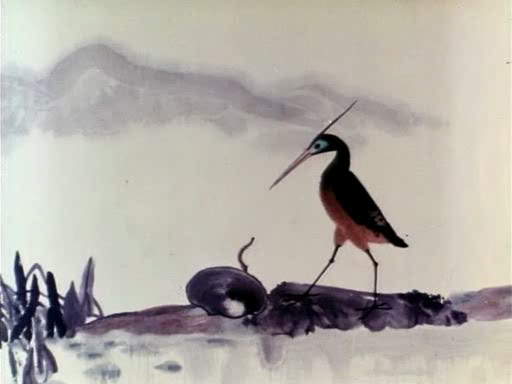
‘The Straw Man’* is yet another example of China’s typical preoccupation with nature, water and fishermen.
Based on an ancient proverb (which one could translate into ‘it’s dogged as does it’), this film tells about a fisherman who is disturbed by two pelicans and who disguises himself as a scarecrow to catch the two birds.
The cut-out animation of the birds is very naturalistic, yet the backgrounds, based on paintings from the Tang dynasty, are are very graphical. Unfortunately, compared to the stunning animation of the animals, the animation of the fisherman is very crude and primitive, and the film suffers a little from a slow pace and all too present music.
Watch ‘The Straw Man’ yourself and tell me what you think:
‘The Straw Man’ is available on the French DVD ‘Impression de montagne et d’eau’
* this film is also known by its French title: ‘l’épouvantail’
Director: Hu Jinqing Release Date: 1983 Rating: ★★½ Review:
‘The Snipe and the Clam’* is one of many Chinese films based on ancient tales.
And like many other Chines films it has a look based on ancient Chinese paintings, it’s set in nature, and it deals with a fisherman.
In this film, a fisherman, a kingfisher and a snipe try to open a giant clam. When the snipe gets stuck, it’s the fisherman who wins the day. The film is based on an ancient Chinese proverb, which can be translated into “two dogs fight for a bone, and a third one runs away with it”.
In ”The Snipe and the Clam’ Hu Jinqing excels in gorgeous watercolor backgrounds, beautiful designs, great silent acting and remarkably naturalistic cut out-animation of the animals. In comparison, the animation of the fisherman is simple and rather crude. The film unfolds at an unhurried, almost meditative speed, which can make it difficult to enjoy.
Watch ‘The Snipe and the Clam’ yourself and tell me what you think:
‘The Snipe and the Clam’ is available on the French DVD ‘Impression de montagne et d’eau’
* this film is also known as ‘Snipe-Clam Grapple’, and by its French title: ‘l’aigrette et j’huitre’
Although the titles say ‘based on the graphic novel’, the manga of the same name was actually created to be able to make the picture.
Based on his own original story, ‘Nausicaä of the Valley of Wind’ is Miyazaki’s first mature film. It’s already a typical Miyazaki film, with its strong environmental message, strong female characters, the absence of clear villains, and the setting of an alien, yet totally convincing world.
The film tells of Nausicaä, princess of a small medieval-like state in a green valley, which is threatened not only by the strange, hostile and poisonous insect world nearby, but also by other human states, especially the militaristic state of Tolmekia. The humans are more preoccupied with destruction than with comprehension. Because of this shortsighted and drastic behavior, the humans almost destroy their entire environment. It is Nausicaä, with her unique understanding of animals and her pacifistic nature, who saves the day.
‘Nausicaä of the Valley of Wind’ is an epic science fiction film, made on a grand scale, with layered characters, beautiful designs, and excellent animation. Its production led to the foundation of the Ghibli studios, which high quality standards it already meets. In no sense it feels like a first-born or a dated film. Even though it’s from 1984, it is remarkably fresh and its message still viable. In other words, ‘Nausicaä of the Valley of Wind’ is the first of a long series of Ghibli studio classics.
Miyazaki would revisit the theme of a sick and angered nature in the similar and equally impressive ‘Princess Mononoke’ (1997). Once again it’s a princess who saves the day…
Watch the trailer for ‘Nausicaä of the Valley of Wind’ yourself and tell me what you think:
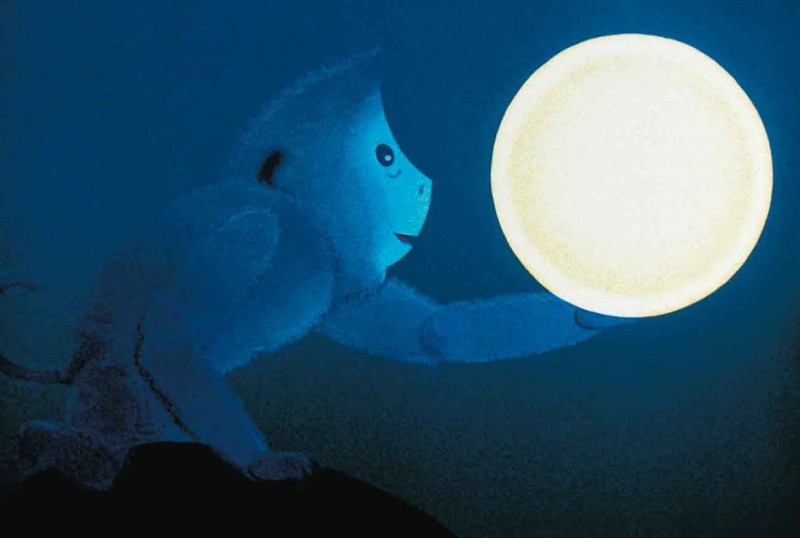
‘Monkeys Fish the Moon’* tells about a troupe of monkeys who try to catch the moon.
When they finally succeed to catch its reflection in a bowl, they drop it, only to discover that the moon still is in the sky.
‘The Monkeys who tried to catch the moon’ is, like many other Chinese films, based on an ancient fable. And, like many others it uses silent acting to tell its story. Nevertheless, the film is also a little atypical. Its elegant designs are not inspired by ancient painting, but more akin to Lotte Reiniger’s films. Moreover, the movements are not really naturalistic and the film doesn’t use Chinese music. Instead we have a lush and colorful forest world accompanied by rich film music. The cut-out models of the monkeys are soft and subtle in design, and there’s a striking use of light.
The result is one of the most beautiful Chinese animation films ever made.
Watch ‘Monkeys Fish the Moon’ yourself and tell me what you think:
‘Monkeys Fish the Moon’ is available on the French DVD ‘Impression de montagne et d’eau’
* this film is also known by its French title: ‘les singes qui veulent attraper la lune’
After ‘Persepolis’ (2007) ‘Jasmine’ is the second animation film about the Iranian revolution of 1979.
In his strongly autobiographical film Ughetto rediscovers his love relationship with Jasmine, a young woman from Iran, whom he visited during the turmoils of 1978/1979, and whom he left behind, to return to France, alone.
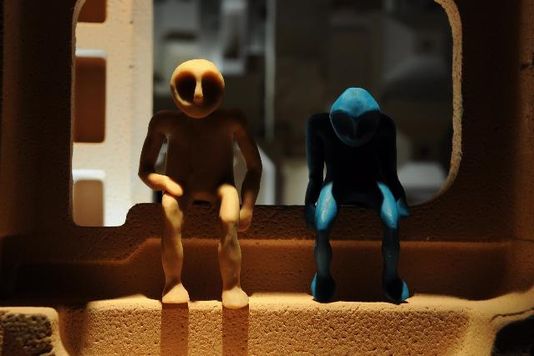
Ughetto doesn’t spare himself, and realizes leaving her was a big mistake on his part. To tell his story he uses love letters from the time, 8mm film images he shot during the Iran revolution and clay animation. He also shows the clay animation process, his elaborate sets made from styrofoam packaging material and collections of clay figures.
Unfortunately, Ughetto’s clay animation is very limited. His plasticine figures are devoid of any facial expression, and they all look the same. The only difference between the Alain and Jasmine puppets is their color (caramel vs. blue – reflecting the color of her eyes). There’s only a limited amount of animation, and little of it is expressive.
Because of this, the film relies heavily on the voice overs, Alain telling his story, a woman reading Jasmine’s love letters. Without the soundtrack the film becomes utterly incomprehensible. Only at one point in the film, the animation images leave a strong impression themselves: when the oppressive forces of the new Islamic regime strike down and kill the former revolutionaries. This is shown by giant floating turbans suddenly falling down and crushing discussing people.
‘Jasmine’ is an intimate, very personal and honest film, and the story of the Iranian revolution and its effects on the everyday lives of people remains moving. But ‘Jasmine’ is no ‘Persepolis’ and in the end falls short as an animation film. It could easily have been a live action film, a documentary, or even a novel, instead.
Watch the trailer for ‘Jasmine’ and tell me what you think:
It seems that with their growing economies the BRIC countries enter a new creative era, in which costly projects like animated features are now possible. Especially Brazil is a surprising new country from which unique and distinct animation films sprout.
In 2013 the Holland Animation Film Festival had shown the ambitious ‘Uma História de Amor e Fúria‘, this year it’s the charming film ‘O menino e o mundo’ (The Boy and the World). Surprisingly, given the extremely different animation styles, the two features have more in common than one would expect.
According to its director Âle Abreu* the idea of ‘O menino e o mundo’ was conceived when the little boy character suddenly appeared in his notes when studying Latin American protest music of the last hundred years. The film tells about this little boy growing up in the countryside, near the jungle, who goes to seek his father, who has left for the city to work. On his trip he discovers the real world that is Brazil, far from his idyllic place in the hills. He meets cotton pickers, people in the cotton industry, and even discovers how cotton is shipped to some futuristic cities (vaguely resembling the US) to be made into clothes, which are shipped back to Brazil to be sold at ridiculous prices.
I say Brazil, but Abreu insists that this story is the story of practically every Latin American country, or even every third world country emerging from a dark dictatorial past and now getting caught up in the World Economy. Indeed, the film’s world may be one great fantasy, with vehicles like animals, towns like mountains, and great futuristic cities in the sky. Yet, what happens in this world is instantly recognizable to people all over the world,
Meanwhile, the film clearly shows the grand effects of the global economy on the lives of ordinary and poor people. Without reservation Abreu shows us cotton pickers being fired because they are old and sick, workers working ridiculously long hours in hot industries to produce cotton, only to be replaced by a machine in the end. We watch poor people living in favelas (slums), while advertisements on the streets and on television produce images of a happy life they’ll never be able to reach. We watch people who demand more freedom being oppressed by military police, in a particular powerful sequence in which a colorful bird of freedom is crushed by a black bird of oppression, etc.
It’s this focus on social injustice that ‘O menino e o mundo’ shares with ‘Uma História de Amor e Fúria’. Unlike the latter film, however, Abreu’s film never becomes too heavy-handed, because we keep on seeing this world through the eyes of a child. To achieve this, Abreu uses a wonderfully naive style resembling children’s drawings and pastel crayons. All images are drenched in imagination and wonder, even those of the city and the oppressive forces, whose tanks look like large elephants. When the boy approaches the city, more and more magazine clippings are added to the colorful images. Abreu says he wanted to tell a tale about freedom, so he wanted to have freedom during the making of this film, too. He says: “A director should listen to the voice of his film, and listen to where the film wants to go“.
The result is an absolutely gorgeously looking film, simply bursting in color and fantasy. The animation, too, is superb, especially when considering that most of it was done in Photoshop. According to Abreu the drawings were then printed, filmed, and imported in After Effects for compositing. Moreover, the whole film was made with a very small crew. Nevertheless, the makers have reached a high quality by any standards.
To tell his story Abreu uses no dialogue. Yes, we hear people speak, but in a language that is constructed of Portuguese words spoken out backwards. Indeed, the voice actors had to act and sing in this backward language. However, in no way comprehensible dialogue is missed, for Abreu is perfectly capable of storytelling by images alone. Added to the mix is the cheerful score by Ruben Feffer and Gustavo Kurlat, which is a perfect match to the colorful images. According to Abreu, even the sounds of nature are made by musical means, like hand claps for rain.
‘O menino e o mundo’ is a magical film of sheer delight, deserving to be shown everywhere in the world. And unlike American films, it doesn’t shun the big questions our world needs to answer. For this bravery alone, it deserves a large audience.
Watch the trailer for ‘O menino e o mundo’ and tell me what you think:
* Quotations from Abreu are taken from his introduction and Q&A at the screening of his film at the Holland Animation Film Festival, March 20, 2014.
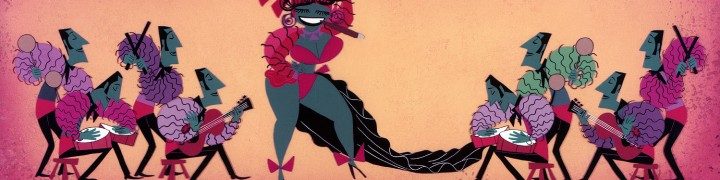
‘Betty’s Blues’ is Vandenitte’s ode to the country blues, and its origins in the South of the United States.
The film is a frame story, with two distinct styles. The framing story is told in stop-motion. We watch a young black blues singer perform in a small and empty bar near a metro line (we hear the cars rattling by from time to time). The singer tells his audience the story of Betty’s Blues. Enter the drawn animation.
The story itself is about a blues singer who loses his girl to the K.K.K. and becomes blind himself. In return for his blindness he receives the gift to make everybody dance to his guitar playing. When he meets the K.K.K. again, his revenge is sweet. The film ends with the audience shocked with horror by this rather violent story.
Both Vandenitte’s stop-motion and 2D animation are of a high quality. His stop-motion puppets have a delightfully gritty texture, and Vandenitte’s animation of guitar playing is wonderfully convincing. In the 2D sequences Vandenitte makes use of a technique simulating wood carving, combined with bold and evocative coloring, sometimes mimicking the color palette of that great cinematic ode to the musical South, ‘O Brother Where Art Thou’. The result is a gorgeous film, if a little shallow in the end.
Watch the teaser for ‘Betty’s Blues’ yourself and tell me what you think:
Director: Sabrina Peña Young Release Date: October 5, 2013 Rating: ★ Review:
‘Libertaria: The Virtual Opera’ must be one of the most unwatchable animated features ever made.
This science fiction film is utterly pretentious, using heavy texts to tell a dystopian story about some post-apocalyptic America. The film makes use of some interesting split-screen techniques, but is hampered by erratic storytelling and the most primitive computer animation techniques. The animation of the characters is appallingly poor and amateurish, and the designs hideously ugly. The emotions of the songs are not mirrored in the images, at all. Even the cheapest video game looks better than this.
This combination of dead serious pretentiousness and extremely poor execution make the film a nightmare to watch. Its best aspect is its music, because that, at least, has some quality. Indeed, Sabrina Peña Young is a composer, not an animator, and it remains puzzling why she wanted to make this film in the first place.
Cobbler, stick to your last!
[UPDATE: Sabrina Peña Young reacted to this blog post to explain why she made this film. Please read her response below]
Watch ‘Libertaria: The Virtual Opera’ yourself and tell me what you think:
Director: Sam Stephens & Christopher Mauch Release Date: May 2013 Rating: ★★★ Review:
‘Tumbleweed Tango’ is a charming little film about two balloon dogs falling in love in a menacing desert full of prickly cacti. The two dance a romantic tango, and together transform into a large bird, escaping the threatening cacti world.
‘Tumbleweed Tango’ is a virtuoso computer animation film, full of swooping camera takes, elaborate landscapes, and convincing animation on the two balloon dogs. Even their metamorphosis into the balloon bird is believable.
Watch ‘Tumbleweed Tango’ yourself and tell me what you think:
Director: Bill Plympton Release Date: October 11, 2013 Rating: ★★★½ Review:
‘Cheatin’ is Plympton’s sixth feature – no small achievement for an independent animator who insists on drawing everything on his own.
‘Cheatin’ is no exception to his rule. True, for this film Plympton had hired some staff to reproduce the looks of his watercolor illustration style, but he still drew every single frame himself. According to Plympton*, the costs of the extra staff broke him, and he had to go for a (luckily successful) Kickstarter campaign to be able to finish his film. Unfortunately, distribution in his homeland, the United States, will remain problematic, as, according to Plympton, ‘Cheatin’ is 1) no computer animation film, and 2) it’s not directed at children. Both ‘handicaps’ are enough to alienate the average American distributor. Add the absence of dialogue, and ‘Cheatin”s chances become mighty low, indeed…
This is a pity, for Plympton is in great shape in this film. His sketchy drawing style is as virtuoso as ever, and his human protagonists are drawn to the extreme – using weird camera angles and outrageous exaggeration. Practically every single frame is a beauty.
‘Cheatin’ is a surprisingly lighthearted love story. It tells about Ella and Jake, who meet each other at a bumper car stand – and it’s love at first sight. They marry shortly after, and nothing seems to stand in the way of their happiness. Unfortunately, more women take interest in the muscular Jake, and one of them frames Ella – making Jake belief she meets other men. Prostrated with grief, Jake decides to take revenge, and to pick up as many girls as possible himself…
At this point, the film starts to falter a little. Plympton steers away from reality to plunge into a weird plot using a strange machine to get to his happy end. This is a pity, for his outrageous portraits of the common aspects of love are perfect in itself. To me the film would have been better if he’d stuck to a more familiar pattern of love, rut, adultery, and revenge. For example, Plympton’s depiction of Ella opening her heart to let love in is the most endearing sequence in the whole film. And his depiction of the married couple’s happiness accounts for the film’s most stream-of-consciousness-like sequence, accompanied by the drinking song from Giuseppe Verdi’s ‘La Traviata’.
When Jake starts cheating, Plympton focuses on his behavior at the EZ motel. However, it remains a rather unclear how Jake behaves at home. He has clearly become cold and distant, and denies Ella the love and sex she desires. But at no point in the film there’s any trace of irritations, rows or fights between the two lovers.
Plympton says the film is based on a experience of his own, in which he discovered he wanted to strangle and to make love to his girl at the same time. There’s indeed a scene depicting this feeling. However, it gets a little lost in the strange plot twist. What it does show is that Ella’s desire to hurt Jake is weaker than her desire to be loved by him. Although both characters look rather cliche, in the end Ella is a far more interesting character than Jake, who remains a rather simple strong man loaded with testosteron. Plympton doesn’t show much of Ella’s character, but her more complex inner feelings can be distilled from several scenes.
Despite the plot flaws, ‘Cheatin’ remains a well-told film throughout, making clever use of Nicole Renaud’s gorgeous score, and of some classical pieces – apart from Verdi, e.g. Leoncavallo’s ‘Ridi Pagliaccio’ sung by Caruso, and Maurice Ravel’s Bolero. The absence of dialogue never becomes a handicap – on the contrary. And the emotions of the characters are played out well – sometimes grotesquely cliche, like Jake’s ride of grief; sometimes subtle and sincere, like Ella’s suffering from Jake’s rejection.
Plympton calls his film ‘anti-Disney’, but ‘Cheatin” is in no way a reaction to Disney’s world. One can say it’s decidedly non-Disney: the film stands on its own and shows us an animation world totally different from Disney’s, one in which American animated features are not synonymous to family films, but can be as wildly diverse as live action features.
I certainly hope Plympton’s world will once come true.
Watch the trailer for ‘Cheatin’ yourself and tell me what you think:
* quotations from Bill Plympton are taken from his introduction to the film at the screening at the Holland Animation Film Festival, March 19, 2014.
Director: Ah Da Release Date: 1980 Rating: ★★★★ Review:
In ‘Three Monks’* Ah Da retells an ancient Chinese proverb: one monk can carry two buckets of water, two can carry one, but three…
Three monks visit a house on a hill top to meditate and to worship Buddha. Unfortunately, they have to fetch their water in the lake below. Only after a fire they are willing to cooperate in this.
The film uses clear and simple designs and very elementary backgrounds. Its storytelling is very lean, and uses no dialogue. Unfortunately, like many other Chinese animation films, it also suffers from slowness. Ah Da clearly takes his time, telling his story on a leisurely speed. The result is a meditative film, the comedy notwithstanding.
Watch ‘Three Monks’ yourself and tell me what you think:
‘Three Monks’ is available on the French DVD ‘Impression de montagne et d’eau’
* this film is also known by its French title: ‘Les trois moines’
Predating Disney’s film to the same classical piece by seven years, this ‘video clip’ to the music of ‘Night on Bald Mountain’ by Modest Mussorgsky is an impressive mood piece.
The Russian-French artist Alexeieff animated ‘Une nuit sur le mont chauve’ on a so-called pinscreen, a device he invented himself , and which consists of a screen with numerous pins, which can be pushed further in or out, to produce a shadowy image together. This technique is highly original, and the images produced are totally unique.The film’s imagery has more in common with surreal paintings from the era than with any other animation film from the 1930s. ‘Une nuit sur le mont chauve’ was Alexeieff’s first film on the pinscreen. Together with his wife Claire Parker he would animate five more, of which ‘The Nose’ (1963) is arguably the best.
The film does not tell a story, but shows us a string of expressionistic images of animal and human forms, floating through air, and morphing into disturbing creatures. The animation is sometimes excellent (with a human figure circling through the air as a particular standout), but at times primitive, too, and the film suffers a little from the crude montage. Both shortcomings are a direct result of the limitations of the pinscreen. However, Alexeieff’s vision overcomes the film’s drawbacks, and ‘Une nuit sur le mont chauve’ is rightly considered an animation classic.
Watch ‘Une nuit sur le mont chauve’ yourself and tell me what you think:
‘Une nuit sur le mont chauve’ is available on the DVD ‘Alexeïeff – le cinéma épinglé’
Director: David Hand Release Date: December 19, 1936 Rating: ★★★ Review:
The success of Oscar-winning ‘Three Orphan Kittens‘ (1935) undoubtedly prompted this sequel, which is both less beautiful, less entertaining and less remarkable than the original short.
The film is aptly titled ‘More Kittens’, which shows its crowd-pleasing character. This time the kittens create havoc in the garden, while dealing with a fly, a tortoise and a teasing blue bird.
The cartoon is remarkable for introducing the good-natured St. Bernard Bolivar, who would become Donald Duck’s dog in the comic strip two years later. He’s not named here, but the likeness is so stunning, not only in design but also in character, that there’s no doubt it’s him. True, there was also a St. Bernard in ‘Alpine Climbers’ (1936), but this dog lacks Bolivar’s character, being more of a cliche St. Bernard instead.
Watch ‘More Kittens’ yourself and tell me what you think:
This is Silly Symphony No. 65
To the previous Silly Symphony: Mother Pluto
To the next Silly Symphony: Woodland Café
Directors: Pinto Colvig, Walt Pfeiffer & Ed Penner Release Date: April 17, 1937 Stars: Mickey Mouse, Donald Duck, Clarabella Cow, Clara Cluck, Goofy Rating: ★★★½ Review:
Mickey is only the straight man while hosting an amateur night at the theater.
We watch Donald trying to recite ‘Twinkle Twinkle Little Star’ while forgetting the words, Clarabella Cow and Clara Cluck performing an operatic song, and Goofy with an automatic one man band that goes haywire.
Donald surprises not only his but also the modern audience by drawing a tommy gun to shoot at the audience(!). However, it’s Goofy’s silly musical machine which draws the biggest laughs in a hilarious sequence, with particularly silly animation.
‘Mickey’s Amateurs’ ends with Donald getting caught in the closing end circle. Self-awareness gags like this were rare at Disney’s (another example is the burning title card in ‘Mickey’s Fire Brigade‘ from 1935), but would become standard repertoire at Warner Bros. and in Tex Avery’s cartoons at MGM.
Watch ‘Modern Inventions’ yourself and tell me what you think:
This is Mickey Mouse cartoon No. 94
To the previous Mickey Mouse cartoon: Moose Hunters
To the next Mickey Mouse cartoon: Modern Inventions
Director: Frank Tashlin Release Date: October 30, 1937 Stars: Porky Pig, Petunia Pig Rating: ★★★★ Review:
In this cartoon Porky suddenly has three elder brothers (Peter, Portus, and Percy), while Petunia appears to be his sister.
The siblings inherit their estate from their late uncle Solomon (who’s a caricature of Oliver Hardy). Unfortunately, the evil lawyer Goodwill is after them, changing himself into a Dr. Hyde-like character. Strangely enough he insults somebody in the audience, the “guy in the third row”. This to his own regret, for it’s this guy who saves Porky and his siblings in the end! This type of dimension-defying humor was a novelty at the time and would become a Warner Bros. trademark in the late 1930s and early 1940s.
Watch ‘The Case of the Stuttering Pig’ yourself and tell me what you think:
This is Porky Pig cartoon no. 31
To the previous Porky Pig cartoon: Rover’s Rival
To the next Porky Pig cartoon: Porky’s Double Trouble
Director: Frank Tashlin Release Date: December 19, 1936 Stars: Porky Pig Rating: ★★★ Review:
Porky has a game refuge in Canada, in which he defends rather cute animals against an evil hunter.
The hunter is designed like the lieutenant from ‘Little Beau Porky‘, but we only see him appear after 4’30. Before this his threat is shown by his shadow only, a remarkably inventive device for a cartoon of the 1930s.
Like other early Warner Brothers films, ‘Porky in the North Woods’ looks very primitive, and rather Disney-anno-1932/1933-like. Yet it features an extremely fast sequence of a squirrel running a ridiculously long distance through the woods to get help (and back to fetch and apple). Such short and fast sequences of characters crossing ridiculously long distances would become a trademark of Tashlin’s colleague Tex Avery. Like his first two films, Tashlin’s third short at Warner Bros. features a battle sequence: this time we watch an enormous number of animals being called to arms.
Porky hardly talks in this cartoon – it seems Tashlin tried to avoid his tiresome stutter. Indeed, in 1937, the original voice artist would be replaced by Mel Blanc, who was able to make Porky’s stutter funny.
Watch ‘Porky in the North Woods’ yourself and tell me what you think:
Director: Frank Tashlin Release Date: October 24, 1936 Stars: Porky Pig Rating: ★★★½ Review:
‘Little Beau Porky’ is Frank Tashlin’s second film at Warner Bros. It’s a more clearly gag-orientated effort than his debut film ‘Porky’s Poultry Plant‘.
Porky (with his old stutter) is a soldier at the foreign legion, being bullied by his lieutenant. However, in the end he manages to single-handedly save the fort and to overthrow an evil Arab and his gang.
Like in ‘Porky’s Poultry Plant’, both design and animation are primitive. But Tashlin unmistakably shows his cinematic talent, especially in the opening sequence and in the preparation for battle.
Watch ‘Little Beau Porky’ yourself and tell me what you think:
Director: Frank Tashlin Release Date: August 22, 1936 Stars: Porky Pig Rating: ★★★★ Review:
Both director Frank Tashlin and composer Carl Stalling make their Warner Bros. debut in this film in which Porky (with his old ugly voice) has a fowl farm, threatened by a bunch of evil buzzards.
‘Porky’s Poultry Plant’ looks primitive when compared to Disney films of the same time, looking more like a Disney film from 1932-1933. Its story is sweet, and not very funny, but Carl Stalling’s music is fresh, and Tashlin’s staging is already very impressive. Especially the air battle sequence (in which Porky, in a small army plane, fights an air fleet of hawks ) is remarkably stunning, showing unparalleled fast montage and original ‘camera’ shots. Both these techniques would become Tashlin trademarks, and would contribute to a faster, more gag-orientated style at Warner Bros. Tashlin had replaced Jack King, who had returned to Disney, and with his first Warner Bros. cartoon he immediately proves to be a more inventive director than his predecessor.
Watch ‘Porky’s Poultry Plant’ yourself and tell me what you think:
‘Modern Inventions’ is Donald’s first real solo outing, sharing screen time only with mechanical objects. He visits a ‘museum of modern marvels’ , where he has to deal with a mechanical robot butler (the running gag of the film), a package wrapper, a ‘robot nurse maid’ and an automatic barber chair. Like in ‘The Band Concert‘ Donald shows an ability to produce numerous objects out of nothing, this time hats. He even manages to change his army cap into a baby cap.
‘Modern Inventions’ was the last of three Donald Duck shorts under the Mickey Mouse flag. With his next cartoon, ‘Donald’s Ostrich‘ he would have a series of his own…
Watch ‘Modern Inventions’ yourself and tell me what you think:
This is Mickey Mouse cartoon No. 95
To the previous Mickey Mouse cartoon: Mickey’s Amateurs
To the next Mickey Mouse cartoon: Hawaiian Holiday
Director: Ben Sharpsteen Release Date: January 9, 1937 Stars: Donald Duck Rating: ★★★★★ Review:
After co-starring with Pluto in ‘Donald and Pluto‘ (1936), Donald really comes to his own in ‘Don Donald’. In this cartoon he only shares screen time with a new character, Donna Duck, a predecessor of Daisy with a temper that matches Donald’s own.
In this film, we watch Donald in a Mexican setting featuring a surprisingly Krazy Kat-like palm in the background. He wears a large sombrero and tries to woo Donna, but his donkey spoils his efforts. Donald trades his donkey for a car (the small red car we would become so familiar with). The car makes a deep impression on Donna, and both go for a ride.
The animation of the car ride is a great showcase of animation of speed, while the hilarious sequence in which Donald tries to restart the motor again is a wonderful example of rubbery animation. The film ends marvelously, when Donna produces a unicycle out of her handbag and rides off into the distance. But the whole film is one of sheer delight and one of the classics of the 1930s.
Despite Mickey’s absence, ‘Don Donald’ is still part of the Mickey Mouse series. Only with ‘Donald’s Ostrich‘ from December 1937 Donald would get his own series.
Watch ‘Don Donald’ yourself and tell me what you think:
This is Mickey Mouse cartoon No. 91
To the previous Mickey Mouse cartoon: The Worm Turns
To the next Mickey Mouse cartoon: Magician Mickey
Animation Backgrounds
A blog dedicated to background paintings from animation films. Kept until 2016.
Animation Scoop
Animation historian Jerry Beck’s animation film news blog.
Cartoon Brew
Topical blog on animation film, led by animation historian Amid Amidi.
Cartoon Modern
Amid Amidi’s blog on modern design cartoon art from the forties, fifties and sixties.
Cartoon Research
THE site on classic animation research, hosted by cartoon historian Jerry Beck.
Cartoons Theory
Frank Beef analyzes classic cartoons. Kept until 2020.
Century Film Project
Michael reviews films of 100 years old and older, roughly in chronological order.
Classic Cartoons
A similar blog featuring many stills and comic strips. Kept until 2012.
Comet over Hollywood
Jessica Pickens reviews classic Hollywood films, especially musicals.
Deja View
Top ex-Disney animator Andreas Deja’s own blog.
Disney History
Esteemed Disney historian Didier Ghez on the latest books on Disney history.
Feeling Animated
Paul Astell brings us thorough reviews of animated features.
Flickers in Time
Short and to the point reviews of classic films (lately mostly pre-code talkies) by an anonymous retired Foreign Service Officer from California
 ‘The Straw Man’* is yet another example of China’s typical preoccupation with nature, water and fishermen.