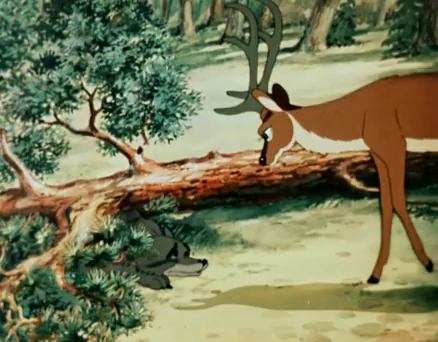
A wolf gets trapped under a tree. A stag helps him out, but as soon as he is free, the wolf tries to catch and eat his helper.
The stag claims this to be unjust, and the two animals ask a bear to be a referee. The bear restores the initial situation to be able to judge the argument, but then runs off with the deer, leaving the wolf under the tree again.
‘The Stag and the Wolf’ is a typical Russian animation film from the early fifties, this time based on an ancient tale (it’s even found among folk tales in Cameroon, albeit with different animals). Like contemporary Soviet films, it has the distinct flavor of Russified Disney. The film pushes the limits of Soviet naturalism, especially in the backgrounds. The bear, however, is very Disney-like, and a little at odds with the particularly realistically designed stag.
Watch ‘The Stag and the Wolf’ yourself and tell me what you think:
Director: Alexander Ivanov Release Date: 1950 Rating: ★ Review:
It’s winter, and a rabbit, a fox and a squirrel wake up a hibernating little bear to go skating with them.
‘Grandpa and grandson’ is one of the countless harmless children’s films the Soviet Union produced in the 1950s. Unfortunately, it’s not among the best. It’s a slow and sugary film starring many all too cute animals and using a lot of dialogue.
Unlike contemporary Soviet animation films it doesn’t seem to be based on a folk tale. Instead, it feels like an overlong Silly Symphony (it lasts almost twenty minutes), ending with a seemingly endless ballet on skates. Because of the slow animation of the characters (typical of Russian films from the era), even this ballet doesn’t really comes off like its Disney models.
Watch ‘Grandpa and grandson’ yourself and tell me what you think:
Director: Olga Khodatayeva Release Date: 1950 Rating: ★★★★ Review:
‘The Magic Windmill’ is one of the classic fairy-tale films produced by the Soviet Union in the 1950s.
In this short an old man, a cat and a cock are having trouble to feed all the animals who seek shelter at their place. Therefore they ask the mountain god for help, who gives them a magical little windmill, which produces endless amounts of breads out of of a few grains of corn. Unfortunately, rumor spreads, and soon the little windmill is stolen by a greedy king. But the cock flies to his palace and brings back the magical object, despite several attempts on his life.
‘The Magic Windmill’ is a gentle, if what overlong little film based on a Russian fairy-tale. It uses a naturalistic style, clearly influenced by Disney, with watercolor backgrounds, and a multiplane camera effect in its opening scene . The animal designs are an interesting mix of the Disney style and Russian illustration art. The animation, however, leaves a lot to desire. The animation of movement is awkward, with most characters moving in a slow, all too constant speed. The film uses dialogue in rhyme, but the lip synchronization with the characters is poor.
Despite these flaws, ‘The Magic Windmill’ is a film of great poetry, and one of the best of the Russian fairy tale films of the fifties. Indeed, director Khodatayeva was a veteran of soviet animation, having made films since the 1920s.
Watch ‘The Magic Windmill’ yourself and tell me what you think:
Director: Jiří Trnka Release Date: 1949 Rating: ★★★ Review:
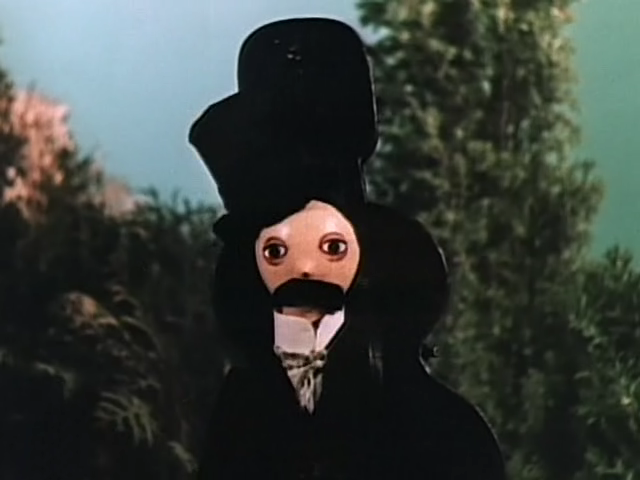
‘Story of the Bass Cello’ is a re-telling of a classic story by Anton Chekhov.
The film tells about a bass player and a girl who both take a swim, but whose clothes are stolen. The bass player invites the lady to take place in his bass case, but when he’s after the possible thief, the case is picked up by his fellow instrumentalists and brought to the palace, where an astonished crowd discovers the naked lady inside.
‘Story of the Bass Cello’ is a mildly amusing and sweet film. It contains nice silent comedy. The short is a little bit slow, however, and not as good as Trnka’s more outrageous ‘The Song of the Prairie‘ from the same year.
Watch ‘Story of the Bass Cello’ yourself and tell me what you think:
Director: Jiří Trnka Release Date: 1949 Rating: ★★★★★ Review:
With ‘The Song of the prairie’ Trnka’s both made a parody of and a homage to the classic Western.
The film uses all the cliches of the genre: a stagecoach, masked bandits, a damsel in distress, a hero with a white hat, a villain fancying the girl, and a climax on a cliff.
Trnka’s animation has much improved since ‘The Emperor’s Nightingale‘: the cinematography is excellent, and particularly the illusion of speed is astonishing. The film is wonderfully tongue-in-cheek and full of brilliant silent comedy, showing Trnka’s then unsurpassed mastery in stop-motion. ‘The Song of the Prairie’ is one of Trnka’s most enjoyable films, and deserves a more classic status.
Watch ‘The Song of the Prairie’ yourself and tell me what you think:
Director: Victor Gromov Release Date: 1949 Rating: ★★ Review:
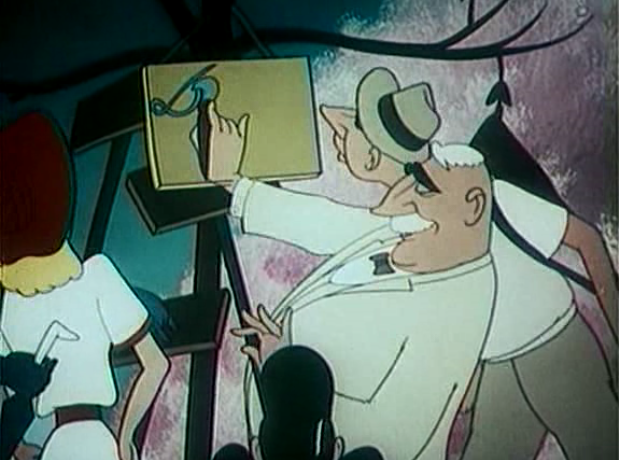
Mr. Wolf is a Russian propaganda film. The film is an oddball in director Gromov’s small animation output. His other seven films are fantastic fairy tales and children’s films
The film tells about Mr. Wolf, a rich American, who is fed up with weapons and war. He retreats with his unwilling family to a peaceful island. But then oil is discovered on the island. Immediately, Mr. Wolf and his family are overpowered by greed, and the American only too gladly drops his pacifism.
‘Mr Wolf’ is based on a comedy by Evgeny Petrov. Although drowned in caricature, this blatant propaganda film is hardly funny: its animation is elaborate, but painstakingly slow, and too excessive. Moreover, it is not too clear what the message is. Are all Westerners blinded by greed? Is pacifism senseless in a world of war? Are oil and peace at odds with eachother? I’ve no idea.
Watch ‘Mr. Wolf’ yourself and tell me what you think:
‘Mr. Wolf’ is available on the DVD box set ‘Animated Soviet Propaganda’
Director: Jiří Trnka Release Date: April 15, 1949 Rating: ★★★ Review:
‘The Emperor’s Nightingale’ is Jiří Trnka’s second feature film (he made no less than six in total).
It tells the familiar story by Hans Christian Andersen from an original perspective: he frames the fairy tale by a live-action story about a lonely rich boy, who lives in a restricted environment. When the boy goes to bed, he dreams the fairy-tale, which stars some of his toys. Thus, after more than seven minutes, the animation kicks in.
In the boy’s dream, the Chinese emperor is a lonely little rich boy, restricted by rules, too, and the whole film seems a plea for freedom and against rules and restrictions, quite some message in communist Czechoslovakia. This theme is enhanced by the English narration, wonderfully voiced by Boris Karloff, which is a welcome addition to Trnka’s silent comedy. The whole film breathes a kind of surrealistic atmosphere and Trnka’s use of camera angles is astonishing, as is his sometimes very avant-garde montage.
Nevertheless, the pacing of the film is slow, its humor sparse and only mildly amusing, and the puppet animation still too stiff to allow elaborate character animation. Therefore, the film hasn’t aged very well, and although a tour-de- force, ‘The Emperor’s Nightingale’ falls short as a timeless masterpiece.
Watch ‘The Emperor’s Nightingale’ yourself and tell me what you think:
Director: Peter Lord & David Sproxton Release Date: 1978 Rating: ★★ Review:
‘Confessions of a Foyer Girl’ is the second film in Aardman’s revolutionary ‘Animated Conversations’ series.
Like its predecessor, ‘Down & Out‘, the film uses recorded dialogue. This time we hear two foyer girls chatting in a cinema. The dialogue is hard to understand and the lip-synch is not as good as in ‘Down & out’. Moreover, the animation is associated with seemingly unrelated stock live action footage, which leads to a film, which is both experimental and vague. The result never quite works and the result must be called a failure.
‘Confessions of a Foyer Girl’ is available on the DVD ‘Aardman Classics’
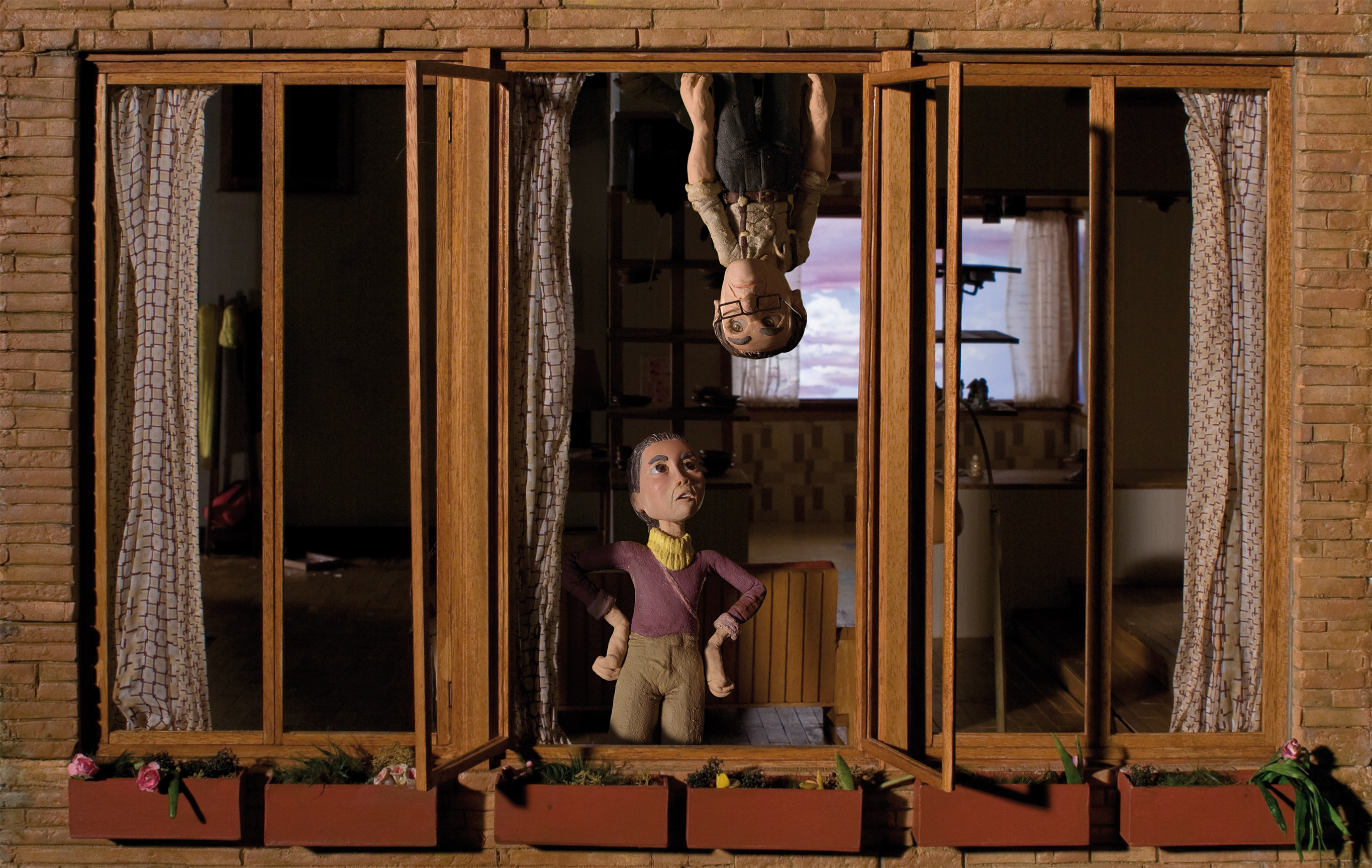
‘Head over Heels’ is a film directed by Timothy Reckart, and produced by Fodhla Cronin O’Reilly. It has won this prestigious Eruopean prize at the Cartoon Forum, held in Toulouse, France. Earlier, the film had been nominated for an Academy Award.
‘Head over Heels’ is a stop-motion film about a couple who have grown apart, even though they still live in the same house. In the film, one of them occupies the ceiling, the other the floor. This concept is a masterstroke, and the story is very well executed. The result is a moving picture, which is a well-deserved winner of the Cartoon d’Or 2013.
Director: Peter Lord & David Sproxton Release Date: 1978 Rating: ★★★★★ Review:
‘Down & out’ is the first film in Aardman’s ‘animated conversations’ series and the British studio’s first masterpiece.
The very idea of using dialogue from real life is revolutionary enough, but to use it for clay animation with lip-synch is a masterstroke. Moreover, the animation of the plasticine figures is startling: it lacks the exaggerations of normal animation, but uses small gestures and real movements, like scratching one’s nose or belly, instead. The animation continues realistically even when not supported by the soundtrack. The result is uncannily realistic, making the drama of an old, confused man asking for food and shelter, but being turned down at an Salvation army office, extra tragic.
With this film Aardman single-handedly invented the ‘animated documentary’, a genre which would lead to fantastic films like ‘Ryan’ and ‘Waltz with Bashir’ in the 2000s.
‘Down & Out’ is available on the DVD ‘Aardman Classics’
Director: Paul Driessen Release Date: 1981 Rating: ★★★★★ Review:
‘Het treinhuisje’ is one of Paul Driessen’s most beautiful films.
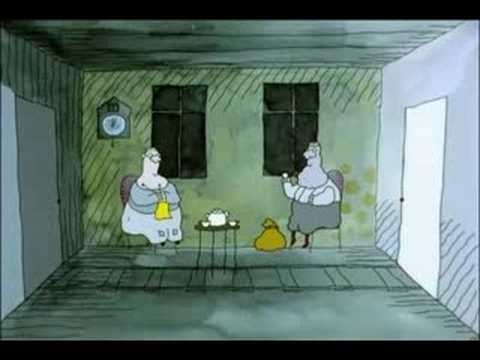
This short builds on the surreal concept of a home built right on a railway track. The daily life of the couple living in the house is dominated by a train passing right through their home at certain times.
With simple and direct storytelling Driessen sets the drama, in which this very train ruins the life of the couple. All the time we stick inside the couple’s home. Only when the man tells of his misfortunes, we shortly cut to the outside world. Ironically, it’s the railway itself that ruins the couple’s life.
The story is told without dialogue, and supported by beautiful country music. The emotions of the couple are depicted well, and are very subtle. However, the film also shows Driessen’s typical animation style at its most radical: the film’s surrealism is enhanced by strange disappearances of the characters when they cross the room and by a ghostly avant-image of the train before it really enters the house.
The film also shares the trademark morbid humor with other Driessen films, especially in the cuckoo clock and in the persistent fly bugging the characters throughout the picture. Nevertheless, the melancholy atmosphere dominates, and its the film’s drama that impresses the viewer time and time again.
Watch ‘Het treinhuisje’ yourself and tell me what you think:
‘Het treinhuisje’ is available on the DVD ‘The Dutch Films of Paul Driessen’
Director: Paul Driessen Release Date: 1980 Rating: ★★★★ Review:
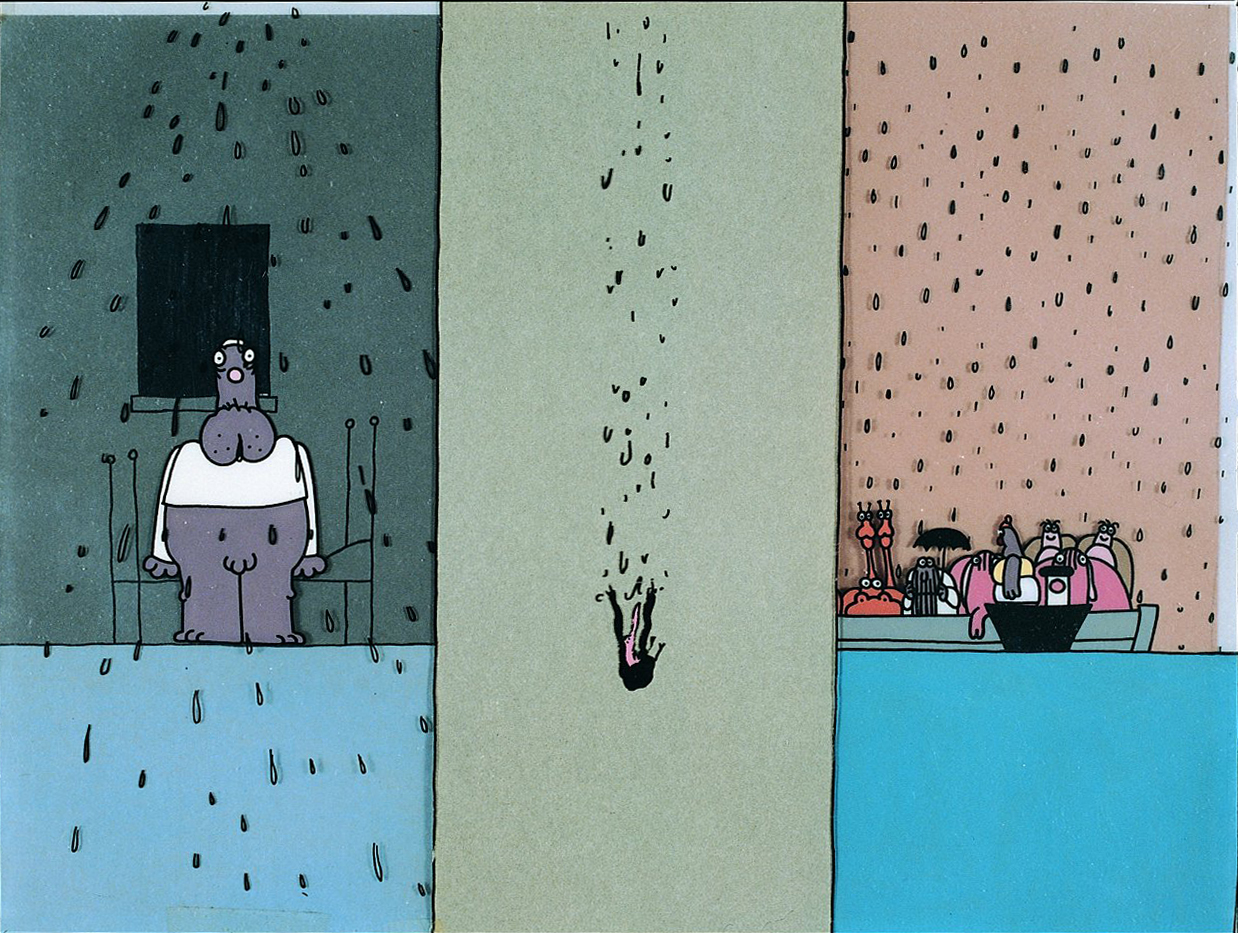
In this film Paul Driessen experiments with the split screen for the first time.
Here we see three narrow frames: the left frame (Land) depicting a sleeping man, the middle one (Air) a bird, and the right one (Sea) a couple on a boat on the ocean. The story involves several themes explored in all three frames, which at times interact but only come together in the end
Like many of Paul Driessen’s shorts ‘Te land ter zee en in de lucht’ involves morbid humor, including a running gag of an ark sinking several times. The film uses no dialogue and no music, only sound effects with very effective results.
Driessen would take the split screen technique to the max in ‘The End of the World in Four Seasons’ (1995), but the genius of ‘Te land, ter zee en in de lucht’ would only be topped by his melancholy film ‘The Boy Who Saw the Iceberg’ from 2000.
Watch ‘Te land, ter zee en in de lucht’ yourself and tell me what you think:
‘Te land, ter zee en in de lucht’ is available on the DVD ‘The Dutch Films of Paul Driessen’
Director: Paul Driessen Release Date: 1977 Rating: ★★★★½ Review:
A man is going to eat an egg, when he suddenly hears a voice from within. He destroys the egg, killing the unseen victim. However his cruel behavior is soon punished in an echo of events.
‘The Killing of an Egg’ is a short cartoon with a very limited setting. The whole action takes place within a single square frame and its perspective is changed only once. In this claustrophobic surrounding the story unfolds its own inner logic. In this limited time-space Paul Driessen shows his mastery of story telling.
This classic cartoon is a prime example of Paul Driessen’s mature style. It’s the first film in which he plays with framing the action (soon followed by split screens, eventually leading to the extreme example of ‘The End of the World in Four Seasons’ from 1995). The film shows Driessen’s typical way of telling a short story based on a simple, yet clever idea which makes the cartoon tick like an inevitable fate. Later examples of this style are ‘Home on the Rails‘ (1981) and ‘Sunny Side Up‘ (1985). And finally, this film is typical of Driessen’s dark humor, which always has a disturbing edge to it. We may feel as powerful as this man, but we, too, will be crushed in the end…
Watch ‘Ei om zeep’ yourself and tell me what you think:
‘Ei om zeep’ is available on the DVD ‘The Dutch Films of Paul Driessen’
Director: Paul Driessen Release Date: 1977 Rating: ★★★ Review:
After working in Canada for the NFB for five years, Driessen experienced a major personal setback, when his marriage failed, and his ex left for The Netherlands with their two children. Driessen soon missed his son and daughter and returned to his native country himself.
In The Netherlands he rented a small attic in The Hague to work and live in. Here he made ‘David’, which he dedicated to his children Anouk and Kaj.
David is the world’s tiniest cartoon star. He’s so small, even the little gnomes can’t see him. During most of the cartoon his presence is only known by his footsteps and his voice. In fact, David is probably the first cartoon star to remain invisible throughout the picture. Nevertheless, Driessen manages to keep the film entertaining, even though most of the time we look at an empty screen.
This film is clearly meant for children and unfortunately, it is hampered by its slowness and large amount of dialogue of David himself (in the Dutch version provided by actor Aart Staartjes). Much of the fun is in David trying to make himself known. Despite its joyful spirit, the film contains a morbid ending, when David, having survived a giant and a predatory bird, is eventually squashed by an unknowing pedestrian…
‘David’ was Driessen’s sixth film, and his idiosyncratic style has matured immensely since his first film, ‘The Story of Little John Bailey‘ (1970). With his next film ‘Killing of an Egg‘ he would animate his first masterpiece.
Watch ‘David’ yourself and tell me what you think:
‘David’ is available on the DVD ‘The Dutch Films of Paul Driessen’
Director: Paul Driessen Release Date: 1970 Rating: ★★½ Review:
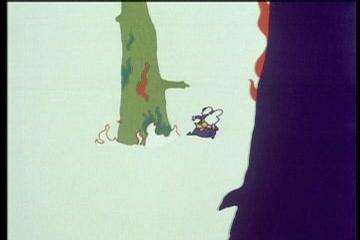
Paul Driessen’s very first film is a charming little short for children.
Made largely in Spain with help of small subsidy from the Dutch Ministry of Culture, the film tells about a small boy who accidentally sets a forest on fire, but repays his deed by extinguishing another one with help of an elephant with two trunks.
The simple story is hampered by the childish voice over (the English version is much more enjoyable than the original in that respect), and the film certainly doesn’t belong to Driessen’s best works, but its imaginative colors and weird perspectives are still thrilling. It already shows the film maker’s very distinctive animation style, which he would expand and improve over the years, creating such masterpieces as ‘On Land, at Sea and in the Air‘ (1980) and ‘The Writer‘ (1988).
Watch ‘Het verhaal van Kleine Yoghurt’ yourself and tell me what you think:
Director: Pete Doctor Release Date: November 2, 2001 Rating: ★★★★★ Review:
Pixar’s fourth film can be considered the studio’s best up to that point.
The very idea of monsters needing to scare children to fuel their city is a masterstroke. As is their mutual fright for children. The idea of closet doors leading to a parallel world is used to the max, especially in the breathtaking finale, whose premise is both logical to the plot as strikingly original and totally unexpected. Nothing to the story is predictable, and its lead characters Sully, Mike and Boo and their nemesis, the slithery Randall, are very well developed.
The only two lesser points may be Monstropolis itself, which is a surprisingly unimaginative copy of an average American town, and the film’s humor. Compared to Dreamworks’s ‘Shrek’, released earlier that year, Monsters, Inc.’s humor is rather mild. It heads for steady smiles, not for loud guffaws. Moreover, the loudmouth comic sidekick, the green eyeball Mike (voiced by Billy Crystal), never really gets convincingly funny or very sympathetic, and he pales compared to Eddie Murphy’s Donkey in ‘Shrek’.
No, the main selling point of Monsters Inc. is heart: the endearing ‘love story’ between top scare Sully and the little child Boo is completely convincing. This makes ‘Monsters, Inc.’, apart from being startlingly original, a sweet film. One that is able to move you time and time again.
Besides, ‘Monsters, Inc.’ displays some spectacular effect animation, the highlight being Sully laying in the snow, with his hair blowing in the blizzard, something unseen up to that point.
In 2013 ‘Monsters, Inc.’ fell prey to Hollywood’s sequel mania ,spawning the prequel ‘Monster University’.
Director: John Lounsberry, Wolfgang Reitherman & Art Stevens Release Date: June 22, 1977 Rating: ★★★★½ Review:
‘The Rescuers’ was a joint venture of an old and a new generation of animators at the Disney studio. It is without doubt the best of the three features the studio made in the seventies.
It was Disney’s first feature film since ‘One Hundred and One Dalmatians‘ (1961) in which Wolfgang Reitherman shared the direction duties, and this fact alone arguably improves the end product.
Unlike the earlier features ‘The Aristocats’ (1970) and ‘Robin Hood‘ (1973) it doesn’t contain any reused animation (with a possible exception of animation from ‘Bambi‘ in a minor mood scene). And while ‘The Aristocats’ and ‘Robin Hood’ relied on proven formulas, both being very reminiscent of ‘Jungle Book’ (1967), ‘The Rescuers’ has a fresh story (based on a children’s book by Margery Sharp), and a unique, surprisingly gloomy atmosphere. In Sharp’s book the mice rescue a prisoner, but for the film the Disney story men chose an orphan girl named Penny to be rescued. A masterstroke, for the lovable little girl easily becomes the center of the story, which contains a lot of heart.
However, all the film’s main characters are adorable: the lovely Hungarian mouse Bianca (voiced by Eva Gabor) and her companion, the superstitious yet valiant janitor Bernard are such great characters that they were able to spawn Disney’s first sequel, ‘The Rescuers Down Under’ in 1990. Medusa is a real and wonderful villain. She hasn’t got any special powers and at times she’s portrayed as preposterous, but mostly she’s sly, mean and genuinely scary: a worthy adversary for our heroes to deal with. She was animated by Milt Kahl, the last and arguably best piece of animation he ever did for the studio.
Medusa may steal the show, but even the minor characters like Orville the Albatross, Rufus the cat, Evenrude the damselfly, Snoops and the two Alligators are delightful. They all contribute to a story, which is concise and well-told. It evolves without delays or side-ways, and leads to a great finale in Devil’s Bayou.
‘The Rescuers’ is also the first Disney feature since ‘Bambi’ (1942) not to be a musical, but to use songs to evoke moods only. All these elements contribute to a story which is both thrilling and moving. The film’s opening credits use a song and beautiful oil paintings by Mel Shaw to start the story. Unfortunately, the background paintings in the rest of the movie are more prosaic, mixing moody oil paintings with more graphic backgrounds to an uneven effect. The animation on the other hand is superb throughout.
Unfortunately, ‘The Rescuers’ proved more of a swansong of the old generation of nine old men than the beginning of a new era. The following features were much weaker, and only with ‘The Little Mermaid’ (1989) Disney found a genuinely new and strong voice. Thus stands ‘The Rescuers’ as a beacon of light in the dark ages of animation that were the 1970s and 1980s.
Watch the trailer of’The Rescuers’ and tell me what you think:
A man rescues a harpy from a man who strangles her. He takes her home, but with disastrous results, because he soon discovers that the harpy eats all his food…
‘Harpya’ is a fantastic surreal film, which makes great use of a mixture of animation, live action and pixillation to create a totally unique atmosphere. The film is both funny and uncanny, and its story is Servais’s best since ‘Sirene’ (1968).
With ‘Harpya’ Raoul Servais made his most enduring work. It’s his all-time masterpiece, and a central film in his oeuvre, defining his mature style.
Watch ‘Harpya’ yourself and tell me what you think:
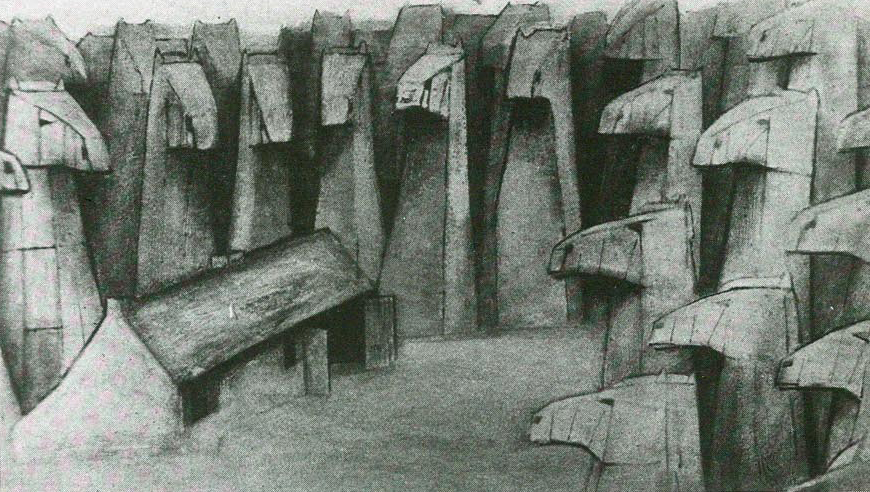
‘Pegasus’ tells about a lonely blacksmith who lives in the countryside.
The blacksmith has a love for horses, but unfortunately his surroundings are totally devoid of them. So he builds a horse head out of metal to worship. Unfortunately, the horse head appears to have an ability to grow and reproduce, surrounding his house like a forest.
‘Pegasus’ is a beautiful and surreal film. Unfortunately, it ends quite abruptly, leaving behind a sense that not everything has been said, yet.
Watch ‘Pegasus’ yourself and tell me what you think:
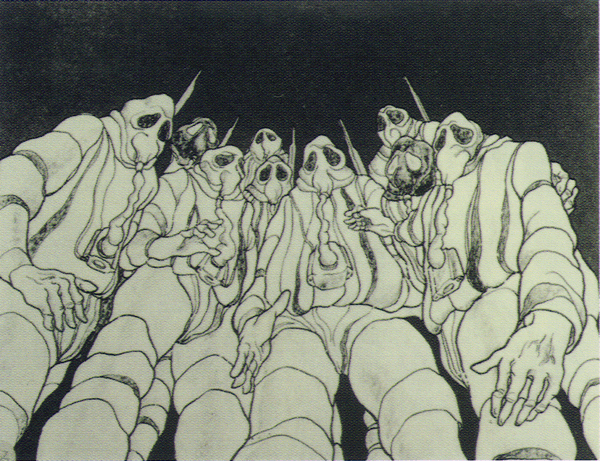
Operation X-70 is a half silly, half scary short by Belgian film maker Raoul Servais.
It tells about a poisonous gas, which turns people into spiritual beings. The gas is advertised as a ‘clean weapon’, because it doesn’t kill people. When the gas is accidentally bombed on the Benelux (Belgium, Holland and Luxemburg), it turns people into angels.
The film impresses with its weird idea, its dark and gloomy atmosphere, and its anti-war message. However, like Raoul Servais’s earlier film ‘Goldframe’ (1968), the film suffers from an all too present dialogue. In the end the short’s images are more lasting than the film itself is.
Watch ‘Operation X-70’ yourself and tell me what you think:
Animation Backgrounds
A blog dedicated to background paintings from animation films. Kept until 2016.
Animation Scoop
Animation historian Jerry Beck’s animation film news blog.
Cartoon Brew
Topical blog on animation film, led by animation historian Amid Amidi.
Cartoon Modern
Amid Amidi’s blog on modern design cartoon art from the forties, fifties and sixties.
Cartoon Research
THE site on classic animation research, hosted by cartoon historian Jerry Beck.
Cartoons Theory
Frank Beef analyzes classic cartoons. Kept until 2020.
Century Film Project
Michael reviews films of 100 years old and older, roughly in chronological order.
Classic Cartoons
A similar blog featuring many stills and comic strips. Kept until 2012.
Comet over Hollywood
Jessica Pickens reviews classic Hollywood films, especially musicals.
Deja View
Top ex-Disney animator Andreas Deja’s own blog.
Disney History
Esteemed Disney historian Didier Ghez on the latest books on Disney history.
Feeling Animated
Paul Astell brings us thorough reviews of animated features.
Flickers in Time
Short and to the point reviews of classic films (lately mostly pre-code talkies) by an anonymous retired Foreign Service Officer from California

 A wolf gets trapped under a tree. A stag helps him out, but as soon as he is free, the wolf tries to catch and eat his helper.











 Dr. Grob's Animation Review