Directors:William Hanna & Joseph Barbera Release Date: October 21, 1950 Stars: Tom & Jerry, Spike Rating: ★★★★ Review:
Tom frames Jerry for eating a chicken leg only to eat the chicken leg himself.
Jerry revenges himself on Tom by repeatedly framing him for stealing Spike’s bone. The cartoon ends with a wonderfully elaborate magnet gag, repeatedly tying Tom unwillingly to Spike’s bone.
Even though it’s not among Tom & Jerry’s most memorable entries, ‘The Framed Cat’ is a fun cartoon. It’s one of those rare cartoons in which Tom speaks a little. It’s also noteworthy for its backgrounds, which are more stylized than usual.
Watch ‘The Framed Cat’ yourself and tell me what you think:
This is Tom & Jerry cartoon No. 53
To the previous Tom & Jerry cartoon: Tom and Jerry in the Hollywood Bowl
To the next Tom & Jerry cartoon: Cueball Cat
Directors:William Hanna & Joseph Barbera Release Date: September 16, 1950 Stars: Tom & Jerry Rating: ★★★★★ Review:
Only a year after Chuck Jones’ Bugs Bunny cartoon ‘Long-Haired Hare‘ the Hollywood Bowl is visited by cartoon characters again in ‘Tom and Jerry in The Hollywood Bowl’.
This short is Tom & Jerry’s second concert cartoon (the first being ‘The Cat Concerto‘ from 1947). This time Tom is a conductor, conducting an orchestra of cats in Johann Strauss Jr.’s overture to ‘Die Fledermaus’. Jerry wants to conduct, too, but Tom doesn’t allow him. This leads to a battle between the two with a great finale in which Jerry makes the complete orchestra disappear, so Tom has to play all the instruments himself. Jerry, who conducts him shares the applause with an exhausted Tom, before the cat vanishes into a hole, too.
During the complete cartoon the feud between the two conductors is perfectly timed to the music. ‘Tom and Jerry in the Hollywood Bowl’ is not as good as ‘The Cat Concerto’, but still very funny. Its only drawback are the designs on Tom and Jerry, which both look poorer than usual, looking forward to the leaner designs of their later cartoons.
Watch ‘Tom and Jerry in the Hollywood Bowl’ yourself and tell me what you think:
Granny sneaks Tweety into a hotel where no pets are allowed.
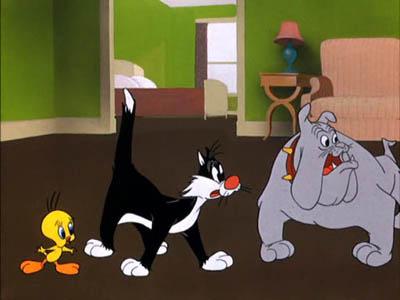
Another old lady sneaks Sylvester in, who inhabits the room next to Tweety. Like in ‘All a bir-r-r-d‘ Sylvester encounters a vicious bulldog, too. The cartoon contains a classic corridor-with-doors-gag, but the cartoon’s greatest joy is its great twist on the chase routine, provided by a pet inspector who at times interrupts the chase of the three animals.
‘Room and bird’ is the first of four 1951 Warner Brothers cartoons featuring music by Eugene Poddany instead of Carl Stalling.
Watch ‘Room and Bird’ yourself and tell me what you think:
‘All a Bir-r-r-d’ is Tweety and Sylvester’s fourth cartoon and in this short their chase takes place in the baggage wagon of a train. Sylvester’s pursuit is extra hindered by a train conductor and a vicious bulldog.
‘All Abir-r-rd’ is a rather formulaic chase cartoon, and in no way among Tweety & Sylvester’s best. It is noteworthy however, for introducing Tweety’s theme song, sung, off course, by Tweety himself.
Watch ‘All a Bir-r-r-d’ yourself and tell me what you think:
‘Bad Ol’ Putty Tat’ is only the third of the Tweety and Sylvester shorts, but it already feels routine.
The short opens with Tweety’s birdhouse all wrapped in barbed wire and a wrecked Sylvester sitting below, thinking how to reach the bird. Friz Freleng and his team waste no time and immediately start with Sylvester’s attempts in blackout gags involving a fake female bird and a badminton game.
In this short Sylvester does manage to swallow Tweety, but the little bird takes control of his head, steering the cat like a train into a stone wall.
Watch ‘Bad ol’ Putty Tat’ yourself and tell me what you think:
Director: Jack Kinney Release Date: January 5, 1951 Stars: Goofy, the mountain lion Rating: ★★★ Review:
In this short Goofy inhabits a house on the top floor of a large apartment block. He needs an extra tree for his hammock, so he fetches one from a forest nearby.
Unfortunately, he’s visited by the tree’s former owner, the mountain lion from the Donald Duck short ‘Lion Around‘ (1950), and together they fight over the hammock.
The gag routine is laid out well, involving many ringings of doorbells and falls from great heights, resulting in an extraordinarily long falling sequence. However, the comedy is hampered by irritating vocal sounds by both Goofy and the mountain lion, and by a slightly sloppy timing. This is too bad, for a possibly very funny cartoon now only becomes average.
In 1952 the mountain lion would reappear again in the Goofy short ‘Father’s Lion’.
Watch ‘Lion Down’ yourself and tell me what you think:
This is Goofy cartoon No. 27
To the previous Goofy cartoon: Hold That Pose
To the next Goofy cartoon: Home Made Home
Director: Jack Kinney Release Date: November 30, 1950 Stars: Goofy Rating: ★★★★★ Review:
This cartoon starts with the opening shot of a tired Goofy dragging himself into his own home from ‘Goofy Gymnastics‘ from the previous year.
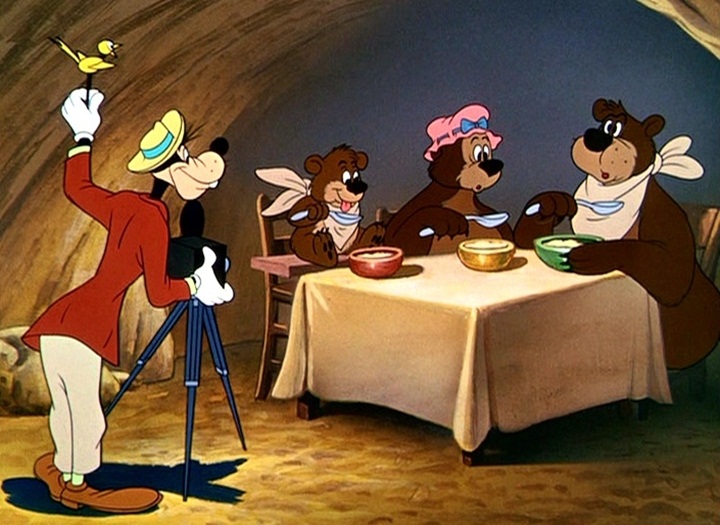
This time, however, the voice over advises Goofy to get a hobby, for example photography. This leads to several great photography gags, especially when Goofy tries to make pictures of a bear, which results in a long, fast and gag-packed chase sequence involving a funfair. It also reuses a gag involving a cab from ‘Baseball Bugs‘ (1946), showing Jack Kinney’s interest in the gag language of Disney’s rivals.
‘Hold that pose’ is one of Goofy’s funniest shorts, and certainly one of his best cartoons of the fifties.
Watch ‘Hold That Pose’ yourself and tell me what you think:
This is Goofy cartoon No. 26
To the previous Goofy cartoon: Motor Mania
To the next Goofy cartoon: Lion Down
Director: Jack Kinney Release Date: June 30, 1950 Stars: Goofy
Rating: ★★★★★ ♕ Review:
In this cartoon a particularly civilized type of Goofy, an “average man” called Mr. Walker, changes into a Mr. Hyde-like wildman called Mr. Wheeler, once he sits behind the wheel of his car.
‘Motor mania’ is a quite disturbing film about road manners, it even becomes nightmarish when we watch cars bark at a helpless pedestrian. It is as moralistic as it is funny. And it remains somehow strikingly relevant today, making it an original classic within the Goofy series.
‘Motor Mania’ is the only Goofy cartoon in which our hero is depicted as an unsympathetic and even evil character. But by now Goofy had lost all his former persona. He had changed into a random citizen, so it works very well.
‘Motor Mania’ forms another step in the evolution of Goofy into the American everyman. By now Goofy had replaced Donald Duck as a representative of the American citizen. Donald Duck had been the average citizen in the 1940s, but at the end of the decade his role had been diminished, evolving into a straight man for the antics of Chip ‘n Dale, the little bee and such. Jack Kinney’s Goofy took over, cumulating in the typical 1950s everyman, George Geef, in ‘Cold War‘ from the next year.
Watch ‘Motor Mania’ yourself and tell me what you think:
Director: Jack Kinney Release Date: September 23, 1949 Stars: Goofy Rating: ★★★½ Review:
In this short Goofy orders some home training devices to improve his condition. All his attempts fail, of course, sometimes in surprisingly long and elaborate gags, involving great situation comedy. It’s this cartoon Roger Rabbit watches in the cinema in ‘Who Framed Roger Rabbit‘ from 1988.
Together with the previous ‘Tennis Racquet‘, Goofy Gymnastics’ is a transitional Goofy cartoon: it’s the first cartoon showing the restyled Goofy as an average American citizen. Unlike ‘Tennis Racquet’, however, there’s only one Goofy in this cartoon, who even sings his own theme song ‘The world owes me a living’ again. ‘Goofy Gymnastics’ marks the last time we see Goofy in his original hat, which he only puts on after changing into his gym costume. It’s also the last of the Goofy sports cartoons. The next year, the same tired Goofy is advised to get a hobby, in ‘Hold That Pose‘.
Like the earlier great sports cartoons it uses a posh voice over, who’s completely out of tune with Goofy’s antics with his home training gear. The action is a bit slow, however, and the animators make no attempts to synchronize their character’s lip movements with the now obligate Goofy vocalizations.
Watch ‘Goofy Gymnastics’ yourself and tell me what you think:
This is Goofy cartoon No. 24
To the previous Goofy cartoon: Tennis Racquet
To the next Goofy cartoon: Motor Mania
Director: Jack Kinney Release Date: August 26, 1949 Stars: Goofy
Rating: ★★★★ Review:
After four years of working on feature films, Jack Kinney returns as a director of Goofy shorts to remain Goofy’s sole director until the series’ end in 1953.
Kinney’s first Goofy film in four years, ‘Tennis Racquet’ is a transitional film: together with the next Goofy short, ‘Goofy Gymnastics‘, it’s firmly rooted in the 1940s Goofy tradition, being a sports cartoon, similar in content to ‘How to Play Football‘ (1944) and ‘Hockey Homicide‘ (1945). Moreover, in the first scene we hear one of the Goofy characters (the cartoon contains several of them) singing Goofy’s own theme song “the world owes me a living”, and in the end we can hear the typical Goofy yell, introduced in ‘The Art of Skiing‘ (1941). The short even features a slow motion gag, not seen since ‘How to swim‘ (1942).
On the other hand, it can also be seen as the first entry of Goofy’s second series, for the character has been completely redesigned. The next year this new, redesigned Goofy would turn into Mr. Geef, the everyman.
Like ‘How to Play Football’ and ‘Hockey Homicide’, ‘Tennis Racquet’ has no educational value: the cartoon consists of one frantic tennis match between two Goofy characters. It’s a fast and funny cartoon, full of silly gags. The highlight may be the running gag of the stoic gardener, who enters the game at several points, undisturbed by the frantic action around him.
Watch ‘Tennis Racquet’ yourself and tell me what you think:
This is Goofy cartoon No. 23
To the previous Goofy cartoon: The Big Wash
To the next Goofy cartoon: Goofy Gymnastics
Director: Charles Nichols Release Date: June 9, 1950 Stars: Pluto, Milton
Rating: ★★★★★ Review:
Pluto has a relatively small part in this very zany cartoon, penned by Goofy-storymen Dick Kinney and Milt Schaffer. It stars two alley cats trying to invade a garden full of milk, birds and fish, but guarded by our hero.
The comedy between the two cats is brilliant and the short is full of fine gags, the best of which is a bizarre fishing scene, in which one of the cats uses a milk bottle for a helmet. The larger cat is a dumb character reminiscent of George in Tex Avery’s George and Junior cartoons, and of Junior Bear in Chuck Jones’ three bear cartoons. However, unlike those shorts, the comic interplay between the two characters is devoid of dialogue. Only in the beginning they exchange some meows. The whole cartoon is a showcase of silent comedy.
‘Puss-cafe’ undoubtedly is one of Pluto’s wildest cartoons, on par with ‘Pluto at the Zoo‘ (1942) and ‘Springtime for Pluto‘ (1944), and it belongs to his all-time best. In fact, the two cats were such wonderful characters that it is hard to understand that they were only used once. Nevertheless, one of them would return as ‘Milton’ in Pluto’s last two cartoons: ‘Plutopia‘ and ‘Cold Turkey‘ from 1951, with equally funny results.
Watch ‘Puss-Cafe’ yourself and tell me what you think:
Director: Fernando Cortizo Release Date: October 31, 2012 Rating: ★★★★½ Review:
2012 was a good year for stop motion animation fans: no less than four stop motion features were released that year. In March we had Aardman’s ‘The Pirates! In an Adventure with Scientists!’, followed by Laika’s ‘ParaNorman’ in August and Disney’s ‘Frankenweenie’ in September. Least known among these was the last release, from October: ‘O Apóstolo’ from Spain.
Somehow, stop motion feature film makers seem to favor horror-inspired plots, and ‘O Apóstolo’ is no exception. However, unlike ‘ParaNorman’ or ‘Frankenweenie’, ‘O Apóstolo’ is not a lighthearted family film. Instead, it’s a dark gothic thriller, and it succeeds surprisingly well in maintaining a high level of suspense throughout most of the picture.
Both the film’s theme and setting are typical Spanish: the film is drenched in a catholic atmosphere, and it’s set in a remote village on the road to Santiago de Compostela, famous for its numerous pilgrims. We follow the thief Ramon, who has escaped from prison to turn to this village to collect a treasure his cell mate has hidden there.
We soon discover that there is something terribly wrong with the little village. Its inhabitants seem to lure innocent pilgrims, and try to keep them there. It remains long unknown why, keeping the suspense at a high level. And even when the obligatory explanation of the events comes, the makers present it elegantly: the explanation, despite being long and quite absurd, is beautifully done in 2D animation with quasi-medieval designs, accompanied by a song.
Luckily, the film also has its lighter moments, mostly in a subplot, involving a particularly unsympathetic archbishop, who goes on his way to invest the loss of pilgrims. It’s soon clear that the film makers have plotted a punishment for this haughty, selfish character.
Apart from the gripping plot, ‘O Apóstolo’ excels in gorgeous production values. The little village and its sinister forest surroundings are conceived with stunning detail. They are as rich as any life action background, and contribute highly to the dark and creepy atmosphere. The puppets are designed less originally than the other features mentioned above, but retain a certain realism, which makes it possible to relate to them, especially with the main protagonist, Ramon the thief. The sole exception is the priest, whose appearance is too absurd and too sinister to blend in. It’s a pity, because his dominant presence casts a shadow on the more underplayed (and underdesigned) other village characters, whose threat is much more subtle, and therefore more disturbing.
In all, ‘O Apóstolo’ easily draws you in. It is without doubt one of the most original and best animated films of 2012. It definitely deserves to be more well-known.
Watch the official trailer of ‘O Apóstolo’ and tell me what you think:
Director: Charles Nichols Release Date: May 19, 1950 Stars: Pluto
Rating: ★★★ Review:
Pluto is sleeping at ‘Mickey’s outdoor reserve’, a forest reserve deep in the mountains, which is shown in a beautiful pan opening shot. There the howling of the wolves, a.k.a. the call of the wild awakes “his primitive instinct”, which takes the shape of a little blue wolf character.
The instinct tries to make Pluto give up his easy life to hunt some meat outdoors. But Pluto turns out to be a lousy tracker, and when he’s bullied by both a rabbit and a bear he rushes home, only to discover that the little wolf has eaten his bread and milk meal.
‘Primitive Pluto’ is a nice cartoon, if not among Pluto’s best. It shows how far Pluto had come from his roots as a tracking bloodhound as shown in ‘The Chain Gang‘ (1930). Like Mickey, Donald and Goofy, Pluto had become urbanized and settled over the years. It’s nice to watch the animators play with this fact.
Watch ‘Primitive Pluto’ yourself and tell me what you think:
This is Pluto cartoon No. 36
To the previous Pluto cartoon: Wonder Dog
To the next Pluto cartoon: Puss-cafe
Director: Charles Nichols Release Date: April 7, 1950 Stars: Pluto, Butch, Dinah
Rating: ★★★★½ Review:
In ‘Wonder Dog’ Pluto tries to impress Dinah, but she’s in love with ‘Prince, the wonder dog’, a circus dog featured on a poster.
Pluto imagines himself to be a circus dog too, but his attempts all fail, much to the amusement of a watching Butch. When Pluto nags Butch, and the latter chases him, he accidentally and unwillingly turns into the acrobat he wanted to be, gaining Dinah’s love once more.
‘Wonder Dog’ is a wonderful cartoon, with some great comedy. Its story, by Bill Peet & Milt Banta, has a surprisingly natural flow, without becoming cliche. Like ‘Pluto’s Heart Throb‘ from earlier that year it illustrates that the trio of Pluto, Dinah and Butch could inspire some excellent comedy. Unfortunately, ‘Wonder Dog’ marks Dinah’s last screen appearance, after a mere four cartoons.
Watch ‘Wonder Dog’ yourself and tell me what you think:
Director: Charles Nichols Release Date: February 10, 1950 Stars: Pluto, Minnie Mouse
Rating: ★★½ Review:
Pluto encounters a gopher in Minnie’s garden.
Minnie accidentally brings the gopher inside, where the chase continues, until the gopher is literally launched outside. It’s inside the house where the cartoon blossoms. However, the cartoon remains a little slow, and it is uncertain with whom we have to sympathize, for neither Pluto nor the Gopher is particularly endearing. The best scene is the one in which the gopher discovers that he’s trapped inside a foreign environment. His panic is both funny and heartfelt.
Watch ‘Pluto and the Gopher’ yourself and tell me what you think:
This is Pluto cartoon No. 34
To the previous Pluto cartoon: Pluto’s Heart Throb
To the next Pluto cartoon: Wonder Dog
Director: Charles Nichols Release Date: January 6, 1950 Stars: Pluto, Butch, Dinah
Rating: ★★★★ Review:
It seems that at the end of the Pluto series, the animators had found new inspiration, for most of Pluto’s best cartoons were made in the series’ last two years. In fact, almost every Pluto cartoon from 1950/1951, Pluto’s last two solo years, is a winner.
‘Pluto’s Heart Throb’ is a good example. In this rather weird short both Butch an Pluto fall in love with Dinah (whom we hadn’t seen since ‘In Dutch‘ from 1946). They’re acting like rivals, but they have to pretend to be friends when she’s watching. When Pluto saves Dinah from drowning, he gains her love and Butch makes a sad retreat.
Penned by Roy Williams, one of the most original of the Disney story men, this short is stuffed with silly ideas, starting with the silly little pink dog cupid, who makes Pluto and Dinah fall in love with each other. The animation is extremely flexible, with wonderful expressions on all three characters. The excellent silent comedy is further enhanced by a very lively score. In all, ‘Pluto’s Heart Throb’ is a great improvement on the earlier in-love-with-Dinah-cartoon: ‘Canine Casanova’ from 1945.
Watch ‘Pluto’s Heart Throb’ yourself and tell me what you think:
This is Pluto cartoon No. 33
To the previous Pluto cartoon: Sheep Dog
To the next Pluto cartoon: Pluto and the Gopher
Directors:William Hanna & Joseph Barbera Release Date: April 8, 1950 Stars: Tom & Jerry Rating: ★★★½ Review:
A ferocious lion has escaped from the circus, and of course, the lion is in Tom & Jerry’s house.
He turns out to be a nervous wreck and he asks Jerry to help him out. Tom, on his guard after a warning on the radio, never finds out the lion is in his house, but he does think that Jerry suddenly has gained enormous strength. In the last scene Jerry says goodbye to the lion, who’s stuck away on an ocean liner to Africa.
‘Jerry and the Lion’ contains some nice confusion scenes, but like most ‘Jerry-befriends-an-animal- cartoons’ the cartoon is rather cute, and the comedy somewhat subdued.
Watch ‘Jerry and the Lion’ yourself and tell me what you think:
Directors:William Hanna & Joseph Barbera Release Date: March 11, 1950 Stars: Tom & Jerry Rating: ★★★★★ Review:
Tom somehow is a cowboy at the ‘Dude Ranch’ in Texas.
This ranch is visited by a sexy kitten in cowboy dress, and Tom tries to impress her: first, by an outrageously cool smoking of a cigarette, then by singing to a record player and courting her at the same time. This is a wonderful scene and undoubtedly the highlight of this cartoon, which is highly enjoyable throughout, anyway.
The record player is an early testimony of the introduction of 331⁄3 and 45 rpm records two years earlier, for it is able to play with variable speeds. The cartoon also features a long bull chase, and ends with Jerry kissing the girl, and riding Tom into the sun set .
Tom and Jerry would return to the West four years later in ‘Posse Cat’, with much less funny results.
Watch ‘Texas Tom’ yourself and tell me what you think:
Directors:William Hanna & Joseph Barbera Release Date: January 19, 1950 Stars: Tom & Jerry, Mammy Two-Shoes, Meathead Rating: ★★★★★ Review:
When Mammy goes out, Tom invites his friends, Meathead, the red cat and the little cat, who we hadn’t seen together since ‘Baby Puss‘ (1943).
Together they play intoxicating hot jazz, which unfortunately keeps Jerry out of sleep. After several attempts to stop them, Jerry calls Mammy who rushes home to catch the cats red-handed. Unfortunately, she likes the same music…
‘Saturday Evening Puss’ is one of the better ‘Tom and Jerry’ shorts, due to the irresistible jazz soundtrack and great comedy from all the characters. Highlights of animation are those of Mammy preparing to go out and of Jerry’s head taking different shapes to corresponding jazz sounds. Seventeen years later, the tables would be turned in Abe Levitow’s ‘Rock ‘n’ Rodent‘ (1967), which is one of the best Tom & Jerry’s by Chuck Jones’s unit.
‘Saturday Evening Puss’ is noteworthy for being the only cartoon in which Mammy’s face can be seen, if only for a split-second when she rushes towards the camera. Unfortunately, this cartoon also exists in a censored version from the 1960s featuring a white girl instead of the familiar black maid.
Watch ‘Saturday Evening Puss’ yourself and tell me what you think:
Directors:William Hanna & Joseph Barbera Release Date: January 7, 1950 Stars: Tom & Jerry, Little Quacker Rating: ★★½ Review:
Tom steals an egg from a duck’s nest. When he tries to fry it, it appears to contain a little duck, who seeks shelter at Jerry’s place.
‘Little Quacker’ introduces the talkative little duckling, whose voice resembles that of Donald Duck. It would be the most frequent character of the Jerry-befriends-another-animal-cartoons, starring seven other shorts. The character even survived Tom & Jerry to reincarnate as Yakky Doodle in Hanna-Barbera’s television series ‘Augie Doggie and Doggy Daddy’ in 1960.
Despite the character’s apparent popularity, ‘Little Quacker’ is no different from any other Jerry-befriends-another-animal-cartoon. Like all the others, ‘Little Quacker’ is more cute than funny, in spite of some fine gags, and a great long chase scene.
Watch ‘Little Quacker’ yourself and tell me what you think:
Animation Backgrounds
A blog dedicated to background paintings from animation films. Kept until 2016.
Animation Scoop
Animation historian Jerry Beck’s animation film news blog.
Cartoon Brew
Topical blog on animation film, led by animation historian Amid Amidi.
Cartoon Modern
Amid Amidi’s blog on modern design cartoon art from the forties, fifties and sixties.
Cartoon Research
THE site on classic animation research, hosted by cartoon historian Jerry Beck.
Cartoons Theory
Frank Beef analyzes classic cartoons. Kept until 2020.
Century Film Project
Michael reviews films of 100 years old and older, roughly in chronological order.
Classic Cartoons
A similar blog featuring many stills and comic strips. Kept until 2012.
Comet over Hollywood
Jessica Pickens reviews classic Hollywood films, especially musicals.
Deja View
Top ex-Disney animator Andreas Deja’s own blog.
Disney History
Esteemed Disney historian Didier Ghez on the latest books on Disney history.
Feeling Animated
Paul Astell brings us thorough reviews of animated features.
Flickers in Time
Short and to the point reviews of classic films (lately mostly pre-code talkies) by an anonymous retired Foreign Service Officer from California

 Tom frames Jerry for eating a chicken leg only to eat the chicken leg himself.




 Dr. Grob's Animation Review