Directors: James Algar, Clyde Geronimi, Jack Kinney
Release Date: October 5, 1949
Rating: ★★★
Review:

The Wind in the Willows © Walt Disney‘The Wind in the Willows’ is the first of the two stories that make up the compilation feature ‘The Adventures of Ichabod and Mr Toad‘. 

This story had originally been conceived in 1938 as a possible feature film, before it was shelved in 1942. The 1949 version is clearly truncated, and it shows. This story tells only an episode from ‘The wind in the Willows’ starring the enthusiastic Toad, whose love for chariots and cars causes a lot of trouble for himself and his quiet, all too British friends Water rat, Mole and Badger. The story is quite unfaithful to the book, giving a large role to one Cyril the horse and containing both a long scene at the court and a long sequence in which our four friends try to steal a document from a gang of weasels.

Although the English feel is retained, this version of ‘The Wind in the Willows’ completely lacks the poetry so typical for the book. Sure, Toad’s intoxicating character has been transferred to the screen very well, but the characters beside him never really come off. Moreover, the story is told too unevenly to be either exciting or endearing, and the interplay between animals and humans remains unconvincing. The backgrounds are uninspired, especially when compared to those in ‘The Legend of Sleepy Hollow‘, except for those in the winter train sequence. The weasels, which are animated excellently with broad comedy, anticipate those in ‘Who Framed Roger Rabbit?‘ (1988).

Watch the trailer for ‘The Adventures of Ichabod and Mr Toad’ yourself and tell me what you think:

‘The Adventures of Ichabod and Mr Toad’ is available on DVD

Directors: James Algar, Clyde Geronimi, Jack Kinney
Release Date: October 5, 1949
Rating: ★★★
Review:

The Adventures of Ichabod and Mr. Toad © Walt DisneyThe adventures of ‘Ichabod and Mr. Toad’ was the last of the Disney compilation features so typical of the 1940s.

Like ‘Fun and Fancy Free‘ (1947) it consists of only two stories, this time both drawn from literature. Both use a narrator, which gives the films a feeling of moving illustrations. Neither of the stories is particularly endearing: the story of Mr. Toad lacks the poetry of the original story, the story of Sleepy Hollow lacks speed. It would be a happy return to direct story telling (opposed to using voice overs) in ‘Cinderella‘, the next year.

The six directing animators of this feature all belong to the group of ‘nine old men’.

‘The Adventures of Ichabod and Mr Toad’ consists of the following two episodes, which I will discuss in more detail elsewhere:

1. The Wind in the Willows
2. The Legend of Sleepy Hollow

Watch ‘The Adventures of Ichabod and Mr Toad’ yourself and tell me what you think:

Director: Robert McKimson
Release Date:
 August 12, 1950
Stars:
 Bugs Bunny
Rating:
 ★★★★★
Review:

Hillbilly Hare © Warner BrothersBugs Bunny is on holiday in the Ozarks, Arkansas, where he meets two dumb and bearded Hillbilly brothers with ridiculously long guns.

When they both chase him, Bugs dresses as a country girl and invites them into a square dance. Soon, Bugs takes the fiddle himself, making the two brothers hurting each other while dancing in a long, catchy and funny square dance sequence.

‘Hillbilly Hare’ is one of McKimson’ all-time best Bugs Bunny cartoons, and certainly his most musical one. Throughout the picture, the animation is delightfully silly and over-the-top.

Watch an excerpt from ‘Hillbilly Hare’ yourself and tell me what you think:

This is Bugs Bunny cartoon No. 74
To the previous Bugs Bunny cartoon: 8 Ball Bunny
To the next Bugs Bunny cartoon: Bunker Hill Bunny

Director: Chuck Jones
Release Date:
 March 11, 1950
Stars:
 Bugs Bunny
Rating:
 ★★★★
Review:

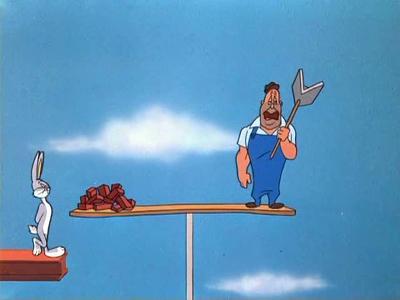
Homeless Hare © Warner BrothersIn ‘Homeless Hare’ Bugs’s home happens to be in a construction site.

When the excavator driver ignores Bugs’s pleas for leaving his home alone, Bugs nags him until the bully can’t take no more.

This film contains a gag of a half conscious Bugs walking at great heights without falling, a scene that is clearly borrowed from earlier shorts, like the Popeye cartoon ‘A Dream Walking’ from 1934 and the classic Disney short ‘Clock Cleaners’ from 1937. It also contains an elaborate final gag with a hot rivet, a type of gag Chuck Jones invented. It anticipates similar gags in the Road Runner series and Jones’s Tom and Jerry films from the 1960s. The Highlight of the cartoon, however, is a gag with the bully balancing on a plank with a bunch of bricks, which Bugs slowly withdraws…

Watch ‘Homeless Hare’ yourself and tell me what you think:

http://vimeo.com/12870621

This is Bugs Bunny cartoon No. 70
To the previous Bugs Bunny cartoon: Mutiny on the Bunny
To the next Bugs Bunny cartoon: Big House Bunny

Director: Art Davis
Release Date:
 June 4, 1949
Stars:
 Bugs Bunny
Rating:
 ★★½
Review:

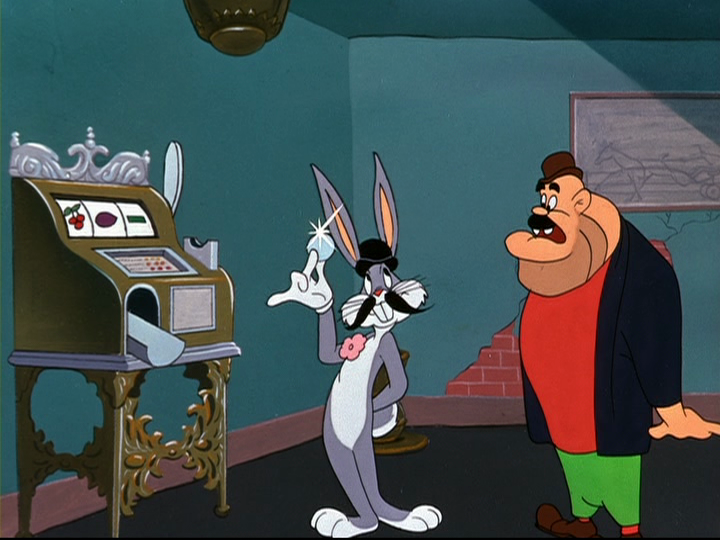
Bowery Bugs © Warner BrothersIn the opening scene of ‘Bowery Bugs’ Bugs Bunny is a tour guide talking about Brooklyn Bridge and why Steve Brody (a historical character) jumped from it in 1886.

A flashback shows Steve Brody, pictured as a typical bully, being out of luck and looking for a rabbit foot as a lucky charm. He encounters Bugs who then drives Brody mad, making him jump from Brooklyn Bridge in the end.

‘Bowery Bugs’ was the only Bugs Bunny cartoon directed by Art Davis. He does a fair job, although the cartoon suffers from erratic timing. His designs on Bugs Bunny are very reminiscent of those by Robert McKimson.

Watch a clip from ‘Bowery Bugs’ yourself and tell me what you think:

This is Bugs Bunny cartoon No. 60
To the previous Bugs Bunny cartoon: High Diving Hare
To the next Bugs Bunny cartoon: Long-Haired Hare

Director: Robert McKimson
Release Date:
 April 9, 1949
Stars:
 Bugs Bunny
Rating
:
★★★★★ ♕
Review:

Rebel Rabbit © Warner BrothersTo his nuisance Bugs Bunny discovers that rabbits (2 cts.) are less worth than foxes ($50) and bears ($75).

He mails himself to Washington, where the game commissioner (“I’m game”) explains to him that rabbits are harmless and therefore worthless for hunters. Bugs decides to be harmful to increase his value. And harmful indeed he gets!

A few of his hilarious actions include painting the obelisk at Washington like a barber’s pole, returning Manhattan to the Indians, cutting off Florida, and filling the grand canyon with sand. He manages to raise the prize on his head to a million dollars, but he ends in Alcatraz prison, too, wondering whether he has carried things too far…

‘Rebel Rabbit’ is full of the zany spirit of the early Warren Foster/Robert McKimson cartoons, and, together with ‘Easter Yeggs‘ (1947) and ‘Hillbilly Hare‘ from a year later, probably the best of all Robert McKimson Bugs Bunny cartoons.

This wonderfully zany cartoon features live army footage.

Watch an excerpt from ‘Rebel Rabbit’ yourself and tell me what you think:

This is Bugs Bunny cartoon No. 58
To the previous Bugs Bunny cartoon: Mississippi Hare
To the next Bugs Bunny cartoon: High Diving Hare

Director: Friz Freleng
Release Date:
 January 15, 1949
Stars:
 Bugs Bunny, Elmer Fudd
Rating:
 ★★★★
Review:

Hare Do © Warner BrothersThis Bugs Bunny short starts with Elmer Fudd hunting our hero with a “wabbit detector”.

Like Freleng’s quite similar ‘Stage Door Cartoon‘ (1944), the action soon shifts into a theater, with wonderful comedy with Bugs’s and Elmer’s repeatedly passing past sitting people, continuously using the phrases ‘pardon me’ and ‘excuse me’ as a major highlight. Other great gags are Bugs’s playing with the intermission switch (which immediately causes the public to rush outside to smoke) and the finale, in which Bugs manages to get a blinded Elmer into a lion’s beak.

Despite the wonderful comedy, the film nevertheless fails to reach the heights of ‘Stage Door Cartoon’, falling short, due to some bad designs of Elmer and to a sense of routine.

Watch ‘Hare Do’ yourself and tell me what you think:

This is Bugs Bunny cartoon No. 56
To the previous Bugs Bunny cartoon: My Bunny Lies over the Sea
To the next Bugs Bunny cartoon: Mississippi Hare

Director: Robert McKimson
Release Date:
 October 9, 1948
Stars:
 Foghorn Leghorn, Henery Hawk
Rating:
 ★★★★
Review:

The Foghorn Leghorn © Warner BrothersHenery Hawk’s cowardly dad forbids his little son to chase chickens, but Henery does it anyway.

Unfortunately, he doesn’t know what a chicken looks like, and he repeatedly ends up catching the barnyard dog, while the Foghorn Leghorn makes feeble attempts in convincing the little chicken hawk, that he‘s a chicken.

This premise is a great twist on the stories of the first two Henery Hawk/Foghorn Leghorn cartoons (‘Walky Talky Hawky‘ from 1946 and ‘Crowing Pains‘ from 1947). It’s clear from the title that by now Foghorn Leghorn had become the real star of the Henery Hawk cartoons, and deservedly so, because in his third appearance, this broad gesturing and talkative rooster is stealing the show.

At the same time, this is a transitional cartoon, in which the original looniness of McKimson’s first cartoons gradually makes way for a more dialogue-driven approach, as is perfectly illustrated by Foghorn Leghorn’s endless jabbering.

Watch ‘The Foghorn Leghorn’ yourself and tell me what you think:

https://www.dailymotion.com/video/x6ecxr1

‘The Foghorn Leghorn’ is available on the Blu-Ray-set ‘Looney Tunes Platinum Collection: Volume 2’ and on the DVD-box ‘Looney Tunes Golden Collection Volume 1’

Director: Chuck Jones
Release Date:
March 4, 1950
Stars:
 Daffy Duck, Elmer Fudd, Henery Hawk, Mama Bear, Porky Pig, Sylvester
Rating:
 ★★★★★ ♕
Review:

The Scarlet Pumpernickel © Warner Brothers‘The Scarlet Pumpernickel’ starts with Daffy Duck being tired of comedy.

He proposes to one of the Warner Brothers (who remains off-screen) to make an Errol Flynn-like swashbuckler film based on ‘The Scarlet Pumpernickel by Daffy Dumas Duck’, with, of course, himself in the starring role. This leads to an all-star cartoon with roles for Porky Pig, Sylvester, Elmer Fudd (with Mel Blanc’s voice), Henery Hawk and Mama Bear. Never before were so many Warner Bros. cartoon stars seen in one short, and we had to wait until ‘Who Framed Roger Rabbit‘ (1988) to see the exercise repeated.

‘The Scarlet Pumpernickel’ is both an excellent parody on and a faithful homage to the Errol Flynn adventure films. But more importantly, this short is important in the evolution of Daffy Duck, for it marks the birth of Daffy’s final incarnation. In this film Daffy is more of a frustrated and misguided character than downright loony. This new role is still a bit out of Daffy’s element: at times his eyes and behavior are similar to that of Charlie Dog, especially in the opening scene. Nevertheless, in the following years the frustrated Daffy would completely replace the loony one.

‘The Scarlet Pumpernickel’ is also the first of Jones’s Daffy cartoons in which Daffy serves as a misguided hero, starting a great series of shorts, with highlights as ‘Drip-along Daffy‘ (1951) and ‘Duck Dodgers in the 24 ½ Century‘ (1953).

Watch ‘The Scarlet Pumpernickel’ yourself and tell me what you think:

http://www.220.ro/desene-animate/20-Daffy-Duck-Sylvester-The-Scarlet-Pumpernickel-1950/KJRkZjBcaE/

This is Porky Pig cartoon no. 131
To the previous Porky Pig cartoon: Boobs in the Woods
To the next Porky Pig cartoon: An Egg Scramble

This is Daffy Duck cartoon No. 51
To the previous Daffy Duck cartoon: Boobs in the Woods
To the next Daffy Duck cartoon: The Bitter Half

‘Boobs in the Woods’ is available on the DVD-set ‘Looney Tunes Golden Collection Volume One’


Director: Robert McKimson
Release Date:
 August 7, 1950
Stars:
 Porky Pig, Daffy Duck
Rating:
 ★★★★
Review:

Boobs in the Woods © Warner BrothersIn ‘Boobs in the Woods’ Porky wants to paint in a forest, but he’s bothered by a particularly loony Daffy.

This cartoon is a typical example of Warren Foster-penned zaniness. Daffy makes no mistake about his zany character, which is similar to the one in the Foster/McKimson outings, like ‘Daffy Doodles’ (1946), ‘Daffy Duck Slept Here‘ (1948) and ‘Daffy Duck Hunt‘ (1949): in the opening scene he introduces himself in a loony song.

Nevertheless, ‘Boobs in the Woods’ is one of the last cartoons featuring this loony version of Daffy. Two months later Jones would introduce a different type in ‘The Scarlet Pumpernickel‘.

Apart from the excellent gags, ‘Boobs in the Woods’ is noteworthy for its extremely stylized and surprisingly flat backgrounds by Cornett Wood and Richard H. Thomas.

Watch ‘Boobs in the Woods’ yourself and tell me what you think:

https://www.dailymotion.com/video/x6egzhi

This is Porky Pig cartoon no. 130
To the previous Porky Pig cartoon: Bye, Bye Bluebeard
To the next Porky Pig cartoon: The Scarlet Pumpernickel

This is Daffy Duck cartoon No. 50
To the previous Daffy Duck cartoon: Daffy Duck Hunt
To the next Daffy Duck cartoon: The Scarlet Pumpernickel

‘Boobs in the Woods’ is available on the DVD-set ‘Looney Tunes Golden Collection Volume One’

Director: Friz Freleng
Release Date:
 September 2, 1949
Stars:
 Porky Pig
Rating:
 ★★★★½
Review:

Dough for the Do-Do © Warner Brothers‘Dough for the Do-Do’ is a remake of Bob Clampett’s ‘Porky in Wackyland‘ (1938) in color.

The cartoon is more than a recoloring, however. Porky is reanimated throughout, and several scenes are different from the original. Scenes that are omitted are the paperboy appearing on the title card, Porky showing us a picture of the dodo, and the cat-dog attacking itself. Two scenes are altered: the way the guide ‘leads’ Porky to the dodo, and the finale: in the original Porky dresses as a paperboy announcing that Porky has captured the dodo, in ‘Dough for the Do-Do’, Porky dresses like a do-do, making the bird itself think he has caught the last of the do-dos.

The most conspicious difference between ‘Dough for the Do-Do’ and ”Porky in Wackyland’, however, is found in the backgrounds: where the original had rather undefined, a little George Herriman-like backgrounds, the remake uses clearly Salvador Dalí-inspired settings, full of typical Dalí-rocks, sticks and eyes. The title card even shows Dalí’s melted watches, linking cartoon surrealism to high art surrealism. Dalí-inspired scenery would return two years later in the Porky Pig cartoon ‘Wearing of the Grin’ from 1951.

It is striking to see how different this cartoon is from its contemporaries. ‘Porky in Wackyland’ was a milestone in surrealism, a move forward in wackiness, an innovative cartoon stirring up the childish make-belief world of the 1930s cartoons. However, eleven years later its remake ‘Dough for the Do-do’ feels old-fashioned: its animation is crude, its characters are unrefined, and its zaniness seems to come from another era.

And it does: in the late 1940s, the wild surrealism of the early Warner Bros. cartoons had toned down. It survived in cartoon conventions, which always contained a twist of surrealism, but the outlandishness had disappeared. Now, more emphasis was played on character humor and dialogue, something the Warner Bros. studio excelled at with its numerous stars. Only at MGM and Walter Lantz some of the original zany vibe was retained, but at large the wild era of studio cartoons was clearly over.

Watch ‘Dough for the Do-Do’ yourself and tell me what you think:

http://www.220.ro/desene-animate/16-Porky-Dough-For-The-Do-Do-1949/mL0EVmznKK/

‘Dough for the Do-Do’ is available on the DVD set ‘Looney Tunes Golden Collection, Vol. 1’

This is Porky Pig cartoon no. 128
To the previous Porky Pig cartoon: Often an Orphan
To the next Porky Pig cartoon: Bye, Bye Bluebeard

Director: Art Davis
Release Date:
 February 12, 1949
Stars:
 Porky Pig
Rating:
 ★★½
Review:

Porky Chops © Warner BrothersIn ‘Porky Chops’ a squirrel from Brooklyn is having a holiday in a forest where Porky is working as a lumberjack.

This outlandish idea creates a rather routinely conflict with loads of dialogue. The result is one of Art Davis’s weaker cartoons, particularly because of the squirrel’s rather unpleasant character. This makes it difficult to sympathize with either protagonist.

The cartoon shows an interesting mixture of styles: the squirrel looks vaguely like a Robert McKimson-character, while Porky is designed and animated in a toned-down Clampettian style.

Watch ‘Porky Chops’ yourself and tell me what you think:

http://www.supercartoons.net/cartoon/650/porky-chops.html#.URQKvKU9R8E

‘Porky Chops’ is available on the DVD set ‘Looney Tunes Golden Collection, Vol. 1’

This is Porky Pig cartoon no. 123
To the previous Porky Pig cartoon: Awful Orphan
To the next Porky Pig cartoon: Paying the Piper

Director: Chuck Jones
Release Date:
 December 18, 1948
Stars:
 Porky Pig, Sylvester
Rating:
 ★★★
Review:

Scaredy Cat © Warner BrothersChuck Jones was the only director to pair Porky Pig with Sylvester.

His Sylvester is very different from the one in Freleng’s Tweety cartoons. In Jones’s shorts he’s a cowardly cat that cannot speak. In all Porky-Sylvester cartoons Porky tries to stay asleep unaware of the real dangers around him. Sylvester, on the other hand, sees them all, but fails completely in convincing his master of the dangers.

The aptly titled ‘Sacredy Cat’ was the first of a series of three. In this cartoon Porky and his cat Sylvester enter their new mansion, which has genuine horror allure, scaring Sylvester to death. And for a good reason, because this mansion is inhabited by homocidal Hubie and Bertie-like mice who make several attempts to murder Sylvester and Porky.

Only when Porky discovers the mice, too, who lead him to a certain death, Sylvester rediscovers his courage and chases all the mice out of the house, except for the headsman mouse, who knocks the cat down, and reveals to be a caricature of comedian Lew Lehr (1895-1950), exclaiming a twist on the comedian’s catchphrase: “pussycats is the craziest people!”. An odd ending to a sometimes rather unsettling cartoon.

Porky and Sylvester would reunite six years later in an all too similar cartoon called ‘Claws for Alarm’ (1954), and again in ‘Jumpin’ Jupiter‘ (1955).

Watch ‘Scaredy Cat’ yourself and tell me what you think:

http://www.dailymotion.com/video/x1z1upl_sylvester-the-cat-ep-12-scaredy-cat_fun

‘Scaredy Cat’ is available on the DVD set ‘Looney Tunes Golden Collection, Vol. 1’

This is Porky Pig cartoon no. 121
To the previous Porky Pig cartoon: Riff Raffy Daffy
To the next Porky Pig cartoon: Awful Orphan

Directors: William Hanna & Joseph Barbera
Release Date: October 22, 1949
Stars: Tom & Jerry
Rating: ★★★★½
Review:

Jerry's Diary © MGMJerry’s Diary’ is Tom and Jerry’s first compilation cartoon.

However, Hanna & Barbera even make this cheap form of cartoon making upper class: ‘Jerry’s Diary’ contains lots of original footage and has a surprisingly good story of its own. Only after 1’56 the compilation starts, to end one and a half minute before the cartoon ends itself.

In the encompassing story an anthropomorphized radio tells Tom that it’s ‘be kind to animals week’, so Tom is persuaded to give Jerry little gifts. He knocks on Jerry’s door, carrying flowers, a box of sweets and a pie. Jerry’s not in, however, and inside his home Tom discovers Jerry’s diary, which he can’t resist reading.

Enter the compilation, which features scenes from ‘Tee for Two’ (1945), ‘Mouse Trouble’ (1944), ‘Kitty Foiled‘ (1948) and ‘Yankee Doodle Mouse‘ (1943). Tom gets so annoyed reading this stuff that, when Jerry finally does show up, he throws the pie at him, smearing him against the wall and leaving the little mouse in complete bewilderment.

After this cartoon, four other compilations would follow, up to their very last year of theatrical cartoons, 1967. However, none of these would reach the high standard of ‘Jerry’s Diary’.

Watch an excerpt from ‘Jerry’s Diary’ yourself and tell me what you think:

This is Tom & Jerry cartoon No. 45
To the previous Tom & Jerry cartoon: Love That Pup
To the next Tom & Jerry cartoon: Tennis Chumps

Directors: William Hanna & Joseph Barbera
Release Date: October 1, 1949
Stars: Tom & Jerry, Spike & Tyke
Rating: ★★★★★
Review:

Love That Pup © MGMTom’s chases of Jerry disturb Spike’s son Tyke. If Tom is at it again, Spike “will tear him apart”. Needless to say, Jerry takes advantage of this situation.

‘Love that pup’ is one of the most hilarious Tom & Jerry cartoons. The gags come in fast and plenty, and Scott Bradley’s music is particularly inspired, perfectly matching the fast action. Highlight may be the running gag involving Tom rushing into several garden tools.

‘Love That Pup’ marks Tyke’s debut. He has no name, yet. But then again, even Spike is still called Butch in this cartoon. Spike and Tyke would become Tom and Jerry regulars in the fifties, even starring two films without the cat and the mouse in 1957.

Watch ‘Love That Pup’ yourself and tell me what you think:

https://www.dailymotion.com/video/x3imryc

This is Tom & Jerry cartoon No. 44
To the previous Tom & Jerry cartoon: The Cat and the Mermouse
To the next Tom & Jerry cartoon: Jerry’s Diary

Directors: William Hanna & Joseph Barbera
Release Date: September 13, 1949
Stars: Tom & Jerry
Rating: ★★★★★
Review:

The Cat and the Mermouse © MGMWhile chasing Jerry at the beach, Tom falls into the water, where he apparently gets unconscious.

Tom hallucinates he can breath underwater. At the bottom of the sea he encounters a mermouse, an evil swordfish and an even more evil octopus. Then he awakes, discovering thankfully that Jerry has rescued him and is reviving him.

Like the previous Tom & Jerry cartoon, ‘Heavenly Puss‘, ‘The Cat and the Mermouse’ is a dream cartoon, more relying on Tom and Jerry’s love for each other than on the hate-part of their relationship.

‘The Cat and the Mermouse’ is a very well executed cartoon. Tom’s underwater joy is wonderfully animated, and the underwater setting is pretty convincing. The mermouse is, of course, exactly like Jerry, and Hanna and Barbera succeed in transferring Tom & Jerry’s typical chase to an underwater setting.

Tom & Jerry would return to the sea in the Esther Williams feature ‘Dangerous When Wet’ (1953), where they, again, encounter a swordfish and an octopus.

Watch ‘The Cat and the Mermouse’ yourself and tell me what you think:

https://vimeo.com/148638484

This is Tom & Jerry cartoon No. 43
To the previous Tom & Jerry cartoon: Heavenly Puss
To the next Tom & Jerry cartoon: Love That Pup

Directors: William Hanna & Joseph Barbera
Release Date: July 9, 1949
Stars: Tom & Jerry
Rating: ★★★★★ ♕
Review:

Heavenly Puss © MGMWhen, during a typical chase, Tom is crushed by a falling piano, he unexpectedly dies

His spirit goes up to heaven on a gigantic golden escalator. But he’s not allowed to go with the heavenly express, because of what he has done to Jerry. Nevertheless, he’s allowed one hour back on earth to persuade Jerry to sign a forgiveness certificate. If he doesn’t make it, it will be hell for him.

After loads of struggle and cheating Tom finally succeeds, but it is too late and Tom falls into hell. Fortunately it’s all a dream, and when he wakes up Tom rushes to Jerry’s home kissing and hugging the completely bewildered mouse.

‘Heavenly Puss’ is one of the all-time best Tom & Jerry cartoons. It draws completely on the two characters and their well-established love/hate-relationship. The silent acting is particularly superb and Tom’s feeble attempts to convince Jerry against a ticking deadline are both hilarious and chilling. His agony is heartfelt and his pantomimed pleas are moving.

‘Heavenly Puss’ may cover familiar grounds (comparable cartoons include Disney’s ‘Pluto’s Judgement Day‘ from 1935, and Paramount’s ‘A Self-Made Mongrel’ from 1945), it’s execution is both brilliant and original and a great example of both silent comedy and character animation.

Watch ‘Heavenly Puss’ yourself and tell me what you think:

https://www.dailymotion.com/video/x5vzdl1

This is Tom & Jerry cartoon No. 42
To the previous Tom & Jerry cartoon: Hatch Up Your Troubles
To the next Tom & Jerry cartoon: The Cat and the Mermouse

Directors: William Hanna & Joseph Barbera
Release Date: May 14, 1949
Stars: Tom & Jerry
Rating: ★★
Review:

Hatch Up Your Troubles © MGMAn egg rolls into Jerry’s house where it hatches, revealing a tiny woodpecker.

The little woodpecker thinks Jerry is his mother and who destroys Jerry’s wooden household almost instantly. When Jerry sends the fledgling home, it encounters Tom and of course Jerry and the woodpecker team against him.

‘Hatch Up Your Troubles’ is one of those Jerry-teams-a-bird-cartoons that are more cute than that they are funny. It is only interesting for its experiments using oil in the backgrounds. It was re-shot in 1956 in Cinemascope as ‘The Egg and Jerry’, which used the same animation against new fifties style backgrounds.

Watch en excerpt from ‘Hatch up your Troubles’ yourself and tell me what you think:

This is Tom & Jerry cartoon No. 41
To the previous Tom & Jerry cartoon: The Little Orphan
To the next Tom & Jerry cartoon: Heavenly Puss

Directors: William Hanna & Joseph Barbera
Release Date: April 30, 1949
Stars: Tom & Jerry, Nibbles
Rating: ★★★★
Review:

The Little Orphan © MGM‘The Little Orphan’ can be summarized as ‘The Milky Waif’ (1946) at Thanksgiving.

Little Nibbles is sent over to Jerry as a Thanksgiving guest. They both patrol the dining table, dressed like pioneers, when Tom, dressed like an Indian, attacks them. He’s won over, however, and in the last shot they all share the dining table, but it is little Nibbles who eats the complete turkey, alone.

Apart from ‘The Milky Waif’, ‘The Little Orphan’ resembles ‘Yankee Doodle Mouse‘ (1943). Both feature a battle fought in a household setting. What makes ‘The Little Orphan’ so great is that Hanna and Barbera are able to play the complete pilgrims and Indians setting at a dinner table.

Watch an excerpt from ‘The Little Orphan’ yourself and tell me what you think:

This is Tom & Jerry cartoon No. 40
To the previous Tom & Jerry cartoon: Polka Dot Puss
To the next Tom & Jerry cartoon: Hatch Up Your Troubles

Directors: William Hanna & Joseph Barbera
Release Date: February 26, 1949
Stars: Tom & Jerry, Mammy Two-Shoes
Rating: ★★★
Review:

Polka Dot Puss © MGMMammy orders Tom to go out, in the pouring rain, so Tom fakes a cold to be able to stay inside bullying Jerry.

But Jerry elaborates on the idea, drawing polka dots on Tom, making him think he’s really ill, so the mouse can put extreme treatments on the cat. When Tom finally discovers the truth, they both really get the measles.

‘Polka Dot Blues’ is a nice cartoon, albeit not among Tom & Jerry’s best. It contains some mild Tex Averyan takes, and a story line akin to the Donald Duck short ‘Donald’s Off Day’ (1944). Jerry’s ‘treatments’ form the highlight of the cartoon.

Watch an excerpt from ‘Polka Dot Puss’ yourself and tell me what you think:

This is Tom & Jerry cartoon No. 39
To the previous Tom & Jerry cartoon: Mouse Cleaning
To the next Tom & Jerry cartoon: The Little Orphan

Enter your email address to follow this blog and receive notifications of new posts by email.

Join 905 other subscribers
Bookmark and Share

Categories