Director: Gene Deitch
Release Date: September 1, 1961
Stars: Tom & Jerry
Rating: ★★½
Review:

Switchin' Kitten © MGMIn ‘Switchin’ Kitten’ Tom visits an eerie castle, where Jerry helps a mad scientist with an experiment changing cats into dogs and vice versa. An anonymous cat, thinking he’s a dog, protects Jerry against an incomprehensible Tom.

‘Switchin’ Kitten’ is the first of a series of thirteen Tom & Jerry shorts directed by Gene Deitch, three years after the MGM animation studio had shut down and Hanna & Barbera had left for television. Gene Deitch’s animation team was based in Czechoslovakia, and it had only seen a handful of the classic Hanna & Barbera films.

‘Switchin’ Kitten’ immediately shows their problems: there’s a fairly good story with some great gags, but these are smothered in ugly designs (especially that of Jerry), bad timing, unappealing animation, terrible sound effects and unimaginative music, resulting in a surprisingly unfunny film. One cannot help but thinking that this short was made only to cash in on Tom & Jerry’s popularity. Unfortunately, it wouldn’t get better…

Watch an excerpt from ‘Switchin’ Kitten’ yourself and tell me what you think:

https://www.dailymotion.com/video/x2oflaq

This is Tom & Jerry cartoon No. 115
To the previous Tom & Jerry cartoon: Tot Watchers
To the next Tom & Jerry cartoon: Down and Outing

‘Switchin’ Kitten’ is available on the European DVD Box set ‘Tom and Jerry Collection’ and on the DVD-set ‘Tom and Jerry: The Gene Deitch Collection’

Director: Jiří Trnka
Release Date: 1965
Rating: ★★★★★ ♕
Review:

The Hand © Jiri TrnkaIn a self-contained world, seemingly outside space and time, an harlequin lives happily in his home.

The harlequin is an artist, a ceramist and a sculptor, making pots for his beloved plant. Unfortunately, his domestic peace is disturbed by a giant gloved hand, which orders him to sculpt a statue of a hand. As the harlequin keeps refusing, the hand uses praise, money, indoctrination, brutal force and erotics to persuade the artist to do what he’s ordered.

In the end the harlequin is caught, his hands are attached to strings worked by the hand, and he has to sculpt a giant hand in a cage. But, after finishing his works, the artist escapes and returns to his beloved home. It sadly is his own beloved plant that kills him by falling on his head, while he’s barricading the entrances to his room. The hand gives the artist a state funeral, making him posthumously part of the system.

‘The Hand’ was Czech puppet animator Jiří Trnka’s last film, and it was to be his masterpiece. Instead of diving into classic tales, he made one of his own, resulting in a most personal film and one that stands as the classic animated tale on totalitarianism.

Trnka manages to tell his tale without any dialogue. Although the puppet of the harlequin knows only one expression, his emotions are well-felt through his animation. There’s no doubt he’s symbolic for artists working in totalitarian regimes in general. The glove is a masterstroke. In its facelessness it is as scary as it is symbolic for the invisible hand of totalitarian power. The result is an equally sad and disturbing film, which shows both Trnka’s genius and the power of animation in general.

It’s no small surprise that this highly symbolic film was forbidden in communist Czechoslovakia.

‘The Hand’s message is still topical, being symbolic for artists working in oppressive regimes all over the world.

Watch ‘The Hand’ yourself and tell me what you think:


‘The Hand’ is available on the DVD ‘The Puppet Films of Jiri Trnka’

Director: Jan Švankmajer
Release Date: 1965
Rating: ★★★★
Review:

A Game With Stones © Jan SvankmajerIn ‘A Game with Stones’ (also known by its German title ‘Spiel mit Steinen’) an odd construction, consisting of a clock, a tap and a bucket, produces stones by the hour. These stones form patterns to the music of a music box until the bucket is emptied, dropping the stones on the floor.

The stones’ abstract patterns are indeed game-like, but they become more and more grim, ending in a destructive game, destroying the stones, and eventually, the bucket, leaving the machine useless. The game is over. It is Švankmajer’s genius that he’s able to give this fairly abstract film a heart and an unsettling, sad ending.

‘A Game with Stones’ is Švankmajer’s first film to use stop motion animation extensively. The fourth game contains faces made of numerous small pebbles, which anticipates similar heads in ‘Dimensions of Dialogue’ (1982), a film in which Švankmajer’s stop motion techniques reach a stunning apex.

Watch ‘A Game with Stones’ yourself and tell me what you think:

‘A Game with Stones’ is available on the DVD ‘Jan Svankmajer – The Complete Short Films’

Director: Jan Švankmajer
Release Date: 1964
Rating: ★★★★★
Review:

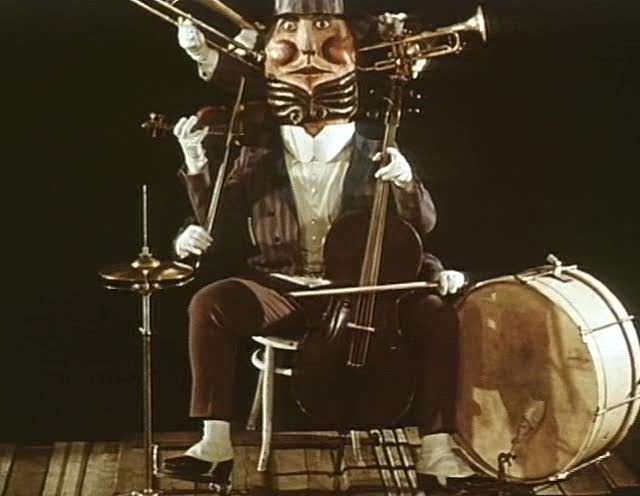
The Last Trick © Jan SvankmajerIn ‘The Last Trick’ two magicians in large masks perform their impossible tricks one after another against a black, empty background.

Although they stay polite, their congratulationary handshakes between the tricks gradually become more and more violent, ending in a disastrous mutual disembodiment. The last shot is of the only really living organism inhabiting this surrealist world, a beetle, dead.

‘The Last Trick’ is Czech film maker Jan Švankmajer’s first film, and already his obsessions with puppets, body parts and death are full blown. Its humor is dark, its images are grim and its story is very unsettling. Švankmajer’s first film (which contains a little stop motion animation) is also his first masterpiece.

Watch ‘The Last Trick’ yourself and tell me what you think:

‘The Last Trick’ is available on the DVD ‘Jan Svankmajer – The Complete Short Films’

Director: Bruno Bozzetto
Release Date: October 1, 1965
Rating: ★★★
Review:

West And Soda © Bruno Bozzetto‘West And Soda’ has a classic Western story: an evil villain is after the land owned by the lovely Clementine. Luckily she is rescued by our cool hero, Johnny, who doesn’t talk much, but who can shoot!

‘West and Soda’ is Bruno Bozzetto’s first feature film and unfortunately, it shows. The Italian animator is at his best in short, well-timed pantomime gags, and he clearly has difficulties with this longer medium. Neither the animation nor the designs are particularly appealing, and the feature suffers a little from its length. Generously mocking almost every aspect of the classic western, ‘West and Soda’ is as silly as it is predictable. Luckily there are many throwaway gags to keep the viewer laughing from time to time.

However, Bozzetto’s comic genius really shines through in two offbeat scenes, in which Bozzetto does what he does best: like his funny short ‘I Due Castelli’ from 1963, these two scenes use a fixed long distance perspective, pantomimed action and a perfect timing, with hilarious results. The first of these two scenes shows us several failing attacks of ferocious ants on Johnny, who is buried up to his head in the desert. The second depicts the villain’s attempts to drop a huge rock on our hero.

Watch the ant scene from ‘West And Soda’ yourself and tell me what you think:

Director: Friz Freleng
Release Date: August 25, 1965
Stars: The Pink Panther
Rating: ★★★★★
Review:

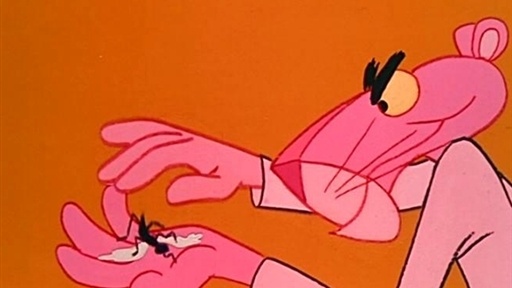
The Pink Tail Fly © DePatie-FrelengAfter a long evening of watching television, a tired Pink Panther tries to sleep, but he’s hindered by a small but annoying mosquito.

‘The Pink Tail Fly’ is one of the better entries in the Pink Panther series, and a worthy addition to the sleeplessness cartoon canon, being able to compete with cartoons like the Woody Woodpecker cartoon ‘Coo-Coo Bird‘ and the Donald Duck cartoon ‘Sleepy Time Donald’ (both from 1947). It contains several good gags, which build up to a great finale. The highlight may be the gag in which the Pink Panther tries to kill the mosquito using karate.

‘The Pink Tail Fly’ was the last Pink Panther film to be directed by Friz Freleng himself.

Watch ‘The Pink Tail Fly’ yourself and tell me what you think:

Director: Friz Freleng
Release Date: June 10, 1965
Stars: The Pink Panther
Rating: ★
Review:

Pink Ice © DePatie-FrelengIn ‘Pink Ice’, the Pink Panther is reunited with what he was named after: diamonds. In this film the Pink Panther owns a diamond mine, which is stolen by two colonial Englishmen.

‘Pink Ice’ is a perfect example of how the DePatie-Freleng Studios struggled to hit the right mark in the early Pink Panther films. In ‘Pink Ice’ the Pink Panther behaves particularly unfamiliar. Not only does he wear a dressing-gown throughout the picture, but he talks, and a lot, too. As was to be expected, it’s not a success. The film is vaguely reminiscent of some of Friz Freleng’s Bugs Bunny-Yosemite Sam outings, but its abundant use of dialogue is annoying, resulting in a weak entry in the series. Luckily, this experiment with a talking Pink Panther was not to be repeated.

Watch ‘Pink Ice’ yourself and tell me what you think:

Director: Friz Freleng
Release Date: April 12, 1965
Stars: The Pink Panther
Rating: ★★½
Review:

Sink Pink © DePatie-Freleng

In ‘Sink Pink’ a Texan hunter builds an ark to lure the animals of the savannah into it.

Sink Pink is the Pink Panther’s fifth film and the first to use dialogue. Unfortunately it’s a bad addition. The Texan hunter’s constant jabbering distracts from the pantomime humor. In the end even the Pink Panther himself speaks, which is even a worse idea. Nevertheless, ‘Sink Pink’ is noteworthy because it’s also the first film in which the Pink Panther shows his unique walk.

Watch ‘Sink Pink’ yourself and tell me what you think:

Directors: John & Faith Hubley
Release Date: September 21, 1964
Rating: ★★★★★ ♕
Review:

The Hat © John & Faith HubleyOne of directors John & Faith Hubley’s quintessential shorts,’The Hat’ is one of the most beautiful anti-war films ever made.

It’s an extraordinary blend of beautiful design, modern animation, improvisation and politics.

When a border guard accidentally drops his hat across the border, he and his enemy colleague argue about it and about war in general. Surprisingly, this is an improvised dialogue between jazz musicians Dizzy Gillespie and Dudley Moore, who also provide the film’s great jazz score.

The film’s leisurely speed is refreshing, its painted backgrounds of a snowy landscape are beautiful, the painted looks of the characters highly original, and its vivid animation by veteran Shamus Culhane stunning. All these aspects mount to a great and essential animation film. A classic.

Watch ‘The Hat’ yourself and tell me what you think:

‘The Hat’ is available on the DVD ‘Art and Jazz in Animation’

Director: Friz Freleng
Release Date: March 17, 1965
Stars: The Pink Panther
Rating: ★★★★★
Review:

Dial P For Pink © DePatie-Freleng‘Dial “P” for Pink’, the Pink Panther’s fourth film, has nothing to do with calling on a phone. Instead, we see a burglar trying to crack a safe. Oddly enough, this safe is in habited by the Pink Panther.

This extraordinary, but very simple idea is worked out perfectly into a tight plot (by Bob Kurtz), which matches that of ‘The Pink Phink‘ (1964).

‘Dial “P” For Pink’ is the first Pink Panther film to use music from the Pink Panther live action film ‘A shot in the dark’ (1964). Besides the familiar Pink Panther theme, this would become the background music for practically every Pink Panther short to come.

Watch ‘Dial “P” For Pink’ yourself and tell me what you think:

Director: Friz Freleng
Release Date: December 18, 1964
Stars: The Pink Panther, The Little Guy
Rating: ★★★★
Review:

The Pink Phink © DePatie-FrelengIn his very first own short The Pink Panther nags a painter by painting everything pink that the painter just has painted blue.

This is the Pink Panther’s first film, and it’s easily one of his best. Its simple idea is worked out perfectly into a tight plot (by John Dunn) with a grand finale. Its pantomime animation is effective and its sober design supporting.

Although he never got a name, the “little guy”,  the white, big-nosed, mustached antagonist, who resembles both his creator, Friz Freleng, and Inspector Clouseau, is very important to the success of the series: he is easily the best designed opponent in the Pink Panther cartoons. Like the Pink Panther he’s monochrome, and a silent character, allowing the animators to make the best out of pantomime animation. Moreover, he could be staged in all kinds of functions and settings. Nevertheless, he kept a consistent character, being normally kind and gentle, but getting puzzled, then frustrated and often in the end, very angry with the Pink Panther’s antics.

Nevertheless, it took the makers a while to realize his potential, for though the little guy would return as a janitor in ‘We Give Pink Stamps’ (1965), he would only become a regular from ‘The Pink Blue Print‘ (1966) on, after twenty films with other, often talking, and always less wonderfully designed characters.

Watch ‘The Pink Think’ yourself and tell me what you think:

Director: Charles Nichols
Release Date: March 16, 1961
Rating: ★★★
Review:

‘The Saga of Windwagon Smith’ was Disney’s last tall tale cartoon after entries like ‘Pecos Bill‘ (from ‘Melody Time‘, 1948) and ‘Paul Bunyan‘ (1958).

Unlike the former, which were rooted in American folklore, this story seems to be an original, although it retains a traditional feel. The story, which is narrated in rhyme, and partly sung by Rex Allen and the Sons of the Pioneers, tells about Windwagon Smith, a sailor who arrives at Westport, a small town in Kansas on a wagon with a sail. He convinces the villagers to make even a larger one to sail the prairies to Santa Fe with. But when it’s ready the villagers get scared and abandon the ‘ship’, except for Molly, the mayor’s daughter, who’s in love with Smith. Together they vanish into a storm.

‘The Saga of Windwagon Smith’ was the last cartoon to be directed by Charles Nichols. It’s also the last of only six shorts directed by him not to feature Pluto. It’s moderately stylized except for Molly, who’s conceived and animated in a charmingly stylized way, seeming to float more than to walk. Nichols left Disney in 1962 for Hanna-Barbera, where he worked on countless television series. In the late 1980s he returned to Disney, where he worked onto his death in 1992, 81 years old.

Watch ‘The Saga of Windwagon Smith’ yourself and tell me what you think:

‘The Saga of Windwagon Smith’ is available on the DVD ‘Walt Disney Treasures: Disney Rarities’

Director: David Hand
Release Date: April 13, 1935
Stars: Mickey Mouse, Pluto
Rating: ★★½
Review:

Mickey's Kangaroo © Walt DisneyIn ‘Mickey’s Kangaroo’ Mickey receives a kangaroo for a present.

Pluto grows jealous of the intruder and its little kid, which is expressed with side glances at the audience in extreme close ups, and through a tough and sneaky voice over by Don Brodie. This is a rather weak device to overcome Pluto’s silent character. While Pluto tries to get rid of the little kangaroo, Mickey gets beaten up by mama kangaroo, but he keeps laughing.

As Jim Korkis reveals in ‘The Book of Mouse‘, ‘Mickey’s Kangaroo’ surprisingly is a film based on a true story. In 1934 Walt Disney got two wallabies as a present from Australian wine maker Leo Buring. By the time they arrived at the studio, the two marsupials had given birth to a child. The three wallabies were kept in a pen outside the studio department.

‘Mickey’s Kangaroo’ became Mickey’s last cartoon in black and white, being released even after ‘The Band Concert‘, Mickey’s first one in color. Unfortunately, it’s not a very funny goodbye to the black and white era. Nevertheless, its story line would be reused in ‘Mickey’s Elephant‘ (1936).

Watch ‘Mickey’s Kangaroo’ yourself and tell me what you think:

This is Mickey Mouse cartoon No. 75
To the previous Mickey Mouse cartoon: Mickey’s Service Station
To the next Mickey Mouse cartoon: Mickey’s Garden

Director: David Hand
Release Date:
January 19, 1935
Stars:
Mickey Mouse
Rating:

Review:

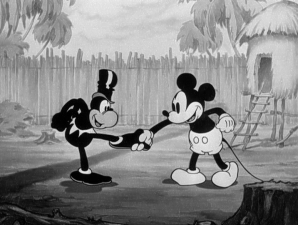
Mickey's Man Friday © Walt DisneyLike in ‘The Castaway‘ (1932), Mickey has been shipwrecked, and he’s washed ashore at a tropical island full of cannibals.

When the cannibals try to cook a young native, Mickey scares them away in order to rescue the poor fellow. He then adopts this young native and they build a fort together, which they finish just in time, before the cannibals return to attack them. These eventually manage to overrun Mickey’s defense, and Mickey and the native flee on a self made ‘ship’.

Even when compared to Disney’s two other embarrassing cartoons about cannibals (the Silly Symphony ‘Cannibal Capers‘ (1930) and ‘Trader Mickey‘ (1932, curiously also directed by David Hand), the depiction of natives in ‘Mickey’s Man Friday’ is backward and humiliating. Mickey’s man Friday uses his feet more than his hands and appears to be more closely related to apes than to man. This is so sickening to watch that this is one of the very rare cartoons of which I feel that they could have remained under the rug, despite the fast and clever ‘invention gags’ featured in this cartoon, which foreshadow comparable gags in ‘The Flintstones’.

Watch ‘Mickey’s Man Friday’ yourself and tell me what you think:

This is Mickey Mouse cartoon No. 72
To the previous Mickey Mouse cartoon: Two-Gun Mickey
To the next Mickey Mouse cartoon: The Band Concert

Director: Burt Gillett
Release Date: September 29, 1934
Stars: Mickey Mouse, Pluto
Rating:
Review:

Mickey Plays Papa © Walt DisneyMickey Plays Papa’ reuses the concept of Mickey receiving orphans from ‘Mickey’s Orphans‘ from 1931. But this time he has to deal with only one orphan mouse, called Elmer.

The film is particularly noteworthy for its scary opening: while Mickey’s reading a scary novel titled “the cry in the night” in bed, someone’s laying the orphan on his doorstep, whose cries startle Mickey and Pluto. When Mickey and Pluto discover that these cries are caused by a cute little baby, they both try to comfort him. These attempts include a nice Charlie Chaplin imitation by Mickey. This cartoon also contains a gag in which Mickey’s being attacked by numerous kitchen tools, which was copied in ‘Who Framed Roger Rabbit‘ (1988).

But most importantly, the cartoon contains long character-based solo sequences, like Mickey’s trouble with a rubber nipple and Pluto’s antics with a toy bunny and a fishbowl. This type of elongated solo scenes, alternating between the two characters, appear for the first time in this cartoon, but unfortunately they’re not very funny here. Nevertheless, they would become a dominant style element of the Mickey Mouse cartoons of the rest of the 1930s, especially in the Mickey, Donald and Goofy trio outings, luckily often with way more hilarious results.

‘Mickey Plays Papa’ ends when Mickey’s released from the rubber nipple and he finally succeeds in making the baby laugh, by doing a Jimmy Durante imitation with his elongated nose. It would be the last cartoon directed by Burt Gillett before he left Disney in March 1934 for the Van Beuren Studios, only to return in 1937 to direct two other cartoons, the excellent ‘Lonesome Ghosts’ (1937) and ‘The Moth and the Flame’ (1938).

Watch ‘Mickey Plays Papa’ yourself and tell me what you think:

This is Mickey Mouse cartoon No. 69
To the previous Mickey Mouse cartoon: Orphan’s Benefit
To the next Mickey Mouse cartoon: The Dognapper

Director: David Hand
Release Date: June 16, 1934
Stars: Mickey Mouse, Minnie Mouse, the orphan mice
Rating: ★★★
Review:

Mickey's Steamroller © Walt DisneyTwo of the orphan mice used in ‘Giantland‘ (1933) and ‘Gulliver Mickey’ (1934) appear in this cartoon.

It’s unclear whether these two brats are Mickey’s nephews Morty and Ferdy, who were created by Floyd Gottfredson in the Mickey Mouse comic in 1932, as they’re not named in this short. If they are, this film marks their only screen appearance, for, unlike Donald’s nephews, they don’t appear in any other film. Anyway, as in the comic strip, these two brats are full of mischief.

This time they steal Mickey’s anthropomorphized steam roller, while Mickey’s flirting with Minnie. The two kids manage to destroy a bridge, a streetcar, a complete hotel and the steamroller itself, but in the end Mickey’s not mad at them, just laughing.

‘Mickey’s Steamroller’ is a real gag-cartoon. Yet, it is not particularly funny and it has an old-fashioned feel to it, especially after such elaborate entries in the Mickey Mouse series, as ‘Mickey’s Gala Premier‘ and ‘Giantland‘.

Watch ‘Mickey’s Steamroller’ yourself and tell me what you think:

This is Mickey Mouse cartoon No. 67
To the previous Mickey Mouse cartoon: Gulliver Mickey
To the next Mickey Mouse cartoon: Orphan’s Benefit

Director: Burt Gillett
Release Date: March 3, 1934
Stars: Mickey Mouse, Pluto
Rating: ★★★★
Review:

Playful Pluto © Walt DisneyPlayful Pluto consists of several loose gags around Mickey and Pluto in a garden. It contains Mickey’s first encounter with a little whirlwind, which he manages better than his second one in ‘The Little Whirlwind’ from 1941.

But ‘Playful Pluto’ is most notable for the now famous flypaper sequence,  in which Pluto gets caught in flypaper. This is an important scene in animation history, because it’s the first time Pluto is seen as a thinking character. Not only that, it is arguably the first believable animation of thought processes. This illusion of thought is achieved solely by pantomime animation.

The flypaper scene elevated its animator, Norm Ferguson, to the eternal hall of animation fame and it showed how laughs could originate in character animation alone. This sequence not only raised the standards of animation of Pluto, but of character animation in general. As to celebrate its success, this scene was remade in color for the Donald Duck short ‘Beach Picnic‘ (1939).

At the same time, this cartoon shows how character-based gags could slow down the pace. This was an unfortunate side-effect, for this high pace had been painstakingly achieved in the Mickey Mouse cartoons during the previous years.

Watch ‘Playful Pluto’ yourself and tell me what you think:

This is Mickey Mouse cartoon No. 65
To the previous Mickey Mouse cartoon: Camping Out
To the next Mickey Mouse cartoon: Gulliver Mickey

Director: Burt Gillett
Release Date: September 30, 1933
Stars: Mickey Mouse, Minnie Mouse
Rating: ★★★
Review:

Still from 'The Steeple Chase' featuring Mickey, his horse and the colonel in a wheelchairMickey is a jockey in a horse race.

Unfortunately, his horse Thunderbolt gets drunk just before the race starts. So he rides a pantomime horse, with his two black stable boys in it, instead. Remarkably, they win, due to a colony of angry and determined wasps, who chase the two poor black boys to the finish and into the distance, while Mickey receives all the glory.

‘The Steeple Chase’ is one of those ‘adventure type stories’ Mickey began having in 1932, and which were undoubtedly inspired by Floyd Gottfredson’s comic strip. ‘The Steeple Chase’ is a prime example: it shows clear similarities to ‘Mickey Mouse and his horse Tanglefoot‘, which ran about the same time (from June to October 1933). The colonel from ‘The Steeple Chase’ returns in that comic strip as a grumpy judge.

The early scenes firmly state why Mickey should win the race, e.g. when Minnie tells him “you gotta win, Mickey, or you’ll break the colonel’s heart”. Thus we are more involved in the horse race then in Mickey’s boxing game in ‘Mickey’s Mechanical Man‘ from earlier that year. Nevertheless, it remains a fact that Mickey’s actually cheating in both these cartoons, and misusing the two black stable boys while doing so. This makes it rather difficult to sympathize with Mickey. Moreover, the race is hardly as exciting as the one in ‘Barnyard Olympics‘ (1932), and the cartoon is by all means inferior to Gottfredson’s classic comic strip. The best gags come from the numerous ways in which the wasps attack Mickey and his fake horse.

Watch ‘The Steeple Chase’ yourself and tell me what you think:

This is Mickey Mouse cartoon No. 60
To the previous Mickey Mouse cartoon: Puppy Love
To the next Mickey Mouse cartoon: The Pet Store

Director: Wilfred Jackson
Release Date: June 17, 1933
Stars: Mickey Mouse, Minnie Mouse
Rating:
Review:

Still from 'Mickey's Mechanical Man' featuring a gorilla boxing a robotMickey has build a robot to fight a gorilla in a boxing match, which is called “the battle of the century: machine vs. beast”.

Mickey’s robot has one disadvantage: he runs wild when he hears Minnie’s car horn. Luckily, this fact helps him in the end: when he’s clobbered by the gorilla (on the tune of Franz Liszt’s second Hungarian rhapsody), he seems almost lost. But then Minnie fetches her car horn, revitalizing the robot. From that point he actually cheats, using multiple boxing gloves, a hammer and hits below the belt.

Despite its clear story and high quality animation, ‘Mickey’s Mechanical Man’ is a very weak short, and a low point in the otherwise outstanding Mickey Mouse year of 1933. The cartoon is surprisingly low on gags and it’s difficult to sympathize with the robot character, as it’s mechanical after all, while the gorilla is a living being. Moreover, Mickey’s motives remain unclear and we’re not invited to care about the match.

The cartoon most interesting feat. are the robot’s jerky movements, which are clearly mechanical and based on wind-up toys, but which become rather frantic and ridiculously elaborate when the robot goes wild. Nevertheless, there are some traces of Stan Laurel’s boxing moves from ‘Any Old Port’ (1932).

‘Mickey’s Mechanical Man’ is reminiscent of the Fleischer Studio’s equally weak ‘The Robot‘ (1932). Both films were inspired by rather hysterical stories about robots taking over jobs, which circulated in the early 1930s, and which struck a chord in an era of vast unemployment.

Watch ‘Mickey’s Mechanical Man’ yourself and tell me what you think:

This is Mickey Mouse cartoon No. 57
To the previous Mickey Mouse cartoon: The Mail Pilot
To the next Mickey Mouse cartoon: Mickey’s Gala Premier

Director: Burt Gillett
Release Date: February 28, 1933
Stars: Mickey Mouse, Minnie Mouse, Pluto
Rating: ★★★½
Review:

Still from 'Mickey's Pal Pluto' featuring Pluto and his little devilish self‘Mickey’s Pal Pluto’ shows how important Pluto had become by 1933.

It’s the first cartoon having the sympathetic mutt in its title, and it’s he, not Mickey or Minnie, who’s the real star of this short, arguably making ‘Mickey’s Pal Pluto’ Pluto’s first own cartoon.

In ‘Mickey’s Pal Pluto’ Pluto saves a few little kittens from drowning. Mickey and Minnie take them home, but there Pluto grows jealous of the intruders, exemplified by a conflict between his devilish and angelic sides, who materialize outside him, and who speak in rhyme. Unfortunately, when Pluto listens to his little devil, this leads to Mickey putting him outside. Nevertheless, when the kittens fall into a well, Pluto rescues the kittens from drowning again, almost drowning himself in the act. In the end he’s rewarded for this unselfish behavior with a roast chicken.

The moral clearly is that being good will be rewarded, as Pluto’s angel character clearly states in the end. So some of the childish sentimentality that had entered the Silly Symphonies in 1933 sneaks in to the Mickey Mouse series, as well.

‘Mickey’s Pal Pluto’ marks the first appearance of Pluto’s imaginary little devil and angel, symbolizing his inner conflict. This cartoon was more or less remade in color in 1941, titled ‘Lend a Paw’. Pluto’s little devil would reappear in ‘Mickey’s Elephant‘ (1936).

Watch ‘Mickey’s Pal Pluto’ yourself and tell me what you think:

This is Mickey Mouse cartoon No. 53
To the previous Mickey Mouse cartoon: The Mad Doctor
To the next Mickey Mouse cartoon: Mickey’s Mellerdrammer

Enter your email address to follow this blog and receive notifications of new posts by email.

Join 905 other subscribers
Bookmark and Share

Categories