You are currently browsing the tag archive for the ‘autobiography’ tag.
Director: Nina Paley
Release date: February 11, 2008
Rating: ★★★★★
Review:
Unlike the European and Japanese animation field, the American animation studio system is unkind to author films. Walt Disney’s ‘Lilo & Stitch’ (Chris Sanders, 2002) probably comes closest, apart from several feature films based on animated television series. Thankfully, some individual artists have filled this gap, most notably Bill Plympton, releasing no less than seven features. Other notable artists are Don Hertzfeldt (‘It’s Such a Beautiful Day’ from 2012), and Nina Paley. Amazingly, all these artists mostly work totally alone, which makes their accomplishments even more stunning.
Nina Paley ‘Sita Sings the Blues’ for example, is written, directed and produced by Paley alone, which took her five to six years, and which could only be finished with help from crowd-funding, being one of the first animated projects to use this type of fund raising.
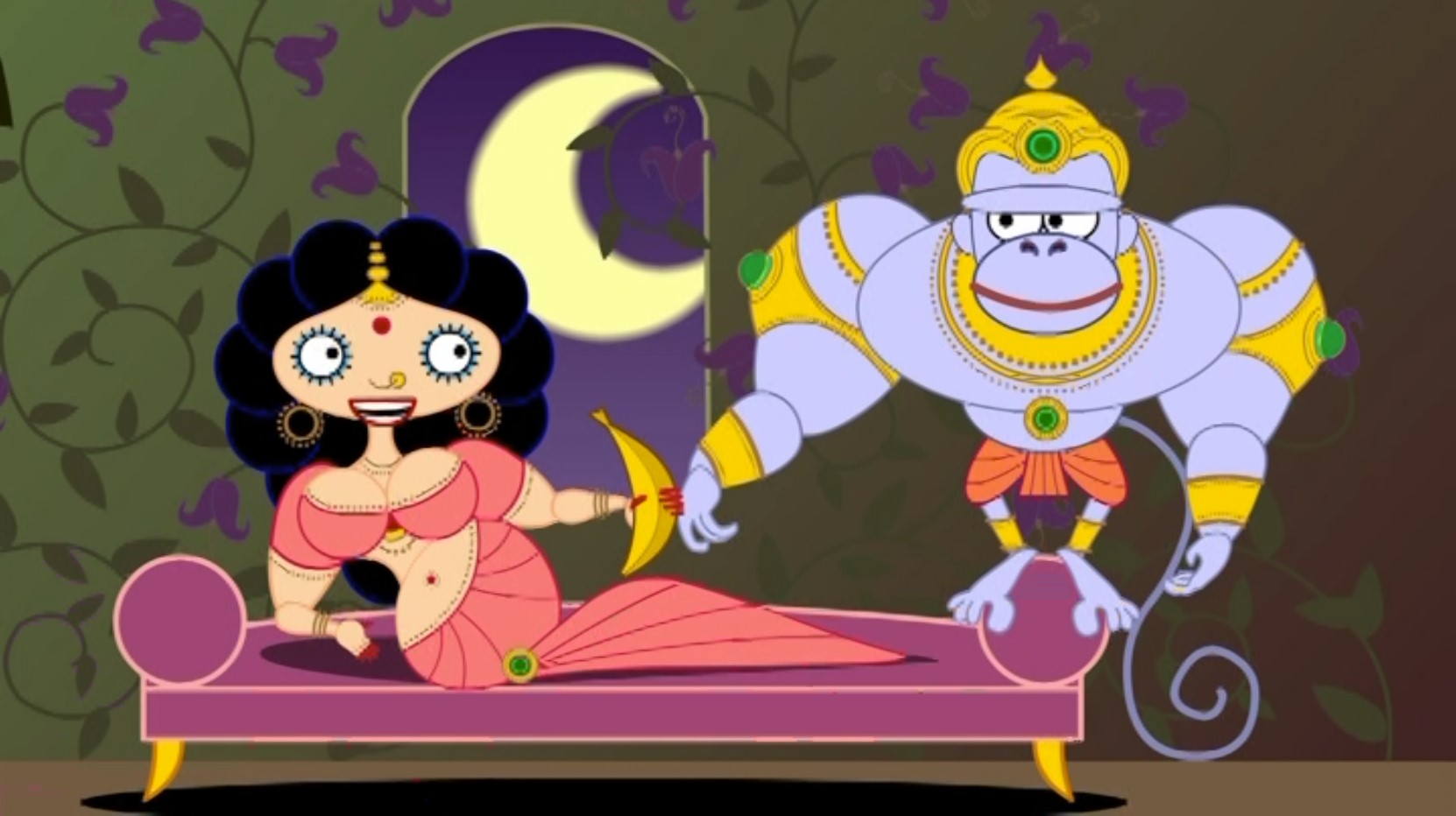
‘Sita Sings the Blues’ retells the Indian epic ‘The Ramayana’, but it’s also a personal film, in which Paley links her own situation to that of Sita, the perfect wife to the hero Rama. The most incongruous element are the eleven songs by 1920s jazz singer Annette Hanshaw, an artist sadly almost forgotten, whom Paley had discovered prior to the film making. The linking of these sweet and gentle tin pan alley songs to the Ramayana is as odd as it is effective, and the pairing certainly contributes to the uniqueness of the film.
The film uses several different animation styles: Nina Paley’s own personal story is told in a traditional scribbly animation style, with sets based on photographic material. These parts are the least attractive of the lot, even though Paley shows to be a very able animator in this classic cartoon style. The Ramayana is retold by three Indians (Aseem Chhabra, Bhavana Nagulapally and Manish Acharya) who are depicted as traditional shadow puppets of Hanuman, Sita, and Rama, respectively. The story they are telling together is shown in tongue-in-cheek cut-out animation.
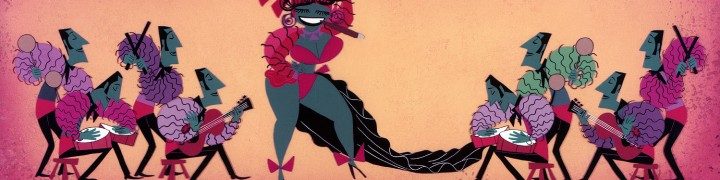
The ‘official’ story is also told in cut-out animation, using very attractive recreations of traditional Indian paintings. But the best parts to look at are the songs, which are done in a most attractive cartoon modern design. In these song parts Paley reuses a lot of animation cycles, but actually she makes excellent use of the flash medium, and she makes the most of her limited animation.
Apart from these five alternating styles, there’s also a short sequence using rotoscope and a much more pop-art influenced videoclip-like filming style. All these are apparently done in Macromedia flash.
As said, ‘Sita Sings the Blues’ retells the Ramayana, reducing the huge epic to its barest elements. For example, Lakshmana is hardly mentioned, and the monkey king Sugriva not at all. Moreover, unlike the traditional poem, the focus is on Sita, not Rama, and Paley highlights the questionable parts from the original poem (one at the end of the Yuddha Kanda, and another in the Uttara Kanda), in which Rama treats Sita very unfairly indeed, just like Paley’s own partner does in real life. This makes ‘Sita Sings the Blues’ a feminist film, which sheds a welcome critical light on the traditional depiction and treatment of women, then and now.
As the story is told by three people, who remember the story differently and interpret it in different ways, this leads to some very funny moments. But Paley adds some humor, too, in the ‘official’ story part, for example when the female rakshasa (a sort of demon) Shurpanakha tells her brother Ravana about the beauty of Sita, comparing all her body parts with lotuses.
As said, the Annette Hanshaw songs boast the most attractive designs, and like traditional opera arias, they shed an emotional light on the events. However, Paley cleverly propels the story forward even during these sequences. Yet, as the songs are featured in their entirety, typically lasting ca. 3 minutes, they also drag the film down. As there are eleven of them, one tends to grow a little weary of them as the film progresses. Nevertheless, ‘Sita Sings the Blues’ does a great job in restoring interest in this almost forgotten singer. Unfortunately, the Hanshaw songs were not free from copyright, causing Paley a lot of trouble, and eventually causing her to release the film completely free from copyright.
The Annette Hanshaw songs are juxtaposed to some Indian pop music, mostly by artist Masaladosa. Particularly strong is the angry song which follows the scene in which Paley gets dumped by email. The complete soundtrack is as attractive as the film’s visual designs, and the two complement each other very well.
In all, ‘Sita Sings the Blues’ is not without its flaws, but as it is made by a single woman, it’s no less than a tour-de-force, and the result is a very interesting personal film, which makes one think. Moreover, the film shows the great power and endless possibilities of animation, and single-handedly puts Paley into the pantheon of the medium’s greats. In 2018 Paley made yet another feature called ‘Seder-Masochism’, which unfortunately has attracted much less attention.
Watch the trailer for ‘Sita Sings the Blues’ yourself and tell me what you think:
‘Sita Sings the Blues’ is available on DVD
Director: Ralph Bakshi
Release date: August 8, 1973
Rating: ★★
Review:
Ralph Bakshi arrived on the scene when American classic studio animation was in steady decline, reaching its low point in the 1970s and early 1980s. In this dry period, Bakshi tried to reinject classic animation with new energy, most notably by ripping it of its association with children. Now, in the golden age animation never had been solely associated with children, but due to the advent of the Saturday-morning cartoon in the mid-1960s American animation more and more became something just for kids.
Bakshi, on the other hand, saw the full potential of the medium, and enriched the animation world with several animated features aimed at adult audiences, thus bypassing the middle ground of the family film, which was Disney’s monopoly at the time, anyway. Thus, Bakshi is sometimes seen as the savior of animation during the medium’s dark ages, but I find it hard to subscribe to that opinion, and that’s because his films are sadly just not good.
Now, I will not talk about the abysmal ‘The Lord of the Rings’ (1977), which is a disgrace to the medium, but even ‘Heavy Traffic’, his supposed masterpiece, fails on several key features.
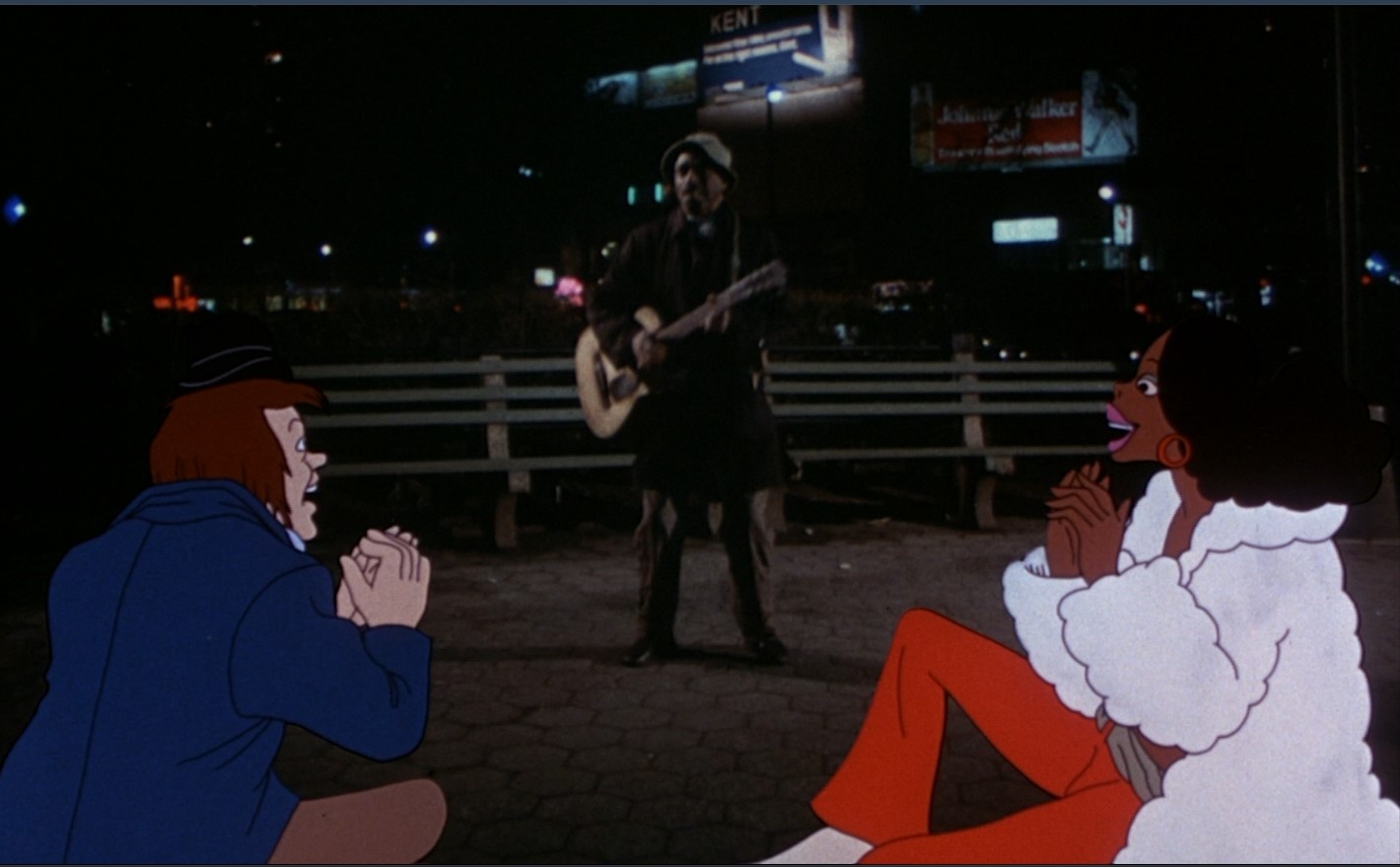
‘Heavy Traffic’ was written by Bakshi himself and has strong autobiographical elements. Set in New York the feature film tells of Michael Corleone, a young and aspiring underground cartoonist, who stills live with his quarreling parents (a Jewish mother and an Italian father), and who dates a black girl called Carole.
The film uses a voice over and the images of a pinball machine as bridging elements, but this cannot hide the fact that the film is a loose bag of scenes, and hardly goes anywhere. Sure, the film is depressing and draws a dark picture of the Big Apple, but its fourteen scenes have little to do with each other and are more about atmosphere than storytelling.
It certainly doesn’t help that none of the characters are remotely sympathetic. Even Michael himself, our supposed hero, is more of a self-centered jerk than anything else. For example, the comics he shows a publisher, wouldn’t interest anyone with a sane mind.
Worse, ‘Heavy Traffic’ falls for the misguided idea that making a film for an adult audience means it must contain sex and violence. ‘Heavy Traffic’ was not the first film to fall into this trap, and certainly not the last one (the unappealing ‘Sausage Party’ from 2016 comes to mind), but Bakshi clearly indulges in both, not only in this film, but also in ‘Fritz the Cat’ from the year before, ‘Wizards’ (1977) and ‘Cool World’ (1992), to name a few, which, to me, only proofs his immaturity. In ‘Heavy Traffic’, for example, bare breasts pop up from everywhere, with little other purpose than arousing the male audience.
Bakshi’s character designs are a mixed bag, sometimes reminiscent of the work of Mort Walker, as in the design of Michael’s father, at other times very cartoony, and reminiscent of DePatie-Freleng (e.g. the gay drag queen Snowflake), at other times quasi-realistic (Carole). Especially ill-conceived is Michael himself, whose quasi-realistic design is as mediocre as it is unappealing.
The background art too is a strange mix of drawings and photographs to a gritty effect. There are even some real live action footage elements from old films, like ‘Red Dust’ (1932) and ‘The Gang’s All Here’ (1943). In the end, the characters change into their live action counterparts, and suddenly one asks himself why this gritty film was not filmed in live action in the first place, as Bakshi’s animation adds surprisingly little.
Now, ‘Heavy Traffic’’s animator list features such illustrious names like Tom Ray, Carlo Vinci, Irv Spence, Manny Gould and Dave Tendlar, and it’s admirable that Bakshi kept these animation greats at work, but I doubt how many people watch ‘Heavy Traffic’ for its beautiful animation, for there’s hardly any. There’s manic animation, there’s outrageous animation, there’s fair animation, and there’s a lot of rotoscoping, but I’d prefer ‘Robin Hood’ from the same year anytime, even if that is the poorest of all classic Disney features.
For a supposed masterpiece, ‘Heavy Traffic’ feels like a sad affair, wasting a lot of animation talent on an egotistical document too heavy-handed for its own good, a film that is as depressing as it is boring and unappealing.
No, to me, Bakshi was more like the wrong guy at the right time: he could not save animation, for he lacked both the talent and the vision to do so. His films never transcend the dark ages, but are firmly rooted in them, and because of Bakshi’s limited view on what an adult film can be, the whole concept never really took off in the United States. This is an infinite pity, for this is one of the reasons we still must deal with the narrowminded view of animation being equal to family entertainment, today.
Watch the theatrical trailer for ‘Heavy Traffic yourself and tell me what you think:
‘Heavy Traffic’ is available on Blu-Ray and DVD
Director: Eric Khoo
Release Date: May 17, 2011
Rating: ★★★
Review:

The film ‘Tatsumi’ celebrates the work of Japanese manga artist Yoshihiro Tatsumi (1935-2015). Tatsumi is the inventor of the gegika manga style, a grittier, more alternative form of manga for adults. The film re-tells five of Tatsumi’s short stories in this this style, all from 1970-1972. These stories are bridged by excerpts from his drawn autobiography ‘A Drifting Life’ from 2008.
Thus, the film is completely drawn (only in the end we see the real Yoshihiro Tatsumi), but to keep the manga style intact the film was animated with Toon Boom Software, specialized in ‘animatics’, which brings story boards to life. Thus, full animation, although present, is rare, and most of the motion is rather basic, often lacking any realism of movement. The animation is enhanced by limited digital effects, and the first and last story are digitally manipulated to make the images look older.
The complete film thus is little more than slightly enhanced comic strips. One wonders if this is the best way to present Tatsumi’s work, as most probably his stories work better in their original manga form, but of course the movie is a great introduction to his work, which without doubt is fascinating and original.
Tatsumi’s manga style clearly deviates from his example, the great Osamu Tezaku. Tatsumi’s style is more raw, sketchier and knows nothing of the big eyes so common in manga. All but one story use a voice over narrator. And all but one are in the first person. The stories themselves are gritty, dark, depressing and bleak. The second story, ‘Beloved Monkey’, in which a factory worker falls in love with a girl at a zoo, is particularly bitter. The outer two take place just after the end of World War II and show the effects of Japan’s traumatic loss. All are about the losers in life, struggling at the bottom of society. As Tatsumi himself says near the end of the movie:
“The Japanese economy grew at a rapid pace. Part of the Japanese population enjoyed the new prosperity. The people had a great time. I couldn’t bear to watch it. I did not share in the wealth, and neither did the common people around me. My anger at this condition accumulated within me into a menacing black mass that I vomited into my stories.”
Surprisingly, the protagonists of all first-person stories, including the autobiography, all look more or less the same, as if Tatsumi couldn’t create more than one type of hero. Only the third story, ‘Just a Man’, the only one to use a third person narrator, stars a different and older man, while the last story, the utterly depressing ‘Good-bye’, is the only one to have a female protagonist. Tatsumi’s own life story is told in full color which contrasts with his short stories, which are mostly in black and white. Tatsumi’s autobiography is less compelling than his story work but adds to the understanding of the artist and his work.
Surprisingly, for such a Japanese film ‘Tatsumi’ was made in Singapore and animated in Indonesia. According to Wikipedia Singaporean director Eric Khoo was first introduced to the works of Yoshihiro Tatsumi during his military service, and immediately was stricken by his stories. When ‘A Drifting Life’ was published in Singapore in 2009, Khoo realized that Tatsumi still was alive and wanted to pay tribute to him. Tatsumi himself was greatly involved in the film and narrates his own life story. The movie is a great tribute to one of the more original voices in Japanese manga, and well worth watching, if you can tolerate a dose of sex and violence.
Watch the trailer for ‘Tatsumi’ yourself and tell me what you think:
‘Tatsumi’ is available on Blu-Ray and DVD
Directors: Laurent Boileau & Jung
Release Date: June 4, 2012
Rating: ★★★
Review:

One of the striking developments of the 21st century was the advent of the animated documentary. Of course, the genre is much, much older, arguably going back to Winsor McCay’s ‘The Sinking of the “Lusitania“’ (1918), but the animated documentary film remained a scarcity throughout the 20th century, and never went beyond the length of shorts.
All that changed with the highly influential Israeli film ‘Waltz with Bashir’ (2008), arguably the very first feature length animated documentary. Subsequent films of this type often told personal stories, if not only told with, then at least augmented with animation, e.g. ‘Tatsumi’ (2011), ‘Kurt Cobain: Montage of Heck’ (2015, with added animation by Hisko Hulsing) or ‘Tower’ (2016).
‘Couleur de peau: miel’ is such a personal story. The film is based on an autobiographical graphic novel by Belgian author Jung, who is of Korean descent, and who was adopted at a young age. His story is told with an all too prominent voice over, and in live action, depicting the present Jung, now 44 years old, visiting Korea, with the use of 8mm films shot by his father in the 1970s, and with computer animation, depicting several of Jung’s childhood memories.
The film succeeds in showing the troubled existence of adopted children, and their struggling with their identity. Jung, for example, doesn’t feel entirely part of the family, and indeed, his parents sometimes snap that they see him differently from their own natural children. Worse, he feels uprooted, feeling neither completely Belgian nor Korean, and feeling alienated from both. This leads to a troubled youth, with Jung being far from a good boy. This unfortunately makes it rather more difficult to identify with him, for he often acts as a real jerk, being full of mischief, for example falsifying his school report.
The French title literally translates as ‘Skin Color: Honey’, and the animated sequences certainly use yellows, together with browns and grays as their principal coloring. Jung also has some dire memories of his early Korean days, which are rendered in more depressing grays than the Belgian sequences. These colors dominate the beautiful, two-dimensional background art.
For the animation the film makers have resorted to 3D computer animation, because it was cheaper. Unfortunately, it also looks cheaper, hampering an otherwise fine film. The characters are a strange hybrid of drawn images projected on three-dimensional models, and never become convincing characters. Instead, they look like wandering marionettes, uncannily devoid of life. In fact, the character animation is so ugly to look at that the emotions of Jung’s memories never really come off. I certainly wonder what a better film ‘Couleur de peau: miel’ could have been, if the film makers had made in traditional 2D animation… Now, we’re stuck with a film that certainly is interesting, but falls short in moving its audience.
Watch the trailer for ‘Couleur de peau: miel (Approved for Adoption)’ yourself and tell me what you think:
‘Couleur de peau: miel'(Approved for Adoption) is available on Blu-Ray and DVD
Director: Ilze Burkovska Jacobsen
Release Date: June 15, 2020
Rating: ★★★½
Review:
The Dutch online Kaboom Animation Festival was not only about shorts, it also presented thirteen feature films, of which I have seen five, the first being ‘My Favorite War’.
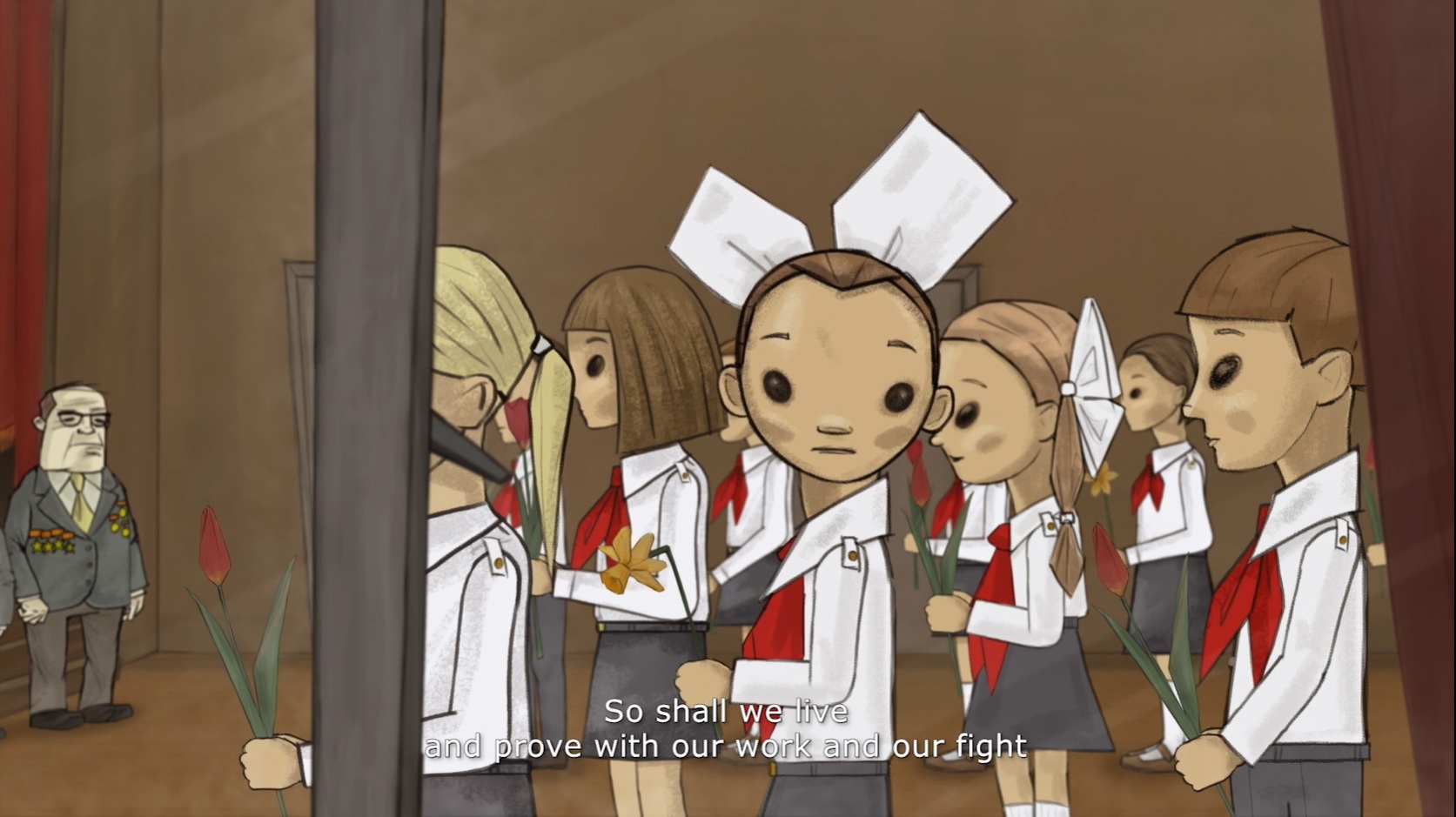
‘My Favorite War’ is an animated documentary and autobiography. In this feature film director Ilze Burkovska Jacobsen tells about her youth in Latvia when it was still part of the Soviet Union, “the self-proclaimed happiest country in the world” as she tells us at the beginning of the film. We follow little girl Ilze from 1974 until the singing revolution of the late 1980s, which resulted in Latvia’s independence of the Soviet Union in 1991.
Burkovska Jacobsen brings daily life in the communist, totalitarian regime back to life, which not only does look hopelessly old-fashioned when compared to contemporary Western Europe, but which also is strikingly preoccupied, even obsessed with its heroic past. Practically everything in Ilze’s life revolves somehow in defending the great Soviet Union against fascism, like the Soviets had successfully done during World War II (the favorite war of the title). In fact, much of Ilze’s life is devoted to a bleak and pointless preparation for a war that never comes.
Ilze lives near a site in which Nazi Germany managed to keep an isolated fastness until the general capitulation, called the Courland pocket, which Burkovska Jacobsen calls the Courland Cauldron, and near a Soviet army training site, and both localities make a marked impression on her daily education and social life. As if the Soviet Union wanted to make their inhabitants relive World War II constantly and persistently. Likewise, Burkovska Jacobsen’s tale often shifts back to the 1940s to tell what happened in the Courland pocket.
Even more tension comes from the contrast between Ilze’s father, a member of the communist party, and her grandfather, a so-called enemy of the state and a Siberia camp survivor. For example, to protect her grandfather and her mother, Ilze strives to become the best member of the communist party…
‘My Favorite War’ is a very sympathetic and welcome film, and tells very well how it is to live under an oppressive regime. Tales like this cannot be told enough, for they show us the values of freedom and democracy. But this does not mean that ‘My Favorite War’ is without its flaws: the film makes interesting use of collage techniques, but the designs are a little inconsistent, and could have done with bolder artistic choices. Worse, the cut-out animation is rather stiff, and at times downright amateurish, hampering the story. The dialogue, too, is dreadfully stiff, and too often fails to come to life, at all. Thus the characters on the screen remain wooden puppets, missing an opportunity to penetrate one’s heart. The best animation is when Ilze kicks the bucket of garbage she has to take outside. This is a rare moment of effective little realism in a tale of otherwise rather grand gestures.
In fact, the symbolic parts are the best. Especially entertaining is the sequence in which Ilze visualizes why her town is deprived from butter, supposedly because it’s saved for the Great War to come. And the film’s most harrowing tale, that of Ilze’s friend Ilga, is in fact told in live action, by the present Ilga herself. In the end one cannot escape the feeling that Burkovska Jacobsen has been relatively lucky to have lived in the twilight days of the Soviet Union, and to have experienced the thaw of Perestroika and the freedom following the singing revolution. But it comes to no surprise that the film ends as a pamphlet against all oppressors, for Burkovska Jacobsen knows well enough what she’s talking about.
Watch the trailer of ‘My Favorite War’ and tell me what you think:
‘My Favorite War’ is not yet released on home media


 Dr. Grob's Animation Review