
You are currently browsing the tag archive for the ‘Betty Boop’ tag.
Director: Dave Fleischer
Release Date: April 3, 1931
Stars: Bimbo, Betty Boop
Rating: ★★½
Review:
 Bimbo is a train robber who holds up a train. Unfortunately for him, his stout wife, Betty Boop (called Nan McGrew in this cartoon), is also on this train.
She confronts him and in the end Bimbo unwillingly reunites with his wife, fleeing with her into the distance on the locomotive.
‘The Bum Bandit’ lacks the wild surrealism of earlier Talkartoons, like ‘Barnacle Bill‘ and ‘Mysterious Mose‘ (both 1930), and is thus less interesting to watch. The best scene is when Bimbo practices shooting, e.g. shooting a cow from the sky. There is also some nice and flexible animation on the riding train. Betty Boop has a distinctly different voice here, which was not repeated after this cartoon.
Watch ‘The Bum Bandit’ yourself and tell me what you think:
This is Talkartoon No. 18
To the previous Talkartoon: The Cow’s Husband
To the next Talkartoon: The Male Man
‘The Bum Bandit’ is available on the French DVD Box Set ‘Betty Boop Coffret Collector’
Director: Dave Fleischer
Release Date: December 26, 1930
Stars: Betty Boop, Bimbo
Rating: ★★★★★
Review:

Bimbo is the uncanny phantom-like Mysterious Mose, who visits a frightened Betty Boop at night.
The cartoon has a jazzy score, using the St. James Infirmary Blues. Like ‘Barnacle Bill‘, it is wildly surrealistic, with all kinds of animals appearing out of nowhere and disappearing into nothingness again, and during the title song there’s metamorphosis all over the place.
‘Mysterious Mose’ is the third cartoon featuring Betty Boop, and the first with her in the starring role. She’s still unnamed here, but her development as as sex object is pushed further, when her night shirt flies off twice, leaving her naked in bed. She’s also animated much better than in her earlier two films, ‘Dizzy Dishes‘ and ‘Barnacle Bill‘. Her looks and moves are more stable, more feminine, and thus, more sexy.
Watch ‘Mysterious Mose’ yourself and tell me what you think:
This is Talkartoon No. 14
To the previous Talkartoon: Up to Mars
To the next Talkartoon: The Ace of Spades
‘Mysterious Mose’ is available on the French DVD Box Set ‘Betty Boop Coffret Collector’
Director: Dave Fleischer
Release Date: August 31, 1930
Stars: Betty Boop
Rating: ★★★★★
Review:
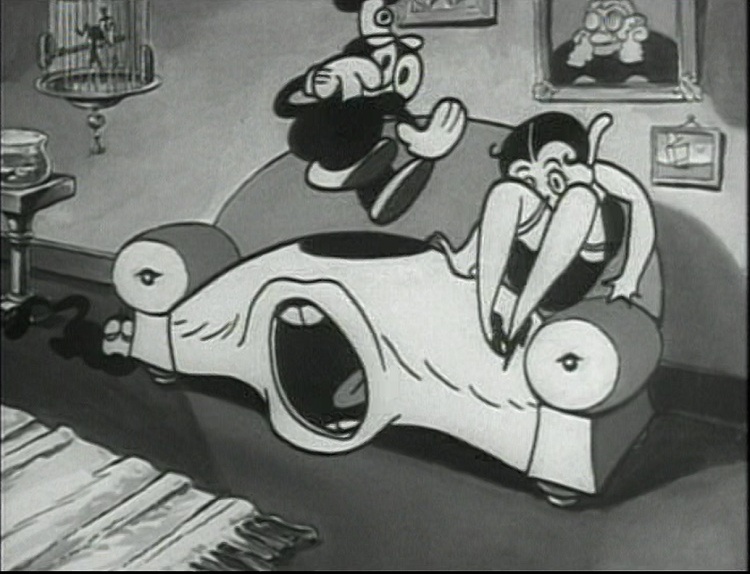
‘Barnacle Bill’ is a literal visual illustration of the folk song of the same name, made famous by Hoagy Carmichael’s 1930 recording.
Barnacle Bill (another version of early Bimbo) is visiting Betty Boop, who’s called Nancy Lee in this cartoon and who apparently is the Captain’s love. All neighbors gossip about it, and when the captain arrives, he chases Barnacle Bill into the sea, where the latter dances with some remarkably humanized mermaids.
‘Barnacle Bill’ is the second cartoon featuring Betty Boop, and it introduces the strong sexual overtones, associated with the character in her early years. One example is Betty’s dress that rolls itself up, exposing her legs. There’s also a couch that itself replaces several chairs when Betty invites Barnacle Bill inside.
‘Barnacle Bill’ uses musical dialogue almost exclusively. It contains some odd perspectives and flexible animation, but most important of all, it is wildly surrealistic, creating a completely original world of utter weirdness. For example, when Barnacle Bill threatens to bust in the door, the door shrinks and hides under the welcome mat. Later, we watch Barnacle Bill swim through the air, and dive into the couch. And when he leaves Nancy Lee’s apartment block, he sails one of the stairs. Touches like these make watching the cartoon a mind-blowing experience. I don’t think it’s considered a classic, but to me it should be.
Watch ‘Barnacle Bill’ yourself and tell me what you think:
This is Talkartoon No. 9
To the previous Talkartoon: Dizzy Dishes
To the next Talkartoon: Swing, You Sinners!
‘Barnacle Bill’ is available on the French DVD Box Set ‘Betty Boop Coffret Collector’
Director: Dave Fleischer
Release Date: August 9, 1930
Stars: Betty Boop (unnamed)
Rating: ★★★
Review:

‘Dizzy Dishes’ is a jazzy cartoon about a waiter in a restaurant who should bring a roast duck to an extremely hungry customer, but who does anything but serving. While the waiter is performing on stage together with the roast duck, the hungry customer eats almost everything in sight.
The cartoon is very typical of Fleischer’s early Talkartoons. The animation is rather crude, and outside the songs there’s no lip synch, but there’s a lot of metamorphosis going on. Apart from that, practically everything can grow hands and feet, creating an urban and surreal world, very different from the merry worlds of nature and farmlands of the rival Walt Disney studio.
‘Dizzy Dishes’ is not too interesting, but it marks the debut of Betty Boop. She’s introduced as an unnamed and rather fat and unappealing dog singer. The animation on her is erratic to say the least, but it already contains some specks of eroticism. She was designed as a caricature of singer Helen Kane, who was the first to sing ‘I Wanna Be Loved By You’, which contains the Boop-Boop-a-Doop-phrases with which Betty Boop became famous.
Betty Boop’s creation is attributed to animator Grim Natwick (1890-1990), a veteran animator, who, according to his fellow animators, was the only animator able to handle the feminine figure. Interestingly enough, Grim Natwick later worked for Walt Disney, animating Snow White, the first realistically animated heroine, in ‘Snow White and the Seven Dwarfs’ (1937).
Betty Boop was in fact the only successful cartoon star conceived by the Fleischer studio after Koko the Clown. Later they had considerable success with Popeye and Superman, but these characters were owned by King Features and DC Comics, respectively.
Betty Boop would become more and more erotic, and she would soon rise to stardom, changing from dog to human in 1931, and getting her own series in 1932, which lasted until 1939. But by then the Fleischer’s years of surrealism and eroticism were long gone.
Watch ‘Dizzy Dishes’ yourself and tell me what you think:
This is Talkartoon No. 8
To the previous Talkartoon: Wise Flies
To the next Talkartoon: Barnacle Bill
‘Dizzy Dishes’ is available on the French DVD Box Set ‘Betty Boop Coffret Collector’
Director: Dave Fleischer
Release Date: May 14, 1937
Stars: Betty Boop, Pudgy
Rating: ★★★★★
Review:
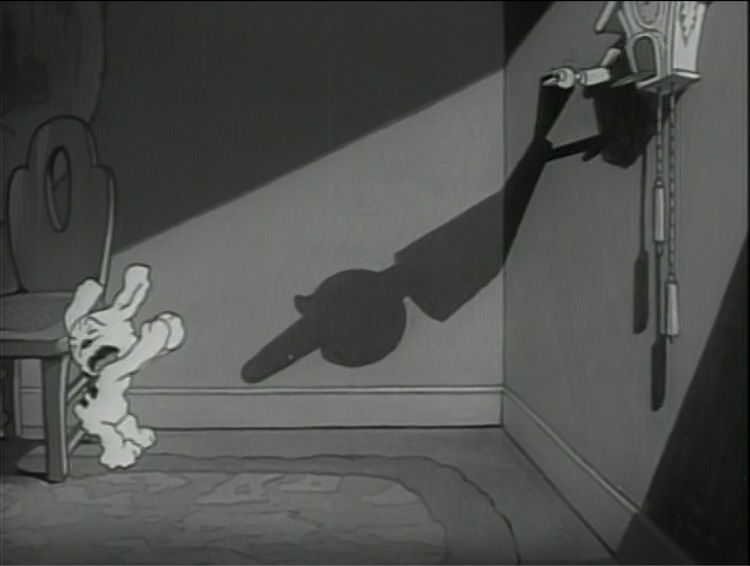 Betty has bought a fox. Pudgy, jealous of the lifeless animal, starts a fight, but after knocking his enemy down, he thinks he has killed it.
What follows is a great depiction of his feeble attempts to revive his foe, and then his genuine horror when he realizes he has killed the animal. His feeling of guilt turns his surroundings into a nightmare.
‘Pudgy picks a Fight’ is undoubtedly the most inspired of all Pudgy cartoons, the nightmare sequence being particularly imaginative. Its theme of guilt and imagination running away with it would be revisited by Disney in ‘Donald’s Crime’ (1945) with equally impressive results.
Watch ‘Pudgy Picks A Fight’ yourself and tell me what you think:
This is Betty Boop cartoon No. 63
To the previous Betty Boop cartoon: Pudgy Takes a Bow-Wow
To the next Betty Boop cartoon: The Impractical Joker
‘Pudgy Picks A Fight’ is available on the French DVD Box Set ‘Betty Boop Coffret Collector’
Director: Dave Fleischer
Release Date: April 24, 1936
Stars: Betty Boop, Pudgy
Rating: ★★½
Review:
 When Betty is gone three kittens cause havoc in Betty’s house. Pudgy gets the blame until the kittens plead guilty.
The three kittens are doubtless inspired by the Walt Disney’s Academy Award-winning cartoon ‘Three Orphan Kittens‘ from 1935, from which it borrows a milk bottle gag. ‘We Did It’ is not half as elaborate as the Disney cartoon. Nevertheless, it shows the Fleischer’s growth in character animation through pantomime. Pudgy, like Pluto, is by design fit for character animation.
Unfortunately, the Fleischer Studio was very inconsistent and this cartoon was followed by many in which character animation is practically absent. And even in ‘We Did It’ the result of this technique is only mildly amusing and hardly impressing.
Watch ‘We Did It’ yourself and tell me what you think:
This is Betty Boop cartoon No. 50
To the previous Betty Boop cartoon: Betty Boop and Little Jimmy
To the next Betty Boop cartoon: A Song a Day
‘We Did It’ is available on the French DVD Box Set ‘Betty Boop Coffret Collector’
Director: Dave Fleischer
Release Date: September 21, 1934
Stars: Betty Boop, Pudgy
Rating: ★★½
Review:
 Betty and her little dog Pudgy are picnicking.
However, Pudgy wrecks the picnic, so Betty sends him home. Unfortunately he’s immediately caught by a dog catcher. Luckily, Pudgy manages to escape together with some other dogs.
‘Betty Boop’s Little Pal’ marks the debut of Betty’s little pup Pudgy, even though he remains unnamed in this cartoon. Though more cute than funny, Pudgy was to be Betty Boop’s most entertaining and long-lasting co-star of the Hays Code era. He was a real character, and, like Pluto, he behaved like a real dog, although he’s as anatomically incorrect as Pluto is. Compared to Pluto, Pudgy is younger, cuter and naughtier. He is as much a child character as a dog character, while Pluto is more mature. Pudgy starred in 23 cartoons, only retiring in 1939. Unfortunately, none of his cartoons can be considered classics, save one: ‘Pudgy Picks a Fight‘ from 1937.
‘Betty Boop’s Little Pal’ is very typical of a trend in the Fleischer films that caught on during 1934 (after the Hays Code was in practice): the story line is very clear, which is a great improvement upon most earlier cartoons, but at the same time all nonsense, weirdness, surrealism, sex and jazz have vanished, too (there’s only one surreal gag, of a car scratching itself). Therefore, this and the other Betty Boop cartoons from 1934 and later are remarkably boring compared with the earlier entries.
Watch ‘Betty Boop’s Little Pal’ yourself and tell me what you think:
This is Betty Boop cartoon No. 32
To the previous Betty Boop cartoon: There’s Something About a Soldier
To the next Betty Boop cartoon: Betty Boop’s Prize Show
‘Betty Boop’s Little Pal’ is available on the French DVD Box Set ‘Betty Boop Coffret Collector’
Director: Dave Fleischer
Release Date: March 2, 1934
Stars: Betty Boop, Koko the Clown
Rating: ★★★★½
Review:

‘Ha! Ha! Ha! was the last cartoon to feature Koko the Clown.
It opens with supposedly Max Fleischer’s hand drawing Betty Boop on a sheet of paper. When Max leaves the studio, Koko comes out of the inkwell for the very last time, and starts eating the candy bar Max had left on the table.
Almost immediately he develops a tootache, so Betty draws a dentist room to operate him, herself acting as the (most sexy) dentist. She first tries to pull Koko’s tooth, but when that doesn’t work, she tries laughing gas.
The laughing gas soon pervades everything, causing not only Koko and herself to laugh, but even the clock, the typewriter, and outside – in the real world – the mailbox, the cars and real people. Even a bridge and some graves join in.
This enjoyable and weird cartoon mixes animation, photographed backgrounds and live action to great results, and it forms a great finale to Koko’s long career, which had lasted fifteen years. Although Koko never had any great roles near Betty, he would be missed, for without Koko and Bimbo (who had his last screen appearance in ‘I Heard‘ from September 1933), Betty became a surprisingly inoffensive and boring character, and none of her remaining 62 films evoked the same fun as ‘Ha! Ha! Ha!’.
Watch ‘Ha! Ha! Ha!’ yourself and tell me what you think:
This is Betty Boop cartoon No. 26
To the previous Betty Boop cartoon: Red Hot Mamma
To the next Betty Boop cartoon: Betty in Blunderland
‘Ha! Ha! Ha!’ is available on the French DVD Box Set ‘Betty Boop Coffret Collector’
Director: Dave Fleischer
Release Date: October 6, 1933
Stars: Betty Boop
Rating: ★★½
Review:
 Rubinoff and his orchestra play the score for this cartoon about a bunch of cats (‘the tom kat social club’) who threaten Betty Boop’s yard full of birds. This orchestra, led by the Russian violinist David Rubinoff, played sweet pseudo-classical music, and this sets the tone for the short.
Based on Franz von Suppé’s overture ‘Ein Morgen, ein Mittag und ein Abend in Wien’ (1844), ‘Morning Noon and Night’ is a very sweet cartoon. It opens with some typical Fleischer gags, like a sun with a hangover, but the overall mood is rather corny and lacking humor. The short is very Silly Symphony-like, and particularly reminiscent of Walt Disney’s ‘Birds in Spring‘ from earlier that year. Both feature a fledgling running away, and encountering a threat.
The cartoon’s finale is a battle scene in which all birds come to the rescue, most notably a boxing rooster. Battle scenes like this could be seen in e.g. the 1932 Silly Symphonies ‘Bugs in Love‘, ‘King Neptune‘, and ‘Babes in the Woods‘. Although ‘Morning, Noon and Night’ doesn’t come near any of these Disney cartoons in quality, it shows that the Disney style was invading the Fleischer studio, and that the brothers were getting more ambitious. This ambition would lead to the launch of the Color Classics in 1934.
Betty is more cute than sexy in this cartoon. The difference in mood between this cartoon and that of ‘I Heard‘ is enormous, although that cartoon was released only one month earlier. The reinforced Hays code would only be installed in the summer of 1934, but ‘Morning, Noon and Night’ shows that already by 1933 its morals had become more and more present in the American film industry’s output.
Watch ‘Morning Noon and Night’ yourself and tell me what you think:
This is Betty Boop cartoon No. 21
To the previous Betty Boop cartoon: I Heard
To the next Betty Boop cartoon: Betty Boop’s Hallowe’en Party
‘Morning Noon and Night’ is available on the French DVD Box Set ‘Betty Boop Coffret Collector’
Director: Dave Fleischer
Release Date: August 3, 1934
Stars: Betty Boop
Rating: ★★★★★ ♕
Review:
 ‘Poor Cinderella’ is the first of Fleischer’s Color Classics series, a series meant to compete with Walt Disney’s ‘Silly Symphonies’.
It features Fleischer’s proven star Betty Boop in her only appearance in color, and it’s undoubtedly her most elaborate cartoon.
Although filmed in the two-color technique of Cinecolor, which only uses reds and blues, its designs are lush and colorful. Nevertheless, ‘Poor Cinderella’ remained the only Color Classic in Cinecolor. The seven subsequent entries were filmed in 2-color Technicolor, using reds and greens, until Disney’s monopoly of 3-color Technicolor expired in 1936. The first full color Color Classic was ‘Somewhere in Dreamland‘ from January that year.
Apart from color, ‘Poor Cinderella’ boasts some stunning backgrounds, using Fleischer’s unique 3D-technique for the first time. In this technique 3D sets are used as a background to the animated cells to mesmerizing effects. Until the invention of the multiplane camera, which made his debut in ‘The Old Mill‘ in 1937, Fleischer’s 3D technique remained unchallenged in its wonderful creation of depth.
The story is quite faithful to the original fairy tale, albeit with some typical Fleischer touches. For instance, when the Fairy Godmother gets Betty into a wonderful outfit, the latter is seen in her underwear, something that would never happen to Disney’s Cinderella.
Oddly, Betty is red-haired and blue-eyed in this cartoon; probably to make her fit in better with the designs of those same colors. The changes between the scenes are creative and original. The Fairy Godmother is closer to human design than anything in previous Fleischer cartoons. The horses are drawn very realistically, as well, surpassing comparable designs at the Disney studio, although they do not move correctly.
‘Poor Cinderella’ was clearly made with the intention to compete with Disney, and remarkably, it does challenge that studio. Nevertheless, the Fleischer studio had difficulties to be on par with the ever advancing Disney studio, which pushed the limits of animation in almost every Silly Symphony it released, leaving the promise of ‘Poor Cinderella’ unfulfilled.
Watch ‘Poor Cinderella’ yourself and tell me what you think:
‘Poor Cinderella’ is available on the French DVD Box Set ‘Betty Boop Coffret Collector’
Director: Dave Fleischer
Release Date: May 18, 1934
Stars: Betty Boop, Max Fleischer
Rating: ★★★★½
Review:
 ‘Betty Boop’s Rise to Fame” is a compilation cartoon, but it’s easily one of the best in its kind.
It features Betty Boop and her creator, Max Fleischer in a nice mix of animation and live action. Fleischer asks Betty, who is depicted as a tiny cartoon character, to perform for a reporter. She does three of her finest moments, using footage from ‘Stopping the Show‘ (1932), ‘Betty Boop’s Bamboo Isle‘ (1932) and ‘The Old Man from the Mountain’ (1933).
In between, there’s some lovely interplay between Betty and “uncle Max”. Even these new scenes are sexy, when Betty changes clothes behind an ink pot and some books. This delightful cartoon can be regarded as an ode to Betty’s glorious past. From now on sex and eroticism would be banished from her cartoons due to the censorship of the Hays code.
Watch ‘Betty Boop’s Rise to Fame’ yourself and tell me what you think:
This is Betty Boop cartoon No. 28
To the previous Betty Boop cartoon: Betty in Blunderland
To the next Betty Boop cartoon: Betty Boop’s Trial
‘Betty Boop’s Rise to Fame’ is available on the French DVD Box Set ‘Betty Boop Coffret Collector’
Director: Dave Fleischer
Release Date: January 5, 1934
Stars: Betty Boop, Fearless Freddie
Rating: ★★★★½
Review:
 Betty is the star in a melodrama with an evil landlord and a classic hero.
Arguably the first Betty Boop cartoon with a clear plot, ‘She Wronged Him Right’ marks the debut of Fearless Freddie, who seems to be designed as Betty’s new suitor (Bimbo, being an animal, was no longer accepted in a Hollywood dominated by the puritan Hays Code). His stay would be short, however, because very soon Betty would lose interest in men altogether, taking the Code even further.
Only nine months later the formula of this cartoon was repeated with less successful results in ‘Betty Boop’s Prize Show’. ‘She Wronged Him Right’ still contains some wonderful metamorphosis gags and some inanimate objects speaking or suddenly growing hands, preserving some of Fleischer’s famous surrealism.
The very idea of Betty performing in a melodrama may have been borrowed from Disney, who had released the comparable ‘Mickey’s Mellerdrammer‘ in 1933.
Watch ‘She Wronged Him Right’ yourself and tell me what you think:
This is Betty Boop cartoon No. 24
To the previous Betty Boop cartoon: Parade of the Wooden Soldiers
To the next Betty Boop cartoon: Red Hot Mamma
‘She Wronged Him Right’ is available on the French DVD Box Set ‘Betty Boop Coffret Collector’
Director: Dave Fleischer
Release Date: April 6, 1934
Stars: Betty Boop
Rating: ★★★½
Review:
 Late at night, Betty Boop is making a jigsaw puzzle with a picture of Alice in Wonderland on it.
When the clock says it’s time for bed, the rabbit jumps out of the puzzle, and through the mirror. Betty follows him, and the mirror changes her more or less into a sexy Alice, with long curly hair, which becomes her very well.
In Wonderland, the Mad Hatter’s hat pulls out several characters from ‘Alice in Wonderland’ and ‘Through the Looking Glass’, a.o. Humpty Dumpty, the Duchess, the Mad Hatter, the Walrus and the Carpenter, the Gryphon and the Mock Turtle. Betty sings “How Do You Do” to them, before being kidnapped by the evil Jabberwock. Of course, the creatures come to her rescue, accompanied by Franz Liszt’s Second Hungarian Rhapsody, but when she falls off a cliff, she awakes.
‘Betty in Blunderland’ is a sweet, albeit a bit uninspired cartoon that fails to deliver its promises. It features wonderful designs of the Wonderland characters, many of which are clearly based on the original illustrations by Sir John Tenniel. However, the Fleischers don’t do anything interesting with them. We watch Tweedledee and Tweedledum fighting, the duchess doing a boring dance, and the Gryphon and the Mock Turtle shooting craps. None of these scenes is remotely interesting. Moreover, one grows tired of creatures kidnapping Betty, something that happens in several cartoons from the era, e.g. ‘Mother Goose Land‘ and ‘Parade of the Wooden Soldiers‘ (both 1933).
Two years later Betty was followed by Mickey who, too, dreamed stepping through the mirror into Wonderland, in ‘Thru the Mirror’ from 1936, which is by all means a much more memorable cartoon.
Watch ‘Betty in Blunderland’ yourself and tell me what you think:
This is Betty Boop cartoon No. 27
To the previous Betty Boop cartoon: Ha! Ha! Ha!
To the next Betty Boop cartoon: Betty Boop’s Rise to Fame
‘Betty in Blunderland’ is available on the French DVD Box Set ‘Betty Boop Coffret Collector’
Director: Dave Fleischer
Release Date: September 1, 1933
Stars: Betty Boop, Bimbo, Koko The Clown
Rating: ★★★★
Review:
 Betty Boop works in a tavern near a coal mine, where Koko The Clown and Bimbo are working. The latter discovers some ghosts in the mine.
This short contains an excellent swinging jazz score by Don Redman and his orchestra, who are introduced in the beginning of the picture, playing in a zany cartoon decor. The music includes adapted versions of Don Redman’s hit songs ‘How am I doing?’ (1932) and ‘I Heard’ (1931).
‘I Heard’ was the last Fleischer cartoon to feature a great jazz score. Don Redman, and his predecessors Cab Calloway and Louis Armstrong, where soon replaced by Rubinoff and his orchestra playing sweet semi-classical music in ‘Morning Noon and Night‘ and ‘Parade of the Wooden Soldiers‘ (both late 1933). Even worse, the cartoon marked Bimbo’s last screen appearance. Being an animal he was no longer accepted as being Betty’s suitor in a Hays Code dominated Hollywood which shunned all eroticism and ‘unnatural sexual behavior’, including human-animal relationships.
After Bimbo, Betty would shortly date a human character named Fearless Freddie, but from 1935 on she remained a bachelor apparently with no interest in men whatsoever. In this cartoon, though, she’s still sexy, and she can briefly be seen in her underwear, after the elevator she and Bimbo had taken has crashed.
Thus, in many ways, one can regard ‘I Heard’ as the last of the classic Betty Boop cartoons. After this cartoon, the intoxicating mix of sex and surrealism was only seen once, in the compilation cartoon ‘Betty Boop’s Rise to Fame‘ (1934), a last tribute to Betty’s glory days.
Watch ‘I Heard’ yourself and tell me what you think:
This is Betty Boop cartoon No. 20
To the previous Betty Boop cartoon: The Old Man of the Mountain
To the next Betty Boop cartoon: Morning Noon and Night
‘I Heard’ is available on the French DVD Box Set ‘Betty Boop Coffret Collector’
Director: David Hand
Release Date: June 29, 1935
Rating: ★★★★★ ♕
Review:
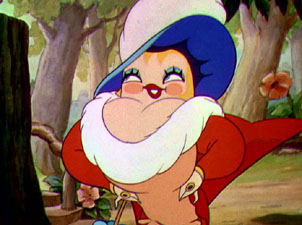 ‘Who Killed Cock Robin?’ is a musical mystery very loosely based on the nursery rhyme of the same name. Its source material notwithstanding, ‘Who Killed Cock Robin’ is the most adult Silly Symphony ever made.
True to the Silly symphony concept, all characters either sing or speak in rhyme to Frank Churchill’s music (with Jenny Wren’s sensual blues as a highlight), but in a bare seven minutes the cartoon manages to mock both the law, racialism and gay people, while displaying an unusual eroticism through Jenny Wren, who is a very fine caricature of famous Hollywood actress Mae West, a tour de force by Joe Grant (design) and Hamilton Luske (animation).
These features are especially striking when one bears in mind that the Hays Code was already active in 1935. Due to his self-censorship of the movie industry sex and violence were banned from the movies. To illustrate its effect: due to this code an erotic cartoon character like Betty Boop had to be tuned down and was turned into a goody-goody and quite a bland character. Yet, ‘Who Killed Cock Robin’ displays its satire and eroticism in full glory.
When Cock Robin has been shot by a mysterious shadow, the Keystone Cop-like police randomly arrests some bystanders: a tough-looking guy, a black bird (in those days blacks were easily arrested just because of their color) and a cuckoo who resembles Harpo Marx. They’re treated very roughly, being knocked by the cops almost all the time. And when Jenny exclaims that justice should be done, the judge simply orders to hang all verdicts even though nobody knows who’s guilty!
It’s Cupid, an obvious caricature of a homosexual, who prevents this cruel sentence. Cock Robin appears to be alive, and finally he and Jenny Wren reunite in a hot kiss. Thus ends one of the most spectacular cartoons of the 1930s.
Watch ‘Who Killed Cock Robin?’ yourself and tell me what you think:
This is Silly Symphony No. 54
To the previous Silly Symphony: The Cookie Carnival
To the next Silly Symphony: Music Land


 Dr. Grob's Animation Review